
I was reading a draft of a collaborative piece and there was a casual reference to weight standards and I found myself wondering if Crawford was indeed correct.
Here’s my summary of the data.
First I think the weight standard is closer to 6.6 than the 6.75g Crawford reports.
RRC 26/1 looks tightly controlled and is slightly heavier in both mean and median that RRC 22/1, 25/1, or 27/1.
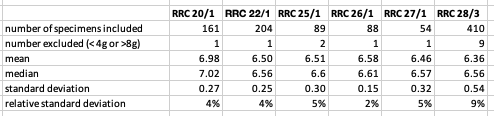
If we look at the various medians and means and interquartile ranges in the chart below I kind of want to nudge RRC 26/1 to before RRC 22/1. Is that nuts? Yes, it is. The legend Roma clearly is a breaking point and RRC 26 has more in common with RRC 25 and 27 but it certainly shouldn’t be separating RRC 25 and 27. I’ll have to look at the hoards again and the weights of the bronze not just the silver. I don’t want to do the bronze weights. I might not be able to resist.
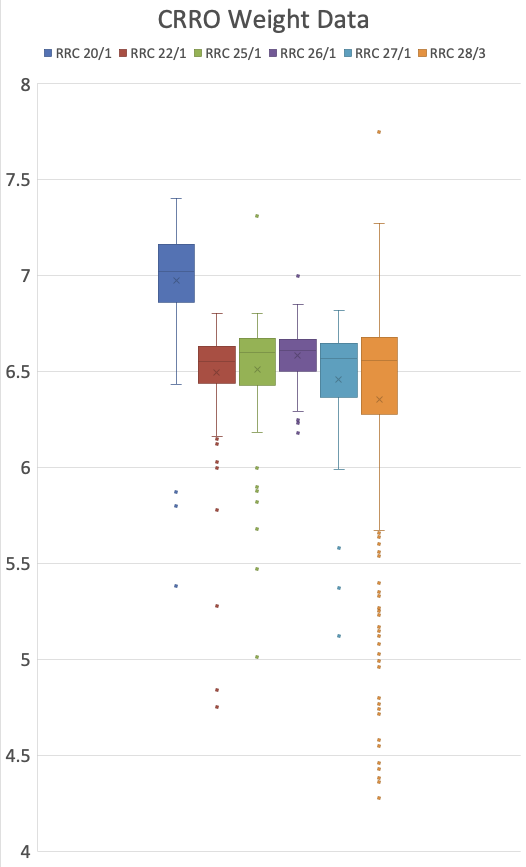
RRC 25 and 27 look very similar indeed.
The quadrigati clearly have less concern for the weight standard control, not unexpected in such a large issue or rather issues.
The aes grave of RRC 26 survive in much smaller numbers and as we know now we’re missing the uncia, if one was ever made. By contrast for RRC 25 and 27 we have lots of unciae. So perhaps 26 comse after these two issues as an attempt to ensure higher standards at the mint.
The acorn symbol is curious. Sickle = Saturn = Treasury. Club = Hercules = Commercial Markets
An acorn? What is that a symbol of beyond some thing small and easily recognizable?
Lockyear’s database doesn’t have the early relevant hoards in it. Phooey. I don’t want to tabulate them myself either. We’ll see. Maybe after I read Burnett’s contribution to the RRDP volume I’ll find I don’t need to say any of this. He will have said sensible things and I can just cite that.
Flashback
A year and a day ago I released a speculative reconstruction to that I cut from an early draft of this article:


2 thoughts on “Is RRC 26/1 in the wrong place?!”