
I’m corresponding with a very smart graduate student working on Bronze to Iron Age differences in the use of aes rude and thus have been talking about archaeological finds and how we date them.
She wrote me of Lucus Feroniae finds:
“… my dataset comes from the temple sectors excavated in 2000-2010. … In Serafin’s corpus there are no Roman denarii: the nine silver coins are all from southern Italy (Neapolis, Velia and Locri), while Roman bronze coins are often found together with aes rude.In Serafin’s corpus there are no Roman denarii: the nine silver coins are all from southern Italy (Neapolis, Velia and Locri), while Roman bronze coins are often found together with aes rude.”
“For Phase I, several primary foundation contexts contain Roman coins dated to 211-208 BCE. For example, US 79 has an uncia dated to 209-208 BCE (RRC 99,8 [= P series]), and US 93 has another uncia dated to 209-208 BCE together with aes rude. Serafin also records 89 coins from primary foundation deposits, with the latest issues reaching 208 BCE.”
This sent me to re read McCabe (and Russo) in RBN 2024:
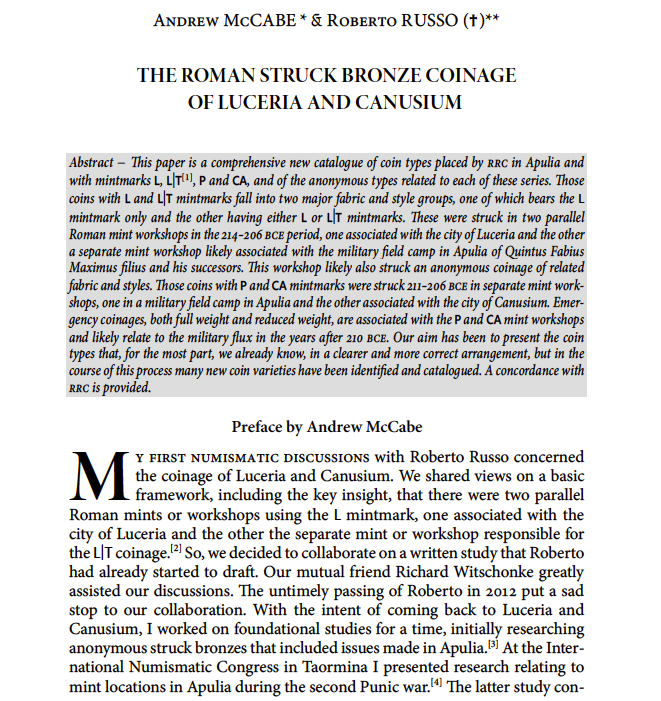
RBN articles are restricted from online posting for two years so this one should be available shortly. If you need a copy now either McCabe or I can probably share one with you.
I agree with P being closer to Canusium that Luceria but likely a camp mint. McCabe does a great job mapping military action and regional coin finds.
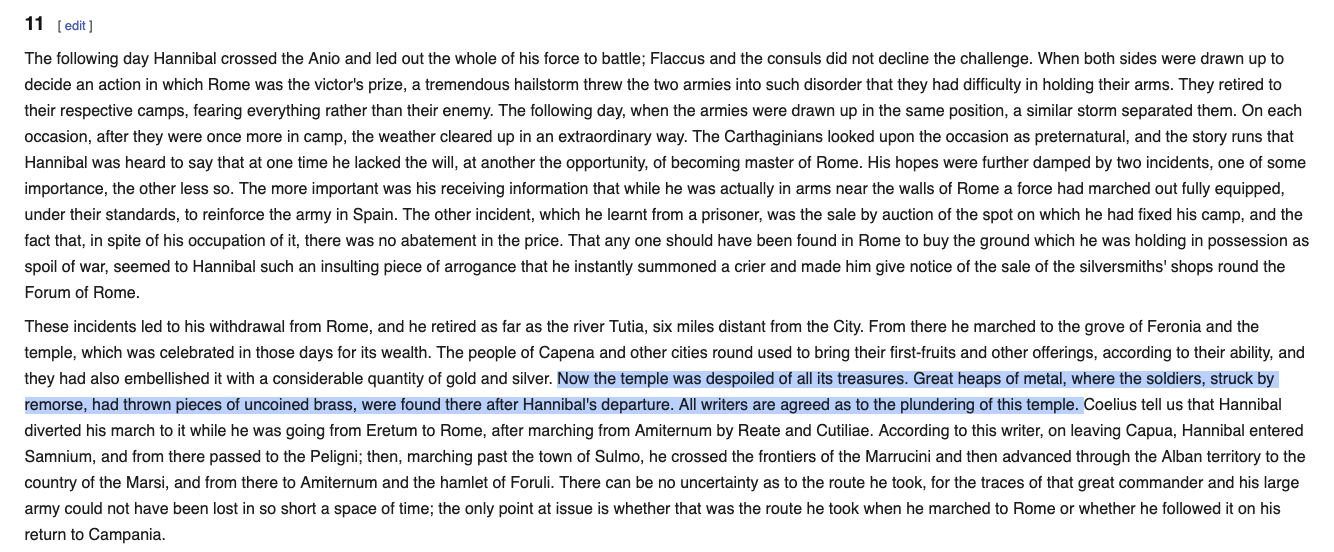
The reason this P series coin at Lucus Feroniae in Phase 1 excites me is that the site was sacked in 211 BCE:
Here’s Livy 26.11 with the old translation wrongly using brass for bronze the Latin phrase is: aeris acerui = “a heap of bronze”
I’ve got to look at Serafin and consult McCabe! But that isn’t on the docket anytime soon, too many other tasks.


