
I ran a scary (to me) experiment. I started my data dumping of Haeberlin and CRRO to looking at aes grave weights in 2019. I published my findings in 2023.
“The Strangeness of Heavy Bronze” In S. Bernard, L. Mignone, & D. Padilla Peralta (Eds.), Making the Middle Republic: New Approaches to Rome and Italy, c.400-200 BCE (pp. 103-131). Cambridge: Cambridge University Press.
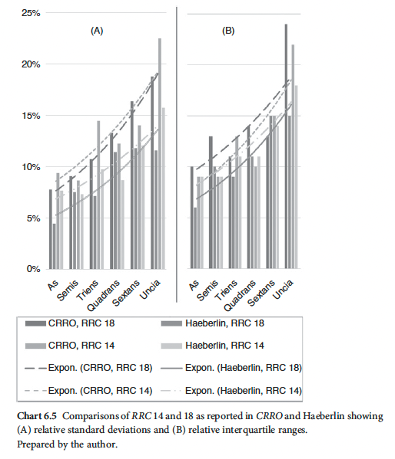
I thought ahead of my Beijing talk at Peking University it would be interesting to ask Claude what it would do with the same data and interrogate my conclusions through this new tool for exploring data and creating data visualization.
As you’ll know from earlier posts that one of my concerns was the accuracy of Haeberlin’s numbers, hence I ran his numbers and CRRO separately. I then went to Berlin and convinced myself of Haeberlin’s incredible accuracy (post).
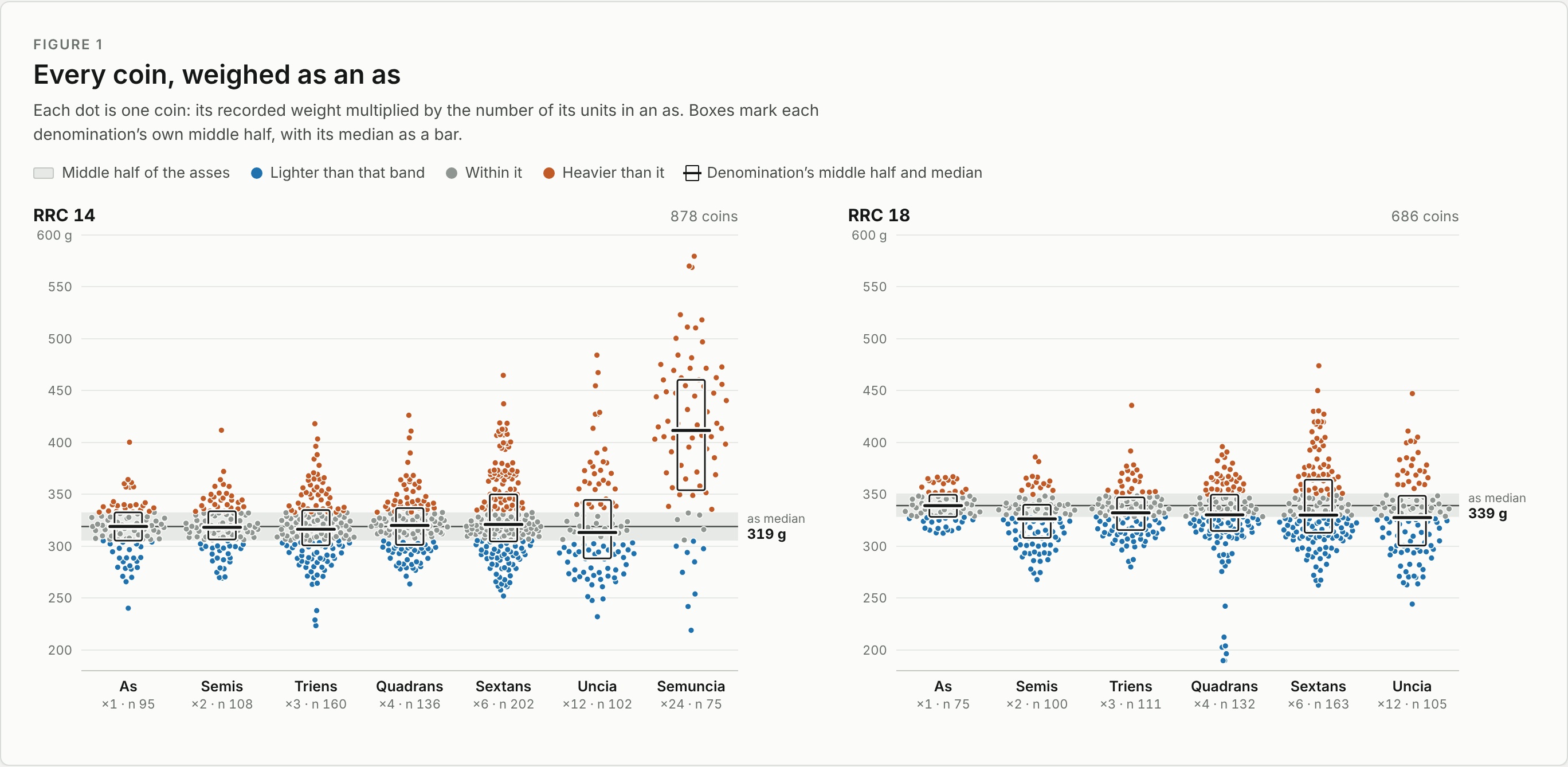
This is the visual Claude developed to communicate the incredible variation in weights. It lets us see at a glance less care being taking with smaller denominations and the overvaluing of the semuncia.
I then explored the question of whether RRC 18 is really meaningfully different in its weight standard RRC 14. It was this this heavier characteristic which led Thompsen to conclude RRC 18 must be after RRC 14, a seriation Crawford followed. No finds to date help us yet determine the actual sequence. They invariably appear together and are clearly earlier than the other aes grave.
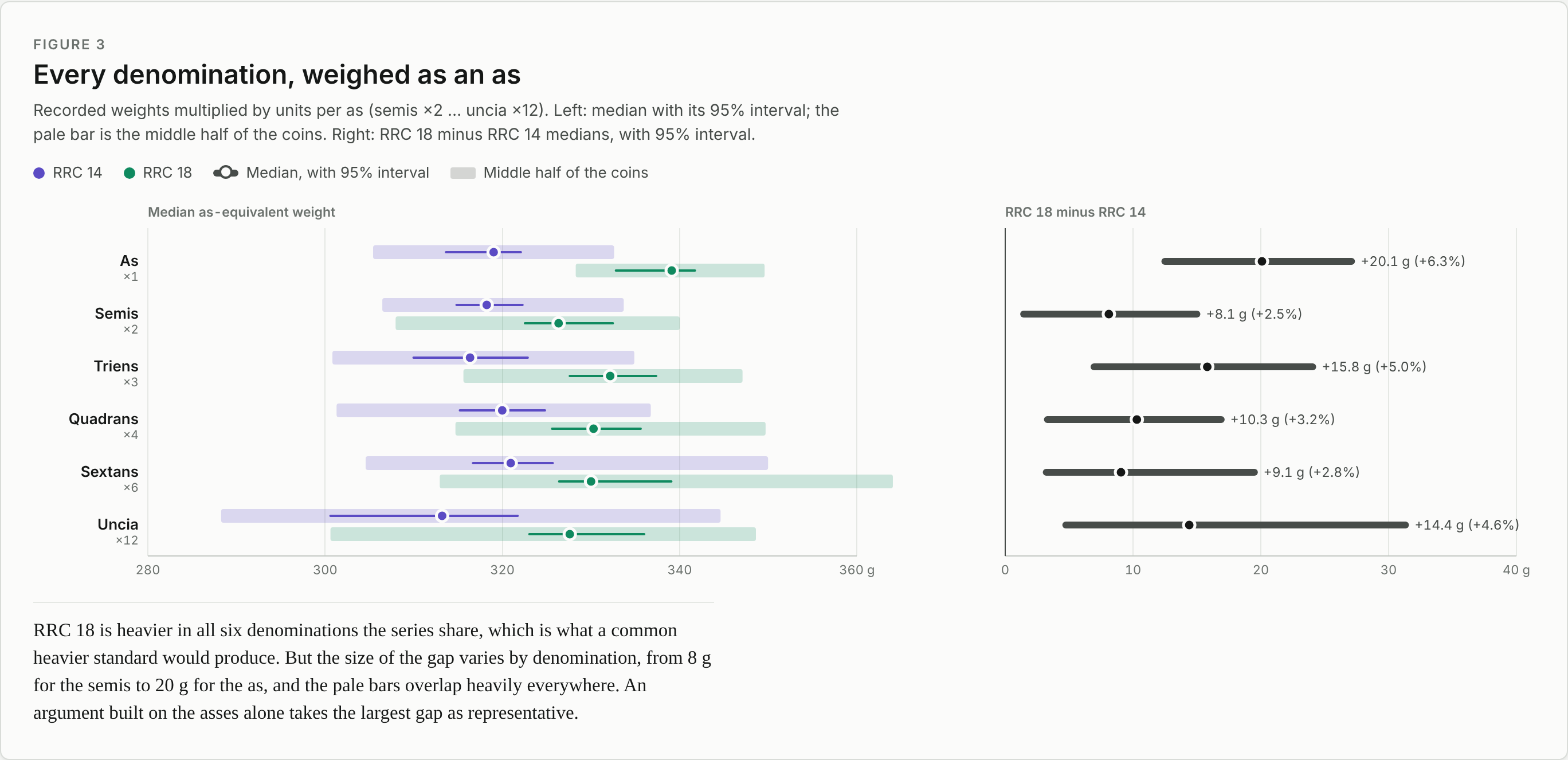
I was worried I might have to issue a retraction… RRC 18 does look statistically meaningfully heavier.
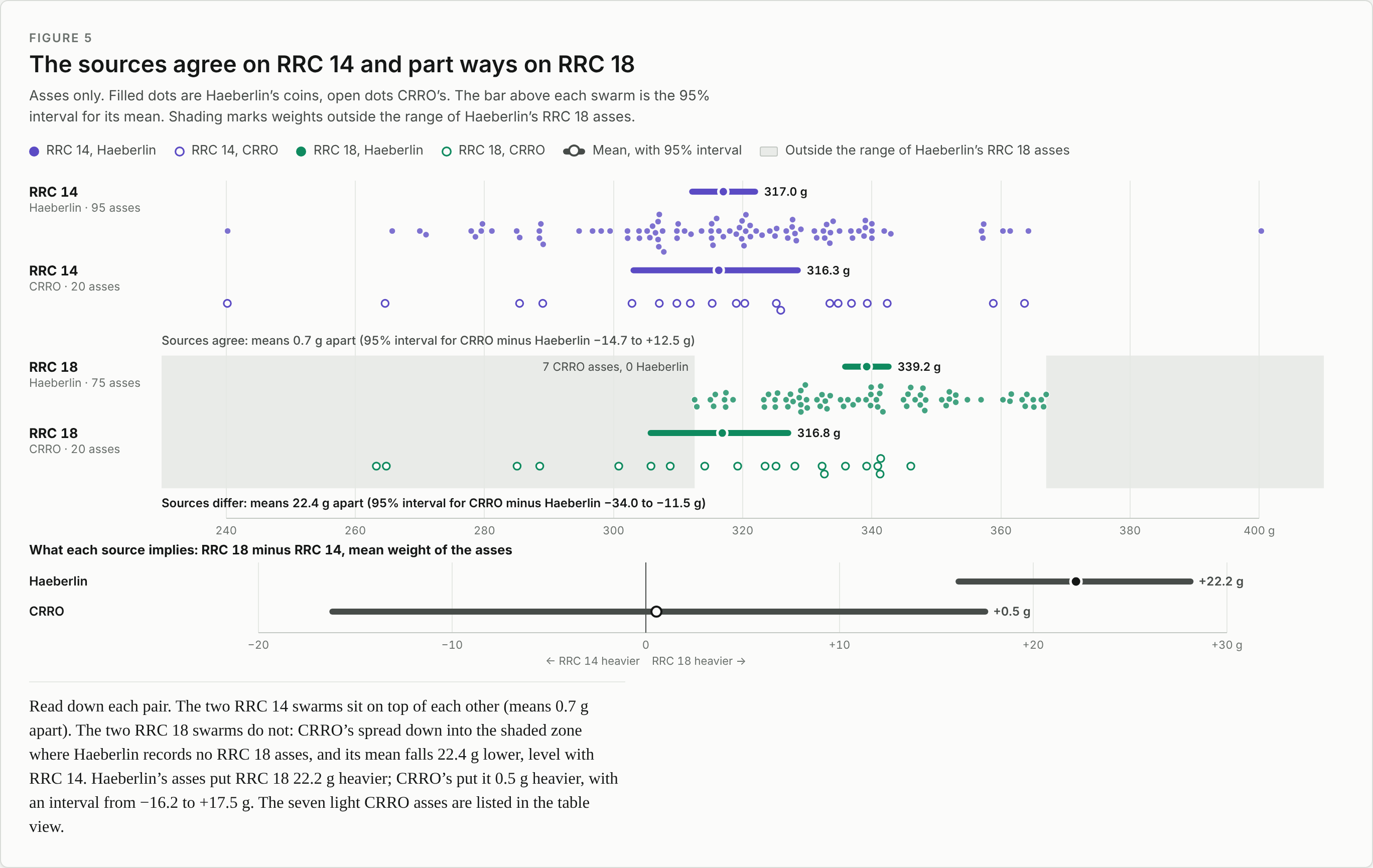
BUT then I returned to the CRRO data and the picture I got was really interesting.
Haeberlin has more heavy asses of RRC 18 and thus if we prioritize his data the two series look far more different than if we prioritize the CRRO data.
In all these comparison the semuncia has been removed as it is only in one of the two earliest series BUT if we add it back in the two series start to look on aggregate more similar.
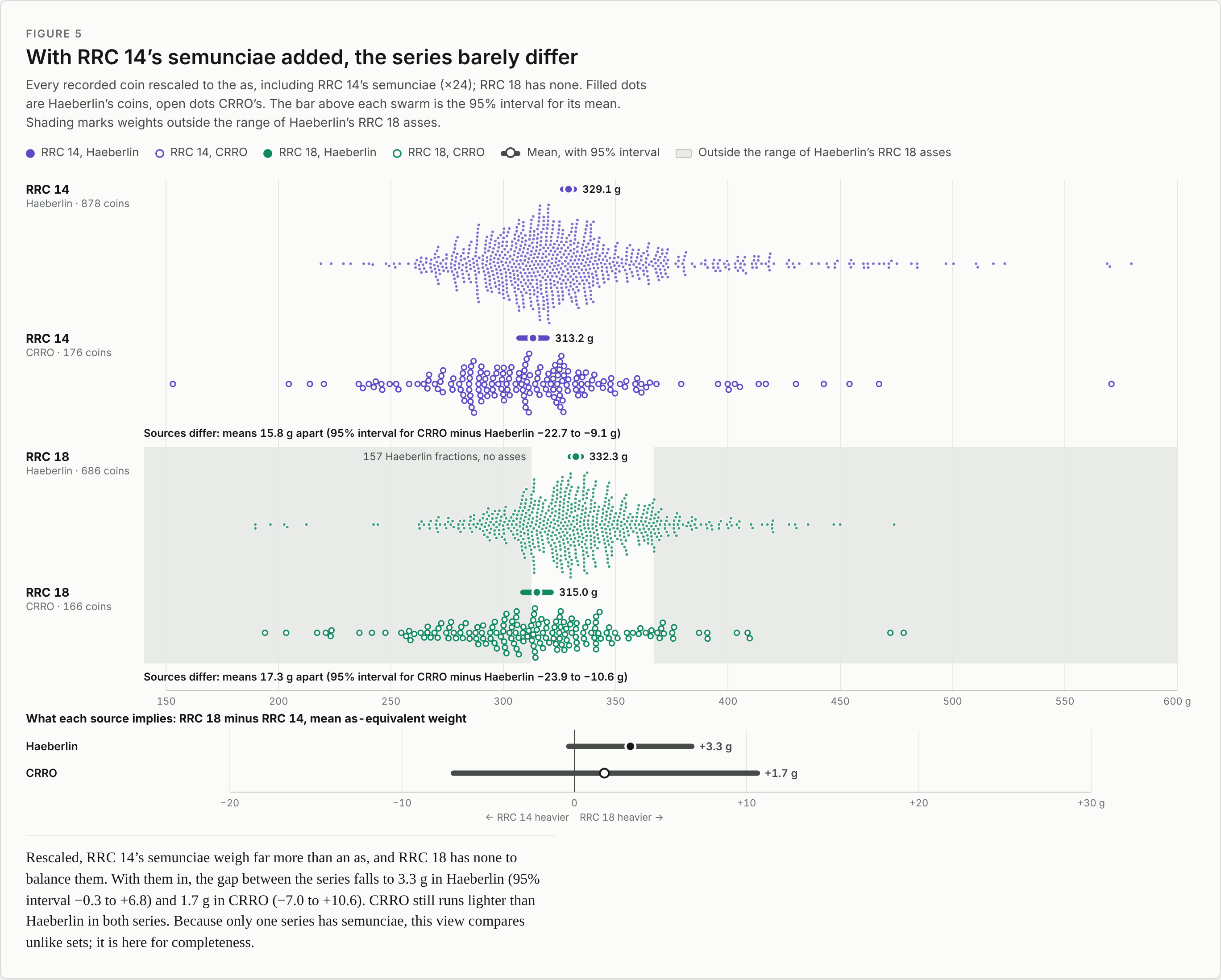
I wasn’t going to post any of this, at least not right away, but then I saw my own old notes about RRC 18 specimens being underfilled more than other series. (last post). And also that at Nemi RRC 18 tend to have innies where as RRC 14 tends to have outies. The manufacturing process was relatively new. The objects were made to trade at face value not weight (that’s the point of denominations!), but the workers were still working it out.
The differences are statistically significant, but are they historically significant? Here we cannot outsource our thinking or analysis. Based on the hoard data especially and the quick move by the Romans to cast the next series at a slightly lighter weight standard, I really don’t think there is any meaningful difference in weight standard between these two issues from the users point of view. The statistical difference does likely reflect either different times or different places of manufacture but these need not be drastically different.
The one thing I can say for sure is that that publication would have been way easier to prepare today.


Ciao Livia,
just to say you are doing a fantastic job.
Felicito te, Italo