So I collect more data than I can ever process. It is one of the reasons I blog as it leaves bread crumbs for future me and others with the same niche interests. While I was taking pXRF readings of specimens of aes grave I not only collected that data but also took detailed notes on what artifacts of manufacture I could observe on the specimens themselves. Those notes have been sitting in my files untouched and uncollated as I pushed forward on the metallurgy. I asked Claude to find the files. It did. I asked it to extract and integrate just the data I wanted to let me focus on the question. Perfect. Fascinating. I let it suggest some data visualization. Meh. Not very meaningful.
129 out 191 aes grave at Princeton, Yale, Rutgers, and Nottingham (Nemi) have two sprues.

This 2:1 ratio may suggest that aes grave were cast in chains of about 3 coins.
The pattern generally holds across the series, but RRC 21 and 27 might have experimented with longer chains. Obviously more data would make this more robust.
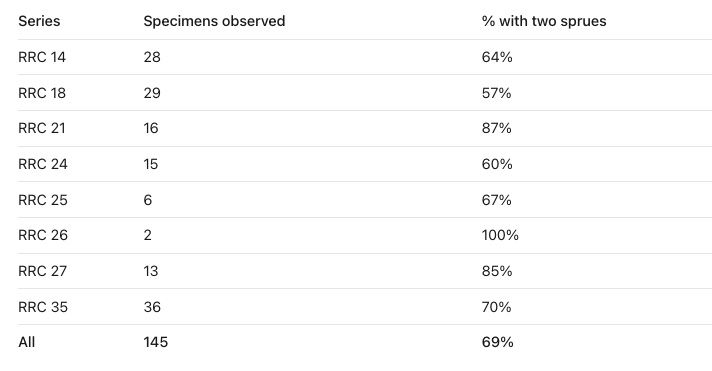
The following table helps us see the uncia was probably cast in longer chains.
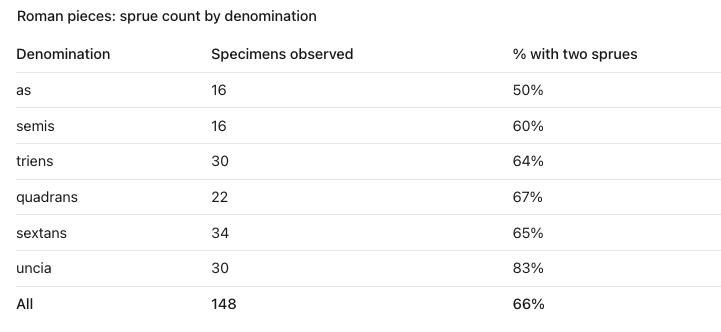
Next Claude was genuinely helpful for seeing Yale and Rutgers were potentially skewing the data. My explanation for why is based on collecting habits. Quite often individuals and institutions want the BEST specimen they can afford. And best is often defined as without artifacts of the casting process or minimal artifacts. Hence a desire to acquire single sprue pieces. Thus chart is perhaps more accurate:
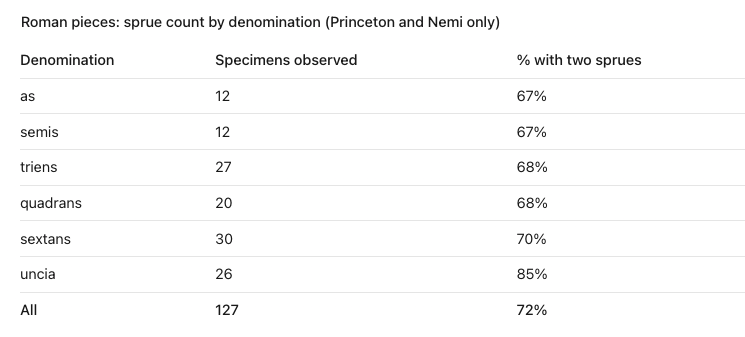
My notes are not as conclusive as I like but I am also reminded that in most cases the molds were filled from the top of the coin downwards, meaning the design on the molds seems to align with manufacturing, no surprise, but we do sometimes need to state the obvious.
To really publish these conclusions I’d probably have to go back to Berlin and sit with their collection and a few other large aes grave collections. It sounds at once very fun and also slightly wasteful for my time. I’d say I’d get a grad student to do it one day but would that really be a valuable thesis component? Or just sole crushing. I wish the data had been habitually recorded like die axes.
Interestingly my notes were also on whether the sprue(s) were innies and outies, there seemed no meaningful pattern here, except!!! Sometimes I would note that the mold seemed underfilled. Claude noticed and drew my attention to the fact that
Underfilling clusters in RRC 18 in every collection:
- Nemi: 5 of 16
- Princeton: 2 of 8
- Rutgers: 2 of 6
- all other series combined: 3 of 135 (p<0.0001)
So fascinating as RRC 18 is often thought of as the heaviest of the aes grave series.
Also Claude observed that at Nemi:
- RRC 14 sprues are mostly flat or outie (13 of 15).
- RRC 18 sprues lean towards innies.
I’m not sure these are meaningful observations but I do want to think more about them.
How accurate was I in my observations? Did I get careless at points? Did I over emphasize certain features? I’m more comfortable with trusting my reports of spue counts.
While we tend to imagine coin casting based on the surviving stones used to make tokens like this:
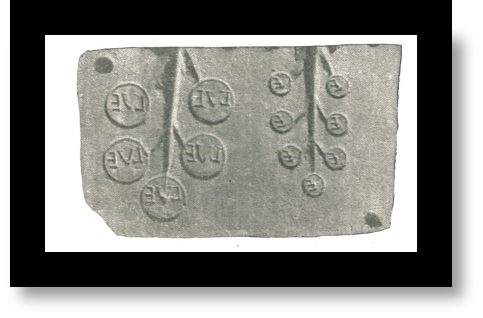
Thus I believe the chain casting would have looked more like this:

It is, of course, possible it might have looked like this Chinese casting layout and leave similar features on the coins themselves, but aes grave were so much bigger I think this more elaborate type of branching structure unlikely.
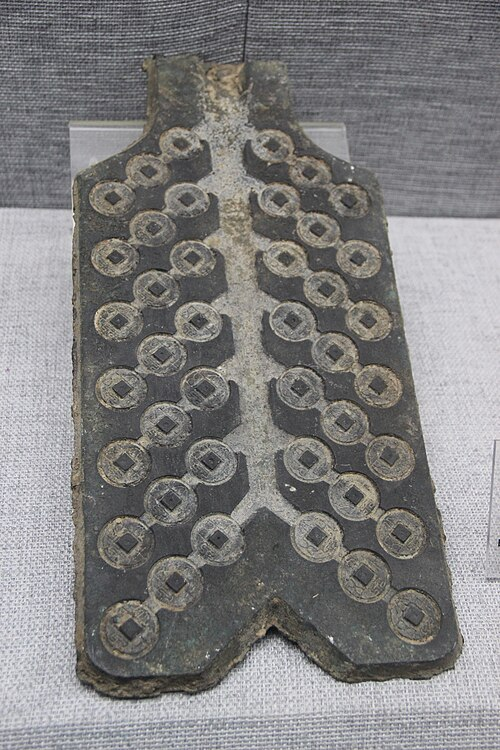
One day I’ll have a more plausible idea of the nature of the casting and manufacture, but we are some ways off being ready for experimental archaeology, but maybe by spring…
[This post is methodologically similar to this earlier piece on having Claude help me extract information from my own collection of data.]
Unfortunately after a decade plus of mistyping sprue as spue, one must search both to find past posts on this favorite topic.


Heberlin’s plates are also a useful resource for this data.
Absolutely. As are all the photos in LOD collections contributing to CRRO, but aes grave are so 3D it can be hard to be certain about sprues in photos. Can be even harder in photos from casts. But perfect is the enemy of done and one can certainly tell some of the time from the photos.
True, there may be some loss or trimming both in casting and photography.
Also of interest is the axis location of the sprue(s).
Sprues in my notes and memory are always 180 degrees apart if there are two.
In relation to the design typically sprues are almost always oriented to top (and bottom) of the longest primary axis. Top of a Caduceus, Nose of a dolphin, short end of a knucklebone etc… This holds less true for Italic aes grave but I’ve also held less of that.