
Just as I’ve concluded there is no meaningful difference in the weight standards of RRC 14 and 18 (and 19), I’m comfortable now saying the same between RRC 21, 24, 25, 27 AND 35. RRC 35 was made on a much larger scale, far beyond any of the earlier aes grave issues. I might do the histograms it, but not today.
Haeberlin’s averages are
As = 267.83g from 1168 specimens
Semis = 269.07g from 312 specimens
Quadrans 270.37g from 266 specimens.
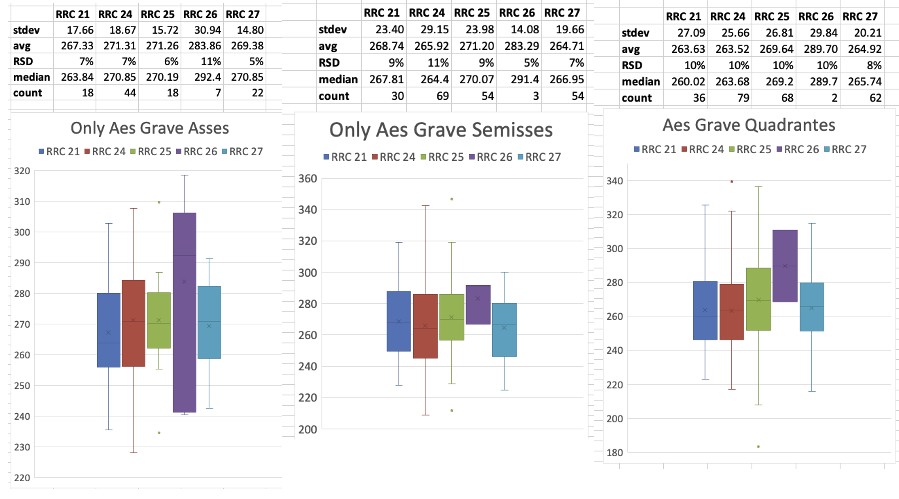
The problem is that RRC 26 looks like a different kettle of fish. A higher standard, a smaller issue, no real connection to the silver. I think it is a problem that does not need solving like RRC 19 the scale of the issue makes it of little real meaning for the overall pattern.
We’ve put a huge amount of importance on the change in legend from ROMANO to ROMA and thus it has been insisted that RRC 26 silver (ROMA) is felt must come after RRC 22 (ROMANO). And by extension the bronze that has been lumped in with RRC 26 silver. As we saw earlier the silver is a bit higher in typical weight and better regulated than others on the 6.6g standard.
Now we see the bronze is also out of sync. Also heavy, and made in smaller quantities and perhaps doesn’t even correspond with the silver at all. It doesn’t have a legend so we could push it between Group 1 (RRC 14, 18) and Group 2 (RRC 21, 22, 25, 27, and 35) and then call it transitional but we may just never know unless a few good hoards appear.
Messy.
Yet more and more I feel RRC 25 and 27 mark something new and interesting at the mint a real emergence of control and regulation. They are substantive and also perhaps more even. Their survival rates across denominations are less radically different that with some other issues. They are complete Uncia to As with no larger units.
What happened? Did the systems that were put in place for RRC 25 and 27 fall out of use because of scaling up of production? Perhaps.


