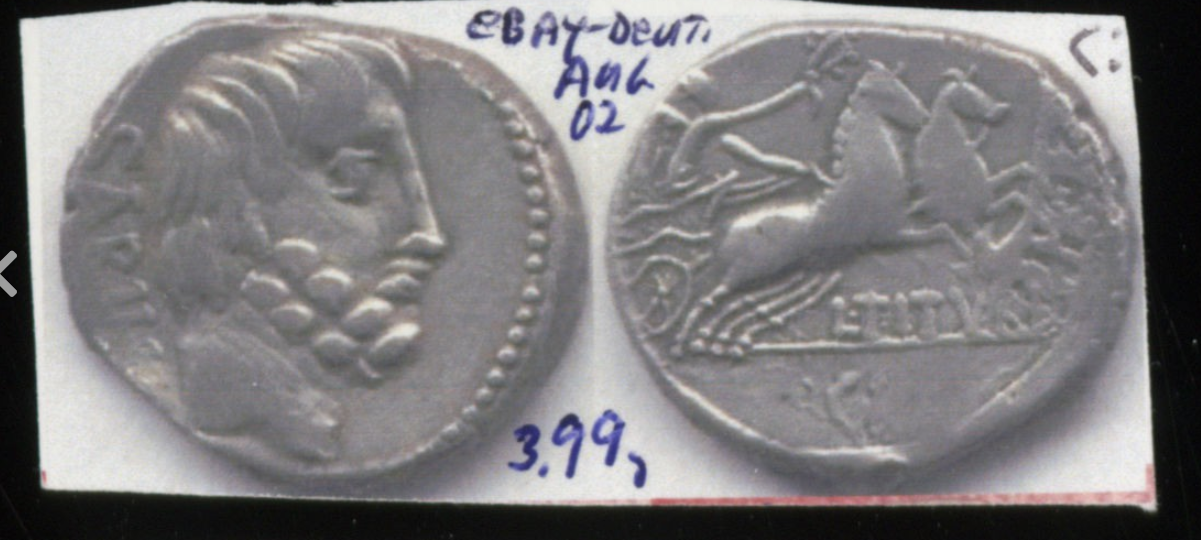

Very intrigued by this turn and wave almost portrait like obverse depiction. I want to think more about it in future, esp. the free flowing Alexander/Helios type hair in lieu of a helmet or other head covering. Link to specimen.
adventures in my head


Very intrigued by this turn and wave almost portrait like obverse depiction. I want to think more about it in future, esp. the free flowing Alexander/Helios type hair in lieu of a helmet or other head covering. Link to specimen.
From Lanzi:

Arachne entry: “”So-called. “Stosch’sche Gemme”: five heroes of the “Seven against Thebes” hold a council”

From Page 52 Footnote 335 of Luigi Lanzi’s notebooks edited by Donata Levi:
“Regarding James Byres, a Scottish resident in Rome, Winckelmann mentions his observations on the theater of Taormina (WINCKELMANN 1830-1834, V, 451-452) and also mentions him (about the trochus) as the owner of a gem, a carnelian with Discobolus (ibid., V, 472), which is often mentioned in contemporary antiquarian literature (for example in GUATTANI, I, February 1784, xiii, and in VISCONTI 1782-1807, I [1782], 95, fig. 7 [SIC! actually fig.6] of plate A): Byres “can boast of having in this carving one of the most elegant and beautiful figures, which have ever been carved in gems”.
He is also mentioned in LANZI, Notizie, 56, [another ref.] as the owner of an Etruscan patera. Byres was also preparing a description of the paintings of an Etruscan hypogeum of Tarquinia with copper plates. For information on him see HAWCROFT 1988, passim: he was in Rome from 1756, at first as a painter with interests also in the field of architecture, but since the mid-1760s he was active especially as a merchant and guide. He participated in important affairs, such as the sale of what is now called the Portland vase to Sir W. Hamilton and the Seven Sacraments of Poussin to the Duke of Rutland. He was one of the first visitors to Paestum in 1766 and left Rome in 1790. See also JENKINS SLOAN 1996, 196, for an onyx cameo with bacchanal, which he sold to Lord Fortrose, Seaforth, before 1781. Byres also acted as an agent on the commission for the altarpiece that Mengs was to have made for All Souls College, Oxford (see ROETTGEN 1993, 30). On Byres see also SKINNER 1966, esp. 16-17, FORD 1974 and STAINTON 1974” (a cleaned up machine translation)
More on Byres in Facos 2018

Checking third proofs, esp. for legibility of images…. fig. 3.21 is HN Italy 407, Italia, 90–89 BCE, denarius, 3.97 grams, ANS 1944.100.873.

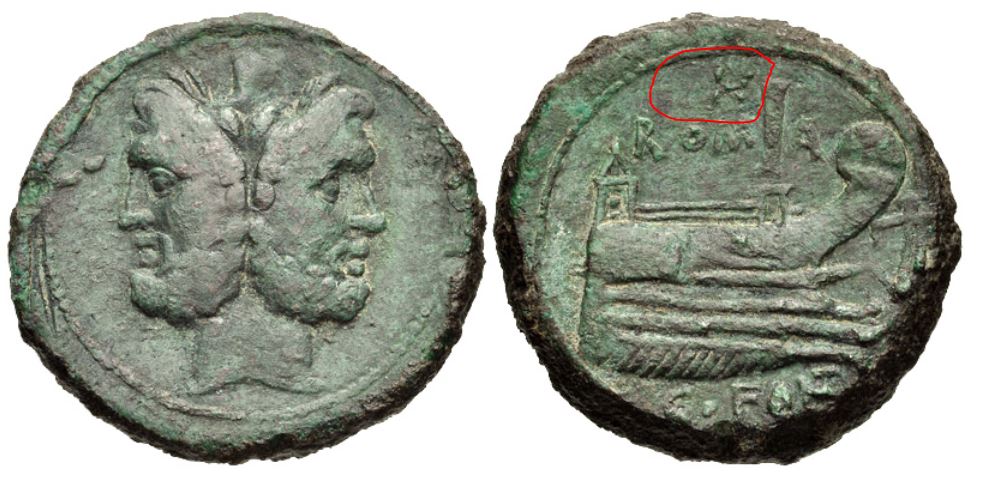
The image reproduction of the coin isn’t great (YET!) so I was looking to see if it could be improved in some way as the ANS images are exceptionally hi res. I noticed some funny features. Circled above. Red could just be the helmet and Blue could be damage, but …
I wanted to compare it to an image of the same coin struck by the same dies. Thanks Campana. But I cannot find an image quickly. Boo. So now I need to get back to the proofs.


I find myself getting more interested in the punch marks / test punches / counter marks seen on some RR specimens. And this is just a fascinating article by Gazdac and colleagues. Can’t wait to see the full details of the hoard when that comes out. I’m especially interested in learning more about the methods used for the Metallurgical testing, particularly the investigation of pre existing ‘minute cracks’ though non-destructive techniques to compare surface and interior readings.
Offering dishes dedicated to the gods.
I am exhausted from being disturbed by small humans all night and should have put this info here on the blog not on twitter as I fell down a rabbit hole. This is a post so I can find the sources and images again as Twitter is terrible for that.

Please see the new page rather than this old post on this same topic. You can also click on this big image to get there fast.


Wish I’d included this in my Glasspastes Article.

The representation of the woman (behind?) The pyre reminded me of representations of the Tarpeia.

Thinking about the evil eye in Roman culture for some lesson planning last night and this am. I came across these two impressions of ancient intaglios. One is said to have been taken in the 18th century in the Florentine Museum. The other is reported as taken from the Sammlung Stosch, W Cl VII 0127 = Staatliche Museen, Antikensammlung Berlin, Berlin, Deutschland, Inv.-Nr. FG 9722. The Florentine is said to be cut from the root of emerald. The Berlin intaglio is catalogued as a glass paste. Was the Berlin glasspaste made from the Florentine gem? Is the Florentine intaglio really another glass paste (I’m not sure what root of emerald means) made from the same mold as the Berlin example? Were glass pastes ever made as ‘fakes’ in the early modern period? Could the Berlin version be such?


A round up other evil eye iconography:


Not a “brothel sign” but another example of an apotropaic carving from Leptis Magna.