
This started as collection of instances where Cicero refers to written account books in his whole corpus. I wanted to get a sense of the vocabulary, types of references, and any cultural norms around record keeping I can deduce. That’s easy to summarize: good Romans keep exceptionally precise records of their finances, good enough to be considered proof in court; bad Roman (and foreigners, obviously) don’t write stuff down, and, if they, do it is on weird scrappy records not in neat chronological tables. Cicero likes to pun on the various uses of tabula. New tabula can mean both a wiping out of debts and the drawing up a list of items for auction. Tabula are places where you credit yourself a bribe from someone and also where you indicate your position on a legal matter. Lots of rhetorical fun.
But the best part of this reading exercise today was finding the yummy passage below, a quote from Atticus’ letter, repeated back to him by Cicero. I’ve read this letter a dozen times before. It is a pathetic and memorable one. Cicero is so upset that his best friend is upset with his decisions. The civil unrest has come home to roost as Cicero feels his age.
sed abesse hanc aetatem longe a sepulcro negant oportere.
However they say that men of my age should not go far away from their graves.
Onwards, towards the yumminess. This read through, this particular passage hit different:
Reversionis has speciosas causas habes, iustas illas quidem et magnas; sed nulla iustior quam quod tu idem aliis litteris, ‘provide, si cui quid debetur, ut sit unde par pari respondeam. mirifica enim δυσχρηστία est propter metum armorum.’ in freto medio hanc epistulam legi, ut quid possem providere in mentem mihi non veniret nisi ut praesens me ipse defenderem. sed haec hactenus; reliqua coram.
My adjusted translation: I have given you the ostensible reasons for my turning back, and they are good and weighty enough. But as good as the best of them is one which you, once again, mention in another letter: ‘Take care, if you owe anyone anything, so that I may reply with like for like. The war scare has made things exceedingly difficult’ I read that letter halfway through the Straits, so that the only means of ‘making provision’ that I could think of was to be on the spot to defend myself. But enough of all this. What remains to be said can await our meeting.
19 August 44 BCE, Att. 16. 7.6, written at sea near Pompeii
S-B translates differently: ‘If you leave any debts, make provision that I have the wherewithal to square accounts. The war scare has made money amazingly tight.’

Don’t believe the bit in the S-B translation about money. It is always worrisome when a dictionary creates a whole new meaning for one particular instantiation for a word. There is no word for money in the words of Atticus. Yes, money is implied, but the implication is deeper and Cicero knows it. Debetur can apply to both monetary debts but all sort of obligations. Consider the vulgate version of the “Lord’s Prayer. Above, I’ve re-translated the quote to add in this vagueness. Atticus has cut off Cicero from any credit, not just monetarily, but socially. Hence Cicero’s choice of the verb defendo, he’s not coming home to settle accounts he’s coming back to save his credit in the sense of fides or good-word or social capital. He asks earlier in the letter if a defense is really necessary to Atticus of all people whom he felt supported his leaving. He will defend himself and his actions before Atticus, coram.
Money matters, but money is also the language of mutual respect and trust among elite Romans. Cicero probably owes Atticus himself, he usually does, that cui, “anyone”, includes Atticus. Moreover, Cicero knows from elsewhere in the letter that Atticus has lively stopped confiding in him. Pilia his wife had a stroke. Cicero learns this from Brutus NOT Atticus and expresses concern. Of course, this reading depends on the dates of the two letters.
Other quotes from Atticus’ letter that Cicero rebuts in this letter:
‘Fine then! You who is all about of belle mort— Fine, forsake your country!’
‘bene igitur tu qui εὐϑανασίαν, bene! relinque patriam!’
SB: ‘All right then! You talk of an easy end—all right, forsake your country!’ The Greek does not imply easy but rather meaningful or well done. A good death.
‘velim σχόλιον aliquod elimes ad me, oportuisse te istuc facere.’
‘I should like you to polish up a little tract to show that such was your duty, and address it to me.’
It is in response to this that Cicero implies that Atticus has changed his tune and in doing so broking faith with him and asks how he can need to defend himself to Atticus even if he will write on duties Atticus will not be the addressee. Hence the origin story of one of Cicero’s final works: de Officiis. In the end he dedicates this to his son, not Atticus.
Account books in Ciceronian Corpus
not a complete survey, but rather illustrative for my own purposes
de Orat. 1.250
An vero si de re ipsa, si de finibus, cum in rem praesentem non venimus, si de tabulis, et perscriptionibus controversia est, contortas res et saepe difficiles necessario perdiscimus:
acknowledging that legal matters often depend on documents that are not present but need complex explanation or discussion
pro Rosc. Com. 1
He, of course, as a fine gentleman and endowed with singular integrity, is attempting to use his own account books [tabulas] as evidence in his own trial. Those who have cited the payment of money by the account books of a man of proven character generally say: “Could I have bribed a man of such quality to make a false entry in his books for my sake?” I am waiting to see how long it will be before Chaerea uses the following argument: “Could I have induced this hand, full of treachery, and these fingers of mine to make a false entry of a debt?” But if he produces his account books, Roscius, too, will produce his. This entry will be found in the former’s books, but not in my client’s. Why should credence be given to the former rather than the latter?
—
Ibid 2
Aeque enim tabulae condemnantur eius qui verum non rettulit et eius qui falsum perscripsit.
For the account books of one who failed to enter what is true are as blameworthy as those of one who has written down what is false.
—
Ibid 3
Non confecit tabulas? Immo diligentissime. Non refert parva nomina in codices? Immo omnis summas.
Did he not keep books? On the contrary, most carefully. Does he not enter small debts in his ledgers? On the contrary, every sum.
—
Ibid 6
Quod si eandem vim, diligentiam auctoritatemque habent adversaria quam tabulae, quid attinet codicem instituere, conscribere, ordinem conservare, memoriae tradere litterarum vetustatem?
But if daybooks have the same value, the same exactness, and the same authority as account books, what is the use of establishing a ledger, of writing down, keeping an ordered list, and entrusting past events to a written record?
Both before and after this passage is extensive discussion of how tabulae are different and more fulsome that adversaria
—
Ibid 9
How is it that, when all other people who keep account books (tabulas) transfer their accounts nearly every month into their books, you allow this debt to lie neglected in your daybook for more than three years? Have you organized all the other debts in the ledger [codicem] of receipts and disbursements or not? If not, how do you keep your books? If you have, why is it that, when you were entering all the other debts in order, you left this debt, which was extremely large, for more than three years in your daybook? You did not want it to be known that Roscius was indebted to you. Why then did you write it down? You had been asked not to enter it. Why do you have it written in your daybook (adversariis)?
—
Ibid 13
Fannius admits that he did not pay the money, he does not say that he entered it as paid, since he does not quote his account books (tabulas). His only remaining alternative is to say that he made a stipulation (stipulatum). For I cannot think of any other way for him to be able to claim a fixed sum of money. You made a stipulation. When? On what day? At what time? In whose presence? Who says that I made a promise? Nobody.
—
Topica 16
A differentia: Non, si uxori vir legavit argentum omne quod suum esset, idcirco quae in nominibus fuerunt legata sunt. Multum enim differt in arcane positum sit argentum an in tabulis debeatur.
An argument based on difference: If a man has bequeathed to his wife all the money that is his, he has not, therefore, bequeathed what is owed him; for it makes a great difference whether the money is stored in a strong-box or is on his books.
—
Cat. 2.18
All right; but would you think that your estates will be regarded as sacred in the general devastation? Or are you waiting for new books? (tabulas) You need not expect them from Catiline; but my good offices are indeed providing new books—auctioneers’ catalogues (auctionariae).This is the only way in which men who possess estates can be solvent. If they had been willing to do this earlier and had not been so stupid as to try to meet the interest on their debts from the income of their estates, we should find them both richer and better citizens.
—
Cic. Att. 1 Oct 54
haec pactio non verbis sed nominibus et perscriptionibus multorum <per> tabulas cum esse facta diceretur, prolata a Memmio est nominibus inductis auctore Pompeio.
The compact, which, as was stated, was not an oral one but had been entered in the account books of many persons with names and full details, was produced by Memmius on Pompey’s advice with the names cancelled.
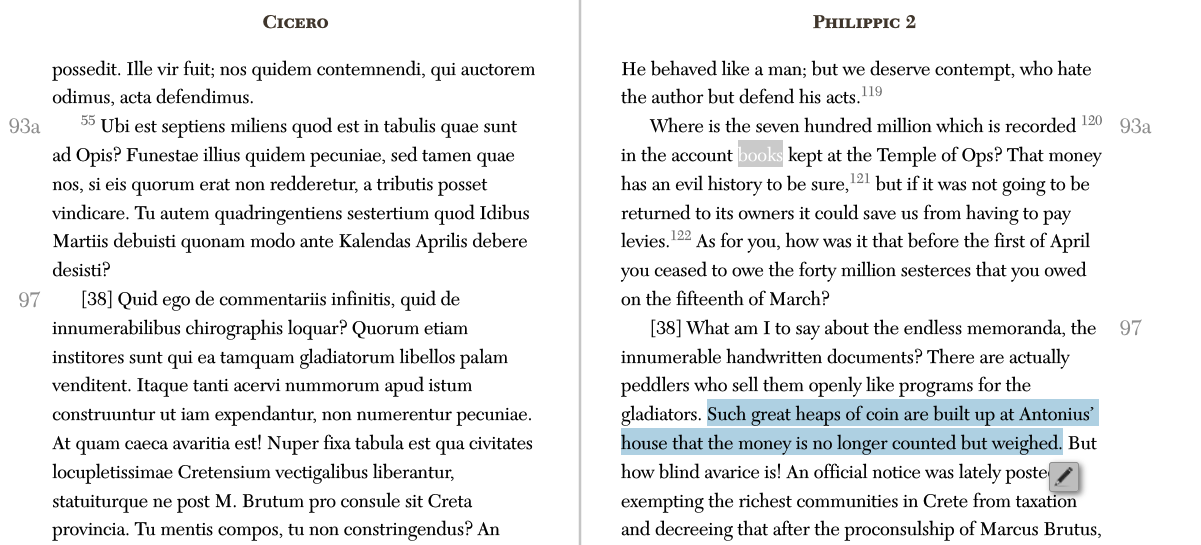
Itaque tanti acervi nummorum apud istum construuntur ut iam expendantur, non numerentur pecuniae.
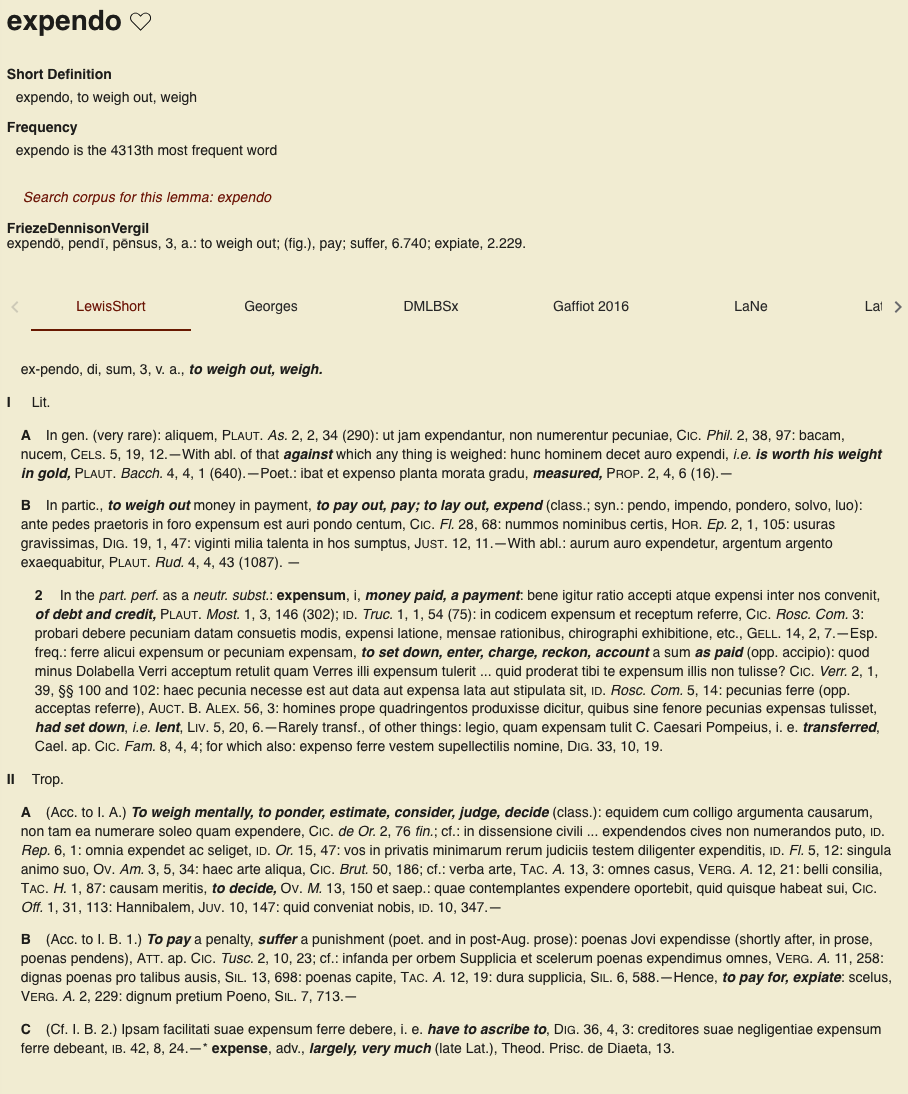
Does it really mean weigh in the literal sense here or could it mean to estimate. Probably literal weighing…
—
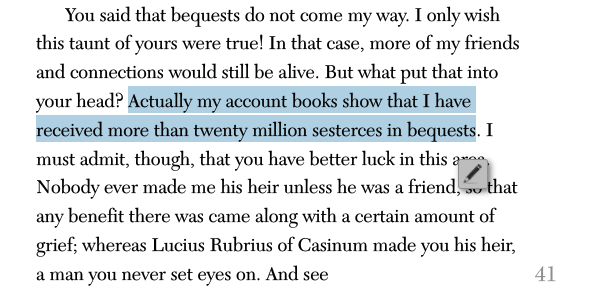
Cic. phil.2.40
—
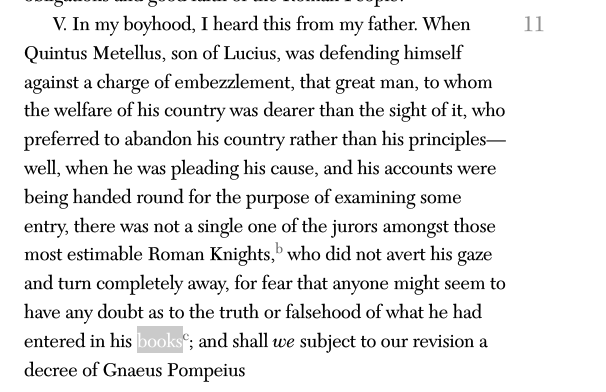
Balb. 11
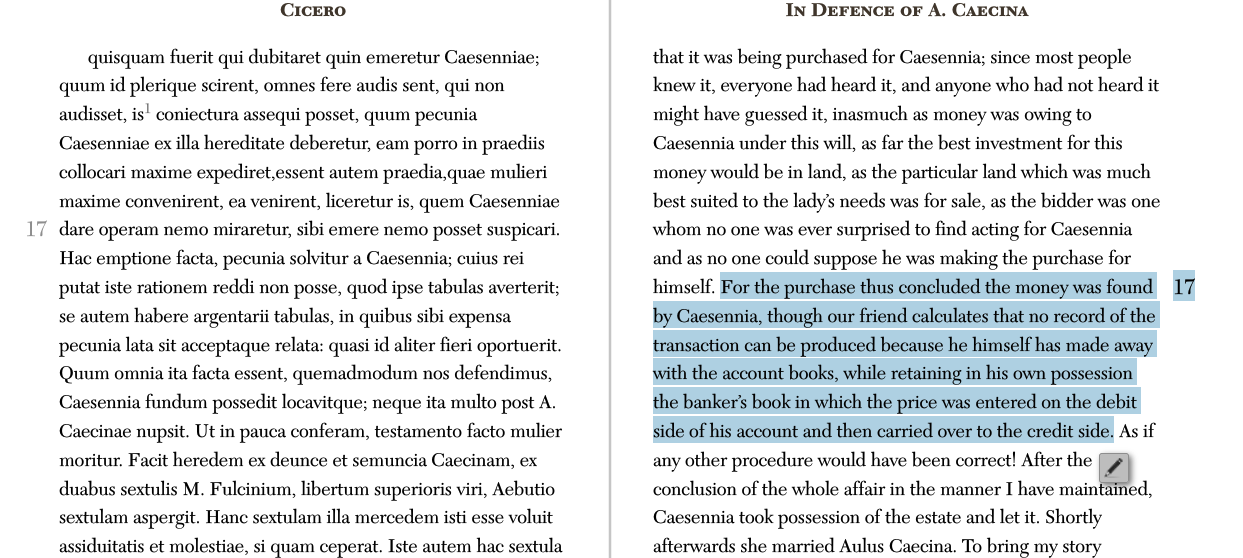
Pro Caelio 17
Nam quod aes alienum obiectum est, sumptus reprehensi, tabulae flagitatae, videte, quam pauca respondeam. Tabulas, qui in patris potestate est, nullas conficit. Versuram numquam omnino fecit ullam.
As for the reproach that he is in debt, his expenditure blamed, his account-books demanded, see how brief is my reply. One who is still subject to his father’s authority does not keep accounts. He has never rolled over a debt to a new creditor. [trans modified]
—
Flacc. 20
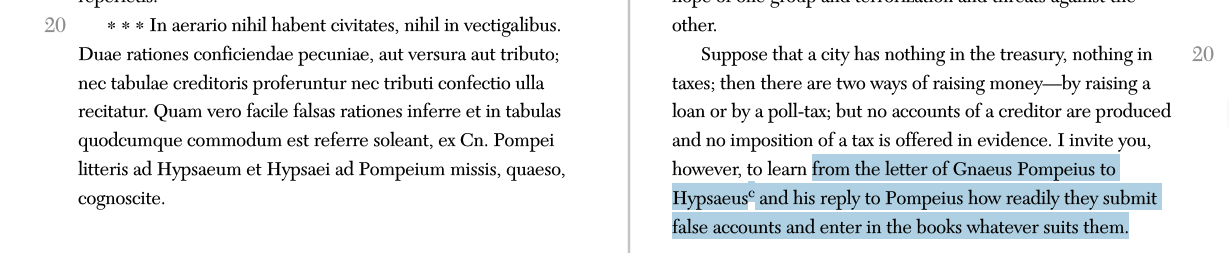
The greeks don’t keep good records like we do! Cf. Pro Saur. 18.
Font. 11
Nemo Gallorum sine cive Romano quicquam negotii gerit, nummus in Gallia nullus sine civium Romanorum tabulis commovetur.
No Gaul ever does business independently of a citizen of Rome; not a penny changes hands in Gaul without the transaction being recorded in the books of Roman citizens.
—
Pro Sest. 72
subito nominibus in tabulas relatis nomen suum de tabula sustulit.
after he had posted up in his account-books the money he had received, removed his name from the posted list
[Cicero plays with the two types of tabula, the personal financial records vs the legal announcement]
—
Verr. 2.1.37
Previous governor turned over records (rationes) along with money, grain, and the army.
Cf. Ibid 98 – Verres uses excuses about not turning over his rationes to the treasury, Cicero holds he should have made copies.
—
Verr. 2.1.100
Hinc illae extraordinariae pecuniae, quas nullo duce tamen aliqua ex particula investigamus, redundarunt; hinc ratio cum Q. et Cn. Postumis Curtiis, multis nominibus, quorum in tabulis iste habet nullum;
He keeps accounts (ratio) with various bankers but doesn’t record them on his own tabulae.
Cf. ibid 102
Homo stultissime et amentissime, tabulas cum conficeres et cum extraordinariae pecuniae crimen subterfugere velles, satis te elapsurum omni suspicione arbitrabare, si quibus pecuniam credebas iis expensum non ferres, neque in tuas tabulas ullum nomen referres, cum tot tibi nominibus acceptum Curtii referrent? Quid proderat tibi te expensum illis non tulisse? An tuis solis tabulis te causam dicturum existimasti?
Oh you consummate fool and madman, when you were making up your books and scheming to escape being charged in connexion with those unrecorded sums of money, did you fancy that you could quite evade all suspicion simply by not recording the payment of money to those who took charge of it for you, or by showing your books with no such entries at all, when the accounts of the Curtii recorded all these sums received from you? How did it help you to make no entry of what you paid to them? Or did you imagine that your case would be tried on the evidence of no one’s accounts but your own?
Verr. 188
Capinatius money lender has secret account on the books for Verres under false name. Slave scribe assumed of writing this name.
Copies made and sealed by reputable men as proof
Verr. 2.3.93 for reading aloud of tabula
—
Flac. 21.
Official records of a magistrate must be held in public custody after being sealed
—
Cluent. 82
Cluentius has kept his accounts most scrupulously—a fact which assuredly has this advantage that no addition or subtraction could have been made to or from the family estate without its appearing. Yet for all these eight years you have been thinking over your case, investigating, discussing, examining every item relevant to it in his or other people’s accounts, and all this time not a trace do you find of such expenditure on the part of Cluentius.
Pis. 61
The treasure official copies out the provincial rationes of Piso and then is imagined exclaiming
ratio quidem hercle apparet, argentum οἴχεται.
The count indeed is plain, the coin—is gone!
Plaut. Trin. 2.4.18
The filing is in line with the Lex Julia


