
I have a bit in an upcoming talk about gold not being used much as money in the Roman republic or even being conceived of as such. I had good secondary literature on this and my own sense of things from woring on the material for so long, but I realized I’d never done any serious dive on this.
I have been thinking more about gold this last year as i’ve put serious time into reading this:
There are any number of related blog posts.
Yet, you know me, I wanted to see for myself what I found.
The only certain reference to gold coins in the whole of the corpus seems to come in the Philippics, where Antony gives gold coins (nummos aureos) to a chief centurion saying they are from Cicero’s property (12.20). This is 43 BCE and the period post 49 BCE saw a great deal of striking of gold coins.
I lean towards an incident in multiple letters of 45 BCER NOT being about payment in gold but I’m not 100% certain.
Att. 12.6 (306 SB): 31 May 45
Please see about Caelius and see that there is no gap in the gold. I know nothing about these matters. But surely there’s enough lost on the exchange. If the gold comes on top of that—but why talk? You’ll see to it. There’s a sample of Hegesias’ style, which Varro commends.
De Caelio vide, quaeso, <et>ne quae lacuna si<t> in auro. ego ista non novi, sed certe in collubo est detrimenti satis. huc aurum si accedit—sed quid loquor? tu videbis. habes Hegesiae genus, quod Varro laudat.
SB claims in his commentary that Caelius is a debt of Faberius and that this passage is about a transfer of debts in lieu of payment, bases his claim on
Att. 12.2a (301 SB) 27 May 45
All the same (?), if you see Piso anywhere, speak to him about the gold. If Faberius comes, please see that the claims assigned, if any are assigned, equal in value the amount owed.
Faberius si venerit, videbis ut tantum attribuatur, si modo attribuetur, quantum debetur.
SB proposes to restore an <et> in letter 306 to separate at the gold from the debt. This is plausible. The gold may be for ornamentation of the villa being planned for renovation in these letters. But I’m not sure we can totally rule out payment. It would be a rare morally neutral reference to gold in leiu of money or as money as far as I can tell, but it would fit with the increase in gold in circulation under the dictatorship…
To support the idea that the gold does appear to be a separate matter BUT it may also still be about payment:
Att 12.5a (307 SB) 31 May 45
I have written to Avius, asking him to make clear to Piso the facts about the gold, which are well known to him. I quite agree with you that this matter is dragging on too long and that now is the time to pull in all I have from every quarter.
ad Avium scripsi ut ea quae bene nosset de auro Pisoni demonstraret. tibi enim sane adsentior et istuc nimium diu duci et omnia nunc undique contrahenda.
Besides the above where gold might be treated as money but is highly doubtful there is very little evidence for gold as form of payment in which the circumstances don’t make clear it is shameful or criminal or highly usual. All the other passages make clear that Gold a sign of wealth, even a store of wealth, and a prized confiscation in war, but that the gold is to be weighted to assessed its value not counted like nummi or pecunia. Below are passages sorted by type. It is not complete but I believe the catagories could cover any reference to gold in the Ciceronian corpus. I’m surprised about the suspicion that seems to attach to gold used as payment, even as it is clearly accepted as a common store of wealth and in forms that have nothing to do with display. I’m going to work the weighing versus counting themes into another talk coming up later this month.
Suspicious Payments in Gold
gold the weight of Gaius Gracchus’ head as payment for hunting him down
De Oratore 2.269
as our friend Scaevola observed to the notorious Septumuleius of Anagnia (to whom its weight in gold had been paid for the head of Gaius Gracchus), when he prayed to be taken into Asia as his lieutenant, ‘Madman,’ said Scaevola, ‘what would you have? There is such a host of wicked citizens in Rome that I guarantee you, if you remain there, the attainment, within a few years, of enormous wealth.’
ut noster Scaevola Septumuleio illi Anagnino, cui pro C. Gracchi capite erat aurum repensum, roganti ut se in Asiam praefectum duceret, ‘Quid tibi vis,’ inquit, ‘insane? tanta malorum est multitudo civium ut tibi ego hoc confirmem, si Romae manseris, te paucis annis ad maximas pecunias esse venturum.’
Clodia’s Gold
Jewellry that could be used either to pay for a high level murder OR to fund some games (Pro Caelio 52-53)
Bribery
M’. Curius’ refusal of gold from the Samnites (c. 290 BCE) (48, cf. De Senectute 56 for more elaborate narrative)
those engines with which Philip said any fortress could be stormed provided there was a way up for a donkey with a load of gold on its back.
Att. 1.16 (16 SB) beginning of July 61
Gold tithe to the Temple in Jerusalem
Notice it is weighed and redirected to the roman treasury. That it was stored in the treasury is v interesting from a state budget point of view.
Flac. 66-67: gold sent to temple in Jerusalem by Jews from all provinces, Flaccus banned the export
The Senate strictly forbade the export of gold on a considerable number of previous occasions, notably during my consulship.
Exportari aurum non oportere cum saepe antea senatus tum me consule gravissime iudicavit.
At Apamea a little less than a hundred pounds of gold was seized as it was being exported and weighed in the forum at the feet of the praetor through the efforts of Sextus Caesius, a thoroughly upright and honest Roman knight; at Laodicea a little more than twenty pounds was seized by Lucius Peducaeus who is here in court and a juror in this case; at Adramyttium a hundred pounds by Gnaeus Domitius, one of Flaccus’ subordinate officers; at Pergamum not much. The account of the gold is correct, it is in the treasury (aerario), there is no evidence of theft, the sole intent is to create unpopularity.
68-69
Cf. In Vatinum 12: “were you not sent by me when I was consul to Puteoli, that you might prevent the exportation of gold and silver?”
Confiscation to pay for land
“The gold and silver from plunder, from spoils, from material for making crowns, to whatever people they have passed, and which have never been paid into the public [treasury] nor spent on a monument,” he orders that this be declared before the Decemvirs and be placed at their disposal.
‘ “Avrvm, argentvm ex praeda, ex manvbiis, ex coronario ad qvoscvmqve pervenit neqve relatvm est in pvblicvm neqve in monvmento consvmptvm” ,’ id profiteri apud xviros et ad eos referri iubet.
De Lege Agraria 2.59
To Fund an Exile
Tu comitibus, tu praesidio, tu etiam tanto pondere auri, quantum tempus illud postulabat, discessum illum sustentasti; tu numquam meis me absente liberis, numquam coniugi meae defuisti.
you comforted my departure with your companions, your protection, and such weight of gold as the juncture demanded; during the time of my absence you never failed my children or my wife
Pro Rabirio. 47
Honorific and Rhetorical Gold
De Optimo Genere Oratorum
19 – gold crown as sign of honor for Demosthenes
Gold as metonymy for wealth – Rhetorica ad Herennium (not really Cicero, but actually a little earlier)
“must have a gold mine at home” to condemn unexplained wealth.
And he [sc. Gorgias of Leontini] was held in such honour by Greece that to him alone of all men a statue was erected at Delphi that was not gilt but made of solid gold.
De Oratore III. 130
When they were putting a golden crown at the head of the text, they were really giving you no more gold than they would give a jackdaw.
Vat. 76
Gold as Ornamentation
Gold as Jewelry and body ornamentation (x3) Rhetorica ad Herennium (not really Cicero, but actually a little earlier); cf. De Senectute 59 for association with Eastern luxury, royalty
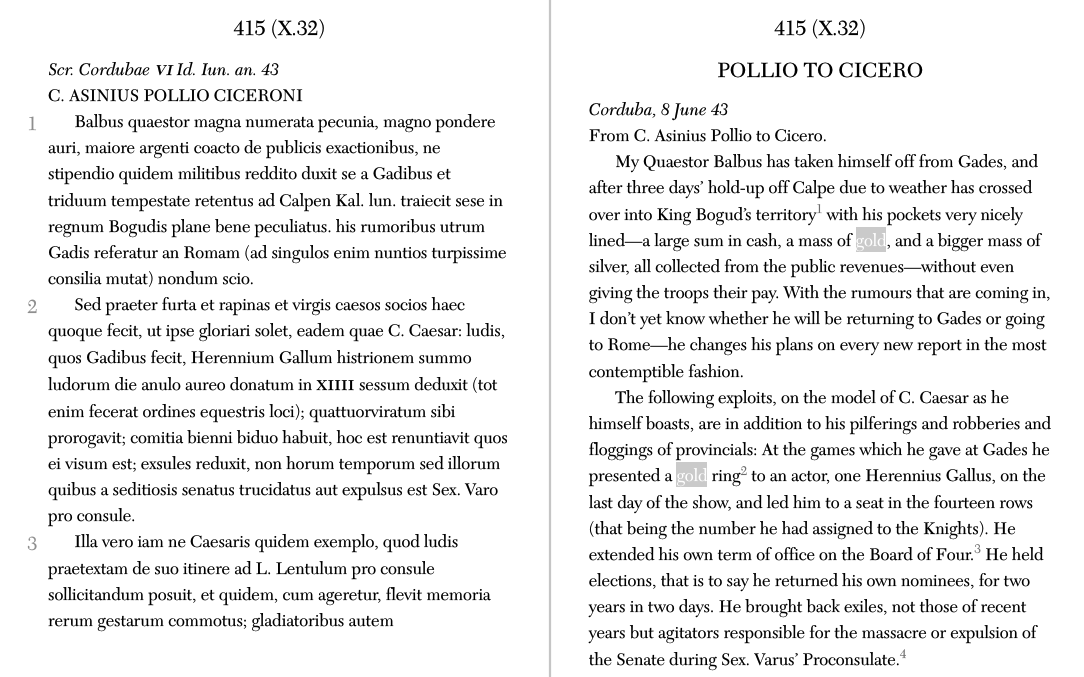
Verres manufactures enough golden cups to furnish half a dozen sideboards, without caring what may be said of him in the Roman law-courts, let alone in Sicily: Piso will have all Spain know whence comes the half-ounce of gold (auri semuncia) to make the governor’s ring (praetori anulus), acting up, plainly, to his third name, just as Verres acts up to his second. (Verres 2.4.57)
Gold a Store of Wealth but distinct from Money
Nothing base or sordid is told of Tarquin: but in his house gold was weighed and money counted among the women’s wool baskets; in a single dwelling all persons interested trafficked in the entire empire of the Roman people.
Nihil humile de Tarquinio, nihil sordidum accepimus: at vero huius domi inter quasilla pendebatur aurum, numerabatur pecunia; una in domo omnes quorum intererat totum imperium populi Romani nundinabantur.

passage is said to be an allusion to Fulvia’s control of the money, but there might also be something about baskets quasilla, rather than fiscus
I leave aside the gold crown and how you hovered in tormenting indecision whether to take it or no; for your son-in-law’s measure forbade that it should be decreed or accepted, unless a triumph were decreed. But in respect of this, as in the case of the hundred talents of the Achaeans, you could not bring yourself to disgorge money (pecuniarum) that you had already received and engulfed; you merely changed the names and descriptions of the various sums.
In Pisonem 90
Cum esset in aedibus armarium, in quo sciret esse nummorum aliquantum et auri, noctu duos conservos dormientes occidit in piscinamque deiecit:
There was a safe in the house which he knew to contain a quantity of coin and of gold; so one night he killed two of his fellow-slaves as they slept, threw them into the fish-pond
Pro Cluentio 179
lost in lacuna how many sesterces were stolen but 5 pounds of gold. auri quinque pondo
Other Passages Unsorted
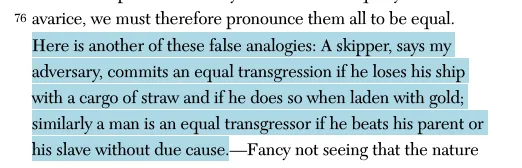
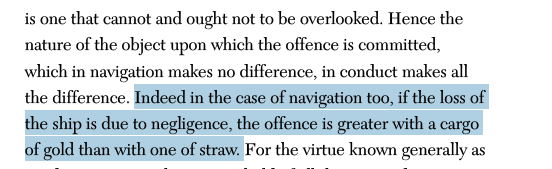
De Orat. 4.76
—
Pro Sest. 93
gold associated with Syria, war, greed (innumerabile pondus auri)
—
Cic. Fam. June 54 BCE to Trebatius VII.7=28

in Britannia nihil esse audio neque auri neque argenti
No word for weight in the Latin
Upon my soul, you are such a coxcomb that I believe you would rather be consulted by Caesar than covered in gold!
Cic. Fam. March 53 BCE to Trebatius VII.13=36 SB
Admittedly it is no easy matter to distinguish the genuine article from the sham, unless a situation happens to arise in which the gold of loyal attachment is discerned in the fire of danger
Cic. Fam 9.16 = 190 SB to Papirus Paetius mid July 46
Paradoxa Stoicorum
Ostentatious display of wealth in home decor (13)
Will you call a man good who pays back ten pounds of gold when as it
the moneyhad been entrusted to him without a witness he could easily have pocketed it without punishment, if he fails to do the same in the case of a sum of ten thousand pounds?An virum bonum dices qui depositum nullo teste cum lucrari impune posset auri pondo decem reddiderit, si idem in decem milibus non fecerit?
(21)
marker of wealth (Pro Flacco 47)
the affair of the gold from Toulouse (allusion to) De Natura Deorum III.74


