
I’m getting better at writing LLM prompts to extract data. I’ve not yet let it run my analyses as that feels like part of my own thinking at least until I’m confident at my methods and how I will check results. I want no magic black box to spit out answers. I do like less grunt work in transcription, data cleaning, etc… Copilot (university paid subscription) needs shorter sets of data but can handle multiple multiple pages of Haeberlin all at once and produce very usable PDFs with high accuracy (now that I’ve gotten better at prompt writing).
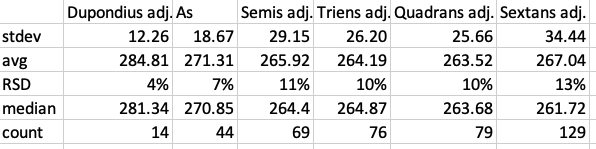
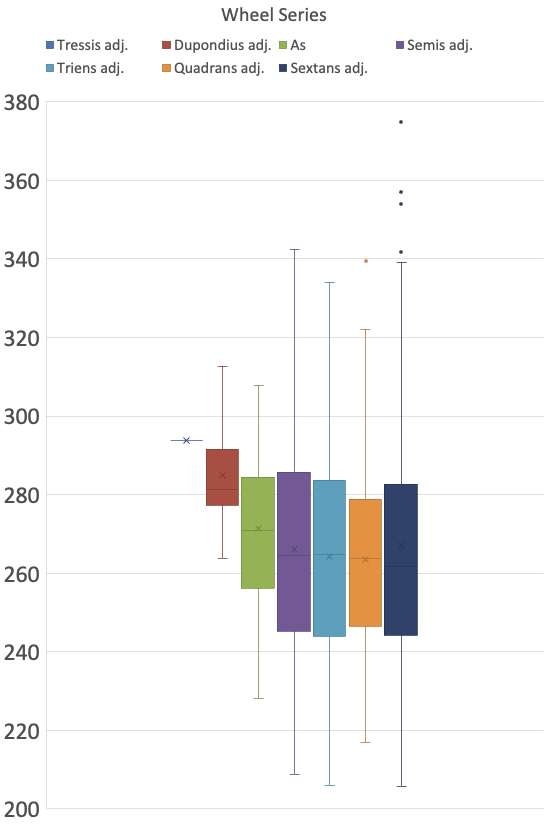
This is a weird picture. The As is much heavier than its fractions. I’m happy (ish) to ignore the tressis (1) and dupondius (14) but the As has 44 specimens and is clearly much more tightly controlled than the fractions as well as heavier.
Why does this series have no uncia?
My notes on Burnett 1989 say that he places this later in the relative chronology because of the standardized reverse on all denominations (cf. prow series) and CHRR 28. But I’m guessing the lack of the unciae is alway a good reason for bringing it down in the sequence of issues.
What should we use as the standard since it looks like the ass is significantly heavier than other denominations. The practical weight standard is 265 grams or so for the fractions, but 271 or so for the As.
I think the As is probably the best unit by which to judge the intended standard of production…
This work is building on my 2023 piece
“The Strangeness of Heavy Bronze” In S. Bernard, L. Mignone, & D. Padilla Peralta (Eds.), Making the Middle Republic: New Approaches to Rome and Italy, c.400-200 BCE (pp. 103-131). Cambridge: Cambridge University Press 2023.
I’m confident in Haeberlin’s weights based on my own reweighing in Berlin. See write up.


