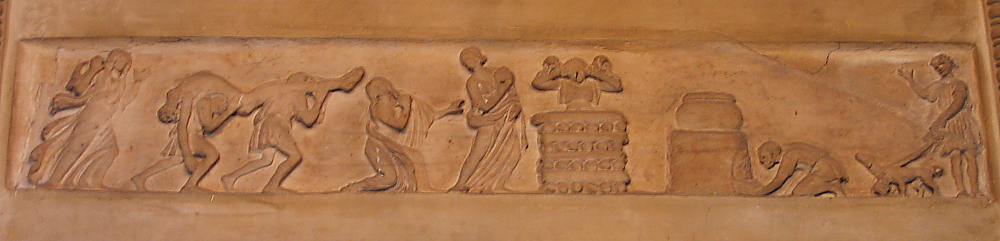
The representation of the woman (behind?) The pyre reminded me of representations of the Tarpeia.
adventures in my head
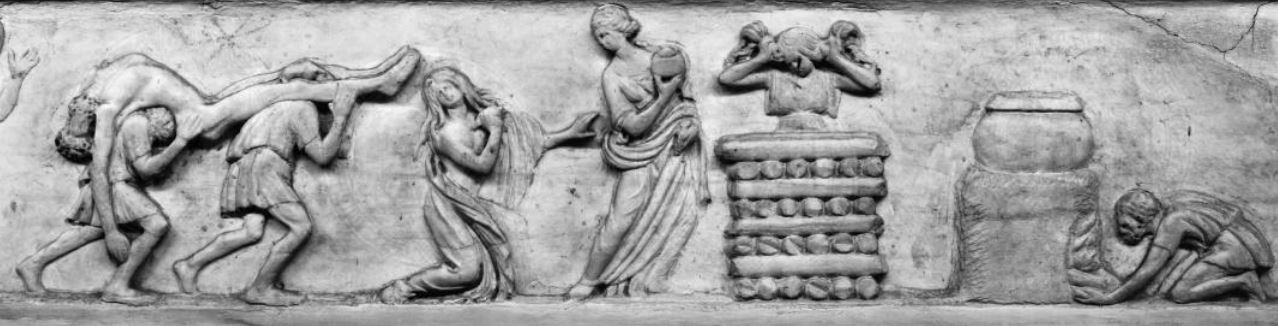
The representation of the woman (behind?) The pyre reminded me of representations of the Tarpeia.
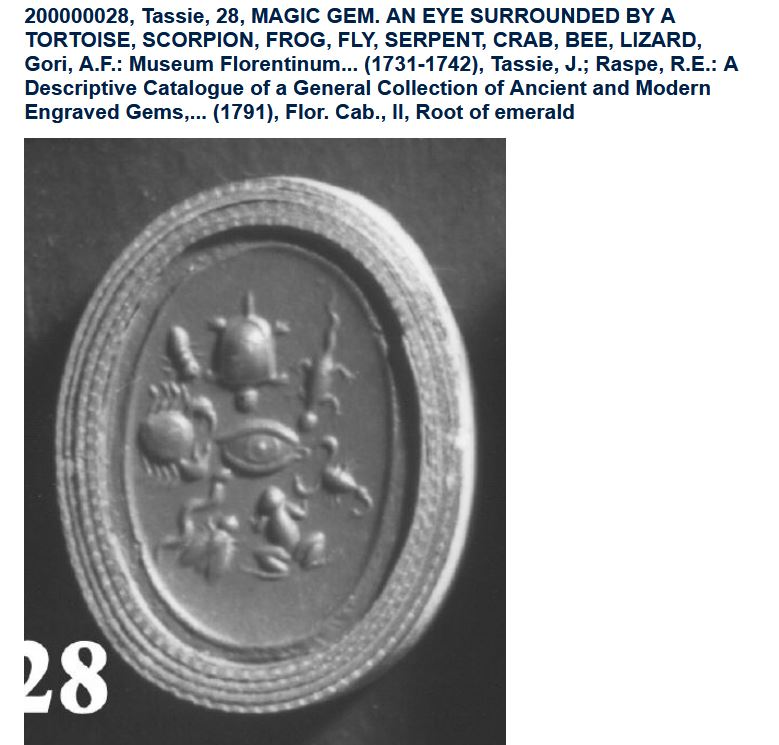
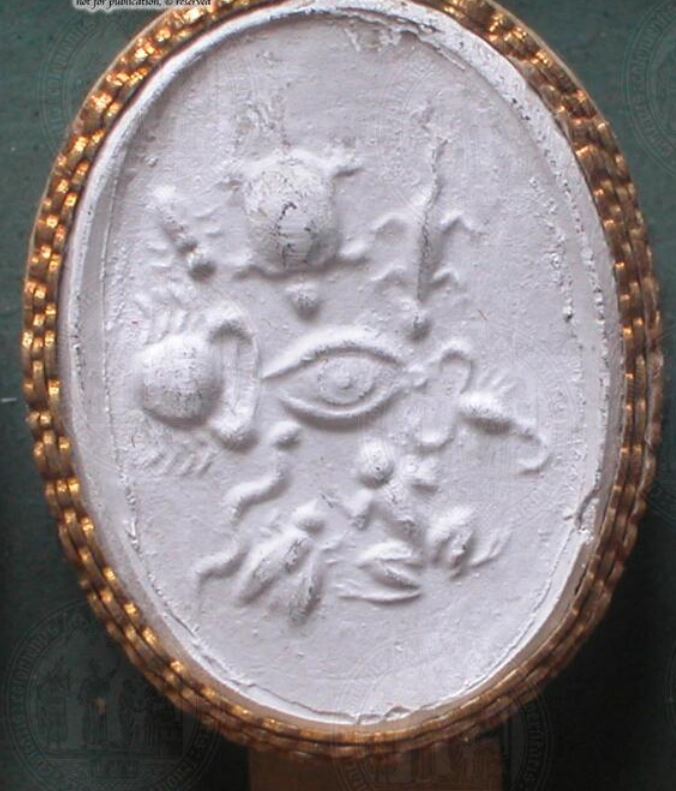
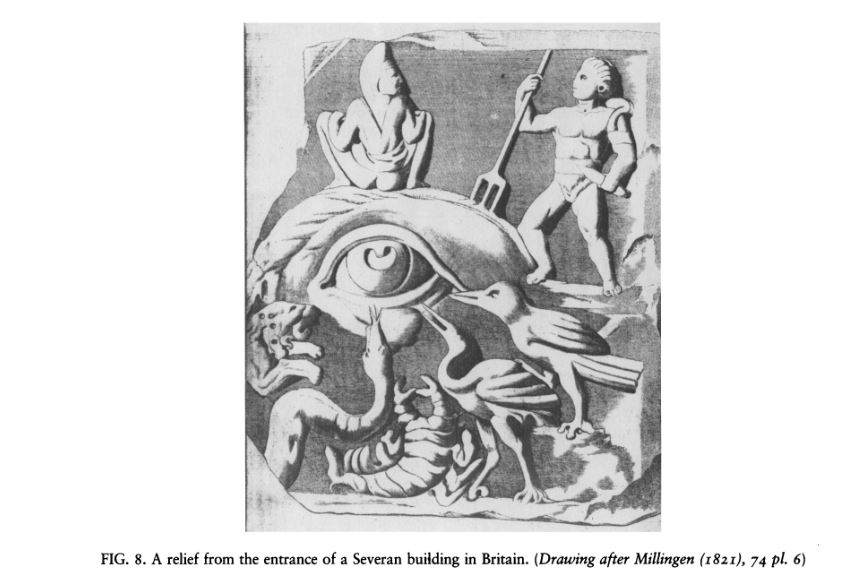
Thinking about the evil eye in Roman culture for some lesson planning last night and this am. I came across these two impressions of ancient intaglios. One is said to have been taken in the 18th century in the Florentine Museum. The other is reported as taken from the Sammlung Stosch, W Cl VII 0127 = Staatliche Museen, Antikensammlung Berlin, Berlin, Deutschland, Inv.-Nr. FG 9722. The Florentine is said to be cut from the root of emerald. The Berlin intaglio is catalogued as a glass paste. Was the Berlin glasspaste made from the Florentine gem? Is the Florentine intaglio really another glass paste (I’m not sure what root of emerald means) made from the same mold as the Berlin example? Were glass pastes ever made as ‘fakes’ in the early modern period? Could the Berlin version be such?
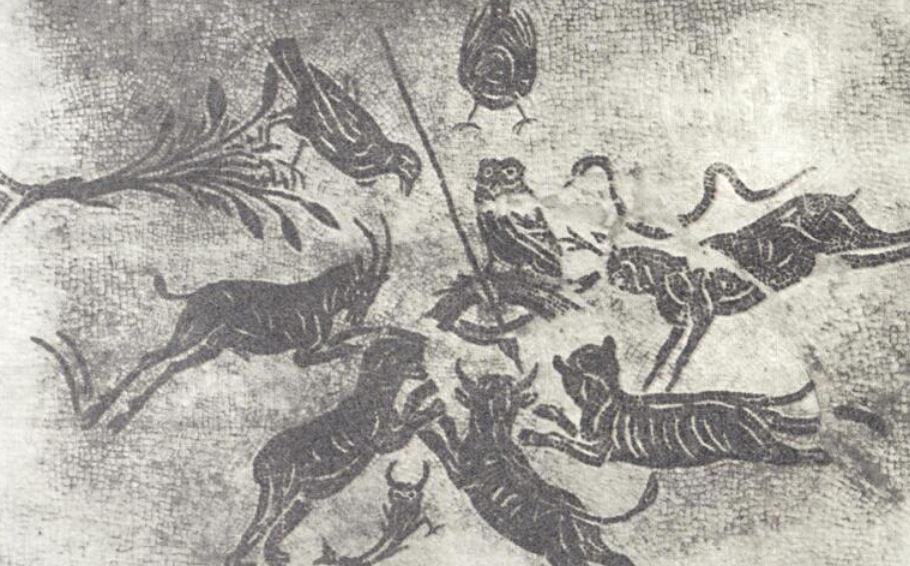
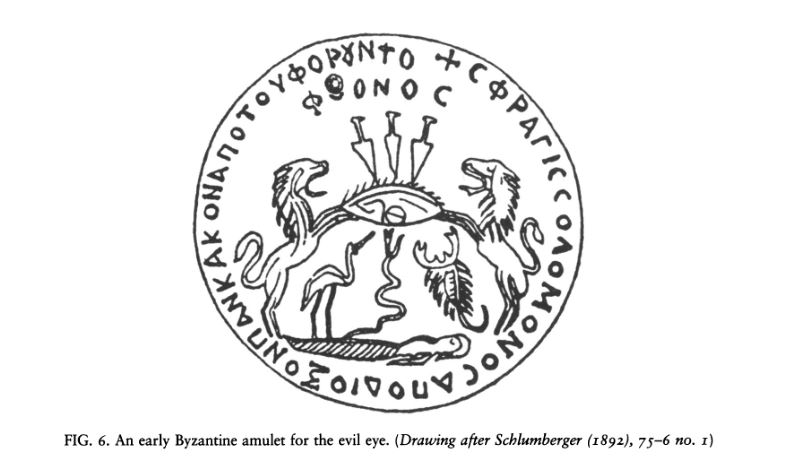
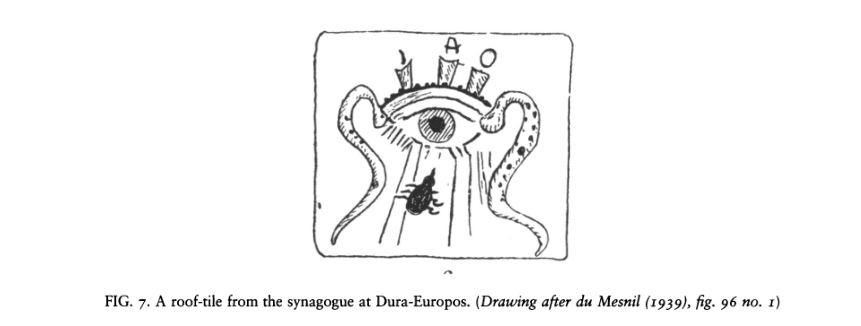
A round up other evil eye iconography:

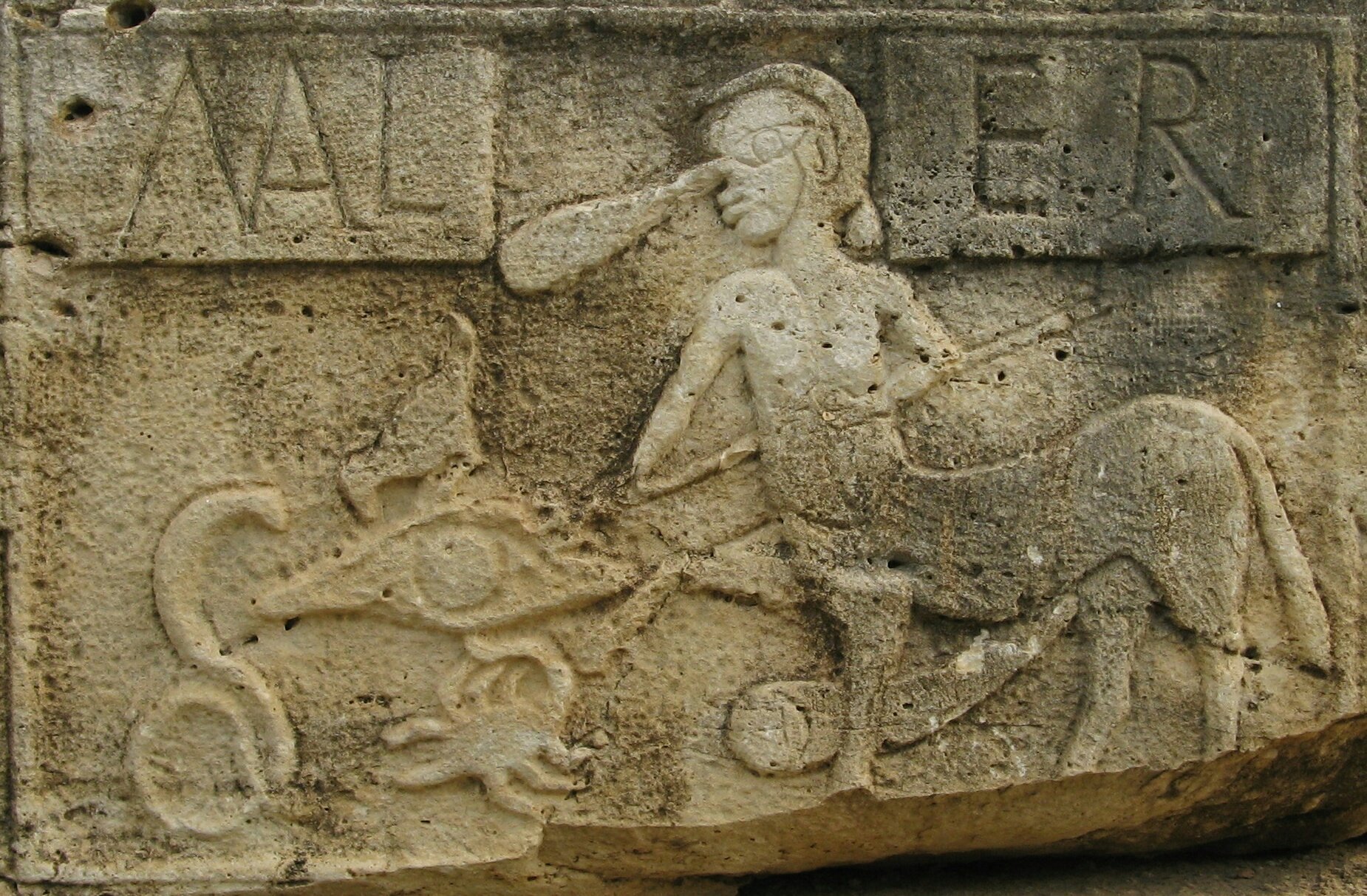
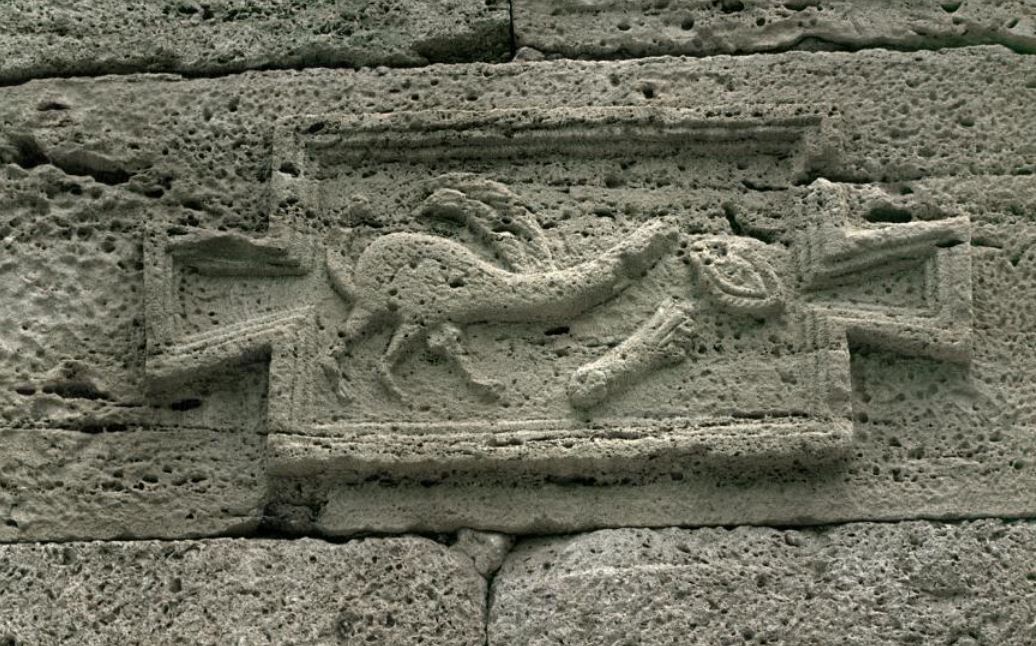
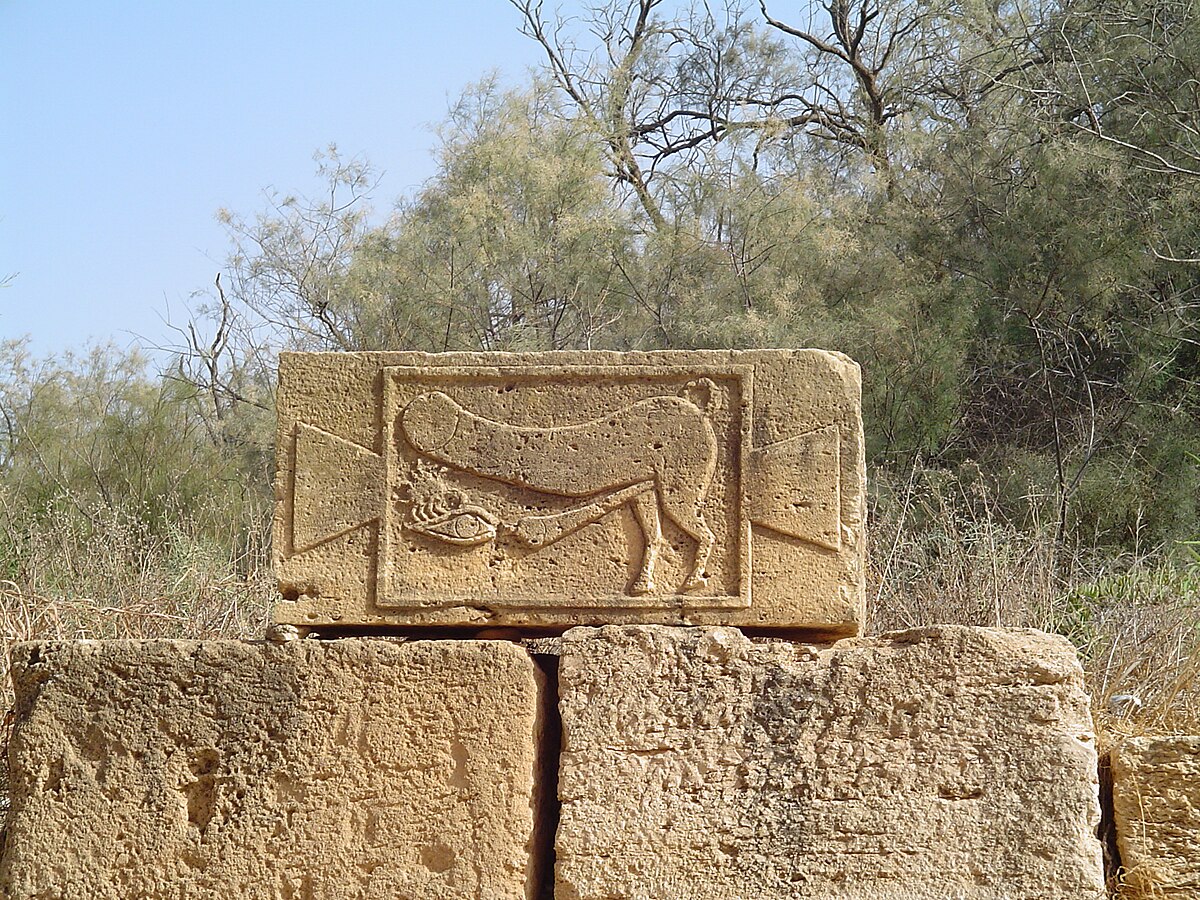
Not a “brothel sign” but another example of an apotropaic carving from Leptis Magna.
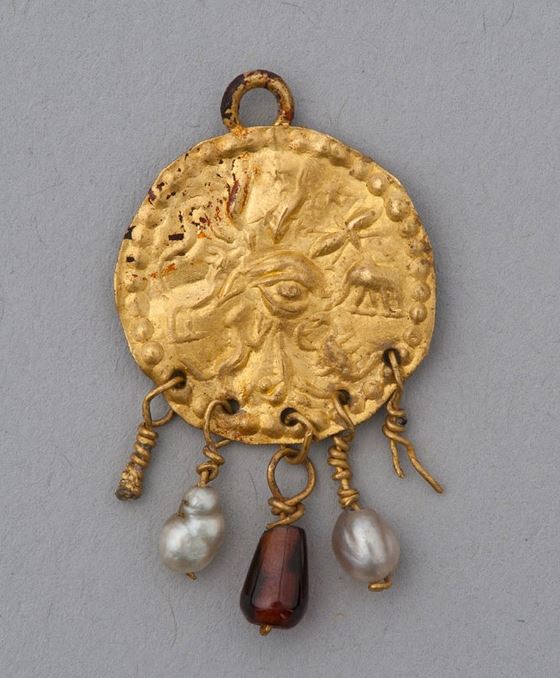
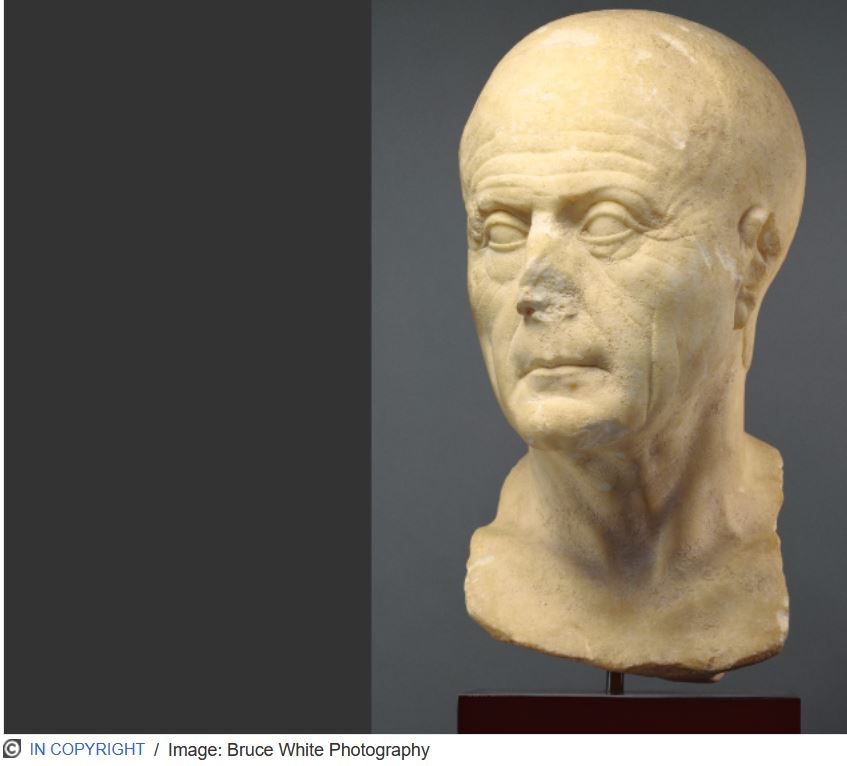
An example with uncertain provenance now in Getty via Fleichman collection.
Deposited c. 230-225 BCE
Just reading Gorini’s admirable write up! V nice to have an archaeological context! I agree with his historical framing and lean strongly to his interpretation of it as possibly votive but not likely constitutionally foundational in anyway.

Note to self: Discussed in Jaia and Molinari 2020/2021 “The Carbognano Hoard” citing
Bonetto J., Falezza G. 2009, Scenari di romanizzazione a Nora: un deposito di fondazione e un deposito votivo per la costituzione della Provincia Sardinia et Corsica, «Sardinia Corsica et Baleares Antiquae», VII, 81-100.
“Bronze mirror cover (16.2 cm diameter) showing a Greek warrior and a fallen Amazon, perhaps intended as Achilles and Penthesilea: ca. 375 BC. Provenance lacking prior to 1898. Image: State Hermitage Museum (ГР-7245)” via Twitter.
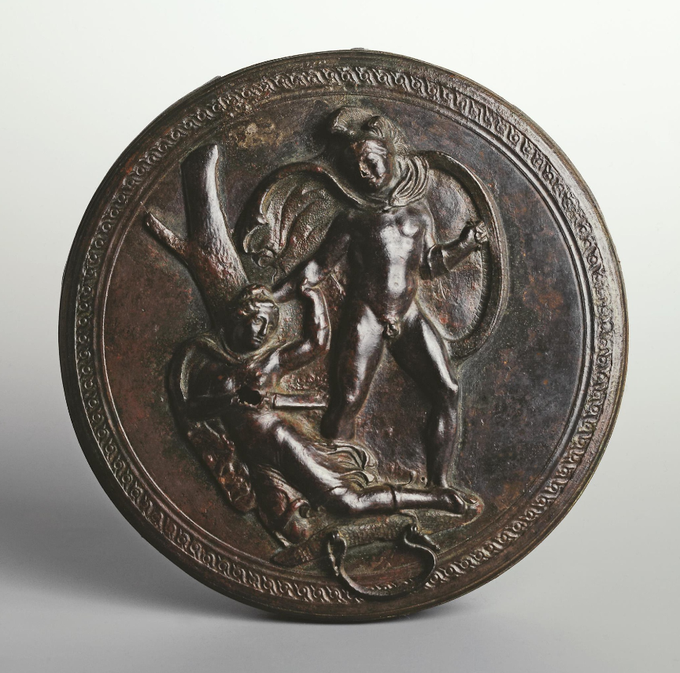
Earlier precedent for iconography seen in the Claudius and Britannia relief from Aphrodisias:
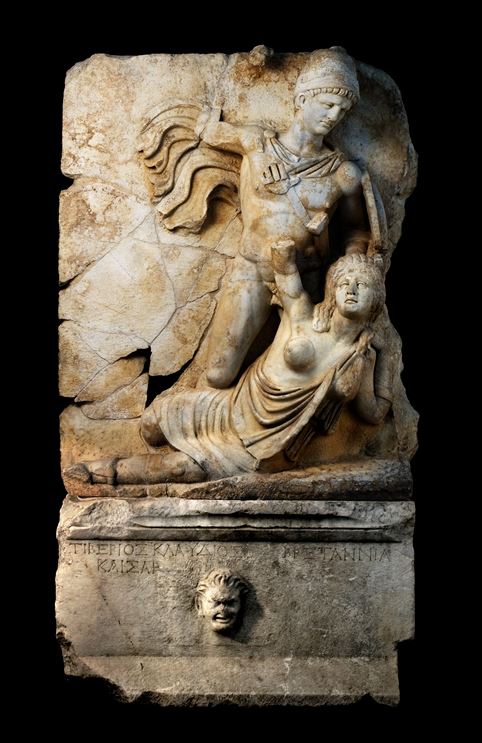
Any one want to remind me of coins with hair grabbing scenes?
Potentially relevant bibliography on hair grabbing (thx to Dr. Draycott for bringing to my attn!):
Aldhouse-Green, M. J. 2004. Crowning glories: languages of hair in later prehistoric Europe. Proceedings of the Prehistoric Society 70 (Decemb), pp. 299-325.
Aldhouse‐Green, M. (2004), Chaining and shaming: images of defeat, from Llyn Cerrig Bach to Sarmitzegetusa. Oxford Journal of Archaeology, 23: 319-340. doi:10.1111/j.1468-0092.2004.00214.x

Why? Control! Security! Block voting! Secret Ballot!
Who doesn’t love lining up under the elements? In all weathers?!
It’s gonna be great!
Let’s make those lines extra narrow and have very limited space inside the voting area!!!
The best thing to read on this is behind a paywall and in French by an Italian. So if you want the quick and dirty version –Really, the: “I should be grading version or developing course materials or answering emails version”–this is it.
[Update: also see Rafferty, David. “Rural voters in Roman elections.” TAPA 151, no. 1 (2021): 127-153.]
Romans voted in blocks and there was no such thing as an absentee or proxy vote or multiple polling spaces. What do I mean by a block? It is kind of like the US electoral college: every one in the block who choses to vote and manages to do so (in our case States, in the Roman case “tribes” or “centuries”) votes and then bases on simple majority the block vote is given its totality toward one candidate or one decision (yes/no in the case of legislation, guilty/not guilt for trials). As I’m fond of reminding you, elitist Greeks at the end of the republic thought this was a very clever way of making sure the poor (suckers) ‘thought’ their vote counted.
So if all those blocks voted simultaneously (or near simultaneously) the Romans needed to make sure each voter gets sorted in to the right group. I’m reminded about how hard it was to find my right polling station within my polling location back in Brooklyn.
At least by the mid-2nd century BCE (but probably much earlier) the Romans has worked out a system they called the saepta (enclosure) or olivia (the sheep pens–great analogy right?!).
We know this because of the archaeological remains of Fregellae (Latin colony from 328 BCE, rebelled and destroyed 125 BCE). The form was designed to allow for long (hot, cold, wet, slow, miserable, sociable, crowded) lines.

Rome had something similar. Long before Julius Caesar co-opted the project as his own, plans to monumentalize the voting pens were underway in late republic.
For in the Campus Martius we are about to erect voting places for the saepta tributis, of marble and covered, and to surround them with a lofty colonnade a mile in circumference: at the same time the Villa Publica will also be connected with these erections. You will say: “What good will this monument do me?” But why should we trouble ourselves about that?
Cicero writing to Atticus, 1 July 54 BCE, translation modified from Shuckburgh
The voting pens are visible on the fragments of the Severan marble plan. Darker areas are those for which parts of the marble plan survive.

I include a modern map for human scale, particularly for those who are used to walking this landscape.
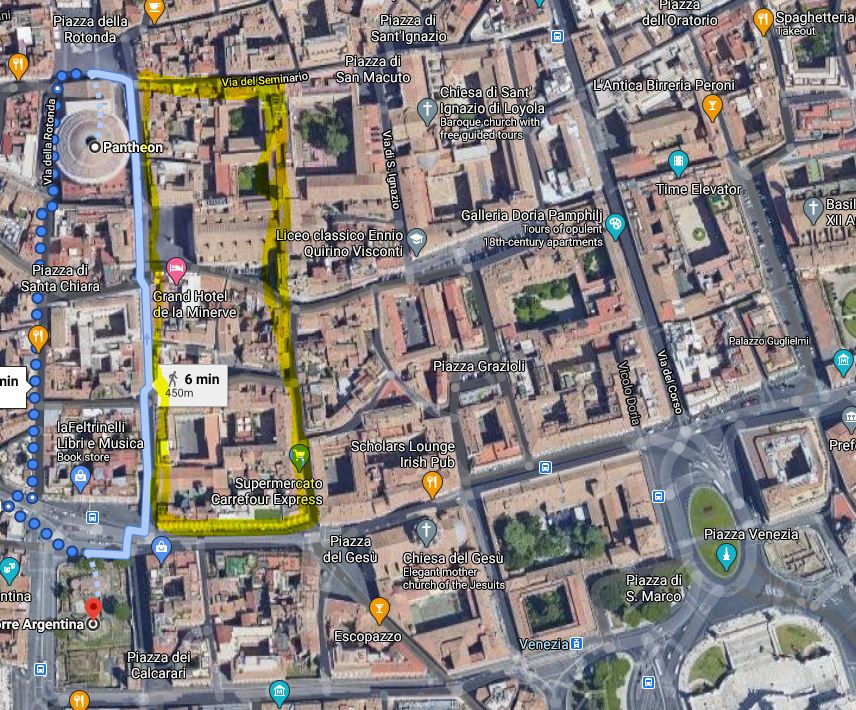
Putting colonnades around ensured that both sight lines and access points to the voting area were highly restricted. Who got in and out was easily policed. Inside the voting area for officials might be covered but the area in which those waiting to vote after being sorted by block was not. Again environmental factors and press of people could be significant including waiting.
The area is huge you will say, massive. More than enough, surely?! So the estimated area (v rough–I just used Google earth) is about 3.51 hectares = .04 sq km = 378,205 sq feet = 8.68 acres. The perimeter is about 875 meters or 2874 feet or 958 yards, so about 2/3s of an imperial Roman mile, but not really that far off Cicero’s 1000 paces. An American football field is 57,600 square feet (5,350 m2). So the Saepta was nearly 6.5 football fields. VAST!
If you allow 2ftx2ft per person (tight!) 14,400 people fit on an American football field or 94,551 in our (over) estimated Saepta, but with all the equipment and crowd control that seems far far too high.
How many Romans were eligible to vote? We’re told that in 70 BCE maybe 910,000 individuals. In 28 BCE 4,063,000?! (See Wiseman 1969).
So we could generalize that the built structure in Rome was intended to accommodate less than 10% of the eligible voters, probably much less than 5%.
What about the logistics of time in this space?
Cicero calls it the tribal Saepta so let’s guess that individuals lined up by tribe or that the basic built structure of the barriers allowed for this. That would mean at least 35 rows. These rows must have been less than 10 feet wide, probably a lot less.
Perhaps these rows were divided again by senior and junior members? So less than 5 feet wide?
So you get in line. The number of people in line ahead of you effects waiting time as do the time it takes for them to vote.

Every voter has to mount the voting bridge, get a ballot, mark their ballot, cross bridge, deposit the ballot in the urn and walk off the bridge. 30 seconds? Just a guess. That would be 120 voters per tribe per hours. Maybe if two lines per tribe 240 votes per hour.
There are about 15 hours of daylight in Rome in summer. So maybe enough time for 126,000 citizen to vote, but that seems far too high.
And that is A LOT of waiting in line.
But somebody must have been policing the order in which everyone got in line for elections because the centuries within each tribe needed to vote in order. So that had to increase waiting time for those lower in the centuries.
Of course tribal distribution was not even. Urban tribes would have longer lines than rural tribes.
Time is a luxury. Standing around all day to vote costs for those living at the subsistence level.
Oh and you might end up in the middle of riot at Rome as you’re standing in line to vote. That was pretty typical in the last decade or so.
For a more serious view of all this, see the work of Lily Ross Taylor (a personal hero of mine)

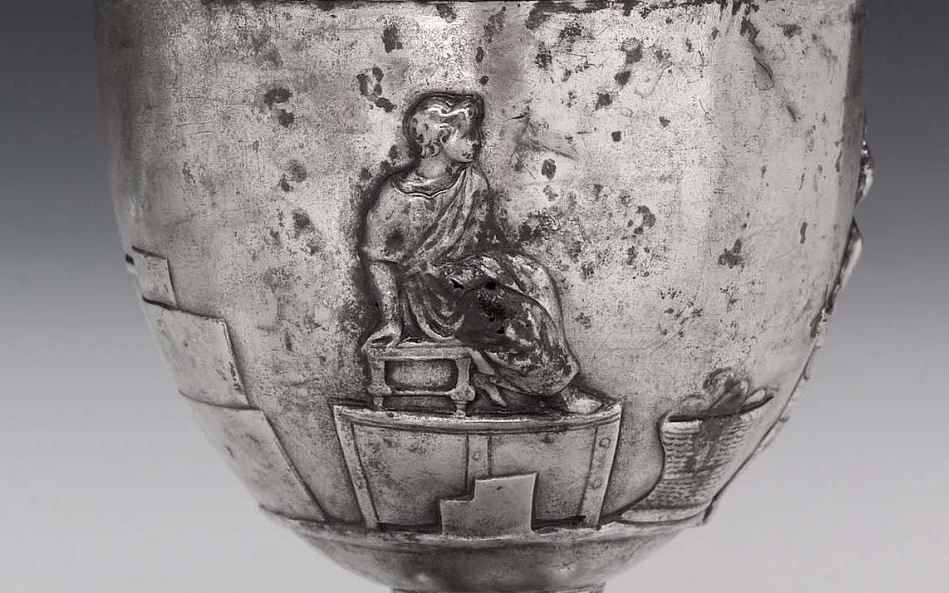
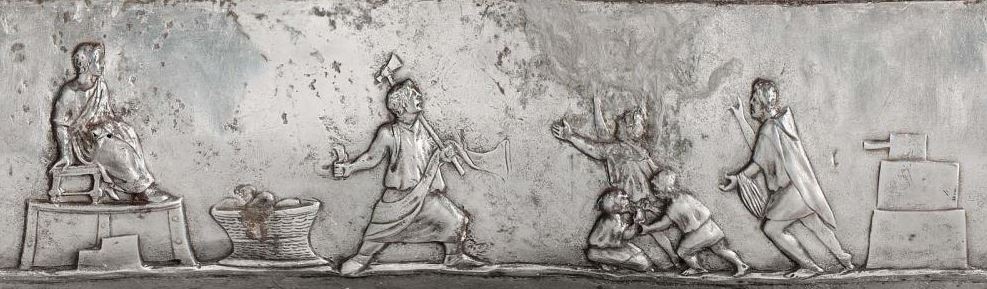
It is the subsellium NOT a sella curulis (curule chair). This means the individual does not hold imperium, so not (pro) consul or (pro) praetor BUT quaestor or tribune (republican period) or possibly Praefect. (The MFA catalogue at time of writing calls it a curule chair hence my assertion.)
My three questions for you! What is in the basket? What is in the man with the axe’s right hand? What is that pile of blocks behind the tribunal and the man with the hood?
Updated shortly after original post as my brain started to work in earnest on the problem:
The sight lines suggest the damage to the cup might be an intentional erasure OR reconstruction that obscures and critical narrative element. I’ve used orange irregular mark to indicate approximate size and dimensions that would capture every one’s attention appropriately for the scene.
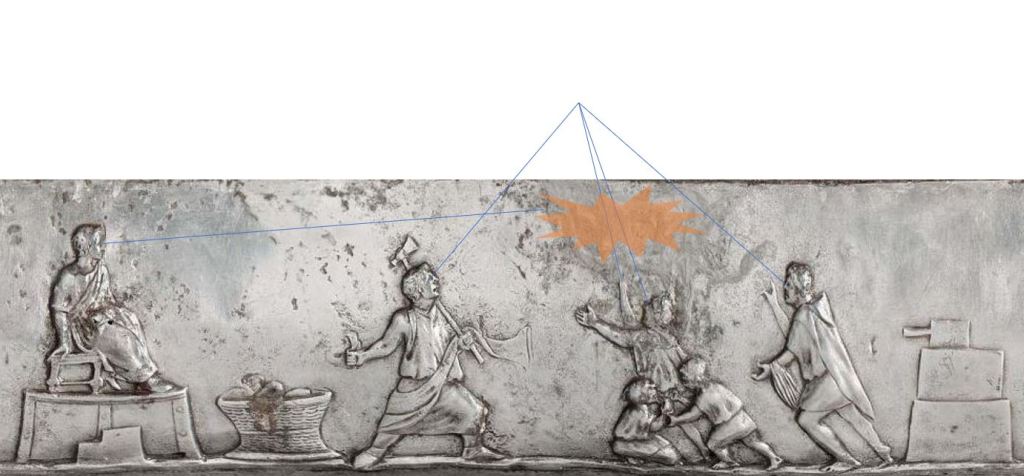
Dude with an axe is holding it in his left hand. He’s not about to execute anyone, but if we compare to other sacrifice scenes he’s not unlike the figure leading the bull to sacrifice it’s just that the collar is empty. Has the silver been over cleaned? Repaired?

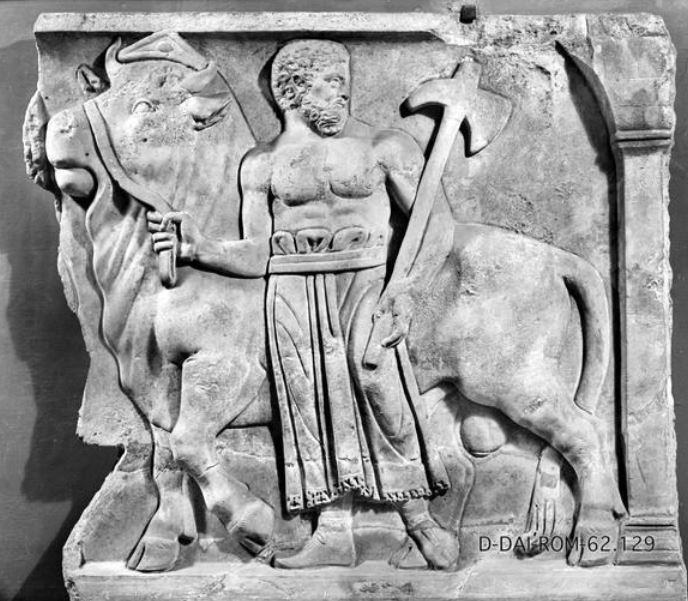
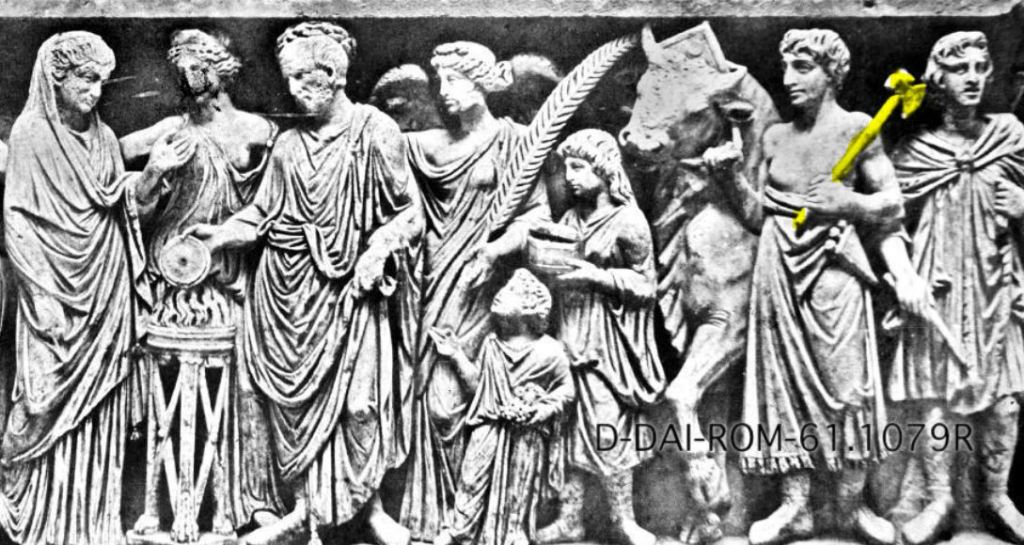
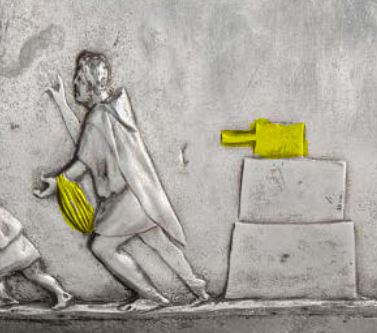
The other figures don’t look like they are all dressed up for a sacrifice or festival (no crowns etc…) but maybe. Notice the ‘purse’ like object around the other dude’s wrist. Has he set down the object on top of an “altar”? Some sort of mallet maybe?
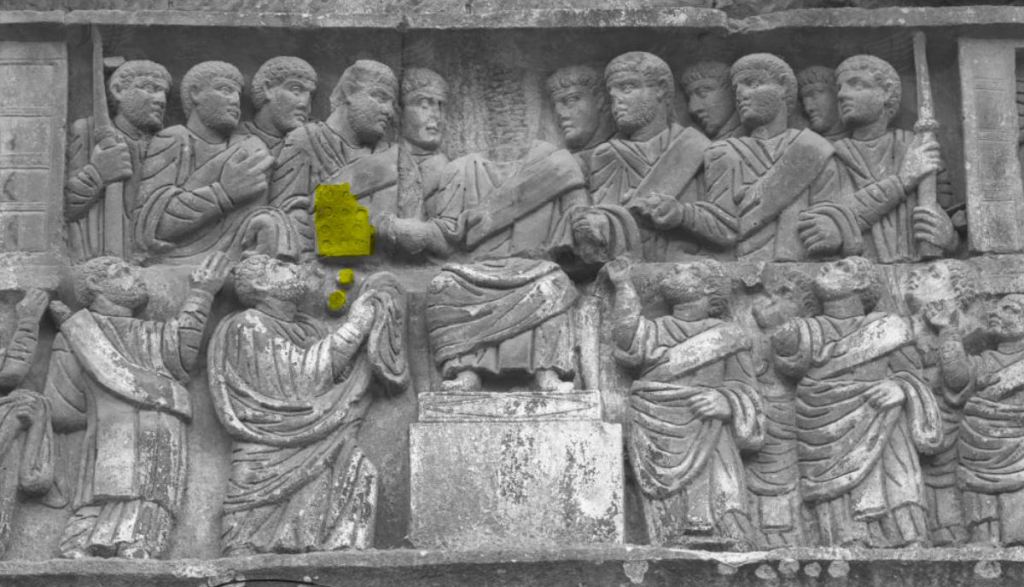
Another one of my working theories is that besides sacrifice this may be scene of liberalitas, as humble individuals are also in such scenes:

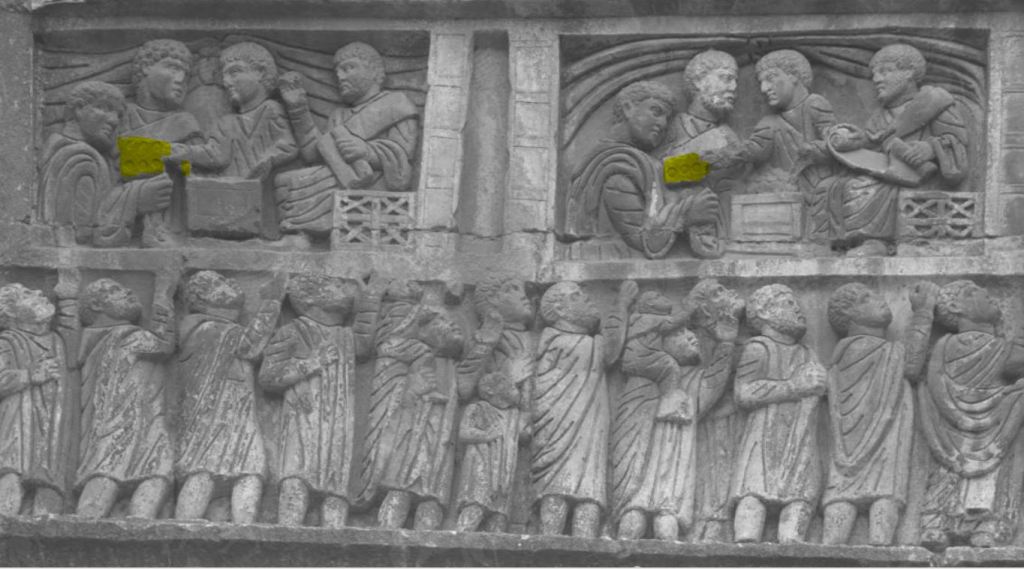
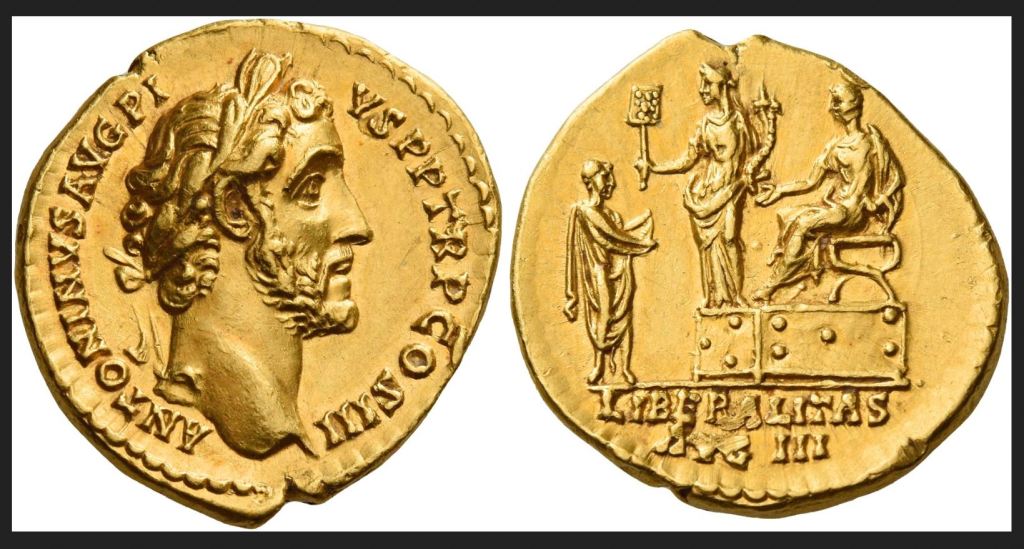
So the top rectangle in the rectangular snow man could be a one of these money scoops on top of a money box on top of a table.
This might make the basket one full of bread being distributed as part of largesse. I can find images of bread baskets, but none just this shape and no images of bread as part of ritual handouts for all we know it happened. The closest I can get is this synagogue mosaic:
:max_bytes(150000):strip_icc():format(webp)/RndBask-56aab1113df78cf772b46c9f.jpg)
Again just a little note of something I want to read. This article will be useful for those interested in Ptolemaic or Neronian Portraiture and more.

I’m looking for the text of another article by the same scholar, but saw this and am v curious. No time to read now but posting so I can come back to it.

Stuff I’ve learned from Twitter and archived here for future reference.
First we’ll credit “v ness” and her response to attacks of a talented graphic artist representing Roman poets with dark skin:

My meagre contribution prompted some scholarly refs I want to save (image I posted was photographed and posted by Gareth Harney):
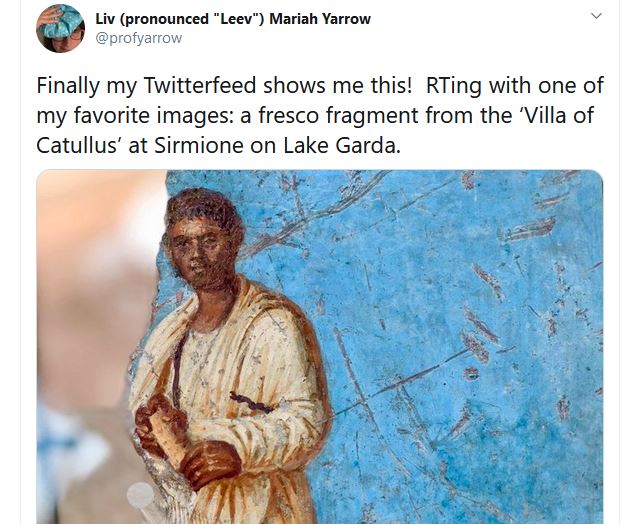
Armand D’ Angour quoted:
” I’m not too bothered, Caesar, to inspire your delight, Nor to determine whether, as a man, you’re black or white. Nil nimium studeo, Caesar, tibi velle placere, nec scire, utrum sis albus an ater homo.“
Catullus 93
While all agree that the b/w allusion here likely does not refer to skin but politics or sexuality, this led Rebecca Futo Kennedy to recommend the following readings:
Dee, James H. “Black Odysseus, White Caesar: When Did “White People” Become “White”?” The Classical Journal 99, no. 2 (2003): 157-67. Stable JStor Link. No paywall link from USC.

Haley, Shelley. “Be Not Afraid of the Dark: Critical Race Theory and Classical Studies,” in Laura Nasrallah and Elisabeth Schüssler Fiorenza (eds.), Prejudice and Christian Beginnings: Investigating Race, Gender and Ethnicity in Early Christian Studies, 4 Minneapolis, Minn.: Fortress Press, 2009: 27-50 No paywall PDF from Press.
Kennedy, Rebecca Futo. “Colorlines in Classical North Africa” Classics at the Intersections: Random thoughts of a Classicist on ancient Greek and Roman culture and contemporary America by Rebecca Futo Kennedy. 8 October 2017.
Also see:
Snowden, Frank M. “Misconceptions about African Blacks in the Ancient Mediterranean World: Specialists and Afrocentrists.” Arion: A Journal of Humanities and the Classics 4, no. 3 (1997): 28-50. Stable JStor Link.
More Black-Centered Resourced for Ancient Mediterranean Studies
Should another reading be listed here? Send it to me! I’d love to expand this post or link to other blogs/websites that collect these readings.


