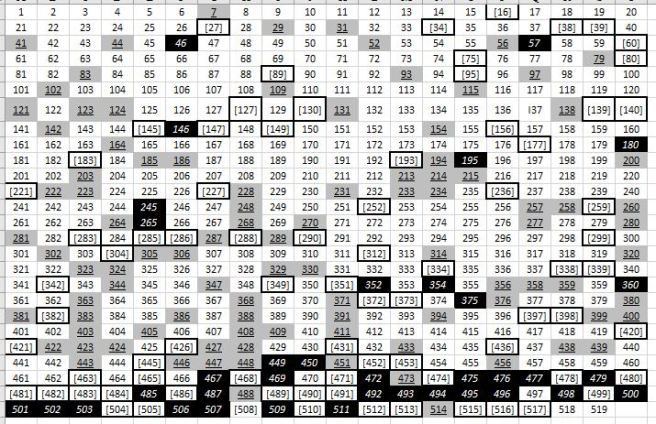
Here’s today’s puzzle. So I knew that RRDP (Schaefer) has better coverage than Buttrey on Crepusius, but what I’d not really appeciated until I started drawing tables of this article was how their combined observations might change the picture.
One of the things I’ve learned as I get older is that if I write as I think rather than try to think first then write, it is A) more fun, B) faster, C) I learn more. This is how the blog works it is my pre-writing/thinking/note holding space. I’m allowed to be silly here and not know everything as a I explore a problem. This version of the table is where I ended my work day on Friday about 6 pm when my beloved brought home tacos. It cost me two bowls of frozen strawberries as bribes to get my kiddos to let me finish it after 5pm — when “mama is supposed to be done working!!”. That means I’ve not really thought about what I’m seeing yet.
Plain white boxes and numbers = Dies seen in RRDP AND by Buttrey
Grey boxes with underlined number = dies seen in RRDP, BUT NOT by Buttrey
Outlined white boxes with numbers in brackets = presumed die numbers NOT seen in either RRDP or Buttrey.
(none of the above surprises me)
Black boxes with white numbers in italics = dies not seen in RRDP, but attested by Buttrey.
Why so many about 449?! Why so many period?! The grey seems nicely scattershot across the field in a plausibly random manner. The missing high numbers bother. And if you look at the last three lines, you’ll notice that very little about 463 is present at all in RRDP. WHY?!
My first hunch is that it might have to do with collections access, so I’m going to take a look at what sources Buttrey had that RRDP may not (yet) have integrated.
This is an active post further additions forthcoming…
So Buttrey built so much on Hersh that he didn’t feel it necessary to record collections. Here’s his statement and the end of his series.


Location of coins not in RRDP archives
(according to Hersh and Buttrey, links are to confirmed specimens)
146 – D-9002. Paris.
180 – Not in Hersh, BERLIN
195 – Oxford
245 – Hersh’s own collection (Now ANS, said to be from Mesagne Hoard)
265 – D-8813. Paris.
352 – Not in Hersh, COPENHAGEN (Buttrey lists as obv. uncertain)
354 – Gnecchi coll., Museo Nationale, Rome (Hersh lists as a ‘hybrid’)
360 – Enrico Leuthold (Milan) Priv. Coll. (Hersh lists as a ‘hybrid’ and ‘fourrée’)
375 – Gnecchi coll., Museo Nationale, Rome
449 – Duc de Luynes Coll., Bibliothèque Nationale, Paris.
This is one of the five RRC 361 coins from the Arbanats Hoard; Luynes 6238 to 6242 = REP-21861 to REP-21865. Thanks to Charles Parisot and the magic of twitter for bringing this to my attention.
450 – Not in Hersh, TURIN, Fava 367 – why not in RRDP, RRDP contains Fava….?
467 – Museum of Antiquities, Castello Carignano, Turin. Shouldn’t this have Fava no?!
469 – Gnecchi coll., Museo Nationale, Rome
472 –D-8774. Paris.
475 – [General Coll., Bibliothèque Nationale, Paris. 1270] AND D-8775. Paris.
Paris 1270 reads 477 to my eye, maybe 478?! (but not same as die as Paris 8968):
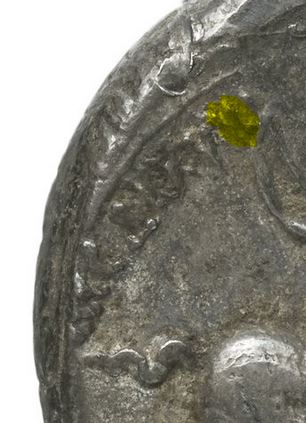
476 – Not in Hersh, ANS
477 – Vatican 2460 AND D-8968. Paris.
479 – Not in Hersh, Buttrey says in Hersh’s own collection (BM now)
485 – Vatican 2444
487 – Gnecchi coll., Museo Nationale, Rome
492 – Museo Nationale, Rome.
493 – Not in Hersh, D-8975 Paris. READING UNCERTAIN COMPARE DIES
494 – Oxford
495 – Not in Hersh, D-8976 Paris.
496 – Museo D’Arte, Castello Sforzesco, Milan. 1177.
498 – BM 2714
500 – Gnecchi coll., Museo Nationale, Rome
501 –D-8969.Paris. AND Vatican 2447.
502 – Not in Hersh, Buttrey says in Hersh’s own collection (now in BM)
503 –D-8970. Paris.
506 – BM 2715.
507 – Not in Hersh, ANS
509 – Not in Hersh, D-8937. Paris. Buttrey says misread by Hersh as X 508. Ambiguous check against 508 die!
511 – D – 8972. Paris.







 Liv Mariah Yarrow