
This post started as just a running list of bibliography I wanted to return to. That material is at the end of the post.
Bowes, Kim. “Tracking liquid savings at Pompeii: the coin hoard data.” Journal of Roman Archaeology 35, no. 1 (2022): 194-220.
p.199:

P. 200

P. 201
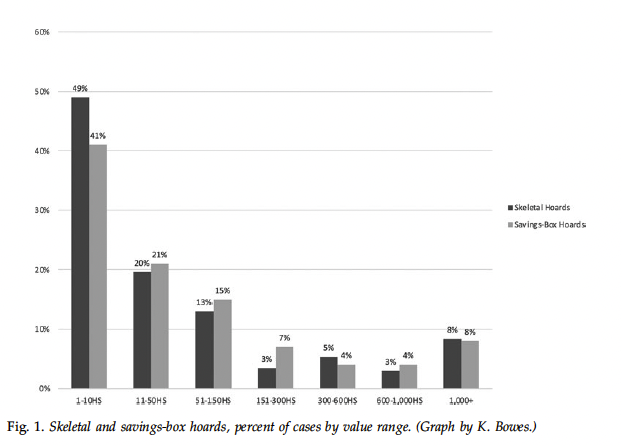
P.202 (I would have liked these as box and whiskers to see shape of data or at least know median)
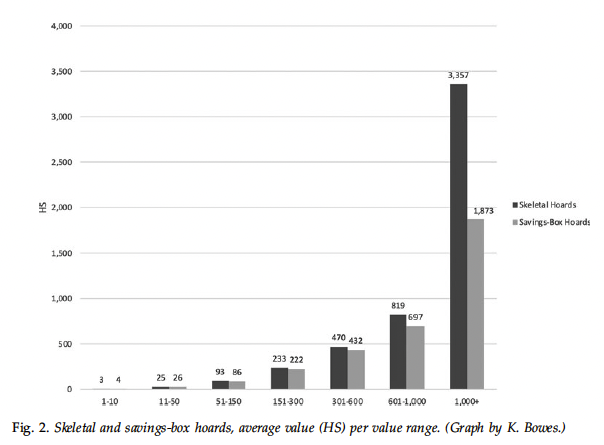
P. 204
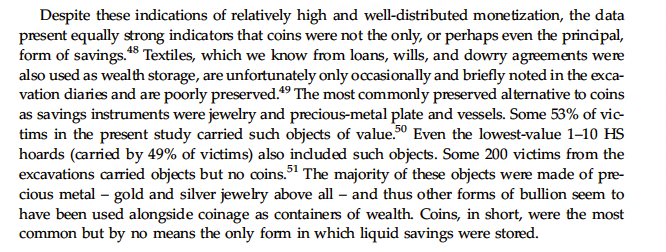
P. 205
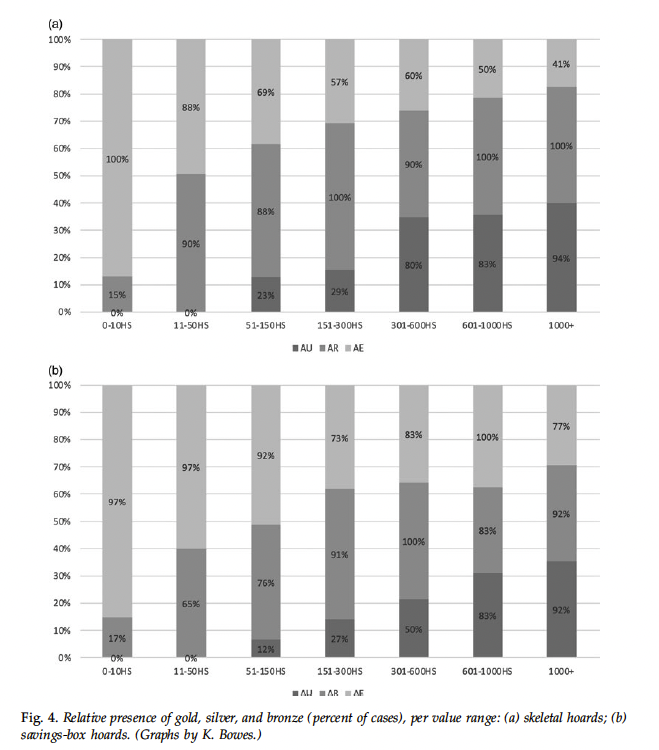
P. 211 – good discussion of costs for sustenance and housing, cf. Bernard 2026 for similar data. The continues on 212 with more prices and notes than if we relied on literary sources alone.
P. 213 –
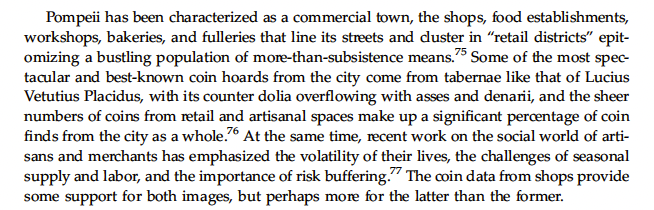
P. 214

P. 215-216
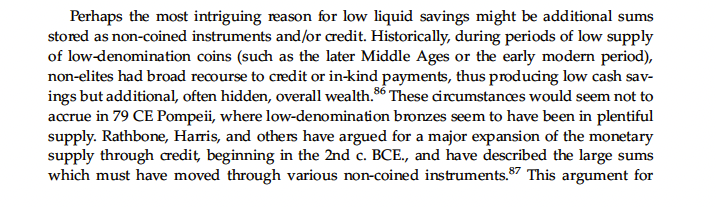
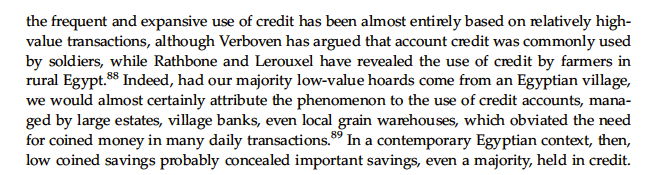
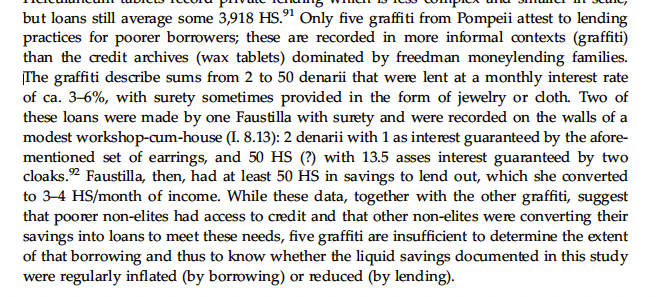
Cf. Verboven, Koenraad. “Currency and Credit in the Bay of Naples in the First Century AD.” The Economy of Pompeii (2017): 363-386. [on file] From Flohr, Miko, and Andrew Wilson, eds. The economy of Pompeii. Oxford University Press, 2017. [acquire?]
Cf. Andreau, Jean. “The use and survival of coins and of gold and silver in the Vesuvian cities.” The monetary systems of the Greeks and Romans (2008): 208-225.
Cf. Duncan-Jones, Richard P. Roman coin circulation and the cities of Vesuvius. na, 2003. in Lo Cascio, Elio. “Credito e moneta nel mondo romano.” In Credito e moneta nel mondo romano. Edipuglia, 2003. [physical book]
Silver, Morris. “Finding the Roman Empire’s disappeared deposit bankers.” Historia: Zeitschrift für Alte Geschichte (2011): 301-327.
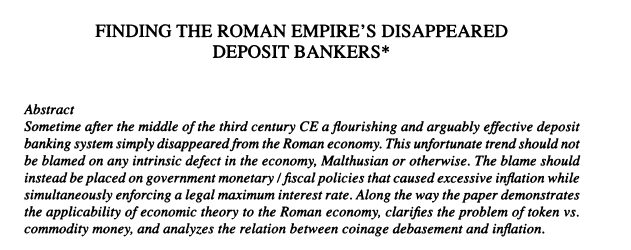
Super interesting and challenges von Reden 2002. Treasure trove of citations esp around credit-earning deposits going back to Republic.
Discusses interest rates. Still anecdotal and focused on empire.
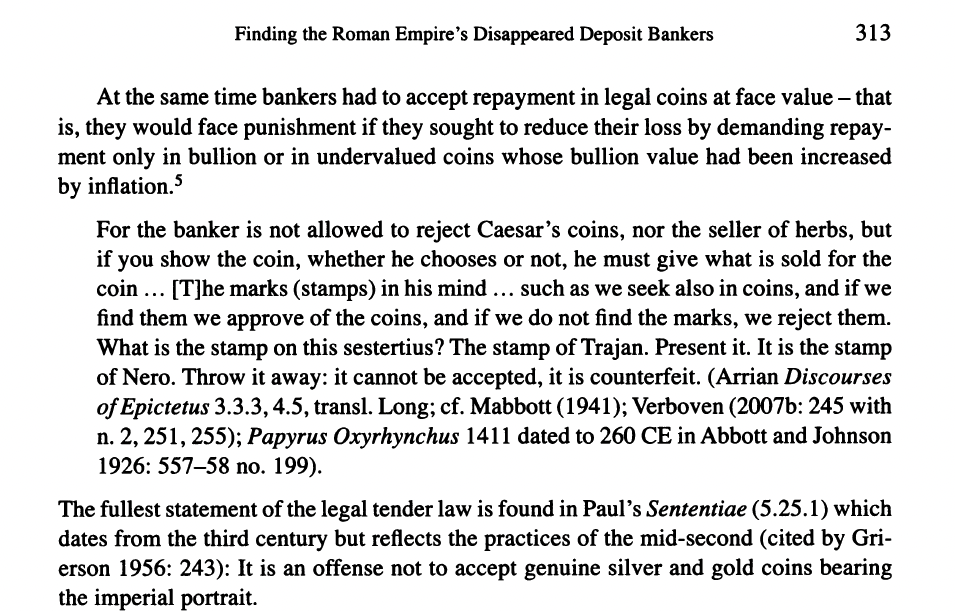
This piece of Arrian is priceless.
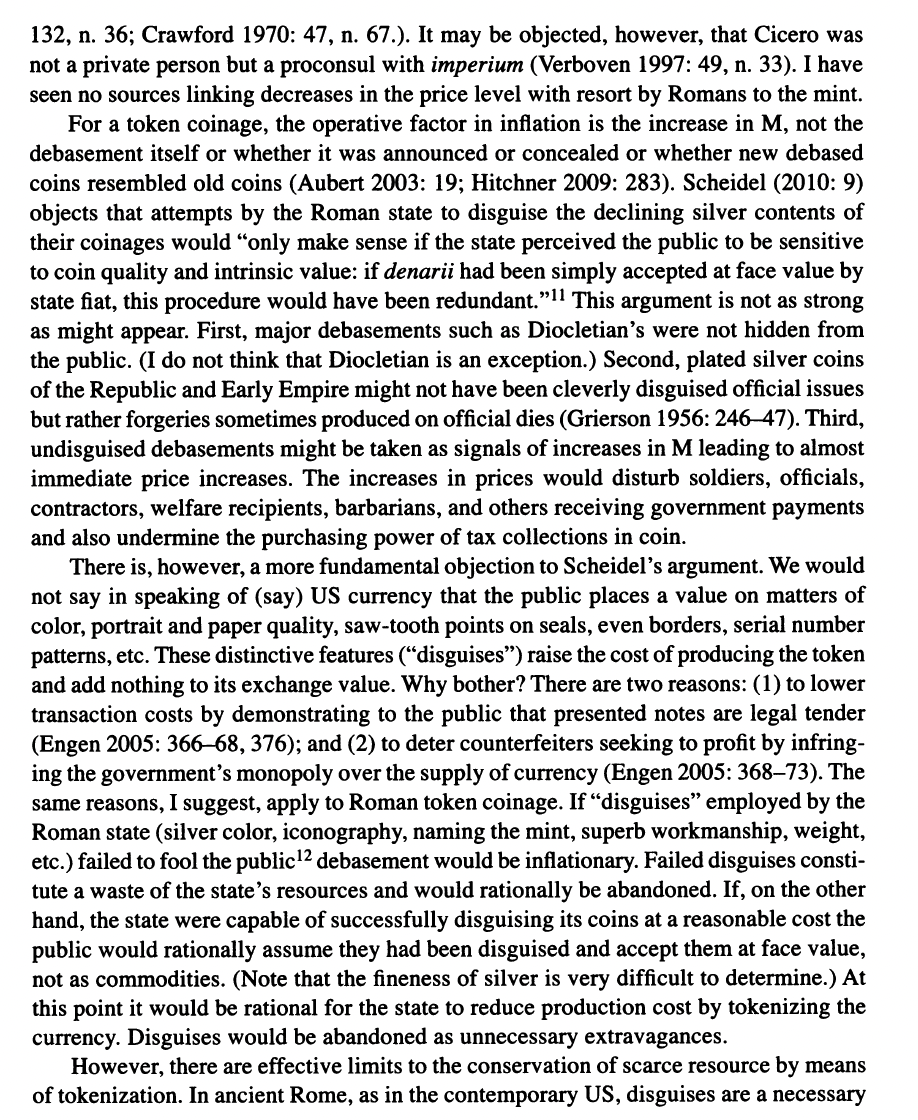
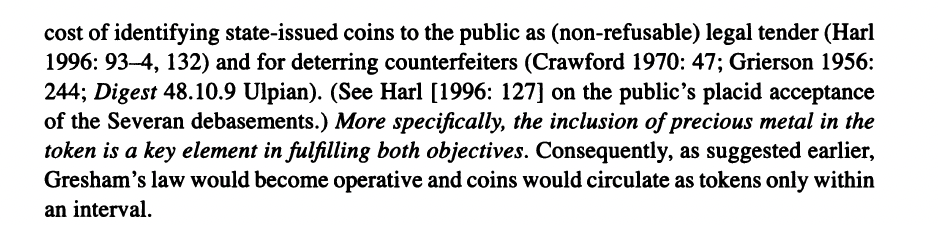
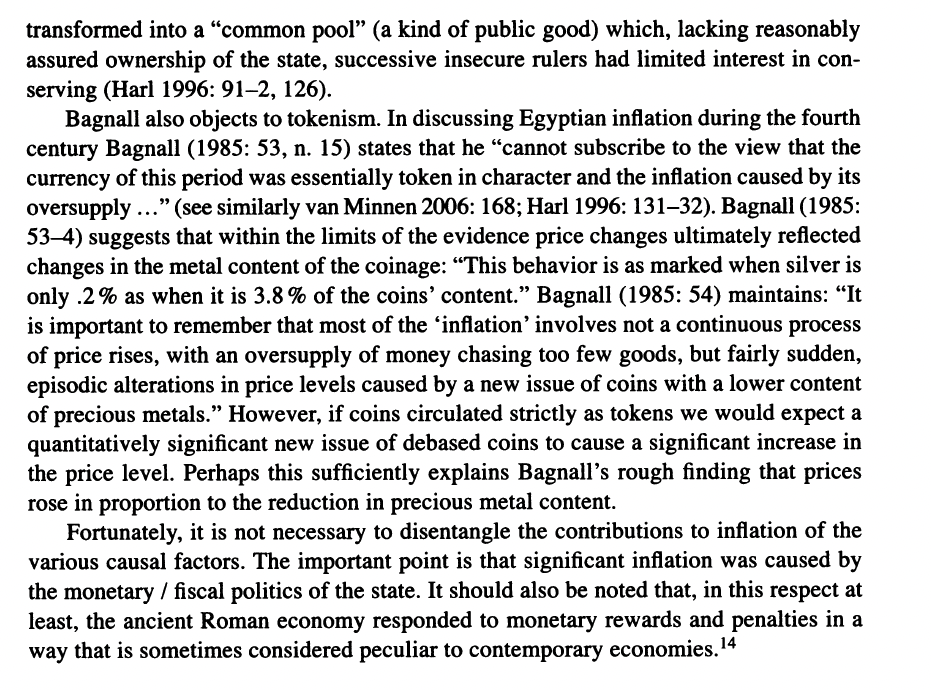
The article ends with the author’s view that by 3rd century CE vast majority of Roman economy is token while acknowledging detractors to this view. Accepts however QMT as fact (see earlier post).
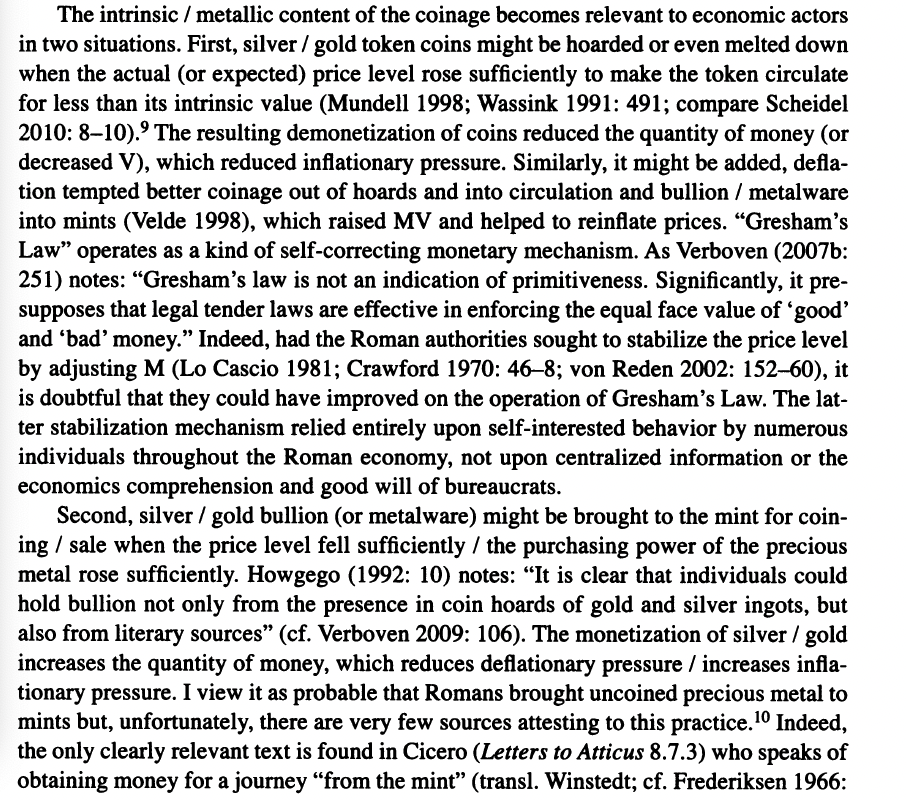
See on Cicero passage: Money from Moneta
Frangipane, Marcella, Monika Poettinger, and Bertram Schefold. Ancient Economies in Comparative Perspective. Springer, 2022.
May interesting essays in this volume: PDF on file:
Gabrielli, Chantal. “Debt and Usury: Economic and Financial Questions in the Roman Republic (Fifth–First Century BC).” In Ancient Economies in Comparative Perspective: Material Life, Institutions and Economic Thought, pp. 325-341. Cham: Springer International Publishing, 2022.
V high level overview. Smart but not terribly useful to me at the moment besides leading me to the reference I really really needed: Ioannatou, M. (2006). Affaires d’argent dans la correpondence de Cicéron. L’aristocratie sénatoriale face à ses dettes. Paris: De Boccard. [ILL ordered whole book, could not buy in time, so will scan private copy.]
Ialongo, Nicola. “Weight-based trade and the formation of a global network: material correlates of market exchange in pre-literate Bronze Age Europe (c. 2300–800 BC).” In Ancient Economies in Comparative Perspective: Material Life, Institutions and Economic Thought, pp. 207-232. Cham: Springer International Publishing, 2022.
Merola, Francesca Reduzzi. “Slaves Sales in the Roman Empire and Perspectives of Comparison.” In Ancient Economies in Comparative Perspective: Material Life, Institutions and Economic Thought, pp. 361-371. Cham: Springer International Publishing, 2022.
Verhagen Hendrik L.E., Security and Credit in Roman Law. The historical evolution of pignus and hypotheca. Oxford University Press, Oxford 2022. XII, 434 S., ISBN 978-0-19-969583-6
R. Svensson (ed.), Economic Perspectives on Monetary History. Stockholm: The Swedish Numismatic Society 2026. I’ll dive in at another point for all I’m irrationally hostile to the AI generated book cover the images and narrative seem sensible enough. [open access]
Morcillo, Marta García, and Cristina Rosillo-López, eds. The real estate market in the Roman world. Taylor & Francis, 2023.
Esp. Andreau, Jean. “The Real Estate Market in the Campanian Wax-Tablets.” in this volume
Andreau, Jean. “Capital and investment in the Campanian tablets.” Capital, Investment, and Innovation in the Roman World (2020): 417-35.
Bernard, Seth. “Slavery, prosperity, and inequality in Roman Pompeii.” Past & Present 272, no. 1 (2026): 3-50. On file!


