This post was written mostly in early August and then saved to drafts. I reviewed it today and decided I was going to post it as I have no intent on expanding the materials any time soon.
EDR166343 = EDCS-20402573 (Loeb Translation). From Forum Novum now in Parma, Museo Archeologico Nazionale, sala dei centri minori dell’Agro parmense, inv. nr. L. 181
(ii) [frau]de lucrum quaesivit su[um] [.. . . . p]rotendit turbam [m]agnam [fu]giesque eam semp[er].
(ii) He got his profit by fraud. . . . it holds out mighty turmoil. . . . and you shall always escape from it.
130 a.C. / 31 a.C. (palaeographia; lingua)
EDCS-20000227, Rome (Esquiline?) 100-93 BCE
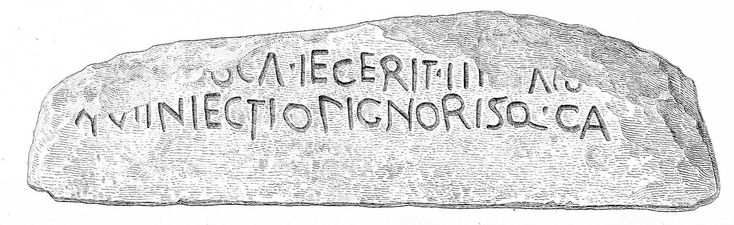
[in ea] loca iecerit in[3 uti HS 3] / [ma]nus iniectio pignorisq(ue) capi[o siet]
… uncertain places, against him there shall be, for a fine of . . . sesterces, laying of hands upon him and taking of a pledge. [Loeb trans.]
senatus consultum de Bacchanalibus of 186 BCE
Sacerdos nequis vir eset; magister neque vir neque mulier quisquam eset; | neve pecuniam quisquam eorum comoine[m h]abuise ve[l]et;
…No man is to be a priest; no one, either man or woman, is to be an officer (to manage the temporal affairs of the organization); nor is anyone of them to have charge of a common treasury… [Wiki trans.]
an arbitration agreement of 117 BCE from near Genoa
pro eo agro vectigal Langenses / Veituris in poplicum Genuam dent in an(n)os singulos vic(toriatos) n(ummos) CCCC sei Langenses eam pequniam non dabunt neque satis / facient arbitratuu Genuatium quod per Genuenses mo[r]a non fiat suo setius eam pequniam acipiant tum quod in eo agro / natum erit frumenti partem vicensumam vini partem sextam Langenses in poplicum Genuam dare debento / in annos singolos quei intra eos fineis agrum posedet Genuas aut Viturius
For the said land the Langensian Veturii shall pay into the public treasury at Genua every year 400 coins of the victoriatus type. If the Langenses fail to pay the said money and do not give satisfaction according to the will and pleasure of the Genuans (on such condition that it is not through the fault of the Genuans that any delay hinders them from receiving the money)—in this case the Langenses shall be required to pay into the public [treasury] at Genua every year one twentieth part of the grain and one sixth part of the wine which shall have been produced on the said land. [Loeb trans modified]
Vectigal anni primi K. Ianuaris secundis Veturis Langenses in poplicum Genuam dare | debento. Quod ante K. Ianuar. primas Langenses fructi sunt eruntque, vectigal invitei dare nei debento.
The Langensian Veturii are required to pay into the public [treasury] at Genua a first year’s rent on the first day of January next but one. For such land as the Langenses have enjoyed and shall enjoy before and up to the first day of January next they are not required to pay against their will. [Loeb translation]
EDCS-20200006 – Lex Acilia, c. 121-113 BCE
queive filius eorum quoius erit quoius pater senator siet in annos singolos pe<c=Q>uniae quod siet amp[lius HS n(ummos) 3] [pro inperio prove potestate ipsei regive populove ipsius parentive ipsius queive in potestate manu mancipio suo parentisve sui siet fuerit quo]ive ips[e] paren[s]ve suos filiusve suos heres siet ablatum captum coactum conciliatum aversumve siet de ea re eius petitio nominisque delatio esto [pr(aetoris) quaestio esto ioudicium ioudicatio leitisque aestumatio queiquomque] [ioudicium ex h(ace) l(ege) erunt eorum hace lege esto 3 sei quis deicet praetorem nomen ex h(ace) l(ege) ita non recepisse utei delatum esset neque ioudicium ex h(ace) l(ege) ita datu]m esse utei peteret de ea re eius petit[i]o nominisque delatio esto pr(aetoris) quaestio esto ioudicium ioudicatio leitisque aestumatio quei quomque ioudic[ium ex h(ace) l(ege) erunt eorum hace lege esto 3]
[Long list of elected officials…] or any person who or whose father is a senator, for a sum of more than . . . sesterces in money for any particular year . . . such sum having been, in the exercise of official rule or rightful authority, carried off, seized, exacted, embezzled, or misappropriated from the person himself or his king or his people or his parent, or from whoever may be or shall be bound to him or his parent in authority, possession, or formal ownership, or from any person to whom he or his parent or son stands as heir—in such a case the said person shall have the rightful power to sue or summon; the inquiry shall be undertaken by a praetor; and the trial, judgment and assessment of damages shall by this law be undertaken by those persons whosoever by this law shall form the court. . . .
… De nomine deferundo iudicibusque legundeis. Quei ex h. l. pequniam ab …
Any person who by this law shall sue an opposing party for a sum of money
. | . q]uei pequniam ex [h. l.] capiet, eum ob eam rem, quod pequniam ex h. l. ceper[it, nei . . . neive tribu mo]veto, neive equom adimito, neive quid ei ob eam rem fraudei esto.
In the event of any person taking money under this law, a censor shall not, on account of such act in taking money under this law . . . or remove him from his tribe, or take away his horse, nor shall any disadvantage occur to him on account of such act.
. | . Ad quem praetorem ita relatum erit iudicum plus tertiam partem negare iu]dicare, is HS. n. [special character], quotiens quomque amplius bis in uno iu[dicio iudicare negarint . . . singulis quei iudicare negarint multam dicito. Tu]m quam ob rem et quantum pequ[niae dixerit, publice proscribito
. . . The praetor to whom it shall be reported that more than one third part of the jurors refuse to give a verdict, the said praetor shall inflict a fine of 10,000 sesterces in money on each separate juror who shall have refused to give a verdict as often as they so refuse more than twice in one trial. Then he shall cause a written public notice to be made giving the reason and the amount of the fine he has announced.
[De praedibus dandis bonisve possidendis. Iudex, quei eam rem quaesierit, earum rer]um, quei ex h. l. condemnatus erit, q. praedes facito det de consili maioris partis sententia, quantei eis censuer[int; sei ita p]raedes datei non erunt, bona eius facito puplice possideantur conq[uaerantur veneant. Quantae pequniae ea bona venierint, tantam pequniam iudex, quei eam rem quaesierit, ab emptore exigito . . | . quaestorique eam pequniam et quanta fuerit] scriptum transdito; quaestor accipito et in taboleis pobliceis scriptum habeto.
The judge who shall have held the said inquiry shall, in regard to such matters, cause the person who shall have been convicted under this law to give a quaestor sureties according to the vote of the majority of the jury and of the amount which shall have been assessed by them. Should sureties not have been so given he shall cause the goods of the said person to be taken into possession by the State, procured, and sold. As regards the amount of money at which the said goods shall have been sold the judge who shall have held the said inquiry shall exact the amount from the buyer . . . and shall hand over the said money, with a statement of the amount in writing, to the quaestor; the quaestor shall receive it and preserve the written statement among the public records.
- Damages assessed at double the value of what was taken by the convicted person
- Disputed funds may have been deposited in the aerarium and must be paid out without any dispute within 3 days
- With multiple claimants the judge determines who gets what
- Money not paid out for a no show claimant is deposited in the aerarium for five years, then forfeit to the state
fiet, nepotesque [t]um eiei filio gnateis ceiveis Romanei iustei sunto [et in quam tribum, quoius is nomen ex h. l. detolerit, sufragium tulerit, in eam tribum sufragiu]m ferunto inque eam tribum censento, militiaeque eis vocatio esto, aera stipendiaque o[mnia eis merita sunto. Neiqui magistratus prove magistratu . . . eius h. l.] | nihilum rogato.
then born to such son, be full Roman citizens; and in whatever tribe the party whom he shall have summoned under this law shall have voted, in that tribe shall the said persons vote and in that tribe shall they be rated by the ’censors; and the said persons shall have exemption from military service, and all moneys and pay earnable by the same therein shall be regarded as earned. It is not intended by this law that any magistrate or pro-magistrate shall not . . .
EDCS-25900656, 105 BCE, Puetoli
Lex parieti faciendo in area quae est ante I aedem Serapi trans viam. Qui redemerit | praedes dato praediaque subsignato | duumvirum arbitratu.
Contract for making a wall in the vacant building-space which lies in front of the temple of Serapis across the road. The contractor shall provide bondsmen and register their estates as securities at the will and pleasure of the members of the Board of Two.
Dies operis: K. 55Novembr. primeis. Dies pequn.: | pars dimidia dabitur ubei praedia satis | subsignata erunt; altera pars dimidia solvetur | opere effecto probatoque. C. Blossius Q. f. | 𐆘 ∞ Đ, idem praes. Q. Fundus Q. f. | Cn. Tetteius Q. f. C. Granius C. f. Ti. Crassicius.
Day for beginning the work: the first day of November next. Day of payment: one half of the sum shall be handed over when the estates have been registered to satisfaction as securities; the other half shall be paid off when the work is completed and approved. Gaius Blossius son of Quintus; he contracts for 1500 sesterces; is likewise surety.
Earlier post on the verb probare. The language of estates as surety is pretty standard, cf. EDCS-44100001.
EDCS-26200338: Lex Bantia, c. 130-70 BCE (disputed)
[sciens d(olo) m(alo) HS 3 n(ummum) populo dare damnas esto et] eam pequniam quei volet magistratus exsigito … sei condemnatus [erit quanti condemnatus erit praedes] ad q(uaestorem) urb(anum) det aut bona eius poplice possideabtur facito sei quis mag(istratus) multam inrogare volet [quei volet dum minores] partus familias taxsat liceto eiq(ue) omnium rerum siremps lexs esto quasei sei is haace lege [pequniam quae s(upra) s(cripta) e(st) exigeret]
… let him be condemned to a fine to a fine to the people of . . . sesterces in money; and let any magistrate who shall be so minded exact that sum. … If he shall have been condemned to pay, he must present bondsmen before a quaestor of the city for the amount in which he shall have been condemned, or in default let the praetor cause his goods to be publicly confiscated. If any magistrate shall be minded to inflict a greater fine, let it be allowed him who shall be so minded, provided only that the same comes to less than a half part of the defendant’s estate; and let the law hold good for the said magistrate in all respects just as if he had exacted, under this law, the sum above set forth.
Sulla’s law of 81 BCE on the 20 quaestors from the temple of Saturn
q(uaestorem) urb(anum) quei aerarium provinciam optinebit eam mercedem deferto quaestorque quei aerarium provinciam optinebit eam pequniam ei scribae scribeisque heredive eius solvito idque ei sine fraude sua facere liceto quod sine malo pequlatuu fiat olleisque hominibus eam pequniam capere liceto
the amount of said payment the magistrate shall report to a quaestor of the city who shall have the treasury as his province, and such quaestor who shall have the treasury as his province shall pay the said money to the said scribe (or scribes) or to an heir and he shall be permitted to do so without risk of personal penalty, in so far as it is done without fraudulent embezzlement, and the aforesaid persons shall be allowed to take the money. [Loeb trans. modified]
…
viatores praecones quei ex hac lege lectei sublectei erunt eis viatoribus praeconibus magistratus prove mag(istratu) mercedis item tantundem dato quantum ei viator(ei) praeconei darei oporteret sei is viator de tribus viatoribus isque praeco de tribus praeconibus esset quei ante hanc legem rogaram utei legerentur institutei sunt
A magistrate or a person acting as a magistrate shall pay, to the messengers and heralds who shall be chosen or substituted by this law, just so much by way of payment as would be required to be paid to a messenger or a herald if such messenger or herald were chosen from the detachment of three messengers or three heralds respectively who were appointed to be chosen before the passing of this bill into law.
Value conveyed without Vocabulary?!
Rome, 88 BCE
Cn. Pompeius Sex. f. imperator virtutis caussa turmam Salluitanam donavit in castreis apud Asculum cornuculo et patella, torque, armilla, palereis et frumentum duplex.
Gnaeus Pompeius, commander-in-chief, son of Sextus, in camp at Asculum, for valour presented the Salluitan squadron with the helmet-horn, a plate, a necklace, a bracelet, breast-pieces, and a double ration of grain. [Loeb trans modified]
Pompeian Graffiti