
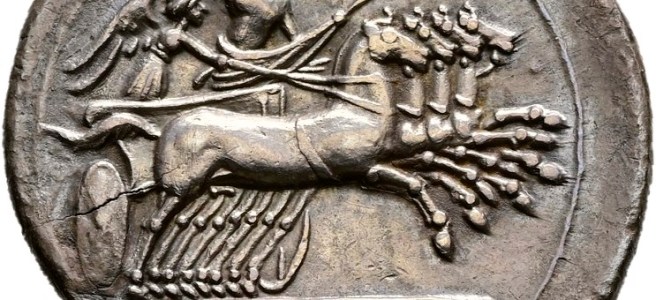
If I had my book to do over again, I could do better with the Hannibalic War, the mid war monetary reforms before and after. A colleague asked me to read a few chapters of book manuscript for input. I enjoyed them a great deal, but realized I did not want to trust his view of the recent scholarship without better reviewing it myself and formulating an independent opinion.
I’m starting my re-education here.
Albarède, Francis, Janne Blichert-Toft, M. Rivoal, and P. Telouk. “A glimpse into the Roman finances of the Second Punic War through silver isotopes.” Geochemical Perspectives Letters 2, no. 2 (2016): 127-37.
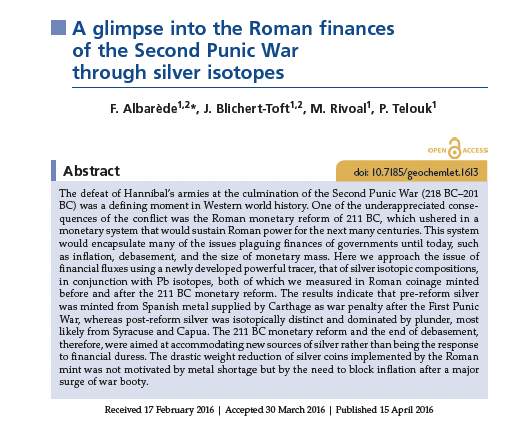
The science is good. Are the historical conclusions? The model of events they propose does not account for debasement. Or the apparent shift in the apparent unit of account, from one system for silver and one for bronze.
While many museum coins are not better sourced, I’d be more confident in the results of this study if the coins came from archaeological finds with clear record of deposition. This practice below is completely out of line with the guidance of the AIA and could not have been published in one of their journals. It makes me wonder about how we should treat citing such work and if the AIA has guidance on that.

A key issue with buying coins to test is that we cannot assume these are even a random sample. The dealers did not disclose the source of the material and there is a possibility that similar coins sold together were acquired from the same findspot/hoard. The continuity that has been found could potentially reflect coins struck at the same time in the same place and a single batch of metal supplied to that mint at that time.
I really appreciate this very complete display of their data.
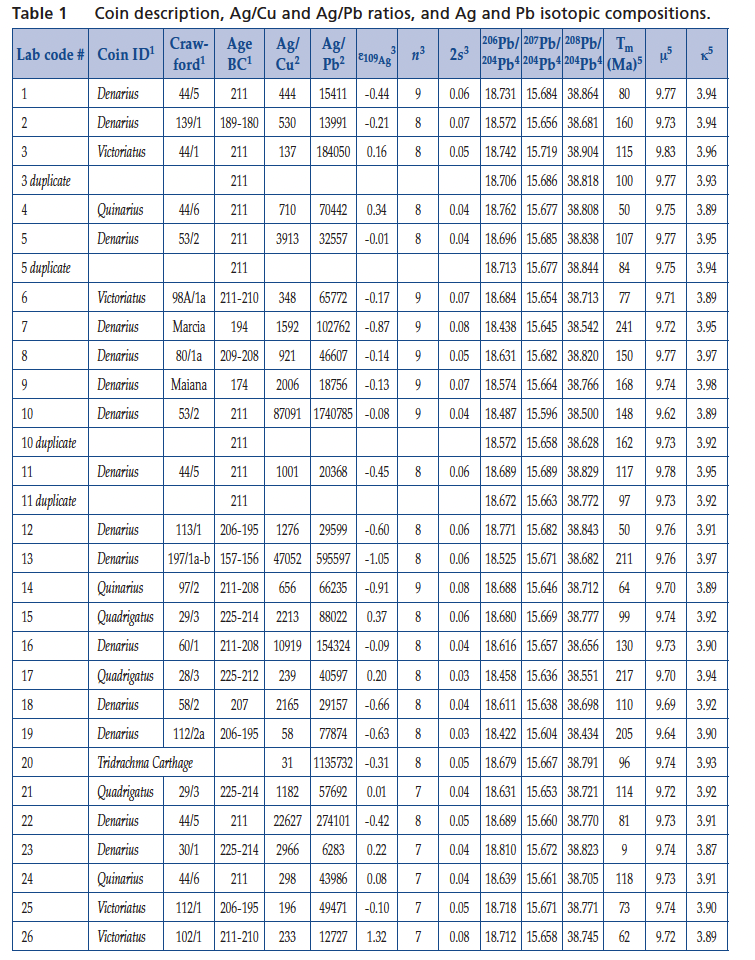
Only three quadrigati were tested. These are all from the early series, those which show fewer signs of debasement. To validate the historical conclusions put forward by this study and implied by their primary graph, I would want to ensure we also tested later quadrigati, RRC 30/1, 31/1, 32/1, 33/1, 34/1, and especially 42/1. I want to go back to the work of Holstein from 2000 to see their results on similar material; it is a real shame that Butcher and Ponting did not evaluate material this early. I wonder if I’ll find stuff from the Orleans team already published or in the works. As I said I’ve not been following Hannibalic era questions and now feel I need to get up to speed.
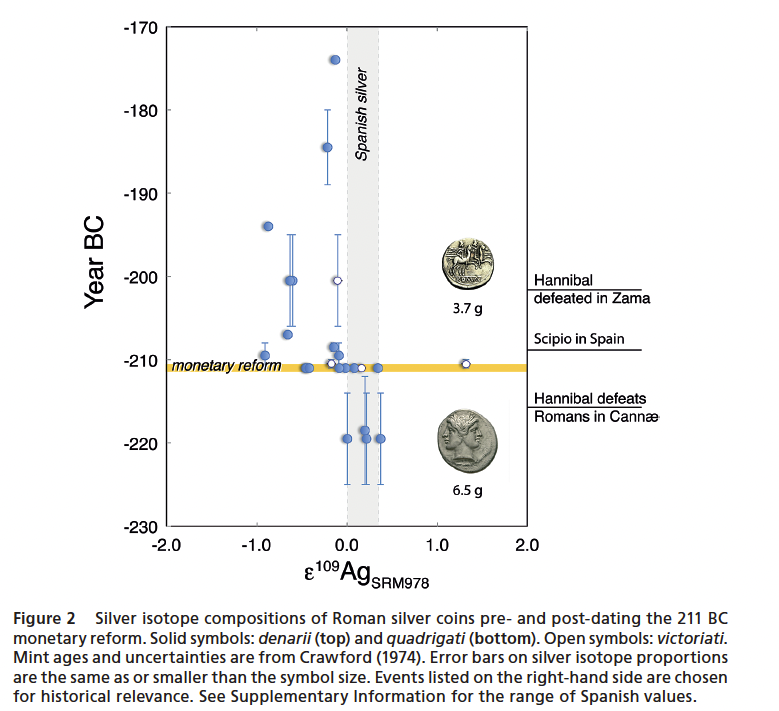
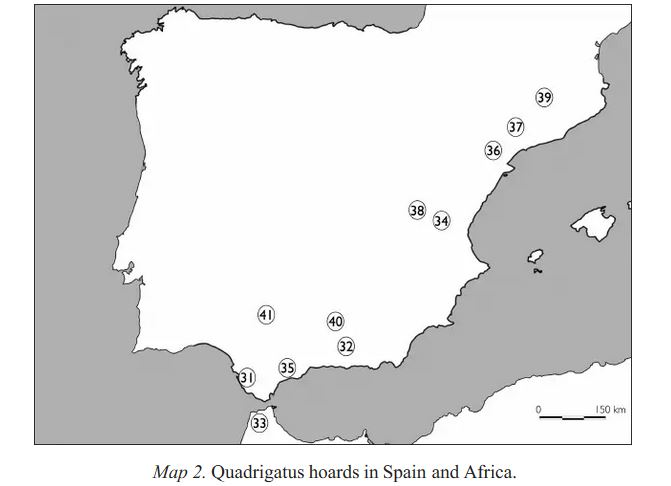
All this said this helps support the pattern of the hoards that suggests a connection between the Quadrigati and Spain and that they represent a monetary innovation.
My desire to not engage in these questions is something of an intellectual shortcoming. It feels like taking my medicine rather than the normal joy of working with the data. Maybe I’ll come round to it.
The things that feel revolutionary:
- This is the first issue by the Romans large enough to represent significant military payment, far exceeding early silver and even bronze production.
- Fitting all the quadrigati between 219/218 and 212/211 makes these issues far larger in terms of economic impact and certainly explains why they are found hoarded alone and in large numbers.
As we’ll see below I remain hesitant to endorse this down dating. Did the Romans know from the moment they decided to send troops to Iberia that they would be paying troops in a new way?
Lets run a thought experiment.
Saguntum is under siege by Hannibal. Saguntum is south of Ebro and thus not really in Roman sphere of influence based on their existing treaties, but a separate Roman ally from when or how not clear. There was direct communication between Saguntum and Rome.
But the Saguntines sent repeated messages to Rome, as on the one hand they were alarmed for their own safety and foresaw what was coming, and at the same time they wished to keep the Romans informed how well things went with the Carthaginians in Spain. The Romans, who had more than once paid little attention to them, sent on this occasion legates to report on the situation.
Polybius 3.15.1-2
It is so weird to be reading this stuff and thinking about it. I’m transported back to my earliest tutorials with Peter Derow. I feel a rush of familiarity, excitement, and imposter syndrome. I know some of you don’t appreciate my inner narrative intruding on my scholarly posts but they work for me, allowing the work to continue through the noise.
[Hannibal] arrived with his forces to winter at New Carthage, which was in a way the chief ornament and capital of the Carthaginian empire in Spain. Here he found the Roman legates, to whom he gave audience and listened to their present communication.The Romans protested against his attacking Saguntum, which they said was under their protection, or crossing the Ebro, contrary to the treaty engagements entered into in Hasdrubal’s time.
Polybius 3.15.3-5
The Saguntines could have sent bullion payment directly to Rome with these messages to pay Rome to pay attention. Or, the legates who visited Hannibal in winter quarters could have picked up bullion from Saguntum or other sources and transported it back Rome to aid in preparations for War after they realized diplomacy had failed. Saguntum was a wealthy city and Polybius believed Hannibal was motivated by the plunder that would be possible.
Besides, Hannibal would then have abundant funds and supplies for his projected expedition, he would raise the spirit of his troops by the booty distributed among them and would conciliate the Carthaginians at home by the spoils he would send them
Polybius 3.17.7
A great booty of money, slaves, and property fell into his hands. The money, as he had determined, he set aside for his own purposes, the slaves he distributed among his men according to rank, and the miscellaneous property he sent off at once to Carthage.
Polybius 3.17.10
Polybius also believed that the Roman senate felt that the war in Spain would require special new preparations
[The Senate] foresaw that the war would be serious and long and the scene of it far away from home
Polybius 3.16.1
Polybius flat out denies there was any debate about the necessity for War and assumes it would already have been declared. He does this through his invective against earlier historians who published speeches.
Livy’s account is very different in tone and more detailed, perhaps following a different source. I’m sure there are dozens of commentaries on this portion of Livy.
I love Livy and yet again my resistance to the Hannibal war has been strong. Those commentaries are not on my well stocked bookshelves… yet.
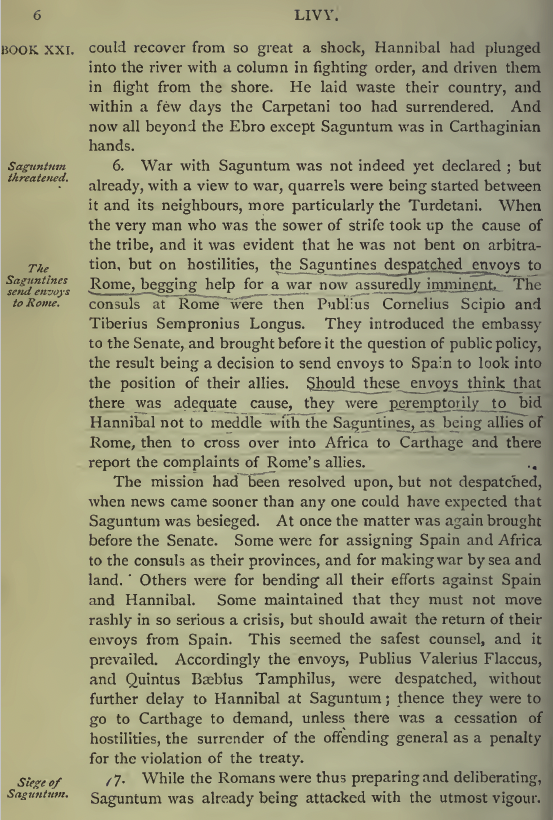
Notice he gives the full names of the Envoys. The Whole account makes Rome look less neglectful. But I’m inclined to believe that those envoys knew War was coming and brought resources back to make it more feasible. Funding war with coinage was a whole new thing for the Romans, this took time and extra preparations both Polybius and Livy emphasize. Notice also below that Livy also emphasizes the material wealth of Saguntum.
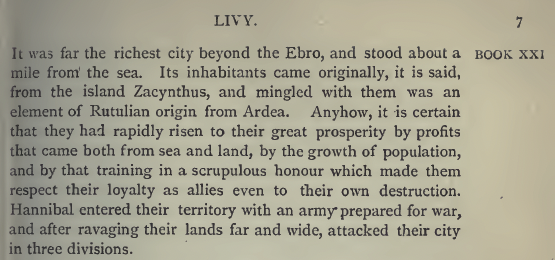
IF at least some of the Quadrigati were dependent on new Spanish Silver and a reason to strike in volume then Sanguntum looks a pretty good guess. The coin need not have been used exclusively for Roman troops, but may have been spent partly as a means of motivating local Iberian populations to ally with Rome against Hannibal
Ok. Next Article.
Westner, Katrin Julia, Thomas Birch, Fleur Kemmers, Sabine Klein, Heidi E. Höfer, and H‐M. Seitz. “Rome’s rise to power. Geochemical analysis of silver coinage from the Western Mediterranean (fourth to second centuries BCE).” Archaeometry 62, no. 3 (2020): 577-592.
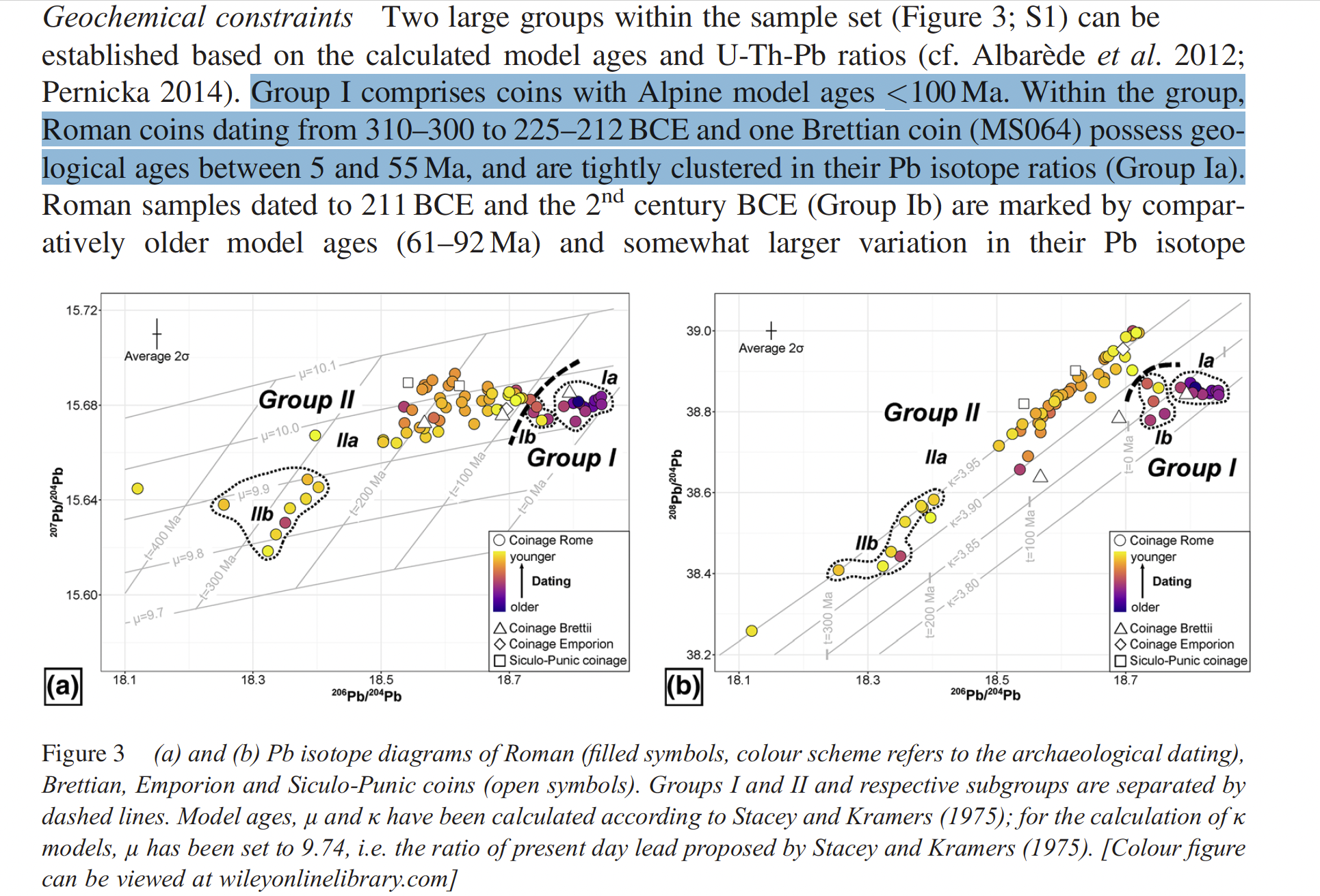
A much bigger over all study. 70 coins total. And the drilling allows results without influence of any surface enrichment. But of these 70 only four were quadrigati, RRC 28/3 (x3) and RRC 30/1 (x1). The four quadrigati they tested show just the opposite of what Abelarde et al found. The ones they tested fit better with the silver of earlier Roman and Brettian coinage.
Their coins were sourced from a range of museum collections.

This probably provided better randomization but the coins still do not have associated find spots. I also find it frustrating that on the visuals I cannot know exactly which coin corresponds with each dot. Notice the two light purple dots hanging out with Groups IIa and IIb above. These seem interesting outliers.
I really appreciate the attempt to put their data into dialogue with previous studies and finding through data visualization
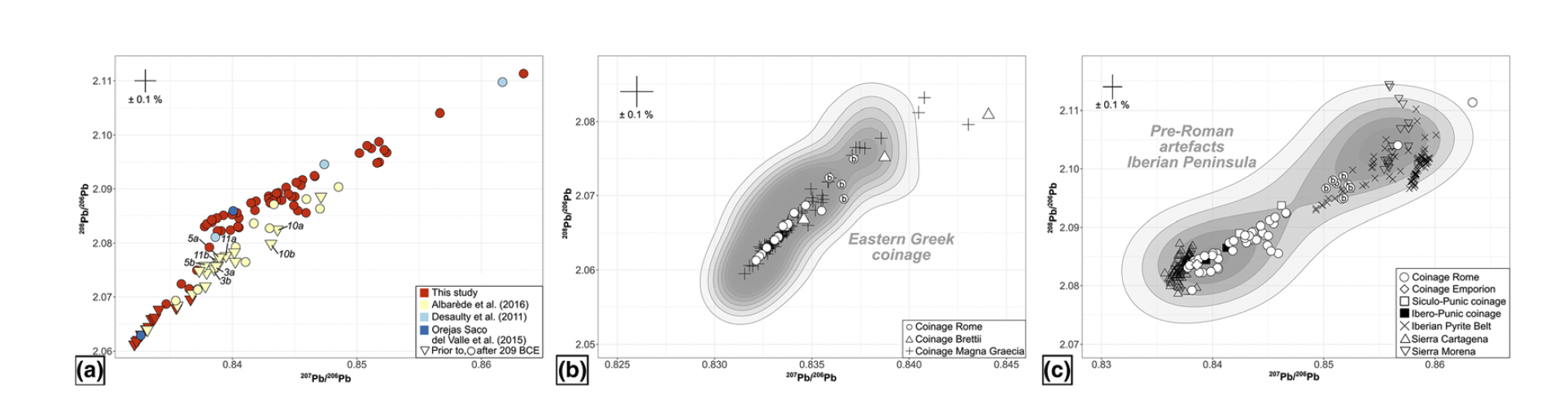
They see 209 as the critical date though so that is what the distinguish when comparing their data to Albarède et al. (Left graph). I’d really like to be able to pick out which coins are the victoriati in both studies. I guess I could write Fleur. She’s always so generous. But I should check if there is supplemental data on the journal’s site first. The middle graph shows how closely Group Ia coins (212 or before) map onto coins from Magna Graecia and other Eastern Greek coins. This includes the Victoriati. The far right graph shows that post 209 coinage clusters near silver associated with the Sierra Cartagena as we would expect.
How to reconcile and explain such different findings. I think the science is good in both studies and that discontinuity likely arises from small non random nature of the samples. What we need is a Quadrigati focused analysis with more specimens and ideally ones from known find spots. While it is plausible Spanish Silver funded some of the start of the war based on Albarède et al.’s results the Westner results show this cannot have been the only source of silver for the Quadrigati.
One more article:
Chico, David Martínez. “El origen del metal en un cuadrigato hispano (ca. 215-214 aC).” Cuadernos de Prehistoria y Arqueología de la Universidad Autónoma de Madrid 51, no. 2 (2025): 233-252.
The following article tests a single coin. The benefit though is that this coin was likely found in Spain ahead of its enter into the Museo de Prehistoria de Valencia (núm. de inv. 58756 = MIB 181002). It shows significant debasement.
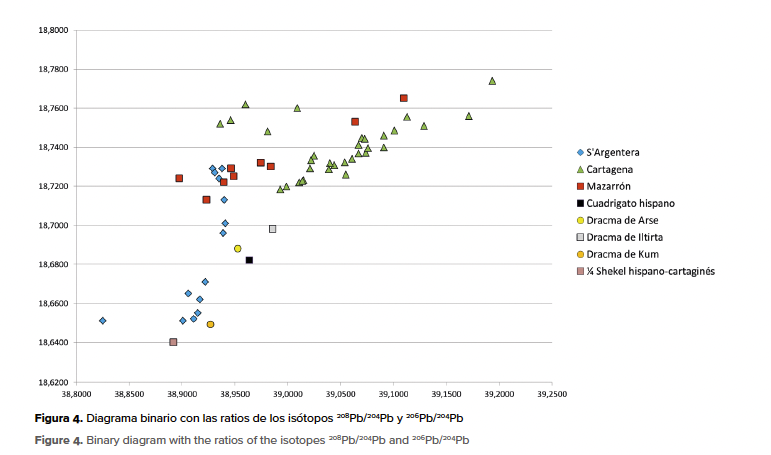
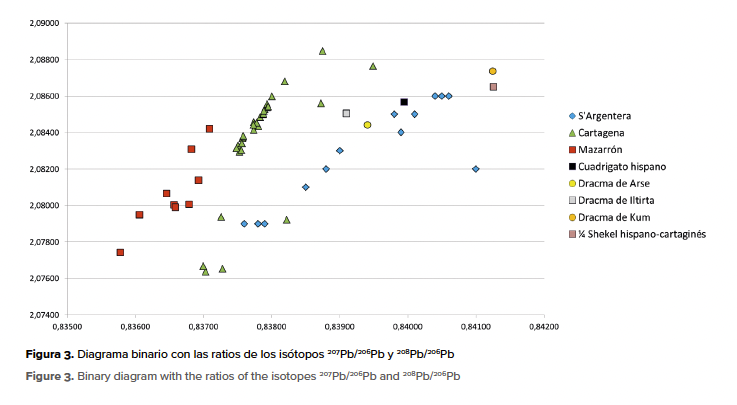
This coin an eighth that has been tested seems indicative of recycle metal primarily but not exclusively a Punic source at S’Argentera (Ibiza), perhaps using a mixture more similar to that used by Iberian mints. It does not look like any of the Cartagena (or Mazarron) material.
So where Am I? Hoarding suggests that yes Quadrigati should be associated with Spain, even Spanish production. The metallurgical testing shows at least some of the Quadrigati were made with Spanish silver, but about half of what has been tested does not show that pattern. We cannot really know when the series started based on these mixed metallurgical results and relying only on Albarède will serious mislead us. We must collect a more robust and archaeologically grounded sample set before we draw firm conclusions.


