
OCRE entries. Documentation of my earlier obsession with falcatae.
Cf. the iconography of RPC 1 2 from perhaps Luco Augusti (Lugo). Twitter thread.
adventures in my head
OCRE entries. Documentation of my earlier obsession with falcatae.
Cf. the iconography of RPC 1 2 from perhaps Luco Augusti (Lugo). Twitter thread.
Someone should have told Gerald Cotten that Quadriga was not the best thing to name his currency… Or maybe, he’s laughing at all his customers from the great beyond …

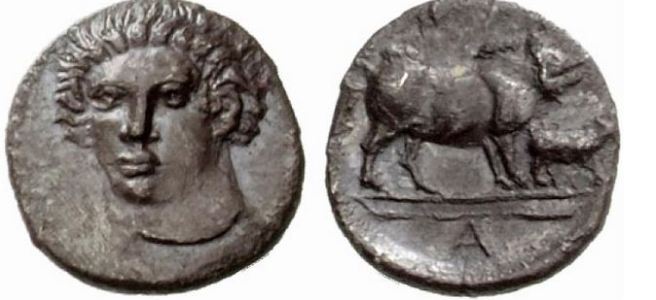
I’m really really into the aesthetics of the coins of Abacaenum. The frontal to 3/4 profile faces are so beautiful and varied!


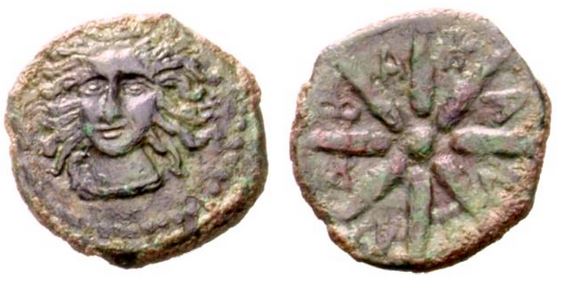
Is it Sol? Helios? Apollo as sun god? Or some one else completely different. The catalogues like to identify it as female (often a nymph). That’s not what I see.
I’m also concerned that the sow and piglet might not include a sow. Where are the teats?
RRC 121/2. Gender is pretty clear. And that is one fierce looking creature. Reminds me of RRC 388.

Has me wondering if I was too quick to think it was non-sense that the pre-Marian standards could have included a female boar, and thus been associated with Demeter…
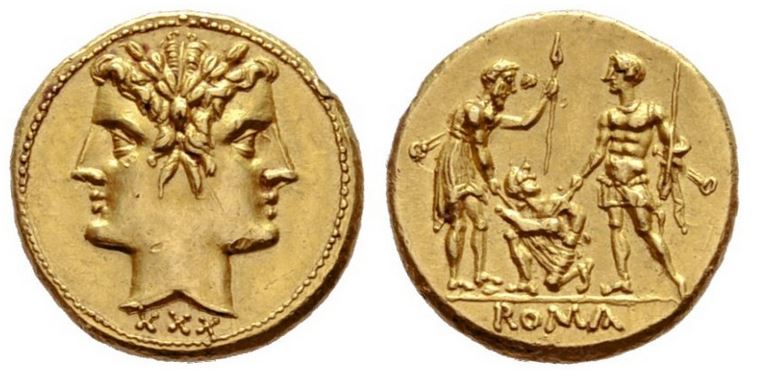
Contra what is below, Burnett 2016: 19 n. 34:
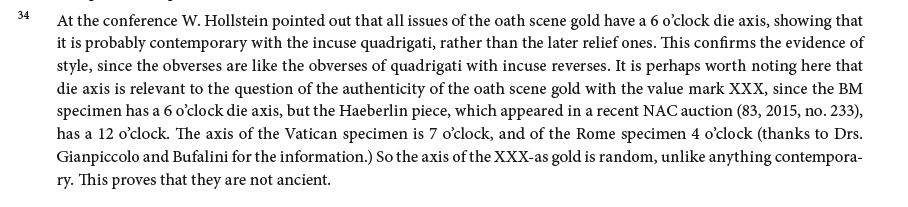
Quoting NAC 83 (2015) in full.
“This coin, one of only four known specimens, has always been the subject of heated debate among scholars. In Early Roman Coinage pp. 261-263, Rudi Thomsen provides a detailed summary of the controversy surrounding the coin:
“Before examining the consequences which the relative dating of the normal denominations of the Oath Scene gold must have for Willers’ theory on the early Roman gold issues, it will be useful to give a short account of the placing of the 4-scruple piece of the Oath Scene gold, with the figure of value XXX, in relation to the 6- and 3-scruple pieces and to the quadrigati.
The 4-scruple piece, which is known only in four specimens, produced by three different dies, has been considered a modern forgery by many scholars. It was denounced on the basis of the stiff, theatrical style of its reverse representation by d’Ailly, followed by Gamurrini. E. Babelon, who held the same opinion, pointed out, in particular, that the figure of value, xxx, was not in metrological agreement with the figures on the Mars/ Eagle gold. In his treatise on the Roman gold coins, Willers made a general attack on the authenticity of the 4-scruple piece, resulting in the following conclusion, based on its style: “Der Falscher hatte wohl Geschicklichkeit, aber kein Verstandnis fur die Antike”. Grueber also denounced the coin, and Bahrfeldt, who had previously been inclined to believe it to be genuine, maintained, in his monograph on the gold coins, that it was probably false. In his first paper on the early Roman coins, Mattingly advanced the same opinion, but in his later works he came to regard it as genuine. Finally, in 1951, the coin was declared a forgery by Forrer.
In opposition to the sceptics mentioned above, a considerable number of scholars have been convinced that the 4-scruple piece is genuine. This group includes the following scholars of the nineteenth century: Borghesi, Mommsen, Hultsch, Fr. Lenormant, Garrucci, and Soutzo. Haeberlin, who for stylistic reasons had originally regarded the coin as false, also declared it to be genuine in his “Systematik”, and was joined in this opinion by Regling, who had studied one of the specimens known and found nothing suspicious about it.
Reacting to Willers’ attack on the genuineness of the 4-scruple piece, Haeberlin submitted this problem to a thorough examination in his paper on the early Roman gold coinage published in 1908. As distinct from Willers, however, he did not compare the coin in question with the other denominations of the Oath Scene gold, but with the various types of quadrigati. As a result of this comparison, which constituted a much more reliable basis for deciding the difficult question of authenticity, he observed striking similarities between the obverse of the 4-scruple piece and the corresponding Janus head on various later quadrigati. These similarities showed irrefutably that the two coin groups were associated; accordingly, the forgery theory collapsed.
Considering that a forger would scarcely have thought of using the obverse of a quadrigatus to create a new form of Oath Scene coin, but naturally would have worked with a genuine specimen of this coin group as a prototype, Haeberlin’s argument was, indeed, conclusive. Accordingly, apart from the scepticism of Forrer, the latest research has been marked by confidence in the 4-scruple piece. Thus the genuineness of this coin has been advocated especially by Giesecke, Laura Breglia, and Mattingly in his treatise of 1945. In this paper it was pointed out that among the quadrigati there can be distinguished a particular group, evidently from a special locality, which is marked off from all other groups in that the Victory standing behind Jupiter on the reverse is not cut off at the waist by the line of the car, but is seen full-length behind the line. This group, which has a mixed incuse-relief legend, must be late among the issues of quadrigati; for the raised tablet used for the legend is of the same shape as the linear frame surrounding the late group of quadrigati with legend in relief, and, furthermore, the coin group is of a weak style, a fact which caused Gentilhomme to assign it to the very latest period of quadrigatus issues. Now among the coins of this group there are found a few with a pellet below the truncation, and exactly with these the 4-scruple piece of the Oath Scene gold is associated, according to the studies of Mattingly. Hence, provided that the gold coin under discussion is genuine- which must be considered extremely probable- it certainly belongs to the final phase of the quadrigatus.”
In addition to the points put forth by Thomsen, it is worth noting that in Roman Republican Coinage pp. 548-549, Michael Crawford dismisses the coin solely on the basis of stylistic considerations.
In light of the above, we would like to hereby explain the reasons that lead us to believe that this coin is indeed authentic. Firstly, it is important to chronologically contextualise this issue. With Hannibal’s Punic invasion, the Romans were confronted with having to mint gold coins for the first time in order to fund the war: the oath-taking stater and the half stater (Cr. 28/1 and 28/2). These two issues can clearly be linked on stylistic grounds to certain quadrigati with incuse legends. The coin offered here is stylistically different from these coins, however, as mentioned above and as supported by Haeberlin, its style is clearly consistent with the quadrigati that bear a dot beneath the neck truncation (Cr. 31/1 and pl. V, 10). The latter issues can be dated around late 216-early 215. The arrival of the mark of value, which is absent on the oath-taking staters, can be explained through the necessity to indicate the value of the coin at a time of bronze’s violent devaluation. It is important to remember that the Romans had no experience of dealing with gold coins and therefore the value would not have been immediately understood. The rarity of this issue is probably due to the fact that it was produced for a very brief period before, a little over a year later, the Romans adopted a new system based on silver which brought about the arrival of the quinarius (214-213 BC) and subsequently the denarius (212 BC), followed by a new gold issue of 60, 40 and 20 asses with the head of Mars on the obverse and the eagle on thunderbolt type on the reverse (211 BC). If our chronological reasoning is correct, the coin would be absolutely correct from a metrological point of view as clearly demonstrated by the following note written by Andrew McCabe:
“The Roman bronze coinage underwent a well-documented series of weight reductions during the second Punic war. The cast bronze as was being made to a libral standard (actually about 10 ounces) at the start of the war. Whilst the silver quadrigatus remained unchanged, the cast bronze coinage was reduced to a semilibral standard (actually about five ounces) between late 217 and early 215 BC, and lower denominations were struck rather than cast for the first time. The emergency conditions then seem to have prompted a precipitous decline in the coinage, both in the silver quadrigatus which dropped in both weight and fineness, and the associated cast bronze coinage which dropped in weight and in manufacturing quality. Sometime about 214-212 BC, a new fine silver coinage was introduced, with the denarius as the main coin. The bronze coinage also stabilised from that time, with good quality struck bronzes generally being minted at weights of between one fifth and one eight of a pound, a standard usually referred to as sextantal. This was supplemented by some lighter emergency issues in conflict areas such as south-east Italy. During that early denarius period, a 60 as gold piece (RRC 44/2) weighed three scruples or 1/96 Roman pound. It equated to 60 sextantal bronze asses, weighing in total about 10 pounds. This implies a gold-bronze ratio of about 960:1 at this time. If we assume the gold to bronze value ratio remained unchanged in the early second Punic war, the four scruple weight (1/72 pound) of this oath scene gold coin would equate to thirty bronze asses, each weighing about five ounces. That tallies with the semilibral bronze standard which Crawford dates between late 217 and early 215 BC (RRC p.43). Crawford associates the oath scene coinage, as a whole, to this same semilibral bronze standard period, with some oath scene gold being associated with later examples of incuse-legend quadrigati 217-216 BC, and others with early examples of relief-legend quadrigati 216-215 BC (RRC p.44). The quadrigatus style with which this coin is associated, RRC 31/1 pl.IV,10, has legends that are transitional between incuse and relief. If we are working within the bounds of Crawford’s overall dating scheme, this would place this coin within the same period as the general issue of oath scene coinage, but at the latter part of that period, perhaps dating to late 216 or early 215 BC, or in other words, immediately after the battle of Cannae, and with the denomination mark XXX referring to thirty of the then-current semibral cast asses.”
This note serves only to confirm the metrological plausibility of the coin, without entering into the discussion surrounding its authenticity. Meanwhile, confirming the metrological considerations put forth by Andrew McCabe, Professor Ted Buttrey writes:
“Andrew McCabe has said all that needs saying. On the assumption that the coin is genuine – and there is at this point no reason to doubt it – its denomination of 30 asses at 4 scruples plainly dates it before the introduction of the sextantal system, which itself fits nicely into the numismatic chronology of steadily declining weights of the cast > struck bronze series. At a gold:bronze ratio of 1:960, the semi-libral bronze seems to be the equivalent of the XXX.
Notice too how this is independent evidence confirming that the sextantal gold was misvalued in relation to the bronze: because the bronze sextantal as weighed 48 scruples. Therefore,
1 scruple of sextantal AV = 20 asses
48 scruples of sextantal bronze = 1 as , which x 20 = 960 scruples, giving a gold:bronze ratio of 1:960 which is impossible since that was the ratio already before the reduction to the sextantal system. Somebody erred.”
I therefore feel that the reservations expressed by Babelon regarding the metrological conformity of the coin are now surpassed.
Let us know address stylistic considerations. According to Thomsen, this issue was struck with three different dies. Along with the coin offered here, I personally have been able to examine the British Museum specimen as well as the Vatican Museum piece and I can say that unlike the first two, I found the latter, (pace Crawford), to be extremely dubious. Unfortunately I have never had the chance to to study the coin from the National Roman Museum collection in person, therefore I would prefer to not pass comment on this specimen. The British Museum piece and the coin offered here were produced from the same die-coupling and both coins are certainly struck, furthermore, they both present traces of a small die break on the reverse die; the break is more advanced on the coin offered here. I was struck by a particular detail which until now nobody appears to have noted: both coins present a circular line similar to a compass line. The same characteristic is also present on some 60 asses-this is surely further evidence that the hand behind the dies was Roman and not from the 1800s. Haeberlin rightly observed that these coins are stylistically ascribable to a specific series of quadrigati. If we therefore were to hypothesise that these coins are forgeries, we would need to imagine that the counterfeiter who produced them in the 19th Century managed to architect a coin that was not only absolutely plausible from a metrological point of view, but also stylistically copied from a chronologically-compatible quadrigatus dated slightly after the oath-taking staters and half staters. Furthermore, the metrological incompatibility of this coin with the Mars/Eagle series can be considered further poof of the coin’s authenticity since a forger would have certainly produced a coin with a weight in line with this series. In light of the above, we find it difficult to understand why Crawford appears so quick to discount Haeberlin’s correct considerations making a brief statement on the style of the coin and accusing Haeberlin of defending the coin merely out of personal interest.
We have had the opportunity of comparing the 30 asses offered here and that of the British Museum with two oath-taking staters, an oath-taking half stater, a 60 asses, a 40 asses and a 20 asses and we could not help but note how the metal of these coins is similar throughout. Today, this would be an absolutely secondary factor since counterfeiters have methods of using ancient metal to produce forgeries, however, in the case of a coin which has been known since the 19th Century, we consider the conformity of the metal to be a fundamental aspect to confirm the coin’s authenticity. On the other hand, hypothesising that in the 1800s a forger used ancient gold, or better still, Roman Republican gold (which is absolutely different from Imperial gold), honestly seems extremely far-fetched to us.
To conclude, despite the fervent debate that has long divided scholars, we believe this coin to be absolutely authentic.”
at the rites that initiate peace, when a treaty is made, a pig is killed; and that at the beginning of the marriage rites of ancient kings and eminent personages in Etruria, the bride and groom, in the ceremonies which united them, first sacrificed a pig. The ancient Latins, too, as well as the Greeks living in Italy, seem to have had the same custom
I like how this parallels the iconography of Dexiosis and Dextrarum Iunctio.
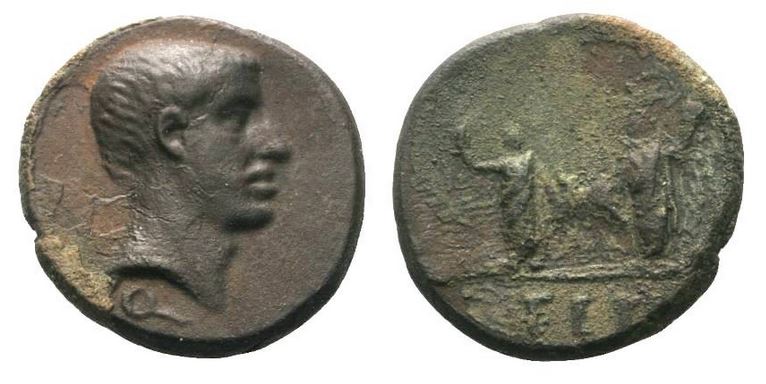
This confirms to my mind the significance of the Q.
***
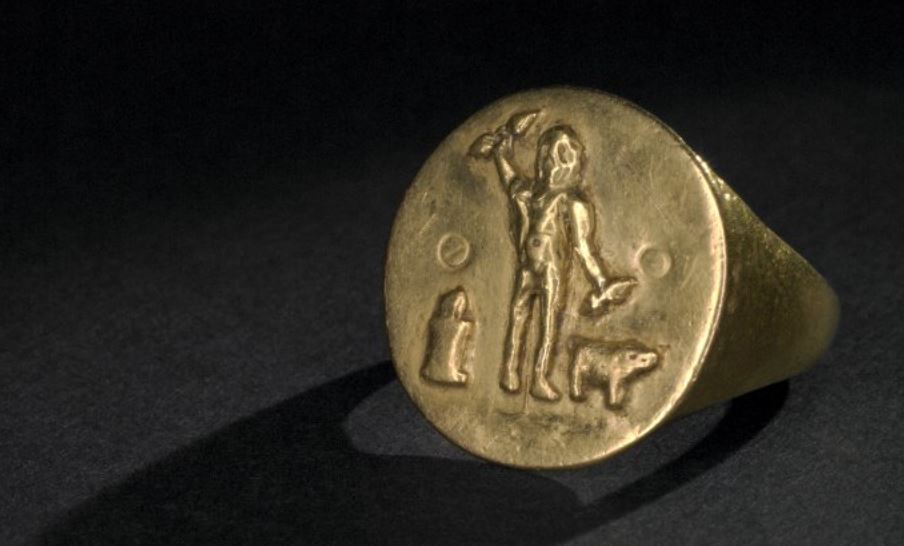
BM 1988,1020.2
Identified as ”Theos Orkios” The god of oaths. Such a strange artifact. …
Indian

African Forest Elephant


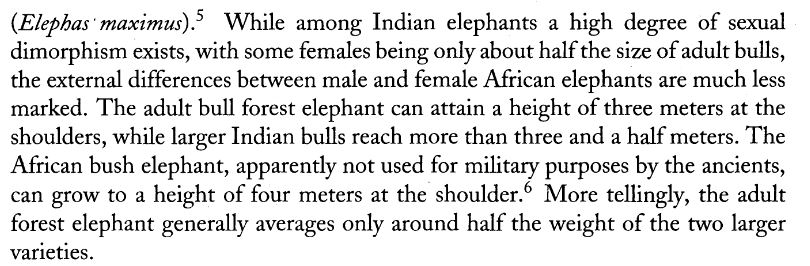
From Charles, Michael B. “AFRICAN FOREST ELEPHANTS AND TURRETS IN THE ANCIENT WORLD.” Phoenix 62, no. 3/4 (2008): 338-62. http://www.jstor.org/stable/25651736.
For numismatists these differences only make sense when they are exceptionally clearly rendered. So the Hispano-Punic coins: e.g. ANS 1944.100.81012 and Siculo-Punic coins: e.g. ANS 1997.9.225 all have the concave back and seem most decidedly African. But many other elephants aren’t rendered with the same care as to make the distinction meaningful.
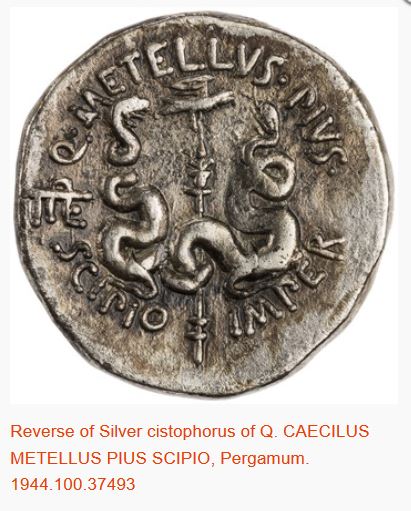
I like how the bow case is replaced with the legionary eagle (aquila). Reminds me of Fimbria’s earlier cistophorus with a legionary standard.
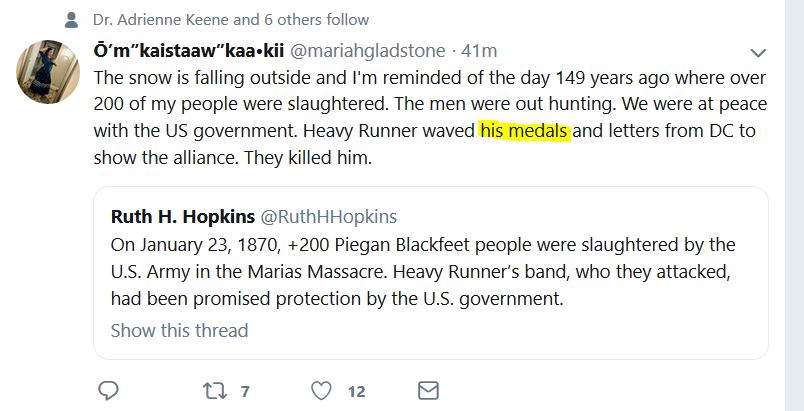
This is a note to myself to learn more about Heavy Runner and the Marias Massacre.
 Liv Mariah Yarrow