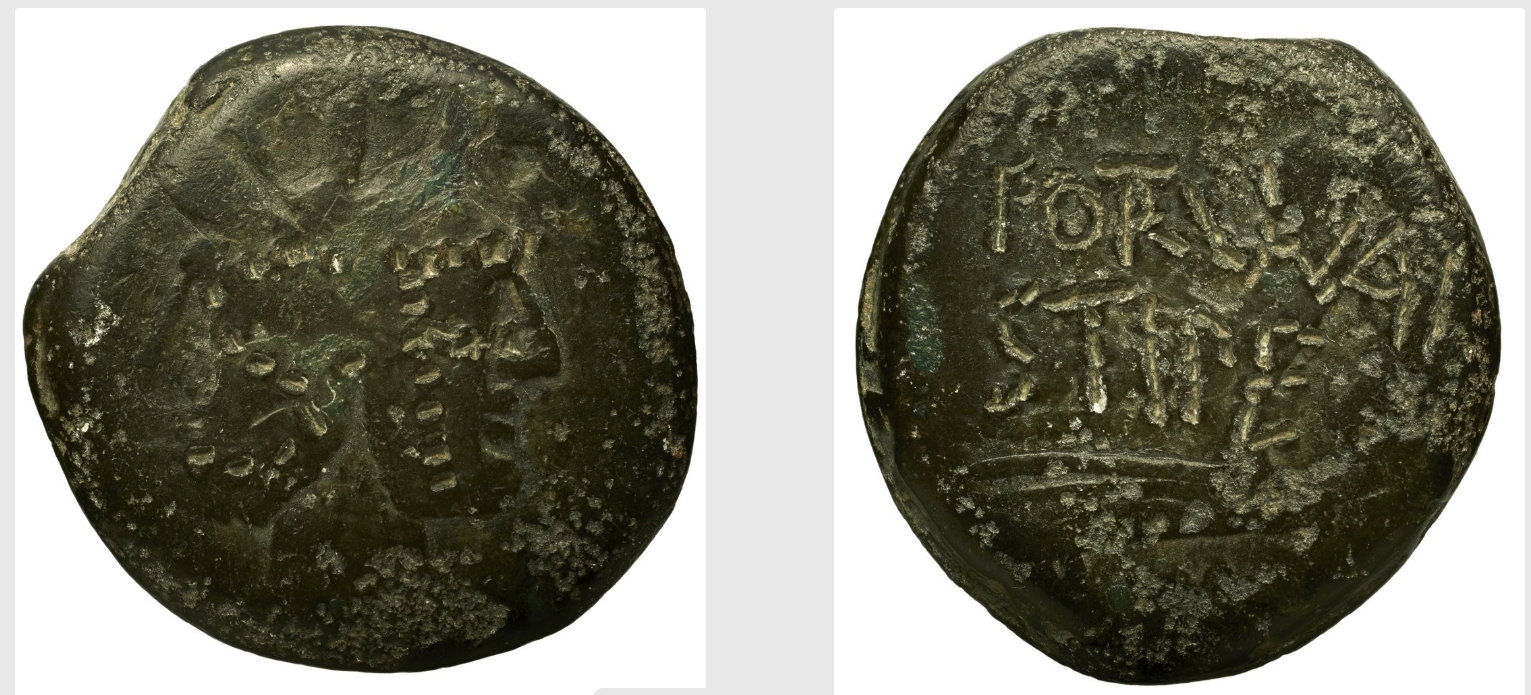
Some Aes Grave Bibliography

From L’Année philologique

Martínez Chico, David. “Reciente hallazgo de « aes grave » – as – en el Algarve (Portugal).” Revista Portuguesa de Arqueologia 20 (2017): 107-111. [pdf online]

A new « aes grave » coin is documented, dated approximately between 275 and 270 BC. C. Although it is part of a private collection, it is known that it was found in southern Portugal, specifically in Figueirinha (S. Marcos da Ataboeira, Castro Verde). An attempt is made to relate this finding to other coins also recovered in the Iberian Peninsula. It is concluded that this Roman coin must have been brought to the region after the outbreak of the Second Punic War.

Martínez Chico, David. “La moneda « aes grave » hallada en la península ibérica y su relación con la segunda guerra púnica.” Rivista Italiana di Numismatica e Scienze Affini 117 (2016): 21-33. [pdf online]

The sporadic diffusion of Roman coins of the “aes grave” type in the Iberian Peninsula is attested only after the outbreak of the Second Punic War and to a much lesser extent than the coin production in silver.

Werz, Ulrich. “Ein Aes grave aus Rheinau.” Archäologie Schweiz = Archéologie Suisse = Archeologia Svizzera 38, no. 4 (2015): 36-39. Doi: 10.5169/seals-587490

A cut “semis”, unearthed in Rheinau in 2011, is the first “aes grave” discovered on Swiss territory. This is a fragment of a coin minted after the monetary reform of 217 BC. J.-C., which reduced the weight of these pieces from 324 to 368 grams.[sic!] This currency did not arrive at the place of its discovery through monetary circulation, but through an exchange.

Hollstein, Wilhelm. “Ovids « Fasti » und das « aes grave » mit der Prora.” In « Noctes Sinenses »: Festschrift für Fritz-Heiner Mutschler zum 65. Geburtstag, Edited by Heil, Andreas, Korn, Matthias and Sauer, Jochen. Kalliope; 11, 59-67. Heidelberg: Winter, 2011.

Ovid leaves in Fast. 1, 229ff. interpret the Prora on the reverse of RRC 35/1 through the Janus on the obverse to indicate the arrival of Saturn in Latium. However, the coin dates to 241 BC, as do RRC 28/3, 35/2 and 35/3. BC, more precisely to the capture of Falerii and the victory in the naval battle of the Aegean Islands. As H. W. Ritter (=> 82-10324) has already seen, Janus on the front of 35/1 and Jupiter directing the quadriga on the back of 28/3 refer to the first victory, as well as Minerva on the front of 35/3 . The Prora on the reverse of the coins refer to the latter victory. On the obverse of 35/2 Saturn is not depicted as assumed by H. Mattingly (=> APh 3, p. 184, under H. Mattingly, 4th title), but because of the two victories Jupiter as the triumphant par excellence. The beardless Janus on the obverse of 28/3 represents the closure of the arch of Janus after defeating the Carthaginians.

Jaia, Alessandro M. and Molinari, Maria Cristina. “Two deposits of aes grave from the sanctuary of Sol Indiges (Torvaianica/Rome): the dating and function of the Roman libral series.” Numismatic Chronicle 171 (2011): 87-97. [on file – obviously it is like my favorite article of all time!]

Molinari, Maria Cristina. “Gli esemplari di « aes signatum » e « aes grave » dalla collezione del Medagliere Capitolino.” Bullettino della Commissione Archeologica Comunale di Roma 111 (2010): 15-53. [academia.edu] [jstor – photos slightly higher quality] Extremely important, esp. Appendices.

See also:

Molinari, Maria Cristina. “Un Ripostiglio Di ‘Aes Grave’ Proveniente Dai «Colli Vaticani» (Roma).” Bullettino Della Commissione Archeologica Comunale Di Roma 105 (2004): 115–22. jstor. [NOTE: The end in particular is very important for its discussion of find context and how it may related to a cult center. Bellona-Ma, Magna Mater]

Bruni, Stefano. “Sulla circolazione dell’« aes grave » di Volterra: nuovi contributi.” Rivista Italiana di Numismatica e Scienze Affini 100 (1999): 47-56. [ILL requested]

Reporting of the discoveries of Volterra coins, completing the contribution of F. Catalli (=> 47-08252), with particular regard to the northern borders of the city territory

Bar, Marc. “À propos du poids des plaques d’aes signatum, de leur nature et de leur fonction.” Rivista Italiana di Numismatica e Scienze Affini 95 (1993): 277-286. [ILL requested]

Burnett, Andrew. “The beginnings of Roman coinage.” Annali dell’Istituto Italiano di Numismatica XXXVI (1989): 33-64. [on file, obviously]

Ercolani Cocchi, Emanuela. Catalogo della collezione numismatica di Carlo Piancastelli. Aes grave. Moneta Romana repubblicana. Forlì: 1972. [next ANS visit]

From Donum:

no author set. “Aes Signatum and Aes Grave of the Morgan Collection” Coin Collector’s Journal, N.S Vol. 18, no. 6 (Nov.-Dec., 1951), pp. 125-129.

Orsi 1908 [Donum citation]

In the News of the excavations (1902, p. 217-218) I announced the discovery in the territory of Visrini (Catania) of a one libral standard uncia of Latium (astragalus [knuckle-bone]; Garrucci, pl. XL, fig. 40) and in that of Ragusa of two Latin quadranti (Head of Hercules – Prow of ship). These three pieces would have been the first specimens of aes grave found, or at least reported, in Sicily, and introductory, it should be noted, not by modern coin dealers, but in antiquity. Following the discoveries of 1902, I have noted others in the following years; and I have always used the greatest scruple in eliminating those pieces that have fallen on the antiques market, for which there may be

legitimate suspicion they were of modern import; whereas I have taken great account of those seen in the hands of country people. A as on the reduced libral standard comes from Castrogiovanni (Janus — Prow, see Garrucci, Table XXIX, 8), of which it was not possible for me to take the weight. From the territory of Nolo a semis of gr. 40.5 (Head of Jupiter — Prow of ship). From a hoard of several aes grave, found according to some in Naxos, according to others, in Piazza Armerina, there were two uncia from Latium (astragalus – Globulus [knucklebone-dot]: Garrucci Pl XXXV11, 6; barley grain with globulus [dot] – Idem, Garrucci Table XXXIV, 6). Another quadrans similar to those announced in 1902 comes from the Ragusa area; finally, from the countryside of Catania a triens from Latium (Dolphin 3 dots— double thunderbolt 3 dots see Garrucci Plates XXXVII, 3). All of these pieces predate, and some by quite a lot, 268 BCE; they serve to highlight the history, still so uncertain, of the commercial relations between Rome, Latium and Sicily in the centuries IV and III BCE. While the consular money of the III – I a. C. are very frequent in Sicily, aes grave had not been reported by anyone up to now, or at least it had gone unnoticed.

Next ANS visit look at publications of Spinelli, S. Giorgio, Il Principe di.

To be continued…

Bonačić Mandinić, Maja. “Aes grave iz Jesenica.” Archaeologia Adriatica 2, no. 1 (2008): 235-242. [full text]

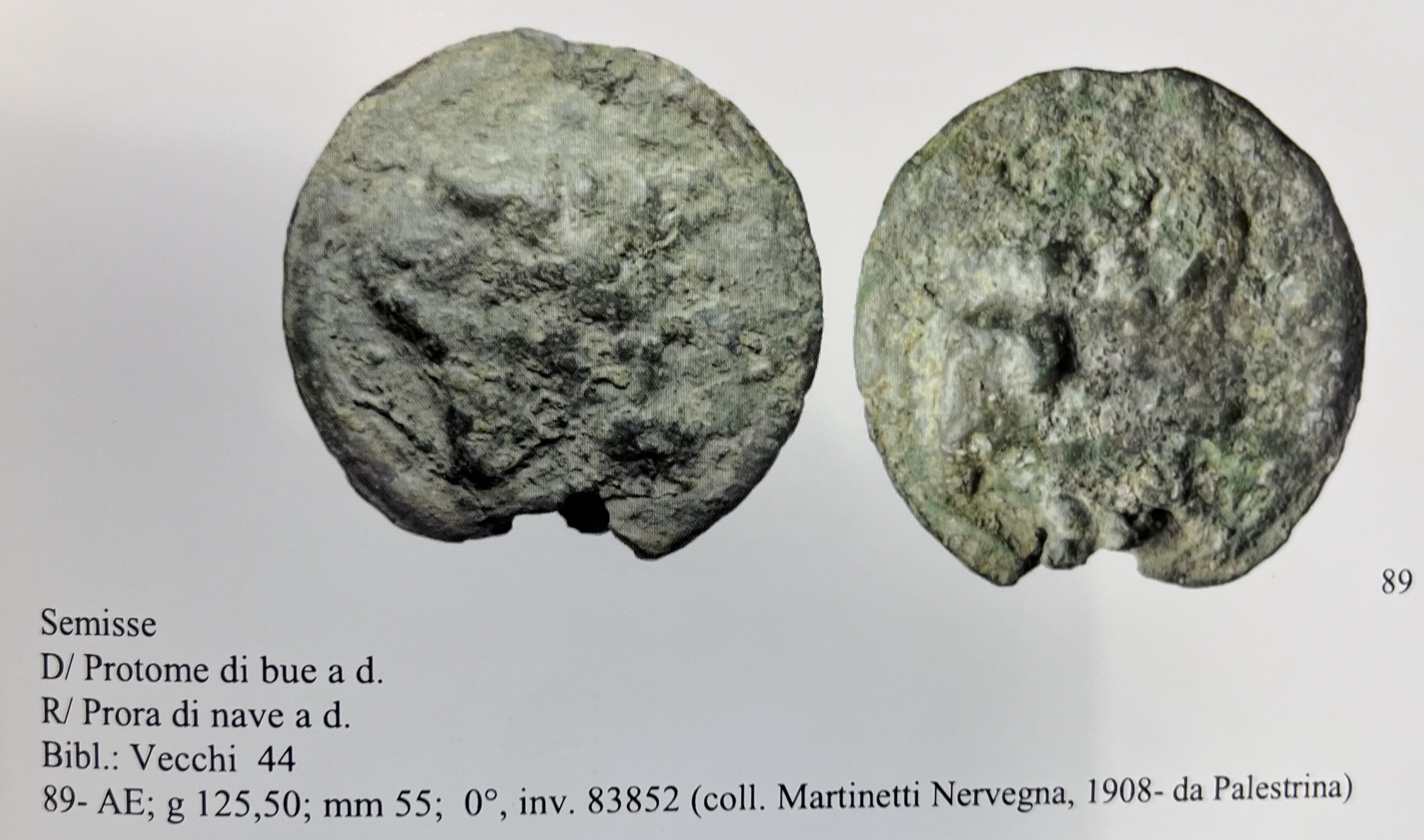
In the collection of the Archaeological Museum in Split, there is a copy of an aes grave of the Apolon/Apolon type (RRC 18/1). It belongs to the issue of the mint in Rome from 275 to 270 BC. It was found around 1901 in Jesenice. Any details about the context of the find are not known. Jesenice is a village at about 200 to 250 m above sea level, on the slope of Perun – the southern slope of the Mosor mountain. Along with other Hellenistic finds from the wider area of Jesenice, along the coast between Split and Omiš, this find could testify to the connection of the Illyrians with the Greeks from Isa and Faros, through the nearby Epeti, that is, with the first Roman merchants who most likely came to contact with the Illyrians. In addition to the aes grave from Jesenice, in the collection of the Archaeological Museum in Split, there are three more semis, fractions worth half of the aes grave. There are two bull/wheel types (RRC 24/4), issue from 265-242. ex. BC, and one of the Saturn/ship bow type (RRC 35/2), issue from 225-217. ex. Kr. Such an early Roman coin in the Illyrian area did not serve as money, but was most likely considered a valuable bronze object with a distinctive appearance, so it was stored as such, and was not used to make other bronze objects.

10 of 234 days: UPenn Nemi connection

The Cesano 1940 (lake?) Nemi coin catalogue has not yet arrived from ILL, but it’s less than 24 hours so I must be more patient, maybe I’ll get to blog about that in a day or two.

Important article on Collection history at UPenn (PDF also on file)

My poking around brought to my attention that the UPenn Museum also was a major purchaser of artifacts from the late 19th century excavations at the sanctuary of Diana

From Flickr

Their online catalogue suggests just shy of 50 objects. The main agent in the acquisition of Nemi material for UPenn seems to have been Mrs. Lucy Wharton (Joseph) Drexel in 1897. That she acquired? (paid for?) along with the ‘fine art’ this weight leads me to believe its is just possible she (or the university agent) might have also brought back coins, even ugly ones.

Catalogue entry (a shame the exact dimensions including mass aren’t recorded)

UPenn also has a pretty decent coin collection, more than 20k specimens when all periods are included, of which the vast majority are Roman. While I cannot say I looked at all their coins, it seemed pretty clear from entries that provenance before 1929 was typically not recorded. My suspicion is that if they got Nemi sanctuary coins they didn’t record them as such. Archival paperwork on the Nemi acquisitions in the museum might answer those questions, but even better would be to fine the Savile photos that Crawford mentions (see earlier post.)

A collection of photos donated by Lord Savile to the British Museum illustrates a number of pieces not otherwise attested, which have been included in the list below, and there may well have been more.

He also says:

A number of pieces were published by E. J. Haeberlin in his Aes Grave as forming part of his own collection and a number of others as having been part of the stock of the dealer X. Pasinati in 1895.

Given the excellent quality of Haeberlin’s images; it should be possible to establish where at least some of these coins from the Pasinati’s stock ended up. I’m making a right pest of myself at the BM as C&M doesn’t seem to have the photos and I am now banging round the other departments asking questions and favors.


Transitioning between projects is so hard. It’s weird. I was so eager to be done with Dionysius and to give my full attention to the coins, but yet finding the most productive steps is harder than anticipated. The habit of worrying about whether my work is good enough and whether I can actually do it is also hard to break. What if I collect all this data and it is all meaningless? I’m a wee bit under the weather (yes, the covid test is negative, and yes I’ll test again before going to NYC this weekend), and that has my mood down I suspect. We’re finally in double digits on the enumeration and yes without a doubt real progress has been made. The running discipline is good to help reassure myself of that.

Today

  • First steps on Aes Grave project – collect relevant bibliography
  • More Italy visit logistics
  • More AAH logistics
  • Book flights
  • More BM communications
  • Schaefer follow up
  • follow up with Lafayette

Not Today (but maybe tomorrow, or the day after)

  • Teaching requests for Fall 2023
  • Circle back to department about any Jan planning meetings
  • Set time table for any collaborative RRDP work/publication prep that needs to happen this semester: Chicago pub, INC pub, collaboration with RACOM, etc…
  • Circle back to Capito project
  • Consider ask for funding from Dean’s office
  • Begin Med school rec letter
  • record mini myth
  • find out what is on that v old harddrive and back up to cloud
  • Write up Teaching Eval
  • Rosen Fellowship refs – Jan 16
  • Cancel at least one more digital membership
  • renew Coinarchives
  • Review grad student apps by Jan 19

The Nemi Temple

Terracotta model of a temple pediment, from the sanctuary of Diana Nemorensis. From Nemi, loc. Giardino, Sanctuary of Diana.Mid-Republican period, 4th-3rd c. BCE Villa PoniatowskiMuseo Nazionale Etrusco di Villa Giulia, Rome, Italy. IMAGE from Dan Diffendale (link)

Dan’s photos are always SO good! If you go to his photo stream he has a few more of this same object from different angles. The detail I wanted to record other than just the existence of this object and its location is the center image, which to my eye in this photo looks like three seated women and I’d be tempted to read as a representation of the cult image.

Here’s another detail from another of Dan’s photos at a slightly higher resolution:

I’m interested in how different (less archaic) this representation is than that on RRC 486/1. I wish I could make out the attributes better on the terracotta model.

9 of 234 days: Nemi lake finds

ILL delivered that article I mentioned yesterday on lamps in Lake Nemi, nothing really on coins. But, the authors notice a long period of ritual deposits in the lake itself and they consider this separate from the sanctuary of Diana which has a longer period of use (well into third century CE), whereas lamp deposits seem to concentrated and then taper off in the second century CE. They speculate that the deposits might have been a means of communicating with the underworld. Nevertheless I find it tantalizing that they mention coin finds along with the lamps suggesting the coins were also part of such ritual deposits in the lake. I wondered if the coins were also in Museo delle Navi Romane di Nemi as the lamps were there. I took a ‘tour’ of the museum using snapshots posted on Tripadvisor.

Just one shot of the coin display
Stratigraphic time line. Notice those coins in the republican era!
Hand crank device for bailing bilge water
This image has an empty alt attribute; its file name is image.png
Component (reconstruction?) from Caligula’s ships on Lake Nemi, showing the same type of ‘ball bearings’ used in Nero’s revolving dining room

I’m guessing that any coin finds were also published by Cesano (I mentioned her last week) here:

Cesano, S. L. “Scavi di Nemi-le monete.” In G. Ucelli, ed. Le navi di Nemi. Roma, 1940. p. 307-327.

I’ve ILL-ed it.


Yesterday, I sent off Dionysius for editorial feedback. That felt good. I hate how admin/logistics never feels likereal” work. I’m trying how best to prepare for my Rome trip and finally have some firm dates for collecting some more data. I don’t know what it makes most sense to work on until then… Do I start crunching data I already have? Or will that lead me down a primrose path or just make double the work? Perhaps more background reading…

Today

  • First steps on Aes Grave project
  • More Italy visit logistics!
  • More Rutgers coordination !
  • More Princeton coordination !
  • EES coordination!
  • BM communications
  • Follow up old student/tree sunset

Not Today (but maybe tomorrow, or the day after)

  • Teaching requests for Fall 2023
  • Circle back to department about any Jan planning meetings
  • Book flights
  • Set time table for any collaborative RRDP work/publication prep that needs to happen this semester: Chicago pub, INC pub, collaboration with RACOM, etc…
  • Circle back to Capito project
  • Consider ask for funding from Dean’s office
  • Begin Med school rec letter
  • record mini myth
  • find out what is on that v old harddrive and back up to cloud
  • follow up with Lafayette
  • Write up Teaching Eval
  • Rosen Fellowship refs – Jan 16
  • Finalize AAH logistics
  • Cancel at least one more digital membership
  • renew Coinarchives
  • Review grad student apps by Jan 19

Decussis miscellany

Balbi de Caro 1993; all specimens in this volume including this one of RRC 41/1 are from the Medagliere Museo Nazionale Romano di Roma

The piercing here is fascinating as the piece weights far too much to be worn as a comfortable ornamental piece of jewelry (almost 2.5 pounds!). I wonder if it was intended for a dedication, say being nailed to the wall of a sanctuary or something similar.

a specimen in trade but not in Haeberlin

Haeberlin’s plate

These two little videos show how closely both the obverse and reverse of the Rome specimen and the BM specimen match. I’ve never seen two aes grave this close. Traditional wisdom is that molds were not re used, but perhaps this is evidence otherwise? Or could one or both be an imitation?!

The Gnecchi Specimen (another photo of the same) however does not seem to fit:

The nose, chin, and overall profile have been aligned but notice the X behind the head cannot be aligned
Here I’ve got the X to align and the helmet curve sort of aligns but the profile is now significantly off.

There is one more specimen in trade but it is SO stylistically different from the BM/Roma one’s I don’t know what to think. The reverse bears passing resemblance to the Gnecchi reverse.

Other amusements

Aestimata poena ab antiquis ab aere dicta est, qui eam aestimaverunt aere, ovem decussis, bovem centussis, hoc est decem vel centum assibus.

Festus (epitome Pauli), sv. aestimata

Penalties in ancient times are said to be measured in bronze; they valued these in bronze, a sheep a decussis, a cow centussis, that is 10 or 100 asses.

a rough translation of my own
A completely fanciful and wrong approach to Italic weights and measures, but perhaps of amusement (link).

8 out of 234 days

…Without trying to decide which of these interpretations is the best, I have stuck to the oldest and most poetic.

original: “Sans chercher à décider laquelle de ces interprétations est la meilleure, je m’en suis tenu à la plus ancienne et la plus poétique.”

This line made me giggle.

Cohen 1857 (link)

This name logic was not only of interest to numismatists in the 19th century, but also to philologists concerns with naming practices (cf. Mowat 1871: 35). Support is derived from the patterns of numerous other nomen and cognomen; the coins are largely used as another epigraphic source.

Continuing with French scholarship I finally came to Babelon. Perhaps wholly unsurprising he is far more thorough and descriptive than any of the others and Grueber seems to owe much to him. There isn’t much new here but it is perhaps the clearest overview.

Why do I keep flogging this dead horse of a coin looking up wrong interpretations of bygone generations? A few reasons. It gets me reading widely and remembering to check various and sundry perspectives and in the past I’ve found my own thinking that seemed new to me, was in fact a resurrection of older ideas (wrongly?) dismissed. But I am getting a little bored of the gens Accoleia as it is taking me too far away from Nemi.

I’ve requested a copy of this article from ILL so hopefully I’ll have something more interesting for a future post.

Diosono, Francesca and Cinaglia, Tiziano. “Light on the water: ritual deposit of lamps in Lake Nemi.” Journal of Roman Archaeology 29, no. 1 (2016): 451-468. Doi: 10.1017/S104775940007224X

Abstract:Following attempts beginning in Renaissance times, in 1927 the decision was taken to lower the level of Lake Nemi to the floor where the hulls of two ships belonging to Caligula lay, using pumps. These operations, conducted between 1928-1932, concluded in 1936 with the opening of the Museo Nazionale delle Navi Romane, where the ships were displayed. The ships were destroyed in 1944. But in addition to the materials belonging to the ships themselves, a number of other materials were gathered from the lake bed, including coins and bronze and terracotta objects. Lamps constitute the majority of these materials. The presence of nearly 250 lamps on the lake bed must be assumed to be due to a deliberate action that was repeated over time. The chronological span of almost all the lamps, from the middle of the 1st to the end of 2nd cent. A.D., is too long to argue for an isolated event. The different types and workshops represented also suggest that we are dealing with an act performed on numerous occasions, for each of which the materials were acquired on the retail market. That characteristic suggests that the lamps featured in an individual ritual practice, ending with their deposition on the waters of the lake.
—-

Yesterday, I tried a more research first, communications second approach to structuring my day. Unfortunately, that meant communications didn’t get moved forward. I regularly overestimate how much I can actually get done. Also, I had to attend a doc appt with a kiddo and that ate up the last 2.5 hours of my day, so maybe I should go a little easier on myself. Started today with a wee walk–any walk is a good walk.

Today

  • Keep up on the Dionysius (sent off to editors!!)
  • More Italy visit logistics!
  • More Rutgers coordination !
  • More Princeton coordination !
  • EES coordination!
  • Local colleague communications
  • push Nemi photo hunt forward
  • JCope filing

Not Today (but maybe tomorrow, or the day after)

  • Teaching requests for Fall 2023
  • Circle back to department about any Jan planning meetings
  • Book flights
  • Set time table for any collaborative RRDP work/publication prep that needs to happen this semester: Chicago pub, INC pub, collaboration with RACOM, etc…
  • Circle back to Capito project
  • Consider ask for funding from Dean’s office
  • Begin Med school rec letter
  • record mini myth
  • find out what is on that v old harddrive and back up to cloud
  • follow up with Lafayette
  • Write up Teaching Eval
  • Follow up old student/tree sunset
  • Rosen Fellowship refs
  • Finalize AAH logistics
  • Cancel at least one more digital membership
  • renew Coinarchives

Day 7 of 234: Still more on RRC 486/1

Days 5-6 were the weekend. And, now that I have a family, I have a better appreciation of the need to stop oneself from working every possible moment.

Grueber 1910 (see last post) cited Borasi 1898 and it is indeed it not only has a very nice sketch/transcription of the stone, but also a discussion of the earlier speculations on the coin including background to the historical dating of it and a little on what was known then on the cult of Bellona in the region. Perhaps fuel for deeper digging

Borasi and others keep mentioning a hybrid type with Augustus and RRC 486/1 and the legend “imp. Caes. Augus, tr. pot. iix.” as reported by Borghesi. I wondered if any of these hybrids have turned up more recently. I’ve not tracked one down yet, but I did come across TWO fun Spanish hybrid types using the obverse of RRC 407/2 and the reverse of RIC 1 404 (or 405). Kind of wild they use different dies but from the same types.

Specimen link
specimen link
Just a nice specimen of RRC 486/1

I don’t think these goddesses are Oak Nymphs or Oak-Grove Lares (Querquetulanae) anymore than they were Larch trees, but its always good to review the evidence, before dismissing it.

Varro LL 5.49

Not my most satisfying warm up writing, but good enough… on to the lists.


Today

  • Spend EVEN MORE time with Dionysius
  • More Italy visit logistics
  • More Rutgers coordination as needed
  • More Princeton coordination as needed
  • Dr. Liz letter

Not Today (but maybe tomorrow, or the day after)

  • Teaching requests for Fall 2023
  • Circle back to department about any Jan planning meetings
  • Book flights
  • Set time table for any collaborative RRDP work/publication prep that needs to happen this semester: Chicago pub, INC pub, collaboration with RACOM, etc…
  • Circle back to Capito project
  • Consider ask for funding from Dean’s office
  • Begin Med school rec letter
  • record mini myth
  • find out what is on that v old harddrive and back up to cloud
  • follow up with Lafayette
  • Write up Teaching Eval
  • Follow up old student/tree sunset
  • Rosen Fellowship refs
  • Finalize AAH logistics
  • Cancel at least one more digital membership
  • renew Coinarchives

Day 4 of 234: More on RRC 486/1

Grueber 1910 (repr. 1970): 569-570 has deliciously erudite footnotes! And yet, like so often he doesn’t explain the theories he’s dismissing. I know they are wrong and so does he, but what a lot of work to make others dig through. It makes me slightly more fond of Crawford’s dismissive asides as he condemns his predecessors. at least I know where he stands and where to look.

I use the 1970 reprint of Grueber as Crawford had a hand in its re issue and correction of errors of the 1910 edition, but if you don’t have it on your shelves or happen to be in need of it away from home, there is a digitized version of the original BMCRR.

Next time I am in Rome I must make a pilgrimage to this inscription in the baths of Diocletian in the section on oriental cults! Strange to think I must have walked by it half a dozen times in the past but not noticed its numismatic connection.

What does it mean? At first reading, It seems to be that this guy Eros wanted to make a dedication to Bellona and needed Accoleius and his colleague’s permission to do so. Our moneyer’s name is in the last line. Also notice the TALL Is which Grueber discusses as a means of indicating the long vowel sound. The stone itself is from Lanuvium.

The back of this same stone has it’s own epigraphic designation in some databases:

Also of note for our current assumptions that this coin represents the cult image at Nemi, is that at two members of the same gens as the moneyer are attested at finds from the sanctuary at Nemi. One clearly played some role in local politics in the early first century CE. AND wait for it… our own dear Lord Savile scooped up this v stone (along with the vast majority of the coin finds from the excavations) and brought it to Nottingham! (I’ll be sure to pay my respects when I visit.)

The other attestation is from a list of names of uncertain function (see line five).

The Lanuvium makes sense once we look at the maps. Lanuvium is only about an hour and 20 minute walk away, and is the next nearest ancient community to the sanctuary after Ariccia.

Screenshot taken from ToposText

There is only one instance of gens in epigraphy from Rome itself and that seems to have been a funerary inscription that was reused in the construction of the walls of the tomb of Caecilia Metella

Right. More to learned and share here obviously, but I’m done warming up, and am ready to tackle the to do list!


Today

  • Submit Signed Tow by 5 pm Jan 6
  • Spend MORE time with Dionysius
  • Contact more curators about feasibility of collections visits concurrent with this trip (progress)
  • BM/Rowan Follow Up
  • Rutgers Follow Up
  • Enter Dates of things in Family Calendar to avoid nasty surprises
  • AAH Logistics (progress)
  • Cancel at least one digital membership
  • Princeton Follow Up (here’s a link the awesome cast bronze collection there!)

Not Today (but maybe tomorrow, or the day after)

  • Spend EVEN MORE time with Dionysius
  • Teaching requests for Fall 2023
  • Circle back to department about any Jan planning meetings
  • Book flights
  • Set time table for any collaborative RRDP work/publication prep that needs to happen this semester: Chicago pub, INC pub, collaboration with RACOM, etc…
  • Circle back to Capito project
  • Consider ask for funding from Dean’s office
  • Begin Med school rec letter
  • record mini myth
  • find out what is on that v old harddrive and back up to cloud
  • follow up with Lafayette
  • Write up Teaching Eval
  • Follow up old student/tree sunset
  • Rosen Fellowship refs
  • Finalize AAH logistics
  • Cancel at least one digital membership
  • More Rutgers coordination as needed
  • More Princeton coordination as needed

3 of 234 Days: Triple Diana or Three Nymphs?

From Schaefer’s Archives (presumed forger’s die, now in Zurich money museum (see previous blog post)

I love that I can use the Berlin catalogue as a digital index for Woytek. The pages here discuss the college of moneyers and why 41 BCE is a better date for them. It does not engage with typology, but rather mint structure.

Smyth 1856: 2 describes two specimens of RRC 486/1. He discounts an unattributed description of as the Caryatidae, and favors seeing it as the metamorphosis of the three Clymenidae, sisters of Phaeton, with the obverse being their mother, Clymene. He quotes in Latin a line from Havercamp. The view is over a hundred years old by the time Smyth paraphrases. AGNETHLER 1746: 72-73 (next set of images) makes explicit what Smyth only implies. The attraction of this interpretation is based on the moneyer’s cognomen LARISCOLUS being derived from larix: the larch tree. The idea was that the three figures are turning into these trees. Smyth rejects an idea he attributes to Cavedoni that the obverse represents Acca Laurentia and that the money is thereby associating he gens, ACCOLEIUS, with the mother of the Lares and more over implying a connection between his cognomen and these protective deities.

Public domain image of a European Larch

Given the conviction of all these forebearers, I found myself surprised no one had pointed me to an ancient account of this myth. I had hope when I turned to Rasche 1785 when he gave a Pliny reference…

But NO! that passage is about the triple nature of the larch, a rather clever means of creating a connection, I admit.

“the fir and the larch divide the process into three parts and produce their buds in three batches; consequently they also shed scales of bark three times…”

Pliny 16.100

So what’s up? Well, outside of the numismatic bubble these sisters are typically called Heliades (a small point, but helpful for tracking down info!) and all of the accounts (as far as I can tell) have them turning into poplar trees if any type of tree is specified. Also their number isn’t fixed, as many as seven appear in some accounts (three is also a known number).

So how and when did our former colleagues reject this interpretation and land on the Diana as worshiped at Nemi…? A story for another day. This was enough of a pleasant warm up exercise and now onto the to-do list.


Today

  • Finalize Tow Proposal (DUE Friday, Jan 6, 5 pm)
  • Spend sometime with Dionysius
  • Send Letter of Recommendation (RE grad teaching)
  • Triage former student emails from over break
  • Contact more curators about feasibility of collections visits concurrent with this trip (progress!)
  • Contact Princeton and Rutgers about possibility of visits
  • Write BM about whether scans of Nemi photos can be had
  • Write Clare in case she’s seen these photos and is interested in those token images mentioned by Crawford

Not Today (but maybe tomorrow, or the day after)

  • Submit Signed Tow by 5 pm Jan 6
  • Spend MORE time with Dionysius
  • Teaching requests for Fall 2023
  • Circle back to department about any Jan planning meetings
  • Book flights
  • Set time table for any collaborative RRDP work/publication prep that needs to happen this semester: Chicago pub, INC pub, collaboration with RACOM, etc…
  • Circle back to Capito project
  • Consider ask for funding from Dean’s office
  • Begin Med school rec letter
  • record mini myth
  • find out what is on that v old harddrive and back up to cloud
  • follow up with Lafayette
  • Contact more curators about feasibility of collections visits concurrent with this trip
  • Write up Teaching Eval
  • Follow up old student/tree sunset
  • Rosen Fellowship refs

2 of 234 days: Nemi and More

This is the opening to Crawford 1983. I know I can visit material on deposit in Nottingham and any of Haeberlin’s collection that ended up in Berlin, but I wonder how likely it is to be able to track down any specimens that were in Pasinati’s stock? Do you know the whereabouts of one or more of these pieces of aes grave? This particular provenance would make the individual specimens deeply important from an archaeological and historical position. Link to Helbig 1885. Crawford in this piece is attempting to improve upon Cesano AIIN 1912. (She’s one of my favorite numismatic foremothers!)
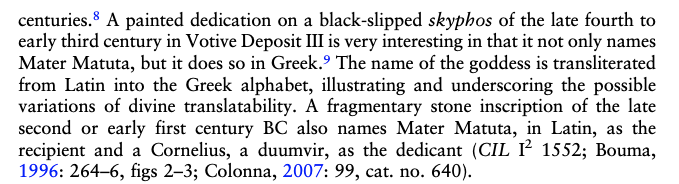
Wiki bio.

Crawford tells us that “A collection of photos donated by Lord Savile to the British Museum illustrates a number of pieces not otherwise attested, which have been included in the list below, and there may well have been more. (The photos also illustrate four tesserae: Standing figure/Standing figure, Standing figure/Standing figure, IVVEN/Blank, COR/THAL /Triple Hecate) .” I think these must be on deposit in the coins and medals department, as they have not been given accession numbers and added to the collection database as far as I can tell…

The enumeration of my days is a discipline for myself. When this blog was anonymous this type of omphloscopy was easier as I could at once construct in my mind’s eye just the right sort of mildly (dis)interested external audience, while being assured that next to no one actually read these posts or cared. Now I know there are some of you are coming for a specific kind of content that has nothing to do with my own writing practice and personal reflection on my profession.

I’ve resolved to re-institute the used of categories to help you filter out posts of less interest. Posts in this series will (like last time) be marked “enumeration of my days”. The coins category will be used to mark posts with… wait for it… coins. Ditto historiography, modernity, material culture, textual evidence, and advice. I think that covers most of the things I usually blog about.

Today

  • Re-shelve books and reset home office space
  • Develop Tow proposal (DUE Friday, Jan 6, 5 pm)
  • Choose ideal dates for Rome trip (and even found my ideal flights!)
  • Contact curators about feasibility of collections visits concurrent with this trip (one, more tomorrow)
  • Respond to external advising email
  • Triage Emails from over Holiday Break (progress, not perfection)
  • respond to podcast request

Not Today (but maybe tomorrow, or the day after)

  • Spend sometime with Dionysius
  • Teaching requests for Fall 2023
  • Circle back to department about any Jan planning meetings
  • Book flights
  • Set time table for any collaborative RRDP work/publication prep that needs to happen this semester
  • Finalize Tow Proposal (DUE Friday, Jan 6, 5 pm)
  • Consider ask for funding from Dean’s office
  • Begin Med school rec letter
  • Contact Princeton and Rutgers about possibility of visits
  • Write BM about whether scans of Nemi photos can be had
  • Write Clare in case she’s seen these photos and is interested in those token images mentioned by Crawford
  • Write up Teaching Eval (overdue!)
  • A little more work on office environment
  • Triage Emails from over Holiday Break
  • Contact curators about feasibility of collections visits concurrent with this trip
  • Send Letter of Recommendation (grad teaching)

Not THIS Sabbatical

I found a post it note on my desk with a idea for a little book, potentially useful to the non-numismatists:

Roman Social History: The Coin Evidence

Ordinary Occupations

Ludi in Rome and the Provinces

Lives of Women

Athletics

Political Careers

Myth and Legend

Architecture