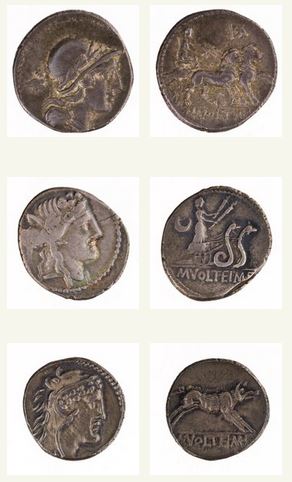
146 out of 410 days: M. Volteius M.f

Image

Image

M. Volteius produced a series of five denarii on the theme of the Roman Ludi in 78BC (so Crawford and Hollstein, but contra Hersh and Walker who date the series to 75BC).  Ludi is usually translated as “games”, but are better thought of as religious festivals.  We’ve already talked about one of these coins regarding architectural issues. The series still remains problematic:

T. P. Wiseman (“The games of Hercules”) offers a new interpretation of a series of denarii issued by the moneyer M. Volteius in 78 BCE. The coins were recognized by Mommsen as representing a series of games, and later scholars have followed this line of thinking, though there is disagreement about which games are depicted. Particularly problematic is the appearance of Hercules on one of the issues. Literary sources do not record Herculean games on par with those of Ceres, Apollo and the Magna Mater, who also appear on the coins, although there is epigraphic evidence of smaller scale, local games in honor of Hercules (CIL 12.984 and 985) in the late republic. Wiseman’s solution is that, at the time of the issue, there were games in honor of Hercules celebrated under the direction of the aediles, probably at the instigation of Sulla. Wiseman proposes, furthermore, that the games were demoted to the local level as part of the Sullan backlash of the early 60s, hence their absence from the literary sources.

Also noted by Crawford is the lack of clarity of which divinity is intended by the helmeted and wreathed head on the obverse of the Cybele coin; he lists Attis, Corybas and Bellona as early suggestions.  Wisemen in his 2000 chapter seems to endorse an idea originating with Alföldi and tentatively exploited and contextualized by Fishwick 1967, namely that the goddess is the Cappadocian Goddess Ma usually associated with Bellona or in Plutarch with ‘Selene, Athena, or Enyo’.  Fishwick’s piece shows the imperial epigraphic references to Bellona elided with Virtus and the close association of that cult with the Magna Mater.  Crawford himself on p. 307 of RRC vol 1 seems to suggest that Bellona is intended on Volteius’ coinage.  The divinity on the obverse should within the logic of the series be one honored alongside Cybele.  Three gods only have attributes on the reverse: Jupiter is paired with his temple, Hercules with the boar, Apollo and the tripod, but Ceres in her chariot is represented with the Father Liber who shares her festival.  So Cybele in her chariot ought to have a similar companion on her obverse?

A standard reading would suggest that Volteius is promising personal largesse at such Ludi if selected as an aedile.  This becomes a little bit more problematic when we consider that the Ludi he honors are put on by both curule and plebian aediles.  It is hard to think he is actively “campaigning” for both. The selection is also not complete: the Floralia and the Plebian Ludi are both missing.  More over the types honor the divinities but do not in anyway recall the spectacles or other public benefits of the ludi as some other ‘promotional’ coin types do.

Also confusing is the inscription of the Apollo coin:

S C D T is resolved by Crawford as stips collata dei thesauro or something similar recalling the original funding by individual contributions of this festival.   It is hard not to see the SC as more readily read as Senatus Consulto as appears on so many other coins.  This would leave the question of the DT.  Dumtaxat is the most common resolution of this abbreviation in Latin inscriptions, usually preceding a number or measurement being translated ‘precisely’.   There are far fewer of the Apollo coins surviving that any of the others in the series.

Omphalos and Snake: Shared Iconography

Reverse of RRC 348/4. 1974.26.25

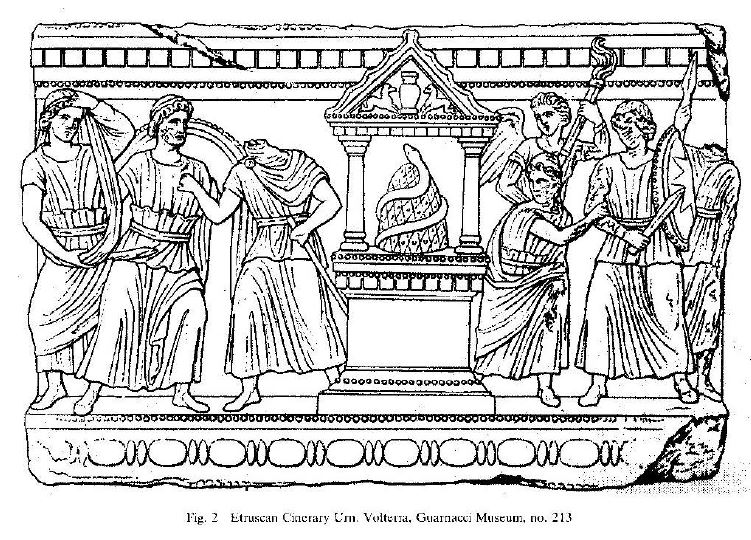
I’m really stuck on this Alföldi article.  [See yesterday’s post for references.]  He makes the assertion that the snake on an omphalos is the iconography of Apollo, not Aesculapius.  He uses Etruscan cinerary urns as comparative evidence:

Image

Yet these visual examples do not specifically link the image to Apollo they only show Italic usage. The image is clearly Delphic as Alföldi asserts.  A point illustrated by the late 4th century Amphictonic Hemidrachms:

reverse

Capture.JPG

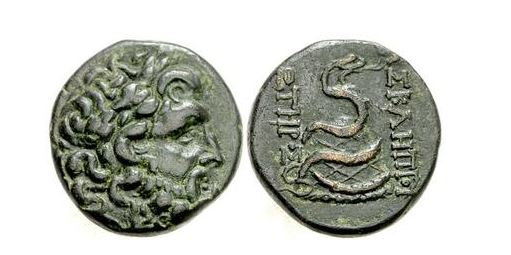
But this is by no means exclusive.  The same reverse type was used at Pergamon after 133 BC to celebrate Aesculapius as Soter (savior):

Reverse of Bronze Coin, Pergamum. 1944.100.43256

Capture.JPG

Aesculapius has been a popular interpretation of the allusions on L. Rubrius Dossenus’ coins because of literary testimony of a plague in 87 BC.  However, if Apollo is meant than these coins might be linked to the Veiovis  / Apollo coins of the Marians.  The interpretation of which remains controversial:

Wiseman T. P. (2009). Remembering the Roman People: Essays on Late Republican Politics and Literature. Oxford, 72-78; contra RRC and Luce, T. J. (1968). “Political Propaganda on Roman Republican Coins: Circa 92-82 B.C.” American Journal of Archaeology 72.1: 25-39.

Also see newer post for iconographic parallels.


144 out of 410 days: Missing Cybele

obverse

Returning to the book has been a jarring experience today. I managed to exhibit huge internal resistance.  For example, it seemed very important today to refine my file and image backup system and clear my hard drive of duplicate files using the latest search software.   Anyway.  Not knowing where to start or even which chapter I wanted to tackle next, I opened the very first item in my file of scholarship to be reviewed and incorporated as relevant.

Alföldi, A. (1976). “The giant Argus and a miracle of Apollo in the coin-propaganda of Cinna and Carbo.” In In Memoriam Otto J. Brendel: Essays in Archaeology and the Humanities, 115-119. Mainz.

This is mostly on the bronzes of L. Rubrius Dossenus (RRC 348).  However, very confusingly he says “Another reference to this function [sc. Rubrius’ theoretical aedileship] is given hy the representations on his quadrans: the head of Kybele on the obverse and her lion on the reverse announce the ludi Megalenses, celebrated in honor of the Magna Mater.”   No such coin is listed by Crawford for this money and I can find no other reference to such a quadrans.  How did Alföldi come to think one existed?

My searches led me a reference to the type above on this website.  The anonymous author of that website is certain the image represents Cybele and to be sure the iconography is be close. The author even wants to go so far as to down date the coin (and the rest of the series?!) from Crawford’s suggested 217-215 BC to 204 BC when the cult of the Magna Mater was introduced to Rome. [See my earlier post with links and also Bowden, H. (2012). “Rome, Pessinous, and Battakes: Religious Encounters with the East.” In C. Smith and L. M. Yarrow (Eds.), Imperialism, Cultural Politics, and Polybius, 252-62. Oxford.]

Crawford simply identifies the observe as “Female bust, r., draped and wearing turreted crown” but on p. 719 of his second volume he suggests that the head may be the personification of the city of Rome herself.  He seems to be imagining something along the lines of the Tyche of Antioch.

This struck me as a rather radical suggestion regarding a means of representing Rome, in contrast to the iconography of Roma or the Genius of Rome.  The underlying assumption of both the website and RRC is that the mural or turreted crown represents a specific thing: Cybele or Tyche or a City Goddess.  All of these are right and there is some decent scholarship explaining how they connect one to another. Reading up on this I was struck by this passage in the article just linked:

As “turrita” (with the mural crown) in Virgil’s Aeneid (6.785), the Magna Mater stands for the rule of the urbs Roma over the entire world (orbis).

Here’s the Vergil passage with Anchises in the underworld prophesying to Aeneas:

Behold, my son, under Romulus’ command glorious Rome

will match earth’s power and heaven’s will, and encircle

seven hills with a single wall, happy in her race of men:

as Cybele, the Berecynthian ‘Great Mother’, crowned

with turrets, rides through the Phrygian cities, delighting

in her divine children, clasping a hundred descendants,

all gods, all dwelling in the heights above.

en huius, nate, auspiciis illa incluta Roma
imperium terris, animos aequabit Olympo,
septemque una sibi muro circumdabit arces,
felix prole uirum: qualis Berecyntia mater
inuehitur curru Phrygias turrita per urbes               
laeta deum partu, centum complexa nepotes,
omnis caelicolas, omnis supera alta tenentis.
huc geminas nunc flecte acies, hanc aspice gentem
Romanosque tuos. 

Vergil’s metaphor certainly equates Rome’s walls with Cybele’s turreted crown, thus drawing the two together.  I’m not sure we can push this back into the late 3rd century, but the goddess on the coin may very well have recalled more than one association in the minds of its earliest viewers.

Update 17/1/2014, just adding a finer specimen: 

This specimen also makes me wonder about reverse figure.  Is this a ludic scene recalling riding competitions at religious festivals?  The figure seems to have a whip but no other weapons.  Is this an early precursor of the desultor and rider types seen later in the republic?  The whole series has unusual types…  Best image of the series as a whole.

Update 31/1/2014:

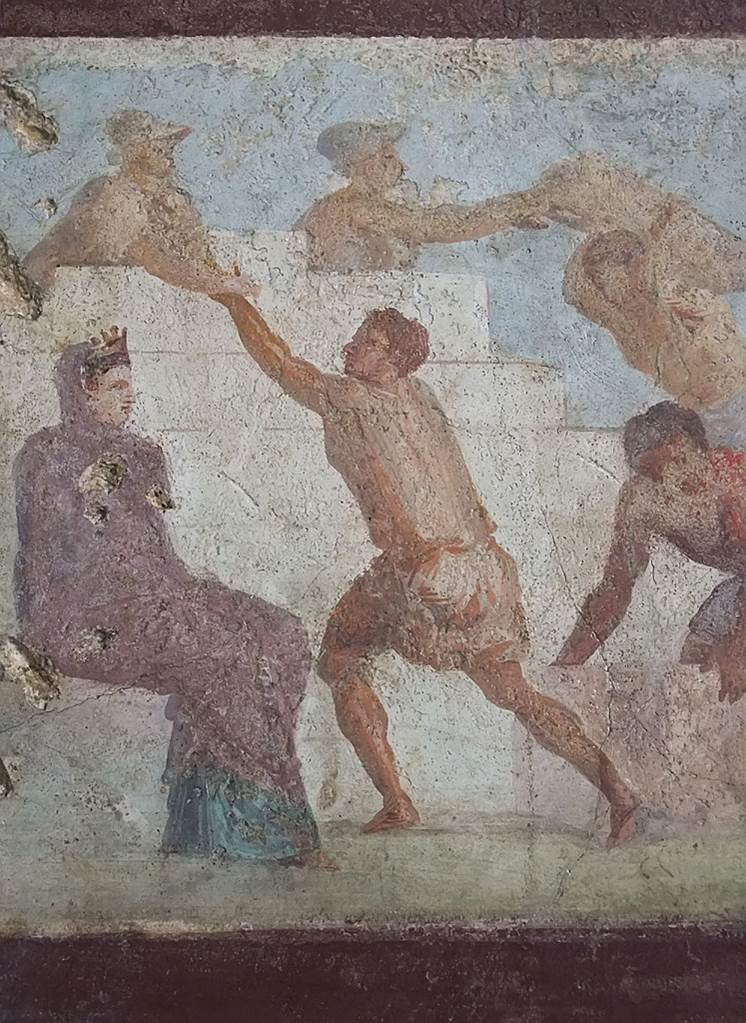
A nice parallel to the Virgil Passage:

Capture

Part of the fresco narrative the origins of Rome from the family tomb of T. Statilius Taurus on the Esquiline.  Now on display in Palazzo Massimo.

Update 27 February 2014: Note this turreted goddess on Sicilian coinage, Acra (SNGANS 902):

obverse

Uncomfortable Texts

Image

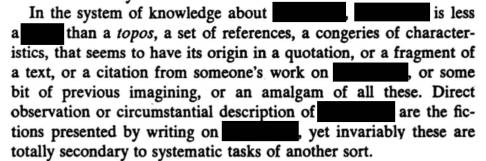
I am staying in the home of some lovely Ottoman scholars.  Thus I picked up Yeğenoğlu’s Colonial Fantasies to read with my grilled cheese (as ya do).  First, it had me wondering what parts of our other travel blog or even this blog or my social media feed might unwittingly be perpetuating Orientalist dialogues, patterns, topoi etc.  Something like an antiquarian curiosity had me reading a Social History of Ottoman Istanbul before bed of late.  Even that book itself — although careful to distinguish between its bedrock of in-culture sources and outsider perspectives and speculations — still seems ready fodder for such curiosities, turning the city and the history into a spectacle for a new crop of Anglophones eager for tales of the mysterious East.

Then, I came across the Said quote above.  Reading it in Yeğenoğlu‘s context, I suddenly stopped seeing the word Orientalism and in its place saw Classics.  How often I find myself drowning in footnotes of detail.  Crafting my cross references at times with more care than my own reactions or observations.  Those are nothing without the substructure of  academic scaffolding.

122 thru 127 out of 410 days: A Little Thought

Most all my time is spent on learning Turkish: writing little essays on my last holiday, constantly comparing the grammar to Latin, and struggling with vocabulary.  Tonight we came home in good spirits from the class and a fun exchange with our vegetable seller.  I put on Cicero’s On the Nature of the Gods on Librivox while cooking dinner.  Normally we listen together to such things at bedtime, and usually Greek or things I’m unlikely to ever write about.  I do enjoy just listening sometimes, remembering that my ‘primary evidence’  is good literature too.  It occurred to me that if I needed a little break from Turkish Cicero might keep the mind ticking over in a useful way hands free.  So… the spinach is sitting half washed in the sink and i’m in my new office at my new standing desk trying to spit out a little thought:

atque haut scio, an pietate adversus deos sublata fides etiam et societas generis humani et una excellentissuma virtus iustitia tollatur.

I do not even know, if we cast off pietas towards the Gods, but that fides, and all the societas of human life, and that most excellent of all virtues, iustitia, may perish with it.

The article I just sent off said a good deal about representations of fides on coins.  I’m struck here by the connection of it with societas generis humani.  The L&S (no OLD with me in Turkey, I will confess!) says of societas:

implying union for a common purpose; cf.: conjunctio, consociatio; and not a mere assembly; cf.: circulus, coetus; conventus, sodalitas; freq. and class.

 The Cicero passage surely supports this implication.  My attraction to the passage is that it gives a nice illustration of how fides is associated with divine bonds in human society.  It demonstrates how the ‘virtue’ is conceived of in a foundational manner, of practical significance to all associations. but also more than practical, something dependent on the sacred as well.

Anyway, spinach awaits.  After the exam (my first in how many years I dread to think?!) we’re going to pop out east to see a ruin and museum or two for 48 hours and then straight on with the coin book.  I finished the book review Friday and tweaked and sent it off Sunday, so it’s not ALL been Turkish.

anon.

120 and 121 out of 410 days: Very Punny Names

Reverse of RRC 141/1. 1944.100.235


Crawford says of this coin:

Image


This type of logic permeates RRC.  Given enough time with the series one starts to think that this type of symbolic language must have been pervasive at Rome.  But is this actually how people thought?  Are the name plays obscure or obvious to their audience? Is it a Roman phenomenon or something much wider?

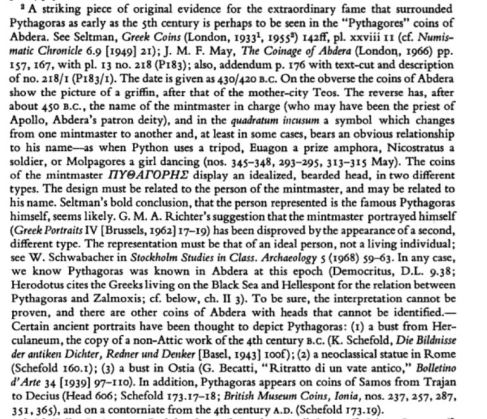
Yesterday (because of the book review I’m diligently working at), I was thinking about the legacy of Pythagoras.  Not a figure I can say I’ve cared much about in the past, beside mentioning the legendary connection to Numa in some of my classes or this rather fun video. Of course, he shows up on some provincial coins of Samos.  But I was surprised to learn that May thought there might be a fifth century portrait on a coin from Abdera.

Here is what Burkert, Lore and Science in Ancient Pythagoreanism, 1972, p. 110 says:


Image


I’ve singularly failed to find you an image of this coin.  And after ‘wasting’ a hour and a half plus looking for it (and in the mean time getting rather visually acquainted with the mint of Abdera — what a great series!), I decided that it had nothing to do with the review or the book and so I’d better drop it.  The only tangential connection is this use of visual puns on the moneyer’s name.  Take for instance this beauty:

The moneyer, Dionysas, has the head of Dionysus.  And here’s Python and his tripod:

Silver coin.The British Museum has their whole (?) collection of Abdera coins up with photos.  It’s a great shame its not searchable by inscription and May number.  [The ANS has the May numbers, but few images and the legends are not transcribed.]  A look through the BM collection suggests straight off that not all images are naming puns, even if some certainly are.

Did real people think like this or was this a coin designers’ game?  Enter, Timeaus (via the anonymous author of On the Sublime):

Observe, too, his language on the Athenians taken in Sicily. “They paid the penalty for their impious outrage on Hermes in mutilating his statues; and the chief agent in their destruction was one who was descended on his father’s side from the injured deity—Hermocrates, son of Hermon.”

Or Timeaus via Plutarch:

Indeed, he often lapses unawares into the manner of Xenarchus, as, for instance, when he says he thinks it was a bad omen for the Athenians that Nicias, whose name was derived from victory, declined at first to head their expedition; also that, by the mutilation of the “Hermae,” Heaven indicated to them in advance that by the hands of Hermocrates the son of Hermon they were to suffer most of their reverses during the war; 

This is prophetic, symbolic thinking, not iconography, but nonetheless I detect a similar type of name=symbol association as we find on the coins.  Perhaps we could marshal Timeaus as part of an argument for decode-ability of the logic behind our numismatic symbols.   And perhaps Abdera + Timeaus = some background to just what exactly the Roman moneyers thought they were communicating with their symbolic language.

—

Update 5/19/14:  An old piece of scholarship that does a fine job of surveying the use of visual puns in media other than coins.


112 thru 117: A “Loyal” Return

Image

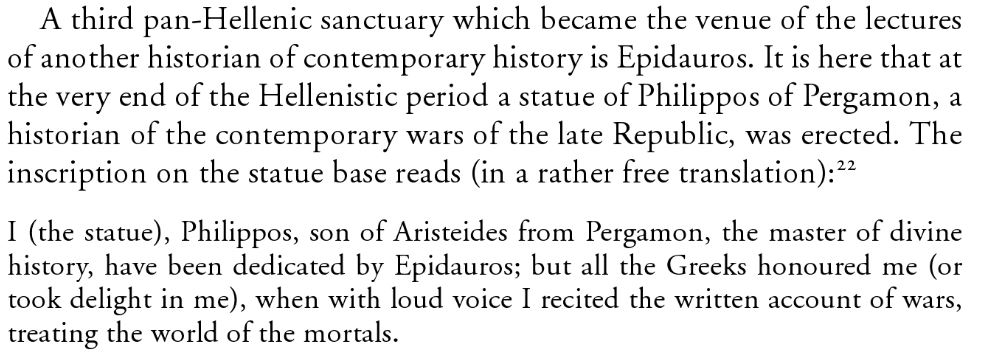
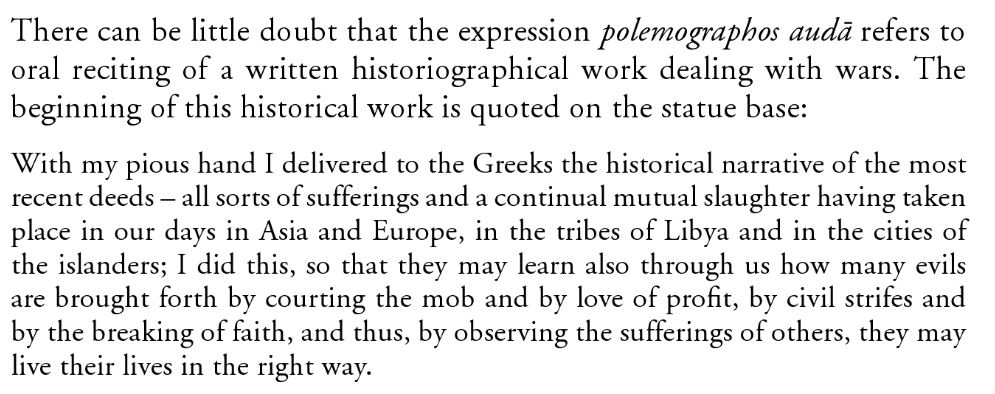
The ‘intensive’ Turkish language class and bureaucracy have occupied much of the last week, but now as the Kurban Bayrami festivities begin our lives are settling down a bit.  The language class is certainly part of my professional goals for this sabbatical, but as it doesn’t touch on my research and writing directly I don’t find I have much to say about it. I set a simple goal of reading two chapters a day of a book I’m reviewing and writing notes there on in order to have a draft of the review by next Sunday.  This should allow plenty of time for flash cards and grammar exercises and perhaps even some more bureaucracy, if any offices are open.  It should also let me blog here a bit about the material, like the inscription above.  Here’s a recent translation:

ImageImage


Here’s the link to the translation source and here’s an even more recent discussion.  There is controversy over the date: Late Empire? Late Republic? The latter is more favored at the moment.  The passage is often discussed regarding the role of the historian in society and how histories would have been experienced by contemporary audiences, i.e. reception in antiquity.  What caught my eye was the list of things that cause problems in societies, the understanding of which will be beneficial to the audience of the history:

  • popular politics
  • greed
  • infighting
  • AND loss of trust (pistis)

It’s the last rhetorical point that resonates with numismatic imagery and more.  In the passage infighting (staties emphulioi), i.e. conflict between kinsmen, those who should be ‘natural allies’, is juxtaposed against the idea of a loosening loyalties (pistion katalusies), implying, perhaps, that the latter refers to external treaties or agreements, interstate affairs.  The first pair similarly contrasts poor and rich.  The poor should be stirred up to want undo societal influence, but equally the rich should not seek to become richer still. Harmony within a community, perhaps, depends on these two precepts (homonoia, the rhetorical opposite of statis).  

This started me thinking about how Homonoia (= concordia) and Fides (= pistis) have a strong overlapping iconography, most obviously the joined right hands. 


The joining of the right hand is so much a part of the iconography of each abstract ideal that when unlabelled we should perhaps read both ideas instead of just one alone:


The question of course becomes how far back should we read the development of this overlapping and sophisticated icongraphic rhetoric:


102 thru 111: The Great Hiatus

Image

In preparing to relocate continents it seems sensible to do the rounds of one’s healthcare providers.  It is NOT sensible to let your dentist drill into your teeth 24 hours before your flight.  A school girl error really.  I’m not that experienced with matters of the teeth having never needed any serious prior work.  A week on we’re settling into Turkey but my jaw still aches.

The jet lag is the worst that I’ve experienced, but the house is lovely and I sent off the chapter to my editor yesterday.  It was basically no different than the draft as it stood before the drilling but I didn’t trust myself to let it go.   We began intensive Turkish Friday.  Four hours every afternoon for 20 sessions.  Being an elementary student again will certain inform my teaching next fall.

More anon.

A travel blog by both of us is in the works.  This will remain primarily about work.

99, 100, 101 out of 410 days: The first Imperator, or ‘EMBRATUR’

Obverse Image

Back on 14 August 2013 I was rambling on about Sulla’s numismatic peers especially in relation to the use of the self-identifier IMPERATOR.  I’ve always been a little uncomfortable with the first instance of this honorific on coins being attributed to Fimbria.  Not that after murdering his commander and taking his army and sacking Troy I thought he wasn’t an arrogant enough @$$hole to do so.  [I really dislike Fimbria: he’s my least favorite Roman and they were generally a bad lot.]  It’s just he didn’t strike me as very creative or trend-setting.  Why would Sulla be copying him?  Did they really come up with it each independently?  Well, turns out we have C. Papius C. f. Mutilus to thank for this innovation.  Yup.  That’s right.  One of the most notable of the Social War generals.   A Samnite enemy of Rome eventually defeated by Sulla.  His coinage is pretty famous too:

So it doesn’t really say Imperator as that’s Latin.  It says, reading right to left, EMBRATUR, in Oscan, but the title has the same meaning in a  very closely related language and cultural milieu.

The coins struck in Mutilus’ name use the same types as those used by the Marsic confederation and are clearly part of the same series, but Mutilus’ ability to use the coinage for the promotion of his own standing and especially his honorific title clearly had a lasting impact.

[A. Burnett raises the possibility of Mutilus inspiring Sulla briefly in general terms on p. 170 of his ‘The coinage of the Social War’ In Coins of Macedonia and Rome: Essays in Honor of Charles Hersh, edited by A. Burnett, U. Wartenberg, and R. Witschonke, 165-172. London: Spink)]

***

I’m rushing to finish a chapter prior to leaving for Turkey and am generally frantic, but this observation was so fun I couldn’t not share!

95, 96 out of 410 days: Divine Abstractions

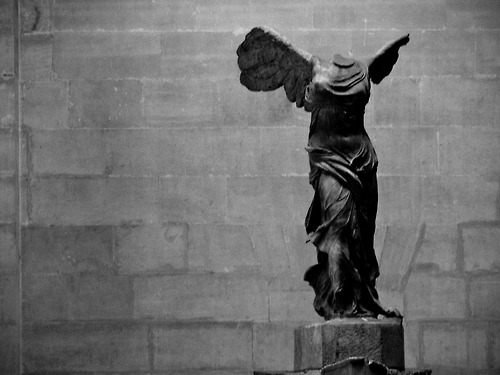
There is a good deal of concern and attention paid to the divine honors given to the personification of abstract concepts.   The habit has it origins in the Hellenistic period.  Think of the Nikes we’ve seen, not to mention much more famous examples:

Victory of Samothrace

All of these turn the idea of ‘winning’ into a goddess who can not only be represented in art but also given cult honors, from temples to sacrifices to prayers and hymns.  The Romans took this practice to great heights.  Click on that link “care and attention” above for discussion.   Of course they did not have a monopoly, but we usually think of them influencing their neighbors.  We’ve seen the Locrians representing Pistis (= Fides = Loyalty) crowning Roma before.  Strangely that coin isn’t usually discussed in context of the coin above also minted at Locri.  It represents (and labels as such) the goddess Eirene (= Peace).  The style of the reverse is modified from the coin of a neighboring town:

Reverse Image

Yes that’s a Nike on this AR Stater, Terina, Bruttium, 400 BC-356 BC.  The bird is a rather different attribute. Something to chase up another time…

What the Eirene coin does is contextualize the Pistos / Roma coin by letting us know that the Locrians are already well versed in thinking about abstract divinities: they don’t need the Romans to help with that.

Pax won’t show up on Roman coins until 82/81 BC at the earliest:

The identification of the obverse here is far from certain.  The first secure appearance isn’t until 44 BC and the is a very rare coin indeed:

Pax may not have had a cult site in Rome until the Ara Pacis!