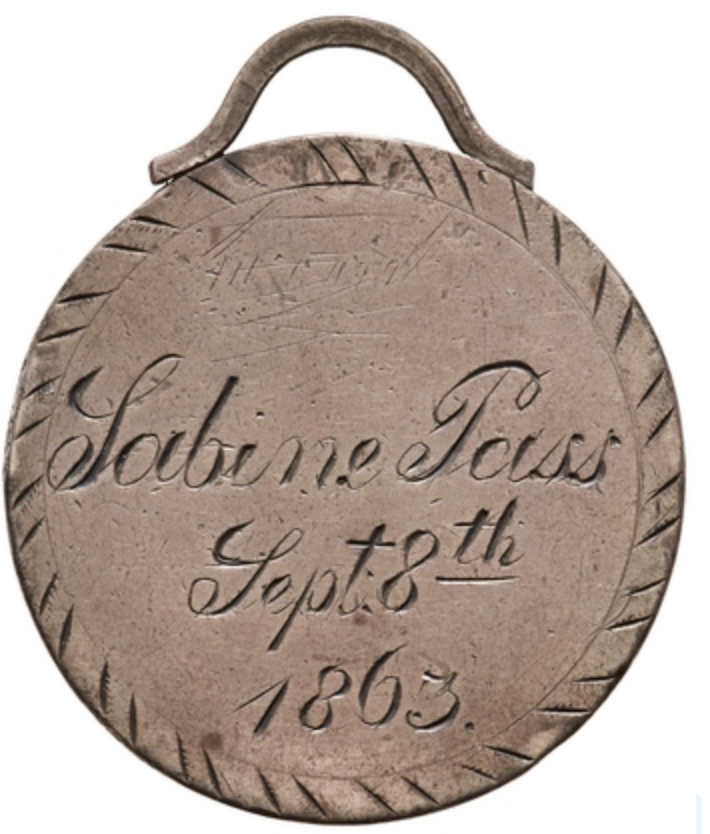
Sabine Pass

ANS specimen

Sometimes there is a danger of learning something completely unrelated to Greco-Roman antiquity when using a coin database.  I searched “Sabine” expecting to return RRC 344/1 [I was thinking about the iconography of two figures carrying two other figures].  Which the search did, but I also got back a handful of medals like the one above.

The Second Battle of Sabine Pass took place on September 8, 1863, and was the result of a Union expedition into the Confederate state of Texas during the American Civil War. It has often been credited as the most one-sided Confederate victory during the conflict.  …

… In recognition of the victory, local residents smoothed off Mexican dollars, stamped them with the battle and date, plus individually the name of each soldier, hung them on green ribbons and presented them to the troops. Approved by the Confederate Congress, the Davis Guards Medal is believed to be the only official military decoration issued by the CSA [wikipedia]

Needless to say anything that rare and historic is likely to inspire forgeries.   A number of the specimens in the ANS collection have notes saying such and such cast doubt on the authenticity of the specimen.  Here are all the ANS specimens together.  Interestingly only the ones with soldiers’ names are listed as possible forgeries.

The coin conversion is particularly interesting to me.  I’d also love to know who and when named the pass and the adjoining Sabine Lake.  The habit of naming places with Classical allusions is one I associate most strongly with New England, especially Upstate New York.

Catanaean Brothers

reverse

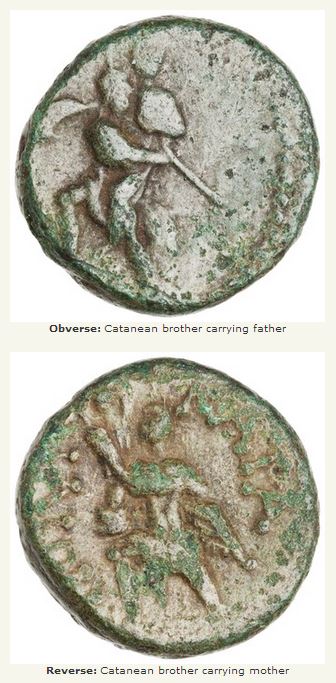
I’m trying to make up my mind whether I think RRC 308/1 represents one of the Catanaean Brothers as most scholars think or if I am swayed at all by Evans’ claim that it is really Aeneas. Above is a coin of Catana showing the brothers.  Here is the Republican coin:

Reverse of Silver Denarius of M. HERENNI, Rome, 108 BC - 107 BC. 2002.46.104

There two literary accounts of the  brothers.  One is Hyginus’ list .  I give the two proceeding entries and the two after for context:

[254] CCLIV. THOSE WHO WERE EXCEPTIONALLY DUTIFUL

…
Xanthippe, when her father Mycon was shut up in prison, nourished him with her own milk.
Tyro, daughter of Salmoneus, killed her sons on account of her father.
In Sicily when Mount Aetna first began to burn, Damon rescued his mother from the fire, and Phintias his father, too.
Aeneas, likewise, in Troy bore out from the fire his father Anchises on his shoulders, and rescued Ascanius his son.
Cleops and Bitias were sons of Cydippe, a priestess of Argive Juno.

… 

The juxtapostion and connection of the brothers with Aeneas suggests that in the Augustan period at least they were linked together.  This makes sense in light of Sextus Pompeius Pius’ coin type:

Reverse of RRC 511/3a. 1937.158.342

The other literary source is the anonymous poem Aetna.  The story serves as its closing climax:

Once Aetna burst open its caverns and glowed white-hot: as though its deep-pent furnaces were shattered, a vast wave of fire gushed forth afar upborne by the heat of the lava-stone, just as when the ether lightens under the fury of Jupiter and plagues the bright sky with murky gloom. Corn-crops in the fields and acres soft-waving under cultivation were ablaze with their lords. Forests and hills gleamed red. … They think they have escaped, but the fire catches them: it consumes its prisoners’ booty: and the conflagration feeds itself, set on sparing none or only the dutiful. Two noble sons, Amphinomus and his brother, gallantly facing an equal task, when fire now roared in homes hard by, saw how their lame father and their mother had sunk down (alas!) in the weariness of age upon the threshold. Forbear, ye avaricious throng, to lift the spoils ye love! For them a mother and a father are the only wealth: this is the spoil they will snatch from the burning. They hasten to escape through the heart of the fire, which grants safe-conduct unasked. O sense of loving duty, greatest of all goods, justly deemed the surest salvation for man among the virtues! The flames held it shame to touch those duteous youths and retired wherever they turned their steps. Blessed is that day: guiltless is that land. Cruel burnings reign to right and left. Flames slant aside as Amphinomus rushes among them and with him his brother in triumph: both hold out safely under the burden which affection laid on them. There — round the couple — the greedy fire restrains itself. Unhurt they go free at last, taking with them their gods in safety. To them the lays of bards do homage: to them under an illustrious name has Ditis allotted a place apart. No mean destiny touches the sacred youths: their lot is a dwelling free from care, and the rightful rewards of the faithful.

Can you represent just one Catanaean brother? There are other coins of Catana that show just one brother and parent per side, but they are still both there…

 Image

What would the contemporary Roman have seen?  Perhaps either narrative?  I’m not willing to follow Evans wholeheartedly but some doubt seems warranted.

Postscript.

nec sanctos iuvenes attingunt sordida fata: /securae cessere domus et iura piorum.

The Loeb translation of the poem really doesn’t do justice to the last line and the thematic emphasis of the last word.  PIUS.

Contemplative War Goddesses

File:Acropole Musée Athéna pensante.JPG

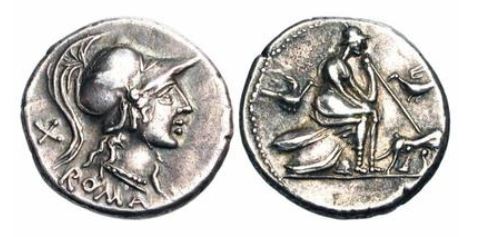
One difference (besides the birds) between the Vespasian restoration and the Republican original discussed the other day  is certainly the posture of the goddess Roma herself.  On the imperial aurei she sits erect with a shorter scepter.  On the republican denarii she leans forward and the spear extends far over her shoulder.   She lets it take her weight.  Her arm which holds it rests on her thigh.  Her gaze is seems full occupied by scene before her.   She is at rest, almost a mournful pose, certainly a contemplative one.  In that, it strongly reminds me of the above Greek relief from Athens in the Acropolis Museum.

The gem, an imprint of which can be seen here: http://arachne.uni-koeln.de/item/marbilder/2688807, does not have the same contemplative pose.  Like on the aurei she sits upright holding her scepter instead of letting it hold her.   The birds are intermittent.  [A. Furtwängler, Beschreibung der geschnittenen Steine im Antiquarium, Königliche Museen Berlin (1896) Cat. no. 9561.]

There is also this gem [http://arachne.uni-koeln.de/item/marbilder/2688808] with Roma and wolf and twins plus tree and Victory, over all a very different composition.


229 out of 410 days: Picus Martius

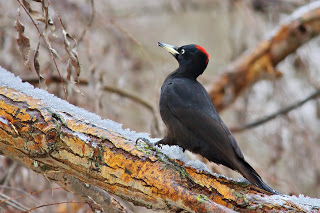
Linneaus that great classifier of living things called this woodpecker Picus Martius, the Black Woodpecker as it’s generally known.   Its modern scientific name is Dryocopus Martius, picus now being used for another genus of the woodpecker family.

But for the classicist the Picus Martius is an important bird.  Ovid puts Mars’ bird, the woodpecker, as a defender of Romulus and Remus on par with the wolf.  (You’ll notice a theme running over the last few posts…)  Pliny has lots of fabulous anecdotes about the bird and its importance in auguries and how it will defend certain flowers or how its beak can be worn as a charm against wasps.  Among other things at NH 11.123 it is described as having a tufted head.

…per medium caput a rostro residentem et fulicarum generi dedit,cirros pico quoque Martioet grui Balearicae, sed spectatissimum insigne gallinaceis, corporeum, serratum…

Not – to be sure – an uncommon trait for woodpeckers and one can see why Linneaus thought the Black Woodpecker a good candidate for Mars’ totemic bird.  I’m sure I’m not the first to deduce this, but I think this is the more likely candidate:

File:Picus viridis sharpei 039.jpg

Today, this beauty is the Picus Viridis or European Green Woodpecker.  The first reason I came to this conclusion was largely based on typical range of the two birds.  The Black is rarely spotted below the Appenines today, where as the Green is known throughout the Italic Peninsula.  Then there is this bit of Virgil:

There Picus, the Horse-Tamer, sat, holding the lituus, the augur’s

Quirinal staff, and clothed in the trabea, the purple-striped toga,

and carrying the ancile, the sacred shield, in his left hand,

he, whom his lover, Circe, captivated by desire, struck

with her golden rod: changed him with magic drugs

to a woodpecker, and speckled (sparsit) his wings with colour.

Of course how do we know that this Picus is Martius Picus?  Well this seems likely from Servius’ commentary:

fabula autem talis est. Picum amavit Pomona, pomorum dea, et eius volentis est sortita coniugium. postea Circe, cum eum amaret et sperneretur, irata eum in avem, picum Martium, convertit: nam altera est pica. hoc autem ideo fingitur, quia augur fuit et domi habuit picum, per quem futura noscebat: quod pontificales indicant libri. bene autem supra ei lituum dedit, quod est augurum proprium: nam ancile et trabea communia sunt cum Diali vel Martiali sacerdote. 

Them Birds

Reverse of RIC II, Part 1 (second edition) Vespasian 954. 1944.100.41630
Reverse of 1944.100.41630: American Numismatic Society

This ‘restoration’ issue of Vespasian takes its inspiration from this republican type (RRC 287/1):

In trade

The literary sources only have woodpeckers associated with the wolf and twins narrative (Ovid, Fasti 3.37 and 54).  One type of woodpecker with a crest was known as Mar’s Woodpecker hence the connection (Pliny NH 11.44).  But that doesn’t mean other birds aren’t found in art.  More than I want to list here. But just as a taster.  Here’s an eagle on a glass paste to which we might compare the Ostian Altar:

Ulvinden med Romulus og Remus. Hellenistisk-romersk paste

And another glass paste with a ‘non-descript’ bird on a grape vine (NOT the ficus Ruminalis then):

Opaque blue glass oval engraved gem

This last is a pretty common type of image.  Sometimes the grape vine has a bird, sometimes not.

Then there are the other republican coins (RRC 39/3 and 235/1) and that mirror we discussed ages ago that should be brought into the discussion but I’ll leave it there for now.  Except for just wondering if this weird BM gem with a mysterious head in the scene might not be Roma’s head, like a reverse scaling of the Roma plus wolf-and-twins motif above:

Sard gem engraved with Faustulus, with a tunic, skin cloak and staff, finding the she-wolf and Romulus and Remus under a rock, above which is a tree and a helmeted head (?).

Update 2/5/2014:  The important bibliography on this is 

A. Dardenay, Les intailles républicaines figurant la louve romaine: essai d’identification des modèles iconographiques.  Pallas 76, 2008, 101-113.

Of course, I had this on file the whole time but didn’t remember the relevance until today….

227 out of 410 days: Confusing Omens, Confusing Cities

Reverse of RRC 472/1. 1944.100.3525


I used to think I was the only person who might mess up Lanuvium and Lavinium.  NOT SO! Apparently Dionysius of Halicarnassus made the same mistake when he told this story:

While Lavinium was building, the following omens are said to have appeared to the Trojans. When a fire broke out spontaneously in the forest, a wolf, they say, brought some dry wood in his mouth and threw it upon the fire, and an eagle, flying thither, fanned the flame with the motion of his wings. But working in opposition to these, a fox, after wetting his tail in the river, endeavoured to beat out the flames; and now those that were kindling it would prevail, and now the fox that was trying to put it out. But at last the two former got the upper hand, and the other went away, unable to do anything further.5 Aeneas, on observing this, said that the colony would become illustrious and an object of wonder and would gain the greatest renown, but that as it increased it would be envied by its neighbours and prove grievous to them; nevertheless, it would overcome its adversaries, the good fortune that it had received from Heaven being more powerful than the envy of men that would oppose it. These very clear indications are said to have been given of what was to happen to the city; of which there are monuments now standing in the forum of the Lavinians, in the form of bronze images of the animals, which have been preserved for a very long time.

Why should we assume he’s wrong?  Or at least that the attribution of this prophecy is disputed? Whelp.  The obverse of the above coin looks like this:

Obverse of RRC 472/1. 1944.100.3525


That’s Juno Sospita, the patron goddess of Lanuvium!  The moneyer’s family is well known for celebrating their connection to this city on their coins.  If there was a statue that looked like the reverse, it probably stood in that forum, not at Lavinium.  Add in this tantalizing bit of Horace:

Bk III: XXVII Europa

 Let the wicked be led by omens of screeching

from owls, by pregnant dogs, or a grey-she wolf,

hurrying down from Lanuvian meadows,

or a fox with young:

And we can be pretty sure that Lanuvium that claimed the she-wolf and by extension the eagle as prodigies of its foundation.  

It’s also a nice example of the wolf as a non-Roman, but still Latin, symbol, one that is morphed into a proto-Roman symbol through its alignment to the Aeneas narrative.

Pity its too late for the book.  Thank goodness for this blog as a thought dumping space.

[Refs found at Crawford 1974: 482]


219 out of 410 days: The Roman Pound

Update: since writing this post some 5 years ago I’ve continued to work on the problems of the pound. Related posts.

I also recommend Riggsby’s Mosaics of Knowledge (OUP 2019).

Image


My concerns about Duncan-Jones’ potential overconfidence in his knowledge of the exact weight of the Roman pound (322.8 grams) and thus his reading of Pliny’s famous statement about 84 denarii to the pound (Money and Gov. 1994: 214-215; NC 1995: 110), led me to the publication of the above objects.  It also made me very sad to have missed this conference.

Anyway, the thing about the big post-Constantinian weight above that seems striking to me is just that its weight, or more accurately its Mass.  1645 g.  It’s high.  And given things like corrosion we’d generally expect these things to be a little on the light side.  It is clearly marked with its standard: 5 pounds.  That makes 329 g to the Roman pound!  See this recent discussion about the problem from a Byzantine perspective.  A conservative ball park is usually 325 to 327 g for the Late Roman/Byzantine pound.  

It’s a huge shame that the weight doesn’t have provenance: no mention of who current owns it and only very vague references to the eastern Mediterranean as to its find spot.

—

Here’s Pliny’s quote just so you have it:

In spurious coin there is an alloy of copper employed. Some, again, curtail the proper weight of our denarii, the legitimate proportion being eighty-four denarii to a pound of silver. In consequence, a method was devised of assaying the denarius: the law ordaining which was so much to the taste of the plebeians that in every quarter of the City there was a full-length statue erected in honour of Marius Gratidianus. (Pliny, Natural History 33.132)

213 out of 410 days: Mars or Achilles?

capture.jpg
capture.jpg

I’ve been writing too much to write here.  Rather ironically it is a brain befuddled by a respiratory infection that brings me back to blogging.  

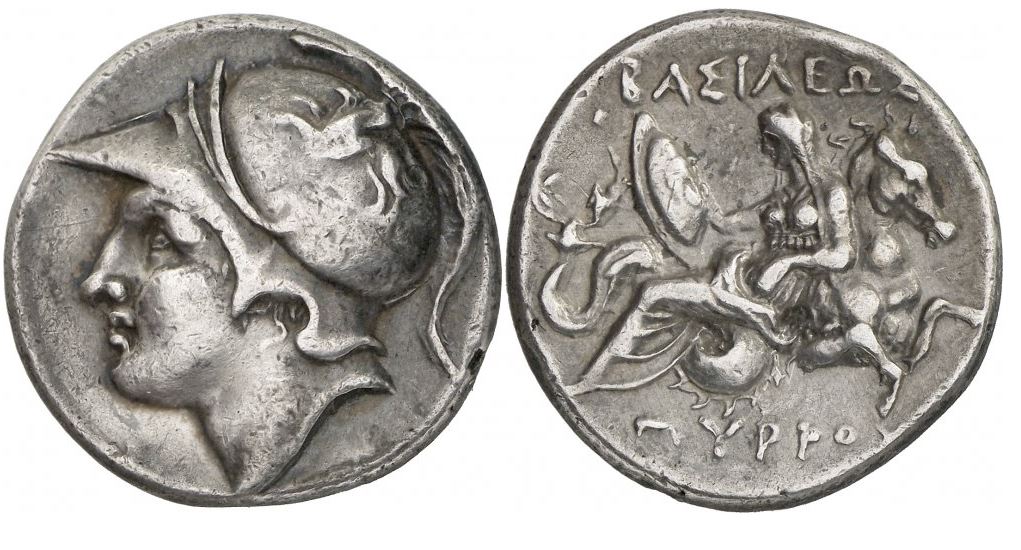
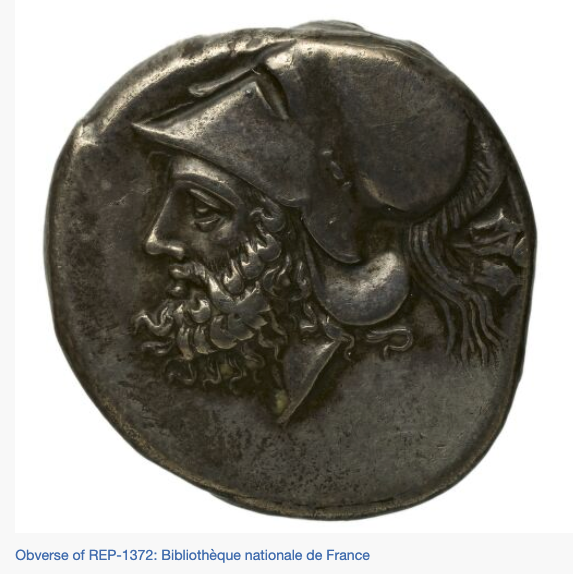
I have already talked about the second coin type illustrated above.  It was produced by Pyrrhus and is said to represent his claim to have Achilles as an ancestor.  Thus the obverse is usually identified as Achilles.

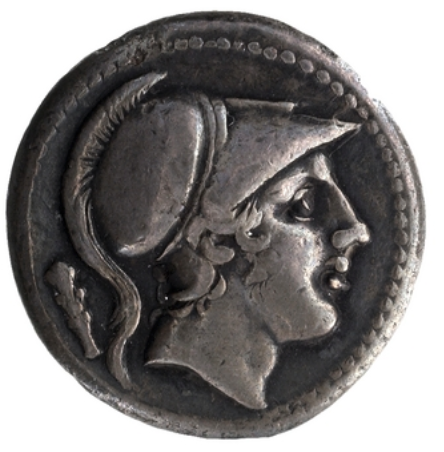
The top coin is a Roman didrachm (RRC 25/1).  There is a another series (RRC 27) that is usually dated a little after with a similar head:

The Roman coins are invariably identified as Mars.  The logic is really no more complicated than this: Helmet = War Deity –> Male War Deity = Mars.  This Mars just happens to be beardless as compared to earlier bearded Mars (RRC 13/1):

[This is by our best reckoning the first silver Roman coin.]  Or later bearded Mars like these beauties:

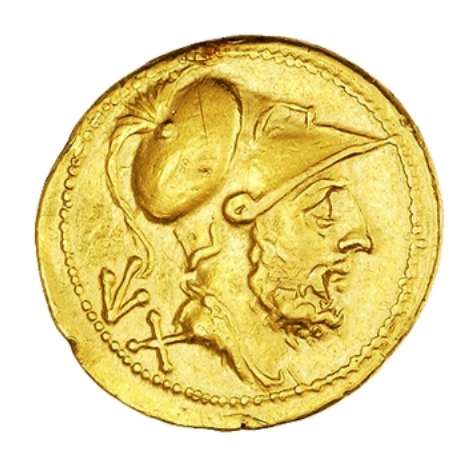
But if we go back up and look the ‘beardless Mars’ of the Roman coin and the ‘Achilles’ of the Pyrrhus coin, I think you’d agree we’d be hard pressed to actually claim there is any iconographic difference.  They match pretty well in their rugged Hellenistic faces and even share the griffin motif of the helmet.  We need not make too much of that.  griffin appear on Corinthian helmets in this position on and off in Hellenistic coinage, regularly enough that we don’t need to attribute special significance to it.  Here’s a specimen from Syracuse.  And a gold Alexander stater of Sidon.

Are the two separate identifications warranted even with the close iconography?  Probably.  The Achilles attribute rests on the Thetis image on the reverse and the mythical connection.  If Rome copied the image or they simply share some common prototype there is no reason to think that it would be mean anything other than male war god, i.e. Mars to a Roman audience.

Update 2/5/2014:  A. Burnett, The Iconography of Roman Coin Types in the Third Century BC. Numismatic Chronicle 146 (1986) 67-75:


Capture

Capture1

Broken links/images fixed 7/14/26.

204 out of 410 days: How much work is involved in a die-study?

Image

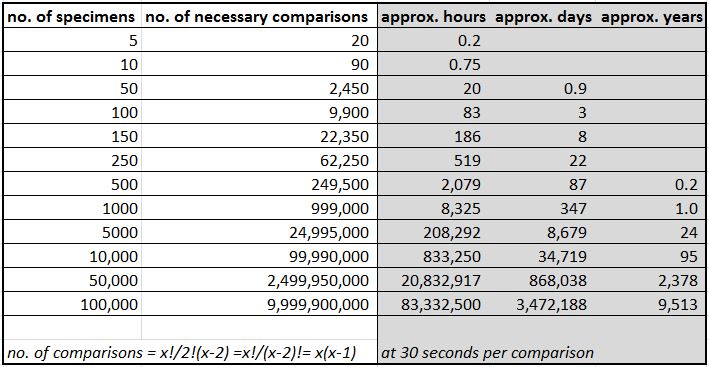
Yes, 30 seconds is an arbitrary number.  Many comparisons will be much faster, after much longer.  And, no consideration is given to the collection of the images for comparison.  But,the numbers a still good to think when consider what sorts of studies are feasible until a meaningful type of machine assist is developed or just the work involved in any individual project.

So for instance, I supervised a masters thesis that was a die study of 383 specimens.  If the student had take a full 30 seconds on each comparison that would have been nearly 153 8-hour work days, nearly half a year.  Not counting the write up.   [The chart above using 24-hour days.]  Obviously, on the republican series certain variations within a type, especially control marks when present, can speed up a die study, but even such sorting requires individual consideration and intense record keeping.   Without such control marks limiting the number of comparisons required, De Ruyter’s 1996 study of the Coins of L. Julius Bursio would have required upwards of 5,287,700 unique comparisons (NC 156: 79-147).