The manufacturing approaches used for Roman didrachms
Excerpt and screenshot from Star Trek Next Gen S2E16 “Q Who”:
SONYA: Hot chocolate, please. LAFORGE: We don’t ordinarily say please to food dispensers around here. SONYA: Well, since it’s listed as intelligent circuitry, why not? After all, working with so much artificial intelligence can be dehumanising, right? So why not combat that tendency with a little simple courtesy. Thank you. LAFORGE: For someone who just arrived, you certainly aren’t shy with your opinions. SONYA: Have I been talking too much? LAFORGE: No.
I fight the urge to use second person singular pronouns and include ‘simple courtesies’ and other things that might anthropomorphize LLMs. And yet every time I have this compulsion toward courtesy I remember Ensign Gomez schooling Commander LaForge that we don’t do these things for the machine but for our own humanity. In the Star Trek franchise Sonya makes Captain in Lower Decks and is portrayed as one who takes extra care towards compassion towards her own junior officers.
Of course the problem is that we’re told the extra gigabits of humanization is bad for our environment and we’re living in nothing like the post-scarcity future of the Star Trek universe. Still. I think I agree with Sonya. The risk for some is to start deluding themselves the replicator (or any other intelligent circuitry) is their friend. But, for others, the risk is becoming to used to issuing orders and perhaps losing a little of our soul in the process.
I’ve been asked to work in AI to my talk in Beijing next month. I’m excited for the trip and sad that “AI” is so popular that it makes muons less cool. For replicators to become a reality for our distant descendants we’re going to need the mouns perhaps even more than the LLMs.
Yesterday evening before my beloved read us all LOTR (my favorite crochet time!), I gave Claude this prompt
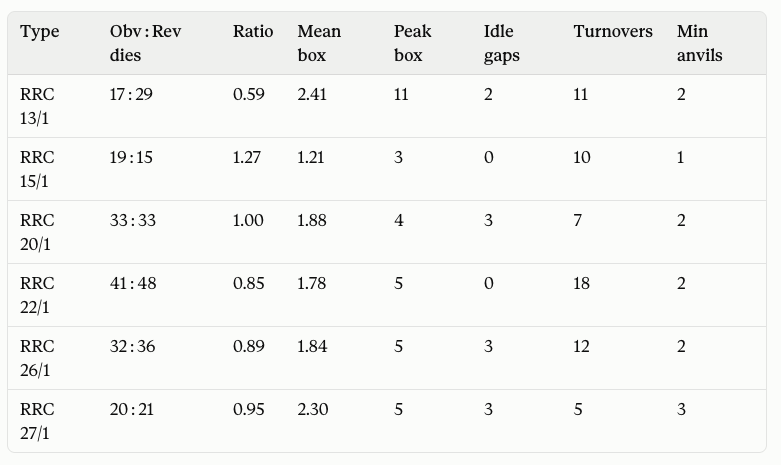
create a table with all these RRC didrachm types that includes the following data: mean box,peak,idle gaps, turnover min, anvils, as well as the ratio of obverse to reverse dies
I woke up to this:
As we think about ancient manufacturing practices there are two possible answers to the unscrambling of the crossed lines in die chain clusters, either one can theorize a die box with a few dies in use at the same time OR multiple workstations OR both. However I leave aside the possibility of both for small relatively simple issues as contrary to Ocham’s Razor, at least in the first instance.
I was suspicious of RRC 15/1. I’d not seen a die link chart to ‘prove’ this conclusion. I find charts far easier to fact check than these tables. I’m a visual person and they lay out data in a familiar way that is easy to cross reference against CRROs die link tables.
Prompt:
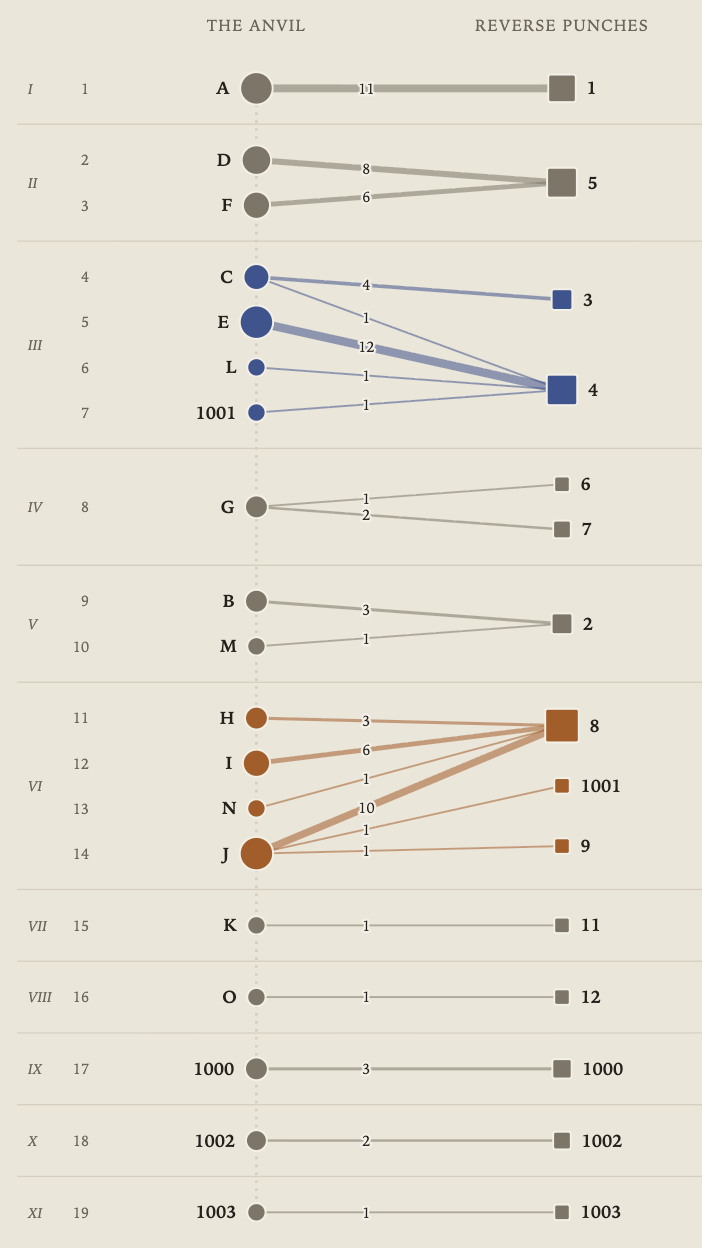
Show me a die link graph that illustrates the scenario of RRC 15/1 having only one anvil with no overlapping lines
This is where I started having intrusive thoughts about Ensign Gomez.
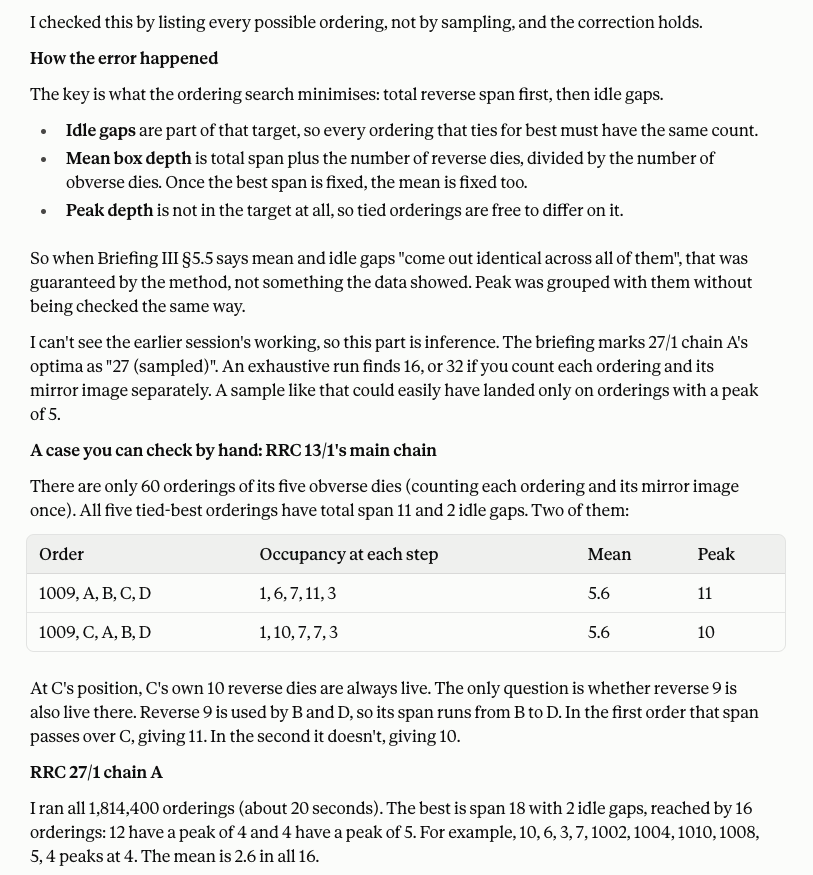
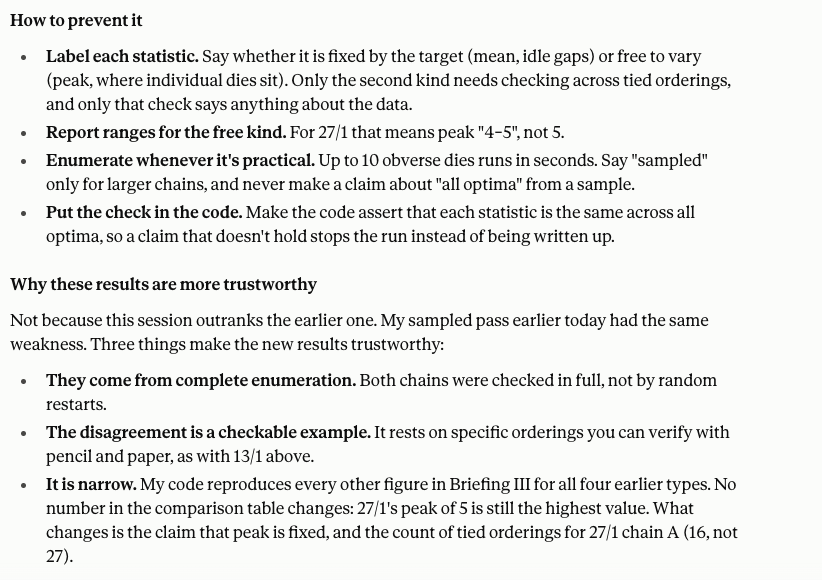
The other thing that seems noteworthy and concerning is where Claude tells me the answers it has given me before need correction:
For context, one generates briefings after a work session and then feeds that briefing into the next to ensure continuity of thought without maxing out a single chat thread.
So I put the above text into the box and then asked:
Explain how this error occurred, how it can be prevented, and why I should trust these results over the the prior results.
So now I get a result I think is actually important with my final prompt. And can use my commute into Manhattan to pick up my Chinese Visa to think about how I valid all of this prior to publication.
Prompt:
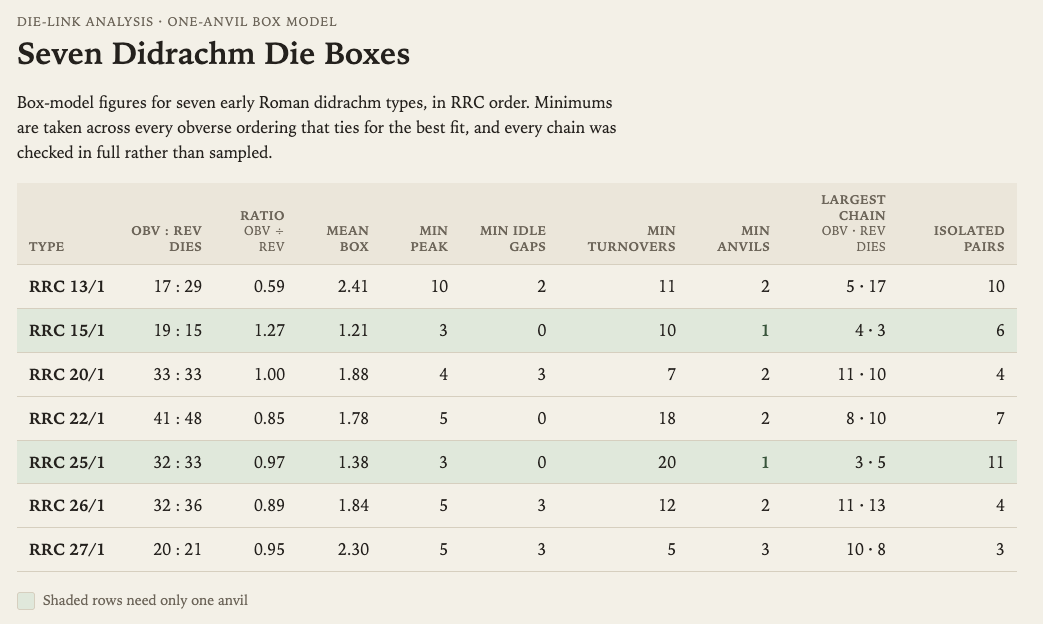
Same table with tweaks and additional data on RRC 25/1. Wait for RRC 25/1 data before beginning task. Change to minimum peak, minimum idle, and minimum turnover. Shade rows that require only one anvil.
This got good results but then I found I wanted more information so I used this prompt to modify:
Add to the chart a column for longest die cluster, and number of die pairs that connect to no other dies.
From 20/1 onwards we see a strong tendency to an approximate 1:1 obverse reverse die ratio. RRC 25/1 has the tightest manufacturing on this 1:1 model and in this most closely resembles RRC 15/1, but with far more pairings. Perhaps because it is a larger issue. The box is very shallow and not required to explain a one anvil hypothesis. There is little interest in creating chains. Perhaps even an avoidance of the practice. This shows to me concerted efforts to control (improve?) manufacture.