Yesterday, I was checking a reference to another occupational relief in this same 1877 German journal. When this figure at the table caught my eye. So I thought I’d let myself track it down this AM.
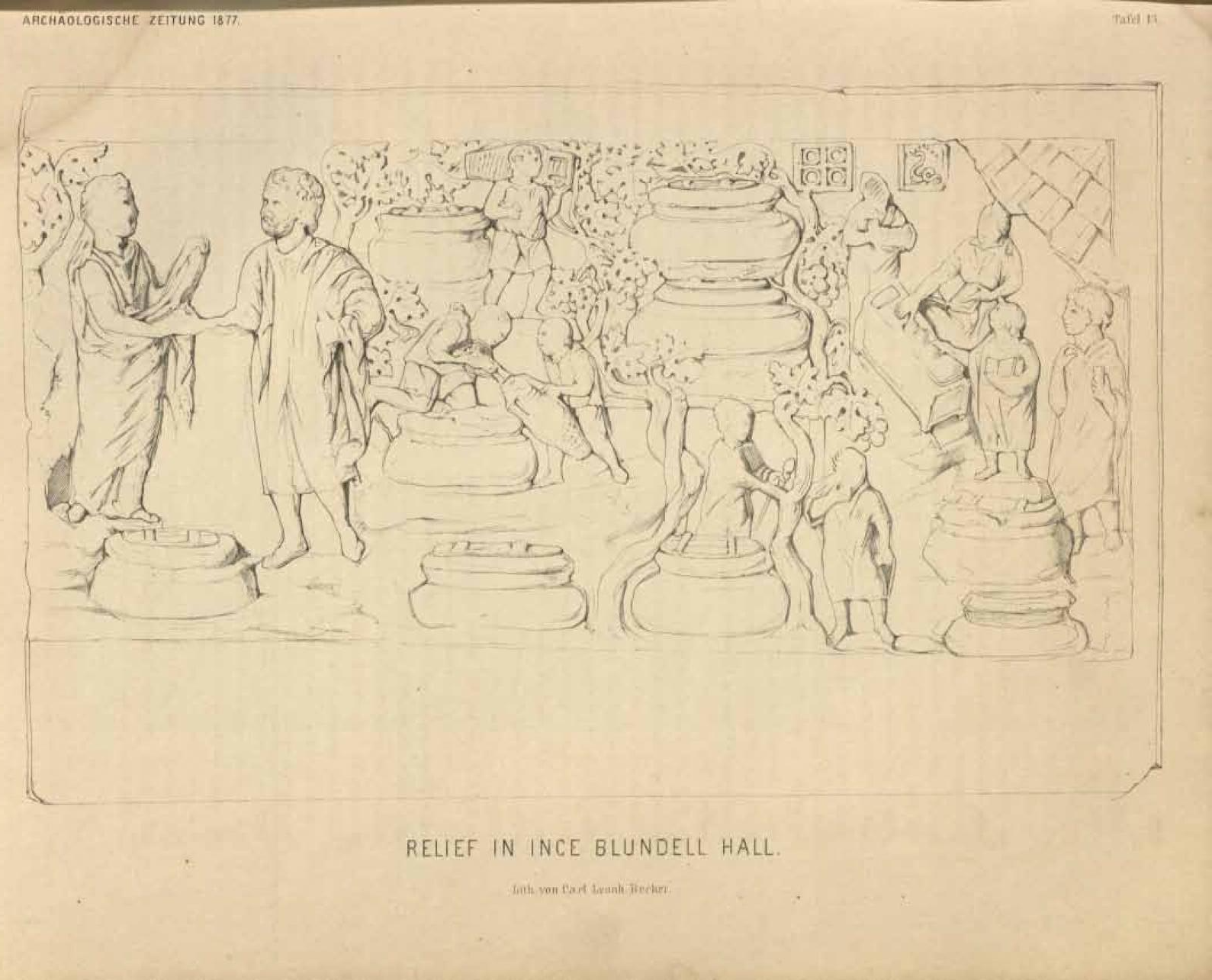
The drawing is fairly true to life it seems. The object is not on display but is well catalogued on the Liverpool National Museum (no. 59.148.298) with its appearance in modern publications.
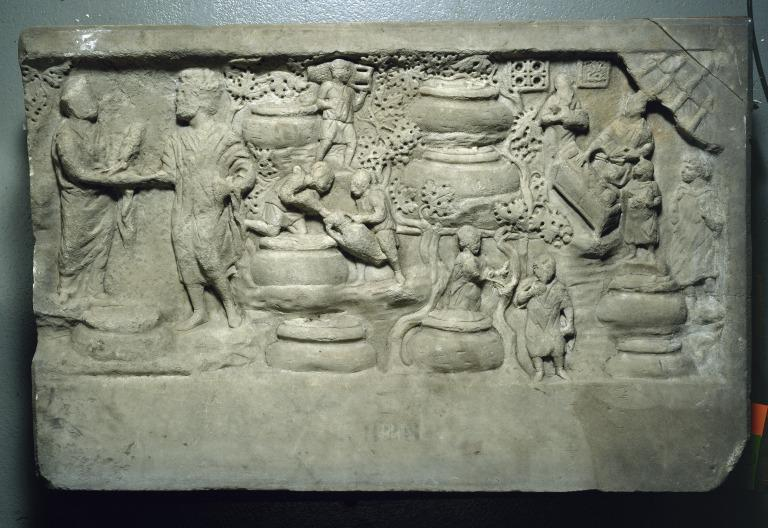
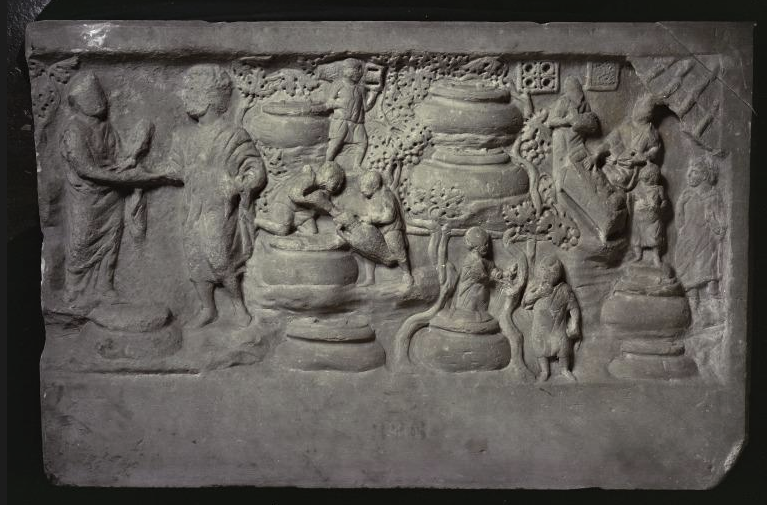
Points that interest me.
Lids on Dolia apparently of wood.
The foreman with a book standing on the lid of a dolia to supervise activities
The offering of a taste
The filling of an amphora (from the dolia?)
The window, do the circles help us see the merchant is rich enough to have glass in his windows?
The snake as a stand in for the lararium and the piety of the operation.
The way the scene alludes to both indoor and outdoor work. Notice the roof on the far right as an indication of spatial transition.
I concur that the figures on the left are likely the married property owners rather than the woman being a customer. Notice the joining of right hands.
The website of the museum says that the man at the desk is likely the merchant. I doubt this. Rather I think it shows the employment of bookkeepers and overseers.
—
If I return to this I must check this book.
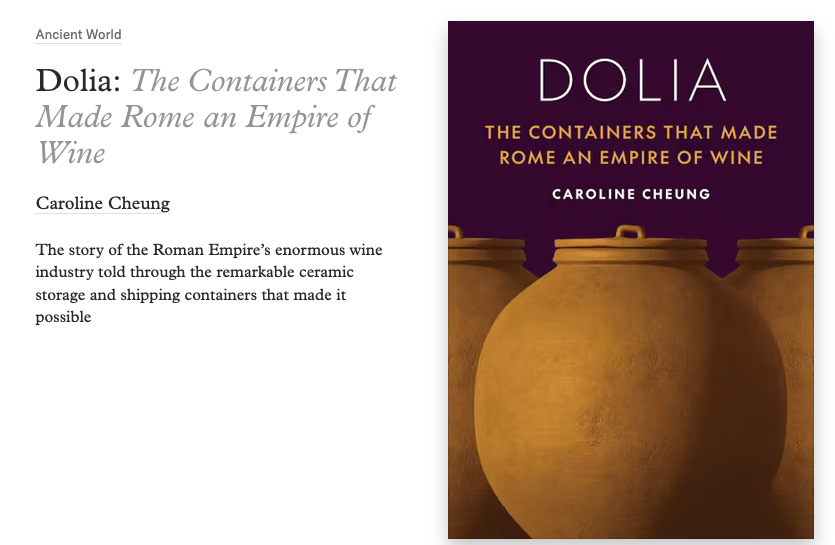
—
keywords: vinter, wine merchant, harvest
—
Flashback.
In 2018 about this time I was was worried about hammers on coins. In fact that post was commenting on an earlier one from 2013. I was wrestling with symbols on early denarii issues as possible canting puns for moneyers and Russo’s redating of some bronzes.
At the time of writing I didn’t know this publication:
Padilla Peralta, Dan-el. “Hammer time: The Publicii Malleoli between cult and cultural history.” Classical Antiquity 37, no. 2 (2018): 267-320.
we also had not digitized Schaefer’s archive yet with the help of the Arete foundation and ANS and what would become RRDP.
The weird obverse I was discussing I would now call obverse no. 3: