

I”m usually circumspect about stuff that appears in trade for fear that I will inadvertently effect (or worse, encourage) sales. Trade happens. I will not be ignorant, but I will be careful. This sale gets a post even quoting the sales catalogue because multiple examples of this type that is missing from RIC have come to light in the last twenty years, most brought to market by one auction house.
Was there a new hoard discovered by a metal detectorist and these civil war rarities are being dribbled on to the market? Have we seen an increase in other civil war coinage in the market that might confirm this? I”m not going to look into it at least not any time soon.
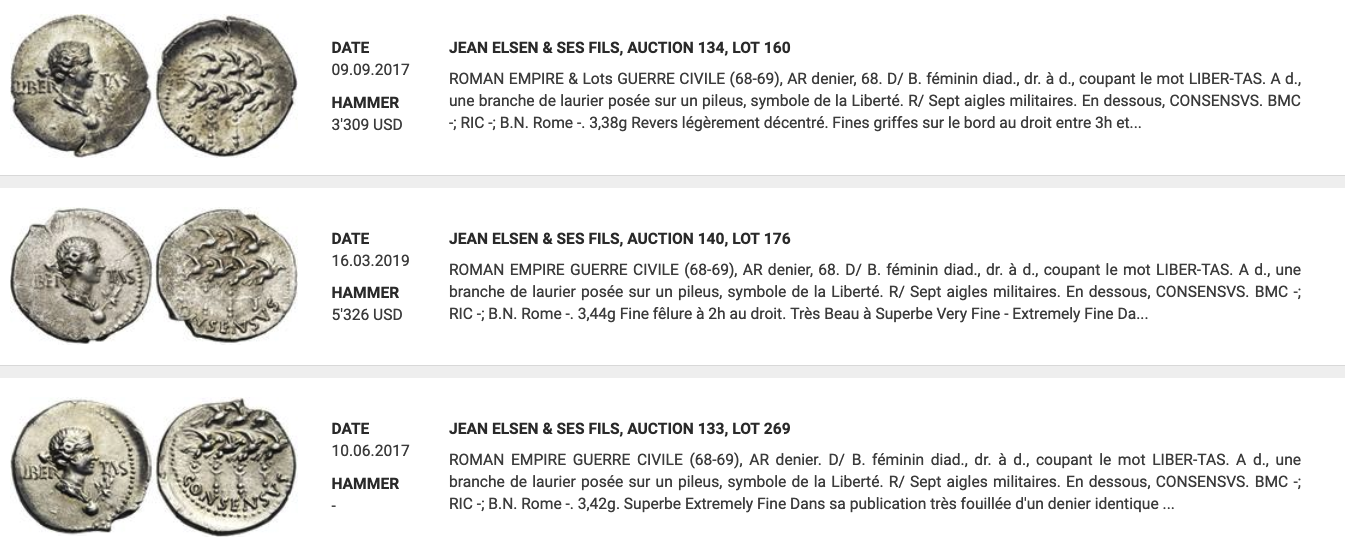
ROMAN EMPIRE & Lots GUERRE CIVILE (68-69), AR denier, 68. D/ B. féminin diad., dr. à d., coupant le mot LIBER-TAS. A d., une branche de laurier posée sur un pileus, symbole de la Liberté. R/ Sept aigles militaires. En dessous, CONSENSVS. BMC -; RIC -; B.N. Rome -. 3,38g Revers légèrement décentré. Fines griffes sur le bord au droit entre 3h et 6h. presque Superbe about Extremely Fine Dans sa publication très fouillée d’un denier identique (Un denier inédit des guerres civiles de 68-69 de n.è.: l’organisantion de la révolte de l’armée rhénane, dans CN 191, mars 2012, p. 21-37), D. Bocciarelli date précisément cette émission d’octobre-novembre 68, quand Valens, légat en Basse-Germanie, réunit les sept légions stationnées en Germanie contre le nouvel empereur Galba pour porter au pouvoir Vitellius, qui reprendra d’ailleurs la légende CONSENSVS EXERCITVVM.
ROMAN EMPIRE & Lots CIVIL WAR (68-69), AR denarius, 68. Obv.: Diademed, draped female bust right, breaking the word LIBER-TAS. To the right, a laurel branch resting on a *pileus* (cap of liberty), symbol of Liberty. Rev.: Seven military eagles. Below, CONSENSVS. BMC -; RIC -; B.N. Rome -. 3.38g. Reverse slightly off-center. Fine scratches on the obverse edge between 3 and 6 o’clock. About Extremely Fine In his in-depth study of an identical denarius (*Un denier inédit des guerres civiles de 68-69 de n.è.: l’organisation de la révolte de l’armée rhénane*, in *CN* 191, March 2012, pp. 21-37), D. Bocciarelli precisely dates this issue to October–November 68, when Valens, legate in Lower Germany, rallied the seven legions stationed in Germany against the new emperor Galba to bring Vitellius to power—Vitellius who would subsequently adopt the legend CONSENSVS EXERCITVVM.

I sincerely hope that some examples of these v rare coins have ended up in a public collection or two or three. We need to be able to test and study these before determining if they are genuine… If you purchased one, please consider donating it to major museum engaged in scientific research and testing.
SMH
An no I will not speculate on where such a hoard could have been found. Really there are too many borders crossed during the year of the four emperors to make speculation meaningful. Coins also travelled some in the aftermath of the war.
Key words: Galba, Vitellius, Otho, Nero, etc…
—
Not a new type, but gold specimens of a type previously known in gold. Here we have to be even more sceptical because of the extra ordinary sale values. Think of the EID MAR gold (of which I’m still not sure what I think about authenticity).
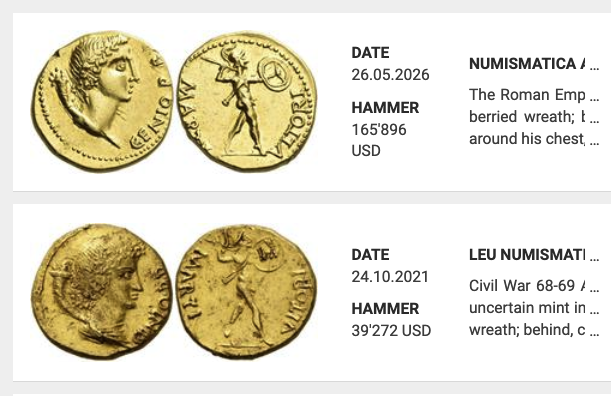
The bottom specimen, the first known, seems similar to the style of this denarius also in trade (OCRE link, no images):


