Victrix Redux

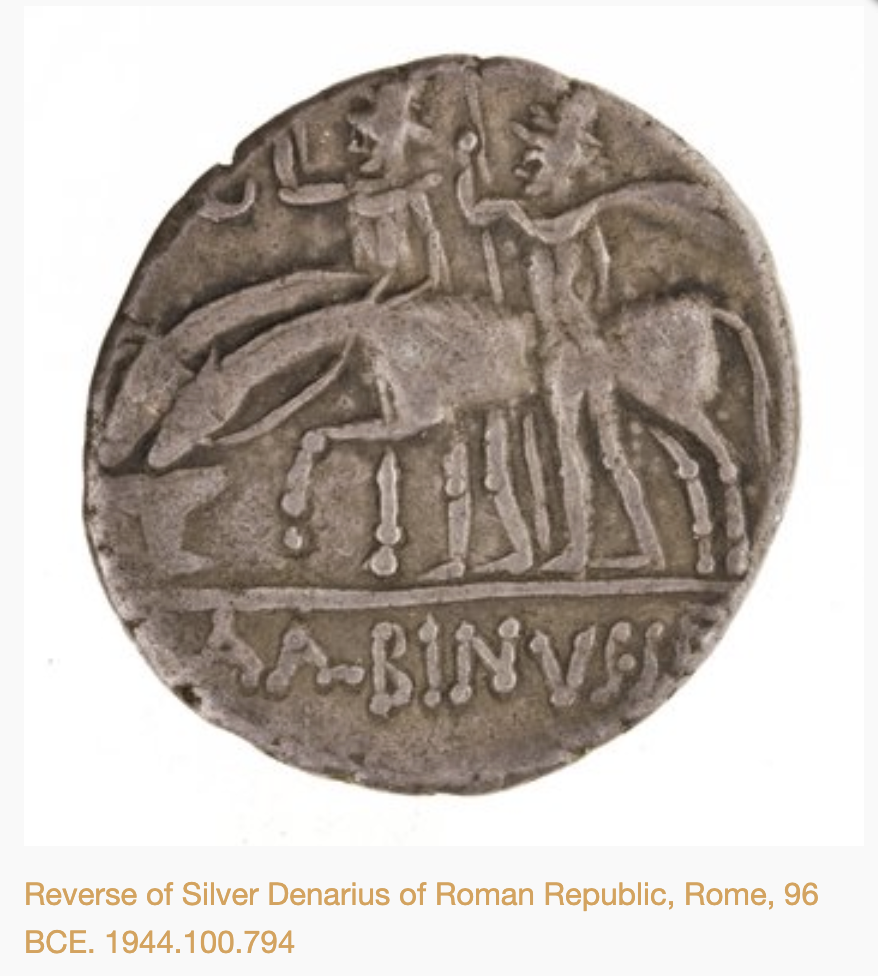
How did I end up here? I was working on the book review and found an interesting footnote on colossal statues of the Roman People and the connection (or not) to the worship of Roma as a goddess. I decided to bring myself up to speed on the scholarship on the subject and I ended up finding another footnote to the fact that Venus Victrix, Fausta Felicitas, and Genius Publicus in Capitolio all share a feast day, Oct. 9. I wondered if these three divinities shared any numismatic representations. I still don’t know the answer to that but I did stumble across this coin above showing Victory on the reverse.

The coin above was made c. 47-46 in Africa after Pompey’s death, but before Cato’s own suicide. Cato is operating independently and fighting against other Romans siding with Caesar. Yet he claims his authority to strike coins in his status as a Roman propraetor. The specimen up top is one of the nicest and the denarii tend to be carved with some care. By contrast the quinarii almost seem to be produced by amateur die engravers:

A sense of the range can be appreciated here or here. Looking at the photos of the ANS and BM specimens I wonder if the quinarii aren’t more debased. It seems they’ve aged worse and their color seems much darker. This might indicate they were made later than the denarii once the Cato’s position became more precarious. I’ll have to check what Cathy says on the subject.

Part of Cato’s claim to legitimacy seems to derive from his nearly exact copying of a regular issue of the Roman mint produced under the supervision of one of his ancestors:

Image

The only difference between the two series comes down to PRO PR on the legend and the qualitative difference in the execution of the die carving. The 47-46 issue should be beyond my worries for the current book project but it helps concentrate the mind on certain problems. How did the engravers in Africa manage to carve dies so similar to the original issue? Did Cato happen to have a specimen with him? Of both the denarius and quinarius? Whatever for? The hairstyle of the female obverse and the seating position of the Victory on the reverse seem too complicated for a simple verbal description from memory. Did Cato anticipate needing to mint coins and so wanted to imitate the earlier type he brought them with? Were there simply enough in circulation that by chance some one found one amongst the coins with the army in Africa? The hoards tell us that the earlier type was still in circulation but certainly wasn’t the most common of types.

Then there is the problem of dating the earlier series 91-89 BC is the range usually discussed and how that is tied to who the moneyer might be and what relation he would have to the famous Cato the Younger that so carefully imitated the series. I’ve ILLed a copy of Wiseman NC 1964 to review his prosopographical notes, before seeing if I have an opinion.

Regardless of the moneyer or specific date of the earlier series, I think the paired issues provides an important reminder of the memory surrounding issues, particularly in families. I wonder if it might be worth doing a die study of the two series to see if any of those without PRO PR are actually part of the late issues. I spend a good deal of time seeing if I could say anything about there appearance in hoards. The later series appears in only 25 hoards of which 14 have specimens of the earlier series. The earlier series appears in many, many more hoards. I’m not sure that really means anything, but at least I’m starting to think with hoards and getting used to the pros and cons of working with the new database.

I also can’t help but wonder what relation if any the Bacchus on the quinarius might have to the Bacchus on the coins of the Italian Allies in Social War. Bacchus as Father Liber is often associated with popular politics.

18 and 19 out of 410 Days: W/O A/C

Finished up a script and slides for my talk on the 15th at the end of Wednesday and suggested to SDA that we take the Tandem to PA for a little overnight visit with his parents before doing fireworks with his brother in NJ.  The family is a wee bit concerned about our decamping to Turkey for 10 months and we want to spend as much time with them as possible before we go.

Arriving back in the state of grace otherwise known as Brooklyn, I find that 36 hours in A/C has made me much less eager to get on with working with just a fan.  We’ve been doing summer without our window units, partly to save the pennies, partly to be green, partly because we haven’t yet hit that “can’t stand it a second longer” point.

I keep considering linking this blog to my FB, but it feels very academically naked.  Which it  would be.  Which would be the point.  To take the pride out of the process.  The posts here aren’t finished products: just little reflections of my imperfect thinking along the way.  Public practice.

Today’s goal is try to put to bed the overdue book review.  And, write back to a couple of very nice numismatists who I asked to help me source an image of a rare coin type, the only specimen of which might be in Paris.  I love how happy coin geeks are to share what they know with one another.  The enthusiasm is palpable.  Makes it easier to ask for help.

update a few hours later:  I broke down and plugged in the little A/C next to me in hopes of it raising general levels of productivity.  The cats seem happily intrigued by the change.

Numismatic Stratigraphy

The numismatic equivalent of archaeological stratigraphy is the overstrike — cases where an older coin is used instead of blank flan in the minting process.  When we can identify the undertype we have a precise means of identifying a chronological relationship between the two types.   However sometimes they tell other stories too…

This is a Sextans (= 1/6 of an As).   Mercury is the traditional deity indicating this denomination.  However, it is over struck on a Uncia (= 1/12 of an As; Roma in an Attic helmet is the associated divinity).   How is this possible? What is going on?

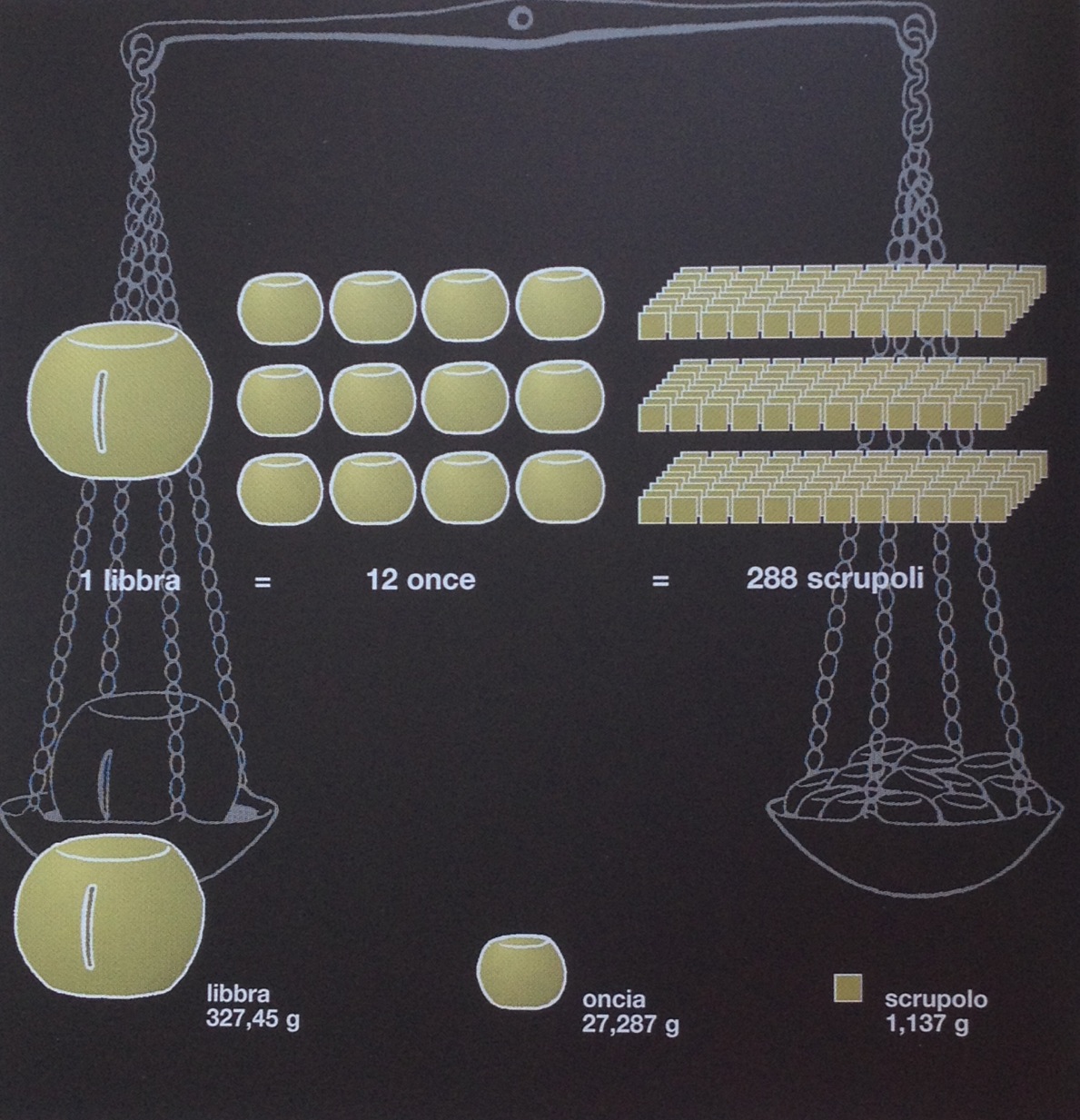
First some background about Roman weights.

photo (14)

This handy visual aid is from p. 28 of this great museum catalogue.  Originally the As was equal to a Roman pound which on a base 12 system divided into 12 ounces or uncia.   The as had fractions, semis (1/2 as = 6 uncia), triens (1/3 as = 4 uncia), quadrans (1/4 as =3 uncia),  sextans (1/6 = 2 uncia), and the uncia itself.  Crawford likes to use 324 grams as the conversion from modern weights to Roman pounds: it’s close enough and divides nicely by 12.  He also observes that full weight as is just about as much bronze as can comfortably fit in the palm of a hand.

So in 217 in the dark days of the 2nd Punic War with Hannibalic in Italy, Rome decides to cut the weight standard of the As in half.  That is to say they now make a coin valued as an as but weighing 1/2 a Roman pound ~ 162 grams.  Over the next six years as the war continues the weight continues to slip downwards eventually ending up with an as that weighted just 1/6 of a Roman pound, i.e. what two uncia or a sextans weighted before 217!  Not exactly the sign of a healthy economic situation.  This coin is from the intermediate stage.  It shows the Romans taking a coin that used to be valued as an uncia and revaluing the exact same piece of metal at double its original value.

This is the road that leads from an intrinsic value bronze coinage to a token bronze coinage.  The silver was not untouched by the Hannibalic War.  We can thank the same economic stressors for the creation of the denarius (10 asses!) in 211BC.  In time the denarius itself would end up retariffed at 16 asses, c. 140 BC, but that story will have to weightwait.

17 out 410 Days: Moving Money

I started wasting time trying to figure out where this image of a Roman banker came from.  I stopped.  It’s one of those wiki images floating around the internet without proper attribution.

Update June 8: A colleague solved the mystery for me!  I love that.  AND she introduced me to another great database I’m ashamed to say I did not yet know about!  Click on the image to be enlightened. 

I find it a little ironic that I spend a good chunk of time worrying how to pay rent in Turkey with money earned in the US.  Moving money internationally isn’t hard, just expensive.  There seems to be no way to avoid paying high transaction fees or trying to operate in cash, though even cash comes with exchange rate difficulties.  All these problems existed in the Roman world.  They had to find ways of shift large sums over large distances.  Maybe I should just bring gold…

Subletter is arranged and our Turkish Landlords are in touch. All very reassuring.  Now I just have to worry about the money.  Modern and ancient.

File Narbo under ‘I just don’t know enough’

So we’re told by Velleius Paterculus that the colony of Narbo was founded in 118 BC and he connects this colony with other Gracchan colonies.  This coin series is taken to be minted as part of the foundation of that colony.  But everything about the historical details of this colony foundation and the relationship to coins seems a little more difficulty than most of the sources want to allow.  Some, like the New Paully, put significant weight on milestone: ILLRP 460a, CIL XVII.2, 294 (picture at fig. 2.12 here): CN Domitius CN f / Ahenobarbus / imperator / XX.  The suggestion being that in order to measure distance on the road from Narbo, the colony must already be founded, and if Ahenobarbus (cos. 122) is imperator he can’t have triumphed yet.  Did he stay in the province until as late as 117 BC?  Is that his name on the coin?  Crawford thinks it is his son (cos. 96) with L. Licinius Crassus (cos. 95) along with some other moneyers.  Why the son?

Crassus’ role is another matter.  The key passage is this:

In a close contest, he never met with his equal; and there was scarcely any kind of causes, in which he had not signalized his abilities; so that he enrolled himself very early among the first orators of the time. He accused C.Carbo, though a man of great eloquence, when he was but a youth;- and displayed his talents in such a manner, that they were not only applauded, but admired by every body. [160] He afterwards defended the [Vestal] virgin Licinia, when he was only twenty-seven years of age; on which occasion he discovered an uncommon share of eloquence, as is evident from those parts of his oration which he left behind him in writing. As he was then desirous to have the honour of settling the colony of Narbo (as he afterwards did) he thought it advisable to recommend himself, by undertaking the management of some popular cause. His oration, in support of the act which was proposed for that purpose, is still extant; and reveals a greater maturity of genius than might have been expected at that time of life. He afterwards pleaded many other causes: but his tribunate was such a remarkably silent one, that if he had not supped with Granius the beadle when he enjoyed that office (a circumstance which has been twice mentioned by Lucilius) we should scarcely have known that a tribune of that name had existed.”

It has been used to argue a later date for the founding of Narbo based on Cicero’s chronology of Crassus’ career.  Crawford strongly disagrees.  Most now seem to follow Velleius and Crawford (and Eutropius who might or might not be following the ‘authoritative’ but lost account of Livy here).  I’m more interested in how the passage hints at the ‘popular’ nature of the colonial foundation.  An idea expanded else where in Cicero where he says Crassus’ speech in support of the colony was anti-Senatorial:

But I, with respect to speeches of that sort, am guided by the authority of many men, and especially of that most eloquent and most wise man, Lucius Crassus; who—when he was defending Lucius Plancius, whom Marcus Brutus, a man both vehement and able as a speaker, was prosecuting; when Brutus, having set two men to read, made them read alternate chapters out of two speeches of his, entirely contrary to one another, because when he was arguing against that motion which was introduced against the colony of Narbo, he disparaged the authority of the senate as much as he could, but when he was urging the adoption of the Servilian law, he extolled the senate with the most excessive praises; and when he had read out of that oration many things which had been spoken with some harshness against the Roman knights, in order to inflame the minds of those judges against Crassus—is said to have been a good deal agitated.

[Same anecdote at Cic. De Orat. 2.223]

The coin itself appears militaristic showing a vicious naked Gallic Warrior.  In iconographic terms we might file it with a coin like this, which is usually thought to have been made the year before and to commemorate the Gallic victories of 121 BC and the double triumphs of Domitius and Fabius in 12o BC.  If they were in 120 BC… (see above)

Was Narbo a military foundation to defend against the menacing Gauls?  Was it part of a Gracchan vision of distributing land to the urban poor?  Was it both?

And then there is that Naked Gaul on the first coin, who Crawford doesn’t think could be King Bituitus — a bizzare figure who appears to have ended his days in Alba (Fucens?).  The literary testimony seems in knots about his relationship to the two commanders (Domitus and Fabius): the Triumphal Fasti seem to give credit to Fabius, but Val. Max. 9.6.3 has a very different story indeed.   Bituitus is probably a red herring from numismatic perspective, but a most enjoyable one.

Enough.

Final Note To Self:  Don’t forget to link the Cicero above to coins of the gens Cassii on prosecuting Vestal Virgins in some future post!

***

July 5 update: After spending an extended period of time with Mattingly 1972 and 1998 as reprinted in 2004.  In 1972 he argues for a lower date on the basis of hoards and Cicero.  In 1998 his arguments are based on patterns on the coins such as types of ligature and the dispensing of ROMA as an obverse legend.  He asserts in his 2004 preface to the 1972 piece that Cn. Domitius and C. Cassius of the coins are not the consuls of 96BC and calls them ‘irrelevant’ to the dating of the Narbo founding.  He holds to a ca. 115BC date.  I find his use of hoard evidence hard to follow; his writing drowns in details and minimal articulation of the logical connections.   I am going to transcribe his dating system into the margins of my copy of RRC and hope in the process of transcription I begin to see the forest for the trees.

16 out of 410 Days: Planning Rollercoaster

This is a pre-run post.  I want to give the phone like five minutes on the charger so I get a full dose of mind numbing music while I pound the pavement.  

The potential Istanbul house for 10 months had begun to terrify me.  Luckily, SDA’s enthusiasm is unwavering.    So, it was something of a relief that the owners hadn’t written back since last Thursday.  Maybe it would fall through and not be my fault.  But!  Then a close colleague/friend wrote to me this morning interested in subletting and cat-sitting for us.   I hadn’t realized how much of my anxiety was about leaving my home to strangers and moving the kitties out of their familiar territory.  Now that we might have that solved I want to put the money down on the Turkish home lickety-split!   I am sure to change my mind a dozen more times about how I feel about the whole thing.

Battle of Lake Regillus

I did switch gears quite efficiently and spent the day revising a previous paper to present in two weeks time.  It’s all about coins, but I find myself reluctant to talk here about things I’m working out for immediate presentation else where.  I made a reference there to the memory of the Battle of Lake Regillus, saying it “…was only won by Romans through the divine intervention of the Dioscuri and the resulting treaty was one of mutual dense, protection, and collaboration.  The moral of that story is that Rome needs the Latins…”  I decided to think about whether this seemed a reasonable claim for the message behind other portrayals of the myth.  The coin above is taken to be a moment in that battle recalling the moneyer’s ancestor’s desperate act of hurling the standard amongst the enemy to motivate his men a turning pointing in the battle that is linked to human, not divine, action.

The same moneyer also minted a coin of the Dioscuri watering their horses at Lake Juturna, an image associated with the divine announcement of victory far off from the city.   This is the Dioscuri as messengers, not necessarily saviors.  These images seem most concerned with connecting the moneyer’s family with a defining moment in Rome’s legendary history.  I’m not sure I see in them any real concern about relations with Latins or greater Italy.

Afterthoughts:  It occurs to me that the second coin is in fact a form of epiphany not unlike the Sulla vision coin of the previous week.  There is a significant literature on epiphanies and that might be the correct angle to investigate.  This particular epiphany is said to explain the origins of the placement of the Temple of Castor in the forum.  It also is said to have recurred after later battles in the historical period, connecting them in magnitude and significance to the Battle of Lake Regillus.  Could any of the later epiphanies/battles be recalled by this coin as well?

***

In other news SDA finished the edits and I actually got to send off the revised chapter and wipe it off the mirror.  The first accomplishment of the sabbatical!

13, 14,15 out of 410 Days: Switching Gears

So the on-the-spot feedback from a colleague was hugely successful.  I asked her to do what I do with students.  I gave her a copy and read aloud from my copy and told her to interrupt me and ask questions about the ideas and expression of ideas as we went along.  I loosened up and got less attached to the words on the page and filled in the gaps in logic and significant sidelines of thought and interconnections between the sections.  It felt magical.  I stayed writing at her living room table and let her read the final bits until it was done, done.  Except for copyediting.  Oh the dreadful typos I create.  SDA has volunteered his services.  We talked through it over the weekend and he seems genuinely desirous of doing it.   Partnership and all that.  Thus its off my plate and onto his.

The weekend was mostly the Tour, and new friends, and tandem riding, and photo sorting, and fridge cleaning, and mentoring a former student…  I did look at the book review and realize I need some of the early volumes in the series before I can finish it.  That’s a trip to campus to the library.   And, I need to pick up mail etc etc.

BUT the book review is not the major goal I must remind myself.  Today’s project is to read through all my unpublished materials (or most of it) and decide what precisely I’ll be speaking about in 2 weeks time for my next public lecture.  AND, ideally what I will be submitting as a chapter of an edited volume by September 30.  They need not be the same but thing.

Facing my corpus of unpublished papers is a little like staring into a treasure chest and also into a closet full of skeletons.  I’ve been hoarding them.   Waiting for just the right moment.  Why?  Who knows!  Maybe I’ll figure that out.