
Update 5-20-26:
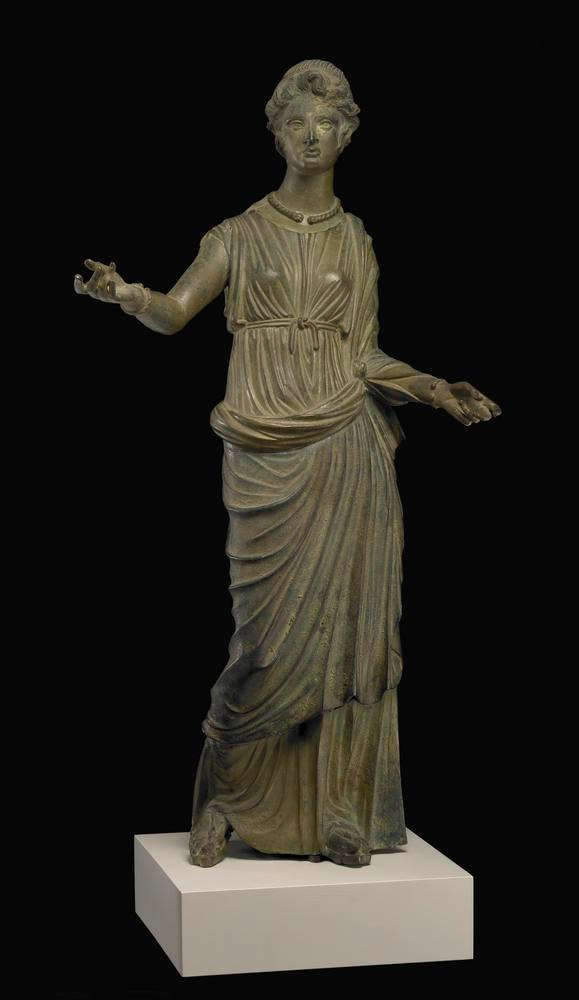
It wasn’t hard to find this statue once I looked. It sits in the British Museum, Room 71, Etruscan world, Display Case 30. Weirdly it doesn’t return with a key word search for Nemi or I would have found it sooner. Databases are strange, the entry clearly associates the statue with the sanctuary (not the boats). This does seem much more likely. It was bequeathed to the BM in 1920 by William Waldorf Astor, 1st Viscount Astor, who perhaps had acquired it directly from Spink(?). I wonder if any papers transferred with it. Reinarch seemed pretty sure that Spink had papers to give the buyer proving the place of origin. Would Astor have kept those papers and given them to the BM?
I’m more and more convinced this statue should be brought in dialogue to the San Casciano recent finds. I’m also glad to see that the BM catalogers agree with me that she probably held a spindle. The torque necklace is super interesting. I want to keep and eye out for parallels for Italic women wearing this form of jewellry.
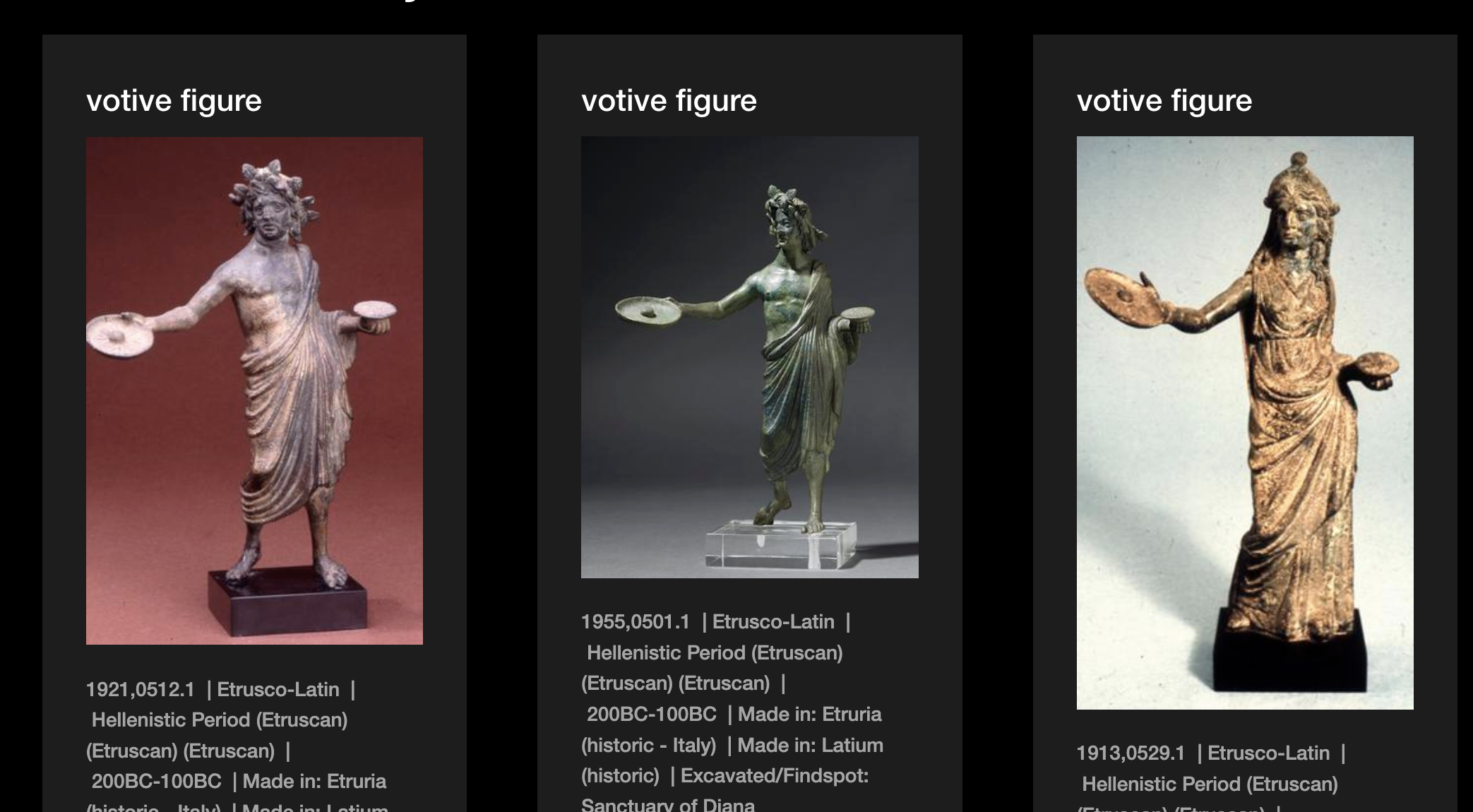
These three much small figures are tagged with the same findspot. They appear to have been from the same Spink sale appearing on the market in 1908. Compare museum images to figures below. I find it deeply suspicious that these figures have attributes apparently intact and all identical. This isn’t standard for the other Nemi figures recovered by archaeologists. And it appears to be true of all the Spink figurines based on photos from Reinarch. This suggests to me that the figures were repaired and augmented after discovery and before public sale.
I’d love to see imaging and testing to confirm, especially on the large statue. The large statue must have had some analyses done as the curatorial notes say it was cast in 9 pieces and then assembled.
What surprises me is that the BM seems to have decided to acquire materials previously offered at the Spink sale over such a long period of time, these four objects came to the museum between 1913 and 1951, all from different sources.
The patina of the bronzes is markedly different between all four objects. I suspect all have been cleaned and some more intentionally re patinated than others. None look particularly close to the patination from bronzes recovered from Nemi in the Nottingham collection but the calcification of the figures on the outside in the below screenshot seem closer than the bright greens.
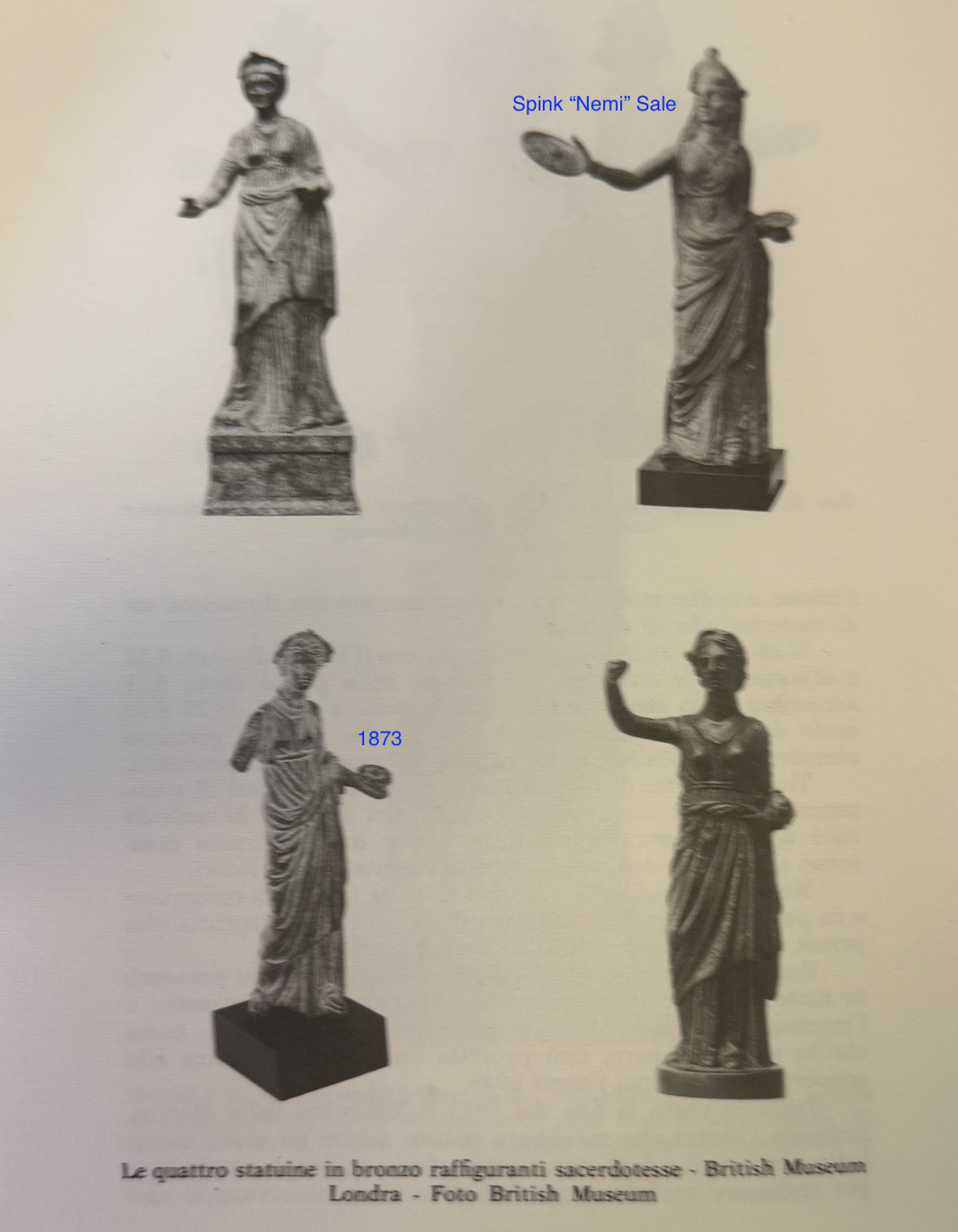
Luigi Devoti in his 1987 book Campagna Romana. Viva Speculum. Dianae Il Lago della Selva Aricina Oggi di Nemi, accepts these artifacts as genuine but attributes the larger statue to the ships. He also seems to imply that more votive figures in the BM are from Nemi than are attributed as such in the online catalogue. He illustrated 4 female figures as if they come from Nemi but only one is listed by the BM as such at least now. One of the three arrived at the museum in 1873 (BM G_1873-0820-64). I’ve not tracked down the other two in the BM catalogue, mostly because of poor internet connectivity on this train.
Here’s my reference image from the Devoti volume. A shame it is blurry, I was working too fast and figured books were lower priority than archival papers.
Before you ask, I have no idea the legal issues around these objects. My goal is simply to share what I know and let others work the rest out.
Update 21 May 2026:
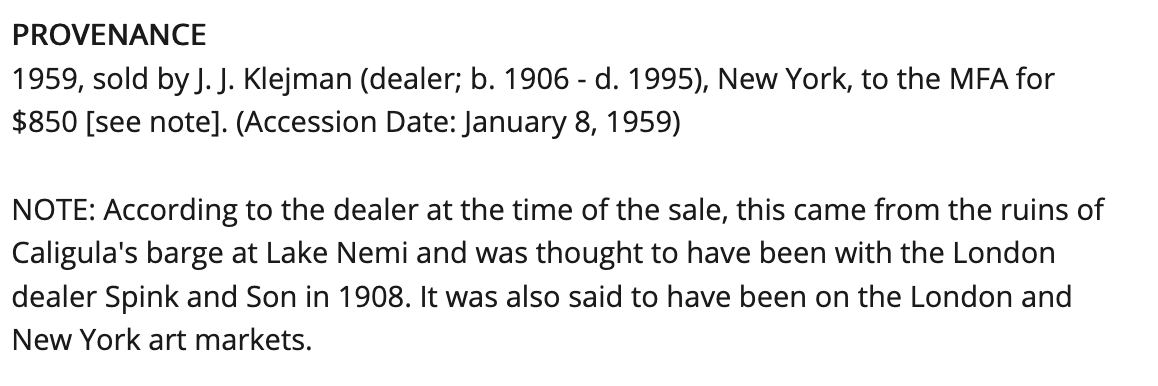
Boston has one of these “too perfect” votives.
It looks a great deal like the London votives and not like any votive I’ve seen from Nemi for the quality and level of detail. I hate to say it but I see why some in 1909 thought these might be forgeries.
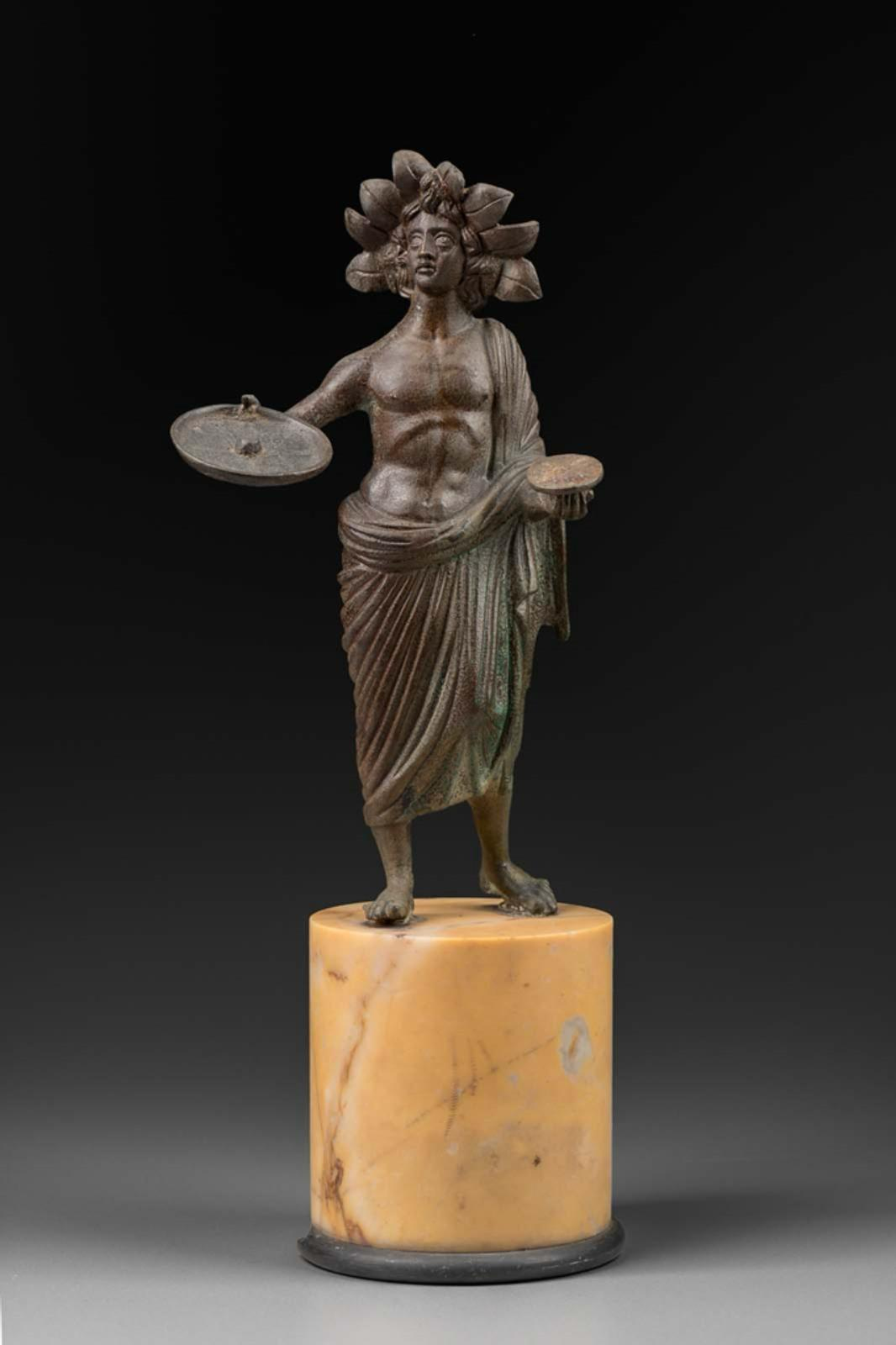
I’m guessing they didn’t know the photos below or they could have been absolutely confident that this votive is from the Spink 1908 sale.
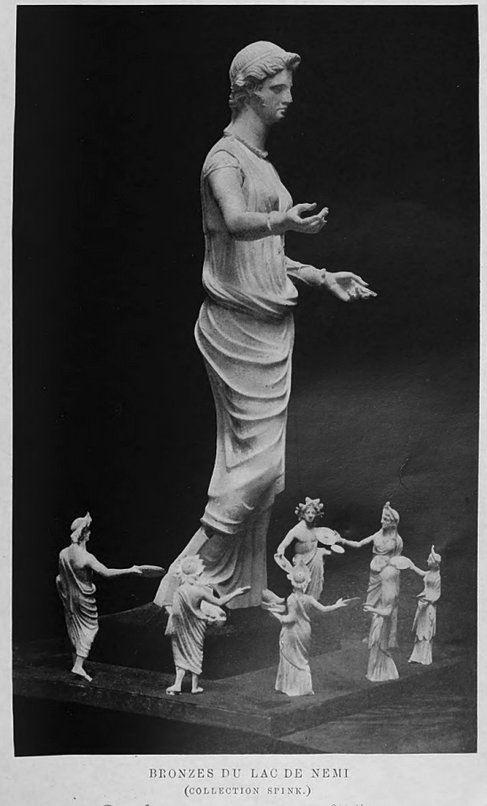
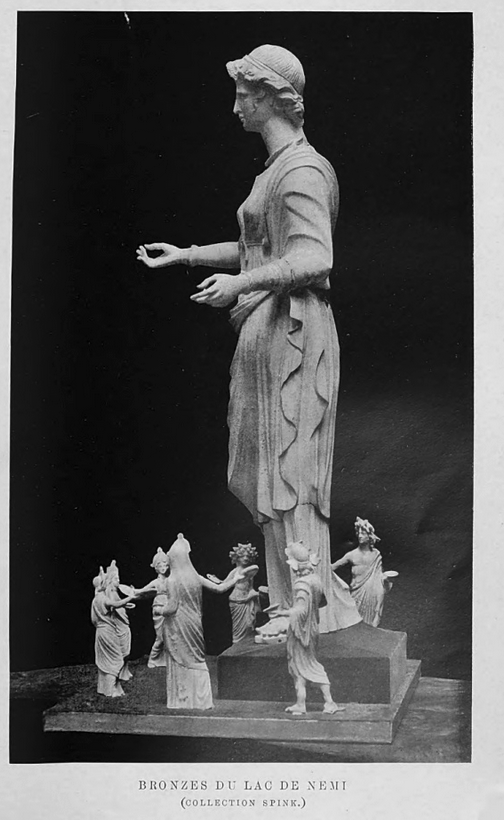
In 1941 Poulsen suggested that these statues were evidence of looting at the site of Nemi between the last excavation of Orsini (1895) and the first government lead excavations of Morpurgo (1924-1928). The statue group were published as genuine by Reinarch in 1909.
Interestingly Poulsen seems unambiguous about connecting the bronzes to the temple of Diana, NOT the ships sunk in the lake, but Reinarch clearly thinks the ships are the true provenance as Spink reports. I wonder what Poulsen knew or if t was just a guess.
Reinarch ends his article with a plea for legal excavations as a means of stopping the illegal looting.
I have reason to believe that the statue and statuettes in the Spink collection are not the only antiquities salvaged from these waters to have found their way to England. However, given the laws governing archaeological excavations in Italy, it is inevitable that beautiful objects—discovered and transported in secret—reveal their true origins only belatedly, if indeed they do not lose or alter their provenance entirely along the way. Such are the results—deplorable for the advancement of science—of a seemingly draconian body of legislation (albeit one tempered, in practice, by negligence and other factors). It bars foreign learned societies from conducting systematic research—even when they pledge to forgo any claim to their discoveries—thereby leaving the field open to less altruistic researchers who, in unearthing and carrying off the treasures of the Roman past, are, after all, merely doing their job.
Reinarch defended his view of provenance and authenticity in 1910.
The Bronze from Nemi. Following a report in the *Evening Express* stating that the King of England had seen and admired the bronze statue from Nemi—which was featured in a previous issue of the *Revue* (Plates XI–XII)—an anonymous writer in the *Corriere della Sera* (January 7, 1910) saw fit to cast doubt not only upon the provenance but also upon the authenticity of this figure. As for the provenance, Messrs. Spink possess documents that they have not shown to me, and which they will disclose only to a prospective buyer; this is a consequence of Italian laws regarding the export of antiquities. As for the authenticity, it cannot appear doubtful to anyone who has seen the original; such, however, is not the case with the *Corriere* writer, who—knowing nothing else, moreover, about the history of this object—missed a golden opportunity to remain silent.
What I love here is the bald-faced admission that Spink had proof they were flaunting Italian law and the scholar blames the law, not the auction house!
The circular display in the photography is non-sense, but the objects could be genuine. My first thought is the meter-high statues from San Casciano. It would be very interesting be able to compare this statue to those. If only, it was in an Italian collection.
I wonder where the large statue is now. I am resisting the urge to go hunt for it.
Based on the hand and arm position, if I had to guess I’d say the large female statue represents a woman spinning wool, and thus might be one of the fates.


