Nothing to do with coin striking

I’m very grateful to Prof. Sinclair W. Bell for reading the below post and sending me the following article which I had not read when I wrote the original post!  I’ve annotated my original post to highlight our agreements and disagreements.

Capture11

—Original post with annotations based on Daoust–

I am very grateful to Dr. Jeremy Haag for sending me an email asking my thoughts on this relief.  I found I had quite a few… As often happens.
Capture15.JPG

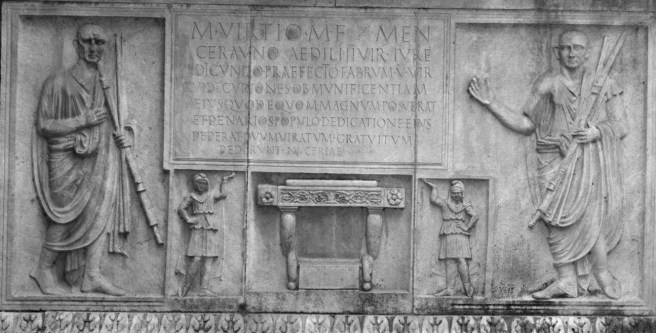
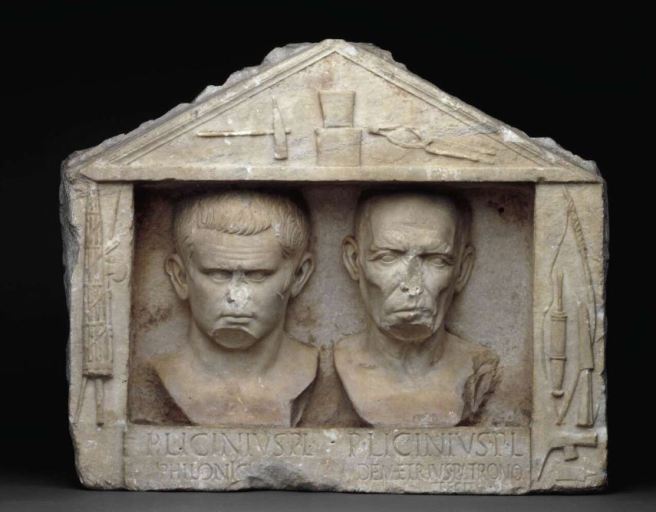
BM 1954,1214.1has since Vermuele been taken as a possible illustration of some mint workers.  This interpretation cannot stand.

Two men are pictured, both formerly enslaved. The man on the left, Philonicus was a lictor.  Lictors not only carried fasces but also carried another thinner rod perhaps what is called by Festus a commetaculum, or maybe it would be called a bacillum (staff) as in  Cic. Agr. 2.93.  Regardless of what the right Latin word is for this little rod, never the less we see it in the hands of lictors all the time!  There is a good case to be made that it’s “the get out of my way” stick–the stick that actually got used as opposed to the ceremonial bundle.

Details of above monument:

Capture9
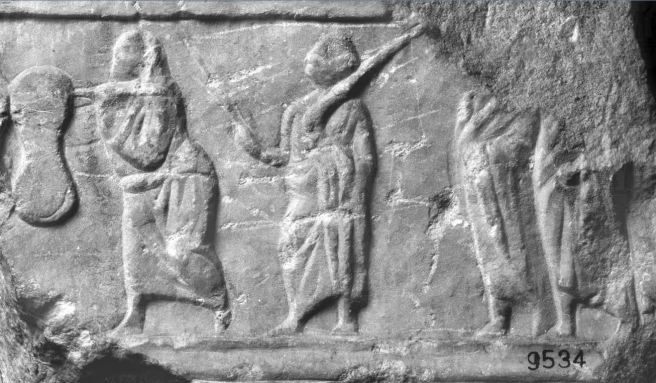
Museo Gregoriano Profano, Vatikanische Museen, Italien, Inv.-Nr. 9534
Capture7
Museo Maffeiano, Verona, Italien, Pronao. Inv.-Nr. 28164
Capture8
Villa Pelicano, Castellammare di Stabia, Italien, Inv.-Nr. 140/1012
Capture14
Museo Maffeiano, Verona, Italien, Pronao. Inv.-Nr. 28165

Why did anyone ever think Philonicus might have not been a lictor?  Because they were misled by the idea that the Mariemont Relief represented a scene of emancipation rather than a scene from the circus with a presiding official and three desultores.

[Update: Daoust p. 239ff. is concerned, as Ashmole and Manning before him, that the axe shape is strange and describes it as archaic following Schäfer’s chronology (dang, I want that book on my shelves forever–pandemic book access is such a pain…).  Not having Schäfer to hand I can’t decide how convinced I am but I’m generally skeptical.  Some times representations of fasces are consistent (e.g. on Norbanus coinage), but often the die engravers are very casual about variations in style and not all iconography ‘evolves’ in the chronologically meaningful way–look at the mess Fittschen hair styles got us into for the Antonine dating.  I agree that the fasces are occupational; I do not believe the men worked for the Roman state as blacksmiths or reported to lictors, I believe Philonicus may have started life as a blacksmith and then became a lictor.]

The man on the right is Demetrius and he was owned by the late Philonicus and made the monument for both himself and his patronus [Update: Daoust concurs, p. 232-3]. I concur strongly with Manning that the tools are the right represent are to be associated with carpentry, a view endorsed by Roger Ulrich (p. 31 of his book Roman Woodworking).  The only thing I have to add is the observation that some of the tools are also depicted in the fresco of Icarus from the House of Vettius, namely bow-drill, adze.

37a4c69b19afb05858f8e6e8c94a7de6

[Update: Daoust p. 237 also mentions this fresco and sees in it Icarus using a tool like the ‘knife’ in the relief–what he identifies as a mortise chisel.  This was my very first thought as well for the identity of the tool on the relief, so I am tempted.  I shied away from this interpretation as I couldn’t find a good parallel image in Ulrich but this may be about which profile of the chisel is shown.  I was inclined to emphasize its knife-like qualities  because of the similarity in profile to knives in cutler iconography.  I grant these are not exact parallels, but neither is the chisel (yet…)]

Capture14.JPG
[Is it a knife?!]
One of the mysteries is why the adze and tanged paring chisel, the lowest two tools on the right hand side are shown without handles, whereas the drill is shown with its finely turned spoke and the knife is also shown with a handle (Daoust, p. 238 also emphasizes this point).  I have a speculation, but I’m going to wait to share until we’ve dealt with the pediment.

Capture1.JPG

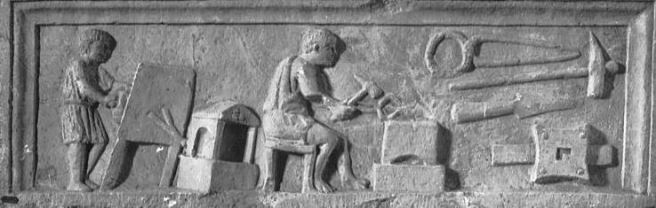
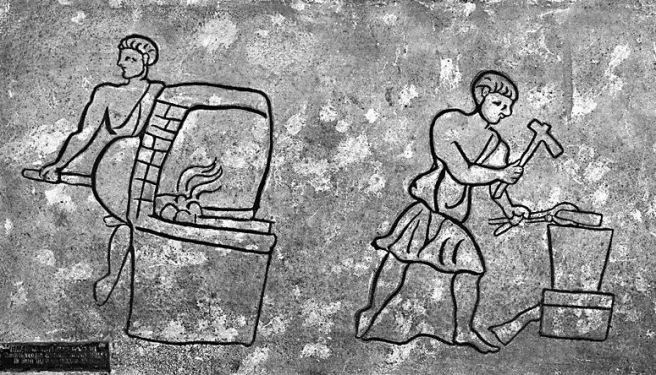
Manning has already observed that the tongs do not hold a flan but instead had a flange to ensure closure and improve grasp [Update: on this feature of tongs and relationship to the production of small tools, Daoust p. 236].  The really kicker though is the two part anvil. One part anvils are known in Roman art, but two part anvils  like the one seen here are very common.  The top portion of the anvil is NOT a die.
Capture15
Museo della Civilta Romana (1964) 617 Nr. 50
Capture9
Türkische Schule, Izmir, Republik Türkei, Inv.-Nr. 80
Capture7
Aquileia, (Aquileia), Udine (Provinz), Italien; Filmnummer: 0783_B03; Negativnummer: Alinari 46962

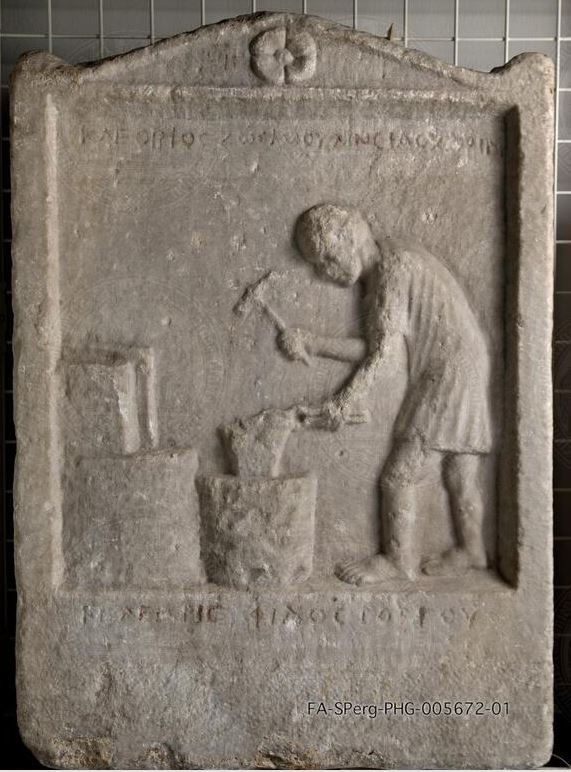
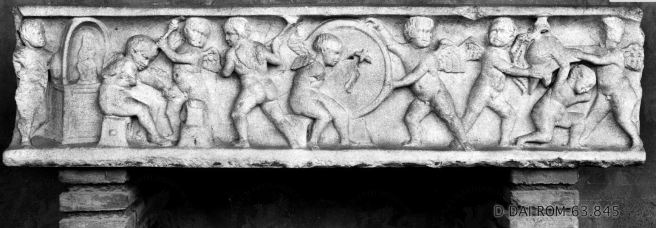
[Daoust p. 236 refers to this type of relief of a blacksmith expert in lock making for comparative evidence of tools and product both appearing on such occupationally themed memorials.]

Capture8
Archäologische Staatssammlung, München, Deutschland, Inv.-Nr. 1981,4404
Capture14
Museo Nazionale Romano – Museo delle Terme
capture13
CIL 13, 02965 = SIRIS 00747 = RICIS-02, 00607/0202 = CAG-89-02, p 666; EDCS-10501963


Capture
Grabstele des Schmieds Kleobios, Staatliche Museen, Antikensammlung Berlin Sk 790

So do we have three professions held by two men here? Maybe.  Maybe Philonicus started off as a blacksmith became a lictor upon being freed and then set up Demetrius in business as a carpenter.  Lictors are essentially bully-boys or body guards and Philonicus does have a meathead look to him and who better than a blacksmith to make a lictor?

But I also think it just possible that Demetrius was a blacksmith specializing in the creation of carpentry tools especially hard to make stuff like drill bits and precise knives.  It’s a simpler explanation, two professions instead of three AND it fits with the last two tools being shown with out handles.

[Update: Daoust believes the tympanum must refer to both men and a share profession.  This is logical.  p. 234 following. He emphasizes on p. 235 that the hammer is a a cross-pene type and thus for finer work.  I’d put less emphasis on on this as identifying the type of blacksmith or try to marshal more comparative evidence to support it.  That said I don’t have Zimmer, G. 1982. Römische Berufsdarstellungen, AF 12. Berlin: Gebr. Mann Verlag to hand and if I did I might be more convinced.]

Smiths with specializations are known:

Capture11
Museo Archeologico Nazionale di Napoli

As are those that specialize in blades.  Tomb 29 from Ostia might be a good comparison point.

Further images

capture13
Tomb relief showing a smith in the act of working with his helper. Imperial times. Roma, Museo della Civilta Romana; Roma, Museo della Civilta Romana. Di Tanna, A., “I Collegi degli artigiani”, Archeo: Attualita del Passato, 140 (1996)


What types are not (yet) online for RRDP?!

This is another working post attempting to respond to user queries and keep a record for myself that can eventually be integrated into an official finding aid on the ANS RRDP website.  Want to know more about RRDP?  Go to our most recent blog post!

(I thank Donna Levinsohn for first raising these questions. PLEASE email me at yarrow [at] brooklyn [dot] cuny [dot] edu if you cannot find an issue in Schaefer’s binders or the index and I will updated this post.)

ODEC = One Die for Each Control-Mark

Status of  release for issues not (yet) linked to CRRO

316– not indexing correctly, must troubleshoot and update data; for now this this issue can be found in Binder 2, on pages 50, 51, 54, 55, 58, 59, 64, 65, 68, 70, 71, 74, 76, 77, 80, 81, 84, 85, 88, 89, 92, 93, 96, 97 100, 101, 104, 105, 112, 113, 115; there are also seventeen (!) clippings images that have not yet been released, but those will contain no new dies.

378 –  part of ODEC, likely to be released by September 2020

394 – disambiguation of sub-types in underlying data is required before the online indexing will reflect location, for now this this issue can be found in Binder 6, on pages 104, 106, 107, 112, 113; there is also one clippings image that has not yet been released, but that will contain no new dies.

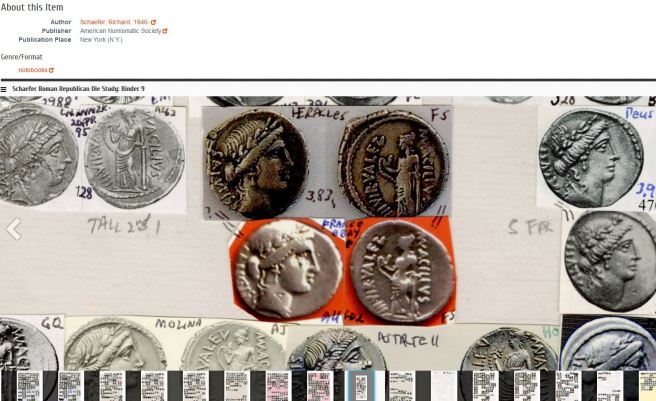
442– disambiguation of sub-types in underlying data is required before the online indexing will reflect location, for now this this issue can be found in Binder 9, on pages 2, 3, 6, 7, 10, 11, 14, 15, 20; there are also four clippings images that have not yet been released, but those will contain no new dies.

453 – disambiguation of sub-types in underlying data is required before the online indexing will reflect location, for now this this issue can be found in Binder 9, on pages 178, 179, 182, 184, 185, 190, 191; there are also three clippings images that have not yet been released, but those will contain no new dies.

Two venerable coins that are just too similar

The poor coin copiers of yesteryear how could they ever imagine  we would now be able to share information so well!  I really never suspected a thing either until I asked what I thought was just an ignorant question to some lovely twitter friends.

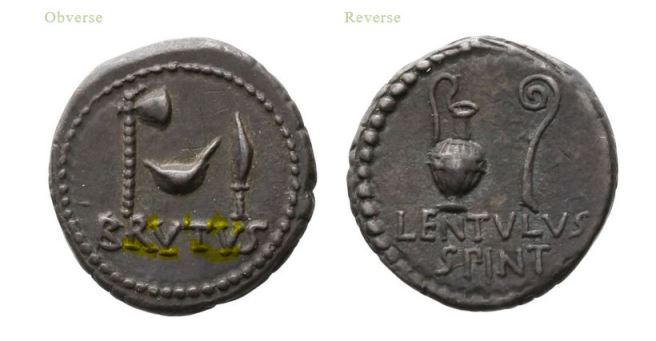
This RRC 513/2 specimen in the Ashmolean has an odd punch mark.  I’d not seen anything like it exactly on a Roman Republican specimen so I wanted to know more about the phenomenon.  An ancient counter-mark of some type seems to be consensus. (Do you know of similar counter-marks on RR coins?  Please do let me know!)

Capture8.JPG

But in the course of conversation the eagle-eyed anonymous (on twitter) numismatist known as “Nero Claudius Drusus” observed  that a similar mark was on a Paris specimen.  Even before this Andrew McCabe had observed that the Oxford specimen “has funny surfaces, wavy, thick devices e.g. lettering, odd patina that looks artificial”.

So now we do some side by sides with the aid of Michael Davis:

Capture9

And for me it is even clearer on the obverse because I can stop staring at that weird S and actually think about the comparison (Paris left, Oxford Right).

Capture10

The reverse die is “Die A” in Schaefer’s archive (RRDP).  He records 4 specimens.  Other examples of this reverse die are known in Berlin and the BM:

Capture6Capture7

The beaded border on the Oxford specimen is clearly too large for the impress made by the die and must be the result of tooling.

So someone in the 18th century sold the Reverend Charles Godwyn a cast of the Paris specimen (when did that specimen arrive in Paris? That is one piece of the puzzle not yet answered).  He then bequested to the Ashmolean and now as the collection is being digitized and references attached to each digital record we now see the fraud.  Or perhaps Godwyn knew and just wanted a copy for his collection of a rare type and then in the bequest the knowledge of its status as a copy was lost.


Reading notations in Schaefer’s binders (RRDP)

THIS POST IS SUPERSEDED BY A NEW PAGE.

Some conversations I’m seeing linking to my earlier blog post (now superseded by our ANS blog post) on various discussion boards are expressing confusion over how to read Schaefer’s work.  Here’s a quick guide to those new to his project and it will give you some idea of what is ahead for the work of the RRDP project as we engage in transcription and number crunching.  We’ve erred on releasing as much data as soon as possible rather than holding back until it is “complete” as that work may take a very long time indeed.

Capture1

  1. These are die names assigned by Schaefer
  2. These parallel lines record a die link
  3. Often on the pages you will see drawings or verbal descriptions of Schaefer’s observations of key die features
  4. If the image source recorded a weight it is noted on the bottom of the image between reverse and obverse: look for the g.
  5. If the image source recorded a die axis it will be represented by an arrow near the weight.
  6. The image source is recorded in abbreviated form at the top center of the image.  These abbreviations are sometimes obvious at least to some of us more experienced numismatists but some are really puzzles.  We’re working with Schaefer to develop a key (see below), but this is still incomplete.  So above BMCRR 1287 is easily found in the BM online collection. Likewise NAC 61, lot 1145 is easily found on coin archives.  MacCabe’s collection is on Flickr.  Rauch is another auction and the A stands for Ailly so that’s in Paris….

This is a really rough guide.  As we get more questions and start to know what our users need Dr. Carbone and I will develop a proper finding aid and guidelines for the ANS site.  MY personal website is always just a sandbox, not an authoritative resource.

This post also has a sequel in which I answer questions about specific RRC types for which individuals have not been able to easily find.


Working list of Schaefer’s common abbreviations

If an abbreviation is NOT on this list and you cannot decode it please send me a hi res screen shot and link to specific page and I will investigate and try to help.  Your asking will improve this list for future generations.  yarrow [at] brooklyn [dot] cuny [dot] edu.

Axx = Auctiones auction xx(run by M&M, Basel)

AB = Peus 322(1Nov88) Coll. A. Banti

AM = McCabe Coll.

A+C = Aureo + Calico

ANE = Asociacion Numismatica Española

Arte = Artemide

ASIN = Asociacion Iberica de Numismatica

ASR = asta senza riservata

Aurelia = McKenna + Barton FPL(Aurelia Coll. Nov1980)

B = Berlin State Museum

Bald = Baldwin’s

Bara = Baranowsky

Benz = Lanz88(23Nov98)

BM = British Museum

BMFA = Boston Museum of Fine Arts

BNF = Bibliothèque Nationale Française

Boll. Num. = Bolletino di Numimatica

Br=Brock= Brockage

CAD = caduceus

CAMB = Cambridge University

CCCH = Coin Collections and Coin Hoards from Bulgaria

CGB(or CGF) = CGB Numismatique(Paris)

CNG = Classical Numismatic Group

CrDeLaBourse = Crédit de la Bourse

CRRR = CSRR = Crédit de la Bourse 19Apr95

DH =  Museo Taranto

DNW = Dix, Noonan and Webb

Doro = Dorotheum

e before xxx = part of multiple lot xxx

e after xxx = xxxth electronic auction

EH = Emporium Hamburg

Epi = wheatear

F = Firenze

F+S = Freeman + Sear

Fab = Fabretti(Museo Torino catalogo)

Frasc = Frascatius(online seller)

G = Gorny

G+M = Gorny + Mosch

G+N = Gitbud + Naumann

G1,2,3,4,5 = CNG43,44,45,46,47 respectively

Germ Inf = Germania Inferiore(online)

Glasgow = Hunterian Collection in Glasgow

Hersh = Hersh Collection in the British Museum

H = Gerhard Hirsch Mzhg

K = Kuenker

KHM = Kunsthistorisches Museum(Vienna)

KN=KB=Knob = Knobloch Coll.(Stack’s 3May78)

Kolnmzkab = Kölner MünzKabinett

Krich = Kricheldorf

Lejeune = Peus 250

Leu = Bank Leu(<2010);

Leu Numismatics(>2010)

LGH = Lead Ground Hoof

MAH = Musée d’Art et d’Histoire, Geneve

M&M = Muenzen und Medaillen(Basel)

M&M-Deut = Muenzen und Medaillen Deutschland

MC = Museo Correr

MOV = mark of value

Mus. Civ. = Museo Civico

Mus. Naz. = Museo Nazionale

MV(monogram) = Müller(Solingen)

MvB = Max von Bahrfeldt

MZ = Muenzzentrum

n.s. = new series

N Circ = Spink’s Numismatic Circular

N+A = Nummis et Ars

NAC = Numismatica Ars Classica

NIC = Leu 17(Nicolas Coll.)

Num Gen = Numismatique Genevensis

O-L = online

Off Die = official die

ONT = Roman Republican Coins in the Royal Ontario Museum, 1998

Peus = Busso Peus

Qd – quadrans

QDG = quadrigatus

QU = quartuncia

RRC = Roman Republican Coinage

RRCH = Roman Republican Coin Hoards

S = Signorelli Coll.;

Santamaria Auct. 4Jun1952

SCMB = Seaby’s Coin and Medal Bulletin

Sobo = St. Omer et Boulogne-sur-Mer

SS = superstructure

Stax = Stack’s

SU = semuncia

Sx = sextans

Sy = Syd = Sydenham 1952 RR catalogue

Syd Coll = Ratto Auction7Feb28

T = Titano

Torino = Turin

Tr = triens

TRI = trident

U = uncia

U PA = Univ. of Pennsylvania

V = Varesi

Vat = Vatican

VE = Victor England (which became CNG) – Thx DS for query leading to this addition!

VICT = victoriatus

VR(ligate)= Voirol Coll.(Leu+M&M 6Dec1968)

WAG = num. company in Arnsberg,Germany

WCN = Warsaw Numismatic Center

WP = Wayne Phillips

Z = Zeno sales by Dorotheum(13Jun55, 8Jun56 and 26Mar57)

An Overstrike (and my latest project)

I’m doing some volunteering and professional development remotely with the Ashmolean’s Heberdeen Coin Room.  All of their republican coins are photographed and online BUT the data is not validated and all RRC references are not yet in the database.  To see all the lovely pictures, go to their search page, and select Roman republican as the period and make sure under status “uploaded”, “for review” and “validated” are all checked. Of the some 3500+ coins, just under half have a Crawford number so far.  To look for a specific type enter under reference value the RRC number (without RRC).  At this time, you’ll need to try  a variety of formats, e.g. 123, 123/1, and 123.1 as the data is not cleaned up or standardized.  I’m adding reference numbers as my good deed. So the number of specimens with reference numbers is rapidly growing.  Once they all have some reference number I’ll use a spreadsheet to clean the data and add type info etc…

Why am I doing this.  1) so Schaefer can access the material and continue his work on RRDP sooner; 2) because it is intensely soothing and interesting to me; 3) I hope it will be of use to many of you.  It’s a beautiful collection AND Jerome Mairat has build a really lovely interface especially for stream lining and collaborating on data entry.  Working with his system is teaching me about how I might want to design numismatic databases in future.


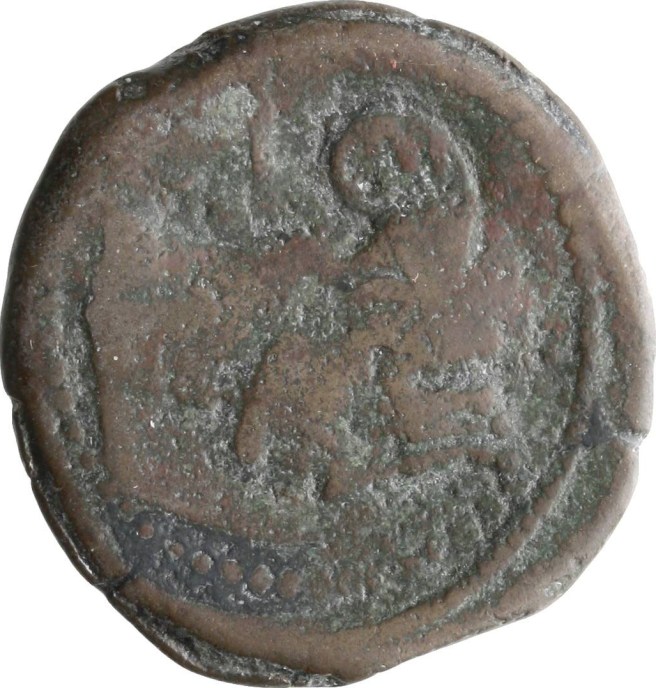
But I promised you an OVER STRIKE and indeed I have one to share.  Any one want to tell me what the under type is?  It should be an that has the denomination mark above the prow.

RRC 535/1, HCR60856:

Capture160856rf

60856of.jpg

Another over struck specimen.

HCR60820

Schaefer’s Binders Online! (RRDP)

Capture

OFFICIAL BLOG POST, click here.

very rough draft of a finding aid (will be replaced with official final version on ANS website)


Older informal write up and partial draft of material linked above.

I am so excited about all the hard work of so many people who have made this possible.  Richard Schaefer for his decades of work and deep generosity; Lucia Carbone for believing we could make this happen, marshaling the resources, connecting all the moving parts, and always pushing me to do more; Erin Richardson for her many hours, days, and weeks of photography; and especially ETHAN GRUBER for taking on the technical challenges and making it happen; and all the good people at the ANS who made this possible.

This is only a part of what is coming in this initial release of images.  Missing from this preliminary release are all the drawers of output images (photographs of specimens not in the binders) and RRC types designed as ODEC = One Die for Each Control-mark.  Getting these on Archer and similarly connected to CRRO is the next step.

Gruber’s blog post on the state of the work right now

Our joint write up on the project as a whole for the ANS Magazine

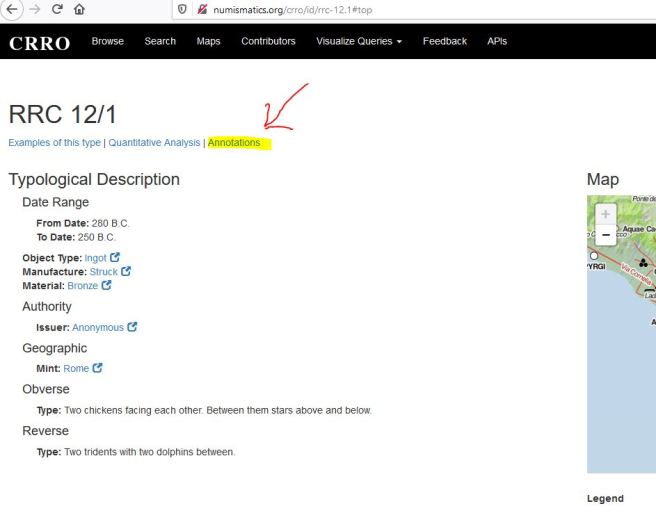
To find a Crawford number the easiest way (to my mind) is go to CRRO and find the type you want, open it and then click on Annotations.

Capture

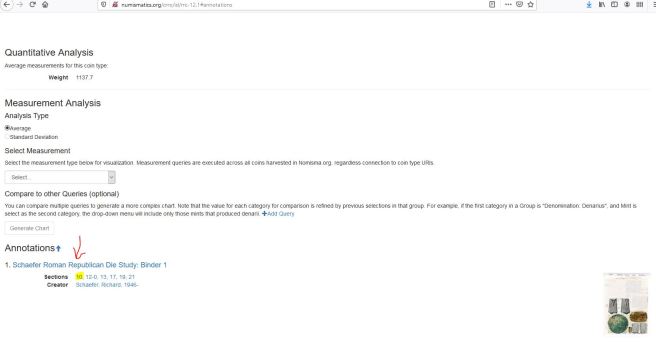
This jumps you down to this part of the page.  To go right to the first illustration in the binder of the type click on the first section number.  If you click on the title where it says Schaefer binder one it will take you to the first page of the binder.

Capture.JPG

Once you’re in the binder, scroll down for a list of all types illustrated in that binder, and then use the list of section numbers in parentheses to jump around as needed.

Capture

You can also just type the RRC number in the Archersearch field and it will spit out the right binder and then you can use the index to jump to your type.

If you want to flip through the binders here they are:

Binder 1

Binder 2

Binder 3

Binder 4

Binder 5

Binder 6

Binder 7

Binder 8

Binder 9

Binder 10

Binder 11

Binder 12

Binder 13

Binder 14

The zoom level is great (I use my mouse scroll to zoom in fast).

Capture


Learning about Mining

These are some notes of mine from reading this article and a reading group convo.  Apologies for any errors/misrepresentations: I learn by writing this type of note.

Capture

Mineralization associated with detachment faults because change in pressure creates conditions for minerals to rise.

Capture

Isothermal fluid: minerals in solution from the magma


Capture.JPG

Capture

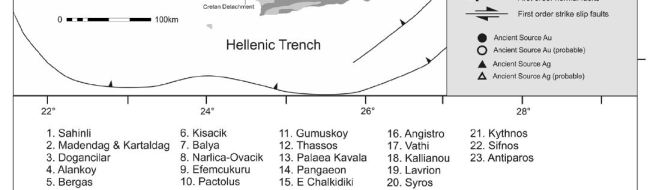
Northern Greece has both Placer Au and supergene Au-bearing iron oxides.

Pangaeon mountain (hills) discussed for precious metal wealth in ancient Greek authors, e.g. Herodotus, Thucydides.  Evidence of both underground and surface mining at 25 sites and 12 smelting sites.

On the island of Thasos directly off-shore likewise significant deposits accesses in antiquity.  The mineral wealth takes the form of Ag-rich Pb-Zn carbonate replacement and Au-rich Cu-Fe-Mn deposits in veins and lenses of mostly oxidised massive and disseminated ore in marble and schists.  In the classical-Roman period at least 5 Ag mines are known and two Au.

Capture.JPG

In an area of about 100 km2 extending from ancient Philippoi to Palea Kavala and Petropigi there are more than 150 ore occurrences rich in Fe, Mn, Pb, Zn, Cu, Ag, and Au, and numerous underground galleries are believed to have operated between 6th century BC and the Ottoman period.  Perhaps same as that discussion in Herodotus 6.46, Theophrastus On stones 17, Lucretius 6.810, and Plutarch Cimon 4.2.

Capture

Metangitsi shows evidence of Mining from the 5th century through Middle ages and Ottoman period.  This region’s mineralization includes: Cu-Au porphyry, Pb-Zn-Ag-Au carbonate replacement, Cu-skarn and oxidized Mn.

Capture.JPG

Different mines even on a smallish island like Thasos all have different Isotopic signatures.  This is because of different timing of events and slightly different creation conditions (if I understood discussion correctly!).  But no tracer is 100% indication of origin.  The more isotopes/ionization you use the better your identification.  Zinc is perhaps too volatile.  Copper can be misleading because it may be added from a different source, ditto lead, at least in some historical contexts.  Copper is less distinctive of the environment.  Tin isotopes not fully understood.    Trace elements, e.g. arsenic.  antimony isotopes might be a potential tracer.  Volatile at v high temps.  Could you sample it given minuscule amount in coin?  Raises question of destructive testing processes.

Recycling of brass might explain zinc in Eastern Roman coins.  ?  Check Haim Gitler’s work on Severan Silver checking Mattingly’s categorization.

Brass complicated process because of Zinc only mastered by Romans in 1st Cent BCE.  (Check)

Forthcoming work from Gil Davis and Ken Sheehy discussion when in 6th century BCE Athens began removing all gold from silver.

In about 2 weeks Metallurgy in Numismatics (Royal Numismatic Society) will be out! Must purchase ASAP.

Vaxevanpoulos – fame in antiquity doesn’t translate it scale of mining.  Forthcoming work on this.