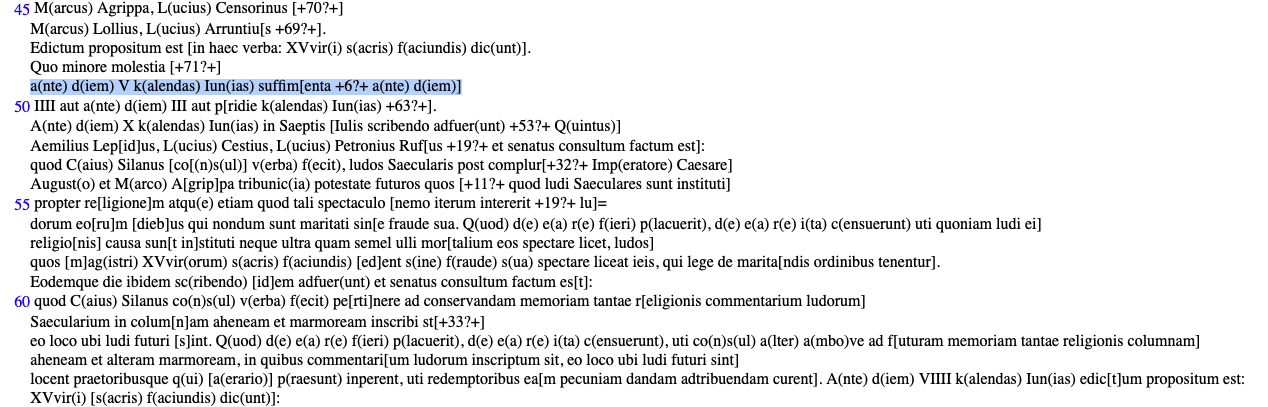
I’m looking for the text of another article by the same scholar, but saw this and am v curious. No time to read now but posting so I can come back to it.

adventures in my head
I’m looking for the text of another article by the same scholar, but saw this and am v curious. No time to read now but posting so I can come back to it.

Stuff I’ve learned from Twitter and archived here for future reference.
First we’ll credit “v ness” and her response to attacks of a talented graphic artist representing Roman poets with dark skin:

My meagre contribution prompted some scholarly refs I want to save (image I posted was photographed and posted by Gareth Harney):

Armand D’ Angour quoted:
” I’m not too bothered, Caesar, to inspire your delight, Nor to determine whether, as a man, you’re black or white. Nil nimium studeo, Caesar, tibi velle placere, nec scire, utrum sis albus an ater homo.“
Catullus 93
While all agree that the b/w allusion here likely does not refer to skin but politics or sexuality, this led Rebecca Futo Kennedy to recommend the following readings:
Dee, James H. “Black Odysseus, White Caesar: When Did “White People” Become “White”?” The Classical Journal 99, no. 2 (2003): 157-67. Stable JStor Link. No paywall link from USC.

Haley, Shelley. “Be Not Afraid of the Dark: Critical Race Theory and Classical Studies,” in Laura Nasrallah and Elisabeth Schüssler Fiorenza (eds.), Prejudice and Christian Beginnings: Investigating Race, Gender and Ethnicity in Early Christian Studies, 4 Minneapolis, Minn.: Fortress Press, 2009: 27-50 No paywall PDF from Press.
Kennedy, Rebecca Futo. “Colorlines in Classical North Africa” Classics at the Intersections: Random thoughts of a Classicist on ancient Greek and Roman culture and contemporary America by Rebecca Futo Kennedy. 8 October 2017.
Also see:
Snowden, Frank M. “Misconceptions about African Blacks in the Ancient Mediterranean World: Specialists and Afrocentrists.” Arion: A Journal of Humanities and the Classics 4, no. 3 (1997): 28-50. Stable JStor Link.
More Black-Centered Resourced for Ancient Mediterranean Studies
Should another reading be listed here? Send it to me! I’d love to expand this post or link to other blogs/websites that collect these readings.
Original Post Title: On Classics and Pedophilia
Update: On 7 October I received a letter from Prof. Hubbard asking me to take down this blog post by Oct 15 at which point he would contact his lawyer “A Harvard JD and successful specialist in this type of litigation”. Among other points below he argues that my use of the term pedophilia was potentially misleading and did not match the DSM-5. Words as we know have both connotations and denotations, in no case did I mean to imply I could diagnose colleagues living or dead. I’ve struck out the word pedophilia throughout to acknowledge the potential misunderstanding of this charged vocabulary.
He also suggests that I lack scholarly expertise to write on these matters. To be clear, this is not scholarship. This is a blog in which I summarize and collect links to material readily available elsewhere and reflect on my own experiences and ideas.
As he says on page 4 of the letter:
“Indeed, it might be a good exercise to show your seminar your blog and this letter responding to it, so that your students can assist you in developing proper standards of respectful scholarly conduct.”
I whole-heartily agree and accept the pedagogic value of this exercise. The class has already seen the blog and I will certainly share this update including the letter in full. Although the power dynamics of a classroom make it inappropriate to expect my students to ‘school’ me as instructor. Thus I invite any peers to offer feedback.
—
Original Post:
Content includes references and testimony regarding modern sexual abuse of children including discussion of grooming and pornography, no explicit a few details are given, but links may contain such more graphic details.
The conditions of writing (thanks Joshel!) are that I’ve just spent far too long in a pandemic trying to remove translations and materials written by controversial figures from my sexuality and gender UG class. I’ve done this so my students need not read about child sex in the ancient world from those either convicted of child sex crimes or who are alleged to dispute the need for laws that seek to protect children from such crimes. I write this as I prepare for a Graduate seminar on professional ethics in Classics. I write this as someone who experienced grooming by a male sexual predator at the age of four and reported and was believed and then had my whole world turned upside down for months as adults tried to protect me as best they knew. That’s another story. Sexual violence occurs every 73 seconds in the US–its just not that unusual. It is unusual to talk about. We need to talk about it.
Update: Hubbard says that my use of the term grooming “suggests that it never progressed to actual molestation”. What this means is unclear to me: my most vivid memories are of an engorged penis in a tent and a jar of urine and a feeling of being deeply disturbed as I watched my underwear from that night dry on a clothes line. He is correct that the reactions of adults around me namely the disruption of my lived environment and separation from primary carer upended my life but his implication that their efforts to ensure my safety were somehow worse than “whatever this alleged predator actually did to [me]” is wrong. Do I feel scarred or traumatized? Do I consider myself a ‘survivor’ or ‘victim’? No. Does it shape my world view? Absolutely. Hubbard contrasts his life experience and desires with mine saying that “for that reason, I am able to be completely objective and dispassionate in my scholarly work on the subject”. I reject the idea that those with lived experience are some how less capable scholars on the matters regarding which they have personal experience. However, scholars are allowed to disagree on such things.
Moreover, after he implies that my lived experience clouds my judgement, he says that my lived experience is far off that of gay teenagers exploring their sexuality. This needs correction. I am queer and explored my sexuality as a teenager. My queer identity (even though I did not label myself as such at the time) directly informed how my parents sought to safe-guard my well-being while simultaneously allowing me to develop in my sexuality; this was entirely appropriate. Do I know what it is like to be a male teenage? Nope. I’m a cis-woman. However, here in lies a quandary, perhaps he is a better scholar of sexuality because of his completely legal lived experiences as well?
Hubbard also worries that I am denying my students his scholarship. No, I mention it, including my admiration for his skills as a translator; I have made past course materials that utilized it available through the regular teaching platform. I simply don’t require they read it. The controversy around him changes the conditions of reading such that I no longer find them useful primary teaching materials.
In what follows underlining with italics indicates something newly added. A strike through indicates wording changed because I concede Hubbard’s objections. Note that Hubbard’s letter gives his views on all four men I mention before I mention him in this original post.
Original Post:
So I am putting this information here so that it is easily available. This is intended to be a record of what has been said, done, and documented. It is not an op-ed. I don’t have the emotional energy to write that, just finding this has been exhausting.
Feedback and links to further sources are welcome.
Classics has a number of three published scholars that are documented pedophiles have been found guilty of crimes of a sexual nature involving minors (if extended to biblical scholars this list would be longer)
Holt Parker, formerly Cincinnati, now in federal prison for child pornography
Eidolon article by Sarah Scullin putting this in context for the discipline at large
His work is widely cited and long considered foundational, especially “Tetratogenic Grid” and “Myth of the Heterosexual”
He inspired an essay on whether such academics should be cited, e.g. Marguerite Johnson’s piece
Christopher Haas, formerly Villanova (faculty page still up – up on 29 Sept 2020, down on 8 Oct 2020), writing on late Antique Christian authors, sentenced to 20-month federal prison term for child pornography with 10 years of supervised release, committed suicide before this prison sentence began
Andrew Dyck, formerly of UCLA, primarily Cicero and other Latin authors, sentenced to 6 months for one felony count of sending harmful matter over the Internet with the intent to seduce a minor and one count of attempting to do so
Another older matter has recently received much attention. Hindley was never changed with any crime. Refer to Hubbard’s letter for another perspective on this:
Clifford Hindley, a British Public Servant and Xenophon scholar, allowed UK government funds to be used to support the Paedophile Information Exchange
We also have an on-going controversy regarding Tom Hubbard, UT Austin, he has been convicted of no crimes and believes my original blog post might imply he committed one. This was not my intent and I have updated to clarify.
Hubbard’s work is broad, including common teaching materials like editing the Blackwell’s Companion to Greek and Roman Sexualities and a widely used Sourcebook


He has also this year sued a student for libel. Note his letter directly speaks to this as well.
He posted on Jan 14, 2011 an online a recording of his SCS conference paper “Greek Pederasty, the construction of Childhood and Academic Freedom”


Richard Pervo received eight years probation and one year in a state workhouse for one count of distribution and five counts of possession of child pornography. Thousands of images were found on his computer at the University of Minnesota at the time these were discovered he was serving as chairman of the department of classical and Near Eastern studies. (added 12/11/2020)
This is an excellent post from Cora Beth Knowles. I’m copying in full to create an archival copy of this materials but this her work, not mine! PLEASE FOLLOW HER both here on wordpress and on twitter!
—
Posted on by Cora Beth
I’ve been reading a lot of abstracts lately, and thinking about what makes a good one. So here are my thoughts, for those times when you’re unexpectedly in need of an abstract!
This year I’m a judge on the Classics and Archaeology Panel for the Undergraduate Awards. As part of the judging process we look at the abstracts that people have written to accompany their essays. Now, I’ve seen some great abstracts over the last couple of weeks, but in general it’s apparent that people don’t know what to do with an abstract. They write a few lines as an afterthought, or more often they simply copy and paste their introduction. So let me address both of those mistakes, to show you why an abstract is important, and why it’s not an introduction.
You should always make good use of the opportunity to provide an abstract. The abstract is the public face of your work – your advert, if you like, for your own research. It’s the first bit of your writing that your readers will see: and if it’s not good enough, it will be the only bit they’ll see, because they won’t bother with the rest! Essentially it’s rhetoric: you’re persuading people to read on.
So what are you supposed to do, and how can you do it well enough to hook a reader?
One crucial element of the answer is that the abstract is different from an introduction. It should be catchier: just ask yourself, ‘What would Cicero write?’. It should be a standalone piece of writing. It’s the classic ‘elevator pitch’: the way you’d sum up your research to someone if you were sharing a lift with them for thirty seconds. An abstract should usually be between 100 and 300 words, and doesn’t usually contain references: so it can be more powerful than normal academic writing.
It should also go further than your introduction. These are the things you’re usually advised to include:
Background information
Focus
Gap
Purpose
Methodology/ Approach
Conclusion
In other words you’re telling the story of your developing research; you set out the context of your main interest and (crucially) the gap that it is going to fill; and you cover the purpose of the work (what does it set out to achieve?). These are all things that you might do in your introduction. But in your abstract you also need to outline your methods: what approach have you chosen? This is important: people might choose to read your work because they want to use similar methods in a different context, so you need to see your methodology as a selling point in your elevator pitch.
You also need to anticipate your conclusion. Many people don’t do that, because it’s not something you would usually do in an introduction – but of course (as I may have mentioned!) this isn’t an introduction. Don’t worry about giving away the ending: frankly, your research is unlikely to contain a great deal of dramatic tension anyway! Tell the reader what you’ve found out: if they find it interesting, they’ll read the full article to see how your research justifies your conclusion.
There aren’t a lot of occasions at undergraduate level when you need to write an abstract. You’re likely to need one if you pursue undergraduate publication or submit an essay to the Undergraduate Awards; but apart from those, it tends to be seen as a higher-level requirement, for MA study and beyond. However, if you can get into the habit of writing a rough abstract, for your eyes only, for every essay (yes, I know, it’s a crazy idea!), you’ll see how the act of writing an abstract forces you to sharpen up your thinking about how your goals, methods and conclusions connect.
Abstracts are a big part of academic life; but for the most part, writing an abstract is a skill that is not taught. Scholars even at the top levels of academia are often dreadful at writing abstracts. It’s a startling omission in research and skills training, but it’s one that you can exploit by developing the ‘elevator pitch’ as a skill that sets your work apart. Keep in mind that when people get out of that metaphorical lift, they should be interested in finding out more about you. If they’re bored or confused when the doors open, you’ve lost that audience forever.
Abstracts: the art of being fun in a lift. Remember that definition and you won’t go far wrong!

(And here’s a detailed discussion of the ideal [arguably!] composition of an abstract, from the LSE Blog.)
Cora Beth Knowles
While preparing for my graduate seminar last night I found references to the importance of Bingham’s Columbian Orator to classical reception particularly the reception of Cato and Addison’s Cato. All things of deep interest to me.
This morning as I was cleaning up my open tabs I couldn’t help but browse the table of contents and noticed an ‘anonymous’ speech:

This is bizarre and also not unexpected. It so well typifies beliefs about the ‘Noble Savage’ and ‘right’ relations with indigenous peoples. I wondered if anyone had written on it, but then I remembered how much I had to do so I am throwing up this blog post. When I return to it I want to start here:
BUT I also want to think about the possible influence of the Bingham version of the speech on the Lewis speech to the Yankton Sioux! Note especially the use of the FAMILIAL VOCATIVE!


What’s up with portrayal of race on this mosaic?!
“…He then attributed his conjecture … to one of his imaginary sources…”