
Oh the frustrations!

Image

I am so angry.  All the nitty gritty of edits are done on the chapter and I just need a clear head to address the “not-so-anonymous” peer-reviewer’s open ended comments on my conclusions where he wants more argumentation some in a direction I want to go, some I will not address.   So I go looking for some new bibliography on an online journal that tells you what articles are forthcoming, pre-release.  One is on exactly the same subject as the first major case-study of my  current chapter.  A case study I wrote up  and submitted for publication in January 2012.   Now, because I had to wait 15 months for feedback and there will be further delays down the road this other guys article will be out and about and easily accessible for the whole world to see long before mine.  If mine had come out in a timely fashion he’d be citing me instead of visa versa.   And my conspiracy theory mind is just sure he must have been at conference and stolen my ideas!  Because no two academic ever can come up with the same topic independently. [Insert sarcmark here.]  And yet I vaguely remember someone writing me asking for a copy of the piece.  I don’t share unpublished work so I may have just ignored the query.  It might have been him doing due diligence.  Anyway.  He’s a junior scholar.  I should be gracious and benevolent in my feelings towards his growing engagment in the field and publication success.  Instead I only feel shame at my own disengagement from the culture of publishing in academic journals with reasonable publication timetables.

Time to go find a coin or three to cheer me up.
10 out of 410 Days: SCOTUS is distracting

Image

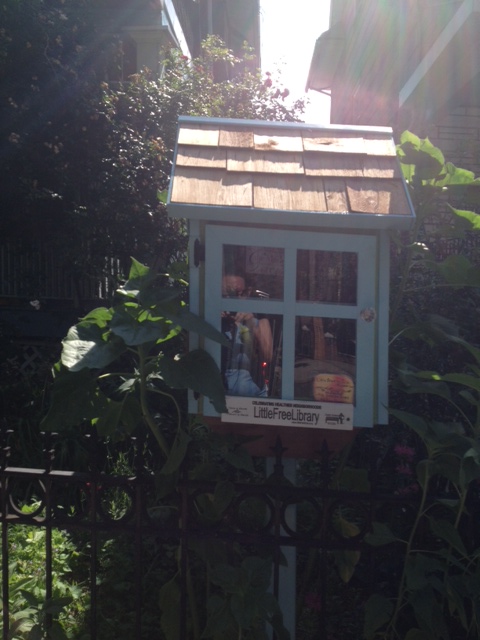
My goodness it has been hard to get anything done this morning.  Late night with good friends should have meant a terrible run but unexpectedly I felt stronger and faster and happier than any previous run in the past 10 days. Spotted this adorable LittleFreeLibrary — what a great neighborly thing to do! Ran into (not literally thank goodness) a girl who I used to tutor at the public library in the first year after she and her family arrived from Bangladesh.  She was so happy to tell me that she got at 91 on the Regents this past year.  Got home to the news on DOMA.  Haven’t done much since.  

Waivering between excitement and panic on the idea of going to Turkey for 10 months.  Had a student as me to be their PhD thesis supervisor will probably do it but only once I’m back.   Okay, lets see if we can salvage the afternoon for something academic. 

Coin Hoards, Egalitarian Numismatics

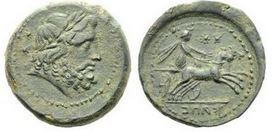
I decided that I’d written too much about the pretty pictures.  So as my “break” from edits today I read a chapter about whether hoard evidence can tell us if their was a monetary crisis between 54-44 BC.  Basically, it was trying to get a handle on the money supply and how to estimate coin loss.   One the most striking statements was the “Even after thirty years of shrinking the output of the eighties still made up more than a third of the money supply in circulation in 50 BCE.”  It got me thinking about whether or not I could reproduce the scholarship.  Did the numbers make sense? Where were they coming from?  How could I ever explain that to any one?  I’ve done a hoard and thus I felt I knew hoards but I haven’t ever really done HOARDS plural in my own research.  Where to start?  To my incredible delight Kris Lockyear and the ANS have teamed up to make Crawford’s research and all Lockyear’s additional work digitizing new material and Crawford’s files accessible TO EVERYONE — CHRR Online.  No digital glass ceiling here!  Just beautiful, beautiful data.  I’m just getting started navigating it and trying to figure out its potential.  Thus I picked a hoard with early coins, Herdade da Milia, but I found it by searching by coin type not for the specific hoard.  The coin up top is the type of the earliest identified coin in this hoard (not the exact specimen).  The latest identified coin type is of this type (again not the exact specimen):

[A wild image I’m going to resist writing about.] This dates to 113 BC-112 BC and if you click on the hoard link above there are some fun distribution graphs on a time line.  That said the official closing date of this hoard is listed at 31 BC.  That’s a head scratcher…  Until one notes that there are 16 unidentified denarii in the hoard that could have been made any time between 211 B.C. – 31 B.C., the whole run of the republican series.  We do need to allow for some of those 16 coins to be later than 112 BC, but the distribution of the coins in the hoard needs to also have some weight.  When using this type of hoard in analyses we should begin by comparing it to others closing in the last decade or so of the 2nd century BC.

9 out of 410 Days: It’s all work

Image


The mirror list got longer.  An editor contacted me and let me know proofs for a long ago submitted chapter were likely to show up in a week or two and I said yes to a new book review.  I really didn’t need another book review.  But the book is so good and needs to get the attention it deserves.  And, by a strange twist of fate it is about the same subject as that obscure chapter I was hunting down last week.  So when the request came in I was actually reading about the very subject.  Seemed a positive omen.

The morning has been spent on the relocation to Turkey project.  The house looks like its ago but now I need some sort of institutional affiliation to make me seem legit for the visa.  The home owner is a historian and offered to reach out to her department.  I wrote a begging email.  I kicked myself for not looking for fellowships last Nov/Dec.  Although I was in the throes of planning my wedding, running a department, and conducting a major search back then.  I’m telling myself I don’t need the ‘permission’ of a fellowship to go adventuring.    Good thing there are mirrors in most houses as I’ll need to write up my list again when we get there.  If we get there…

Lunar Deities Everywhere!

I came home in awe of the presenter’s PowerPoint skills.  It was a visually stunning two hour talk and was googling around for an image of a fun trishekel minted by the Carthaginians in Spain, the one with the diademed head and a ship prow.  I thought I’d write about that.   No reason other than it captivated my imagination.  But in my digging, I ended up here.  I was about to move on as I’m trying to avoid images not in museum collections on this blog as much as possible, but I was struck by the similarity of the reverse of HN Capua 494:

Image


To a coin of about 56 BC minted by Sulla’s son (same series as the first coin in the last coin post):

So I started searching for Selene or Luna on Roman Republican coins to find the Faustus coin and any relevant predecessors.  The Faustus coin was entered as Diana so didn’t appear, but it did return the lead coin above–a spectacular image of Luna appearing Sulla in a Dream, a story known from Plutarch.  The BOOK as approved by my publisher and series editor ends in 49 BCE.  This epiphany coin playing on the Endymion/Selene iconography dates to 44 BC.  That said, it directly contextualizes the Diana in a biga coin by demonstrating a contemporary awareness of the Plutarch narrative.  I think I better include it.  The Capua coin is also likely to make an appearance as it strengthens Crawford’s suggestion that the divinity on the coin should be linked this passage:

“It was while Sulla was ascending Mount Tifata that he had encountered Gaius Norbanus. After his victory over him he paid a vow of gratitude to Diana, to whom that region is sacred, and consecrated to the goddess the waters renowned for their salubrity and water to heal, as well as all the lands in the vicinity. The record of this pleasing act of piety is witnessed to this day by an inscription on the door of the temple, and a bronze tablet within the edifice.”

Mount Tifata directly overlooks Capua.  The temple of Diana Tifatina still stands, at least in part, as the Basilica di Sant’Angelo in Formis.  I find no need to choose between the Plutarch or the Velleius narrative.  Diana, Luna, Selene, Artemis, we are still firmly in the realm of moon goddesses.  There is no meaningful iconographic distinction in the coins.


6, 7, and 8 out of 410 days: Back At It

Saturday morning was spent with a backache prone on the floor with a copy of a text and translation of a fragmentary author that I’m reviewing.  A portion of the work has been carried out by a very capable scholar who I’ve  only met once in the spring of 1998.  I was looking for private tuition in Ancient Greek prior to grad school.  I never did well in class based language instruction because of the dyslexia.   I made an appointment with the scholar being clear about what I needed and my goals.  He invited me to meet with him in his university office.  He then proceeded to tell me that it was impossible to do what I wanted to do and I’d never learn enough Greek in such a short time to succeed in grad school.  My mission was ignorant, arrogant, and pure folly.  He declined to be my tutor.  I left not sure why he’d agreed to meet with me.   Maybe he felt a moral obligation to tell me to cease and desist.  I try to remember that conversation every time I want to rain on the parade of some bright-eyed student with outlandish dreams and no sense of what might be involved in fulfilling them. His work is very good: there is no question of a hostile review.  I didn’t even know he was part of the project when I agreed to review the volume as his is not first author (perhaps a personal oversight).  

And all is well that ends well, I found a lovely lady at a local seminary to work with me.  And well, I’m not a linguist, but my Greek ain’t SO shabby.

We then went bookshelf hunting and celebrated a family birthday by making vast quantities of homemade fettuccine and harvested garbage bags full of swiss chard and I even fit in a run yesterday.  I didn’t know how weekend would work on the blog but this seems a not half bad approach.  I do feel guilty for taking 36 hours off of research and writing and I’m anxious that my plan is to go to another lecture this afternoon, but not all work can take place here.  I’m also anxious that my BOOK won’t be as good as the other books in the same series because all the other authors are so much more dreadfully clever than I am.  I can get over this.  Perfection is the enemy of done.  And my work is worthy of being read regardless of whether it is the best or the brightest.

Aplustre and Bow Cases

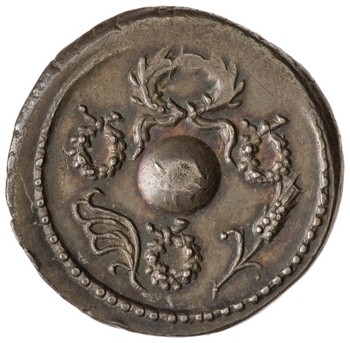
I sat in on a seminar on Cistophoric Coinage today.  I had learned most of what was presented along the way or had read about it in books, but there is something so nice in being talk through a topic, show the pictures, and handling the coins.  I creates grooves in ones mind and one sees the image anew.  Some of what I saw got me thinking about the coin above.  Not that it looks anything like a Cistophoric coinage.  Look at the reverse (“tails” side).  (I’ve turned it around.)Image

On the bottom left corner of this is image is something called an aplustre, the stern decoration of an ancient ship:

The coin is made by Sulla’s son, Faustus, who at the time of its manufacture was quite close to Pompey and these images are widely accepted as celebrating Pompey’s various accomplishments with the aplustre representing his clearing the seas of pirates.  That’s not controversial.  It’s just that before this aplustre aren’t known on the republican series.  There are plenty of aplustre on various greek coinages.  For example its often on the observe (“heads” side) the coins of Sinope (e.g. SNGuk_0901_1463)

Or even better this beauty:

reverse

But, sitting in the lecture today I was struck by how prominent (at least to my eye) the decoration on the bow case of the typical cistophori seemed to resemble an aplustre.

Here’s one that looks more like a bow case:

But many look more like this:

or like this:

Stylized bow case or an actual aplustre?  I don’t know.  Is there any reason for naval symbolism on late Attalid coinage?  I do think that many ancient viewers would see an apulstre before they saw a bow case. I’m not the first to think this.  The BMC catalogue recorded the image as an aplustre, but the description has fallen out of favor along the way.  Want a look at the whole group? This is a good starting place.  So does it relate to Faustus’ coin probably not through an sort of intentional symbolicalism, but cistophori might have been just about the most common aplustre type of coin imagery the creators and uses of the coins may have handled.

***

Both of the bibliographical difficulties from earlier have been cleared up!  Thank goodness for academic friends.

5 out of 410 days: Digital Glass Ceiling

Yesterday it was obscure print publications with poor library deposition, today it is completely find-able entries in research databases behind the pay wall.  One well known publisher in our field has taken to publishing digitally new editions of old reference works that used to be printed in book form.  This is a huge advantage for searching and cross-referencing and updating.  It’s a huge disadvantage if your institution doesn’t subscribe and in good conscience I can’t ask my library to pay $9,540.00 for the database.  That’s more than the operating budget of my department his past year.  ILL can easily secure me a copy of just about any page in any book in any library in the country, but that pay wall creates a huge research gap between poorly funded state institutions and large privates.  It puts the individual researcher in the position of having to spend hours travelling and getting permission slips to access the resources at another institution OR begging for a little favor from a scholar with a better job to make a copy and send it along OR pay for a day pass from the publisher out of one’s own pocket. The edits continue.

Can one plagiarize oneself?

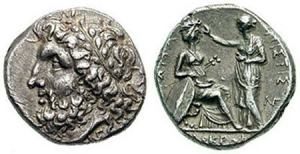
Locri - Roma Pistis SNG ANS_531


Being rather demoralized by the stalling of the edits and then further derailed by a networking lunch (a most pleasurable experience with much inspiration about future study abroad, err… ‘international education’ as one says today), I couldn’t really think about coins, but didn’t want to break my promise to put a coin from the book here every day.  So I looked in my coin file and this one popped to the surface.  It looked familiar so I did a key word search and sure enough just over a year ago I talked about it at a nice invited lecture at Leeds University.  I said: “Near, or at the end of, the war with Pyrrhus, the Locrians, a community in the very toe of Italy, created a coin which has the very earliest depiction of the personification of Roma on it.  She bears a scepter, rest her right arm on a shield, and sits upon a curule chair.  She is being crowned by the personification of Pistis, the Greek equivalent of fides.   Both figures are labeled with legends so the audience cannot mistake the unusual scene.  Even this type of labeling on coins is virtually unknown at this date.  Legends usually named whose coin it was ‘the coin of King Philip’ or the ‘the coin of the Athenians’.  Our literary sources on the Pyrrhic War are spotty but according to the epitomes of Cassius Dio, the Locrians changed sides a few times and suffered the consequences of those choices—a pattern of events that repeated itself in Hannibalic War.  I take this ‘celebration’ of Roman good faith as an expression of a rather desperate hope that they might benefit from this particular Roman virtue.” I then connected it with a few literary texts.  Anyway.  It’s something.  Back to the damn edits.