Finished up a script and slides for my talk on the 15th at the end of Wednesday and suggested to SDA that we take the Tandem to PA for a little overnight visit with his parents before doing fireworks with his brother in NJ. The family is a wee bit concerned about our decamping to Turkey for 10 months and we want to spend as much time with them as possible before we go.
Arriving back in the state of grace otherwise known as Brooklyn, I find that 36 hours in A/C has made me much less eager to get on with working with just a fan. We’ve been doing summer without our window units, partly to save the pennies, partly to be green, partly because we haven’t yet hit that “can’t stand it a second longer” point.
I keep considering linking this blog to my FB, but it feels very academically naked. Which it would be. Which would be the point. To take the pride out of the process. The posts here aren’t finished products: just little reflections of my imperfect thinking along the way. Public practice.
Today’s goal is try to put to bed the overdue book review. And, write back to a couple of very nice numismatists who I asked to help me source an image of a rare coin type, the only specimen of which might be in Paris. I love how happy coin geeks are to share what they know with one another. The enthusiasm is palpable. Makes it easier to ask for help.
update a few hours later: I broke down and plugged in the little A/C next to me in hopes of it raising general levels of productivity. The cats seem happily intrigued by the change.
The numismatic equivalent of archaeological stratigraphy is the overstrike — cases where an older coin is used instead of blank flan in the minting process. When we can identify the undertype we have a precise means of identifying a chronological relationship between the two types. However sometimes they tell other stories too…
This is a Sextans (= 1/6 of an As). Mercury is the traditional deity indicating this denomination. However, it is over struck on a Uncia (= 1/12 of an As; Roma in an Attic helmet is the associated divinity). How is this possible? What is going on?
First some background about Roman weights.
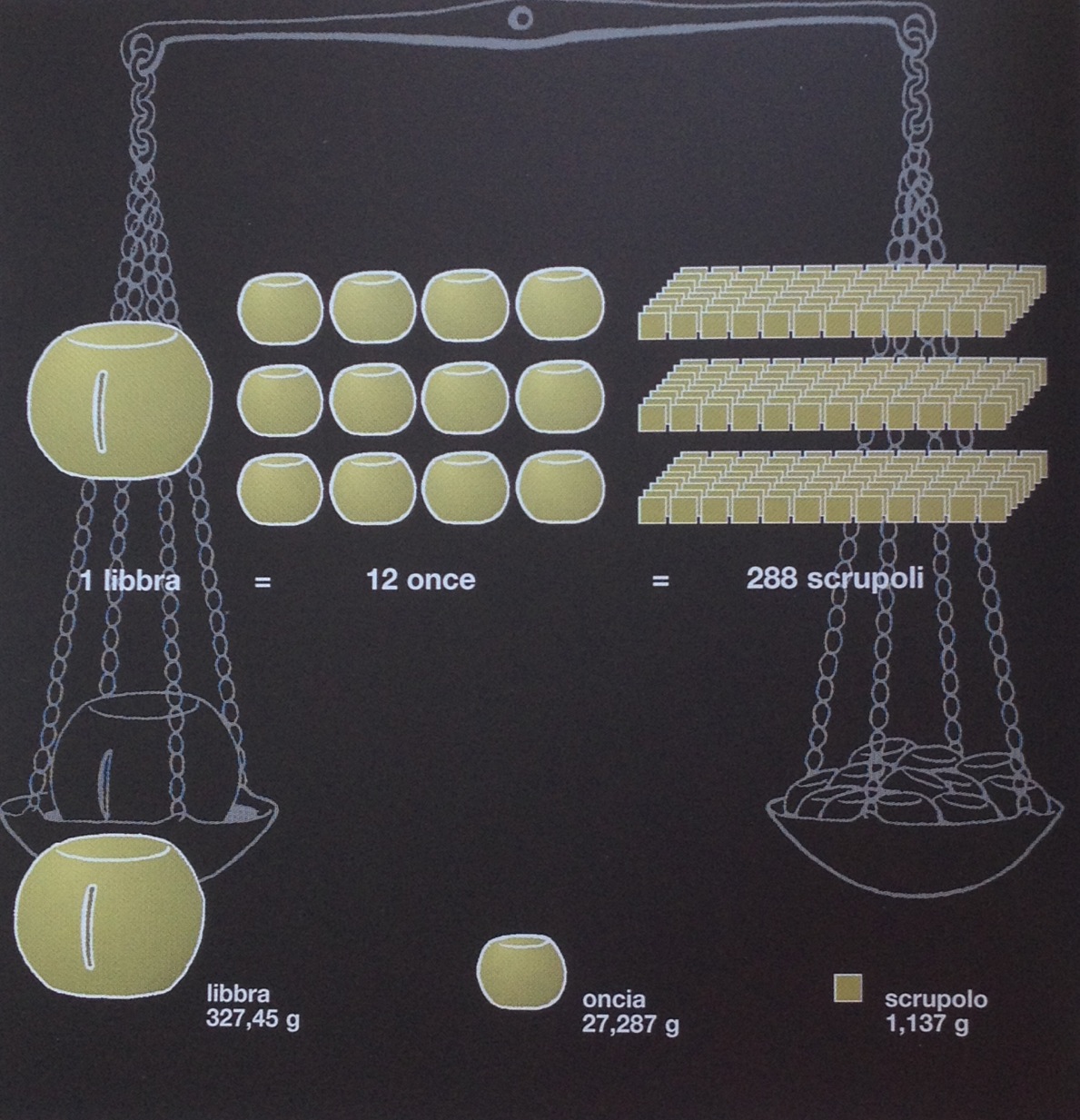
This handy visual aid is from p. 28 of this great museum catalogue. Originally the As was equal to a Roman pound which on a base 12 system divided into 12 ounces or uncia. The as had fractions, semis (1/2 as = 6 uncia), triens (1/3 as = 4 uncia), quadrans (1/4 as =3 uncia), sextans (1/6 = 2 uncia), and the uncia itself. Crawford likes to use 324 grams as the conversion from modern weights to Roman pounds: it’s close enough and divides nicely by 12. He also observes that full weight as is just about as much bronze as can comfortably fit in the palm of a hand.
So in 217 in the dark days of the 2nd Punic War with Hannibalic in Italy, Rome decides to cut the weight standard of the As in half. That is to say they now make a coin valued as an as but weighing 1/2 a Roman pound ~ 162 grams. Over the next six years as the war continues the weight continues to slip downwards eventually ending up with an as that weighted just 1/6 of a Roman pound, i.e. what two uncia or a sextans weighted before 217! Not exactly the sign of a healthy economic situation. This coin is from the intermediate stage. It shows the Romans taking a coin that used to be valued as an uncia and revaluing the exact same piece of metal at double its original value.
This is the road that leads from an intrinsic value bronze coinage to a token bronze coinage. The silver was not untouched by the Hannibalic War. We can thank the same economic stressors for the creation of the denarius (10 asses!) in 211BC. In time the denarius itself would end up retariffed at 16 asses, c. 140 BC, but that story will have to weightwait.
I started wasting time trying to figure out where this image of a Roman banker came from. I stopped. It’s one of those wiki images floating around the internet without proper attribution.
Update June 8: A colleague solved the mystery for me! I love that. AND she introduced me to another great database I’m ashamed to say I did not yet know about! Click on the image to be enlightened.
I find it a little ironic that I spend a good chunk of time worrying how to pay rent in Turkey with money earned in the US. Moving money internationally isn’t hard, just expensive. There seems to be no way to avoid paying high transaction fees or trying to operate in cash, though even cash comes with exchange rate difficulties. All these problems existed in the Roman world. They had to find ways of shift large sums over large distances. Maybe I should just bring gold…
Subletter is arranged and our Turkish Landlords are in touch. All very reassuring. Now I just have to worry about the money. Modern and ancient.
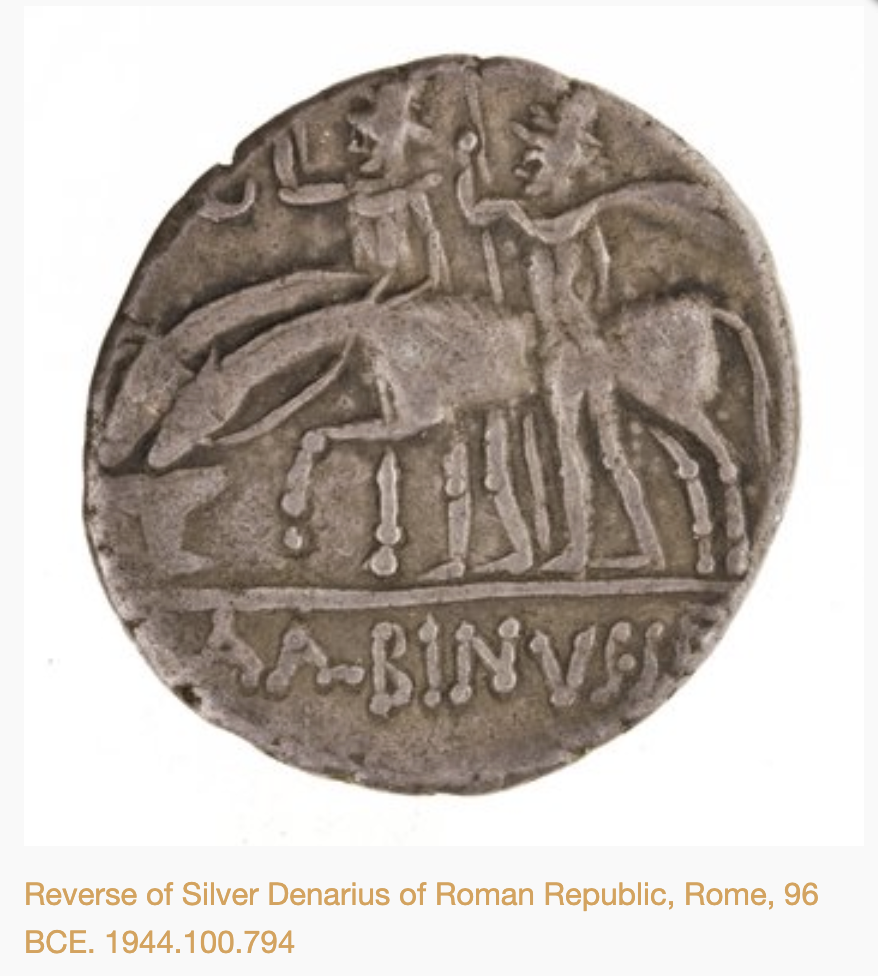
So we’re told by Velleius Paterculus that the colony of Narbo was founded in 118 BC and he connects this colony with other Gracchan colonies. This coin series is taken to be minted as part of the foundation of that colony. But everything about the historical details of this colony foundation and the relationship to coins seems a little more difficulty than most of the sources want to allow. Some, like the New Paully, put significant weight on milestone: ILLRP 460a, CIL XVII.2, 294 (picture at fig. 2.12 here): CN Domitius CN f / Ahenobarbus / imperator / XX. The suggestion being that in order to measure distance on the road from Narbo, the colony must already be founded, and if Ahenobarbus (cos. 122) is imperator he can’t have triumphed yet. Did he stay in the province until as late as 117 BC? Is that his name on the coin? Crawford thinks it is his son (cos. 96) with L. Licinius Crassus (cos. 95) along with some other moneyers. Why the son?
Crassus’ role is another matter. The key passage is this:
It has been used to argue a later date for the founding of Narbo based on Cicero’s chronology of Crassus’ career. Crawford strongly disagrees. Most now seem to follow Velleius and Crawford (and Eutropius who might or might not be following the ‘authoritative’ but lost account of Livy here). I’m more interested in how the passage hints at the ‘popular’ nature of the colonial foundation. An idea expanded else where in Cicero where he says Crassus’ speech in support of the colony was anti-Senatorial:
The coin itself appears militaristic showing a vicious naked Gallic Warrior. In iconographic terms we might file it with a coin like this, which is usually thought to have been made the year before and to commemorate the Gallic victories of 121 BC and the double triumphs of Domitius and Fabius in 12o BC. If they were in 120 BC… (see above)
Was Narbo a military foundation to defend against the menacing Gauls? Was it part of a Gracchan vision of distributing land to the urban poor? Was it both?
And then there is that Naked Gaul on the first coin, who Crawford doesn’t think could be King Bituitus — a bizzare figure who appears to have ended his days in Alba (Fucens?). The literary testimony seems in knots about his relationship to the two commanders (Domitus and Fabius): the Triumphal Fasti seem to give credit to Fabius, but Val. Max. 9.6.3 has a very different story indeed. Bituitus is probably a red herring from numismatic perspective, but a most enjoyable one.
Enough.
Final Note To Self: Don’t forget to link the Cicero above to coins of the gens Cassii on prosecuting Vestal Virgins in some future post!
***
July 5 update: After spending an extended period of time with Mattingly 1972 and 1998 as reprinted in 2004. In 1972 he argues for a lower date on the basis of hoards and Cicero. In 1998 his arguments are based on patterns on the coins such as types of ligature and the dispensing of ROMA as an obverse legend. He asserts in his 2004 preface to the 1972 piece that Cn. Domitius and C. Cassius of the coins are not the consuls of 96BC and calls them ‘irrelevant’ to the dating of the Narbo founding. He holds to a ca. 115BC date. I find his use of hoard evidence hard to follow; his writing drowns in details and minimal articulation of the logical connections. I am going to transcribe his dating system into the margins of my copy of RRC and hope in the process of transcription I begin to see the forest for the trees.
This is a pre-run post. I want to give the phone like five minutes on the charger so I get a full dose of mind numbing music while I pound the pavement.
The potential Istanbul house for 10 months had begun to terrify me. Luckily, SDA’s enthusiasm is unwavering. So, it was something of a relief that the owners hadn’t written back since last Thursday. Maybe it would fall through and not be my fault. But! Then a close colleague/friend wrote to me this morning interested in subletting and cat-sitting for us. I hadn’t realized how much of my anxiety was about leaving my home to strangers and moving the kitties out of their familiar territory. Now that we might have that solved I want to put the money down on the Turkish home lickety-split! I am sure to change my mind a dozen more times about how I feel about the whole thing.
I did switch gears quite efficiently and spent the day revising a previous paper to present in two weeks time. It’s all about coins, but I find myself reluctant to talk here about things I’m working out for immediate presentation else where. I made a reference there to the memory of the Battle of Lake Regillus, saying it “…was only won by Romans through the divine intervention of the Dioscuri and the resulting treaty was one of mutual dense, protection, and collaboration. The moral of that story is that Rome needs the Latins…” I decided to think about whether this seemed a reasonable claim for the message behind other portrayals of the myth. The coin above is taken to be a moment in that battle recalling the moneyer’s ancestor’s desperate act of hurling the standard amongst the enemy to motivate his men a turning pointing in the battle that is linked to human, not divine, action.
The same moneyer also minted a coin of the Dioscuri watering their horses at Lake Juturna, an image associated with the divine announcement of victory far off from the city. This is the Dioscuri as messengers, not necessarily saviors. These images seem most concerned with connecting the moneyer’s family with a defining moment in Rome’s legendary history. I’m not sure I see in them any real concern about relations with Latins or greater Italy.
Afterthoughts: It occurs to me that the second coin is in fact a form of epiphany not unlike the Sulla vision coin of the previous week. There is a significant literature on epiphanies and that might be the correct angle to investigate. This particular epiphany is said to explain the origins of the placement of the Temple of Castor in the forum. It also is said to have recurred after later battles in the historical period, connecting them in magnitude and significance to the Battle of Lake Regillus. Could any of the later epiphanies/battles be recalled by this coin as well?
***
In other news SDA finished the edits and I actually got to send off the revised chapter and wipe it off the mirror. The first accomplishment of the sabbatical!
So the on-the-spot feedback from a colleague was hugely successful. I asked her to do what I do with students. I gave her a copy and read aloud from my copy and told her to interrupt me and ask questions about the ideas and expression of ideas as we went along. I loosened up and got less attached to the words on the page and filled in the gaps in logic and significant sidelines of thought and interconnections between the sections. It felt magical. I stayed writing at her living room table and let her read the final bits until it was done, done. Except for copyediting. Oh the dreadful typos I create. SDA has volunteered his services. We talked through it over the weekend and he seems genuinely desirous of doing it. Partnership and all that. Thus its off my plate and onto his.
The weekend was mostly the Tour, and new friends, and tandem riding, and photo sorting, and fridge cleaning, and mentoring a former student… I did look at the book review and realize I need some of the early volumes in the series before I can finish it. That’s a trip to campus to the library. And, I need to pick up mail etc etc.
BUT the book review is not the major goal I must remind myself. Today’s project is to read through all my unpublished materials (or most of it) and decide what precisely I’ll be speaking about in 2 weeks time for my next public lecture. AND, ideally what I will be submitting as a chapter of an edited volume by September 30. They need not be the same but thing.
Facing my corpus of unpublished papers is a little like staring into a treasure chest and also into a closet full of skeletons. I’ve been hoarding them. Waiting for just the right moment. Why? Who knows! Maybe I’ll figure that out.
A Lex Gabinia of 139 BC began the trend by which Roman political proceeding came to be largely held by secret ballot. Instead of saying aloud one’s choice, voters would place their clay ballots into an urn. Voting bridges were introduced to protect the voters from interference from the surrounding crowd. Overtime more laws were enacted in the same spirit moving most all forms of voting (elections, legislative sessions, trials, etc..) to secret ballot. What does this have to do with coinage you ask?
First there is the theory that this lack of ability to hold individual voters directly responsible for their actions forced members of the elite to find new ways to influence the voting and win supporters. The idea is that the huge variation in types that one see emerge in the 130s onward is inspired by the desire of moneyers to promote themselves, their families, or their political allies in the eyes of the voting public. Harriet Flower has taken this idea a step farther and suggested that the change voting procedure and coin output together with other factors mark the end of the republic dominated by the nobiles and heralds in a new type of republic. She even suggest that there is pretty radical shift in the audience of the coin iconography from images previous directed to individuals outside the community to an inward target (p. 76). I find that a challenging idea. I would rather want to say that all the images on Roman coins were directed at both internal and external audiences. The main function of the design is to mark the coin as Roman currency, to make it spendable — that is to identify it as legal tender. The images accomplish that goal in any period. The shift in images is possible because of the extension and stabilization of Roman hegemony. The more readily familiar the denarius is the less its design needs to conform to a single type.
I am also concerned with presumption that the secret ballot was about lessening the power of the elites or their influence. I am rather taken by this recent assertion by Crawford:
Crawford, Michael. ‘Reconstructing what Roman republic?’ BICS 54-2 (2011) 105-114, p. 110
If he is right that elite support for the secret ballot was an attempt to paper over growing divisions amongst the ruling classes, then the diversity of coin type would be symptomatic of those division rather than inspired by the new electioneering needs of candidates for office. There are many problems of course with seeing coin types as directly forms of electioneering – time in circulation, slow disbursement, as well as others.
What coins can add to the discussion is the long term resonance that such legislation had.
In 51 BC C. Coelius Claudius decides to create a series explicitly commemorating the accomplishments of his eponymous ancestor the consul of 94 BC. All the other accomplishments alluded to on the type record military victories, the traditional source of gloria for a Roman noble. [The epulum on 437/2 may be an exception but we’ll investigate that another day.] And, yet of equal note along side the military accomplishments is the plebicite of 107 making treason trials use the secret ballot–notice the ballot behind the portrait head! There are a number of other coins which commemorate ballots, but those can be saved too.
I’ll close by trying to contextualize Coelius’ series. The ancestor portrait needs to be thought of as akin to the funeral imagines, ancestor masks worn by younger decedents of similar stature at family funerals. Those masked descendants would recount accomplishments, just like the coins do. The masks might have elogia next to them while on display in the family tabularium. Coelius is using the coins in just same way as that familiar aristocratic ritual. I bet Flower says something similar in her first book. I best check…!
[There are two ANS specimens but they are a little harder to see.]
I decided to start with coins today to ensure a happy start and so I didn’t feel like I was rushing at the end of the day or stepping away from editing the chapter too soon. I didn’t have any plan other than to open up a real book and see where coins entered the history. Bispham mentions the coin above in relation to two Volumnii, possible cousins, who set up an in inscription (CIL i2. 1505 = CIL 10, 05971) in Signia (modern Segni) as quattorviri with jurisdictional power. Bispham’s concern is to elucidate the nature of this local magistracy, but refers to an article by Badian which tries to grapple with Volumnii family. While there are Volumnii of the early period attested in Livy, the family emerges suddenly in Roman politics in the 1st century BC. The L. Volumnius Stabo who minted this coin above in 81BC is thought to be same as the military tribune of Gn. Pompeius Strabo at Asculum in 89 BC known from this inscription and also the same at Senator Volumnius mentioned by Cicero in his Letters. Based on the Signia inscription, Badian suggests that Volumnii of the late republic acquired their Roman citizenship through serving as magistrates of this Latin Colony.
I then swapped over to thinking about Signia. Wallice-Hadrill has a fabulous reading of the evidence from the site (p. 121-126). Besides the giving the Roman World waterproof concrete, opus signinum, Signia is also known for its monumental building program of the late second century BC, including a temple of Juno Moneta and a nymphaeum whose architect signed is work and maybe have also build Marius’ temple to Honos and Virtus in Rome and even the sanctuary at Praeneste. Zevi has hypothesizes a strong regional connection between these communities and the Marians. Regardless, the building renaissance of Signia and its neighbors of which Bispham’s inscription is but further testimony, came to an abrupt halt after the Social and Civil Wars. Think of Sulla’s sack of Praeneste just the year before this coin was struck.
That the Volumnii, or specifically one particular L. Volumnius Strabo, should be found climbing part of a cursus honorum (mit. trib., IIIvir monetales, quaestor? –> senator) at Rome right as his home(?) community is dwindling in significance is worthy of note. A community to which his ancestors had been very generous. Perhaps Signia and its neighbors waned as their elite redirected their energies toward securing recognition in Rome. Or perhaps the elites felt compelled to move to greener pastures as the region suffered in aftermath of war. Or a bit of both.
The meaning of the type is obscure… for now.
[Some have thought the Volumnii were Etruscan, see bibiography at Farney, p. 128 n.9]
I thought I might write about this stunning series which shows Hercules and each of the nine muses on the reverse. I started by reading Rutledge’s Ancient Rome as a Museumbut didn’t find much. I ran some bibliographical searches and re-read amongst other things the classic Richardson article which raises more questions than it answers. Farney connects the observe to a family connection to the Games of Apollo, but is silent on the reverse. I then went and checked my own notes and saw that I was going to talk about it in relation to Fulvius Nobilior’s (cos. 189) temple to Heracles and Muses and the statues of the later he brought back from his conquests of the Greek East. The theory being that the coins show those statues and the impression they made. That’s really speculative. We really know nothing about this coin series. Perhaps it had better go in the introduction during a discussion of re-dating and the use of hoards. Crawford has it as 66 BC but based on the huge Mesagne hoard Hersh and Walker redated it to 56 BC. I used it as an opportunity to play around with searching the database I mentioned yesterday. Mapping findspots. Seeing the date spread of hoards. Seeing whether types in the series are found together (they are, no surprise). The re-dating by hoard evidence and the name pun might in the end be the best most honest history one can write from these beauties. Though, of course, Farney’s point will get a shout out when I talk about references to ludi (games) on coins.





 Liv Mariah Yarrow