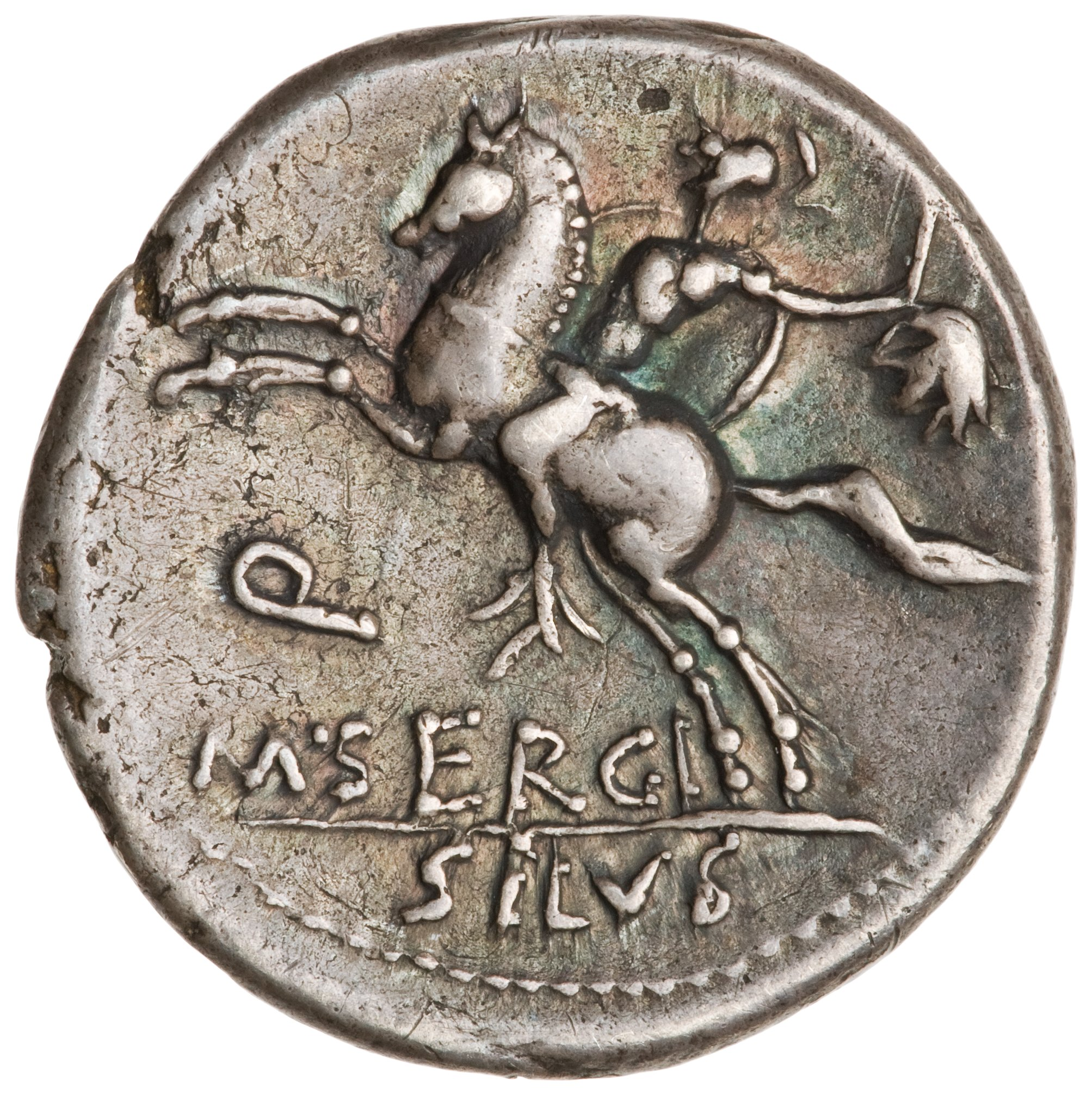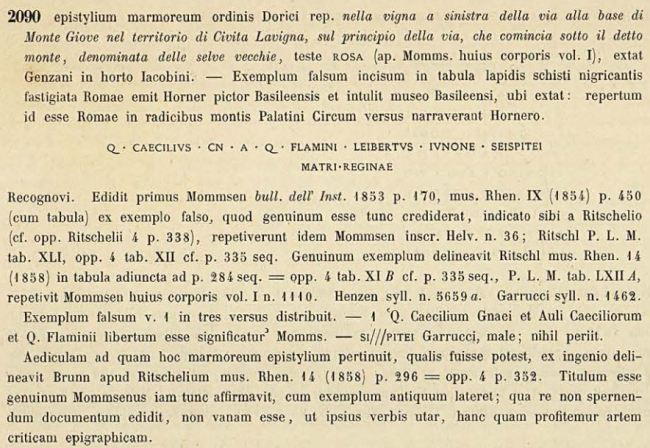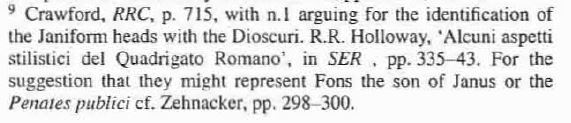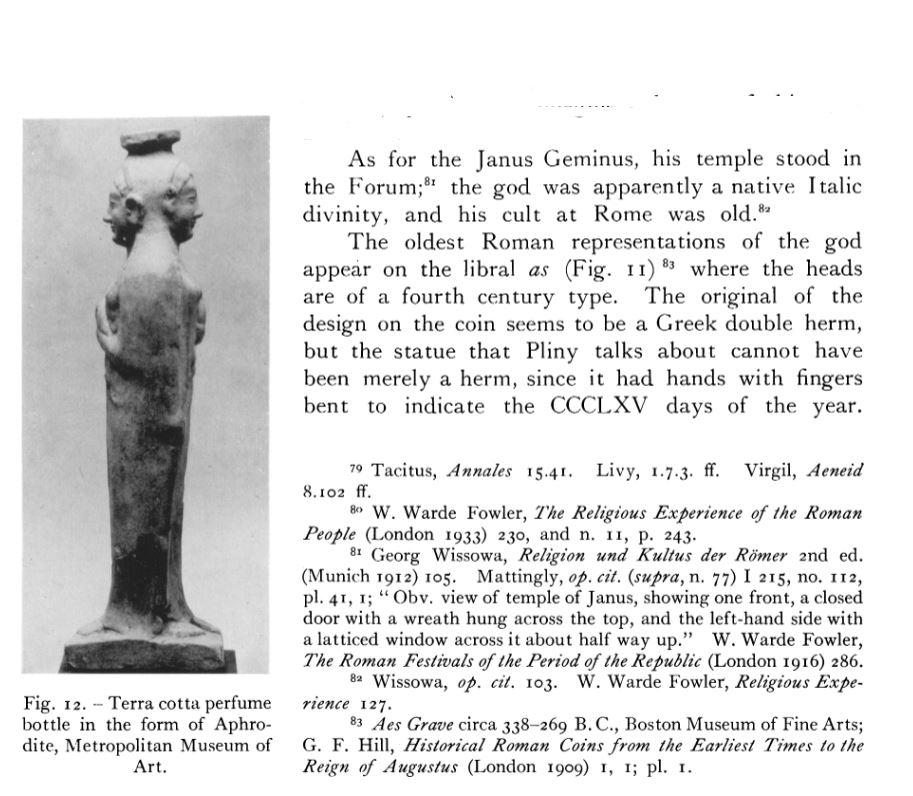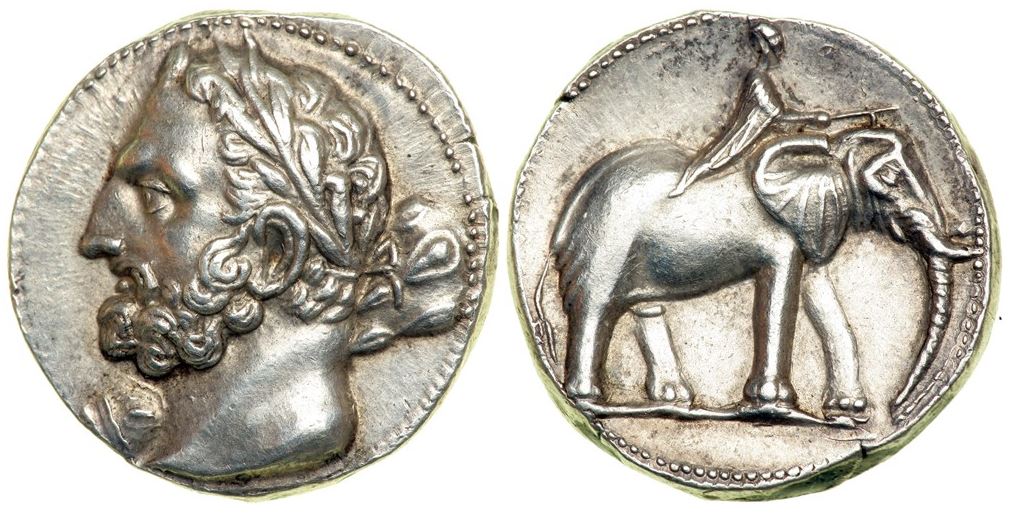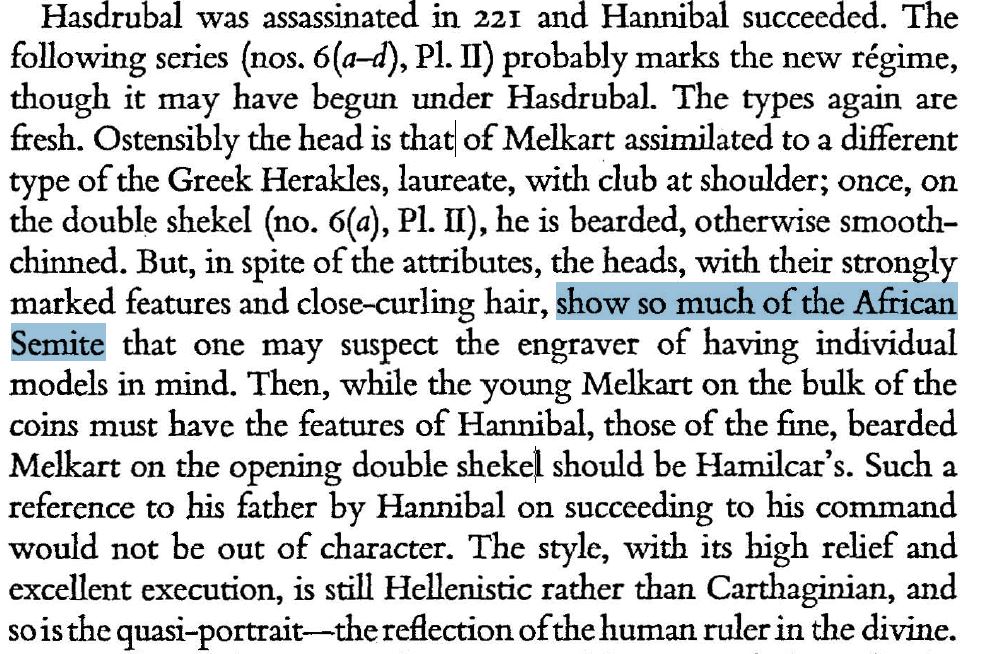
I couldn’t do my research without the hard laboring librarians of ILL. Those at my own institution process and vet my innumerably requests, but others all over the world slave at scanners to bring me tidbits of information. My favorite part is when I find a little trace of their humanity in the margins of my scans. Thumbs of glory disseminating esoteric knowledge free of charge. Or, more accurately, as all the coversheets now say:
Anyway in honor of the thumb above: ” Dear Librarian of Binghampton University, THANK YOU!”
24 January 2012 Update: Thank you University of Chicago ILL:
I always love a good cross-cultural narrative parallel. There is a dreamer in me that secretly wants Jung’s Archetypes to be real. I’m reading Wiseman’s “Games of Flora” today and he has a nice opening about how Flora under her Greek name, Antho, appears in some versions of the Romulus foundation legend:
So basically the evil king’s good daughter rescues the future leader of the people. This time before the infant leader is tossed in the river, instead of after. Still I can’t help but think of the Exodus story. This led me to a very illuminating look at the character of pharaoh’s daughter in the Jewish tradition.
What does this have to do with coins? Not much particularly, except that now this coin with the head of Flora will probably get a wee mention in chapter 2 along with the more obvious wolf and twins types:
This coin is only known from one unique specimen in Paris. {Irritatingly the digital catalogue entry has the wrong image linked to it as of 7/20/18} Its authenticity seems guaranteed by the accuracy of the Oscan language inscription, which at the time of its first documentation was not yet fully understood. Photos on the internet are hard to find. The wikipedia entry is okay. Heck, I’m impressed it has an entry or sub-entry. I’ve taken the drawing above from Wyler’s 2008 article.
Mostly I’m writing this post to make a note of Mattingly’s rather under-acknowledged theory that this is not a Social War coin at all, but a product of the Mithridatic Wars (2004: 189-192). The usual explanation is that the Italians copied the type from the bronze of Amisos:
And that thus it represents tangible proof of the suggestions in the literature that the Italians sought (and perhaps obtained?) support from Mithridates (Diod. 37.2.10; Athenaeus 5.213C). My enemy’s enemy is my friend, as they say. On Dionysus imagery during the Social War, see:
Pobjoy, M., ‘The First Italia’ in K. Lomas and E. Herring (eds.), The Emergence of State Identities in Italy in the First Millennium BC (London: Accordia Research Institute, 2000), 187-211.
Anyway, Mattingly focuses on this passage from Plutarch’s Lucullus:
He thinks that the Parisian specimen is one of these pieces of gold and that the Oscan was used to unsettle the Italian troops in Lucullus’ army and encourage them all the more to revolt.
This seems even more far fetched, than the Social War explanation. Really the problem comes down to there only being one of these gold coins. We have no comparative evidence or geographical data, let alone archaeological context. We remain in the realm of speculation. Anyway, just to make this post a little more complete, we should note that a similar bust of Dionysus does appear on the Italian’s silver coinage:
Update 8-29-25:
I’m interested in early knowledge of this type/specimen.
I’m reading V. Arena’s fabulous new book on Libertas. The BMCR review made it seem like a very theoretical take. I find it well grounded in both theory and evidence. Really well conceived throughout. She does a brilliant job of integrating numismatic evidence throughout.
In the midst of a well-reasoned discussion of why libertas and victoria are linking in the Roman mind set, she drops in the bit about Cicero I quote above (p. 77).
This kicked off in my mind an old thought I’ve often had while reading the prophesy of Jupiter in Vergil’s Aeneid with my students in gen ed classes. Do we have the Romans to blame for such problematic ideologies as Manifest Destiny, The White Man’s Burden, vel sim. Did all that classical education in post-renaissance Europe provide a template for justifying Imperialism to the emerging christian colonial powers?
I hope some one smarter than me has articulated the connection.
This summary by Crawford in RRC vol. 1 on page 6 is so useful I thought I’d toss it up on the web so it would be easy for me (and others) to find in future.
This present chapter on popular politics has been running away from me. I set aside my first draft with a well formulated intellectual introduction at about the ~3,000 word because I just wasn’t getting to the bulk of the coins fast enough. I had gotten stuck in the minutae around the coins of Minucii. So I pulled them out and wrote them up at about ~1,500 words. I also had some even more tangential thoughts about Lepidus’ Alexandria coin that will ideally be a separate paper. I kept that write up to about ~1,000 words. I then started again. I used a ruthlessly chronological structure for agrarian issues and grain supply. I did myself an elaborate timeline first and than wrote through the evidence. I would need a decent introduction and conclusion but it does what it needs to do and I’m generally happy with the results, but its 5,500 words. And it was supposed to be a 1/3 of my present chapter. In total that means I’ve written 10,000 words in the last month besides the non-sense here on the blog. I’d be happier if it felt ready to go but it doesn’t and that’s that. Today, I’m going to switch over to writing about libertas and citizen rights on the coinage. There’s a pretty well trodden bibliography which should ideally make my work easier. I don’t need to re invent the wheel I just need to survey the evidence and frame it in a user friendly way. I hoping to perhaps abandon the chronological framework to keep the whole thing tighter and more compact. That said history is built on chronology and the narrative of the Roman republic is one of constitutional change and development.
The blog is still feeling useful. At times. I’m not allowing myself to worry about not writing here. I put things here when writing them up is a good way to move on from an idea that’s caught my attention or write something up long form or in a chatty voice before transforming it into a sentence or two in the book. To find out what I think by putting it down on ‘paper’ and looking at it.
I can’t believe this is finally coming out! Even with an author’s discount at the press its pricy enough, I might have to wait to see if my grant comes through and add it as a budget line on that, if possible. Oh. And they say it will also be available as an ebook. I might have to have both a digital and hard copy. I’m stupidly excited to read it. ALL OF IT. It would be really tacky but I’d almost consider fishing around for an opportunity to review it.
Two very respected scholars read this coin of 58 BC as an iconographic turning point. They see it as shocking that both sides commemorate ‘personal’ or ‘familial’ themes and thus leave no room for the state. They see the divinities of the obverse embodying community identity in a manner that by implication the ‘private’ types can’t.
While the type is visually innovative and thus fitting with the character of this aedileship which was known for the spectacular (see below), the types would not be meaningful if they were only private. The images are making a direct claim to the importance of the events thus celebrated to the community as a whole. The state glorified through individual acts.
In the ædileship of M. Scaurus, three hundred and sixty columns were to be seen imported; for the decorations of a temporary theatre, too, one that was destined to be in use for barely a single month. And yet the laws were silent thereon; in a spirit of indulgence for the amusements of the public, no doubt. But then, why such indulgence? or how do vices more insidiously steal upon us than under the plea of serving the public? By what other way, in fact, did ivory, gold, and precious stones, first come into use with private individuals? Can we say that there is now anything that we have reserved for the exclusive use of the gods? However, be it so, let us admit of this indulgence for the amusements of the public; but still, why did the laws maintain their silence when the largest of these columns, pillars of Lucullan marble, as much as eight-and-thirty feet in height, were erected in the atrium of Scaurus? a thing, too, that was not done privately or in secret; for the contractor for the public sewers compelled him to give security for the possible damage that might be done in the carriage of them to the Palatium. When so bad an example as this was set, would it not have been advisable to take some precautions for the preservation of the public morals? And yet the laws still preserved their silence, when such enormous masses as these were being carried past the earthenware pediments of the temples of the gods, to the house of a private individual!
The accuracy of this testimony is however called in question by other passages in Pliny.
I’ve been reading Schafer’s 1989 dissertation on sella curulis und fasces. Many nice little observations and details here and there. This coin has the distinction of being the first to display the curule chair and to be the first minted by a curule aedile. The head of Cybele recalls the oversight of her games by the curule aediles. Schafer also wants to connect the lion’s feet on the curule chair as a fantastic detail linking to the role of lions in the cult of Cybele, a detail added to the coin to make the connection between obverse and reverse that much more obvious. He bases this assertion on the absence of such feet on other representations of the chair. I’m not so sure it is that unlikely that some sella curulis weren’t so adorned.
I’m interested in how the moneyer has used symbols and words together to communicate his message. The P. FOVRIVS is written onto the chair itself making the individual and the status of the object absolutely clear. This isn’t any old curule chair its Furius’ chair!
Then on the obverse at the end of the legend AED CVR is a foot. The foot is the visual symbol for the moneyer’s cognomen, Crassipes = crassus + pes = thick foot, i.e. probably clubfooted. The cognomen is known in other families in the Imperial period but primarily used by the gens Furii. Why is another matter. If it refers to the congenital birth defect it may be that the family had the genetic mutation that made the disorder more common. Or perhaps some ancestor just had a fat, swollen foot from a war wound or some more mundane reason. All that said the foot is clearly being used as a symbol of the name which appears on the reverse. Who was AED CVR? Crassipes obviously! There’s his foot.
The other thing this issue is good for is illustrating how spelling varients in proper names. He is always FOVRIVS with an O before the U, where as we later see the gens switching to just Furius. That said, the engravers swap between the CRASSVPES and CRASSIPES spelling. The varients crop up elsewhere but its curious that the moneyer himself didn’t seem to impose a single spelling of his cognomen on his coinage. I usually get quite sniffy if my name is misspelled or mispronounced.
There is, I should mention, a good chance that this moneyer is some relation to Cicero’s later son-in-law, a Furius Crassipes of unknown praenomen.
We’ve talked about Roman names a bit and how they can be the inspiration of visual puns on coins. There is no pun today. Just a really unfortunate rather common cognomen. Brocchus.
Bucktooth. As in, “Hey Mr. Bucktooth get in here!” Just unfortunate. I guess it isn’t any worse than Balbus, the Stammerer. But really it isn’t very nice.
Do you know what else isn’t nice? Stereotypes. Especially, racial stereotypes. The new Google image search seems perfectly designed to help re enforce and educate us all about common stereotypes. Case in point:
I know this is result of the algorithm that suggests just what other people commonly search for and click on, but how deeply sad and unfortunate.
Here’s Mr. Bucktooth’s coin from 63BC who inspired this post.
And while we’re at it. I really hope his father wasn’t THIS Gnaeus Furius Brocchus: