Most commonly abolitionist medals resort to scripture for their legends. This Swedish Abolitionist is honored here with a line from one of Angelo Sabino‘s poems written in the persona of Ovid’s colleague, Aulus Sabinus. It is line 40 of his letter from Demophoon to Phyllis. His three letters circulated in renaissance editions of Ovid’s Heroides and were widely believed to be genuine into the eighteenth century and beyond. Wadström was a devotee of Emanuel Swedenborg and his religious (mystical) arguments for abolition.
The use of pseudo classical verse instead of a biblical quotation is interesting to me for how it flags the strong classical influence on this visual media.
Reverse of RIC II, Part 1 (second edition) Vespasian 1268. ANS 1954.203.168
The legend of the medallion, LIBERTAS MERITIS EST MIHI FACTA TUIS, translates: ‘My freedom is the result of your services.’
Frankly I find it creepy that a line of love poetry is used in this context. Wadström is known for his personal relationship with the young Peter Panah whose freedom he bought, but who continued to live in Wadström’s household until his death two years later.
How free was Panah? Not very. His baptism, education, and place of residence were all controlled by his ‘benefactor’. What we know largely comes from his benefactor’s own account. The relationship was idealized by contemporary abolitionists:
[Update 3/26/15: On this painting see the good discussion by Colman 2005: 93].
Carl Frederik von Breda’s illustration (1792) showing Wadström teaching the freed slave Peter Panah the virtues of Swedenborg’s tract The Wisdom of Angels
This coin came up as I was looking for specimens for my Warwick Keynote in July. It won’t appear there but some coins of Liberia may.
This type of hard times token was designed to circulate in the regular monetary system as a large copper cent. The reverse in particular is designed to imitate official coinage of the time.
The token is designed not only to circulate as money but also to carry with it a popular abolitionist message. The appeal is to humanity of the enslaved. The specific token type above has its design origins in British abolitionist tokens of the previous century:
More examples here and this medallion. Notably the American version has a woman and the ‘Am I not a Woman and a Sister’ legend. Notice that the date is many years earlier than Sojourner Truth’s famous speech on May 29, 1851 in Akron, Ohio, the speech we now know as the ‘Ain’t I a Woman’ Speech. The earliest printed version of this speech has no such line in it. The first version was published on June 21, 1851 by Marcus Robinson, a close associate of Truth and the secretary of the Convention.
We call it the ‘Ain’t I a Woman’ speech because of Gage’s version published in May 1863 in which the speech is re-crafted in a parody of Southern Dialect: Truth was born and raised in NY in a Dutch speaking household. The refrain of ‘Ain’t I a Woman’ was inserted in four times. The new refrain was as demonstrated by the tokens such as that illustrated above an accepted and common abolitionist plea one that is combined with the image of the slave as down trodden, in need of external salvation, begging for mercy. Gage brought all these prejudices and more to her rewriting of the speech to sound as she and her audience thought a former slave woman should speak. Stealing the Truth.
Here is Robinson’s version, the closest we are likely to come to the power of Truth’s words as she spoke them.
I want to say a few words about this matter. I am a woman’s rights. I have as much muscle as any man, and can do as much work as any man. I have plowed and reaped and husked and chopped and mowed, and can any man do more than that? I have heard much about the sexes being equal. I can carry as much as any man, and can eat as much too, if I can get it. I am as strong as any man that is now. As for intellect, all I can say is, if a woman have a pint, and a man a quart – why can’t she have her little pint full? You need not be afraid to give us our rights for fear we will take too much, – for we can’t take more than our pint’ll hold. The poor men seems to be all in confusion, and don’t know what to do. Why children, if you have woman’s rights, give it to her and you will feel better. You will have your own rights, and they won’t be so much trouble. I can’t read, but I can hear. I have heard the bible and have learned that Eve caused man to sin. Well, if woman upset the world, do give her a chance to set it right side up again. The Lady has spoken about Jesus, how he never spurned woman from him, and she was right. When Lazarus died, Mary and Martha came to him with faith and love and besought him to raise their brother. And Jesus wept and Lazarus came forth. And how came Jesus into the world? Through God who created him and the woman who bore him. Man, where was your part? But the women are coming up blessed be God and a few of the men are coming up with them. But man is in a tight place, the poor slave is on him, woman is coming on him, he is surely between a hawk and a buzzard.
VB series. Victoriatus, uncertain mint circa 211-208, AR 3.34 g. Laureate head of Jupiter r. Rev. Victory crowning trophy; in lower field, VB ligate and in exergue, ROMA. Sydenham 113. Crawford 95/1a. NAC 61 (05/10/2011) lot 396 .
So I love maps and I was just adding a beautiful map from Fronda’ Between Carthage and Rome to yesterday’s post when I notice a place called Vibinum. I’ll happily admit its not a topographical location whose historical significance I’ve ever considered, although modern Bovino is quite pretty indeed. Here’s Fronda on its possible position during the 2nd Punic War (2010: 86 n. 152):
It occurs to me that of the VB series whose mint is usually listed as unknown is found in large numbers in the Canosa hoard. Anyway. VB is probably just some junior official. No coins of Vibinum are known or much else about it for that matter! Just thought I’d share the wild speculation for kicks. (And because the specimen above is just so beautiful!)
***
When Mommsen attributed this type to Vibo Valentia, he did not have the benefit of any strong dating evidence. Vibo was not founded until 192 (planned 194; Livy 34.53 and 35.39) and once it was founded it used Valentia on its coins not Vibo.
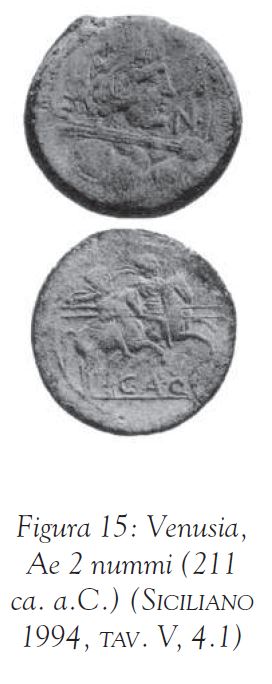
HN Italy 718. Venusia. ‘double-nummus’. Image from Burnett, ‘La monetazione di Venosa…’ (1991), 4.1.
This post is hot on the heels of the last. There is a lot going on in the numismatic world of SE Italy during the Hannibalic War. I wish I had a copy of Marchetti’s Histoire économique et monétaire de la deuxième querre punique (1975) to hand. I can’t let go my concerns about the CA series and its attribution to Canusium, especially when the Latin colony Venusia just 40km up the same river valley and on the Via Appia (the better road!) was Marcellus’ base of operations and thus hosting many soldiers in need of payment. So I thought I’d peak at the Venusian coins–I can’t type Venusian without smirking and thinking of hippy-dippy alien theorists–but in all seriousness I observe a couple of things:
The quincunx, teruncius, biunx, and sescuncia are all reported as being overstruck on other issues (HN Italy 720-723).
The coin above is signed by a quaestor with the initials CA.
No this isn’t a smoking gun, but if I was a Roman general looking for a mint in the Aufidus region I think I’d pick a colony near a troop base on a main road, even if they were a little lazy about not recasting flans.
Burnett, and HN Italy following Burnett, read GA.Q, not CA.Q, but C/G are pretty much the same letter form in this period and most subsequent ones. The letter forms are different from the CA on Roman coins and I can’t actually bring myself to say RRC 100 is actually close in ‘style’ to any of the Venusian specimens I’ve looked at.
This is not the only coin in the region that seems to be signed by a quaestor. Reportedly (I’ve not seen an image) Naples, S.2219 = HN Italy Brundisium 749 reads M.PV Q. Brundisium is also a Latin colony and a major military staging post in this period of the second Hannibalic War. In fact it seems THE major port and certainly M. Valerius Laevinus’ original base before he started his cross Adriatic shenanigans. Brundisium’ coinage is signed by a bunch of magistrates. And most of M.PV’s coins aren’t labelled with a Q.
These two instances of quaestors at Latin colonies got me thinking about quaestors and coinage more generally. As I’ve said before, there isn’t a lot of evidence on 3rd century quaestors generally and that part of what made the signed Egadi rams special, but here are two more quaestors.
Are they local quaestors? Probably, the lex Osca Bantina of the late second early first century BC mentions quaestors in its list of magistrates and it is thought to derive from an earlier Venusian prototype (Bispham 2007: 142-152, p. 143 n. 124 lists other examples of Italian communities borrowing the structure of Rome’s magistracies). That said, Badian in his 1975 article on the quaestorship spent a lot of time thinking about the Roman expansion of the quaestorship and the growth and change of the coinage system. These two minor examples might lend a little weight to the idea of a third century connection between coinage and quaestors. And might help point the way towards how we should be thinking about some of the unidentified signatures on Roman series. … Early posts on quaestors.
Yes, I’m still laughing about ‘Venusian’:
A useful map:
From Fonda, Between Rome and Carthage (CUP 2010): xx; note especially the indication of the limits of river navigation!
A slightly clearer image of the coin above taken from Carroccio 2008:
“The issue with com-ear occurs in the Serra Orlando hoard; here as on the denarius and bronze the com-ear is a symbole parlant for Sicily.” (Crawford 1974: 16) Clearly, the ear of wheat is a symbol of Sicily (Hersh 1993: 141). But there is some difference between the selection of the symbol because of a canting pun or because already by the Hannibalic War the Romans were thinking of Sicily as a ‘bread-basket’. See, for example, this discussion of the symbol in a chapter on Sicilian identity. Crawford doesn’t explain how he thinks the visual pun works and so what follows is only speculation.
The Latin word for wheat is triticum.
There is a tradition that the ‘original’ name of Sicily was Trinacria. “(Τρινακρία/Trinakría, Hellanicus FGrH 51 F 79b), later Sicania (Σικανίη/Sikaníē, Hdt. 7,170; Σικανία/Sikanía, Thuc. 6,2,2) and only then Sicelia (Σικελία). The change of name reflects the successive immigration of the Sicani and Siculi; however, Trinacria is probably an unhistorical construction from the Homeric Thrinacia (Hom. Od. 11,107; 12,127; 12,135; 19,275), taking into account the triangular shape (tría ákra) of the island.” (So Olshausen in Brill’s New Pauly).
Maybe the adjectival form of triticum in the feminine, triticia, is close enough for a canting pun, but I’m not one hundred percent convinced.
Would the name Trinacria be widely known? Jacoby’ collection of the fragments of Timaeus suggests it was in use in the West (FGrH vol. 3b.566, F164 ln.4) But when we go to the source text, Diodorus, it’s hard to be sure that particular word was actually Timaeus’ contribution. [I give the big block quote at the end of this post.]
In Latin authors its mostly used in poetic authors, and not before Catullus. By contrast the early poets Ennius, Naevius, and Plautus all just use the name Sicilia.
But perhaps Crawford has a different Latin or Greek near homophone in mind which I just have yet realized.
An aside. One of my favorite Turkish phrases is jeton düştü! The penny dropped! In this case, perhaps I should say, jeton düşmedi. The penny has not dropped. I’m not really sure the idiomatic phrase really carries over from English to Turkish but my Turkish teacher seemed to suggest as much and as a numismatist how can I resist using it.
Crawford labels this quadruped as a ram. Not a great fit. Hersh thought differently:
Denarius circa 206-195, AR 4.30 g. Helmeted head of Roma r.; behind, X. Rev. The Dioscuri galloping r.; below, ram r. In exergue, ROMA in linear frame. Sydenham –. Crawford 123/1. Extremely rare. Lightly toned and extremely fine The symbol on this issue has been called a ram and a calf, but Charles Hersh, in his review of Crawford, asserts that it is, in fact, a heifer, and that the distinguishing feature is abundantly clear on his specimen, now in the BM Collection. In any event, the coin a great rarity. (RBW) [NAC 61 (5/10/11) lot 561I hate to disagree with Hersh, but I don’t think that’s an udder hanging down. I was misled by the sales catalogue! Shame on me for not checking immediately! I even have the review on file.
I think it really must be a calf, a male calf (JUST LIKE HERSH SAID). I submit as evidence specimens of RRC 526:
Reverse of RRC 526/2. ANS 1960.170.9
Reverse of RRC 526/4. ANS 1935.117.30.
Reverse of RRC 526/1. ANS 1967.153.37.
Can we by extension guess that moneyer might be a Vitulus?! Or perhaps its too early for such punning symbolism. The main family to use the cognomen in the 3rd century were the Mamilii, namely the consuls of 265 and 262 BC.
Of course bulls and bull calves and Italian identity go together more generally (Pobjoy 2000: 201):
But then again it could just be just another symbol to distinguish the series. Something vaguely thematically appropriate (abundance, sacrifice …) but of no special significance.
RRC 111/1, Central Italy (?) circa 211-208, AR 4.03 g. NAC 61 (5/10/11), lot. 498.RRC 126/1;uncertain mint circa 206-200, AR 4.56 g. NAC 61 (5/10/11) lot 571
I enjoy how these two coins together illustrate the variety of acceptable forms of the letter A in the Latin alphabet at the end of the third century. That on each specimen two very different forms of the same letter co-exist warns the epigrapher against using these letter forms alone as a dating criteria. It also suggests to me that certain names were rendered in particular ways habitually. Compare for instance the VAR ligature of RRC 126/1 with that C.VAR ligature of RRC 74/1 (links to BM specimen). ROMA has an open single bar A because that’s just how the word looks right.
To my mind one of the most interesting aspects of the secondary marks on the early denarius, victoriatus and related issues is when they begin to experiment with different types of secondary symbols. Most of the secondary symbols that appear on the coinage of the Hannibal War had already been in use as control marks on the didrachm series with Roma and Victory (RRC 22): cornucopia, crescent, caduceus, anchor, rudder, dolphin, star, pentagram, club, corn-ear, wreath, and so on…. These are relatively common symbols into which its dangerous to read too much particular meaning. Other issues are signed by the responsible magistrates, most certainly on Sardinia (RRC 63-65) and Sicily (RRC 74–75). I particularly like how we can see the development towards longer abbreviations on Sardinia. The praetor of 211 BC just uses the first letter of his nomen, ‘C’ for L. Cornelius Lentulus (RRC 63). The praetor of 210 uses two letters, ‘MA’ for P. Manlius Vulso (RRC 64). And finally in 209, the praetor C. Aurunculeius uses three letters ‘AVR’ (RRC 65). We don’t know the position or identity of the Sicilian magistrates, C.VAR and C.AL, but c. 209-208 they choose to use their praenomen initial, as well as an abbreviation of their nomen. This type of signing of issues by junior officials will become standard at Rome in the future. We can look to the signed Egadi rams for a possible comparable phenomenon. On other issues the letters seem to be used to designate the place of issue rather than a magistrate, such as at Luceria, Canusiumand Corcyra (RRC 97-98A, 100, 101). The place names and magistrates names may simply be thought of as functional elements for the purposes of identifying the source and/or authority behind the issue. We need not read them as acts of self-aggrandizement.
Then there are the other abbreviations the resolution of which is more controversial: are they indicating magistrates or places? (e.g. RRC 92-95). We can easily find places to match the abbreviations, but then fitting those places as possible mints into the historical narrative of the Hannibalic War becomes very problematic. I’m not proposing to resolve these difficulties here.
It has long been recognized that the wheat-ear functions as symbol of Sicily on certain issues. More interesting are some of the more ‘creative’ symbols used by the Sicilian mint, one’s we’re not absolutely positive about their identification. A possible bit-drill (so Hersh for RRC 77) and measuring stick (RRC 78) and the pick-ax that might be a canting pun (RRC 73), but also isn’t that different from the ceremonial hammer found on coins from central Italy (RRC 59). Then there is also the very odd serrated issue of denarii with a wheel (RRC 79). Did the Sicilian mint have a fashion for practical tools as symbols? Why?
On to the meat of the matter:
The Sicilian symbols help us see that there was room for experimentation with the range of symbols. The introduction of three new symbols onto the coinage stand out in particular: the torque, the falcata, and the carnyx and shield. None of these elements are typical elements in Hellenistic art, but are instead identifying attributes of Roman enemies, especially elements that the Roman troops actually encountered on the battlefield. Both the torque and the carnyx appear frequently enought on the republican series and other media to make them familiar symbols to numismatists and art historians alike. That said, their first appearance on the coinage is noteworthy. These issues borrow a symbol of the enemy and display it on the coinage like a trophy of war, the appropriation of the symbol representing the defeat of the fearsome aggressor. The torque victoriatus is very rare (RRC 91/1a; two in the BM and one in trade). Frankly, if we didn’t have a preconceived idea of what a torque looked like it would be a difficult symbol to decode, looking rather like an omega. The carnyx and Gallic shield is far more common and the iconography beyond dispute (RRC 128; examples in trade, ANS specimens). The falcata is called a knife by Crawford, but as one independent scholar has recognized, the republican coins are clearly representing the typical Iberian weapon.
Discovered in 1867 in Almedinilla (Province of Córdoba, Andalusia, Spain). Now in the National Archaeological Museum of Spain.
The falcata is depicted in Iberian funerary art as well (Blázquez 1988: 506; cf. Osuna relief). It’s two occurrences on Roman coins should be seen as akin to depictions of carnyx, i.e. as appropriated symbols of the defeated enemy.
All of this is important because, taken together, these three types represent a critical development in the ‘money as monument’ phenomenon at Rome. Just as actual torques, carnyces, shields, and falcatae were displayed in Rome as the spoils of war –dedicated in temples and hung on the houses of the generals as lasting testimony to the victories — so too the alien symbols on the coinage testify to the defeat of a specific formidable foe.
This is perhaps a natural evolution from, say, the display of enemy ship rams on war monuments and their appearance on the coins.
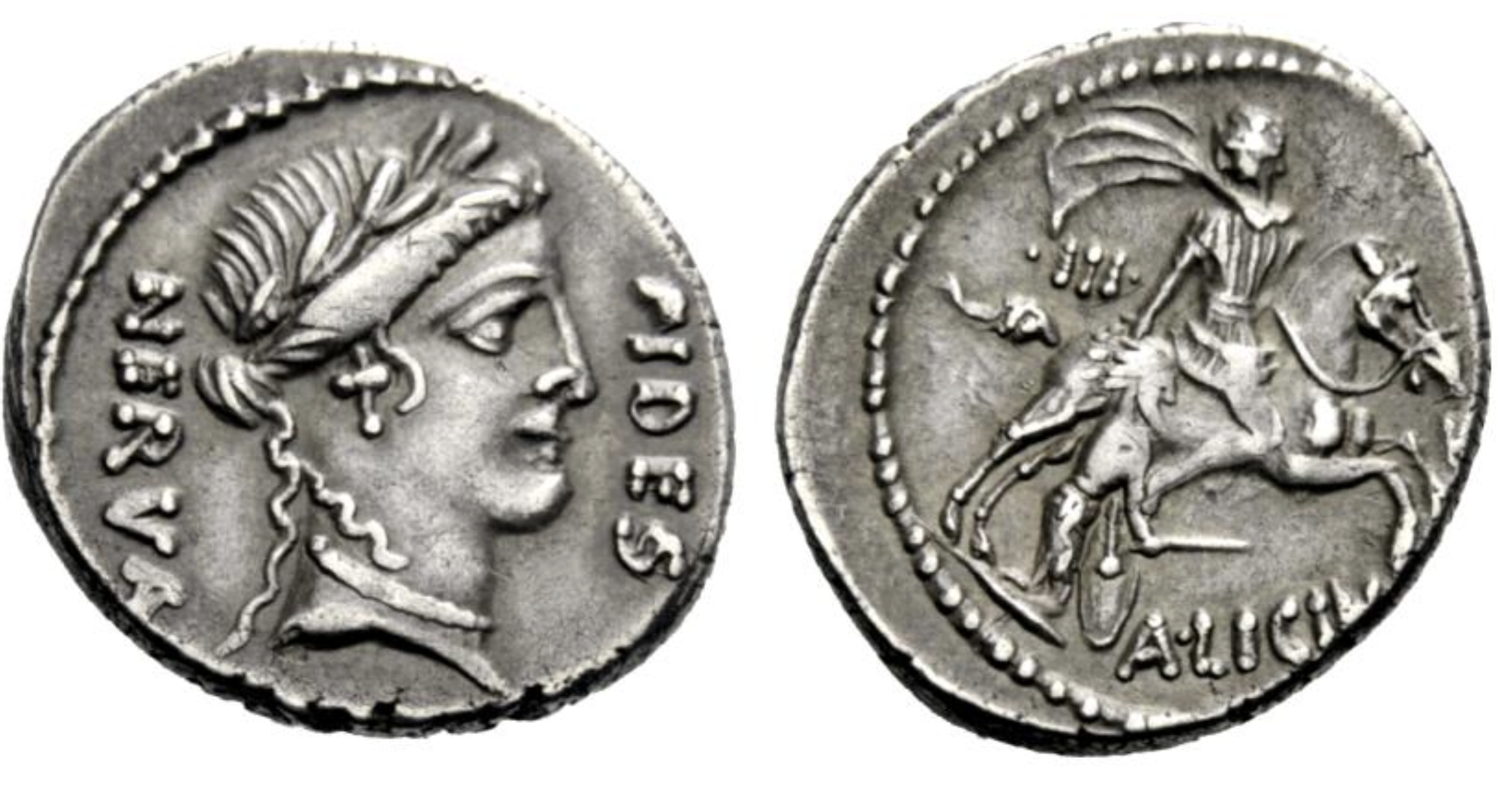
The JD collection of Roman Republican Coins part II – session II; A. Licinius Nerva. Denarius 47, AR 3.88 Babelon Licinia 24. Sydenham 954a. Sear Imperators 30. Crawford 454/1.
This beautiful specimen has been photographed just like most specimens are. This orientation of the reverse is necessary to have it match Crawford’s description, ‘Horseman galloping, r., with r. hand dragging naked warrior, who holds shield in l. hand and sword in r. hand.” The difficulty with the photography and this description is that it ignores the ground line. Here’s the same image slightly rotated.
The warrior is kneeling. He may be wearing pants. He’s clearly a ‘long haired barbarian’. The horse is rearing. And, the most likely interpretation of the scene is that the barbarian is stabbing the horse. If you remember from a couple of posts ago, having two horses cut out from under him (and living to fight on) was part of the heroic career of Sergius. Facing horse stabbing enemies is part of the motif of the brave Roman warrior. And, it shows up in artistic representations left right and center. I don’t have to collect the information because one military historian, Prof. Michael P. Speidel (University of Hawaii – nice work if you can get it!), has collected a whole chapter’s worth of examples. I kid you not, chapter 17 of his book, Ancient Germanic Warriors (Routledge 2004) is called ‘Horse Stabbers’. While his presentation of the evidence is strictly non-chronological and I don’t always agree with his interpretation of the evidence, he cites all his primary sources and does a fine job of making clear that Romans (and the Greeks) thought a horse stabber was a very scary thing indeed.
Does this help with answering which heroic ancestor this was? Not particularly. But Brennan, Praetorship (2000) 228, 246, esp. n. 38 and 39 on p. 344, relies on Obsequens 22 and Frontinus Str. 2.5.28 to suggest that Licinius Nerva the Macedonian Praetor of c. 142 (Liv. Per. 53, Var. R. 2.4.1-2 and Eutrop. 4.15) was engaged in difficult combat with the Scordisi and perhaps the Iapydes on the Northern frontier of his province.
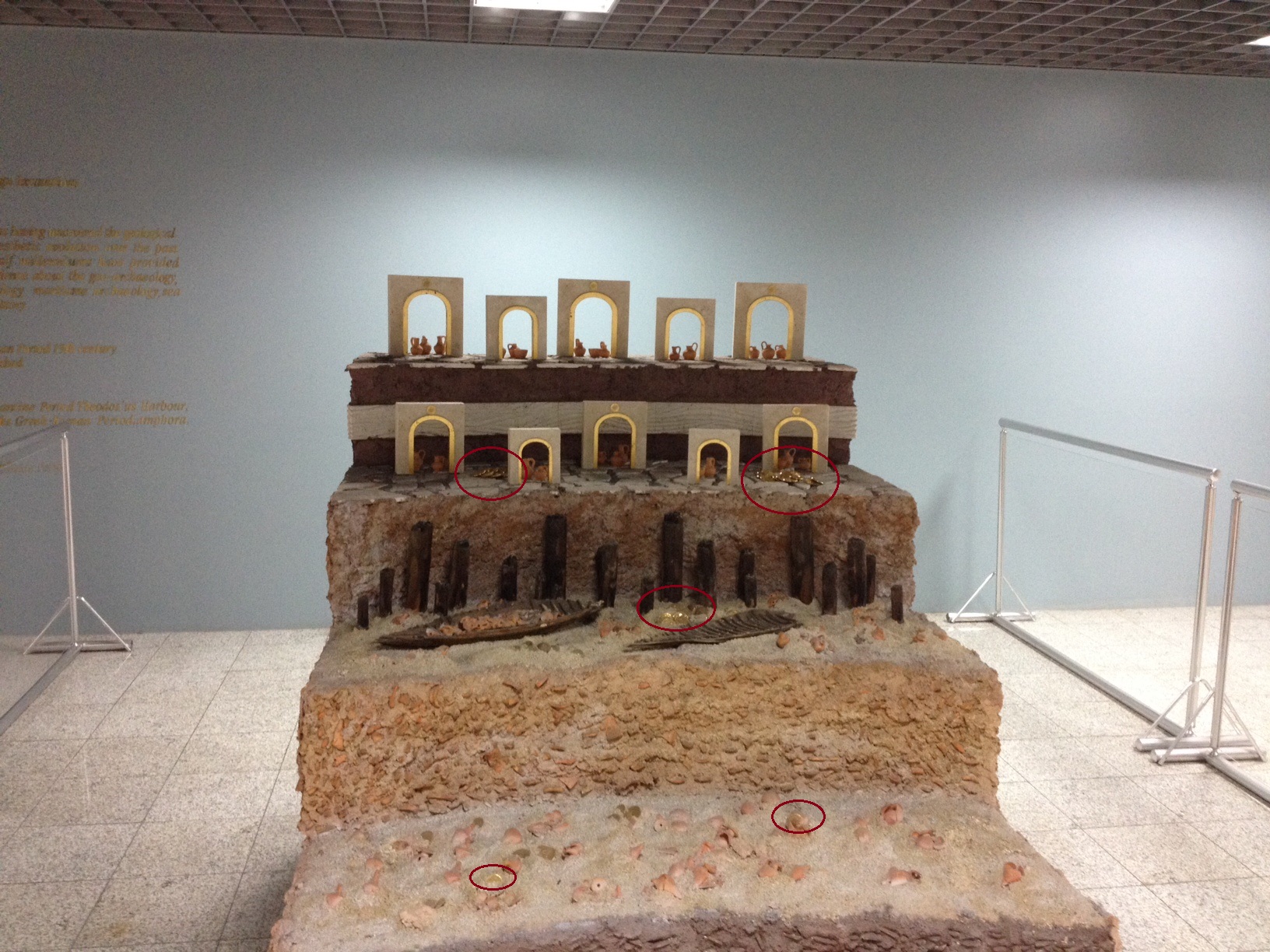
Yenikapi is Istanbul’s major new transportation interchange center. It links the Marmaray (the new train under the Bosporus) with two of the city’s existing subway lines and has easy foot transfers to the ferry ports and tram and bus systems. It’s fabulous. It could teach NYC not just a thing or two, but dozens upon dozens of things. It also happens to be on the site of the Theodosian harbor. You can still look down into the massive open air pit filled with hundreds of crates of finds, bones, amphora, and the detritus of everyday life. And some awesome exposed piers with reused marble facing. It should be on every history and transport buff’s must see list for Istanbul.
The artistic displays in the station are meant to celebrate the layers of history exposed by the building of the station. Mostly this is very successful. However, the display pictured above makes me mad. Not for the loose interpretation of stratigraphy or historical inaccuracies. It’s art. It’s an impression. It doesn’t have to be true in a scholarly sense, to be true the spirit of the thing. A transportation hub isn’t a museum. [Although they do that pretty well in some places in Rome…]
What infuriates me is the sprinkling of fake gold coins throughout the model to make is glittery and appealing.
Treasure hunting is a huge problem in Turkey, not unlike many countries. I’m not talking about the professional looting of antiquities. That’s a problem but it’s an organized crime executed by people who know exactly what they are doing. By contrast, treasure hunting comes from a lack of public education about the value of archaeology for its own sake. There are no gold coins hidden under the pictures of birds in the Roman mosaics. Smashing necropolis with sledgehammers or bulldozing Hellenistic foundations will not lead to a pot of gold.
Turkey’s museums are doing an awesome job educating visitors about problems with both looting and treasure hunting. But, the average Turk who might think about treasure hunting is not the target audience of those museums. The display at Yenikapi will be seen by millions upon millions of Turks and foreign visitors. The impression it gives is one that gold coins are the bread and butter of archaeology at all levels and all civilizations. This can only but feed the imagination of the misinformed.
We need to do a better job educating the general public about the historical, cultural, and social value of archaeological finds, not as treasure but as time capsules that can open up a whole new world of knowledge. Knowledge we can all partake in. Discovers that cause awe and wonder. Insights that will enrich our lives.