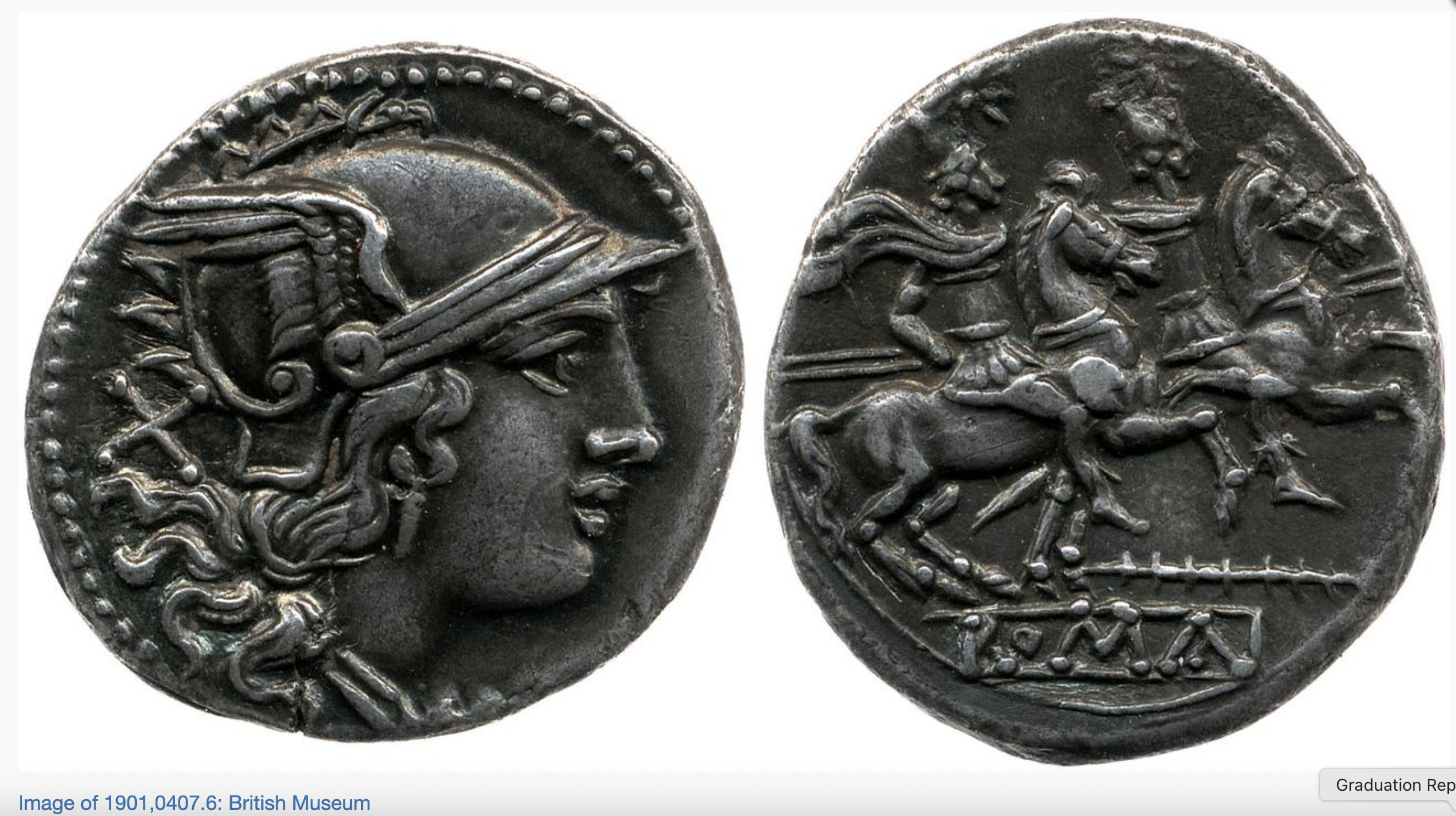
Measuring Sticks, Decempeda, Pertica etc…

RRC 78/1

A while back when I first looked at this type I asked a colleague who works on science and technology in the ancient world and their representations in literature what he thought about Crawford’s suggestion that this “staff” is actually a measuring tool, specifically the decempeda.   He wrote back that he thought it a plausible identification and added:

“It doesn’t have ten divisions, but I don’t think that matters; it’s clearly some kind of ruler. Also called ‘pertica’: see Propertius 4.1.127-130 for association with land confiscation. And ps.-Vergil Dirae (‘Curses’) line 45.”   The key line reads:

nam tua cum multi uersarent rura iuuenci,
    abstulit excultas pertica tristis opes.

Even though many bullocks ploughed your fields, the merciless measuring-rod stole your wealth of land.

What the literary tradition suggests is a generally negative connotation of symbol.  An emphasis on the confiscation aspects of its application.  Could this really be a numismatic symbol?  Is it just a staff?  I’ve been a bit ambivalent, until today.

I was skimming for a good Caesar coin or two in the ANS database for my next class and came across this beauty.  Outside the time frame of my book project, but still very interesting indeed.
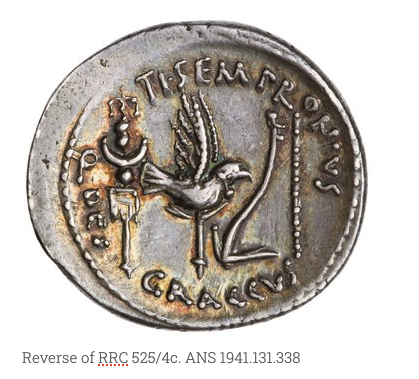
Here we have a young Ti. Sempronius Gracchus (quaestor designate!) trading on the reputation of his famous name by aligning himself with contemporary land distributions, particularly to Caesar’s veterans.  Notice the Legionary standards set right next to a plow and our measuring stick.

The flip side of confiscations is always distributions.  The power of the measuring stick as political symbol is its appeal to those to benefit from the rearrangement of property holdings.  Its power as a literary device is just the opposite.

What resonance would the symbol have in Sicily c. 209-208 BCE?  The Romans certainly engaged in some territorial redistributions on the island as rewards to their allies.  I do not want to say RRC 78 refers to any one such confiscation and allocation, but as an illustrative example, I provide a passage from Livy (26.21) that will be quite familiar to numismatists already:

Not the least conspicuous feature of the spectacle was the sight of Sosis the Syracusan and Moericus the Spaniard who marched in front wearing golden crowns. The former had guided the nocturnal entry into Syracuse, the latter had been the agent in the surrender of Nasos and its garrison. Each of these men received the full Roman citizenship and 500 jugera of land. Sosis was to take his allotment in that part of the Syracusan territory which had belonged to the king or to those who had taken up arms against Rome, and he was allowed to choose any house in Syracuse which had been the property of those who had been put to death under the laws of war. A further order was made that Moericus and the Spaniards should have assigned to them a city and lands in Sicily out of the possessions of those who had revolted from Rome. M. Cornelius was commissioned to select the city and territory for them, where he thought best, and 400 jugera in the same district were also decreed as a gift to Belligenes through whose instrumentality Moericus had been induced to change sides. After Marcellus’ departure from Sicily a Carthaginian fleet landed a force of 8000 infantry and 3000 Numidian horse. The cities of Murgentia and Ergetium revolted to them, and their example was followed by Hybla and Macella and some other less important places. Muttines and his Numidians were also roaming all through the island and laying waste the fields of Rome’s allies with fire. To add to these troubles the Roman army bitterly resented not being withdrawn from the province with their commander and also not being allowed to winter in the towns. Consequently they were very remiss in their military duties; in fact it was only the absence of a leader that prevented them from breaking out into open mutiny. In spite of these difficulties the praetor M. Cornelius succeeded by remonstrances and reassurances in calming the temper of his men, and then reduced all the revolted cities to submission. In pursuance of the senate’s orders he selected Murgentia [i.e. Morgantina], one of those cities, for the settlement of Moericus and his Spaniards.

Images and links fixed 3-4-26. Nothing else changed.

No More Meaningful Than a Postage Stamp?

One can’t seem to give a paper at a conference about coin designs without someone asking, if they’re really any more meaningful than a modern postage stamp [usually in a really special tone of voice].  Because of this ever present question and the resulting need to justify oneself, an apologetic reference to the metaphor is found in most modern books on ancient coin types (examples here and here and here).

The old trope comes from a 1950s debate between Jones and Sutherland.  Jones in Essays Mattingly 1956 and Sutherland’s rebuttal in the widely read 1959 JRS article.  [The latter some kind soul has put up on the web.]

Here’s the thing that gets me.  Who are coin geeks to disparage stamps?!?!  You’ve got to be kidding me that academics and enthusiasts alike can’t see the problem with this analogy as a negative analogy.  There is good, fascinating work out there about the importance of stamp imagery as a vehicle for studying national identity, social norms, cultural trends over time…  Why aren’t we reading this work?

Here’s a good place to start:

The next time someone brings up postage stamps, I’m going to congratulate them on their great positive analogy showing the power of studying coin imagery.
[And if you’ve said this to me or in my hearing in the last two weeks, don’t worry I’m not actually insulted, I just like a good rant. ;-)]
Bye-the-bye.  Just to prove there is an enthusiast for everything here’s a great website that specializes just in images of coins on stamps!


Infantilization of the Colonial Other

Speaking today at the Warwick Coin Day, “Currencies between Cultures”. Here are two slides cut from the presentation and their accompanying script.

infantilization1

“One of the most common visual metaphors of American and European imperialism is the infantilization of the colonial Other.  We’ve already met it today in Lewis’ speech to the Sioux about the symbolism of the medallions. We’re most familiar with the image from various comic renderings of the ‘White Man’s Burden’. Notice themes of feeding, teaching, and nurturing.  And, in fact, in Kipling’s 1899 poem about America joining the ranks of the imperial powers through the take over of the Philippines after the Spanish-American War the last stanza ends with the characterization of the colonial subjects as half devil and half child.  At first glance, this is not a particularly classical conception of empire, even if a classical personification of liberty does show up occasionally.   …

infantilization2

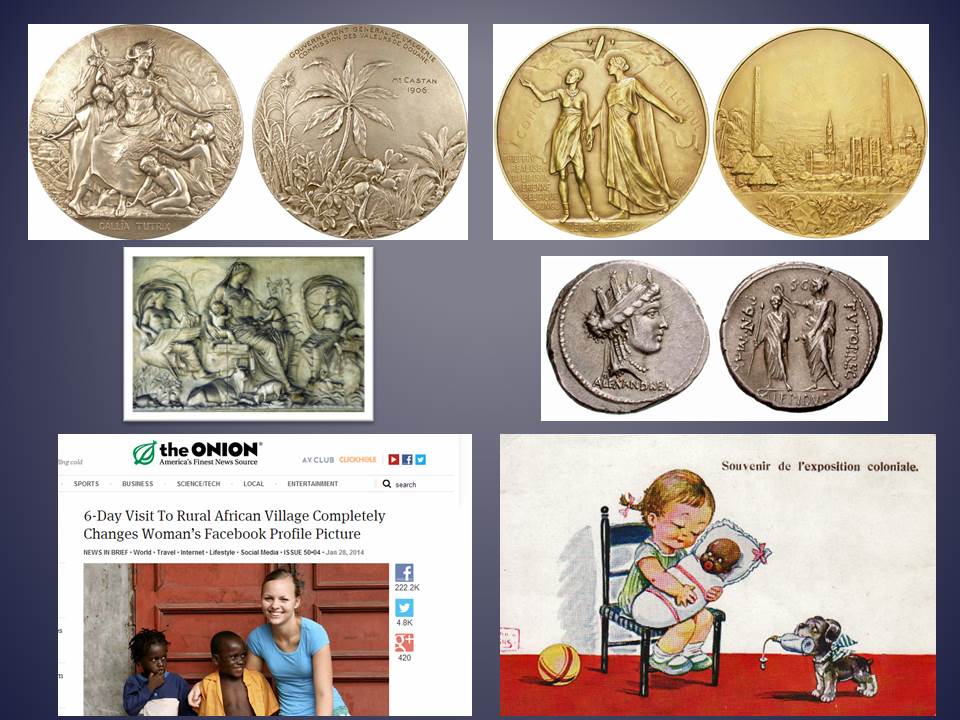
…However in its more romanticized version we can easily see how Roman models are once more adapted to meet the ideological needs of Colonial Europe. Beyond the obvious visual parallels and basic elements such as hierarchy of scale, also notice parallels in language in the legends. We have Gallia Tutrix in the upper left hand picture and in the middle right Lepidus the Tutor of the king, tutor meaning guardian in Latin.  The middle left image from Augustus’ ara pacis is probably not a personification of Empire but rather of the earth and harmonious bounty she can produce under the Roman peace.  However that peace conceptualized as a gift of empire and the later European adaptations simply take out a conceptual layer by making the female figure the personification of the imperial power in her own right.  And of course we have our now very familiar our palm trees and huts and rays of light.  This idea of motherhood rather than fatherhood as a metaphor for the colonial relationship is of course not restricted to medallic art. This is a postcard making a joke about the popularity of the French 1931 colonial exposition, what has been called by some commentators a human zoo. And This is an Onion article lambasting today’s voluntourism and its propagation of colonialist values from this past January.”

P on Roman Voting Tablets

Image

Image

Image

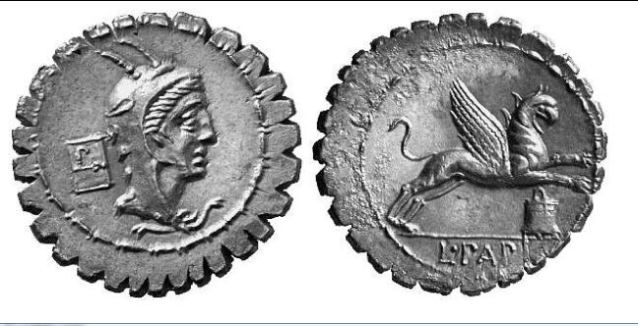
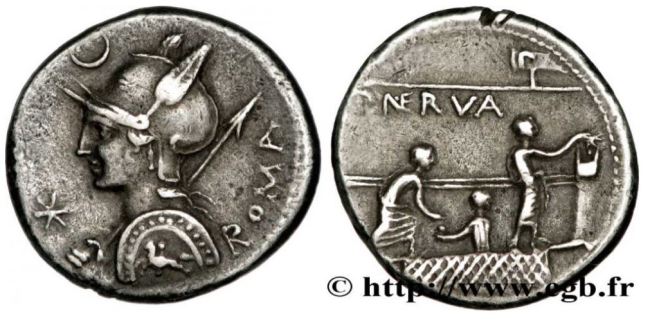
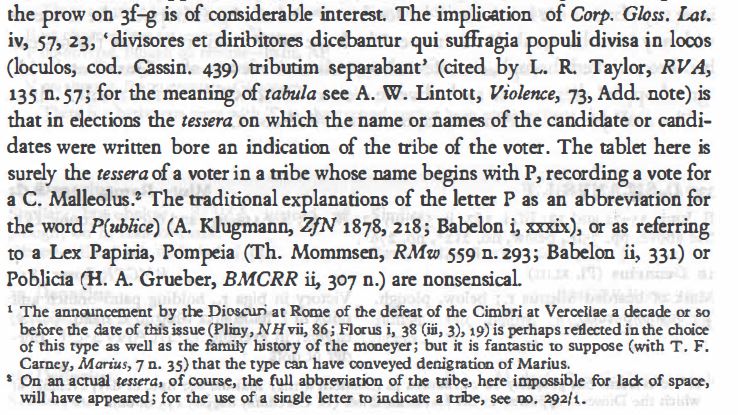
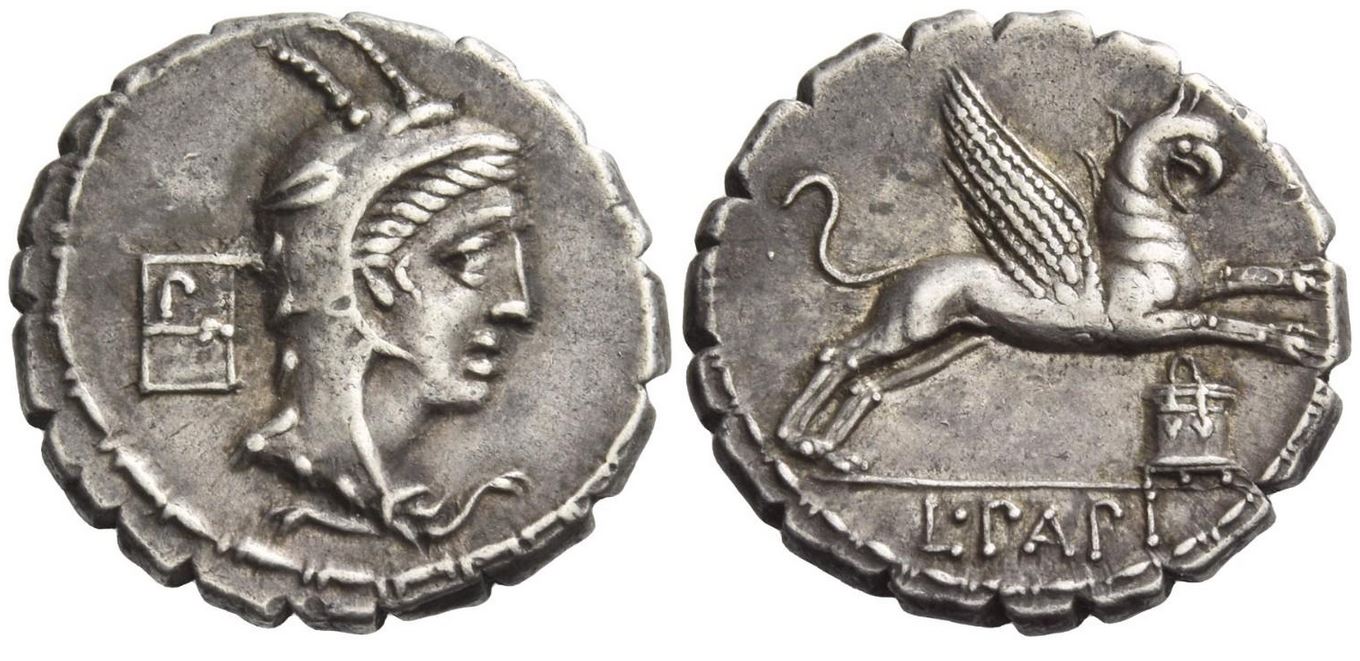
It is a remarkable coincidence that all of these types, RRC 292, RRC 335, and RRC 384, all made by different moneyers from different families each represent a voting ballot* with the letter P. I find it hard to accept that in each case the P stands for a tribe.  Why would they all select the same tribe or initial if it is indeed generic?  Compare the voting tablets market V for V[ti Rogas], RRC 413 and also as a controlmark for Piso Frugi (obv. 33, Crawford 1974: table XLII), or the A[bsolvo ] C[ondemno] of RRC 428.  I think the P needs a bit more investigation.

* – On the Nerva coin the P on the tablet is more commonly understood as a placard identifying the unit presently voting at the polling station.

A better example of the Papius control mark in question:

Capture1.JPG

I’ve been using Tom Elliott’s list of latin epigraphic abbreviations to think through this P.

Maybe… Praesens or something similar?!

OR just PRO as in for or on behalf of as in the titles of speeches!  That, I might just believe…

___

P(accio), p(ace), p(aeses), p(agani), p(agi), p(agina), P(alaestinae), P(alatina), p(alma), p(almarum), P(almyrenorum), P(annonia), P(annoniae), P(annonicae), P(annoniorum), P(aphlagonum), P(apiria), p(arentes), p(arenti), p(arentibus), P(aria), p(arte), P(arthica), P(arthicae), p(artis), p(assum), p(assus), p(assuum), p(ater), p(ater), p(aterna), P(aternae), P(aternam), p(aternis), p(atinam), p(atre), p(atre, p(atres), p(atri), p(atriae), p(atriae, p(atribus), P(atriciae), p(atrimoni), p(atrimonii), p(atrio), p(atris), p(atroni), p(atrono), p(atronus), p(atrum), p(ax), p(ecunia), p(ecunia, p(ecuniae), p(ecuniam), P(edes), p(edes, p(edibus), P(edites), p(editum), p(edum), p(er), p(eregrinorum), p(erfectissimi), p(erfectissimo), p(erfectissimum), p(erfectissimus), p(erfetissimum), p(ericulo), p(eriit), p(erpetua), p(erpetui), p(erpetuis), p(erpetuo), p(erpetuus), P(ertinaci), p(ertinebit), p(ertinet), p(es), P(estiensia), P(etronius), P(huensium), P(i), P(ia, P(ia), p(iaculum), p(iae), p(iae, p(iam), p(ie), p(ientissima), p(ientissimae), p(ientissimi), p(ientissimis), p(ientissimo), p(ientissimus), p(ietate), p(ietatem), p(ietatis), P(ii), P(iis), p(iissima), p(iissimae), p(iissimis), p(iissimo), p(ili), p(ilo), p(ilus), P(io), P(io, p(iperis), p(istorum), p(ituitae), P(ium), p(ius), p(lacerent), p(laceret), p(lano), p(lebis), p(lus), p(lus, P(oetovionensium), P(olybium), P(ompei), P(ompeia), P(ompeio), P(ompeius), p(ondera), p(onderata), p(onderatum), p(ondere), p(ondo), p(ondos), p(ondus), p(onendam), p(onendum), p(oni), p(ontes), p(onti(fex), P(onti), p(ontifex), p(ontifice), p(ontificem), p(ontifices), p(ontifici), p(ontificis), p(ontis), P(ontius), P(opidium), p(opuli), p(opuli, p(opulique), p(opulo), p(opulum), p(opulus), P(orolissensis), P(orolissensium), p(ortori), p(ortorii), p(ortus), p(ortuum), p(osita), p(ositi), p(ositum), p(ositus), p(ossederunt), p(ossessionem), p(ossint), p(ossit), p(ost), p(osterique), p(osterisque), p(ostulante), p(osuerunt), p(osui), p(osuit), p(osuit), p(osuuerunt), p(ot(estate), P(otaissa), P(otaissensis), p(otestate), p(otestate), p(otestatis), p(raecepto), P(raedia), p(raediis), p(raedio), p(raedis), p(raeerit), p(raeerunt), p(raeest), p(raefecti), p(raefecto), p(raefectorum), p(raefecturam), p(raefectus), p(raeposito), p(raepositus), p(raeses), p(raeside), p(raesidi), p(raesidis), p(raestare), p(raesunt), p(raeteriens), p(raetor), p(raetore), p(raetoria), p(raetoriae), p(raetorio), p(raetura), P(rastina), p(ria), p(ridie), P(rima), p(rimae), p(rimi), p(rimigenia), P(rimigeniae), p(rimigeniae, p(rimno), p(rimo), p(rimus), p(rinceps), p(rincipe), p(rincipi), p(rincipibus), p(rincipis), p(riores), P(risci), p(rivata), p(rivatae), p(ro), p(robaverunt), p(robavit), p(robe), p(roconsul), p(roconsuli), p(rocurandis), p(rocurator), p(rocuratori), p(rocuratoris), p(romiserunt), p(romotionem), p(ronepos), p(ropio), p(ropria), p(roprio), P(ropter), p(rosedente), p(rovincia), p(rovinciae), p(rovinciarum), p(roximae), p(roximi), P(soricum), P(ubli), P(ublia), P(ublias), p(ublica), p(ublicae), p(ublicam), P(ublicani), p(ublicarum), p(ublice), p(ublici), p(ublicis), p(ublico), p(ublicorum), p(ublicos), p(ublicum), p(ublicus), P(ublii), P(ublio), P(ublio), P(ublio, P(ublium), P(ublius), P(ublius, p(uella), p(uellae), p(uellam), p(uer), p(ueri), p(uero), p(ugnabunt), P(ulli), p(urus), P(usinnus), P(ylis)

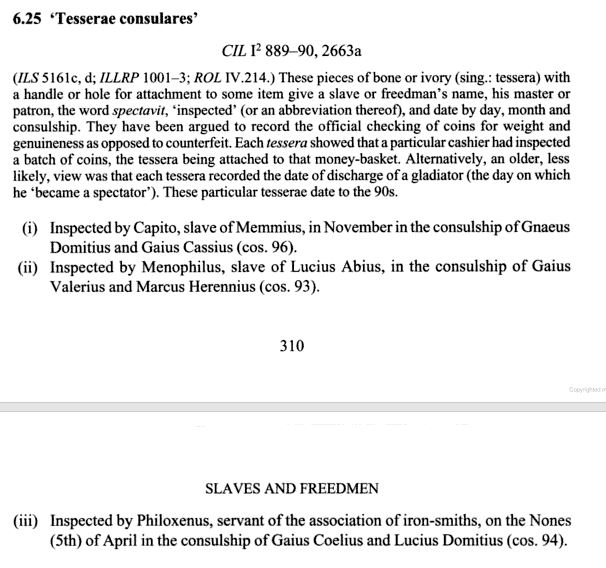
Tessera Nummularia and Control Marks

Image


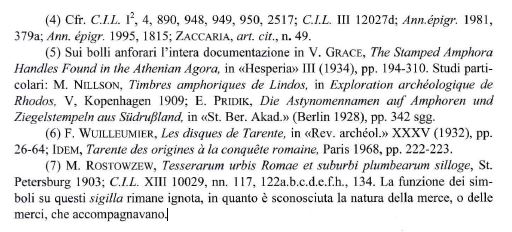
If you’ve read more of this blog than is probably good for your health, you might remember me wondering previously about the possibility that some of our tesserae that are usually attributed to bankers might actually be part of mint operations and the batch control system. I came back to that idea when was reading about this one found in Ostra.  Notice how instead of names or dates as are often found on these it has two symbols.  Reminded me of control marks.  Here’s a translation of the paragraph in the publication of this tessera about the symbols.

The two symbols, the altar burning and lightning, which appear on the card Ostra are not new: they are present, along with other symbols (palm branch, caduceus, dolphin, trident, crown, lightning) on other Tessera Nummularia  (4). The presence of such symbols is found, however, on other classes of objects: first stamps on amphorae from the eastern Mediterranean (5). In this case, the symbols used have been set in relation to the origin of the jars themselves (from Rhodes: caduceus, dolphin, trident, crown, palm branch, from Cnidus: altar, caduceus, trident, from Thasos: caduceus, wreath, from city ​​of Pontus: thunderbolt, caduceus, dolphin, trident, crown, branch). Closer to Tessera Nummularia, and probably not only geographically, is a class of small clay disks found in Taranto among the evidence from the Greek colony (6). Even the symbols on them are similar, a name-probably that of a civil servant rather than that of the manufacturer – an indication of the weight or quantity of the coins she, as well as two holes that are rightly supposed to use these objects similar to that of the Tessera Nummularia . We finally add a significant amount of lead seals from Rome and Lyon (7).”

Image


Here is a link to a pdf of the first item under no. 6, the Les disques de Tarente. I’m not sure they really offers that close of a parallel…

Wiseman, T. P. (1971) New Men in the Roman Senate, 139BC-AD14. Oxford p. 85-6 noticed that the names on the tessera often correspond to moneyers.  He collects a list of known argentarii and faeneratores in his appendix C:

Image


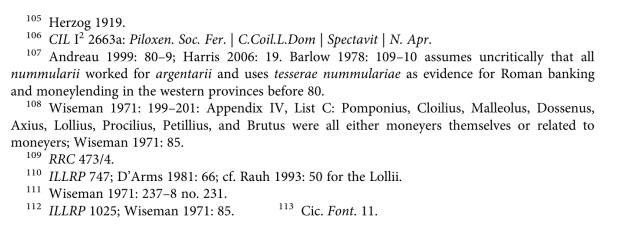
Philip Kay has an up to date summary of the issues:

CaptureCapture1


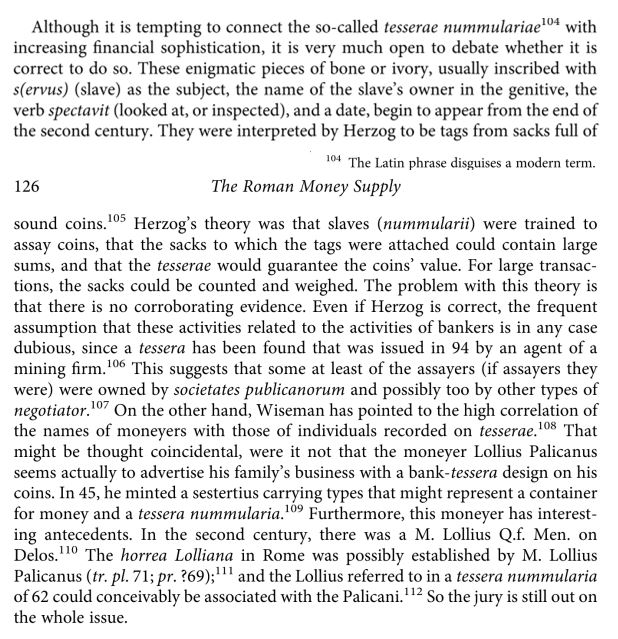
The chapter length treatment by Andreau, Banking and Business in the Roman World, 1999, chapter 7  is still the most detailed discussion. Here’s a sample:

Capture


The first and third arguments are weak, esp. the latter as no evidence is given.  Four in true is by far the strongest.  But #2 is almost strong enough to make the case on its own.  Here’s Lewis and Short sv. specto definition I.B.3:

To examine, try, test: (argentum) dare spectandum, Plaut. Pers. 3, 3, 35: ut fulvum spectatur in ignibus aurum, Tempore sic duro est inspicienda fides, Ov. Tr. 1, 5, 25; cf.: qui pecuniā non movetur … hunc igni spectatum arbitrantur, as having stood the test of fire,Cic. Off. 2, 11, 38; cf. spectatio, I. B., and spectator, I. B.—

Capture

‘driving a two-horse team’ vs. ‘in a biga’

We numismatists have caused ourselves a world of unnecessary confusion by the common language of our catalogs that describe various deities as being in a biga or in a quadriga.  In Latin in bigis just isn’t used.  Perhaps because the visual conjured up by such a phrase might be something like the scene with Luke and Han on Hoth:

The phrase ‘in curru’ is regularly used.  And we might note especially the line of Lucretius On the Nature of Things (2.601):

sedibus in curru biiugos agitare leones

There are four instances of in quadrigis in Latin, but notably three describe statues.

Gaius Plinius Secundus, Naturalis Historia 34.78.4

C. Iul. Caes. Augustus Octavianus, Res Gestae 4.51

Maurus Servius Honoratus, In Vergilii Bucolicon Librum 6.22.3

And the fourth is in Cicero’s Brutus when he means ‘in the chariot races’ not ‘in the chariot’  (173.5).  [I leave aside the odd Latin of Hyginus, Fabulae 250].

bigae and quadrigae, as Latin grammarians are forever going on about, are plural nouns not singular, because they refer to the animals, not the vehicle.  Perhaps the most clear is the statement by Fronto from Aulus Gellius’ Attic Nights:

Image

The Loeb translation is misleading.  So here’s a slightly modified version:

Quadrigae, etsi multiiugae non sunt, always keeps the plural number, since four horses yoked together are called quadrigae, as if it were quadriiugae, and certainly that which denotes several horses should not be compressed into the oneness of the singular number.

The problem is how to translate etsi multiiugae non sunt: ‘although they are not many’ is accurate, but misses the contrast in the Latin between quadrigae and multiiugus, the latter adjective which can be singular, where as the former cannot.  Or we might even read a joke here, ‘although there are not a many teams yoked together’.  But how funny was Fronto, really?

Anyway all of this is just in support of Luigi Pedroni’s point in AIIN 2010. p. 349:

Image

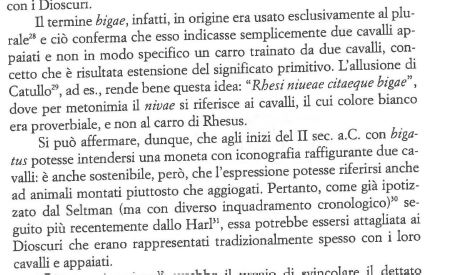
“The term bigae, in fact, was originally used only in the plural, and this confirms that it simply indicate two horses paired and not specifically a chariot drawn by two horses, a concept that was extension of the original meaning. Catullus 29 makes this clear: “Rhesi niueae citaeque bigae”, where the nivae metonymy refers to the horses, their white color was proverbial, and not to the chariot of Rhesus.

It can be argued, therefore, that at the beginning of the second century. B.C. a bigatus was a coin with iconography depicting two horses: it is sustainable, moreover, that the term could also refer to mounted animals rather than yoked. Therefore, as suggested by Seltman previously (but with a different chronology), followed more recently by Harl, it may have been used to describe the Dioscuri who were often traditionally represented with their horses as a pair.”

Serrati. A rant cut from the book.

I’m rather silent at the moment as I’m in editing mode.  This just got cut from the Intro.  too nitty gritty, too negative.  Anyway I thought I’d throw it up here to say I’m alive.

Students more used to humanistic approaches should not be “blinded by science” or other technical details.  Not all new analysis is good analysis.  Two teams have used SEM technology to look at serrati.  Both separately concluded that the serrations were manually added to the flans by a knife or similar slicing tool prior to their striking (Balbi de Caro et al. 1999; Kraft et al. 2006).  Separate confirmation gives confidence in the result, but the Anglophone team seems to have been unaware of the Italian published work some seven years earlier and thus does not interact with that data in anyway.  The Italian team also used energy dispersive spectrometry (EDS), a non-destructive procedure similar to XRF, and concluded that the serrati used a purer silver alloy than standard issues that was more brittle and that the serrations applied to the flans prior to striking made them more stable (Balbi de Caro et al. 1999; Pancotti and Calabria 2009).  This goes against basic engineering principles: each cut introduces a new possible failure point.

Moreover, these conclusions were based on the EDS readings from only four serrate specimens and those readings were compared with data from just three specimens analyzed in 1964 by Caley.  Caley used traditional wet chemistry to analyze physical samples  thus his results are in some ways more accurate than the more sweeping analyses of Walker and Hollstein et al. using types of XRF technology (1980 and 2000). Comparison of Balbi de Caro’s data EDS with results of the XRF analysis suggests those serrati are very much in the normal range of fineness with their contemporary coins.  Balbi de Caro’s higher readings than Caley’s samples are better explained by surface enrichment or small size of the samples used in each study.

These studies demonstrate more than anything the limits of metallurgical analysis to answer the question “why”.  Kraft’s team shows that forgers knew to emulate the same technique on foil-covered based metal flans.  Perhaps serrati were preferred because they were perceived as less likely to be forged. It would have been a costly, labor intensive technique, so there must have been some perceived benefit beyond any questionable esthetic value. It is tempting to connect the height of their production with the monetary anxieties reflected in contemporary legislation (see p. XXX below chapter; chapter 6).  Good technical studies can provide insight into “how” and “what” of coin production, but need to be based on a wide enough body of data to have meaningful conclusions and take into consideration pre-existing data.

Abolitionist Art in Hands of the Slave Owner

780251-m

Catalogue description:

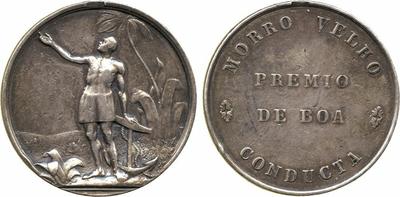
Commemorative Medals By Subject. Slavery [ Brazil ], Morro Velho Gold Mines, Silver Slaves Medal for Good Conduct, c.1848, bare- footed slave stands with one hand outstretched, the other resting on anchor, rev MORRO VELHO – PREMIO DE BOA CONUCTA , 38mm (Cavalcanti 59). Very fine with deep tone, ‘clip’ mark to top edge from where suspension loop has been removed, extremely rare . A note with the medal states, “Morro Velho slave medal of Freedom … given by dying slave to a missionary. Given to me by an Old Lady as a parting gift when leaving Chiswick”. The image of the slave derived, perhaps, from C F Carter’s 1834 medal to commemorate the Abolition of Slavery. Viscondessa de Cavalcanti’s Catalogo das Medalhas Brazileiras , lists the medal under “Abolition of slavery” and attributes it to 1848. She also quotes “Sr Hopkin, president of the company in 1888” who said that by 1882 all but 28 had been emancipated. Morro Velho is a complex of gold mines located near the city of Nova Lima in the Minas Gerais state of Brazil , in operation since 1835, it is the world’s oldest continuously worked mine. The English-owned St John del Rey Mining Company was the largest slaveholder in the Brazilian province of Minas Gerais during the second half of the nineteenth century. The explorer Sir Richard Burton and his wife Lady Isabel, visited the mines and his account, Explorations in the Highlands of Brazil , published in 1869, tells of the fortnightly Slave Muster. He describes how on every other Sunday, early in the morning, over a thousand slaves, men, women and children, all dressed in a special wardrobe assigned by the superintendent (but bare-footed), gathered in front of the Casa Grande (big house) where the selected few were given medals, awards, and public recognition by the overseers.

Here’s Burton’s description (image below).  Notice how he works on the theme of how much better life is for the slaves than it used to be and how much better they are then their unenslaved kinsmen.  The medal draws on abolitionist imagery, substituting the promise of freedom for the actual thing.  [Cf. Images such as this. and this.] The medal is thus an instrument of control.   It and other instruments of control are celebrated by Burton as part of good practices of the British Mining company.  Strangely, the Wikipedia entry for the mine has no mention of its infamous use of slavery….

Image :

The Latin that heads the chapter is from Caspar Barlaeus‘ poem, Mauritius Redux.