292 out of 410 days: Signia

Kombination af to masker og et vildsvinehoved. Romersk ringsten
Combination of two masks and a wild boar’s head. Roman ringstone, 100-300 Cornelian. 1,1 x 1,6 cm. Inventory number: I1538. Thorvaldsens Museum.

Sometimes I tell myself I’m too obsessed with the connection between gems and coins.  And then one of my hunches pays off and the obsession comes back full swing.  In case the above image doesn’t set off exciting alarm bells in your head, allow me to remind you what the coins of Signia, a Latin Colony, during the Pyrrhic War looked like:
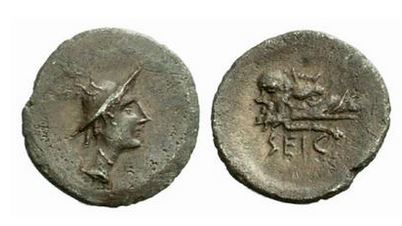
Capture
Latium, Signia. Obol circa 280-275, AR 0.64 g. Head of Mercury r., wearing petasus; below neck, dolphin r. Rev. Mask composed of Silenus head l., and boar’s head r.; below, SEIC. Campana CNAI 1b (this reverse die). BMC 3 (this reverse die). Historia Numorum Italy 343 var.

[I show this particular specimen just so I can point out that it reappeared back on the market with a brand new patina, all nice and shiny and toned just one year later, and fetched a much higher price.  I think it looked just lovely before some one decided to ‘fix’ it.]

Let me assure you that the gem above is by no means a one off.

Image
Beazley Archive Reference Number: 716; Description: Heads of a BOAR and a man conjoined. Inscribed in Greek THIE. Current Collection: Walters Art Museum, Baltimore: 42.1070; Previous Collections: Story-Maskelyne, M.H.: The Marlborough Gems (1870): no. 716. Material: Jasper

And based on descriptions without images the Thorvaldsens Museum has a number more similar gems, Inventory numbers: I1537,  I1539,  I1722, I1536.   The last two are of particular interest as they are glass pastes which suggests the image had resonance with members of a variety of different social classes.

This particular type even made the BBC!

Roman intaglio
From a 30 March 2010 article ‘Guernsey, the Roman Empire’s trading post’. Image links to article.

What the heck does it mean?  Was it the badge of some particular noble?  Or like grylloi is it a humorous, apotropaic emblem? Or a philosophic meditation on the theme of man and beast?  Or all these things?  or something else entirely?

OR! the penny drops!  Is it a visual pun?!  Signia in Latin is also the plural form of the neuter noun meaning: standard, seal, sign, signal, proof, indication from the verb signo to mark, stamp, designate, sign, seal.  The type chosen is a very very common seal type.  [This is why I blog by the way. It took writing the whole damn post for that penny to drop and me to make the obvious connection.]  This is a really exciting idea to me.  Name puns are all over Roman Republican coinage to show its early early adoption is Latium is especially good. I think it provides a missing link of sorts between the ideas I explored in this earlier post discussing Republican habits, the Abdera series, and Timeaus.  [I’ve talked about puns a lot on this blog, but that post is the best of the lot I think.]

For follow-up later: Henig has some clever things to say about gems usually.  There are two possibly related gems (CG72 and CG 354)  in the Fitzwilliam that he’s written up in his 1994 catalogue.  Must get those pages from ILL…  Strangely none returned in BM, Met, or Boston MFA searches all of which have robust gem collections.

As an aside, I find it funny that Mercury on the obverse is wearing a necklace or similar band.  At first I thought at first it might be an unfortunate die break, but it shows up on a different die as well, but not all of the dies.  Also what the heck does Mercury have to do with dolphins?  Could it have anything to do with bizarre composite deity on the coins of Bursio who has wings and a trident (RRC 352/1)?  I doubt it.  But finding any representation Hermes or Mercury with any nautical attributes is tricky.

Update 4/11/2014:  If more canting types from Italy are sought, consider Rutter’s note at HN Italy 446, an obol of  the Saunitai with a javelin head on the reverse, σαύνιον = javelin.  He gives a date of c. 325.

Update 7/12/2017:

Another example of this gem type from Gori:

Capture.JPG

cf. also this other Gori plate.


291 out of 410 days: San Martino in Pensilis Hoard

Image

The San Martino in Pensilis hoard and Andrew Burnett’s analysis thereof is probably the most important new information on third century Roman and Italian Silver issues from the last decade.  Highlights included:

  • Evidence of a significant gap (ballpark 300-260BC) between Rome’s first and second silver issues
  • The first Roma and Pistis Locrian coin in a hoard context
  • 30 ‘fresh’ coins of Teanum, Cales, and Suessa!  (No Cora specimen, alas.)

My scanned photocopy was really crappy, so I’m just delighted to realize that it’s available open access via Persée.  No more squinting for me today!  I’m also intrigued by the location of this hoard, just north of the Gargano (if you go, you must try the mysterious and delicious Lesina eel!).  It’s just down the road from Larinum (see earlier posts).  The Frentani became allied to the Romans in 304 BC and somewhere around the mid third century Larinum shifted from minting Neapolis type bronzes with Greek legends, to Roman type bronzes with Latin legends (well Oscan language, Latin Alphabet) (HN Italy 622 vs. 623).

San Martino in Pensilis - View

287 out of 410 days: Tripods, Libertas, Victory

RRC 498/1. C. Cassius with M. Aquinus. Aureus, mint moving with Cassius 43-42, AV 8.41 g. M·AQVINVS·LEG· – LIBER – TAS Diademed head of Libertas r. Rev. C·CASSI – PR·COS Tripod with cauldron, decorated with two laurel branches. B. Cassia 12. C 2. Bahrfeldt 56. Sydenham 1302. Sear Imperators 217. Calicó 63.

I was thinking about tripods in a totally different framework when I came across the very smart work of Carsten Hjort Lange (again!).  In his 2009 book, Res Publica Constituta, he gives a new reading of the famous plaque from the Palatine in light of the use of tripods on the coinage of 42 BC (p. 172ff).  A great read, but too long to extract here just follow the link!

Greek influences

I also came across a reading of the Tripods on the Coins of Herod (same time frame) that I thought delightfully sensible:

Obverse of Bronze Coin, Jerusalem, 40 BC – 4 BC. ANS 1944.100.62799
Image
From p. 110 of The Coins of Herod: A Modern Analysis and Die Classification edited by Donald Tzvi Ariel, Jean-Philippe Fontanille (Brill 2011). Image links to google books.

Further non-numismatic support for the idea that the tripod could be a general symbol of victory can be found here.

286 out of 410 days: Cocks, Victory and Virility

Gem of glass paste imitating sard, engraved with a terminal figure of Hermes, before which stands a youth holding a wreath and palm-branch in his left hand, and a cock on his right.
Gem of glass paste imitating sard, engraved with a terminal figure of Hermes, before which stands a youth holding a wreath and palm-branch in his left hand, and a cock on his right. BM 1923,0401.420; Gem no. 2794

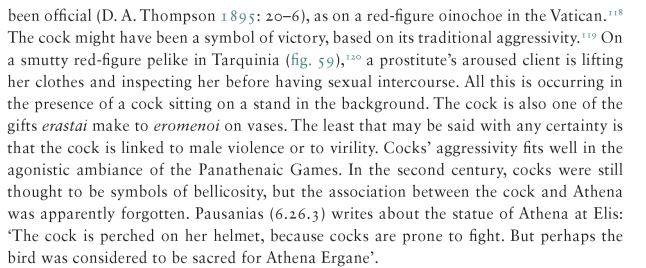
I was writing up my thoughts for the book on the symbolism of the cock on coinage during the First Punic War this morning.  [An issue touched upon in an earlier post, here.]  The idea that in the Greek world the cock need not be directly linked to Hermes, but more generally be a symbol of bellicosity and manliness, is well summarized by this book.

Image

Image


This might help explain the pairing of cock and Minerva (Athena) on coins of Suessa, Teanum, et al (for images see earlier post).  But I was still playing around with the Mercury association in my mind, when I came across the glass paste above.

Here we see the epitome of manhood, the victorious young athlete standing before a terminal Herm.  He has his prize crown and palm-frond and in thanksgiving for his victory he offers the god a cock. [Just like the victor in the Callimachus epigram quoted in the previous post!] The cock symbolizes at once his victory and his virility.  A Herm’s most notable feature was its phallus.  Although we are often think of Mercury (Hermes) as first the god of commerce, we must remember he ended up as such by his status as the fecund god, the wealth-bringer.   Just as cock is slang for male genitalia today, so in the ancient world the cock encapsulated a similar semantic range of meaning as the phallus: power, especially masculine power, the (pro)creative power that leads to wealth and to overcoming one’s adversaries.

Anyway, the glass paste is a ‘gem’ of a summation of the symbolism of the cock, so I thought I’d share. Okay, back to my other writing.

Post Script. 

When two cocks appears facing each other on gems it is most often a representation of a cock fight, thus a type of agonistic scene, often with victory imagery incorporated into the design:

Gem with two cocks and a palm branch. [Arachne image database]

Gem with two cocks one being crowned by victory.  [Arachne image database]

Gem with one cock on a rudder with a palm branch. [Arachne image database]

But also relevant are images where the are associated with martial symbolism:

Gem with military standards, cocks, and stars, flanking scorpion grasping a cresent.  [Arachne image database]

This is a good image showing the early association of the cock and Athena:

Vase in the Beazley Archive.

Other relevant bibliography:  Hoffmann 1974.

277 out of 410 days: agri quaestorii and Rome’s first issue of cast bronze coins?

reverse
RRC 14/1. 358.81g. ANS 1969.83.385. Gift of E.R. Miles.

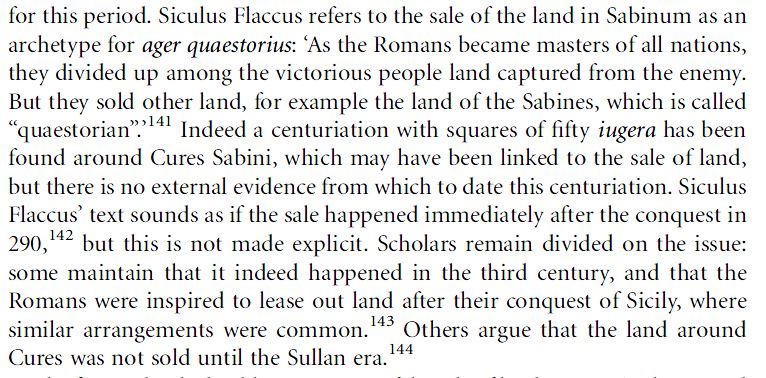
In CMRR, Crawford first uses the evidence of the Nemi finds to place the RRC 14 finds ‘no earlier than about 280’.  He then goes on: “One may speculate that the need to administer the agri quaestorii acquired in 290 (Lib. Col. 253, 17L; 349, 17 L) played a part in the decision to produce the first issue of cast bronze coinage.” (p.40-41).

To wrap my head around the plausibility of this I turned to Roselaar’s Public Land in the Roman Republic (2010).  She gives a good definition and survey of ager quaestorius (p. 121-127).  On 290 BC she says:

Image

Even if we go ahead and concede the land around Cures was sold shortly after 290, I have a hard time following the logic of how the sale of land is made easier by the creation of coinage.

The other issue muddying the waters regards agrarian issues in this period is the parallel and in precise testimony that M’. Curius Dentatus distributed land. Viris Illustribus has a good mash-up of various accounts.  First after conquering the Samnites he says in a contio  ” I took so much land that it would have become a desert, if I had not taken so many men. I took so many men that they would have starved, if I had not taken so much land.” (33.2)  Then, he gives 14 iugera of land the people (which we do not learn) and only takes so much for himself saying, “there was no one for whom this amount was not sufficient”. (33.5-6)  The latter echoes a pithy saying of his found in Plutarch, but where we are offered no context for it. Valerius Maximus says only seven iugera were given out, but also makes a moral out of the general taking no more than the rest.  Pliny has the very same nugget:

The words, too, that were uttered by Manius Curius after his triumphs and the addition of an immense extent of territory to the Roman sway, are well known: “The man must be looked upon,” said he, “as a dangerous citizen, for whom seven jugera of land are not enough;” such being the amount of land that had been allotted to the people after the expulsion of the kings.

Then at the end of the mini bio in Viris Illustribus (link above) we’re told he’s given 500 iugera by the public for his services (33.10).

And, just to add to the mix we should remember that his campaigns in the Po is said to have led to the founding of the colony of Sena which would have also included land distributions (Polybius 2.19).  The Periochae of Livy don’t have a land distribution, but do have the colonial foundation.

Cato the Elder, and Cicero after him, loved Dentatus as the epitome of the rustic Roman, military man and farmer, happy to conquer everyone in sight and still eat a simple stew from a wooden bowl. [Cincinnatus, anyone!?] The literary sources care FAR more about the bon mot than the distribution.  I don’t think we can nail down a context for it.

Thus, I think this is just a fun rabbit hole with very little promise for finding a context for the aes grave.

That’s not to say Dentatus is completely useless to us when we’re thinking about early contexts for making coins:

6. in the four hundred and eighty-first year from the founding of the City, Manius Curius Dentatus, who held the censorship with Lucius Papirius Cursor, contracted to have the waters of what is now called Old Anio brought into the City, with the proceeds of the booty captured from Pyrrhus. This was in the second consulship of Spurius Carvilius and Lucius Papirius. Then two years later the question of completing the aqueduct was discussed in the Senate on the motion of the praetor. At the close of the discussion, Curius, who had let the original contract, and Fulvius Flaccus were appointed by decree of the Senate as a board of two to bring in the water. Within five days of the time he had been appointed, one of the two commissioners, Curius, died; thus the credit of achieving the work rested with Flaccus. The intake of Old Anio is above Tibur at the twentieth milestone outside the* Gate, where it gives a part of its water to supply the Tiburtines. Owing to the exigence of elevation, its conduit has a length of •43,000 paces. Of this, the channel runs underground for •42,779 paces, while there are above ground. substructures for •221 paces.

I’d not like to connect this aqueduct to any one issue but like the construction of Via Appia, big infrastructure projects and the establishment of colonies are easier if the state has an easy means of making payments.

Map of the course of the Aqua Anio Vetus

269 out of 410 days: Do you believe the pig story?

Update:  This old blog post eventually led to a journal article.

“#NotAllElephants (Are Pyrrhic): Finding a Plausible Context for RRC 9/1” Ancient Numismatics 2 (2021), pp. 9-42. DOI: 10.19272/202114401001Unformated text and images with indication of page number in print text.

There comes a day in every young numismatist’s life when he or she asks the question is the pig story true?   Did the anyone, let alone the Romans, ever use pigs in battle against elephants?  Would it work?   And if it worked wouldn’t everyone have used it?  Fighting elephants was certainly the opposite of fun.

First off, let’s throw out the idea of Roman flaming pigs (regardless of what the video games offer you as options).  That is bad scholarship at least when it comes to the Roman account.  Here’s some of that bad scholarship (p. 87ff) and another one (p. 202). Don’t believe everything you read it books, even books with footnotes.  Lamentably, or admirably, Wikipedia is actually far better at reviewing the sources, than apparently some university presses.  Here’s the War Pig entry.

So why do numismatists think that pigs and elephants should date the above currency bar to the Pyrrhic War? Because of these two sentences in Aelian (on the nature of animals, 1.38):

 Ὀρρωδεῖ ὁ ἐλέφας κεράστην κριὸν καὶ χοίρου βοήν. οὕτω τοι, φασί, καὶ Ῥωμαῖοι τοὺς σὺν Πύρρῳ τῷ Ἠπειρώτῃ ἐτρέψαντο ἐλέφαντας, καὶ ἡ νίκη σὺν τοῖς Ῥωμαίοις λαμπρῶς ἐγένετο.

Ariete cornuto et suis grunnitu abhorret elephas. Sic Romanos Pyrrhi Epirotarum regis elephantos in fugam vertisse dicunt, victoriamque amplam ex eo bello retulisse.

The elephant fears the horned ram and the grunting of a pig. Thus, the Romans are said to have routed the elephants of Pyrrhus, king of the Epirotes and brought about brilliant victory for themselves.

I put up the Latin as that’s more readily available online for those who want to check out context. My translation is based on the Greek (not that it makes a huge difference).

This is not great historical evidence. And everyone gets so hung up on the pigs that they ignore the mention of rams completely. Aelian followed Pliny and other writers for most of his little anecdotes.  Pliny has squealing pigs and elephants, but no Pyrrhus. Let’s put this in context: Pliny is also our earliest source for elephants being afraid of mice.  And common on, did you really need a Mythbusters episode to debunk that?

The whole thing sounds like some marvelous tale.  And in fact it’s found in the some of the Alexander Romances:

Image

The ‘secret’ of the elephant’s fear of a pig is attributed to Porus, the Indian King.

There is a better attested version of the elephant and pig story in Hellenistic history, but no Romans in sight.  Again, our sources are late and known for being magpies of wonderful tales:

 At the siege of Megara, Antigonus brought his elephants into the attack; but the Megarians daubed some swine with pitch, set fire to it, and let them loose among the elephants. The pigs grunted and shrieked under the torture of the fire, and sprang forwards as hard as they could among the elephants, who broke their ranks in confusion and fright, and ran off in different directions. From this time onwards, Antigonus ordered the Indians, when they trained up their elephants, to bring up swine among them; so that the elephants might thus become accustomed to the sight of them, and to their noise.

Aelian knew this story too (Latin trans.).

If it weren’t for the currency bar I’d throw the whole story out.  Dionysius offers some perfectly plausible accounts of the Roman tactics against elephants in the Pyrrhic War:

Outside the line they stationed the light-armed troops and the waggons, three hundred in number, which they had got ready for the battle against the elephants. These waggons had upright beams on which were mounted movable traverse poles that could be swung round as quick as thought in any direction one might wish, and on the ends of the poles there were either tridents or swordlike spikes or scythes all of iron; or again they had cranes that hurled down heavy grappling-irons. 7 Many of the poles had attached to them and projecting in front of the waggons fire-bearing grapnels wrapped in tow that had been liberally daubed with pitch, which men standing on the waggons were to set afire as soon as they came near the elephants and then rain blows with them upon the trunks and faces of the beasts. Furthermore, standing on the waggons, which were four-wheeled, were many also of the light-armed troops — bowmen, hurlers of stones and slingers who threw iron caltrops; and on the ground beside the waggons there were still more men.

When Pyrrhus and those with him had ascended along with the elephants, and the Romans became aware of it, they wounded an elephant cub, which caused great confusion and flight among the Greeks. The Romans killed two elephants, and hemming eight others in a place that had no outlet, took them alive when the Indian mahouts surrendered them; and they wrought great slaughter among the soldiers.

Elephants left a big impression on the Roman mind.  Of this there is no doubt.  But if pigs worked so well why not use it as a tactic elsewhere?

I find myself asking myself about the provenance of the BM specimen (acquired 1867 from the Sambon Collection).  Are there other specimens of this type of currency bar?  Are there more of them? Any with a decent archaeological provenance?  Is it all just to good to be true?

268 out of 410 days: South Italian Digital Archive

I was worrying about the conflicting testimony in Livy and Diodorus over Cleonymus of Sparta’s Italian adventures.  Oakley has a good overview of the problem but there is more that can be said on the historiographical side. Barnes also has a take on the matter.

Amongst other things is a place called Thuriae, not Thurii mind you, that features in Livy’s narrative:

During the year a fleet of Greek ships under the command of the Lacedaemonian Cleonymus sailed to the shores of Italy and captured the city of Thuriae in the Sallentine country. The consul, Aemilius, was sent to meet this enemy, and in one battle he routed him and drove him to his ships. Thuriae was restored to its former inhabitants, and peace was established in the Sallentine territory.

[In case you’re wondering, the Sallentine territory or peninsula is the heel of Italy’s boot.]

This little mystery led to finding this 1932 publication that suggests it is the same as Turi, outside of Bari.

The interesting thing about this publication is how it ended up on the web.  The provincial administration of Brindisi seems to have decided in 2012 to scan and archive online pretty much every last regional publication.  Here’s the announcement.  There is as far as I can find no easy portal for searching through all the old newspapers and journals to find the relevant bits, but the archive is hiding lots of numismatic tidbits.   For instance, here’s the publication of the Salvatore Hoard.

The best I’ve found to mine its depths is to use Google site search.  Just go to the google homepage and enter a likely term in Italian, say ‘didramma’, and then ‘site:emeroteca.provincia.brindisi.it’.  Leave off the quotes.

Postscript.  I just don’t think the Cleonymus of Polyaenus’s Stratagems is the same character.  It’s just too early a date for the Romans to control Apollonia and Epidamnus.

256 out of 410 days: Helmet Hair

So I was looking at the Neapolis coins that served as prototypes for the earliest coins in the name of Rome.  And, Apollo has a very flippy hairdo of a not terribly typical type.  Here’s another to prove I’m not making this up:

That flip was feeling familiar.  And not from just the Roman type (RRC 1/1):

Here’s a link to one more of these.  Anyway.  It struck me that that hair flip is visually quite related to the neck flap that appears on Roma’s helmet on certain early types like these:

Or to a lesser extent on these earlier bronzes (not to mention Rome’s first silver piece with bearded Mars and Horse’s Head probably also minted at Neapolis, modern Naples):

But that’s clearly not the direction of influence.  The culprit must be the pegasi of Corinth that became so common in S Italy at the end of the 4th century BC:

The interesting iconographic borrowing isn’t really the Roma helmets, but the Neapolis (and soon-to-be-Roman) Apollo who gets his flip and snaky tendrils by way of Athena’s Corinthian manifestation.

Update 4 March 2014:  Check out images of Roman types at Nick Molinari’s site, note especially the image of the RRC 2/1, known from only one specimen.

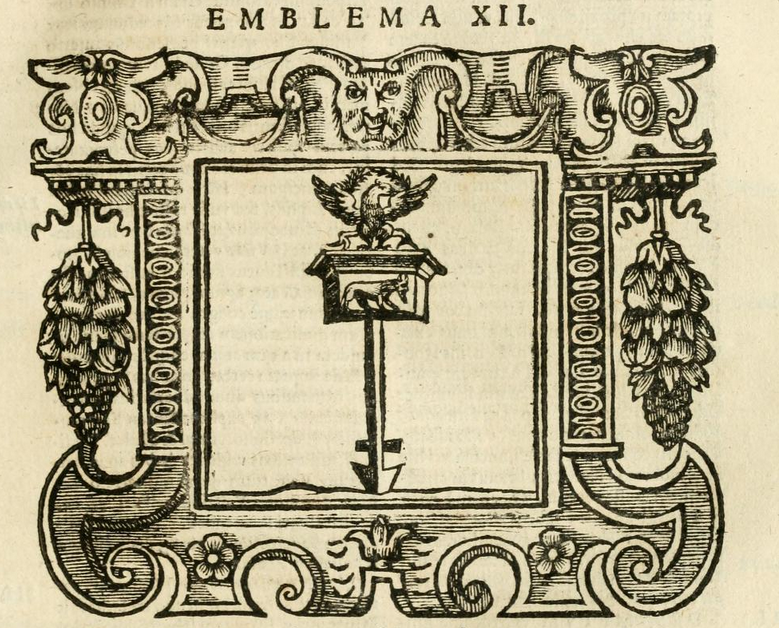
230 out of 410 days: Minotaurs on Roman Legionary Standards

Image

Image

Here’s the Pliny quote:

The eagle was assigned to the Roman legions as their special badge by Gaius Marius in his second consulship. Even previously it had been their first badge, with four others, wolves, minotaurs, horses and boars going in front of the respective ranks; but a few years before the custom had come in of carrying the eagles alone into action, the rest being left behind in camp. Marius discarded them altogether. Thenceforward it was noticed that there was scarcely ever a legion’s winter camp without a pair of eagles being in the neighbourhood.

Horses, Wolves, Boars are all featured on the Republican coin series.   Not so much, minotaurs …  It’s not really an argument, but surely something went wrong in Pliny’s account or the manuscript or something… Very strange.  But then there is the Festus to back it up…

MINOTAURUS. The figure of the Minotaur was among the military insignia, because the projects of the general should not be less mysterious than the labyrinth which held this monster. The Minotaur, it is said, was the fruit of the love of Pasiphae, wife of King Minos, and a bull. But others say that Taurus was just the name of her lover.

A little background on Roman Military Insignia.

Update 8/12/2016:  The thing to read on this subject is:

Capture

Update 9/2/25:

This emblemata might explain why some decided the minotaur standard was a manfaced bull.


218 out of 410 days: Civic Virtues

ANS specimen

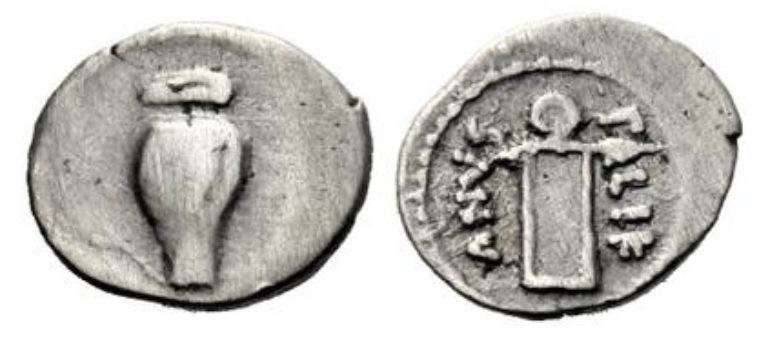
This little coin, a silver sestertius of 45 BC or there about, has me worried about the chronological limits of my book project.  Yes, stopping in 49BC to leave the discussion of Caesar and the Civil Wars to another book does make good sense.  However, a good number of post-49BC coins are intimately thematically related to earlier coins in the series.  The issue of Palikanus taken as a whole is a good illustration of the “republican” characteristics of some of these later issues.

The above coin was thought to show a money pot or olla and a banker’s tessarae.  This at least was Wiseman’s suggestion, based on the banking interests of the moneyer’s family.

Wiseman, T. P. (1971) New Men in the Roman Senate, 139BC-AD14. Oxford p. 85-6.

His idea is largely endorsed by Crawford and even to an extent by Zehnacker.

Zehnacker, H. (1972) ‘La Numismatique de la République romaine: bilan et perspectives’, ANRW I.I (Berlin), 266-96, at 284: “En tout cas, l’appartenance au monde de la finance expliquerait trés bien le mélange caractéristique chez les monetales de noms illustres—des cadets de famille qui ont préféré l’argentaux honneurs—et de noms quasi inconnus—de parvenus”

Based on the themes of the rest of the series as a whole, I think L. R. Taylor’s original suggestion of voting urn and ballot is far more likely (VDRR p. 226).  The series celebrates:

Libertas and the Tribune’s Bench on the Rostra:

Obverse of RRC 473/1. 1944.100.3528
Reverse of RRC 473/1. 1944.100.3528

Honor and a Curule Chair flanked by Grain:

Obverse of RRC 473/2b. 1944.100.3533
Reverse of RRC 473/2b. 1944.100.3533

Then on the quinarius, Felicitas and Victory:

Given that all the other elements in the series celebrate civic virtues, even popular virtues, interpreting the smallest denomination in the series as a banking advert seems a bit of a stretch. A voting theme would harmonize much better.

All that said, there was a temple of Ops (wealth) in Roman.  If its not voting being represented, I’d go with another divine personification before assuming a reference to a family banking business.

Also the use of the genitive on all these is types is striking.

Perhaps I’ll just need to include a flash forward to work a few of this series in.

Update 24 January 2014:  So I was re-reading Witschonke 2012 on the possible uses of control marks at the Roman mint.  Really the very best thing on the subject.  Speculative in places by necessity, but logical and solid reasoning throughout.  It depends on the important work of Stannard (Metallurgy in numismatics vol. 3 1993: 45-68 pl 1-2) on the evidence for mint practices revealed by gauging, namely that the mint worked in batches.  What if money pot and tessarae (if that’s what they are) aren’t banking icongraphy but in fact minting iconography?   A claim to the rigorous control of the issue.  A celebration of Juno Moneta.  Something like this coin of c. 46BC:

reverse