I like this passage as it shows the performance of hierarchies with emperor explicitly in the role of pater familias and the young emperor praised for acting old. I’d translated parsimonia as restrained as parsimony can have more negative connotations in English here than I think the Latin intends.
Stuff to keep in mind: domestic servants are enslaved as are huntsmen, grooms, and entertainers. Maybe some formerly enslaved but the jobs are associated with enslavement. Also Historia Augusta is as friend put it closer to fan fiction than history, which makes it extra useful for seeing tropes and moralizing expectations.
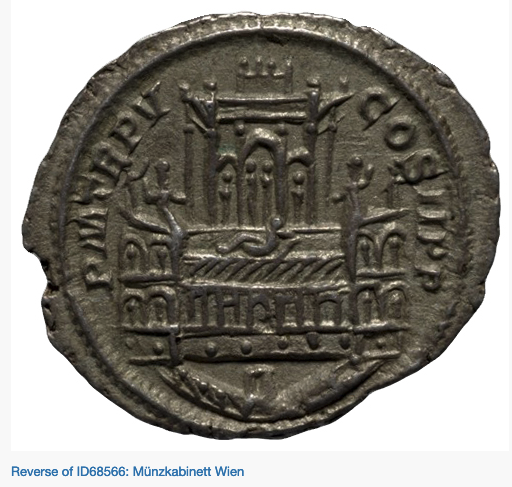
Emperor is appropriately more generous with those higher on the social ladder, his friends, the citizens of Rome (as well illustrated on the coins):
It is exactly this type of discrepancy that drives me nuts with numismatic typologies–there has to be a way our digital tools can help us correct and improve this sort of thing.
Later same day. This discrepancy on what architecture is being shown on the coin really bugged me.
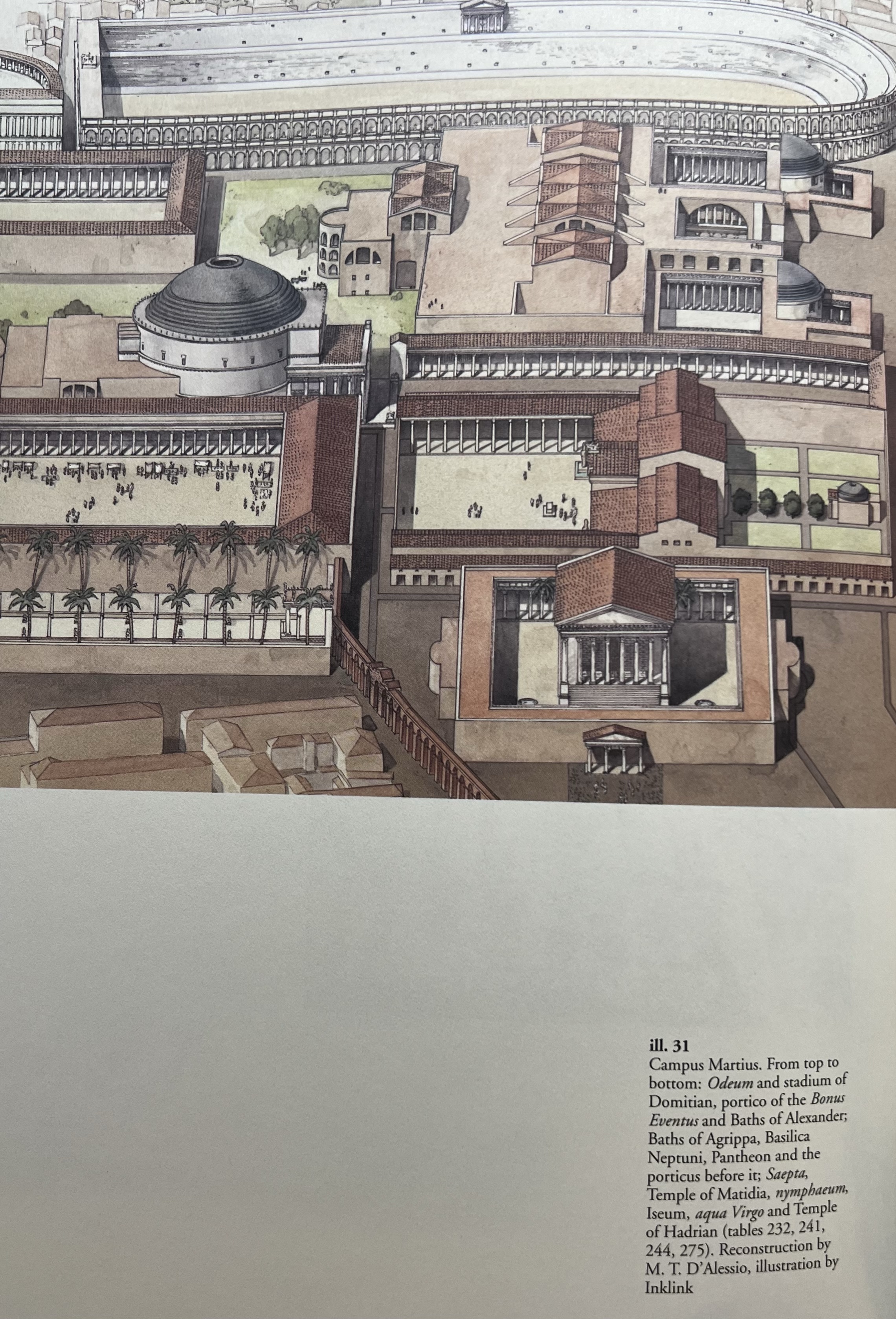
Nothing about the plan or reconstruction of the baths reminds me of what we see on the coin.
It is the big roofed building behind the Pantheon below Domitian’s stadium (= Piazza Navona), what was before Sev Alex got to it had been the baths of Nero. This causes confusion for the association of artifacts with Nero or Alex. And there are some impressive ones!
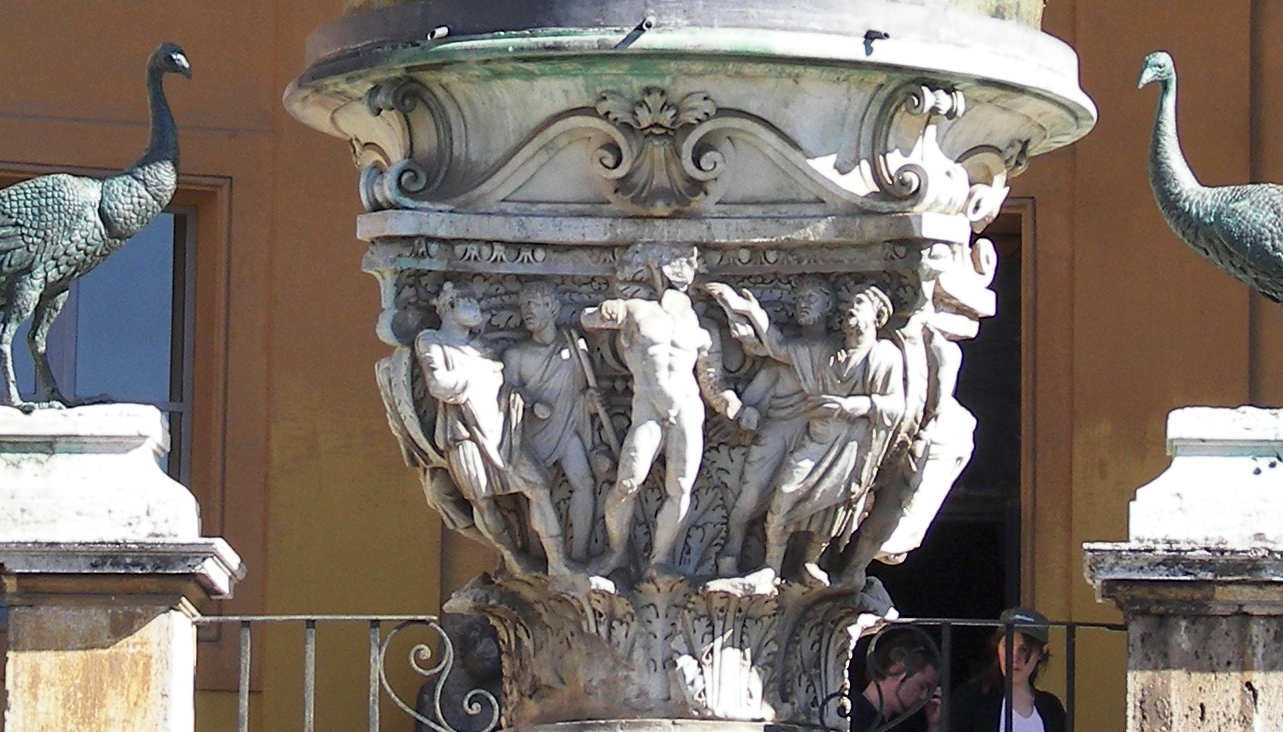
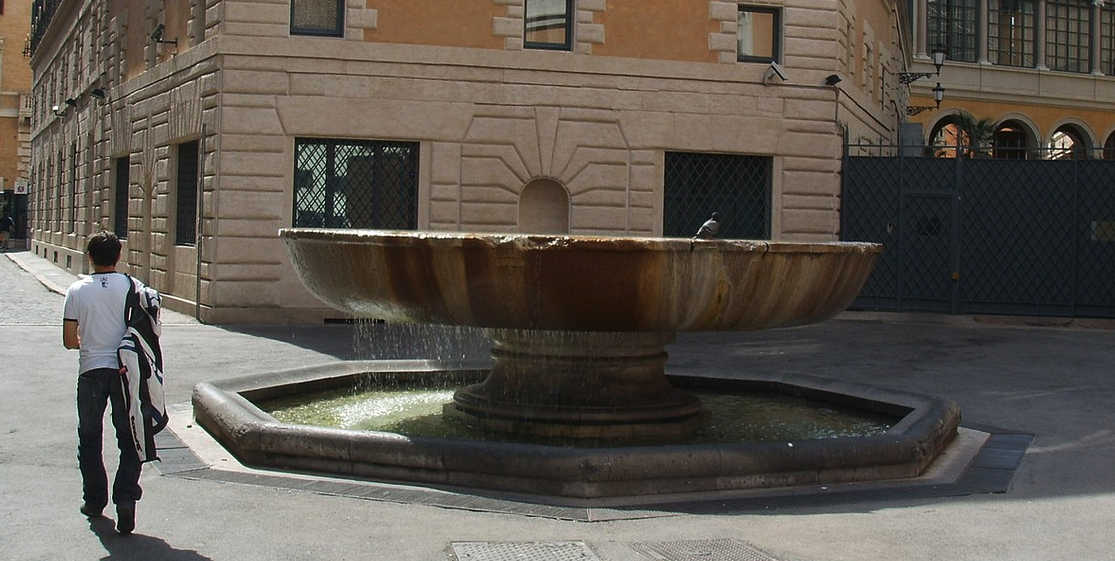
Like this giant capital now in the Vatican holding up a giant bronze pine cone.And the Giant wash basin turned Fontana del Senato
What about the Nymphaeum? Long story short. ALL The coins show the Nymphaeum and we have a pretty good idea how to match the coin image onto the surviving archaeology which is significant.
(This Elkins, of course, knew, see p. 104-105 of his 2015 book for details of numismatic introduction of this misguided Baths theory)
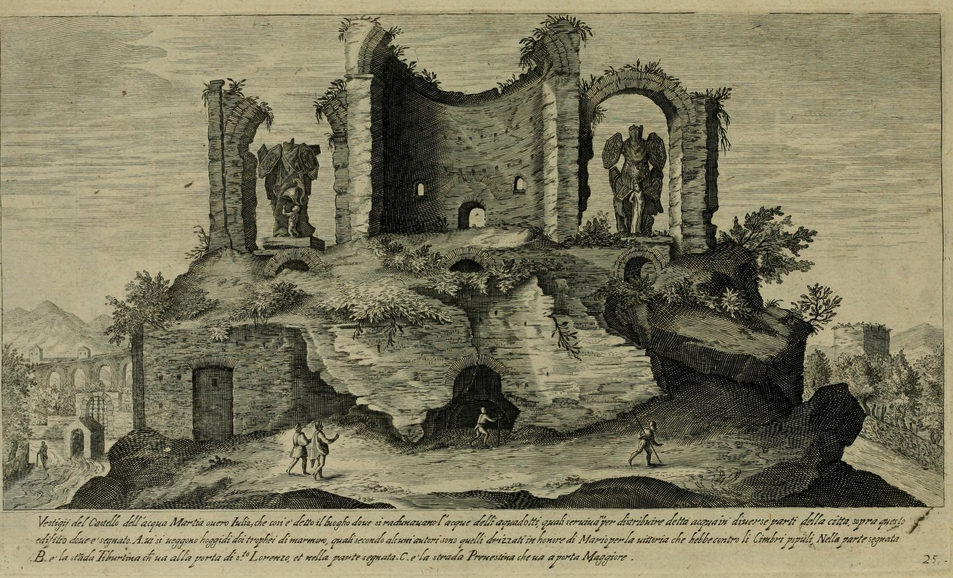
My favorite part?! The Coins show statues that still and if you’ve been to Rome you’ve probably seen. Look at the arches:
Historic view by Sadeler (Source; very distracting only open if you have time!!)
Those trophies now known to be repurposed from a Domitianic monument are still standing at the top of the ramp up to the Capitoline after being moved there!
On this blog I’ve been linking to Iris, esp. for Italic coins, but it seems as if Arch might be a better choice for searching going forward as it pulls in more types from various different databases including Iris. Anyway. Flagging my intent to change practice and sharing the link as it has other useful information on where to find various coin types online.
I’m interested in Phrygian helmets before they become associated with personifications of Roma. An earlier blog post talked about a Ptolemaic use, but this one is Italic and v early Hellenistic and thus even better precedence.
Note the griffin on the side and knot of Herakles, tying a diadem or fillet at the front; like my colleague Eduardo who brought this to my attention I too am a fan of the curls!! And want to think about this type of addition along wiht other things like horned helmets and animal helmets and helmets with faces. Notably I don’t see any space for wings or plumes but maybe that is just the photo angle.
“Salva res est dum cantat senex”, quare parasiti Apollonis in scaena dictitent, causam Verrius in lib. V, quorum prima est p littera, reddidit, quod C. Sulpicio, C. Fulvio cos., M. Calpurnio Pisone praetore urb. faciente ludos, subito ad arma exierint, nuntiatio adventus hostium, victoresque in theatrum redierint solliciti, ne intermissi religionem adferrent, instaurati qui essent: inventum esse ibi C. Pomponium, libertinum mimum magno natu, qui ad tibicinem saltaret. Itaque gaudio non interruptae religionis editam vocem nunc quoque celebrari. At in hoc libro refert Sinni Capitonis verba, quibus eos ludos Apollinares Claudio et Fulvio cos. factos dicit ex libris Sibyllinis et vaticinio Marci vatis institutos, nec nominatur ullus Pomponius. Ridiculeque de ipsa appellatione parasitorum Apollinis hic causam reddit, cum in eo praeterisset. Ait enim ita appellari, quod C. Volumnius, qui ad tibicinem saltarit, secundarum partium fuerit, qui fere omnibus mimis parasitus inducatur. Quam inconstantiam Verrii nostri non sine rubore rettuli.
This passage seem to correspond to a tradition of an interruption at the games as mentioned by Macrobius above. It also seems to engage in a debate about the role of Pomponii in the festival. Servius also knows this story!
avdax qvos rvmpere pallas sacra vetat ne interruptione sacrificii— ‘rumpere’ enim pro ‘interrumpere’ posuit—piaculum committeretur: unde etiam Helenus “nequa inter sanctos ignes in ho- nore deorum hostilis facies occurrat et omina turbet”. denique cum ludi circenses Apollini celebrarentur et Hannibal nuntiatus esset circa portam Collinam urbi ingruere, omnes raptis armis concurrerunt. reversi postea cum piaculum formidarent, invenerunt saltantem in circo senem quendam. qui cum interrogatus dixisset se non interrupisse saltationem, dictum est hoc proverbium ‘salva res est, saltat senex’. ‘audacem’ autem dicit ubique Vergilius, quotiens vult ostendere virtutem sine fortuna: unde etiam Turnum audacem vocat.
APOLLINARES LUDI, games in honor of Apollo; the people witnessed the spectacle crowned with laurels, and each paid according to his means.
Varro LL 6.18 (Loeb adapted)
The Nones of July are called the Caprotine Nones, because on this day, in Latium, the women offer sacrifice to Juno Caprotina, which they do under a caprificus ‘wild fig-tree’; they use a branch from the fig-tree. Why this was done, a historically themed play presented to them at the Games of Apollo enlightened the people.
Nonae Caprotinae, quod eo die in Latio Iunoni Caprotinae mulieres sacrificant et sub caprifico faciunt; e caprifico adhibent virgam. Cur hoc, togata praetexta data eis Apollinaribus Ludis docuit populum.
See Cirilo de Melo trans and commentary for reasons for necessary adaptation. Cf. Mac. Sat. 1.11.36-39 for summary of events that likely represent the plot of the play. Also cf. also Plut. Rom. 29.4 and Cam. 33.3. – I’d like one day to write an article about the loyal slave gets freedom trope in togata praetexta (historical plays) at a foot note to Richlin’s work on Plautus.
Diphilus tragoedus, cum Apollinaribus ludis inter actum ad eum versum venisset in quo haec sententia continetur ‘miseria nostra magnus es,’ derectis in Pompeium Magnum manibus pronuntiavit, revocatusque aliquotiens a populo sine ulla cunctatione nimiae illum et intolerabilis potentiae reum gestu perseveranter egit. eadem petulantia usus est in ea quoque parte ‘virtutem istam veniet tempus cum graviter gemes.’
Cicero gives “nostra miseria tu es magnus” and as S-B notes in commentary, Pompey was not in the theatre but in Capua.
Plin NH 19.23 (Loeb)
Tenting were used to make shade in the theatres, something first instituted by Quintus Catulus when dedicating the Capitol. Next Lentulus Spinther is recorded to have been the first to stretch awnings of linen in the theatre, at the games of Apollo. Soon afterwards Caesar when dictator stretched awnings over the whole of the Roman Forum, as well as the Sacred Way from his mansion, and the slope right up to the Capitol, a display recorded to have been thought more wonderful even than the show of gladiators which he gave.
In theatris tenta umbram fecere, quod primus omnium invenit Q. Catulus cum Capitolium dedicaret. carbasina deinde vela primus in theatro duxisse traditur Lentulus Spinther Apollinaribus ludis. mox Caesar dictator totum forum Romanum intexit viamque sacram ab domo sua et clivum usque in Capitolium, quod munere ipso gladiatorio mirabilius visum tradunt.
Cic. Phil. 1.36 (regarding pro Brutus anti Antony sentiment in 44; cf. Phil 2.31, 10.8)
And then there was the applause at the Apollinarian games, or rather the people’s testimony and expression of their feelings. Did you find that insufficient?
Apollinarium ludorum plausus vel testimonia potius et iudicia populi Romani parum magna vobis videbantur?
On political demonstrations also Cic. Vat. 115-127. Not explicitly Games of Apollo but most think refers to events at them.
Cic. Att. 16.4.1
I went to Nesis on the 8th. Brutus was there. How distressed he was about the ‘Nones of July’—quite extraordinarily upset! So he said he would write instructing them to announce the Hunt which takes place on the day following the Games of Apollo for the ‘14th Quintilis.’
Dio 48.20
However, when Sextus learned of this, he waited until Agrippa was busy with the Ludi Apollinares; for he was praetor at the time, and was not only giving himself airs in various other ways on the strength of his being an intimate friend of Caesar, but also in particular gave a two-days’ celebration of the Circensian games and prided himself upon his production of the game called “Troy,” which was performed by the boys of the nobility. Now while he was thus occupied, Sextus crossed over into Italy and remained there…
Dio 47.18-19
And they compelled everybody to celebrate his birthday by wearing laurel and by merry-making, passing a law that those who neglected these observances should be accursed in the sight of Jupiter and of Caesar himself, and, in the case of senators or senators’ sons, that they should forfeit a million sesterces. Now it happened that the Ludi Apollinares fell on the same day, and they therefore voted that his birthday feast should be celebrated on the previous day, on the ground that there was an oracle of the Sibyl which forbade the holding of a festival on Apollo’s day to any god except Apollo. Besides granting him these honours, they made the day on which he had been murdered, a day on which there had always been a regular meeting of the senate, an unlucky day.
Dio 43.48, 45 BCE
The administration of the finances, after being diverted at this time for the reasons I have mentioned, was no longer invariably assigned to the quaestors, but was finally assigned to ex-praetors. Two of the city prefects then managed the public treasuries, and one of them celebrated the Ludi Apollinares at Caesar’s cost.
Dio 48.33, 40 BCE (perhaps 41?)
In the year preceding this, men belonging to the order of knights had slaughtered wild beasts at the games in the Circus on the occasion of the Ludi Apollinares, and an intercalary day had been inserted, contrary to the rule, in order that the first day of the succeeding year should not coincide with the market held every nine days—a clash which had always been strictly guarded against from very early times.
Dio 47.20
And yet Cassius was praetor urbanus and had not yet celebrated the Ludi Apollinares. But, although absent, he performed that duty most brilliantly through his colleague Antony; he did not himself sail away from Italy at once, however, but lingered with Brutus in Campania and watched the course of events. And in their capacity as praetors they kept sending letters to the people at Rome…
Something seems to have gone wrong here and Cassius and Brutus should be reversed in this passage to match other testimony
Plin. NH 35.100
Boy in the Temple of Apollo, a picture of which the beauty has perished owing to the lack of skill of a painter commissioned by Marcus Junius as praetor to clean it in readiness for the festival of the Games of Apollo.
Cic. Brut. 78
Now by this time a richer and more brilliant habit of speaking had arisen; for when Gallus as praetor conducted the games in honour of Apollo, Ennius at that festival presented the tragedy of Thyestes, and died in the year of the consuls Quintus Marcius and Gnaeus Servilius.
Serv. Virg. Aen. 6.70
festosqve dies de nomine phoebi ludos Apollinares dicit, qui secundum quosdam bello Punico secundo instituti sunt, secundum alios tempore Syllano ex responso Marciorum fratrum, quorum extabant, ut Sibyllina, responsa.
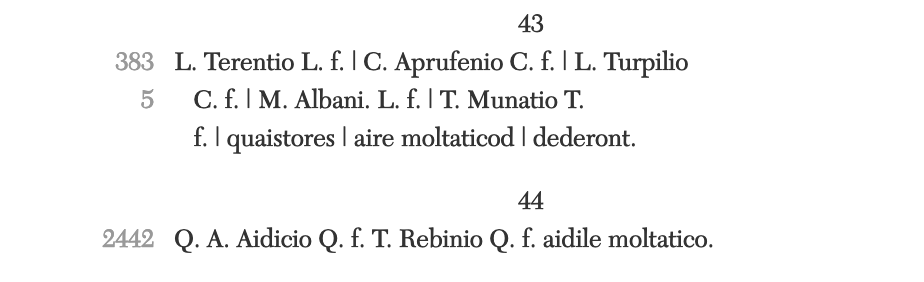
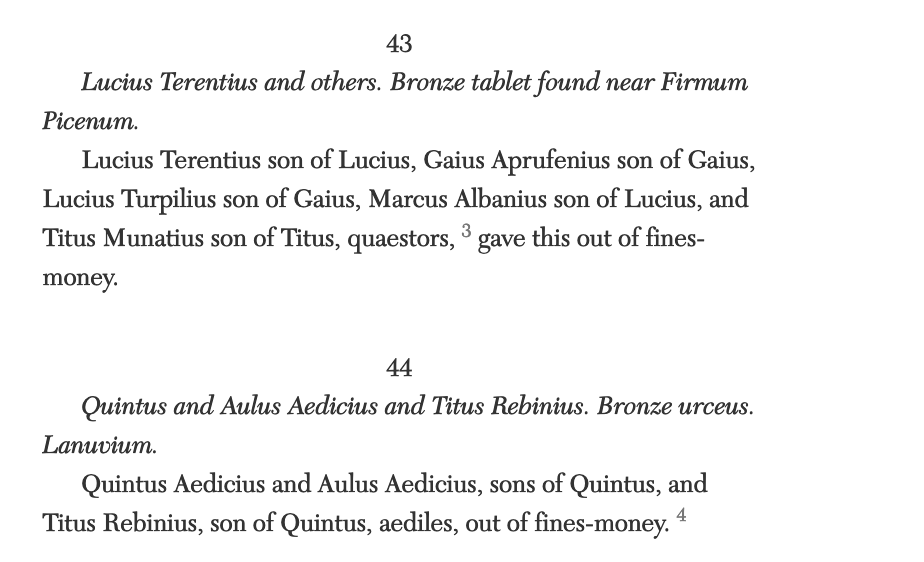
“[lost names, as] Curule Aediles authorized the dedication of this from the money collected from fines”
This was found in the podium underneath that for Apollo Sosianus during excavations c. 1937-1940.
There terminology is familiar from other inscriptions (from Loeb):
This inscription is typically dated to between 170-131 BCE on letter forms and vocabulary. You all know I love the verb probare and term probum. We see it from the 1st Punic War onwards as a term of how magistrates authorize stuff, coin issues, rams of ships, dedications, etc…
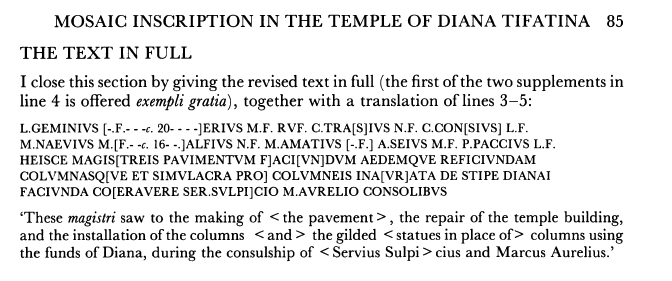
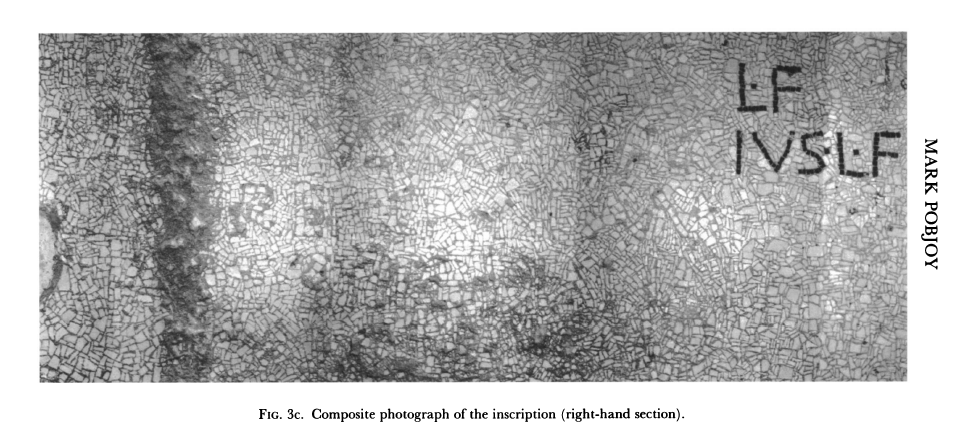
The other reason I love this inscription is that it reminds me of the one in Temple of Diana Tifatina. She’s also a recurrent character on this blog. There is a black and which dedicatory inscription on the floor of that temple that has been the subject of intensive reconstruction and is dated by Pobjoy to 108 BCE.
Pobjoy, Mark. “A New Reading of the Mosaic Inscription in the Temple of Diana Tifatina.” Papers of the British School at Rome 65 (1997): 59–88. (Link)
The inscription from Rome was clearly done with much greater care and attention, but the later one from Campania helps us imagine more of the effect and how popular this type of inscription was, perhaps because of its very enduring visibility.
Which reminded me of another from Nemi c. 30-1 BCE that I was worried was unpublished as all I’d seen was the 1885 photos but thank goodness it turns out it is: EDR147036
It has been suggested that the mosaic in the Temple of Apollo might be connected with works in the area c. 179 BCE conducted by the Censors (Livy 40.51). cf.
Ciancio Rossetto, Paola. “Tempio di Apollo: nuove indagini sulla fase repubblicana.” Atti della Pontificia Accademia Romana di Archeologia. Serie III, Rendiconti 70 (1997-1998): 177-195.
What is distracting me for sleuthing out the cult of Apollo pre Ludi Apollinares this Monday morning, you ask?! Well I did start with good faith in on the Italian scholarship, but then swerved rapidly when I saw an intriguing engraving, related to one of the individuals names in an inscription. These things happen.And, so I fell into:
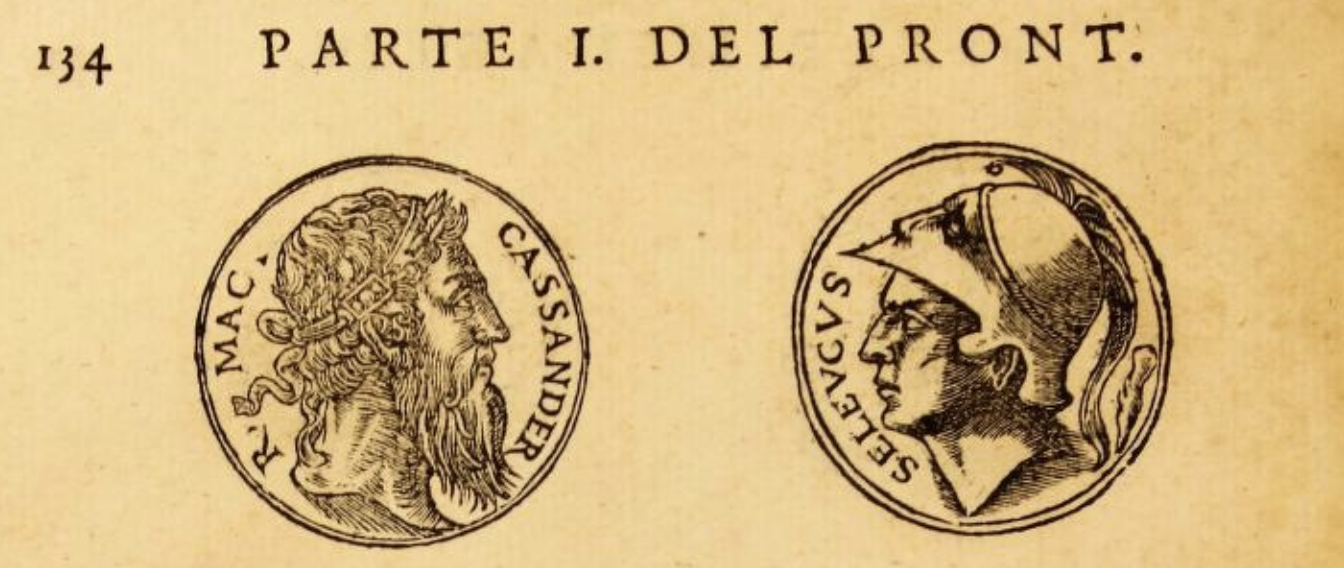
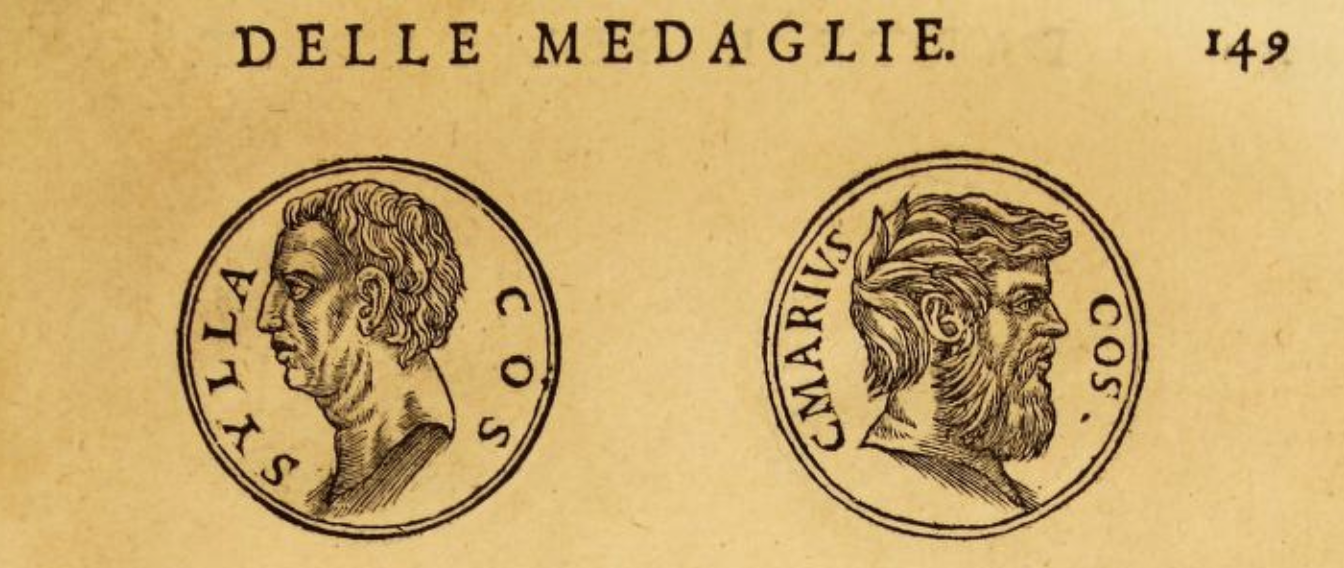
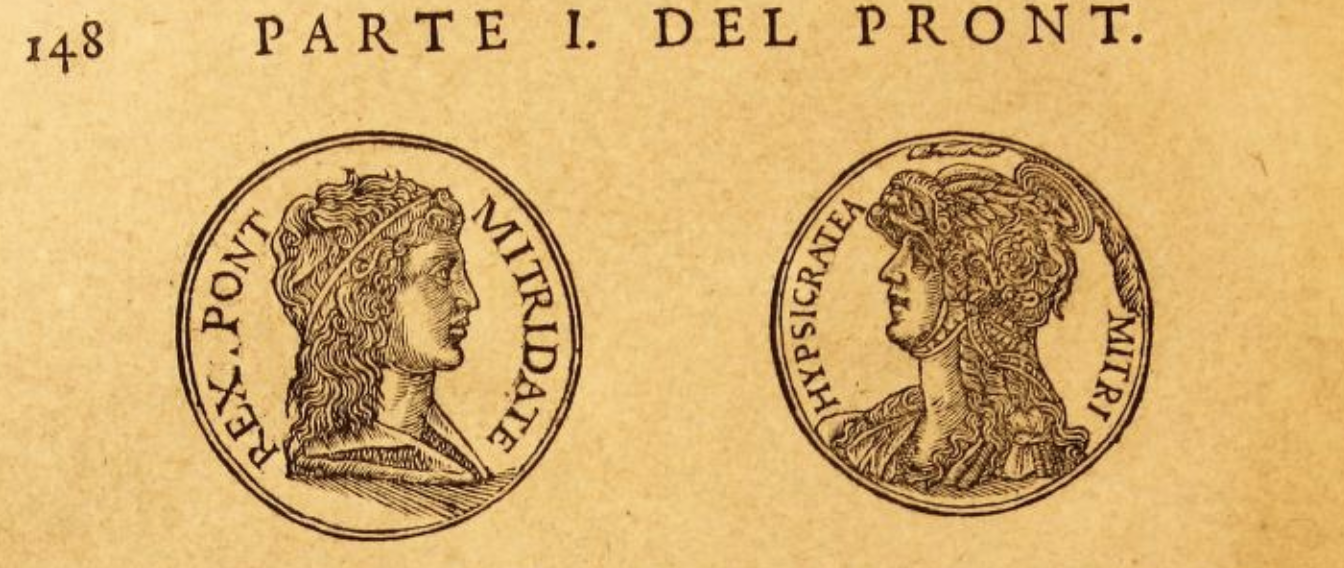
Guillaume Rouillé (text), Georges Reverdy (images), Prima pars Promptuarii iconum insigniorum à seculo hominum, subiectis eorum vitis, per compendium ex probatissimis autoribus desumptis. (full text; wikipedia entry on history of book)
While the book itself admits to some of the images being fantasies, the images also reveal a deep knowledge of numismatics.
You and I know that that isn’t the minotaur but rather a Man-faced bull with a barley grain above from an ancient coins that has been adapted by the authors and illustrator for their rationalizing retelling of the Theseus narrative.
Lavinia here has a hair style borrowed from either the Artemis of Massalia or more likely Flaccus’ Victoria (RRC 365) which also borrows from the same, or another derivative like RRC 455/3 or RRC 407/2. And that Latinus and Amata owes something to the Numa Ancus coinages of Censorinius (RRC 346), esp. to my eye the bronzes.
RRC 407/2 is certainly the inspiration for his Hersillia Sabina
The lituus among other things makes Ancus’ relationship to RRC 425/1 indisputable. And I cannot but help see some of the Republican Apollo heads with ringlets in the Tullius Hostilius.
I’m particularly in love with the use of the Mars club series here (RRC 27/1)
There are more echoes of specific coins of Caesar and Juba and more, but I started to get bored, and am restricting my clippings to those that amuse me. Like the use of RRC 453/1 ‘s Medusa as a pseudo portrait; this feels a very knowingly amusing misappropriation.
Similarly the use of Sospita from a coin of Thorius to created a Taurus portrait (cf. RRC 316/1). This by the way was the image I saw and wanted to follow up on it’s source that cost me the last hour or so. But I had so much fun I have no regrets! Back to Apollo.
Others are vaguely numismatic but hard to pin to an exact type.
Thales derives from a Hercules wrestler type.
As does this Ptolemy!
Daniel from a Rhodian Helios Apollo type.
So also Rodope where the name itself makes a joke on the the prototype
Perhaps Aeneus has something of this Brutus about him
So many veiled goddess candidates from the coins for Cresa.
Some Apollo for Artaxerces
A new style Athenian tetradrachm for Alexander. Which is hilarious given Alexander tetradrachms could have been used again I feel there is deep humor in this book’s engagment with coins and the rejection of obvious prototypes for more playful ones. Cf. the Ptolemy Lagos as Hercules above.
Mithridates morphs into Antigonous and and Demetrius becomes a wide eyed Ptolemy. These seem surely designed to amuse the intelligent coin collector of the day.
And here Alexander become Lysimachus and a pegasi Athena becomes Antigonus
Does Phyrrus come from a later Antigonid? Alexander of Epirus gets upgraded to the coinage of the III!
Mithridates becomes a youthful Apollo such as we see on numerous intaglios
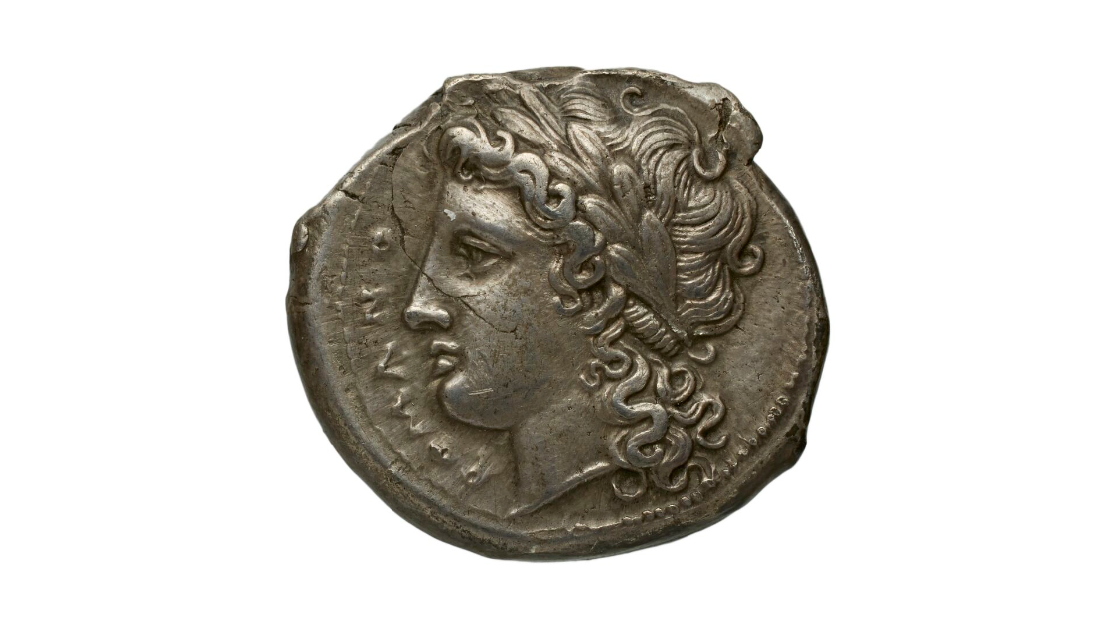
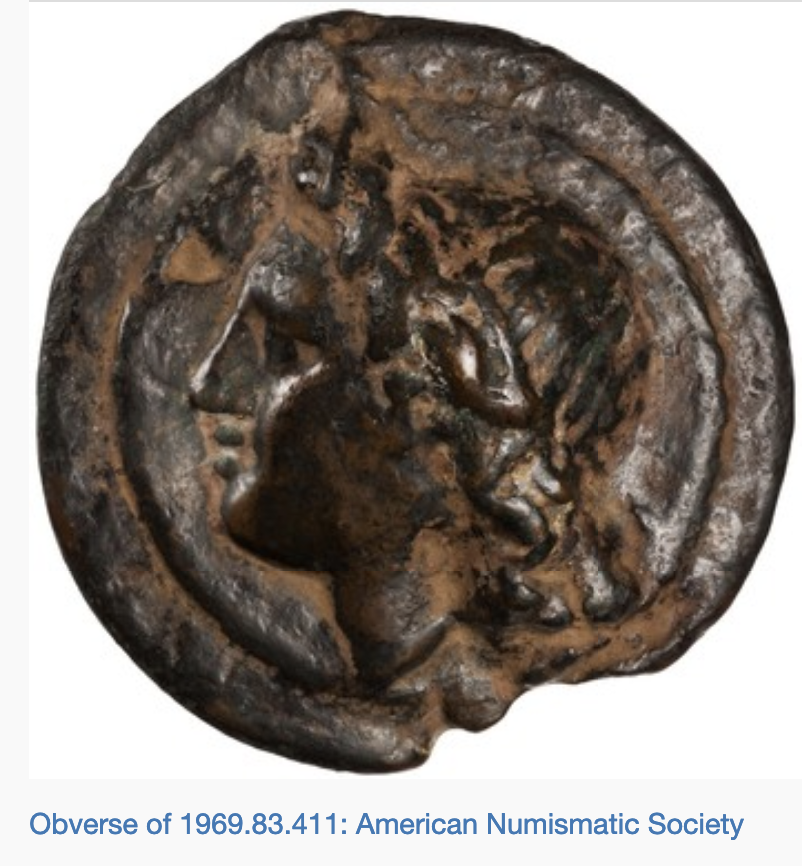
Sometimes it is no problem to tell which side has priority or should be considered “heads”. Prows and wheels etc… are clearly ‘tails’ so the other side must be ‘heads’. The knucklebone, not the dot. The acorn, not the sigma. No clue with the thunderbolt vs dolphin. You get the idea.
Crawford for RRC 18 prioritized facing right and had the facing left heads as ‘tails’. This never bothered me until today. I’m thinking about early Apollo imagery for this book chapter now.
The other Apollo that is closest in date is facing left. Should we assume RRC 18 parallels this and give facing left priority for that series? We’d then go back to facing right priority for the aes grave of RRC 26. I’m delighted to note a number of collections have their photographs labeled this way, even if inadvertently:
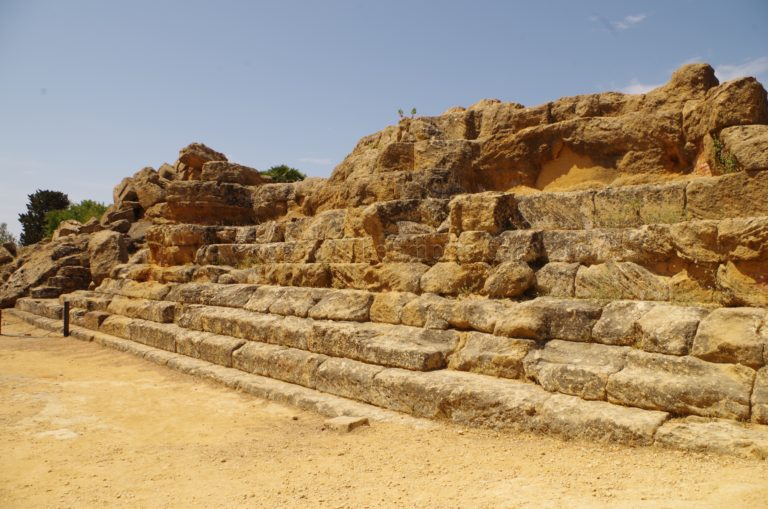
Now the sacred buildings which they constructed, and especially the temple of Zeus, bear witness to the grand manner of the men of that day. Of the other sacred buildings some have been burned and others completely destroyed because of the many times the city has been taken in war, but the completion of the temple of Zeus, which was ready to receive its roof, was prevented by the war; and after the war, since the city had been completely destroyed, never in the subsequent years did the Acragantini find themselves able to finish their buildings. [2] The temple has a length of three hundred and forty feet, a width of sixty, and a height of one hundred and twenty not including the foundation.1 And being as it is the largest temple in Sicily, it may not unreasonably be compared, so far as the magnitude of its substructure is concerned, with the temples outside of Sicily; for even though, as it turned out, the design could not be carried out, the scale of the undertaking at any rate is clear. [3] And though all other men build their temples either with walls forming the sides or with rows of columns, thus enclosing their sanctuaries, this temple combines both these plans; for the columns were built in with the walls, the part extending outside the temple being rounded and that within square; and the circumference of the outer part of the column which extends from the wall is twenty feet and the body of a man may be contained in the fluting, while that of the inner part is twelve feet. [4] The porticoes were of enormous size and height, and in the east pediment they portrayed The Battle between the Gods and the Giants in sculptures which excelled in size and beauty, and in the west The Capture of Troy, in which each one of the heroes may be seen portrayed in a manner appropriate to his role. [5] There was at that time also an artificial pool outside the city, seven stades in circumference and twenty cubits deep; into this they brought water and ingeniously contrived to produce a multitude of fish of every variety for their public feastings, and with the fish swans spent their time and a vast multitude of every other kind of bird, so that the pool was an object of great delight to gaze upon. [6] And witness to the luxury of the inhabitants is also the extravagant cost of the monuments which they erected, some adorned with sculptured race-horses and others with the pet birds kept by girls and boys in their homes, monuments which Timaeus says he had seen extant even in his own lifetime.
The note on this bit of ekphrasis from Naevius book 1, fr. 4 in Loeb suggests that it describes the pediment at Agrigentum in Sicily and thus suggesting it relates to events of the 1st Punic War, i.e. the historical portion of this book rather than the mythical. Ekphrasis is a favorite of Vergil of course (I love teaching Dido’s temple and the Daedalus’ doors!). BUT the Loeb didn’t justify the connection with Agrigentum and the sculptures don’t exist today. Hence, I found myself reading Diodorus and then wondering if even Diodorus had seen the sculptures or rather if he is just borrowing heavily from Timeaus… A problem for another day.
In my heart of hearts I hope Naevius is creating his own symbolic ekphrasis rather than just admiring something the Romans saw in Sicily, but that is deeply unknowable.
I’m reading Naevius and it is SO DISTRACTING from my writing, if necessary and relevant.
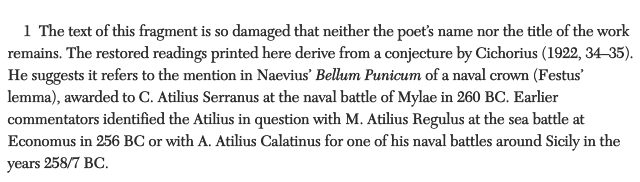
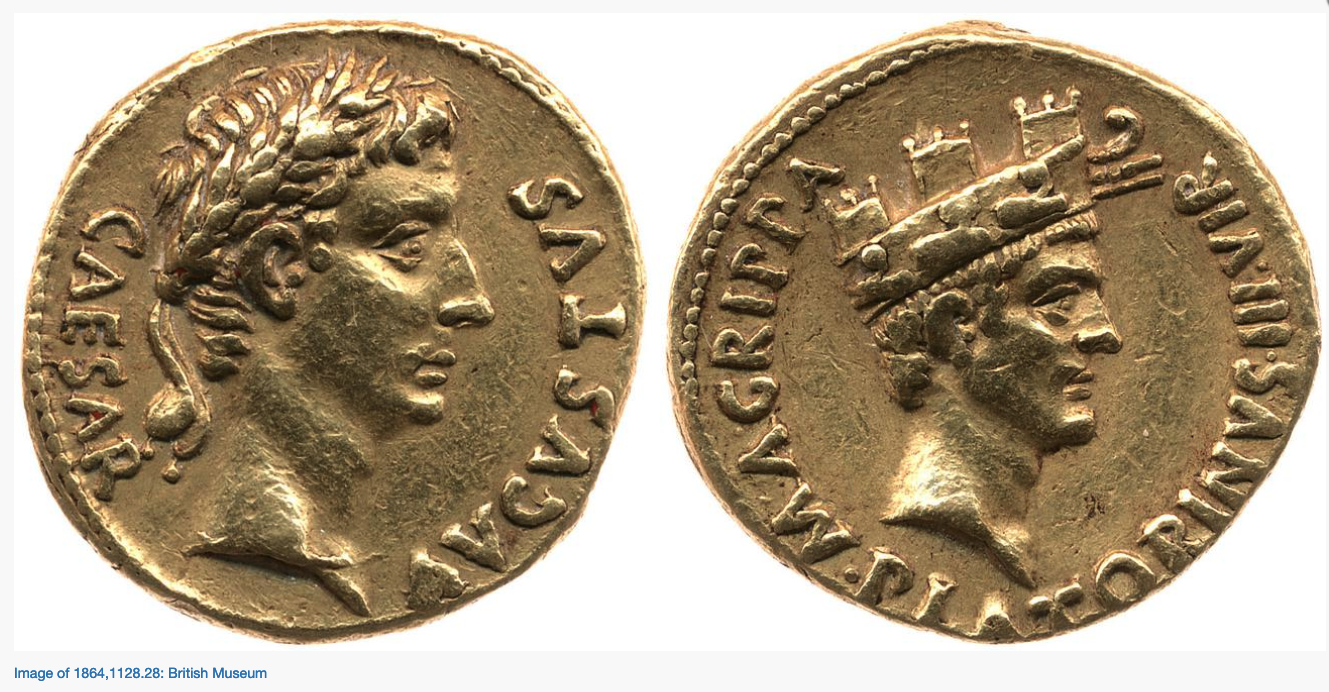
Agrippa is seen on many early Augustan coins with very funny head gear:
Naevius helps us see how this symbolism (absent from the republican series) fits with Augustan habit of reviving older traditions as a means of legitimating the new regime:
Link to relevant coins in OCRE (more than illustrated here including v unusual use of Agrippa under Caligula, Flavians, and then a restoration type under Trajan…)























 Liv Mariah Yarrow