
A correspondent of this blog sent along an article via email.
Haddad, E.A., Araujo, I. Economic footprints: mapping coin circulation and economic networks in ancient Rome. Humanit Soc Sci Commun (2026). https://doi.org/10.1057/s41599-026-07815-7
It was received 29 May 2025, accepted 22 May 2026 suggesting a v long time under review and revision.
I’m not sure that any numismatists were engaged in the peer review process. But does numismatic expertise matter in this case? I’m not even sure the original authors of the data sets are aware of this re-use. It is technically proficient and seems very well peer-reviewed for the methodology. Thus far Google Scholar reports no citations. That said, any venue under the nature.com family of academic journals is considered prestigious and ‘important’. The idea is creative and with real historical merits, as is the experiment of the combining of the data sets worth.
The lead author is very eminent with citations off the charts by compared to run of the mill academics like myself. My instinct is that our discipline can benefit from having those outside ancient studies look at our datasets from a fresh perspective.
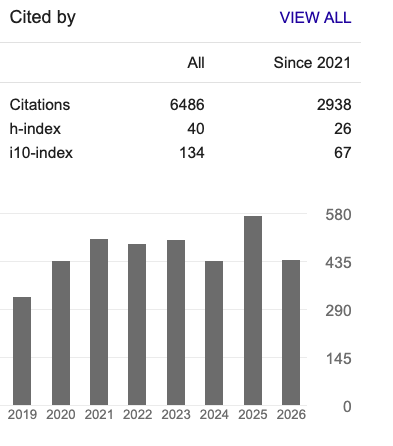
[My citations scores are also suppressed because most numismatic publications never get registered in these things and has led me to think harder about where I home my publications. Not for the sake of numbers, but for the sake of what audiences I reach!]
What does the article use?
It uses CHRR as published on line by Lockyear in 2013 and Scheidel and Meeks’ Orbis.
Both are sources I use all the time and consider invaluable.
What gives me pause then?
- Lockyear has continued building and refining the CHRR offline for thirteen years! He is very wonderful about sharing his data with those who ask and provided updated information.
- CHRR was build to focus on silver and Roman issues. If it mentioned other mints it is incidental or is based on the HYPOTHETICAL location of Rome’s satellite mints.
- CHRR also relies on dating which has know issues, particularly the redating by Mesagne and other finds.
- Reported hoard findspots in the 20th century often have been fabricated to allow those with financial interests in illegal excavation and exportation of cultural heritage to still share data while protecting their sources.
What would make the same study (more) valuable (or more comfortable to me as a coin person)?
- Cleaning the data in collaboration with the original creators of the datasets.
- Scoring findspots for likely accuracy after review original hoard report
- improved correlation findspots to nearby site usage with consideration of chronological usage/historical events
- consider how to integrate re-dating of coin issues
- consider recent literature on mint attributions
- Expand to include hoard data closing in the same period but not included in CHRR. The basic resource is https://coinhoards.org/, but that is just IGCH not all the of the subsequent coin hoards publications.
- Consider that coinage is not the only form of money. While Philip Kay’s work is cited, Hollander’s is not.
Would this make the results of the study significantly better?
The issue may be macro vs micro benefits. I’m not an economist, I’m a historian, and that means periodization matters a great deal to me. There are big picture people in history, e.g. Scheidel and the Stanford school, that I might imagine find this really valuable. It will likely be cited by the next big historical economics book, what ever that maybe, but some successor to Debt by Graeber. My questions tend to be about narrower periods of time or causality.
The following is from the conclusion:
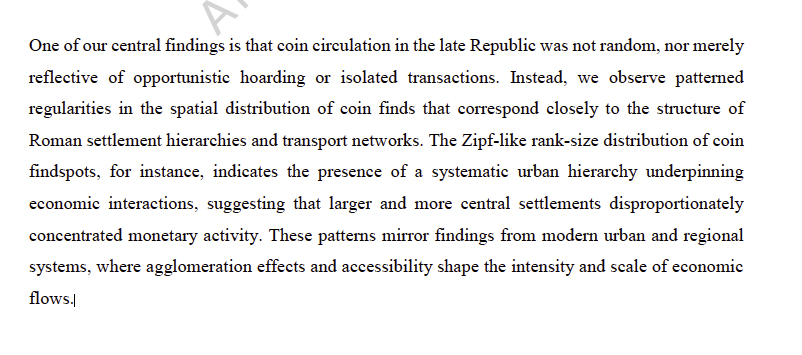
I wonder how new this conclusion is really to those of us in the world of ancient coinage and the Roman economy. It feels like common sense, but maybe we need data to prove these patterns? I feel I’ve seen sufficient data visualization that make this point previously, but perhaps this more robust?
I also wonder if there is not some circularity here.
The study correlated purported find spots with Orbis locations. Isn’t this forcing the conclusion?
“Each mint and findspot was then assigned to its corresponding ORBIS location within a 50 km bandwidth.” (p. 11 of the preprint PDF”
50 km is a very long way in a pre modern society…
There are some things I do find very usefully thought provoking in the article, that could lead to new research questions:
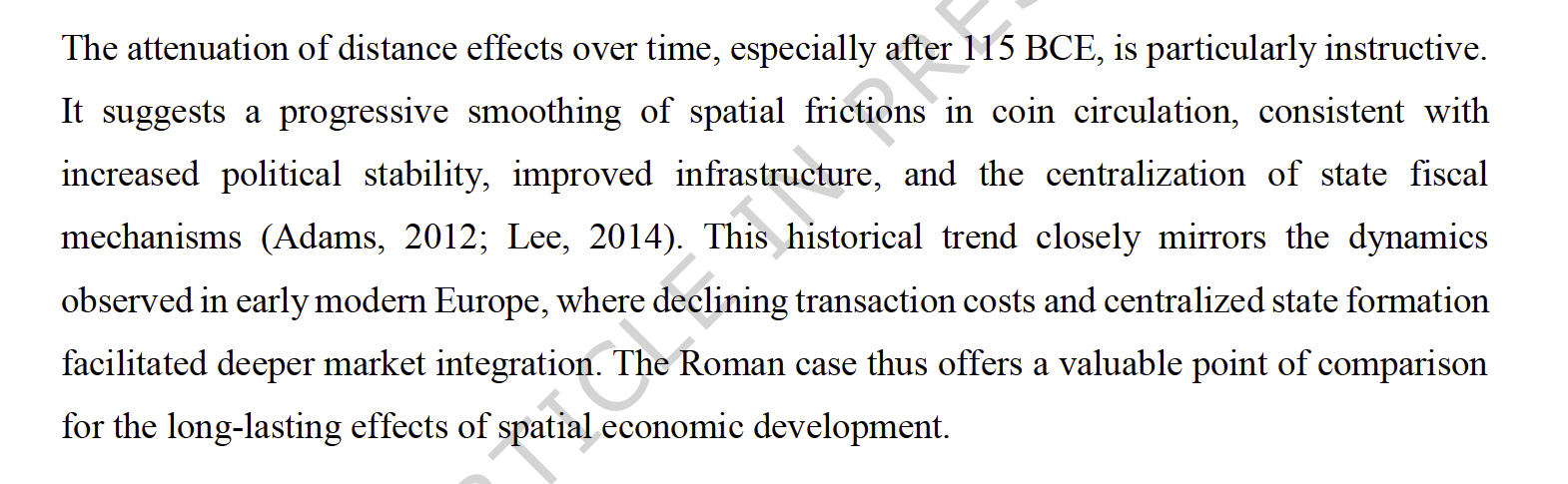
This statement certainly deserves some future consideration from a historical perspective for its implications and considerations of causation for the observe pattern.
The use of LISA clusters (Local Spatial Autocorrelation) creates some interesting patterns but again I worry that this may be a forced correlation based on how findspots were correlated to known landmarks.
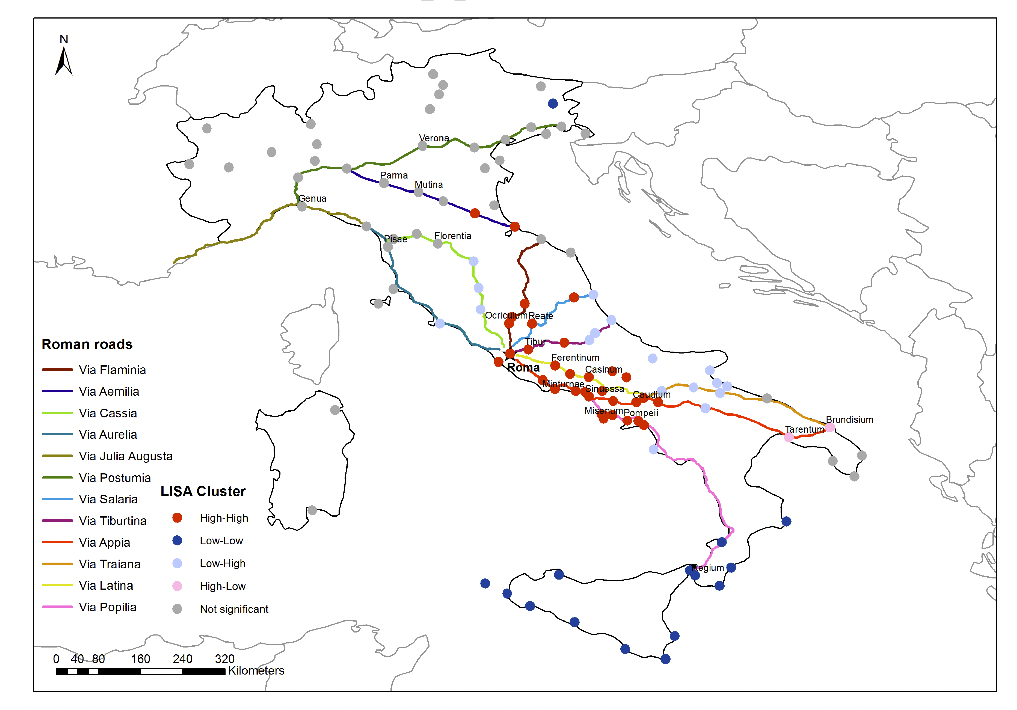
On the other hand the LISA clusters on the northern frontier are fascinating:
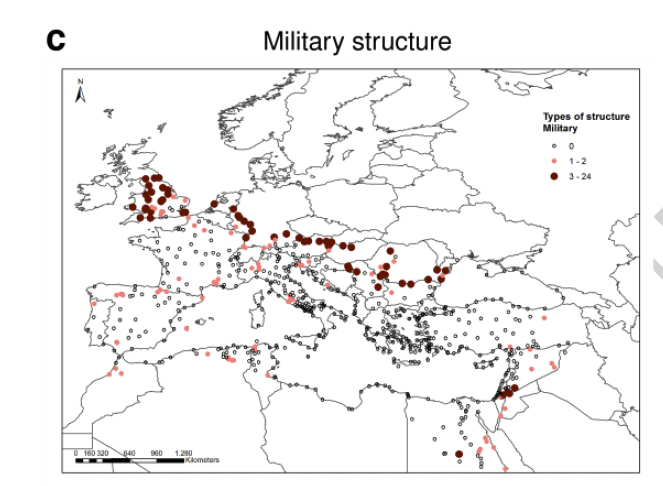
p. 20
So where am I? I’m glad that non numismatists, non historians, are engaging with our data of the ancient world and showing how the datasets we build can be used in ways less common in ancient studies. I see big disciplinary gaps and it makes me uncomfortable that data in aggregate may overcome many of my concerns about the minutiae.
I like minutiae.
But I also want to try to see the forest and to be open to new ideas.
I encourage you to read the article for yourself. Tell me if I’m wrong about anything. I didn’t fine-tooth-comb it.
I also wonder how I would feel if someone used RRDP this way or another data set. I hope I would be glad. I also might be a little sad if they didn’t reach out to me.


