
Right now most computer-aided die comparisons ask the question: “are these two coins struck from the same dies?” Or “how similar are these two images?”
I thought I might experiment with a different approach. What if I trained Claude on Schaefer’s existing die IDs? Could it incorporate new specimens into the existing die ‘typology’?
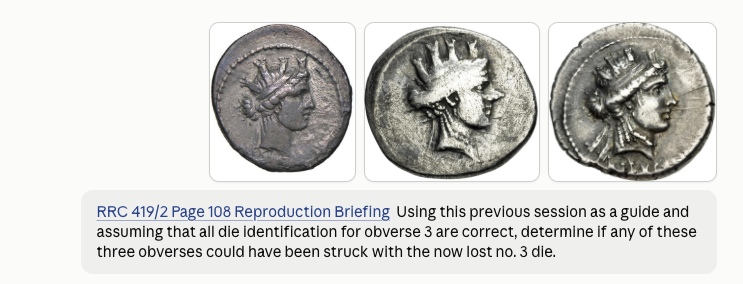
I used the briefing shared in the last post to start the new session and selected the three top coins of RRC 419/2 from acsearch.info when sorted by most recent. [links below]
The results are ok but not nearly as fast as doing the visual comparison myself. It took over an hour of processing time.
I asked only for a yes or no on die 3 as Schaefer had the most examples of coins struck by this obverse die such that I thought it might have the best luck at an accurate answer. Here’s a summary of the answer with my critique
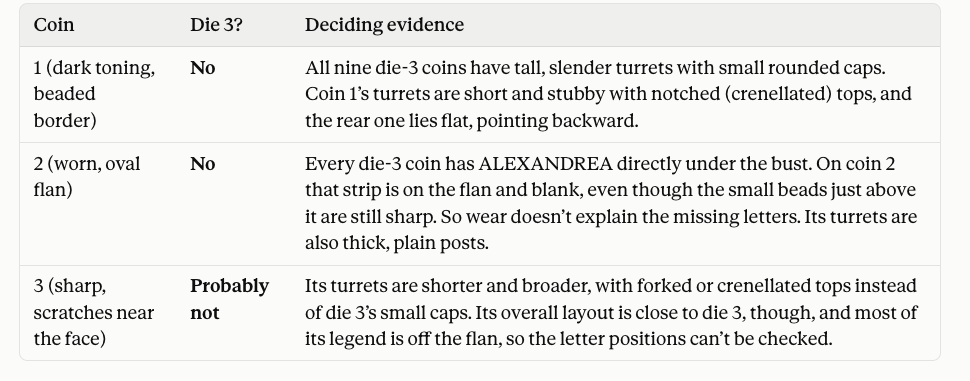
I’m going to discuss them in the order of 1 and 3, and then 2, as two presents the most problems. I didn’t ask Claude to look at the other obverses but it did anyway, to a point. This is at once useful and irritating that it regularly exceeds commands. I’m sure you can use your imagination about why this might not always be a good thing.

For Coin 1, Claude showed me a new graphic representation to help me see the die match. Notice the squiggly red lines at the bottom:
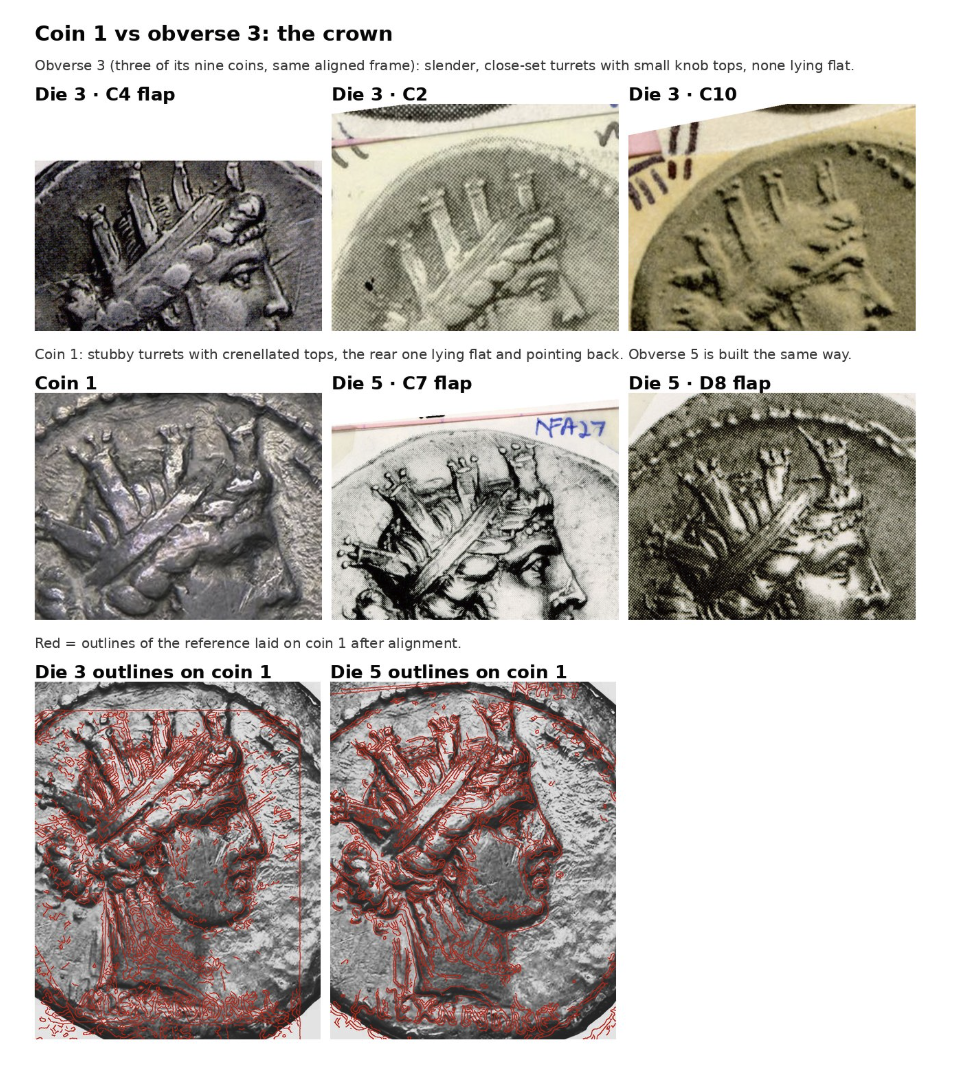
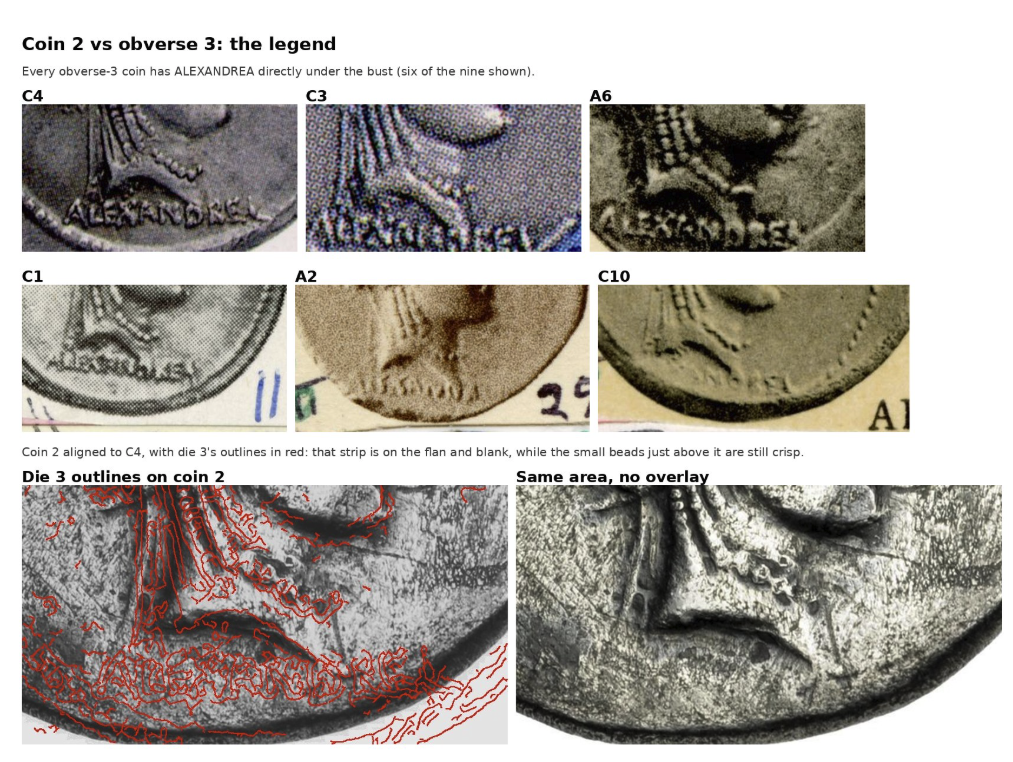
Even though the angles of the first and third turret are the dead give away for obverse 5, I’m most impressed by the red overlay of the E and X. The comparison with die 3 overlay (the left bottom image) is really helpful for seeing what areas of the die are distinctive enough for a comparison facial features less than hair, crown, lettering etc…
For Coin 3 it made no die ID just said it didn’t match Die 3 (it doesn’t). Strangely it did not point out to what I consider to be the most obvious difference between coin 3 and die 3, namely the angle of the diadem bands. It showed some comparison pictures but not the useful red overlay. I could ask for it but I don’t need it. The die ID is easy and I found another small human error in the process.
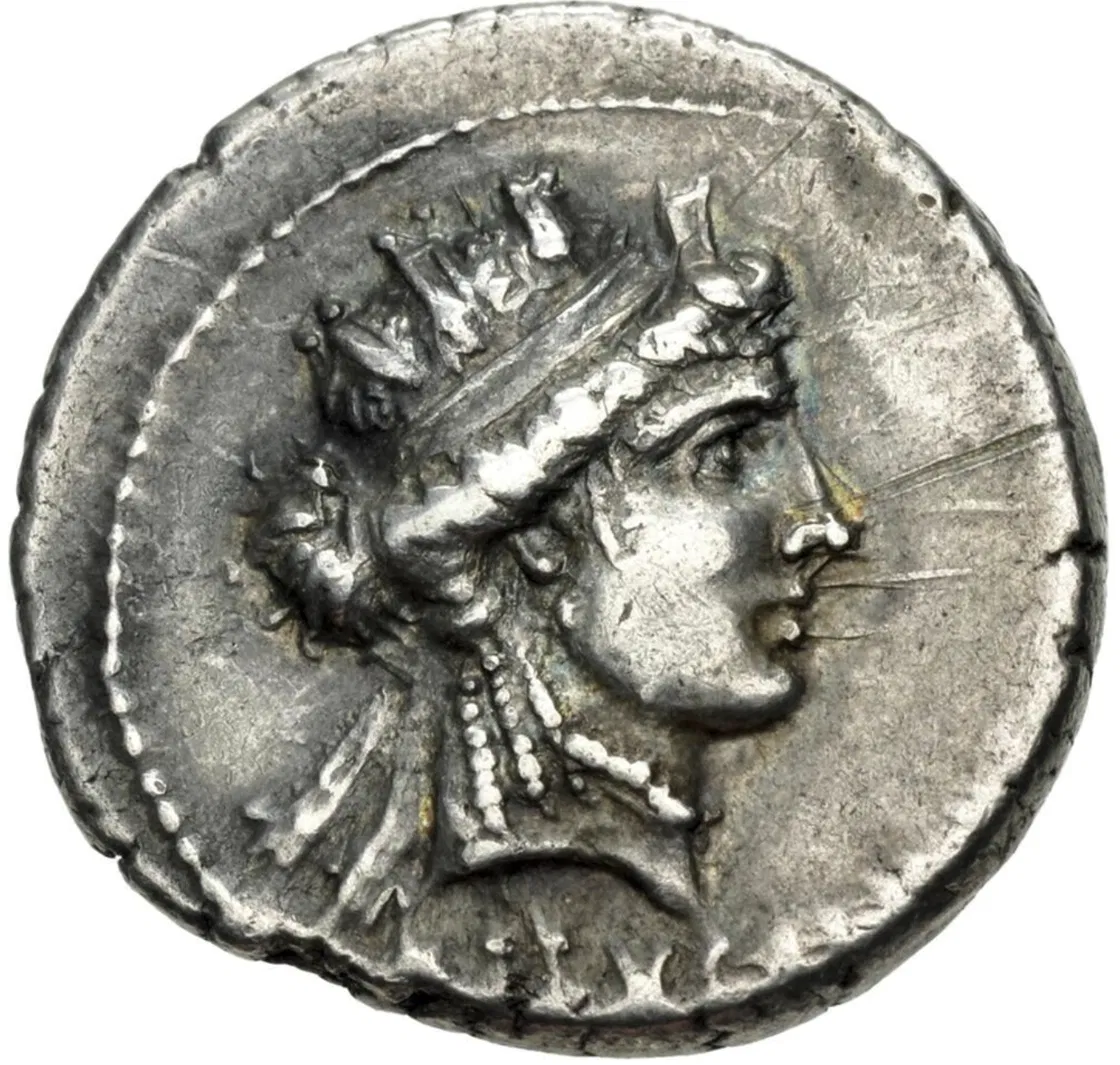
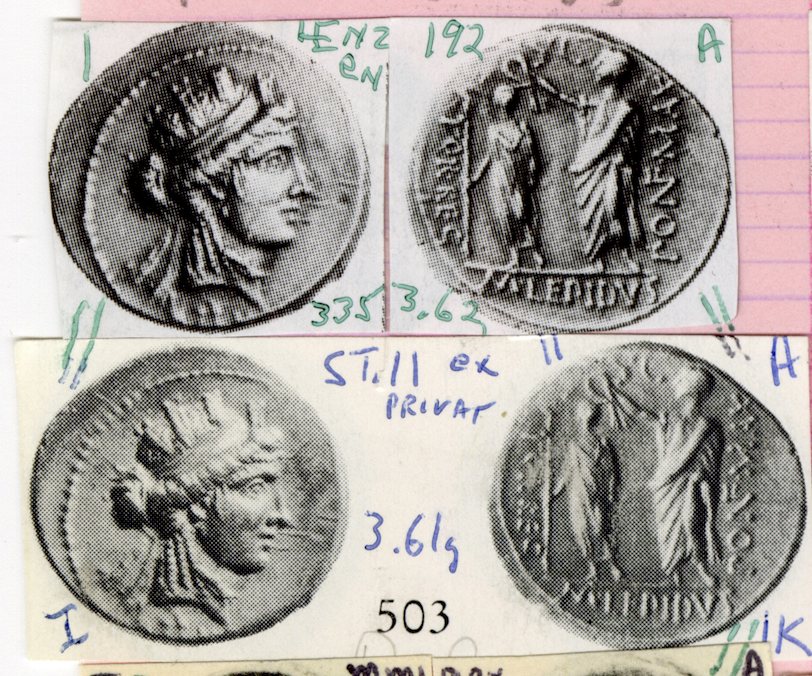
Did you notice it? St. 11 503 and Henzen 192 335 are the same coin (!) but appear as die linked specimens in the Schaefer archive. Meaning before coin 3 (left) appeared Die 1 was only known from a single specimen. Now we have a true second. The reverse of this new specimen is also Die A, but with more of the die on the flan. I’m interested in the three scratches in front of the face. Clearly a die artifact not specimen specific. I also find it curious, that while not the same coin, coin 3 is positioned on the flan v similarly to the previously known specimen.
What about Coin 2?
My first guess looking at it is that it is a Dacian imitation likely made from hubbed dies that have been recarved. Not really fair to give to Claude as a test, but there you go.
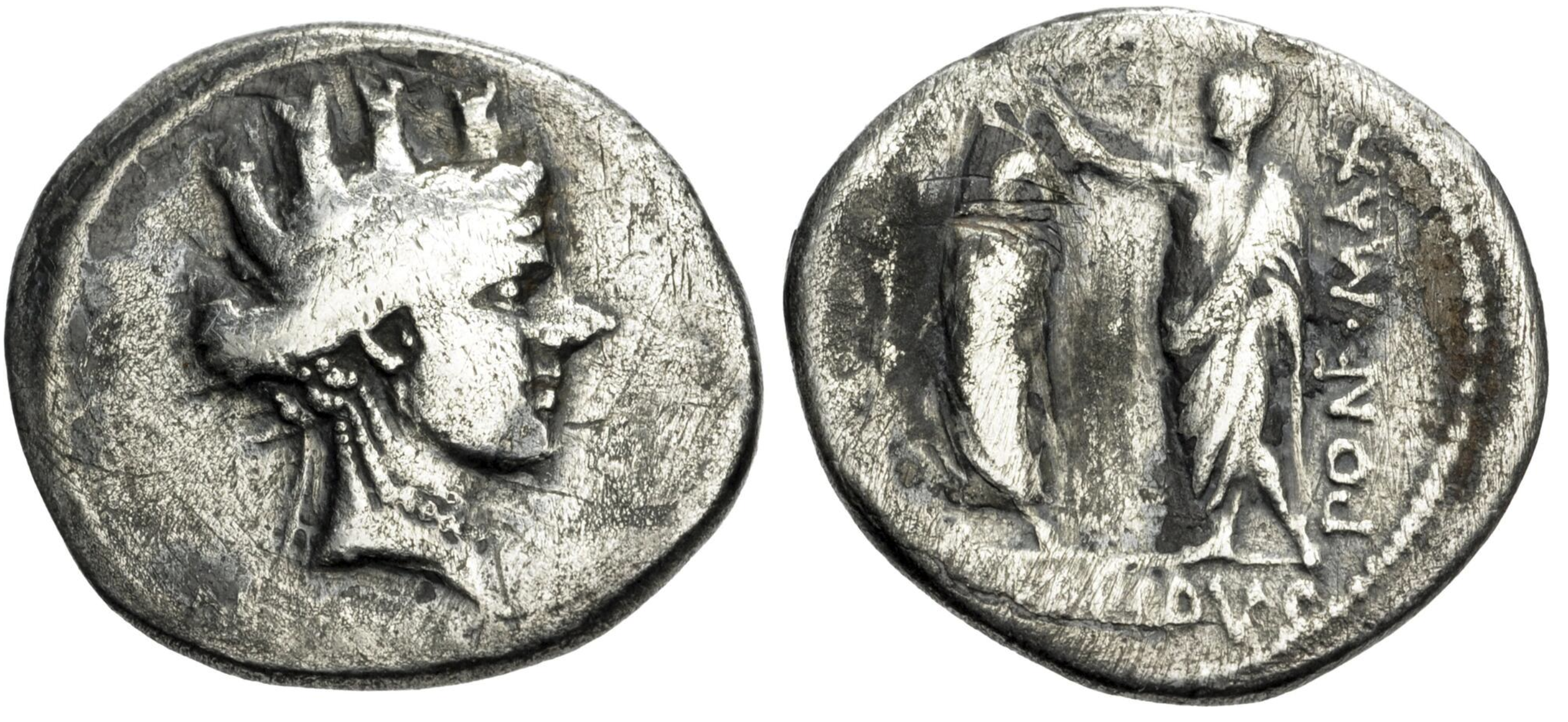
Claude’s negative conclusion that this coin was not made using die 3 is based on the lack of lettering when the necklace and hair are relatively crisp.
So I took a different approach for deciding what I thought about coin 2. I decided to first match the reverse and then look at obverses that linked to that reverse. I think it has been hubbed from reverse H. Notice the feet of the togate figure in relation to the DVS of the legend and the distinctive different in the bottom of the letters D and V.
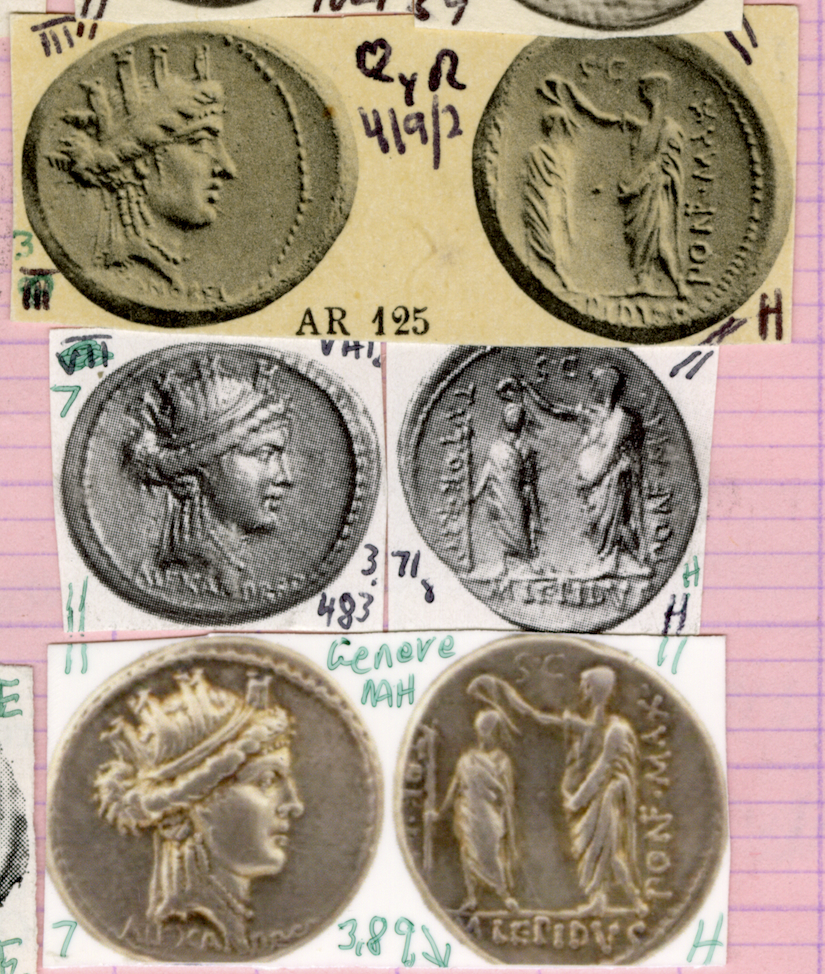
Reverse H pairs with Obverses 7 and 3. Three is a much better match for coin 3, but I don’t think it was really struck by that die. I think dies was created from a coin with these dies and then those new dies were ‘cleaned’ before being used to strike fresh coins.
At last, I found something that (as of now) I’m pretty sure I can do a great deal better than Claude.
I asked for some images to test out my theory. Claude is still convinced that there is no match, and obviously a hubbed die isn’t a real match but it is an interesting test. These images are suggestive but not decisive.
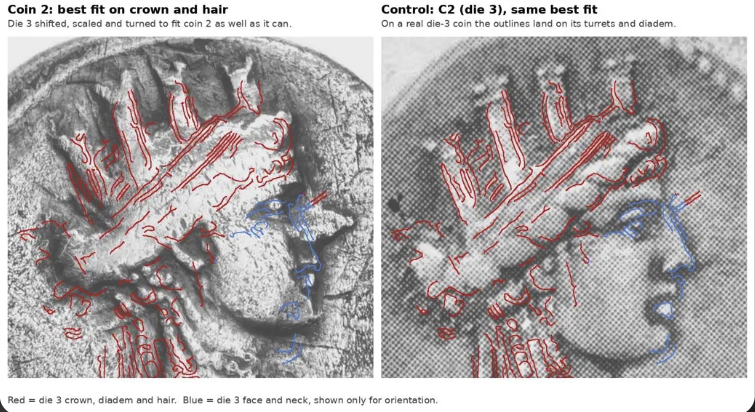
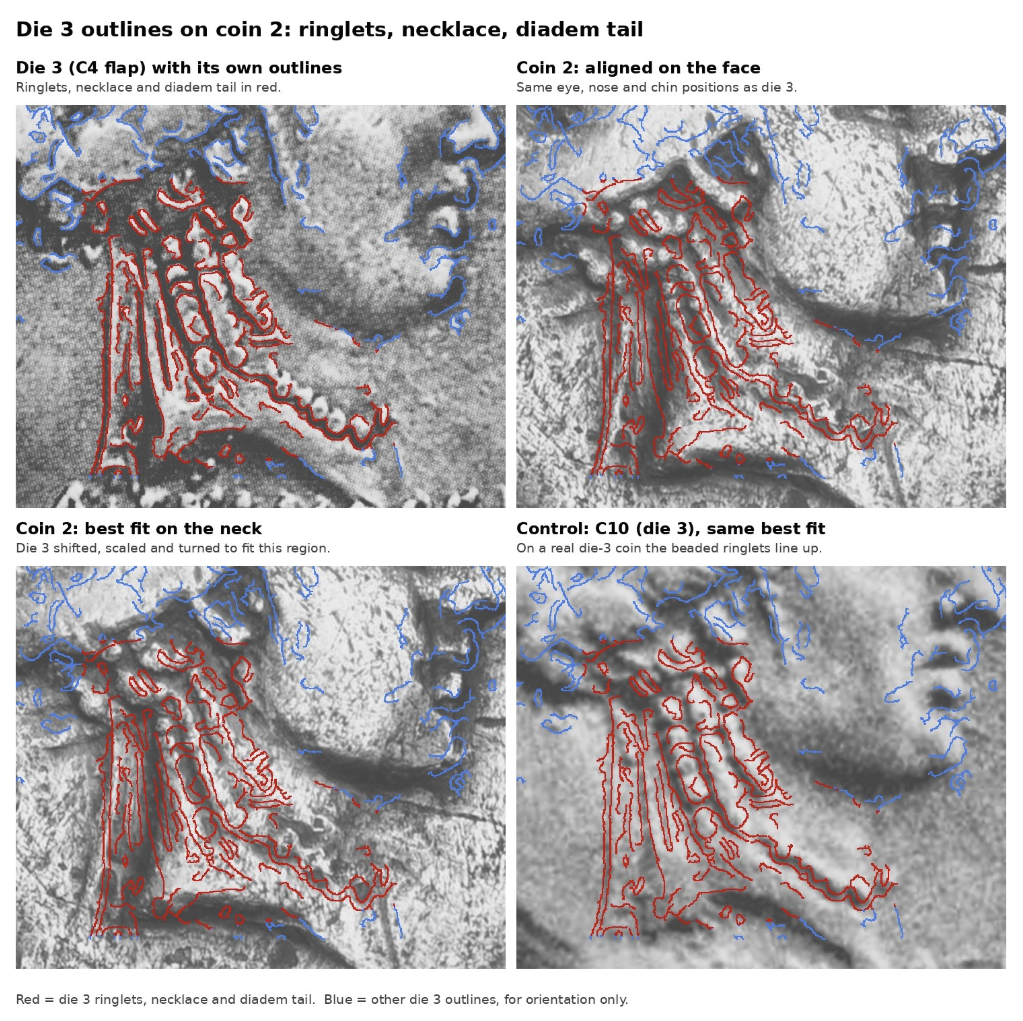
If I were just interested in the die study itself I’d throw out coin 2 as not useful to the study, but for the purposes of testing Claude it is interesting.
A similar, earlier, human-only experiment trying to die link an example of hubbing.


