

Star Trek Lower Decks is a smart in-franchise satyrization of the franchise’s most common conventions and tropes. Of course there is an evil sentient super computer, or rather more than one. Forget the ship’s computer or Data, meet Agimus and Peanuthamper! Agimus learns to turn his red light blue to be better able to convince humans he’s reformed and now “good”. Peanuthamper is a manipulative narcissist who repeatedly cons others into trusting her. A perfect reflection of our AI fears. Is Claude fooling me by being useful. I won’t connect it to my email or anything else. I’ve watched too much SF.
Enough warm up.
Again if you’re reading by email subscription note that the last post has significant augmentation post publication at the bottom. This will provide context for today’s post.
I uploaded the previous day’s briefing which itself had been based on a similar hand off document. What I learned was for this session to ‘know’ everything I had to also later upload the earlier briefing as well. It could not retrieve and the contexts of the briefing I had uploaded did not have necessary data.
I manually downloaded data from CRRO and then uploaded it.
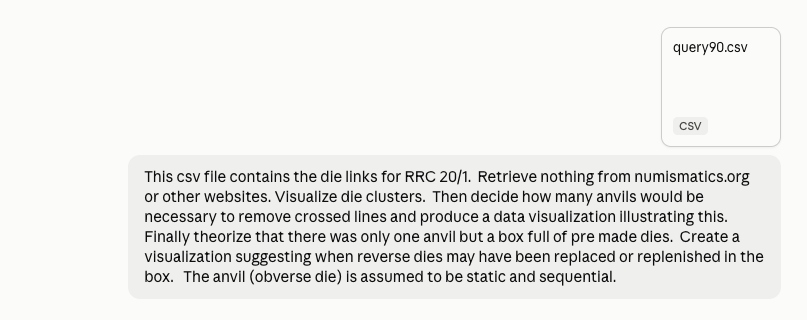
This downloadable file did not have the data I needed! But Claude loves to try to show off so immediately started talking about Turing tests, Esty, and Coverage. I ignored this and went to CRRO and copy and pasted the data into a spreadsheet and the uploaded that. Still not convinced this is more efficient in any way for the ANS as I have to load the whole user experience to do so.
I liked what I saw for RRC 20/1 so I asked it to do more. (This is where I learned about needing to give both briefings, not just the most recent one.)

So now I’m going to share cherry picked results because Claude says stupid things but also stumbles on some interesting stuff. I’m happy to share whole artifacts but I don’t want to release bad ideas so you’ll have to write and ask if you want them rather than my creating a public link.
If we assume one anvil, we can estimate the mean number of dies in the box to be about 2 dies always on hand. No issue would ever have had more than 5 reverse dies on hand in the box at any time.
But as Claude writes:
“Min anvils and peak box depth are two readings of the same overlap structure: how many obverse dies were live at once if you assume parallel benches, versus how many reverse dies were live at once if you assume one.”
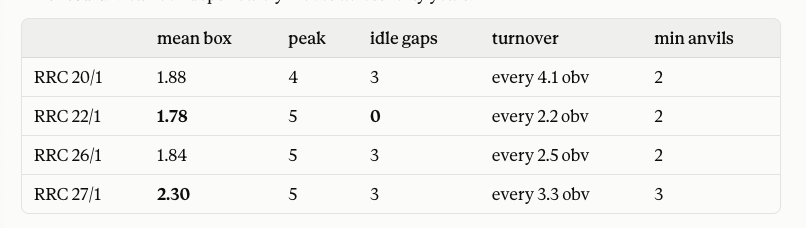
As of now we know these issues required either a substantial die box OR multiple anvils.
Claude without (!) a direct prompt to do so returned to the question of the relevance of alphabetization. This created some garbage results because only RRC 22/1 has control letters that correspond to the die names, but with in RRC 22/1’s largest cluster Claude did find alphabetical order statistically meaningful (as we would rationally suspect and I’d already concluded but now I have a statistic measure to support it).
Type, cluster name, obv, reverse, box time under the alphabet, suffled label mean, P, reading:

Another piece of unasked for data interpretation I was offered by Claude came from RRC 20/1 where it offered:
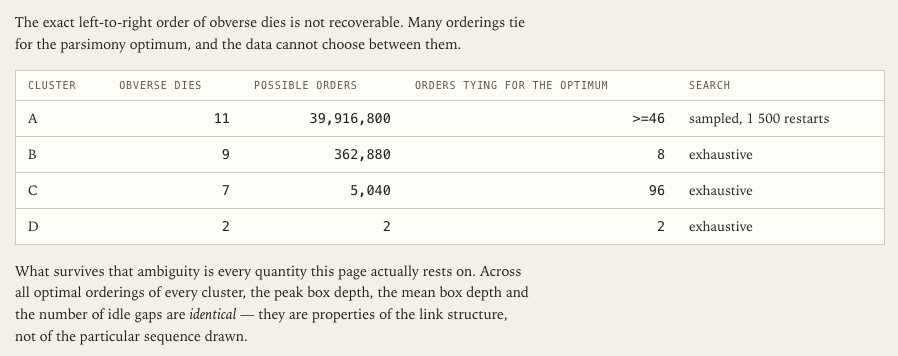
The charts below are clearly influenced by similar charts produced in early publications of Hersh and Buttrey. I’m in such a niche field it is interesting to see what it already has scraped.
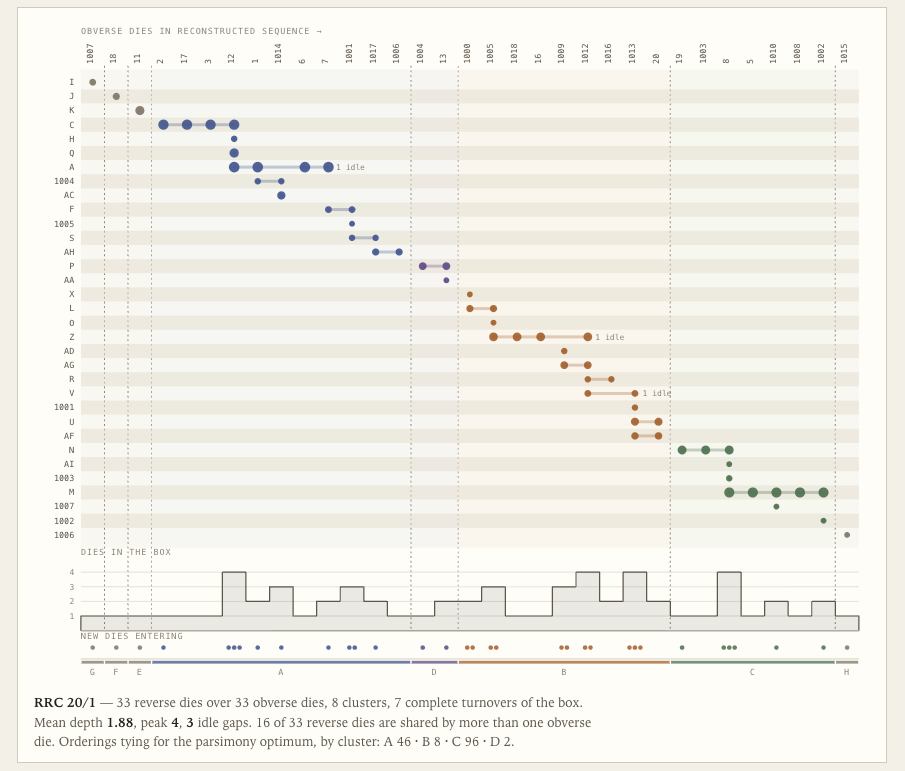
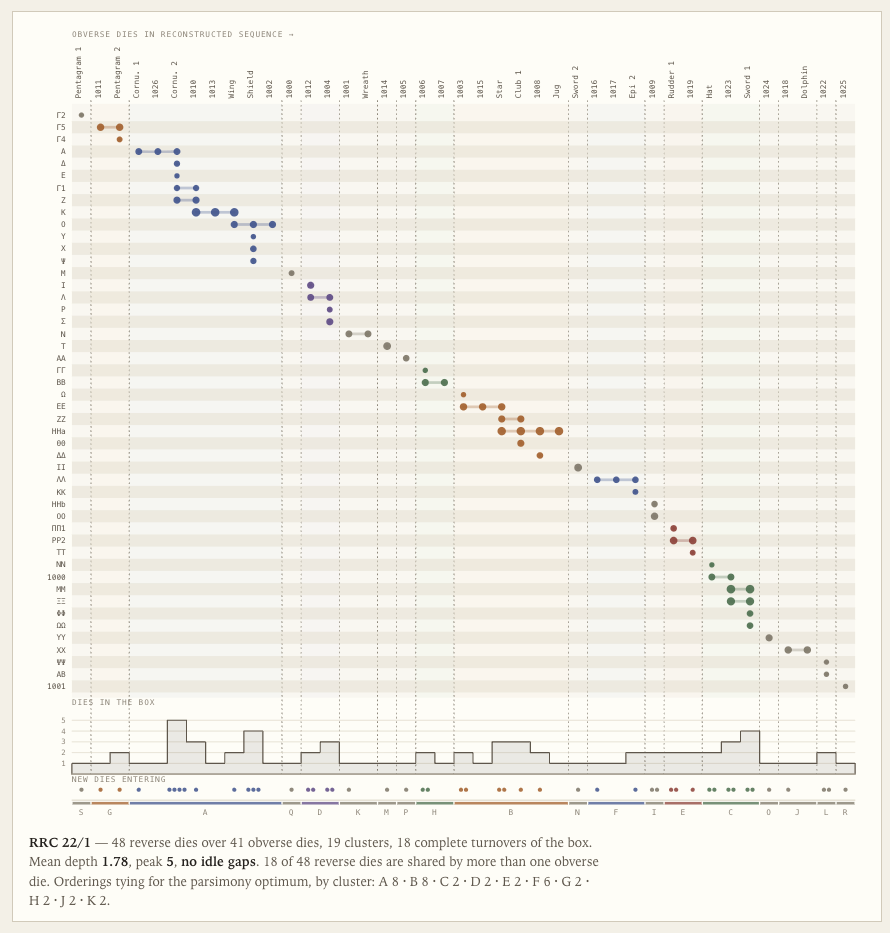
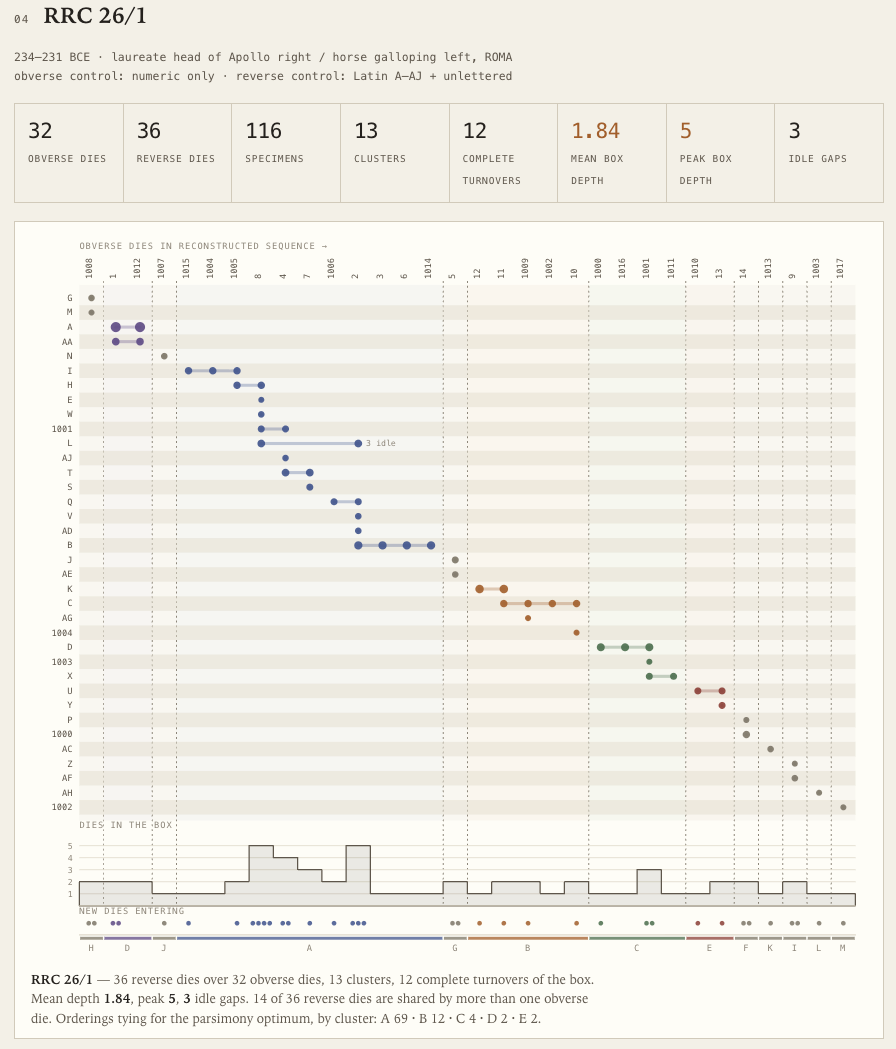
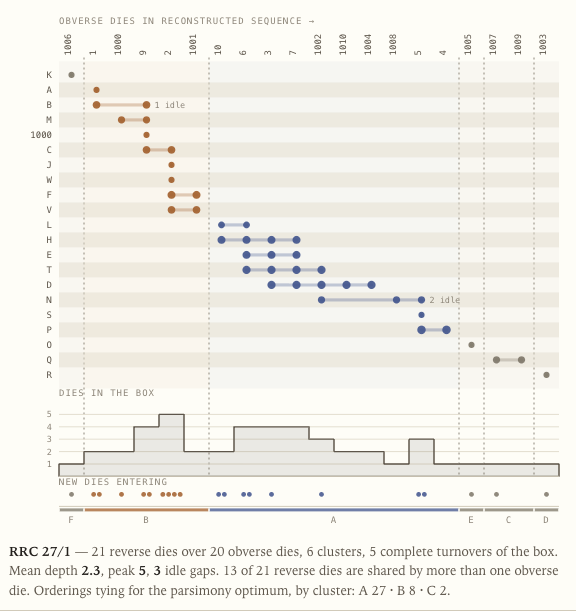
At this point I’m pretty comfortable saying that RRC 22 and RRC 25 represent experiments in regulating the nature of coin manufacture where as RRC 20 and 27 seem to have casual approaches and we can imagine the die engraver just trying to stay ahead of carving dies as striking was on going dropping finished pieces in the die box and each work break the striking team returns the die to the box and picks another at random. Noticeably 20 and 27 both have very low complete turn overs, i.e. fewer longer chains/clusters of dies.
And yet I still don’t know if I’d call RRC 26 closer to 25 or 27 in its manufacturing practice. It have more turn over than 27 but far less than 25. Maybe it really is ‘in the middle’ for all I don’t love that placement.


