
I took a break between trying to do some professional travel planning and some bibliographical formatting–none of these tasks spark joy, but must be done. I decided to read something fun and share:
Counterfeit Roman Bronzes. Unfortunately, the file on forgeries must always remain open. Modern industry is constantly refining itself and devising new ways to deceive collectors. Today, we intend to discuss Roman bronzes in order to warn collectors of this series, as the coin-forging industry in Rome has reached an incredible level of perfection. Everyone knows how difficult it is to forge bronze coins for two reasons—the patina and the edge—features that are nearly impossible to replicate authentically. However, in Rome, they do not manufacture fake coins from scratch; instead, they take genuine coins and restrike them using a counterfeit die, impressing the design of a rare coin onto a common one. The edge remains perfectly preserved and appears genuine—as it truly is—even to the most expert eye. The patina, or at least the coin’s ancient coloring, also remains unaltered. To identify these restruck coins, one must look for an unusual sheen in the background areas and, conversely, a certain roughness on the raised parts of the design, particularly the lettering. The metal undergoes immense pressure during this double striking, creating the glossy background; the roughness of the relief details arises because the metal—sometimes depleted by the original striking—fails to fully fill the new die.
We have seen medium bronzes, large bronzes, and even a medallion produced using this method, and we consider it a service to warn all collectors about this extremely dangerous type of forgery. When rare or extremely rare coins are offered to you, if you wish to avoid being deceived, you should begin by being wary; furthermore, rather than relying on the authenticity of the rim or the patina—which, incidentally, can be quite skillfully faked nowadays—you should carefully examine both the flat field of the coin and its highest relief areas. One can never be too cautious.
Counterfeit Roman gold coins are also in circulation, but these are more easily recognized.
RIN 1891 p. 413-414, machine translation
Wouldn’t you love to see one of these re strikes just to get a sense of what they look like?! If you know of one and want to send me pictures I’d love that. I wonder if they mean gold is counterfeited the same way? This type of modern restrike seems something different, closer to what Becker might have been attempting?! [If we believe he did not mean to deceive.]
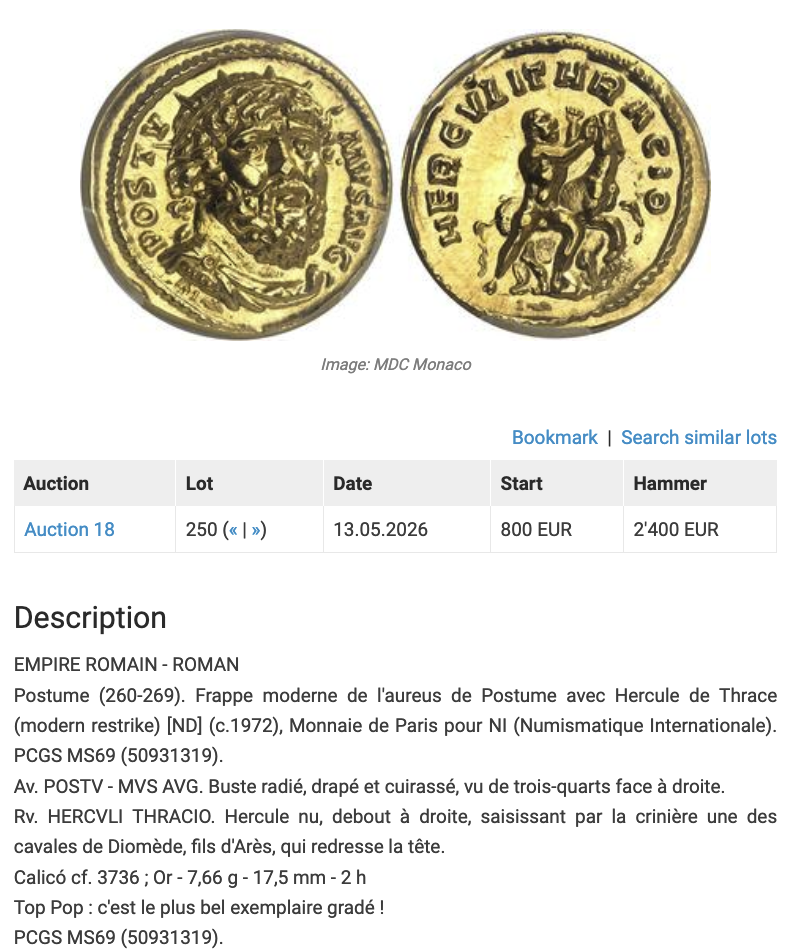
All of this is a good argument about why archaeometallurgy can help, but cannot prove authenticity.
A point I’ve made on this blog before:
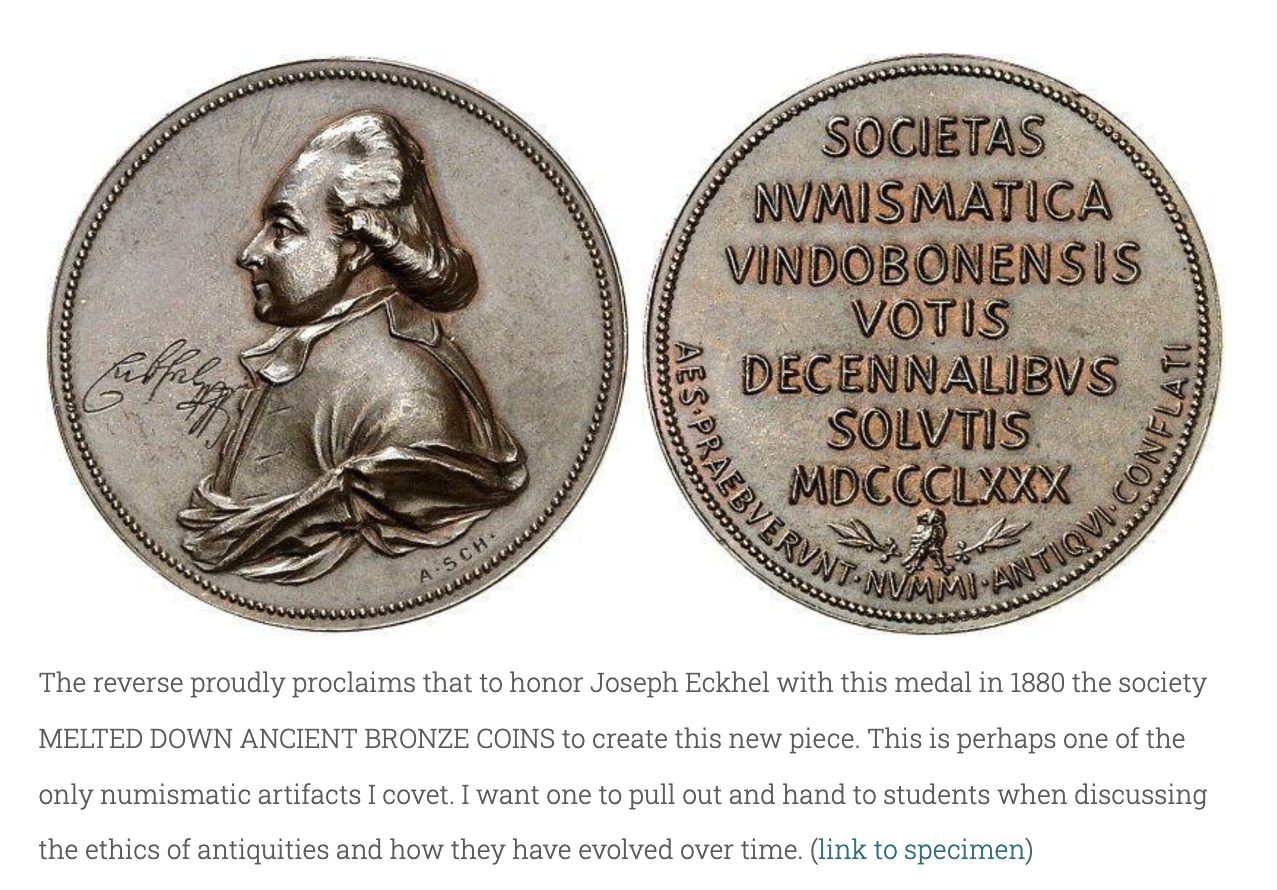
Flashbacks
Sept 1 isn’t a big day for posting in the past. All I have is some random RR bibliography. I’m very frustrated these days with the lack of digital modernization in numismatic literature. Lots of my publications aren’t indexed by google scholar and don’t count towards any citation metrics and fundamentally get cites less because of it. I could manually enter them but a) boring and b) would it help people access them?! Also Donum has great data but doesn’t have it formatted to populate correctly in Zotero or similar software, and the INC bibliographies are now online but as PDFs not as an actual searchable database. All of this means I spend more time hunting and hand formatting when I work with coin than I do for other subfields. I tend not to care too much about metrics of productivity but I do care about being read and I’m hearing from scholars that those metrics matter a great deal at some institutions and that I have colleagues moving away from publishing in the discipline in order to actually achieve promotion and institutional recognition.
Back to my loathsome formatting.


