
I can’t say I’ve thought much about centaurs. I remember my freshman year art history lectures on how like amazons and giants they represent on the Pantheon the struggle between civilization and wild forces and impulses that threaten it. A form of the ‘Other’ and a thinly veiled allusion to the defeat of the Persians. Chiron gets more of my attention for his relationship as Achilles tutor and its use in motifs of retrained education in ancient art. I’ve wondered about the centaur on RRC 39/1, but only vaguely as one more of Hercules’ many labors and side quests.

Then today I came in to the AC after a bit of entertaining in the garden to sit and cool down. I grabbed a book of Etruscan pots (a purchase from my recent trip), just to give me something to look at besides my phone.

So it is super wierd the creature whose foot the centaur is holding and I have no answers but check out that branch and compare it to the coin at the top of the post. Why are the centaurs holding branches?! And why have I not wondered at this before?


This vase below felt like the answer I was looking for. The Centaur is primitive. He bites. He throws stones. He fights with his bare hands. We cannot give him a club because he’s even more primitive that Hercules. So if we want to give him a weapon in an artistic composition he must carry a branch that has not yet been formed into a club. The raw and ready to hand weapon rather than one crafted to be more functional.
So the above vase, the one that got me thinking is a reflection on how the centaur is different than the armed men who have other weapons and even shields. The denarius reflects Heracles victory over the centaurs as primitive adversaries. Typically in art when centaurs are yoked together to draw a car they pull Bacchus and are part of revelry. This is something different, less revelry, more subjugation.

The plate below is in the Villa Guilia. I’ve seen in many times, but have always been so fixated on the fabulously strange wolf-man (with red arm bands!), I’ve never really thought of the other figures. A centaur with a whole tree pursues a woman who makes eye contact with Hercules as Hercules seeks to defend her. The centaur is the type with human front legs (always somehow more disturbing); he looks back to see how close Hercules is to catching him.

The amphora below is from Porano but is now displayed in Orvieto (see note below). Notice that the centaurs are harvesting trees to use as weapons and fighting(?) over them. Another holds a large rock another uses a pitch fork like tool to stab a sleeping man. Notice that two of the rocks on the ground seem to have heads, perhaps oracular, perhaps personificatons of place. Another figure with a double axe seems to look down from the heavens. It is dated to 330-310 BCE.


Part of me wondered if this was primarily Italic but I did find a little Eastern material in my search.


—
Based on Dan Diffendale’s useful comment I suspect the find spot of that amphora is likely the Porano just south of Orvieto.
—
additions 30 July 2026
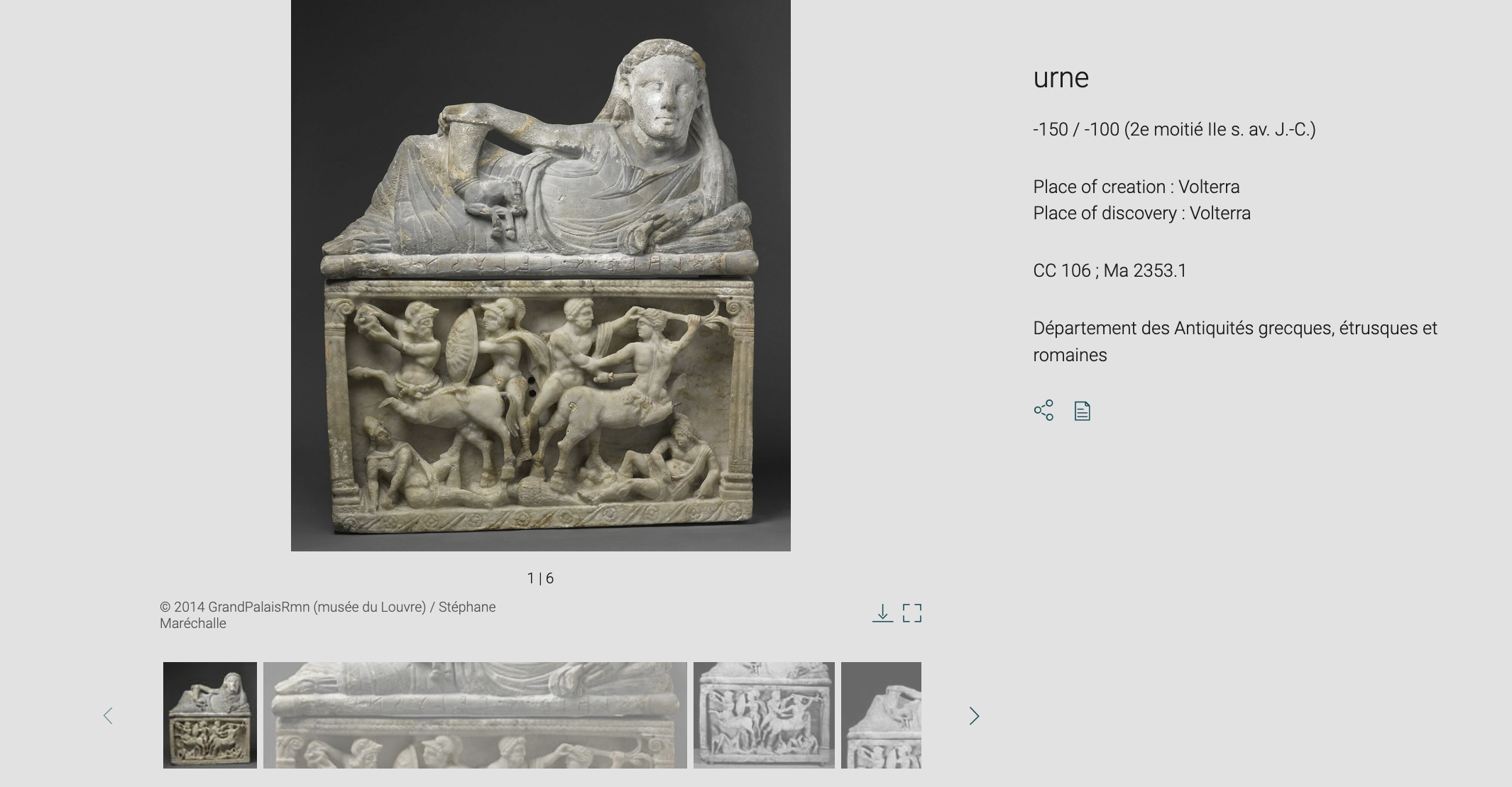
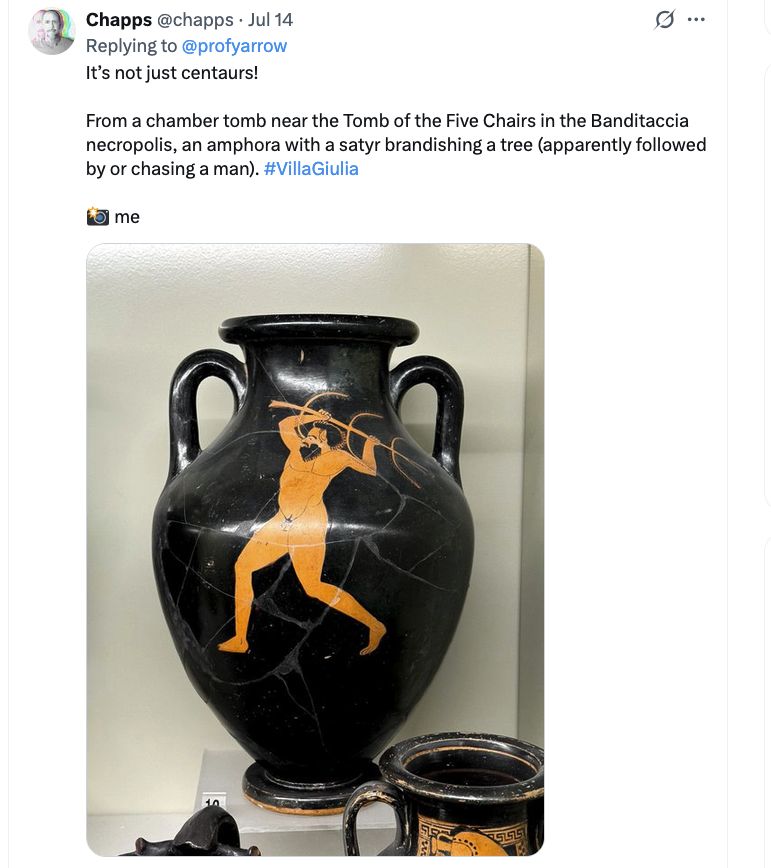


It’s common to catch sheep and goats by the hind leg. Typically this is done with a shepherd’s crook, but it can be done by hand, and the crook may be too “civilized” for the centaur here. The creature’s ears look a bit deery; I suppose one could imagine catching a deer in the same fashion.
Note that there is a Porana a few km south of Orvieto.
Ahhhh. That Porana seems a better candidate for a find spot thank you! I was a little mystified. Interesting about that catch technique!!