This is a post of pre writing, not a draft.
The origins of this blog and the RRDP project are pretty much the same. I was trying to figure out how to write my second book on Roman republican coins and how to explain their significance to the average historian. In the spring of 2014 (still in the first year of this blog) I was still thinking of the book as a chronological treatment (I gave that approach up in 2018). But even as I conceptualized the project of translating republican numismatics for republican historians, I already knew that certain topics and themes would be more important or just frankly easier for the uninitiated to see the relevance.
Already in December 2013 I had identified the grain supply as one of those topics and had written off the blog in a word document some 5,500 words on that topic. I naively thought at that point that that writing was ‘drafting’ my ‘book chapters’. I still clung to the view that this blog was ‘non-sense’ and that drafting could be done in the raw without pre-writing. I did eventually post the timeline I had created and then used those early off-blog drafts to influence other bits of published writing in the book. Some of the work also ended up in my 2017 Minucius article. Strangely, the topic ended up being scattered over the whole book.

Sometime while I was wrestling with the grain supply, I think, in early 2014, I realized the key importance of RRC 330/1, the Caepio Piso issue, as potential quantitative evidence to set against literary testimony of state expenditure on grain, particularly for the urban population.
Then came the key question: Had a die study been done already or was that for me to do?!
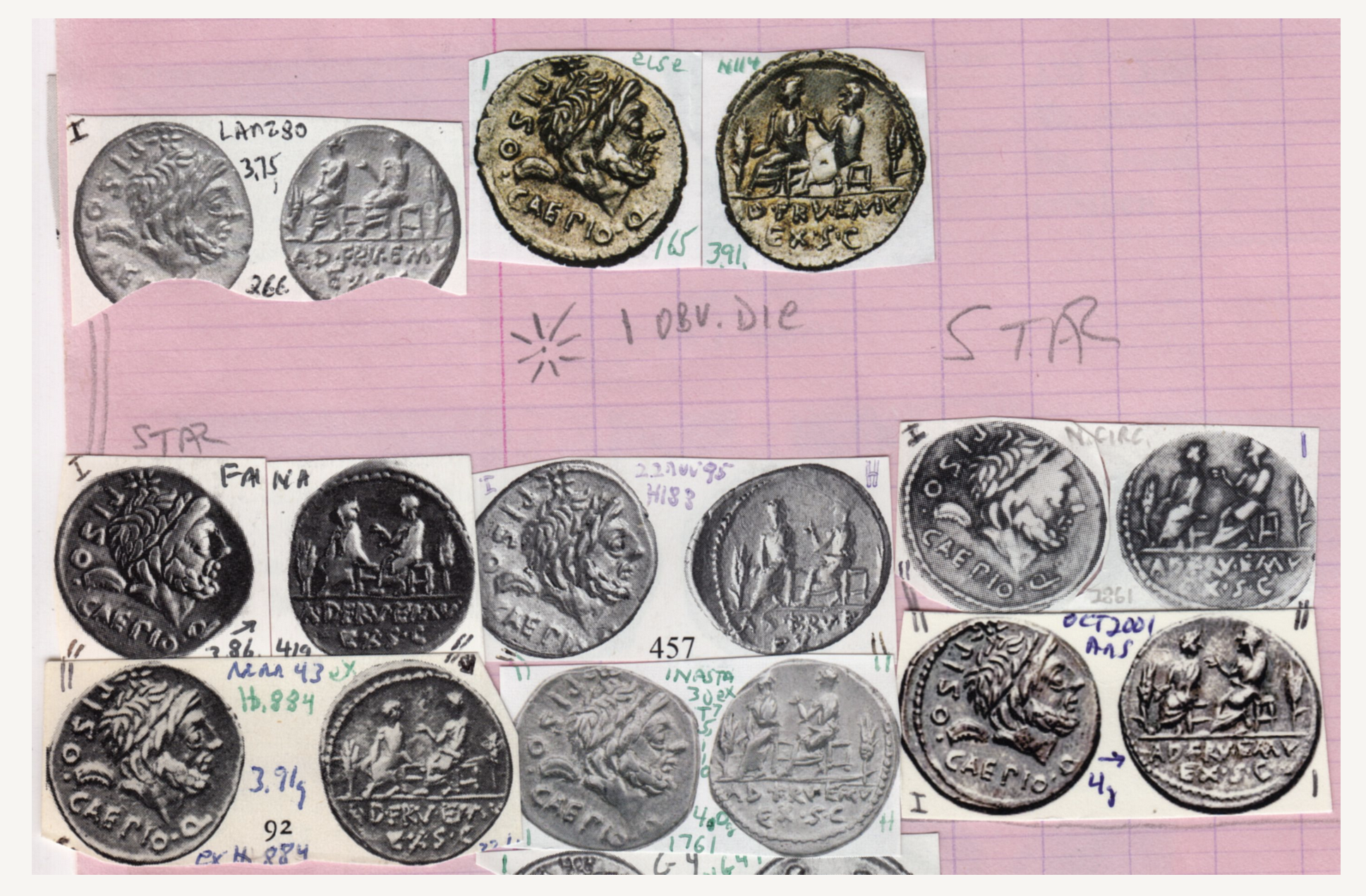
I asked Rick Witchonke and in his response was the first time I learned about Schaefer and his monumental archive. I wrote Richard and he very kindly sent me scans of the binder pages for RRC 330/1. I didn’t believe such a thing could exist. It was brilliant and tantalizing. If the metadata is correct on the below image file. The birthday of RRDP or at least the first seeds of the project were planted on April 17, 2014. I was out of my mind on all the hormones and stress involved with invasive infertility treatments and here was a numismatic treasure trove that promised a lifetime of curious puzzles, meaningful work, and joy. I was obsessed.
That August I returned to the US pregnant with twins and with about 80% of a manuscript. I hit three walls simultaneously. The deep fatigue of growing humans, the demoralization of learning my manuscript bore no resemblance to what my publisher wanted to publish, and teaching four days a week for the first time ever because of scheduling snafu. Fall 2014 was the hardest teaching semester of my life. I taught, I slept, I tried to ingest as many calories as I could keep down. I did not think about coins. And I really didn’t return to coins for a significant period of time. As the fog lifted mid 2015 (post birth and post-partum depression) I let myself enjoy Dionysius of Halicarnassus, work that will appear in future years, in various fora, and I threw myself into Mellon Mays, which eventually took me towards new meditations on debt, slavery, and the nature of freedom. As those regular readers of the blog will know that debt is a topic to which I’ve been returning with gusto over the last 18 months.
I didn’t make it back to mentally engaging with either my second book project or the Schaefer archive until Fall 2017. [That is about one year after I bought my house and left the city to get a little physical distance from my campus, as I was not really managing to have any emotional distance.] That Fall I recruited a team of undergraduate research assistants and wrote a successful proposal for us as a team to work on the RRC 330/1 using the images Schaefer had sent me back in April of 2014. Those students were so brilliant! They helped me learn how to teach RR coins and die studies and databases to Undergrads. Each took a control symbol and completed the remainder of the die study augmenting the the Schaefer material with other specimens. Of course at that point I didn’t know about overflow/clippings images Schaefer didn’t have in the binder. The students ended their semester’s work with data visualization of how best to represent die links within their individual controlmarks. Those posters decorate my office in Brooklyn and they collectively convinced me of the Roman republican inclination to pair dies. There are a few clusters but mostly pairs.
[I’ll finish the origin story, but I’ve already decided that the introduction to the RRDP volume will center RRC 330/1 as a case study and exempla of the importance of the project as a whole. I had to write to this point to know that I want to do this and to believe it would work and I’d have something to say. Just like my previous post was necessary to realize, I WANTED to write the volume introduction, not just to have written it.]
Fast forward a year and I was thinking more about aes grave and my former teaching partner, Wayne Powell, was talking to me more and more about his work on ancient bronze artifacts. I started dreaming up a metallurgical project on cast coinages. I pitched it to the ANS. After much back and forth, I failed to convince them that such a project had any merit such that they wished to provide access to their materials for testing.
That was hard to hear, but eventually led to two great outcomes. First, the aes grave work has continued first with my work on metrology and then actual metallurgical work with Princeton, Yale, Rutgers and then Nottingham for the Nemi material, and now the ISIS particle accelerator. This work is ongoing and has led to a much broader network of collaborations. Had, the ANS not said ‘no’ in the first instance, it is hard to see myself as being brave enough to reach out to other partners and the project might never have led me to such exciting horizons. Second, as I was discussing my disappointment and numismatic ambitions with Lucia Carbone in the aftermath, I told her my biggest dream, the one I most wanted to accomplish, was a digitization of the Schaefer archive. And, she said, LET’S DO IT. I needed that “yes”. That confidence that it could be possible, that it was worthy of funding, and time, and preservation, and our creative engagement.
There have been many struggles and compromises along the way, but I have no regrets we did it. And we did deliver what we said we would. I might have dreamed of more and different data interfaces, but the data is accessible and safe for future generations. I doubt I will ever write anything on republican coins that will not utilize it in some fashion.
It is good to still be hungry for more…

 Liv Mariah Yarrow
I’m fascinated by the growing intersection between chemistry/geology technology, particularly those associated with isotopes for dating and origin/locations, and classics/economic history. Another example is the study of sedimentation residue in aqueducts, showing annual water flows, periods of shutdown/cleanouts and other operational details