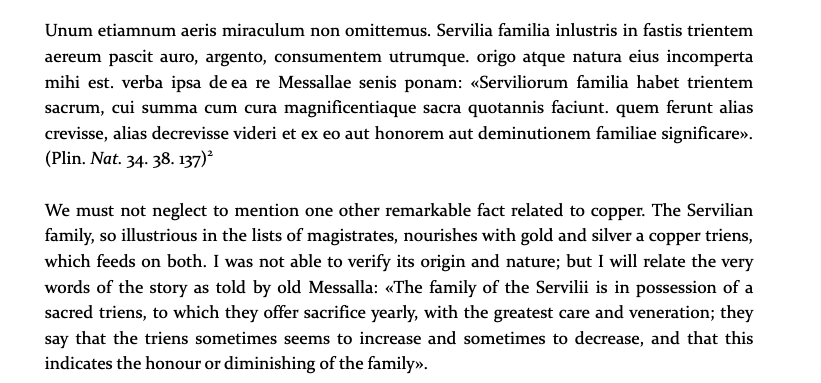
Capitoline Temple Again

Just more overlap between my Dionysius bibliographical research and my love of coins.

Reverse of RRC 487/2, ANS specimen

Mura Sommella, Anna. “Un frontone di età arcaica per il tempio di Giove Capitolino.” Atti della Pontificia Accademia Romana di Archeologia. Serie III, Rendiconti 89 (2016-2017): 277-298.

Abstract: The late Republican denarius of « Petillius Capitolinus », issued by the mint of Rome in 43 BC. C., confirms what is described in D. H. 1, 4, 61, 4 regarding the appearance of the Temple of Capitoline Jupiter after the destruction of the Sullan period (rebuilt identical to the original archaic building in terms of dimensions and decorative apparatus) and allows to identify in the pedimental space the presence of the Gorgon in the race on his knees, an image interpreted as a celebration of the origin of the Tarquini, who claimed to belong to the Corinthian lineage of the Bacchiadi.

Contrast this Campana tile I posted earlier.

On this passage of Dionysius also see:

Kaderka, Karolina and Tucci, Pier Luigi. “The Capitoline Temple of Jupiter: the best, the greatest, but not colossal.” Mitteilungen des Deutschen Archäologischen Instituts, Römische Abteilung = Bullettino dell’Istituto Archeologico Germanico, Sezione Romana 127 (2021): 146-187. Doi: 10.34780/09q1-1e01

Cf also this other earlier post.

Servilii

RRC 239/1

This morning I’m trying to catch up on my historiographical bibliography on Dionysius of Halicarnassus. [I look away for a couple of years and my friends and colleagues go and publish a mountain of stuff without telling me!] So this is just to get this bit of cross over numismatic bibliography on file.

Zanin, Manfredi. “« Servilia familia inlustris in fastis » : dubbi e certezze sulla prosopografia dei « Servilii Gemini » e « Vatiae » tra III e I secolo a. C.” Tyche 34 (2019): 221-236. [ download link]

Abstract: Despite some progress, it is still not possible to reconstruct the genealogy of the Servilii Gemini / Vatiae down to the last detail. The prosopographic hypotheses presented here are possible starting points for further considerations. Using Greek and Latin inscriptions as well as literary (including Dionys von Halikarnass, Pliny the Elder and Cicero) and numismatic evidence (including RRC 239).

This in turn led to some scholarship on this odd bit of Pliny turning up in my search results

Viglietti, C. “The Servilian triens reconsidered.” I Quaderni del Ramo d’Oro on line (2012): 177-202. [download link]

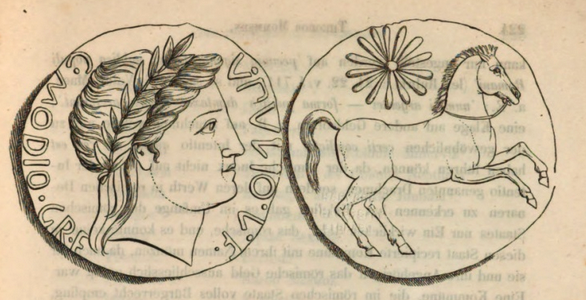
Mommsen’s coin?

This is the only illustration in whole of Über das römische münzwesen von Theodor Mommsen (1850).

And, it’s not even a product of the Roman mint but rather of Luceria (HNItaly 668 = Vecchi 333 = Haberlin 196 no. 2 Pl. 72.16). For good context see Termeer 2019. The iconography is likely borrowed from RRC 15/1, BUT we should bear in mind that earlier the same types were used by Arpi (HNItaly 633 = Yarrow 2021: fig. 3.1). Arpi is very close neighbor of Luceria.

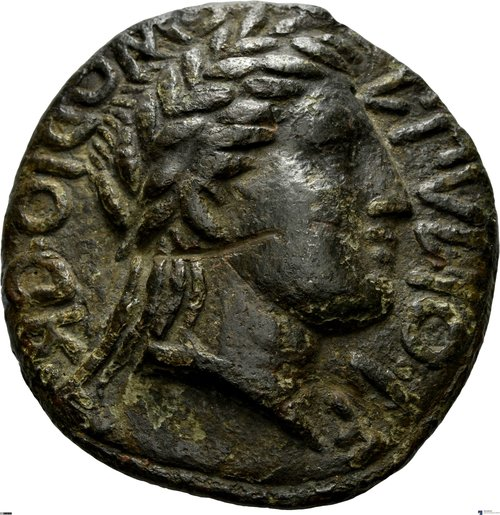
The best known specimen is that in Berlin (below) once owned by Haeberlin, but the letter formations are slightly different (notice the R on the bottom left). It weighs 326.40g, almost exactly a Roman pound.

Bull-Prow Aes Grave again

This is HN Italy 359 = Vecchi 276 = Haberlin, pp. 157-158. A favorite of mine. This specimen from Hirsch 1914 gets a blog posting because of its heavy weight, 172.40 gm. Vecchi notes a weight range of 167.96-118.20g and this exceeds that. Maybe I’ll have to do a histogram of the known weights for myself one day soon, but not today. I got to Hirsch from Sydenham 1926

Prior posts.

26 Oct 2019

18 Nov 2019

1 Apr 2020

Update 11-7-2-25:

I found two specimens in the Schaefer Archive, Binder 14, page 209, exposures 267-268.

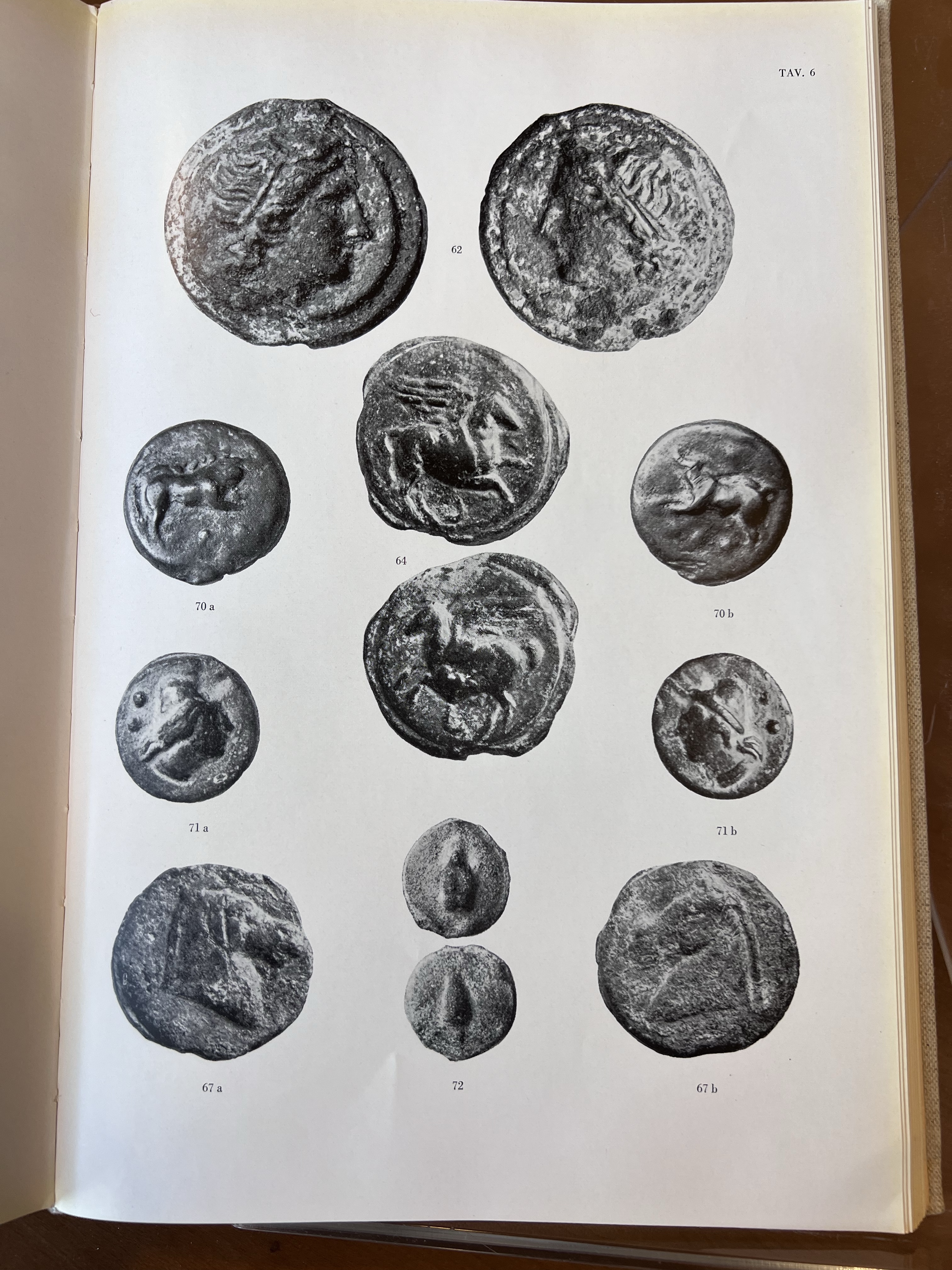
Early Aes Grave in Milan

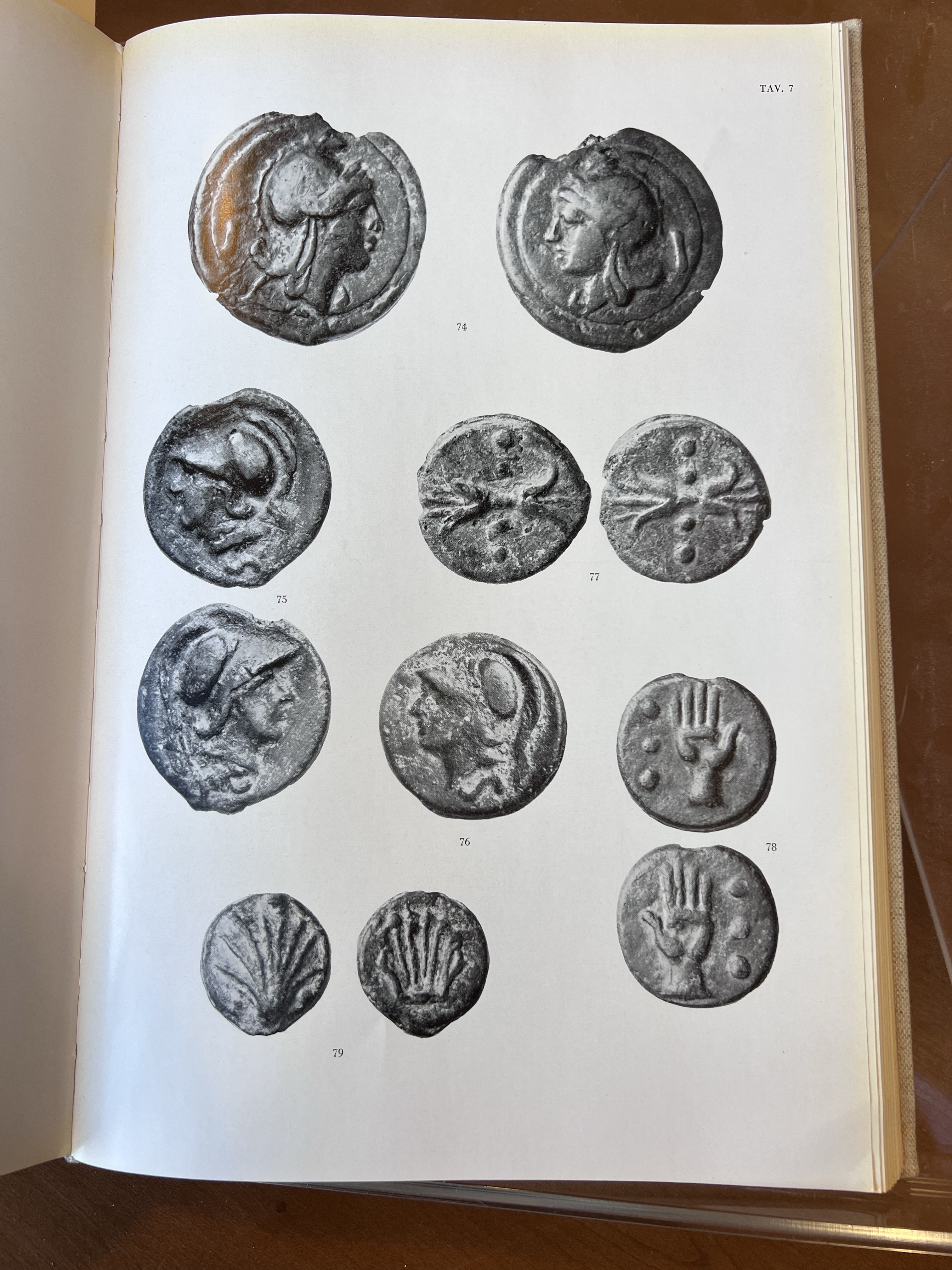
I’m sitting in the ANS library post lecture and allowing myself a little time with the Belloni 1960 catalogue.

Image from Schaefer archive.

The RRC 4/1 bar has really weird edges. I’m trying to think how the could have occurred. Some pits and holes are common enough, but the number and the gathering of them at the edges seems v strange indeed. Did it come out of the mold like this? Is this the resule of deposition. Note that on the eagle side there is a significant straight/smooth edge on the right. I notice that the BM bar is broken or rough on the left side as well with the right edge smoother than the other sides. My current thought is that this was cast single entry with that smooth right edge being opposite the entry point of the molten metal.

The coins below are also in the Schaefer archive but I wanted to to have the full plates as well.

Relevant catalogue pages