Male-Male Sex in Polybius

From a discussion of military discipline:

ξυλοκοπεῖται δὲ καὶ πᾶς ὁ κλέψας τι τῶν ἐκ τοῦ στρατοπέδου, καὶ μὴν ὁ μαρτυρήσας ψευδῆ παραπλησίως, κἄντις τῶν ἐν ἀκμῇ παραχρησάμενος εὑρεθῇ τῷ σώματι, πρὸς δὲ τούτοις ὁ τρὶς περὶ τῆς αὐτῆς αἰτίας ζημιωθείς. 6.37.9

The punishment of the fustuariumis assigned also to any one committing theft in the camp, or bearing false witness: as also to any one who in full manhood is detected in shameful immorality: or to any one who has been thrice punished for the same offence. (Shuckburgh trans.)

The bastinado is also inflicted on those who steal anything from the camp; on those who give false evidence; on young men who have abused their persons; and finally on anyone who has been punished thrice for the same fault. (Paton trans.)

Walbank commentary:

παραχρησάμενος . . . τῷ σώματι: cf. xiii. 4. 5. The offence of stuprum cum masculo (Digest, xlviii. 5. 9 pr.) was punishable under early republican law, as Val. Max. vi. 1. 10 implies (for an example see Val. Max. vi. 1. 7). But in the former passage (Val. Max. vi. 1. 10) the accused alleges in defence that his partner was one who ‘palam atque aperte corpore quaestum factitasset’, which suggests that such a person, like a registered meretrix, was not guilty of any legal offence. In the army, however, male prostitution was clearly an intolerable breach of military discipline and so a capital offence. Presumably the active partner was liable to the same penalty. Cf. Mommsen, Strafrecht, 703–4.

I doubt Walbank is correct to assume equal justice for both partners in the sex act. The cross reference is to part of the slandering of Philip V’s associate Heracleides of Tarentum:

πρῶτον μὲν γὰρ ἀναφανδὸν τῷ σώματι παρεκέχρητο κατὰ τὴν πρώτην ἡλικίαν,

For he, to begin with, in his early years he had openly prostituted his person, (Paton)

His boyhood had been stained by notorious immorality; (Shuckburgh)

We can also bring into the lens the characteristics that herald the transition from Aristocracy to Oligarchy 6.8.4:

But here again when children inherited this position of authority from their fathers, having no experience of misfortune and none at all of civil equality and liberty of speech, and having been brought up from the cradle amid the evidences of the power and high position of their fathers, they abandoned themselves some to greed of gain and unscrupulous money-making, others to indulgence in wine and the convivial excess which accompanies it, and others again to the violation of women and the rape of boys; and thus converting the aristocracy into an oligarchy aroused in the people feelings similar to those of which I just spoke, and in consequence met with the same disastrous end as the tyrant. (Paton trans.)

οἱ δ᾽ ἐπὶ τὰς τῶν γυναικῶν ὕβρεις καὶ παίδων ἁρπαγάς,


Oratorum romanorum fragmenta: Making Do

One day we’ll all be able to consult the new Glasgow edition of the fragments of the Roman orators (assuming they publish it in a manner that allows for wide access, fingers crossed!).  Right now you need a copy of Malcovati, widely available in libraries, but nearly impossible find for purchase.  And it wasn’t so great anyway and we’re about to get the Glasgow edition so perhaps no point in hunting it down.  (Book hunting?  Try here! Best international aggregator of data I know.)

In the meantime, I’m delighted with the digitization of H. Meyer’s earlier edition of the fragments.  It often give the basics of what one wants from Malcovati.

Here’s the entry on Laelius’ speech on Roman Religion by way of example.

Circumcision in the Greek mind

These are images of Beazley Archive 206325= Athens, National Museum, 9683.  I wanted to think a little more about the myth of Herakles and Busiris and especially what the artistic tradition says about it in contrast with the literary sources (summarized here).  Basically, he’s an evil king of Egypt who sacrifices humans and Herakles puts a stop to it.  His attendants are often represented with stereotypical sub-Saharan African features.

The vases are likely to have strong relationship with the theatrical tradition of the play.  The above image struck me because of its use of facial features to differentiate Greeks and Africans but not skin color.  The other major distinguishing feature is the emphasis on the penis.  Herakles is a ‘proper’ small uncircumcised non-erect phallus.  The African are represented not as ithyphallic like satyrs or other some pygmies, but instead as non-erect and circumcised!  The hitching up of their tunics to reveal this feature is likely to be a borrowing from the stage, but this vase tells us something of the Greek conflation of cultural practices when thinking about ‘The Other’.

Playing with Iconography

What does the imagery on a tomb mean? Meleager of Gadara here plays with the decoding of relatively traditional symbolism and reinvents its meaning to be appropriate for another poet Antipater of Sidon, while at the same time mocking the man and his art.  The joke in this poem turns on the specialized, atypical meanings given to the very typical images. I’ve discussed cocks elsewhere on this blog: they often mean martial Mould-made pottery lamp with a voluted angular-tipped nozzle (broken), a flat shoulder and a broad inward-sloping moulded rim. The discus is decorated with a cock holding a palm-branch. Within the slightly raised base is a faint mould-mark in the form ofprowess and are combined with typical images of victory like the palm or wreath.

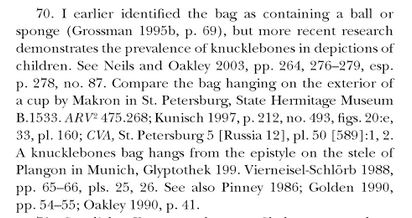
Knucklebones are also very common images on funerary monuments especially of children:

Capture

Elsewhere, they may symbolize chance or fate.

In a much more general sense this type of joking reading of familiar iconography is helpful to the numismatist because it confirms the visual literacy of the ancient audience.

More Modius Iconography

Capture

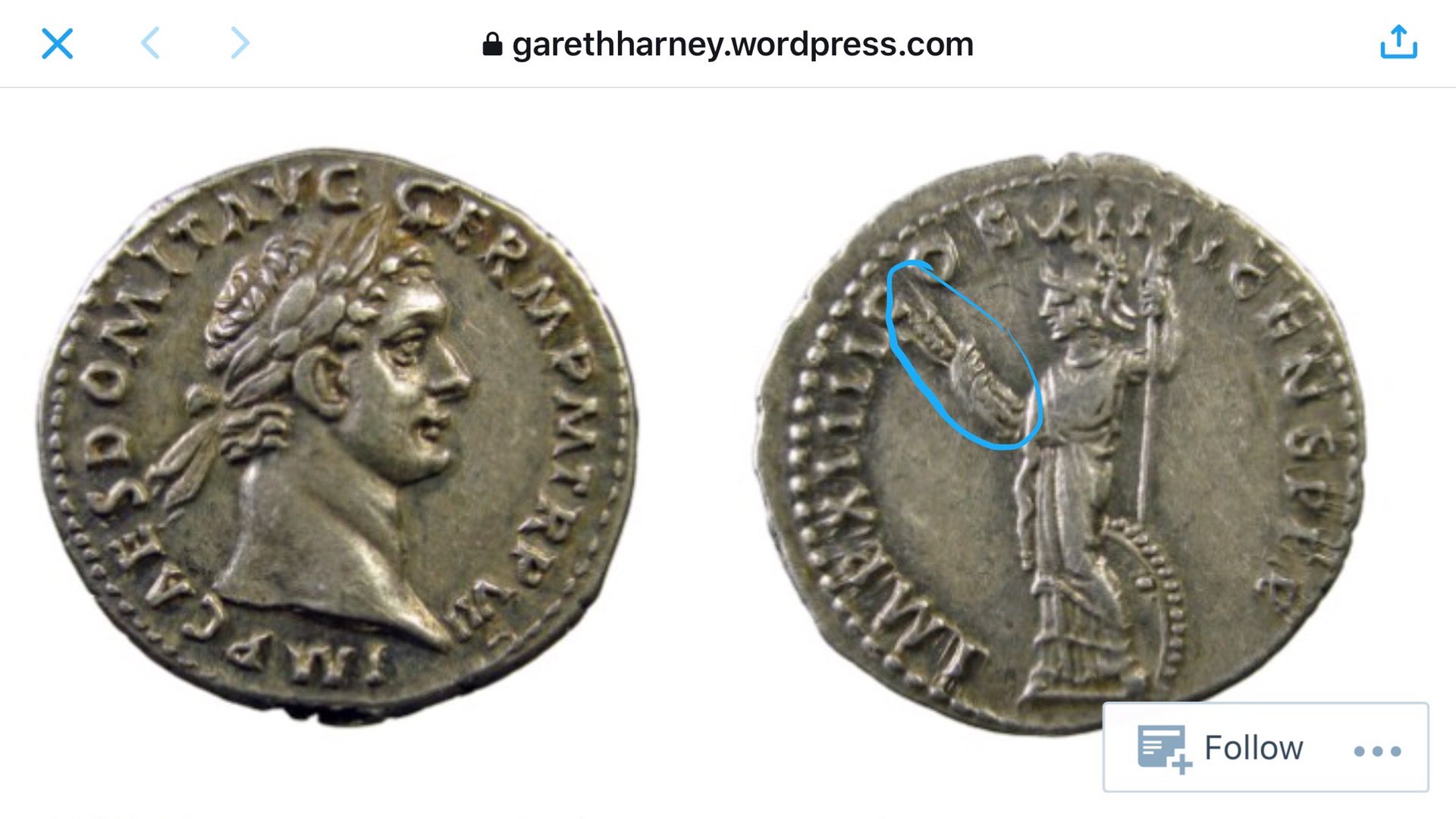
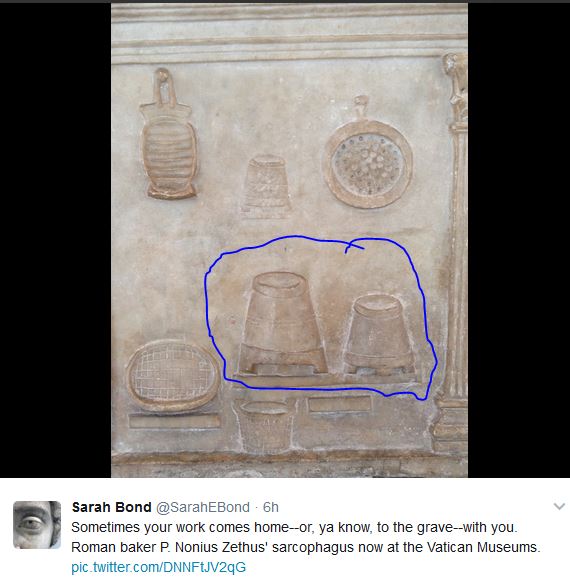
This came across twitter.  (Blue circle my own addition.) What I particularly love is that this type of dry measuring container clearly come in units other than the standard modius.

5/5/17 addendum:


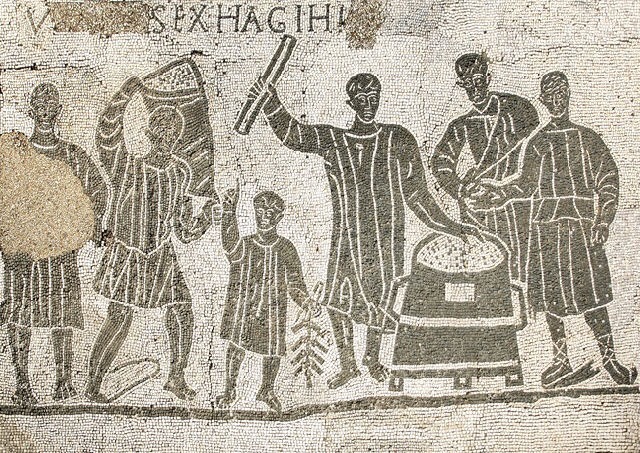
From Ostia via twitter token communities 

Update 2/11/22:

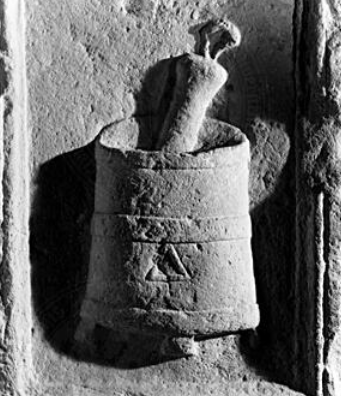
From Bologna museum, image source

Is that a scoop inside that modius or something else?

Should I put part of my dissertation in an edited volume?

I’m working on two edited volumes related to my upcoming conference.  I have a number of potential contributors who are more junior than myself.  Hence the question about the relationship of their conference presentation to their dissertation to the edited volume to other publications such as a future monograph and journal articles comes up quite often.

So, here are my general thoughts on the subject at this moment.  Feedback and different perspectives welcome in the comments!

Prioritize peer-reviewed journal publication.  These are always better than a contribution to an edited volume: don’t get over-committed to the latter at the expense of the former.  I learned this lesson the hard way.

Time is of the essence, especially if you are on the job market or will be on the job market or have a ticking tenure clock.  How long will it REALLY take for the book to appear?  Check the CV of the individuals involved, if they have edited volumes before.  How long between conference and final publication?  1-2 years is super awesome; 3-4 year decent; 5-7 sucky but all too common.

You can cite yourself.  Are you a voluminous writer?  Can you give the conference volume a case study or digression or potential appendix or fuller treatment of minor point of the dissertation?  This may actually stream line your future monograph!

Where is conference volume likely to appear?  Is that press reputable in your field? Will it be viewed as peer-reviewed and scholarly by hiring committees and referees?  Will it be read and seen by those you want to see it?

If you’ve not defended the dissertation, does your discipline consider it a pro or con to have portions already accepted for publication? What do your mentors say?

Something is better than nothing.   Don’t clutch your work forever hoping for a perfect moment to share it with the world.  This is how dissertations languish unread, uncited, unloved.

Is the conference volume a networking opportunity?  Does participation build your circle of advocates and allies in academia?  Think about the editors and other contributors, but also the relationship with a university press commissioning editor.  Too often the world works on familiarity and favors, thus a wide circle of can give you a leg up.

So a definite maybe.  No more. No less.

“As the Mistress, so the Dog”

So I got stuck on a proverb, or rather 1/2 a proverb in Cicero (Att. 5.11.5).

As yet our journey through Greece has roused great admiration, nor, by heaven, have I as yet a fault to find with any of my people (meorum). They appear to me to understand my point of view and the conditions on which they accompany me. They entirely devote themselves to my reputation. For the future, if the proverb “like mistress…” (οἵαπερ ἣ δέσποινα) holds…

The saying is so famous he doesn’t finish it. It is catalogued among the fragments of Epicharmus of Kos (fr.168) and is known to the scholiasts and grammarians of late antiquity.   But other than Cicero the only literary usage is in Clement of Alexandria (in rather infuriating section on appearances, esp. of women):

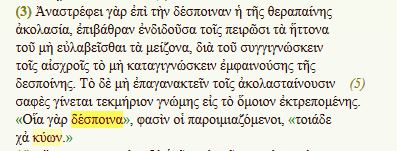
I deem it wrong that servant girls, who follow women of high rank, should either speak or act unbecomingly to them. But I think it right that they should be corrected by their mistresses. With very sharp censure, accordingly, the comic poet Philemon says: You may follow at the back of a pretty servant girl, seen behind a gentlewoman; and any one from the Platæicum may follow close, and ogle her. For the wantonness of the servant recoils on the mistress; allowing those who attempt to take lesser liberties not to be afraid to advance to greater; since the mistress, by allowing improprieties, shows that she does not disapprove of them. And not to be angry at those who act wantonly, is a clear proof of a disposition inclining to the like. For like mistress like dog, as they say in the proverb.

Capture.JPG

What I find telling in both of these passages is to compare human-human relationship in hierarchies to human-animal relationships.  I doubt most of Cicero’s companions would have loved being compared to a dog…

It is remarkably different in fact to the potential positive connotations of like father, like son and related sayings.