Our culture is changing. It always does. Quite often in response to wider events. I can stop my own doom scroll and limit my news in-take. I can speak up where it might make some small impact. I can do the right thing by those I meet. Yet, I cannot stop noticing the signs of despair and fragmentation among my neighbors and nation-wide. It tells me we collectively are a long way from the hope of 2008, when change seemed possible. Positive change, not the violent, traumatizing kind that seems bubbling up everywhere.
Personally, I’m in a pretty good place. I don’t have long Covid, the initial viral infection just sparked a bacterial one in my sinuses. 24-hours into antibiotics I started feeling like my old self. I’ve had clarity of purpose in my work and a degree of mental peace from learning to trust my ability to make moral choices and accept whatever comes next. It helps that my small domestic world is full of joy and pleasures. I picked beans and treated the weathered front door. Dinner is in the slow cooker. All the neighbor kids are in the dining room playing D&D with the best of all DMs (a doting father). My beloved is building a garden shed out of salvaged hardwood doors. Life really does not get better than this. I even have time to write and interrogate the shift I’m seeing.
Exhibit one.
I posted this on Instagram as a story. I thought it was silly and unexpected. Then a colleague helped me connect the dots. It is a pre-packaged BORG or more accurately in this instance a BORL.
A BORG is a Black Out Rage Gallon. I kid you not. It has a wikipedia page. And these are all the rage I’m told on college campuses. Around this country, our smart young people want to lose consciousnesses. To stop the rage? To feel the rage? To embrace the rage? Whichever it is they certainly want to forget it all.
The practice is so common that companies are now emulating the packaging and recipes to bring this to a liquor store near you. There were other flavors but this one leans into tongue and cheek patriotism and a shade of artificial blue reminiscent of anti-freeze, that famously sweet ‘treat’ that has killed many an unsuspecting family pet.
It’s good business to make something cheaper and more convenient than one can make at home. This is a sound example of entrepreneurship in late stage capitalism. Make it easier to black out and give the people a little joke to chuckle about as they do so. The elites can thumb their nose at the packaging and think it ironic. The working class can embrace the messaging and thumb their nose at the judgy elites who would never buy such a thing. Something for everyone.
Genius.
Exhibit 2.
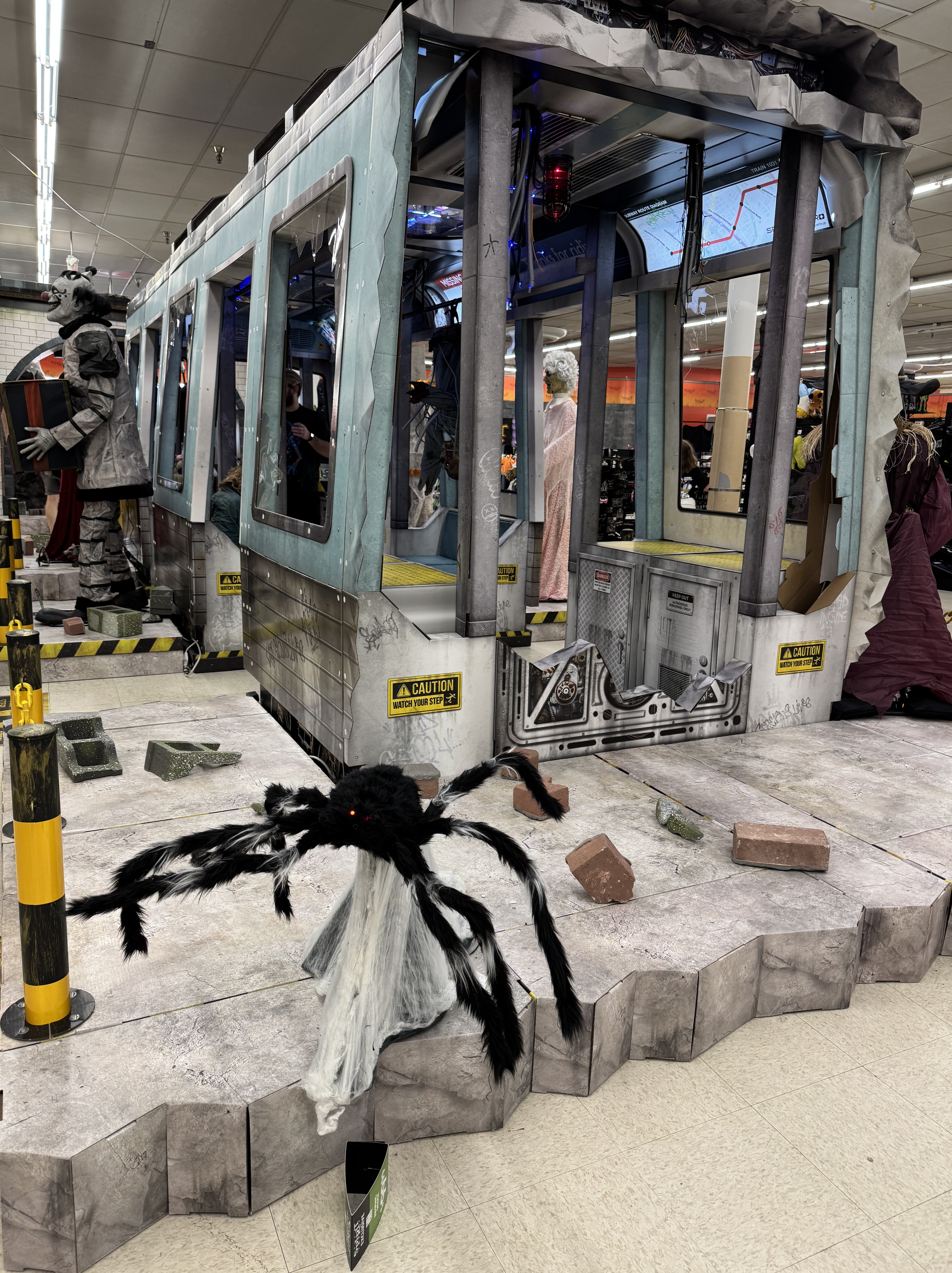
This is Spirit Halloween 2025. The whole business model of the company profits from the failures of late stage capitalism. Aged malls are full of abandoned spaces. A big box store closes and no new company wants to move into a failed space. 99% invisible did a fabulous deep dive on this so just go listen to that for the corporate context. Spirit Halloween rents those places at deep discount for just a couple months of the year. No long term contracts: fast cash into the landlord’s pocket and no off-peak costs for the tenant.
For the customers the annual opening marks the beginning of the ‘holiday season’. More and more I hear friends and friends of friends say Halloween is their favorite holiday, more than Christmas, more than Thanksgiving. I get it. You decorate, but cooking is at a minimum, and far less pressure to be with your family of origin. Back in the day, Dan Savage, a sex-positive gay advice columnist, used to call Halloween ‘straight pride’. Go head and do a little bad cross-dressing. Get into a slutty nurses outfit. Play with handcuffs with your cops and robbers costume.
My kids adore Spirit Halloween. My beloved and I play act our way through each visit. Do you like me in this mask? Don’t we need this giant fake battle axe? We learn a little more about our children’s internal fantasies, fears, hopes, dreams by watching them interact with the ever more dazzling array of plastic crap. This year as we approach the store one kiddo says she wonders what the theme will me. Carnivals and Carnies was last year. It is always that sort of thing. Gothic Horror or Mad Scientist or anything else you might find as a theme for a haunted house.
By now you’ve realized what the pictures are. It’s this years theme–the NYC subway.
Somewhere in a corporate creative unit they workshopped this idea. What are we afraid of this year? Not Nazis, they’re back in fashion. Creepy Doctors? Plague? Too soon. Pedophiles? Could be too political.
I KNOW. PUBLIC TRANSPORTATION.
*cough* Unsegregated Urban Spaces *cough*
Thanks Fox News.
What’s the biggest baddest city of them all. The most iconic. NYC of course.
Didn’t you hear those people want to elect a brown muslim mayor? One who might actually address issues like public transportation and the cost of living.
Spirit Halloween creative team hit the nail on the head. There is profit in fear. They serve populations with cars that shop on Stroads. People who can at least dream of owning a 20 foot skeleton and having a place to store it in the off season. They may live near those urban centers, but they don’t necessarily know how to navigate those spaces. They tell stories of rich panhandlers pretending to be homeless while living in deluxe apartments right off Time Square. The city is not for the innocent or the naive.
I understand. I travel. Each new transit system takes some learning. But while I’ve smelled death on the subway (don’t get in the empty car, it is empty for a reason), it never features in my nightmares.
Instead, when the night gremlins come to wake me up at 3 am, they only ask, will my children be able to move through this country and the world with the incredible freedom and joy with which I have?
It is Friday of the first week of classes. It is the last week of August a month I’ve spent almost entirely either sick with Covid or trying to get back to normal. I’m still foggy, fatigued, and phlegmatic. How’s that for an alliterative tricolon?
Yesterday I finished emails and fell asleep for 2 plus hours in the afternoon. This is unheard of for me. I can certainly perform, I’ve had great classes and meetings, but instead of feeling energized I feel zonked. Yes, I’m griping, but I’m also doing that thing of re directing my focus and exercising my writing muscles to try to get to a different mental space.
Beside this little writing exercise, I’ve been starting my day with a short walk and reading something intellectual and in my discipline but without direct connection to any project. My idea is that if I get my blood moving and my brain working before the email, it will set a better tone for the day. I’m finding my work for the college all-consuming. This isn’t necessarily bad. I love my students. I value my colleagues. I’m motivated by our mission. The work is good and meaningful. Besides the fatigue, there is my age old problem of switching gears. I tend to do one thing well and find it all consuming in any moment. This is a core asset to my identity as a researcher. Once I get stuck in I don’t let go.
When I was a lowly grad student, Michael Crawford (yes that one), said to me the secret of success was knowing exactly what you most wanted to look up the next time you had just 15 minutes in a research library. This terrified me. My supervisor told me not to worry, I wasn’t at that point in career. Now, I so wish, I knew the answer to Crawford’s question. I have promised many people many things related to my research. I even think I know what most of them are. I have as always a thousand puzzles I’d like to investigate. I have ambitions to continue to apply for grants and similar opportunities so future me will have what she needs to do the work.
And then there is email.
I find it more addictive than social media. Social media is where I dump intrusive thoughts. Email puts me in a reactive rather than proactive state of mind. What have I missed? Who needs my attention? Where are the fires? How can I avert the next crisis? I write and write and write and beast never quiets. Until it does and then I wonder why I don’t have answers to my questions yet…
I yearn for pigeon post, inter office mail, paper memos, and actual letters. Anything to slow down the flow of communication. It is like drinking from a fire hose. As I type this I’ve my work email closed on my computer.
And… I just slipped and peeked at it on my phone, as I was trying to remove it from my phone for the long holiday weekend. So now I know I have a draft personal statement to comment on and a bunch of lunch requests for a catered meeting next week (no I don’t have a secretary right now and the back up person is out on annual leave). This is not urgent stuff. I can write and get back to those little tasks when I finish this little writing exercise.
I. CAN. COMPARTMENTALIZE.
I. CAN.
Or, I must believe it is possible to both rest enough and work enough.
My beloved has suggested that I physically block out my research hours on my calendar. The advantage of trying this out is both the reminder to myself and also the physical act of knowing I’m sacrificing my research if I take a meeting at that time. I won’t say it won’t happen but at least I will have to face facts about what I’m doing.
The other goal for today is just to figure out what tasks can get fit around the edges. Stuff that doesn’t need large blocks of free space but that I could knock out rather than obsessing over my inbox.
That phrase I used earlier, PRO ACTIVE, rather than reactive, is really my current professional goal. I want to drive my work forward rather than scrambling from behind.
Another part of my internal dynamic is that it is so much easier to prioritize the immediate needs of living humans, than my own quest for knowledge. There is still a part of my brain that feels research is selfish. A vanity project.
Obviously that thinking is a little messed up. My research connects me to many brilliant humans with whom I also want to remain engaged. And my own drive to know is a worthy of attention. I never doubt that when I doing the actual work. Of course I sometimes find certain tasks boring, but the material remains ever fascinating. It is when I’m am focused else where that I tend to discount it.
Ok. With this window still open, I sweeped up the last of those emails and set an out of office until Tuesday.
It will be ok. I might even get some writing and/or research tasks done.
In addition to chairing I’ve taken on two new roles for the coming academic year. I’m serving as the Faculty Director for the Mellon Mays Undergraduate Fellowship on my campus and I’ll also have seven weeks in residency at the Institute for Classical Studies in London as the 2025-2026 T.B.L. Webster Fellow. Those week should be the last two in November, the middle two of January, the second week in February, and the first two weeks in June.
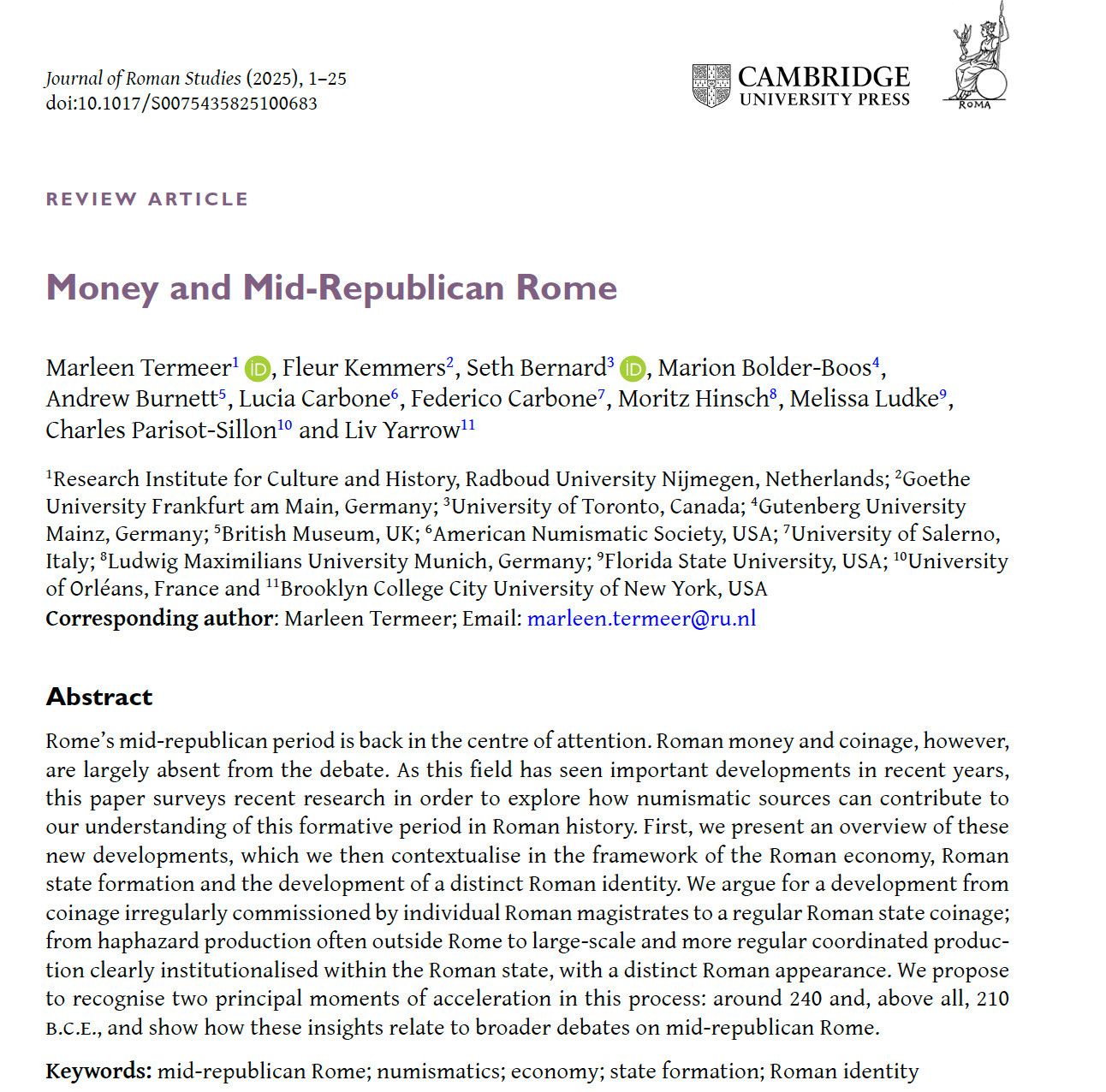
BUT, I really hoped on here to announce this publication in which I played a part.
Ok let me fan-girl Zach for a moment. He is that perfect combination of brilliant, witty, cutting and compassionate. He brings this voice and expertise into his writing. He got his JD and his PhD. He knows a thing or two and I adore learning from him.
This particular mosaic from Piazza Armerina has been the most sticky in my brain. And I hope writing about it will help.
The mosaic is located at the star on this public domain site plan from wikimedia. This set of rooms is sometimes considered private family quarters. The dating of the mosaics are disputed but definitely no earlier than the tetrarchy and perhaps even mid to late 4th century. As I learn more I’m sure I’ll have more opinions.
So let’s start with good old fashioned visual description.. There are five registers summarized as as follows. I’ll treat each in turn below.
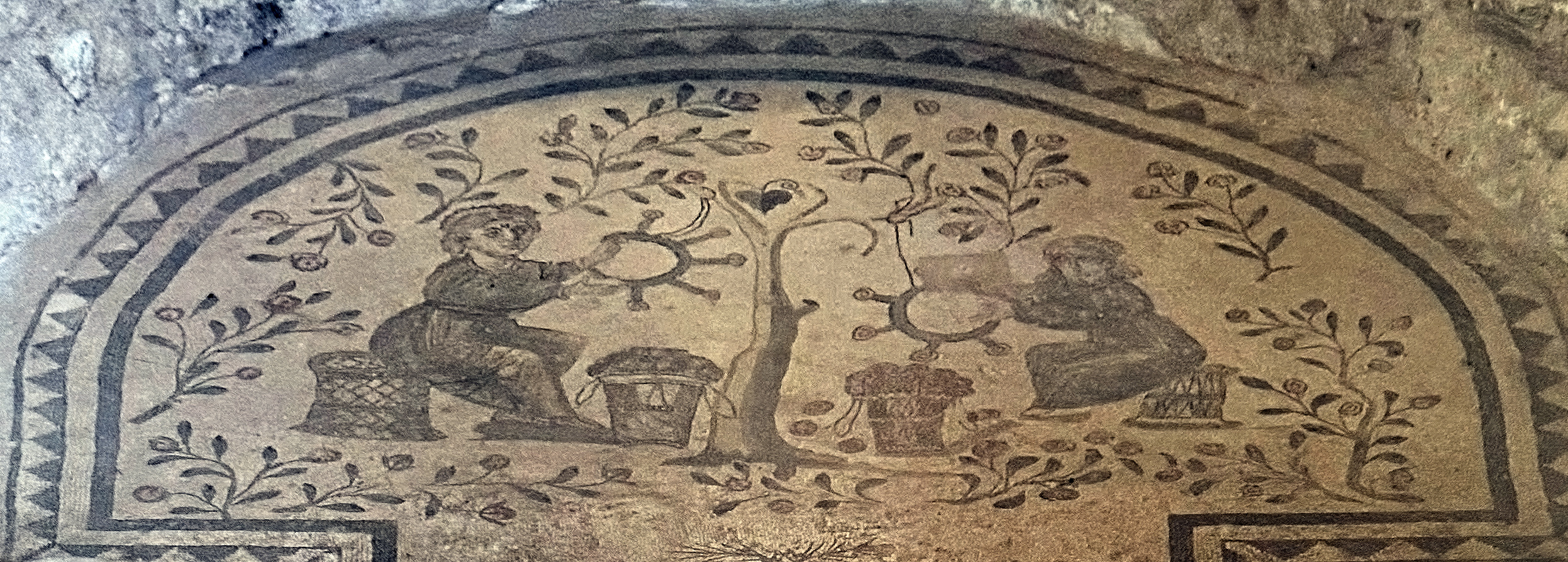
(A) in the Apse two seated women making flower crowns
(B) The narrowest register between the columns a prize table
(C) Five standing male figures with musical attributes
(D) three standing figures, two inanimate objects, two more standing figures
(E) Three obscured (figures/objects), an inanimate object, two standing figures
Taking them in order. The photos used here (unless otherwise attributed) were taken by myself or my beloved. I’ve used Photoshop to de-skew the angles using rectilinear elements within the images themselves (i.e. the mosaic borders). I’ve also sharpened contrast to make details easier to observe.
Register (A)
At first glace the image is one of pleasing symmetry but in every detail the artist(s) break the perfection for heightened naturalism. The ‘tree” trunk curves left, and has only one broken branch on the left, on the right there are three all smaller than the one on the left. The right root is shorter than that on the left. A single heart shaped leaf is framed by the fork of the two upmost branches. It connects to the top of the left branch but has a vine-like spiral pointing to the right. From a branch on each side of the tree a crown is tied to support the work of the seated women. The left hand crown has a thicker or double band connecting it to the tree branch. The right hand crown is tied with a single line but wee can also see the short tail of this string as it is knotted around the branch.
The body postures of the two women echo each other nearly exactly they’re furthest legs are bend back, their form post legs come forward. Their further hands hold their respective crowns and their foremost hands reach out to each other and they seem to make eye contact. Here the similarity ends they’re garments are different colors. The left figure has a prominent belt and headband; the right figure a necklace. They seem to have different shades of hair, but of this I’m less confident. Their hair styles are clearly different, but they both have the v mark between their eyebrows.
Each woman sits on a stool that appears to be woven. The left hand stool has a checker or crisscross pattern, the right hand a zigzag. Both have a central band and a slightly flared top and bottom. Probably because (I would assume) this is the basic construction of such stools. Their flower baskets have similar minor differences, while still sharing the same basic conical form with two broad bands, narrow, bottom, top, and middle bands and two loop handles on either side. The contents are represented as two rows of flower heads the top being narrower than the bottom. The left basket has as its top band of its body a broad zigzag, the bottom is checkered or crisscross in pattern. The right basic has a narrow zigzag for both top and bottom body bands. The color and shape of the flower contents seems slight different. The top lip of the right basket is slightly broader. The right basket has a few flower heads scattered around it and a long shadow; all elements missing from the left basket. The scene is surrounded by irregular branches with leaves and flowers. Perhaps we are meant to interpret the branches as recently pruned fro the central tree? The leaf shape is different between the branches (ovoid) and the trunk (heart-shaped), but perhaps the heart shape is to remind of of evergreen ivy and indicates the tree is not truly dead, only hard cropped for the season.
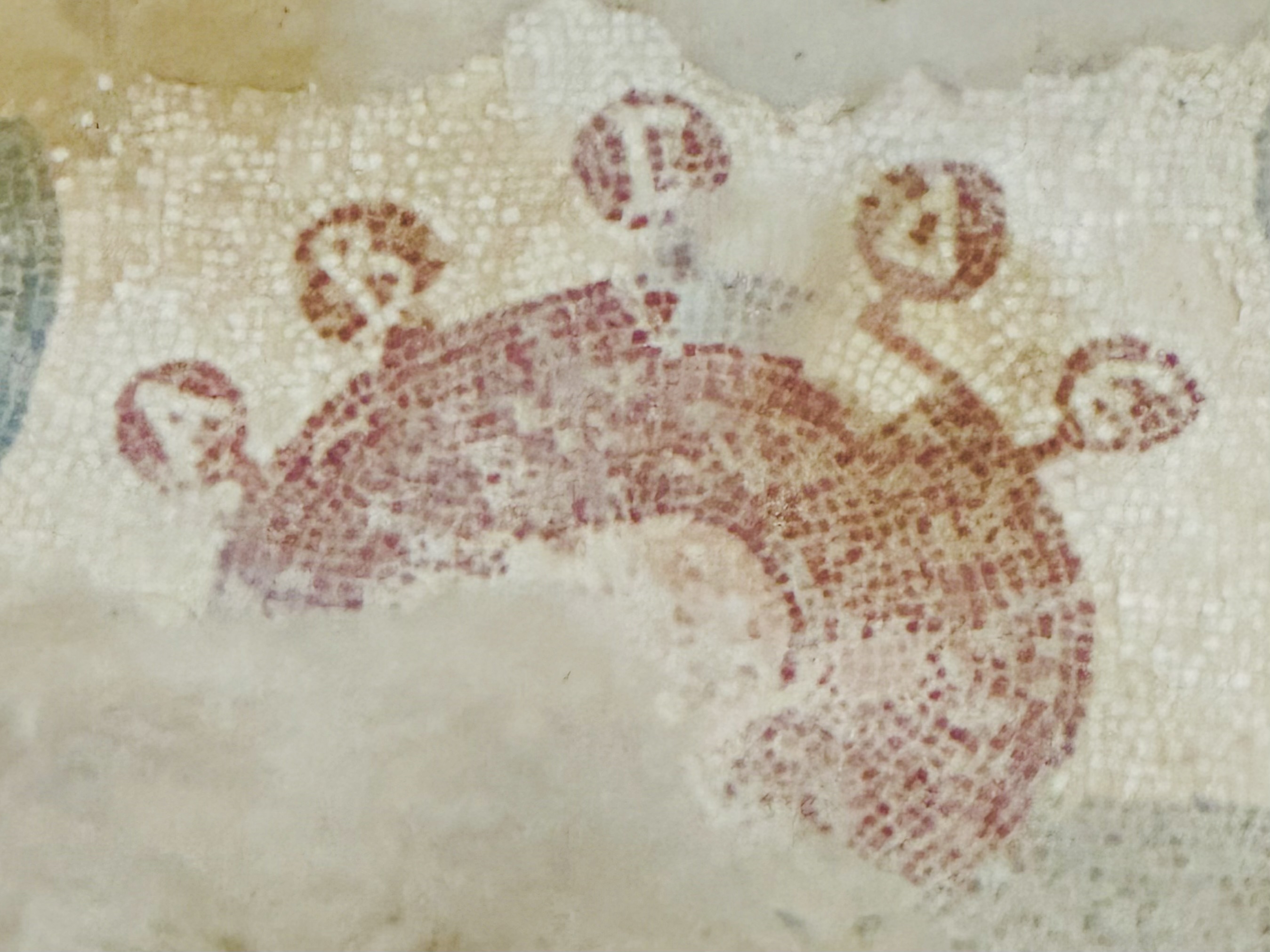
The closest comparanda for these images within the villa itself are shown below. In the top register short squat female figures with v-shaped forehead markings pick flowers. In the next register down has taller more slender females with out forehead markings. The left hand figure makes flower garlands rather than crowns but the garlands are hung from a pruned trunk clearly meant to be the same plant from which the flowers are harvested. The trimmed branches seem to lay between the seated woman and the garlands she constructs. The composition shows similar tendencies towards ‘false symmetries’.
Register (B)
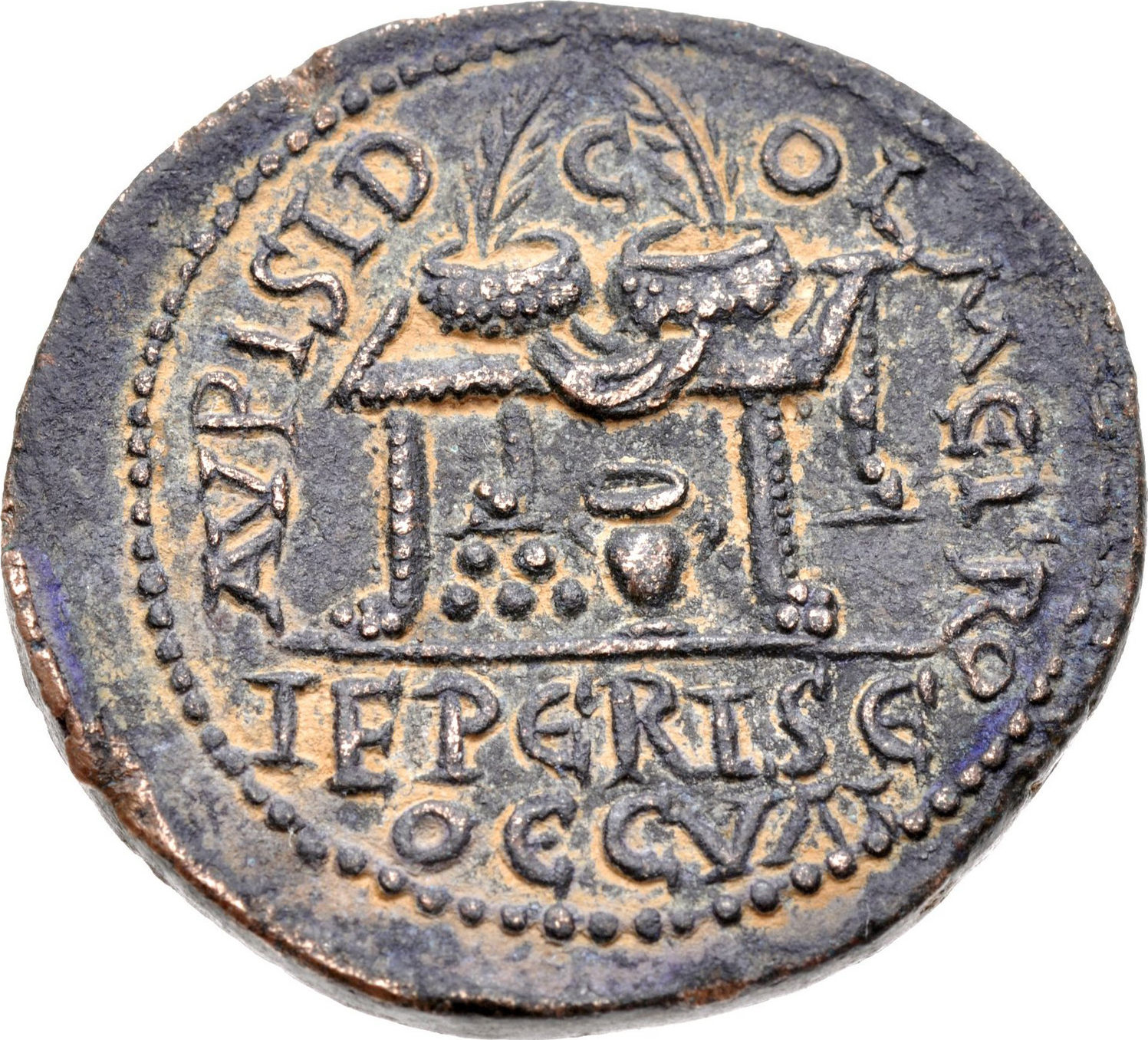
Before visiting Piazza Armerina IRL I had already talked about some of the mosaics on this blog. Particularly how the prize table depictions can help us better understand numismatic imagery.
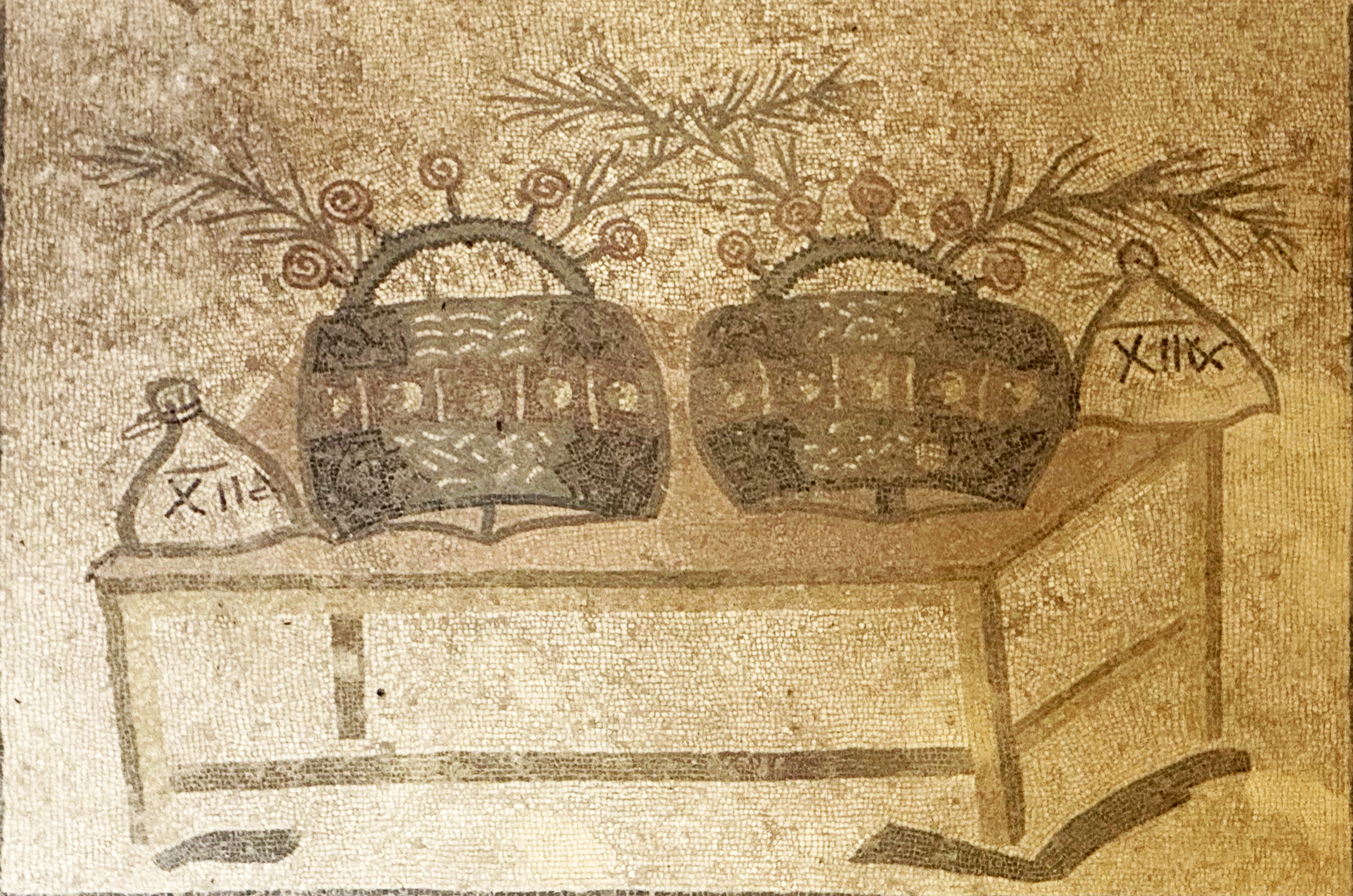
This table holds from left to right:
(i) a money bag marked with an XII with a line above and another symbol perhaps something like a lower case “d”
(ii) a large prize crown with a middle band in a different color decorated with circles and vertical lines in another lighter contrasting color. From the top of the prize crown rises a flower crown with five flowers depicted as red and white spirals, these closely echo the crowns with five flowers similarly depicted in register A. Two palm fronts also emerge from the crown.
(iii) the same with minor variations in the depiction of the top and bottom band of the prize crown.
(iv) a money bag marked XIII with a line above followed by another X.
How do we interpret the numbers on the bags. A good question. I’m not fully satisfied I know, but I’ll build on what I said in my earlier post. The line above multiplies by a thousand. So the left bag might read 12,500 if the symbol to the far right is a lower case D and is also roman numeral. There is no indication of denomination as in the other prize table discussed in the other post. If this interpretation is correct, then the right hand bag could be 13,010. These seem random numbers and maybe they are just that, random numbers the artist(s) made up for decoration.
Register (C)
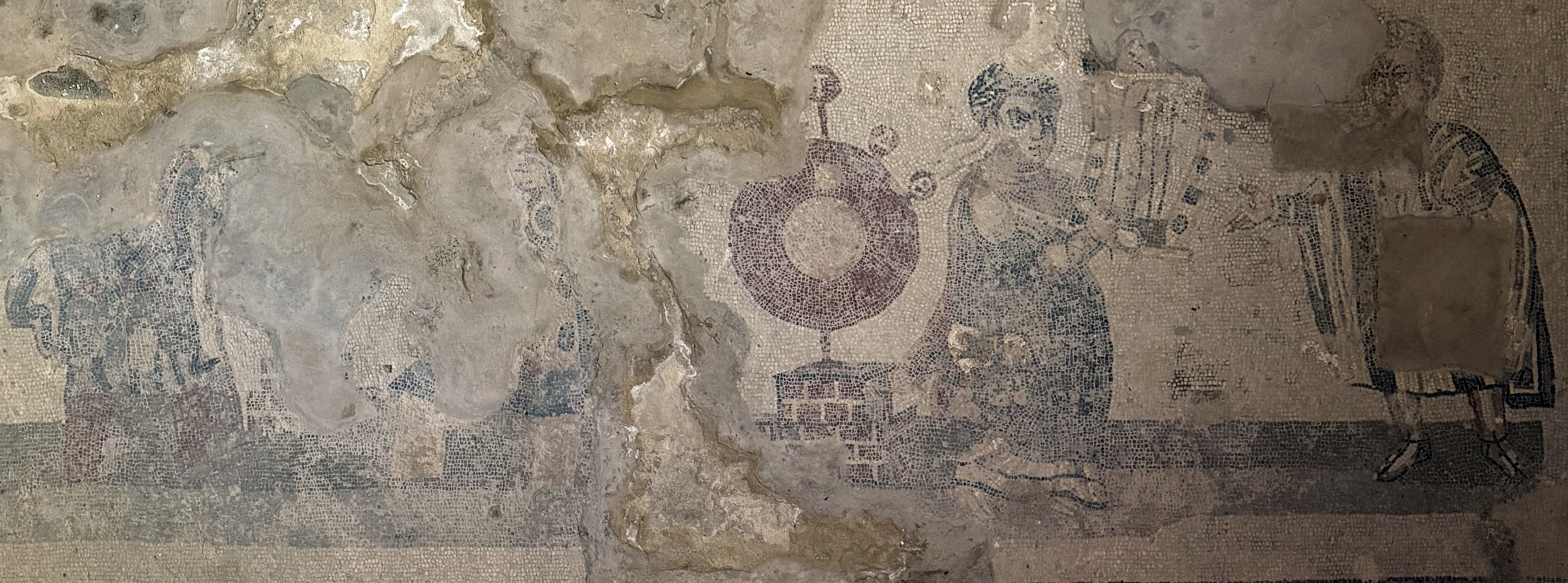
Register “C” is not a well preserved but is still better than most. Each of the five figures is somewhat distinct and thus we will describe in turn left to right before considering the composition as a whole.
(i)
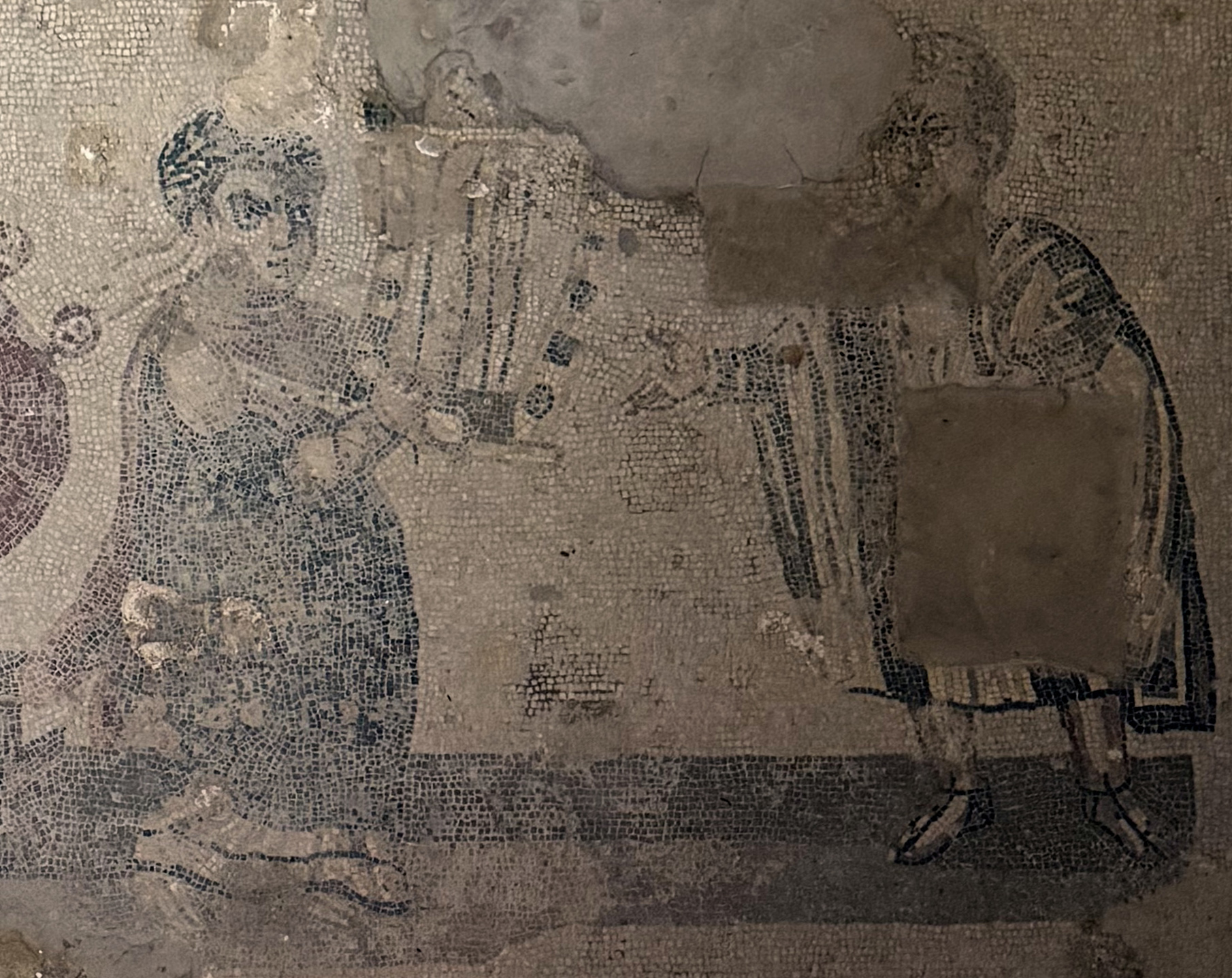
The first figure is all in white. The top garment is worn over tunic with broad stripe visible on his right shoulder. The top garment is likely a toga but I hesitate to confidently identify it as such. The bindings on the sandals reach almost to the bottom of the drapery. On his head is a crown with five protrusions, likely flowers. The crown, like the palm frond in his left hand, echo the iconography of the prize table above, even as the flowers are not the same shape, color or pattern. The figure raises his right hand palm up in a gesture often associated with oratory/declamation. V mark is clear on the forehead. The body proportions are squat almost childlike.
(ii)
The second figure might be female. The damage on the top of the figure makes me hesitate. I see no long hair and no breasts or typically female jewellry. The feet a fully slippered and the garment consists of at least three pieces an under garment in reddish tones, a darker bluish over garment and a reddish cloak. The lighting and the dust and photography makes me hesitant to say anything much about pigments. Again the forehead V. The hair is largely obscured by damage and what seems to be a crown of overlapping leaves or leaf shapes with a center circle medallion.
The stringed lyre-like instrument rests on a small table. The bottom of the instrument rest flat on the table top and is shaped almost as an open book with its fan of leaves on each side. There appear to be four strings but I am not confident–they’re could be more. They attach to long almost triangular pegs protrude down from the top bar. The top of the bar is smooth and each end has a ball. The two side arms seem to curve slightly towards the player and widen as they join the odd shaped base. We see the instrument resting at an angle on the table by aid of a small black support. The player has both hands on the strings. One in front one in back like a modern harp player. There is no suggestion of a plectrum.
(iii)
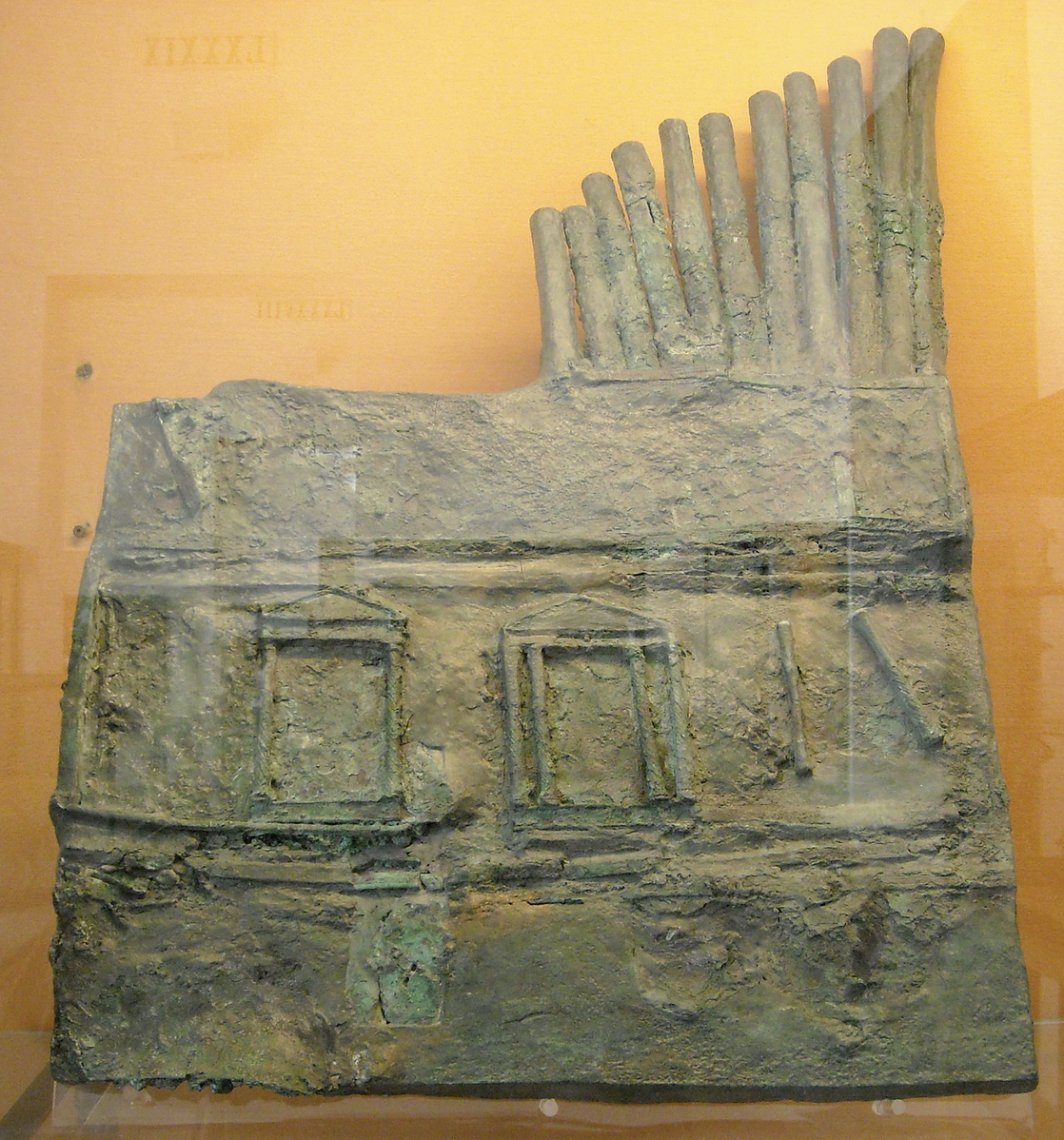
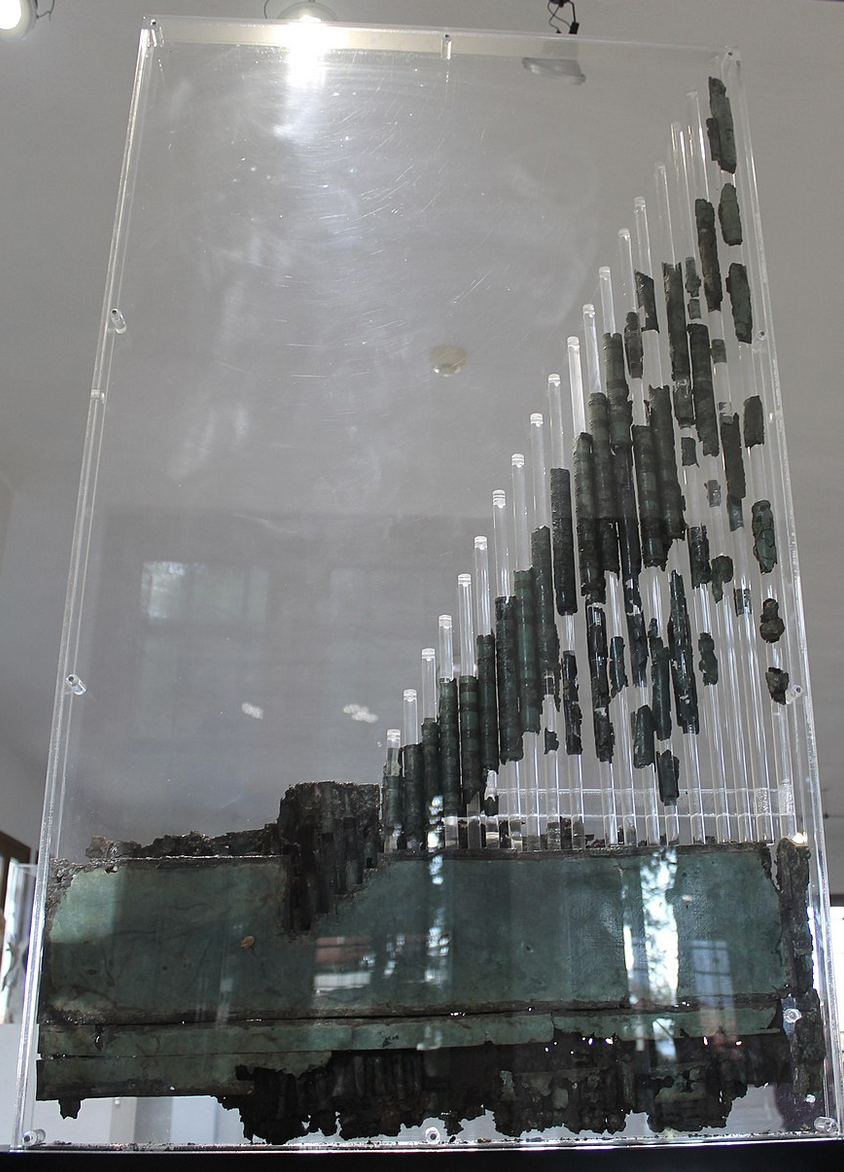
This figure kinda kicked off my obsessive need to interpret and better understand this mosaic. His crown looks like pipe organs. I love pipe organs in antiquity but find it odd I’ve not posted much about them on the blog. They appear in this past post because of the manual bellows. Basically I looked at this guy and asked why were the pipes on his head not on the table and the stringed instrument being held by hand. Lets say the object isn’t even an organ (lots of images below), but instead just upside down pan-pipes: WHY on the HEAD! He touches his head with his left hand in a gesture of self crowning. This type of gesture is completely normal for athletes even if it is more typical for them to crown themselves with their right hand than their left, we do have left handed parallels (RPC examples; as well as examples from the athletes in the mosaics from the Baths of Caracalla now in the Vatican).
His empty right hand is held out in a waist level palm up gesture. It is a gesture often intended to indicate the importance of something. Is he gesturing to the table and its odd use as a stand for the stringed instruments where we might expect to see his pipes resting? Yet his isn’t suggested by his gaze which seem to be offer to his left.
Is this meant to be funny? They are all rather stocking figures with the V s on their foreheads. Are they imitating common activities but doing them just slightly wrong for our amusement? I lean toward no but I will keep the theory in mind.
In dress he echoes the first figure (i). Mostly white with just a few details. A garment draped over his left shoulder revealing an undergarment (tunic) with a stripe on his right shoulder. This tunic appears to have long sleeves with broad dark cuffs. There is a dark decorative circle in the bottom left hem of his garment. His sandals are much less elaborate in their strapping and lower as well. His legs are bare between the sandals and the hemline.
Partial surviving organ from Pompeii, the only real example I know of from antiquity (flickr – image source)detail from the Zliten mosaic, 2nd century CE (wiki commons)Nennig Villa Mosaic (wiki commons)Organ from Dion (wiki commons)found in Trier (reddit = image source)
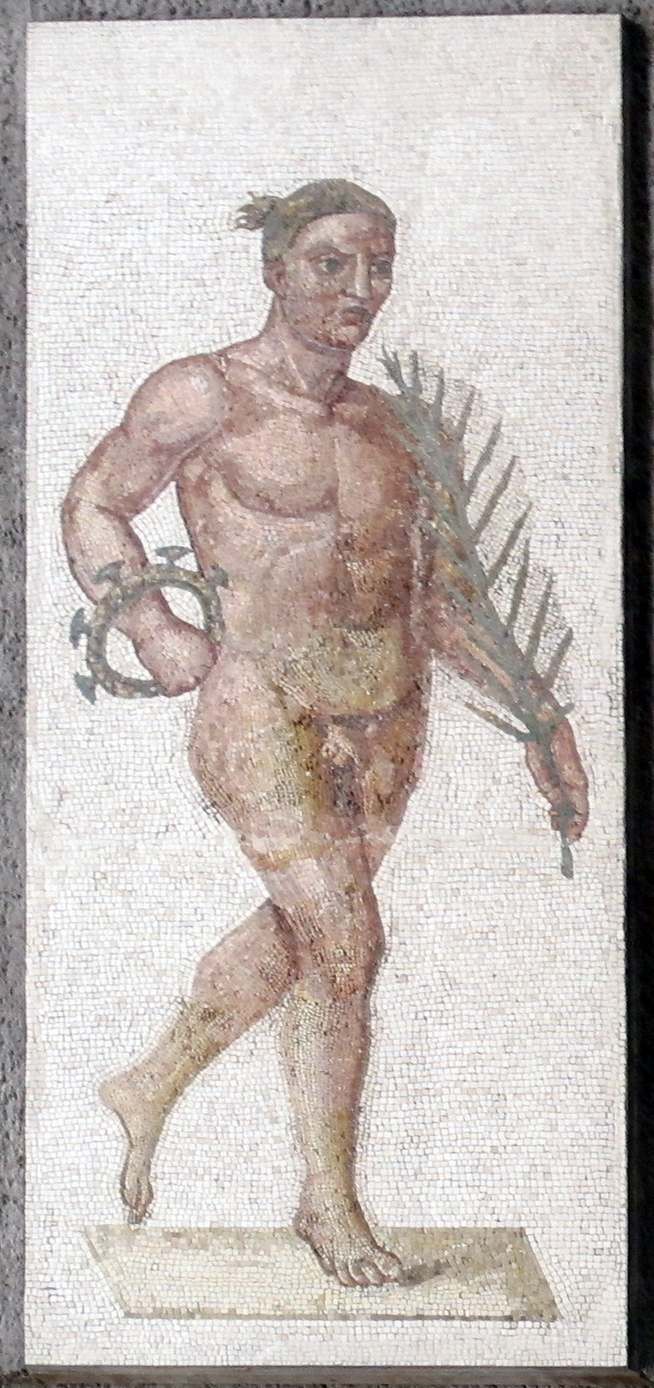
These athletes from the baths of Caracalla show the five pointed crowns and palms as contest prizes. The left figure also demonstrates an act of self crowning.
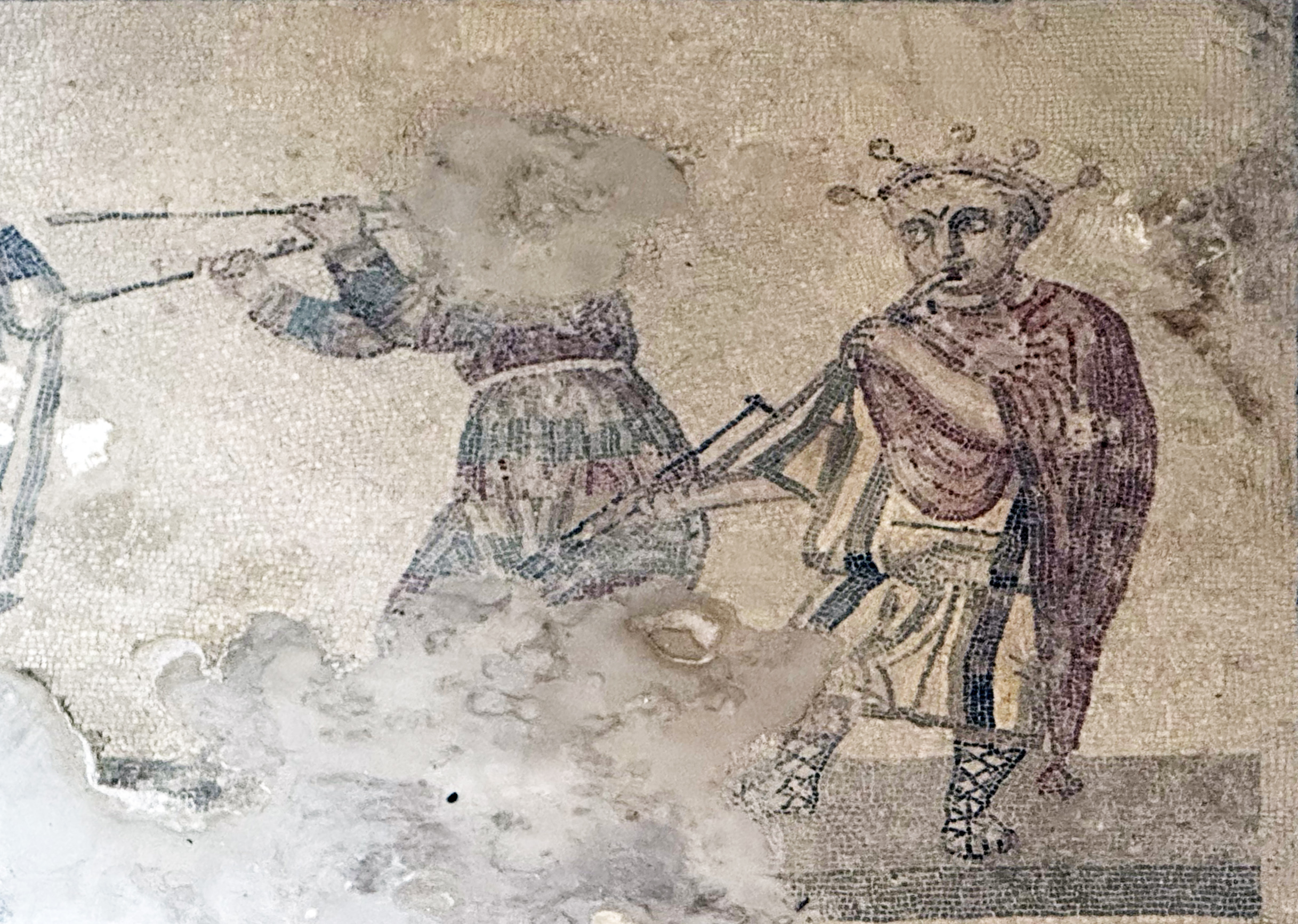
Figure iv may be female but beyond the high waist-ed, long sleeved horizontally striped dress there is little remaining of the figure to allow us to be certain. The figure plays the double auloi (flute) with raised elements along the shaft (cf. reference images for RRC 412/1, no. 127)
Figure v is clearly male he wears a double striped white tunic belted low on his waist. A reddish cloak covers his shoulders and hangs down on his left side ending in a tassle. His sandals or boots come up almost to the hem of the tunic and the strapping pattern is even more dense than on figure i. Like figure i he wears a five pointed crown, potentially represented flowers but not depicts in the same manner as those in register A or B. Again we have the v on the forehead.
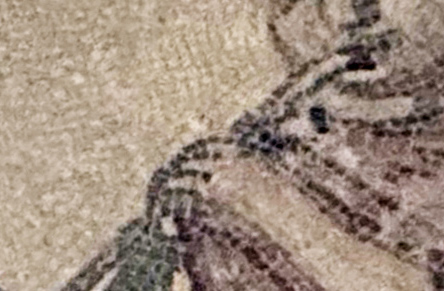
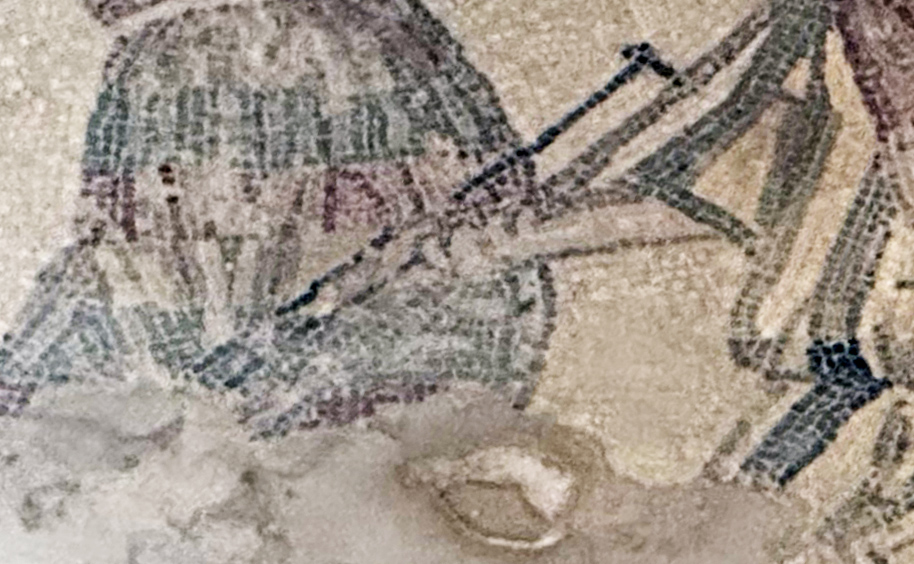
The instrument is curious and I do not have good parallels. I give close up images of key details below. The mouth piece seems distinctive. This is common enough on depictions of single wind instruments (cf. reference images for RRC 412/1, no. 20). The player’s left hand uses an over hand grip or fingering close to the mouth piece, while his right hand uses an under hand grip or fingering much lower on the instrument, such that his arm is almost fully extended and there is only a slight bend in his elbow. I’m most curious about the black bar on the top of the instrument. What is its function? I’ve never seen a wind instrument with this feature. Could it be a slide of some sort?! Did that exist in antiquity?
Perhaps the best parallel for these two figures are the figures from the Patras mosaic below. The far left figure seems to play a wind instrument with a similar elevated linear element near a female figure (right most in this cropping). The figure in the middle may be a judge. He could be equivalent to to figure (i) in this register.
Stepping back how can we see the five figures as a group belonging on a single register together?
I’d read this composition and three men and two women. All the men wear striped tunics. While none of the figures is identical they closely echo each other from the outside in, again using principles of what I’ve been calling false symmetry. So the two outer most figures both have the five pointed crowns and tall extra strappy sandals. All the male figures extend their right arm but the elevation of the hand decreases left to right. The two female figures face inwards helping direct our focus to the mirroring center of the composition. their hands are closer together with arms bent and raised to about chest height. The harp on a stand and the crown of pipes are the historically strangest elements but they nicely visually echo each other as linear inanimate objects on either side of the center point of the composition.
If we had to describe the scene we might say these are winners in a musical competition, if we allow the right hand figure to be a singer. Otherwise we may call them competing performers to be more generalized.
Further reference images
Register (D)
This register has three figures (i, ii, and iii), two inanimate objects (iv and v) and two further figures (vi and vii). Again we’ll describe each as they can be seen in their presently heavily damaged condition.
(i and ii)
These two figures are dressed in near monochrome dark collars. Each may have a darker narrow stripe running down from each shoulder. The left hand figure has a white narrow line as if the dress is belted under the breasts. No hands are visible but seem to be hidden within voluminous sleeves. There may be traces of longer hair on the right hand shoulder of figure (i). A single slipper on the right hand foot of figure (i) peaks out from the floor length garment. The head is turned slight upwards and towards the center of the composition, even with the damage at least part of the forehead v is visible. Figure (ii) is badly damaged but clearly stands just in front of and to the left of figure (i) and they are too be considered closely related.
(iii and iv)
All we have of figure (iii) is a small section of their billowing garment of a similar shade to the figures (i and ii). The billowing suggests movement towards the center of the composition and perhaps interaction with object (iv). The top of object (iv) is also lost as is a little of the bottom right hand corner. The basic shape is of a rather round bellied amphora, notice the circular handle visible on the upper left corner of what remains. It rest on a narrow pole merging from a pyramidal base of a reddish color seemingly made of rectilinear blocks (bricks? stones?). A similar more elaborate base is visible in register E and will be discussed below.
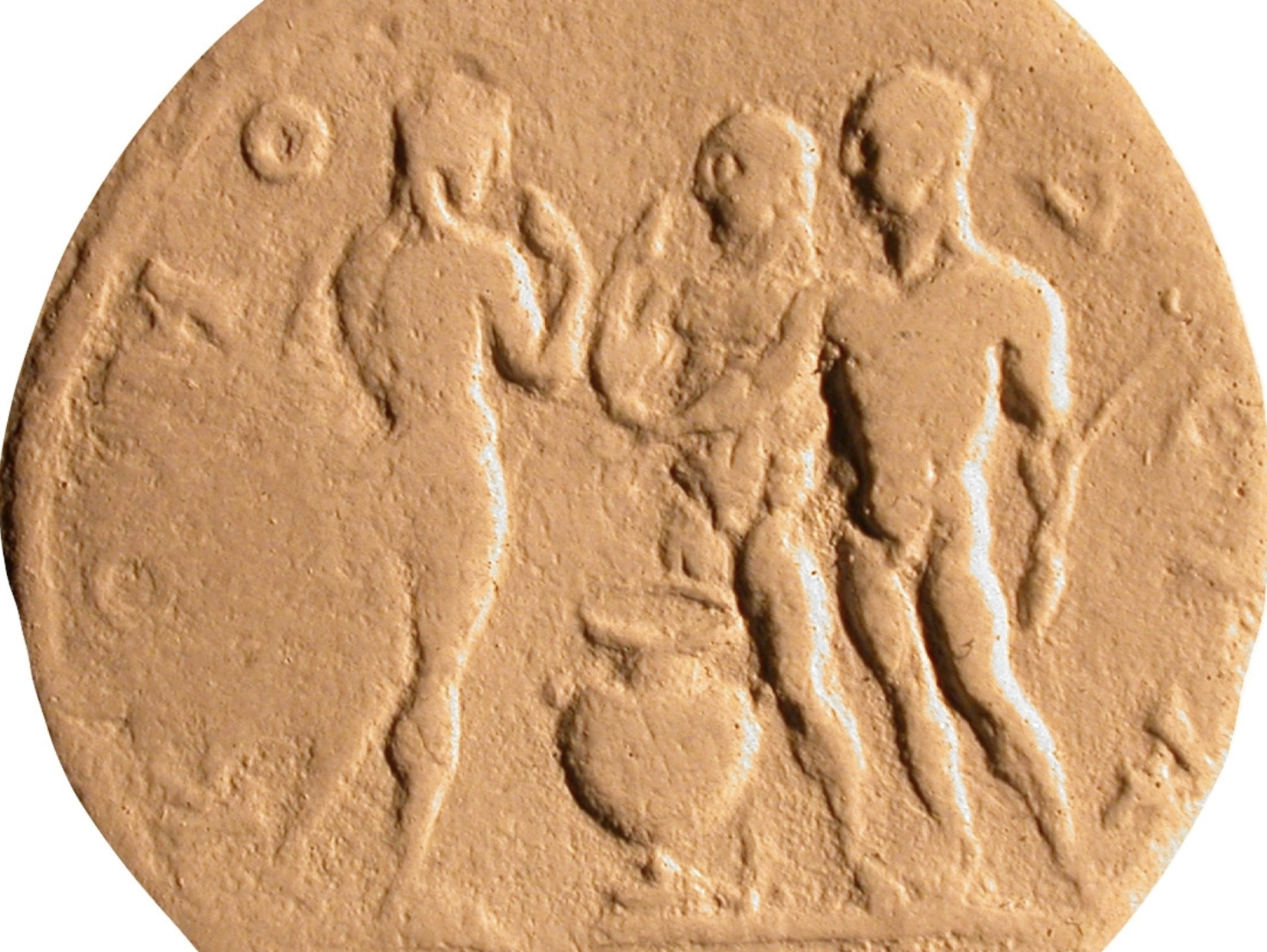
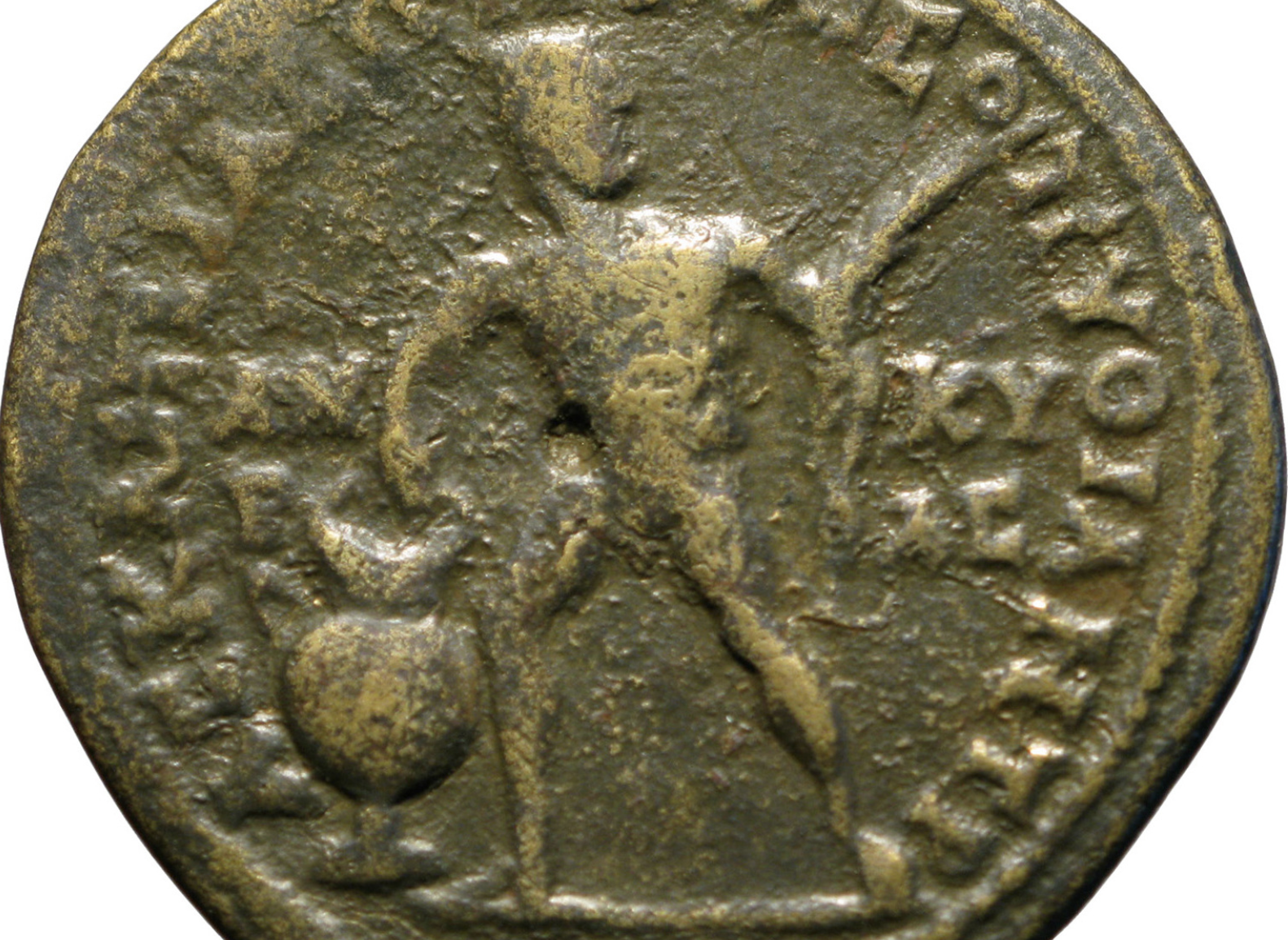
Amphora are often depicted near prize tables. See below for the mosaic from Patras and further discussion of it. When on the prize table they are often interpreted as prizes themselves — think of the Panathenaic vases from centuries earlier. However, amphorae were also used for sortition or drawing lots to decide in a fair and random manner the order in which individuals were to compete and perhaps even who would be matched with whom in some instances. From the time of Commodus onwards we find the motif on Roman provincial coinage primarily from Asia Minor. Three figures is the most common depiction. But we have one instance of a man looking away as he sticks his hand in the vase to draw his lot.
I propose that we have a similar scene of lot drawing ahead of competition in this mosaic. Figure (iii) draws.while Figures (i and ii) observe in the interests of fairness. While this type of drawing for lots is best attested for athletics, we also know that a different randomization of order was used in the circus (past posts). The Patras mosaic to which we will return below provides clear points of commonality between athletic and artistic competitions.
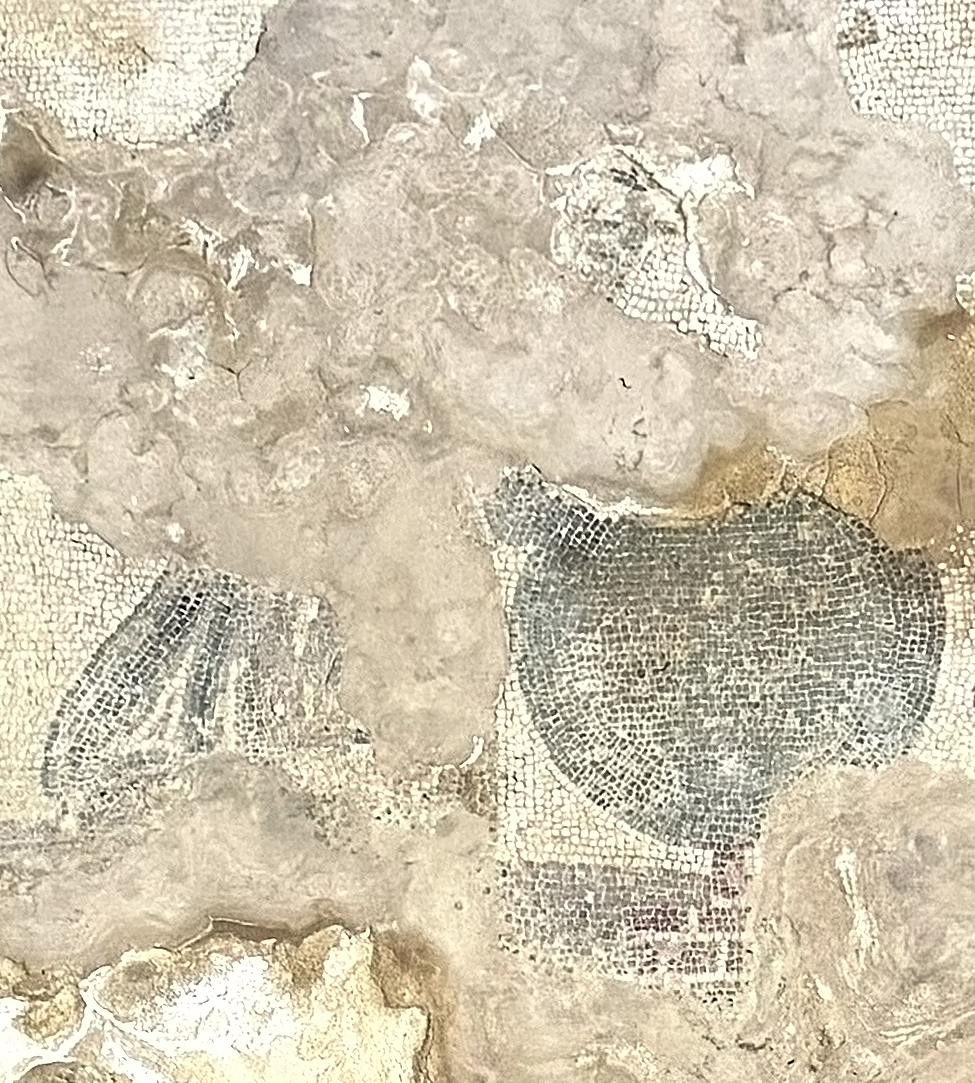
Object (v) is the other major oddity which sparked my deep interest (obsession?) with this mosaic since our visit last week to Piazza Armerina. A red ‘donut’ with five circles radiating out from the top half with the letters A, B, Γ, Δ, E. I failed to get a copy of the label on the site, but I’m positive it suggested these were musical notes and possibly an instrument. This cannot be right. Musical notation worked on different principles and this resembles no known instrument.
Our best clue is that another such object is depicted in register (E) and it like the amphora, object (iv), rests on a tiered stand made out of blocks.
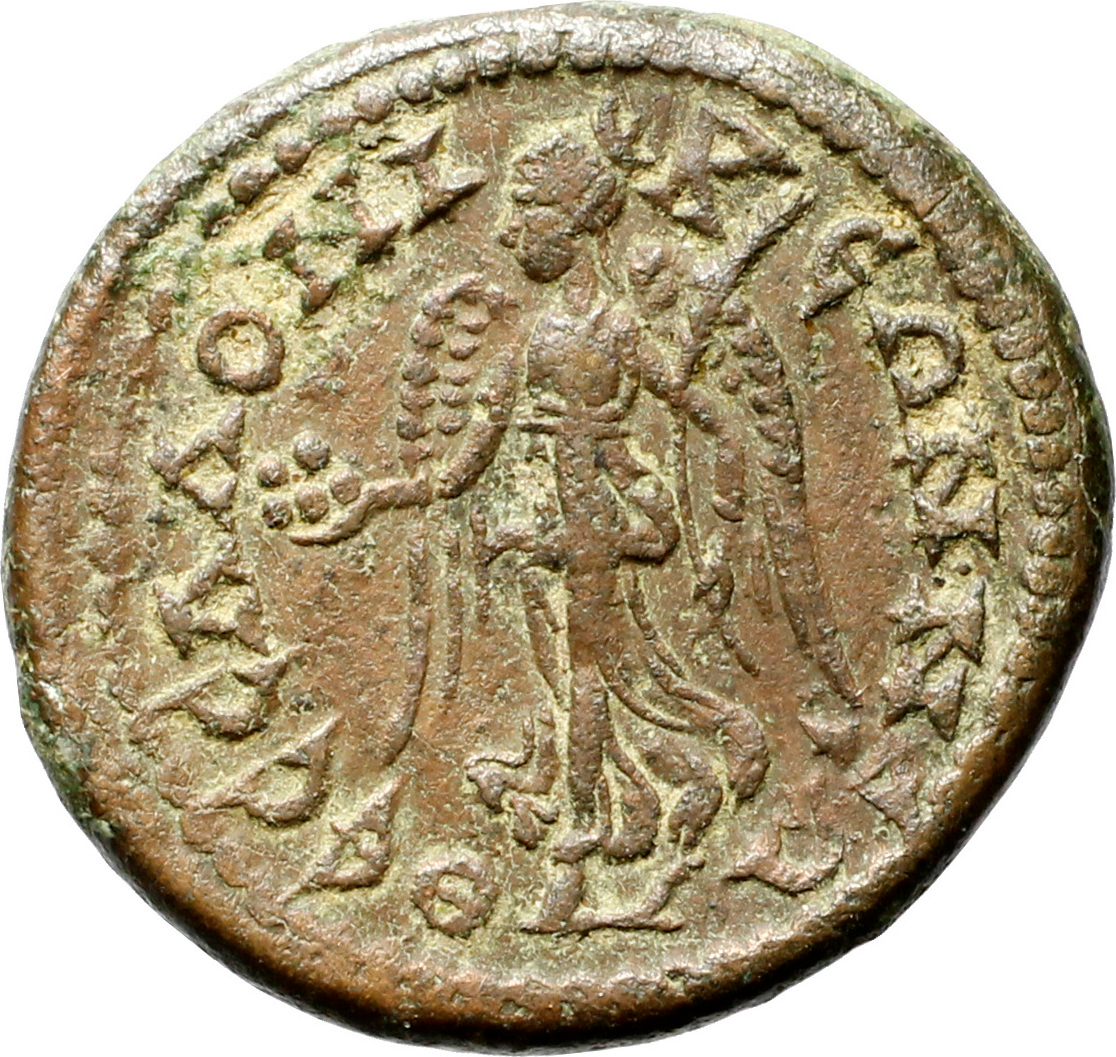
To this end I decided to look further at depictions of vases in agonistic art. On more than 143 different Roman provincial coin types there is a collection of five balls, nearly always called “apples”. Sometimes there are on the crowns, or next to the crowns on the table. Below I show an example of them under the table next to the vase and another rare example of Victory holding the five balls. I am no means certain these five balls are related to those on the “doughnut” stands in the mosaic, but I consider it a possibility. I see two potential interpretations. These are the balls that go into the vase and are drawn out to determine the order of the competition, or they represent 1st, 2nd, 3rd, 4th, and 5th place in the competition. I lean towards the first interpretations. Perhaps after they are drawn out of the urn they are displayed in the order drawn on the stand? Again this is speculation.
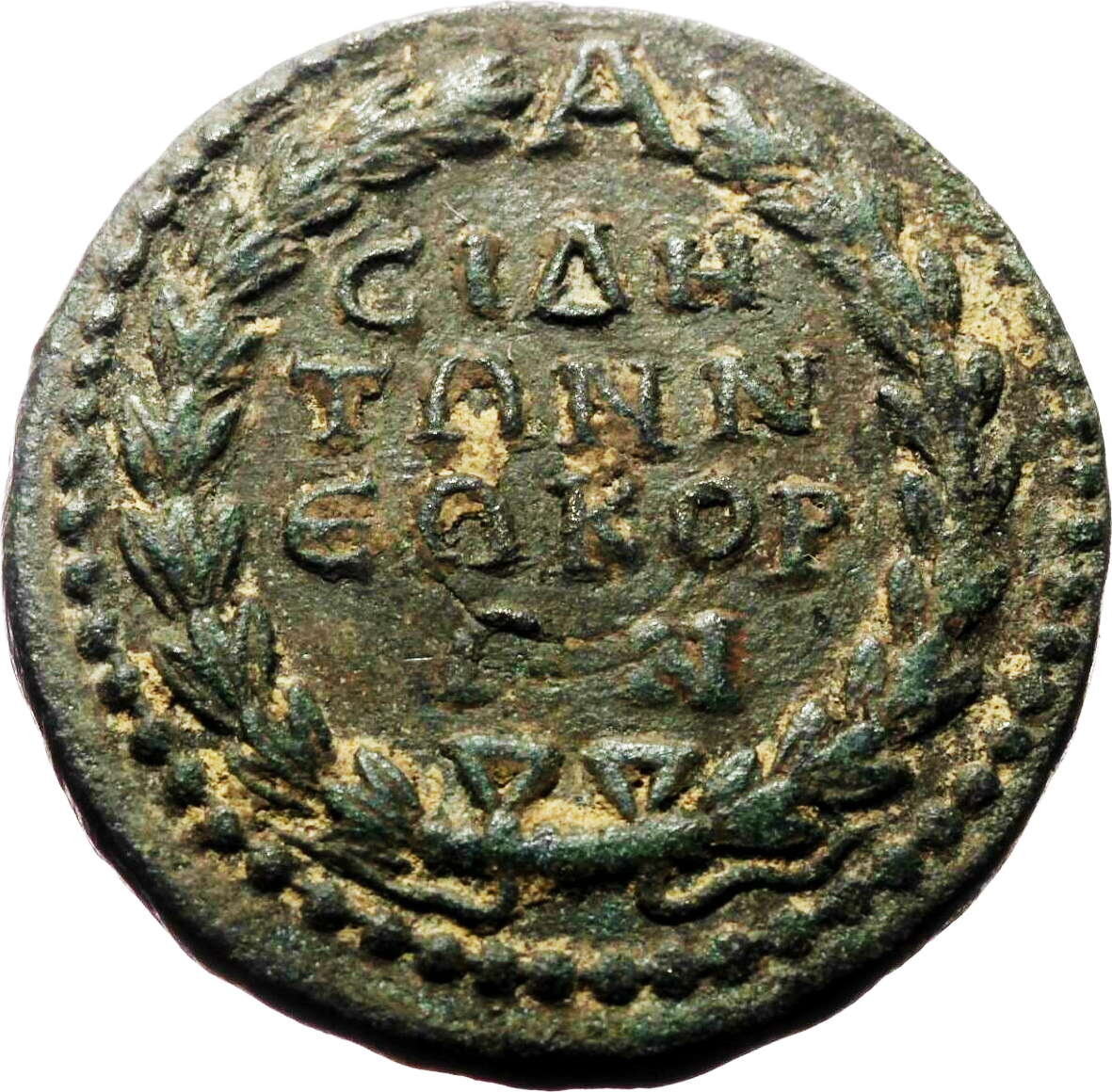
A tempting association of letters as indications of priority and associated with crowns comes from the coinage of Side. See the A at the center of the crown. Now the A on the coins of Side is their claim to be the first city among the Neocorates. It also appears on temple pediments, just hanging out in the legend, and on vexillum in coin designs, not just crowns.
RPC X, — (unassigned; ID 62692)
18 cities issued coins with design that is typically described as “dropping a pebble into a (voting?) urn”. In total RPCOnline records 102 coin types with some version of this description spanning the Antonine period down to Valerian.
The mints
The figure with the so called pebble is invariably identified as divine and typically seated. The most common identification is Athena. But their are some interesting personifications esp. the Boule and Agon. However we should not be so certain in these catalogue identifications. All five types attributed to Agon, might equally be attributed to Tyche. The key attributes are a crown (mural? agonistic?) and a palm branch. Of the nine types identified as Boule only one is labeled as such. By contrast with or without pebble and urn when the personification Koinoboulion is identified on a coin she is invariability labeled as such.
I do not take these to be scenes with so called pebbles and urns as celebrating voting but rather the divine hand in the random selection necessary for a fair contest. The same imagery that can be read as put a spherical object (‘pebble’) into an urn, can just as easily be intended to show the object being removed from the same vessel.
The relationship of iconography of a deity with “pebble” (ball) and urn to agonistic events is made clearest by this rather poorly preserved specimen.
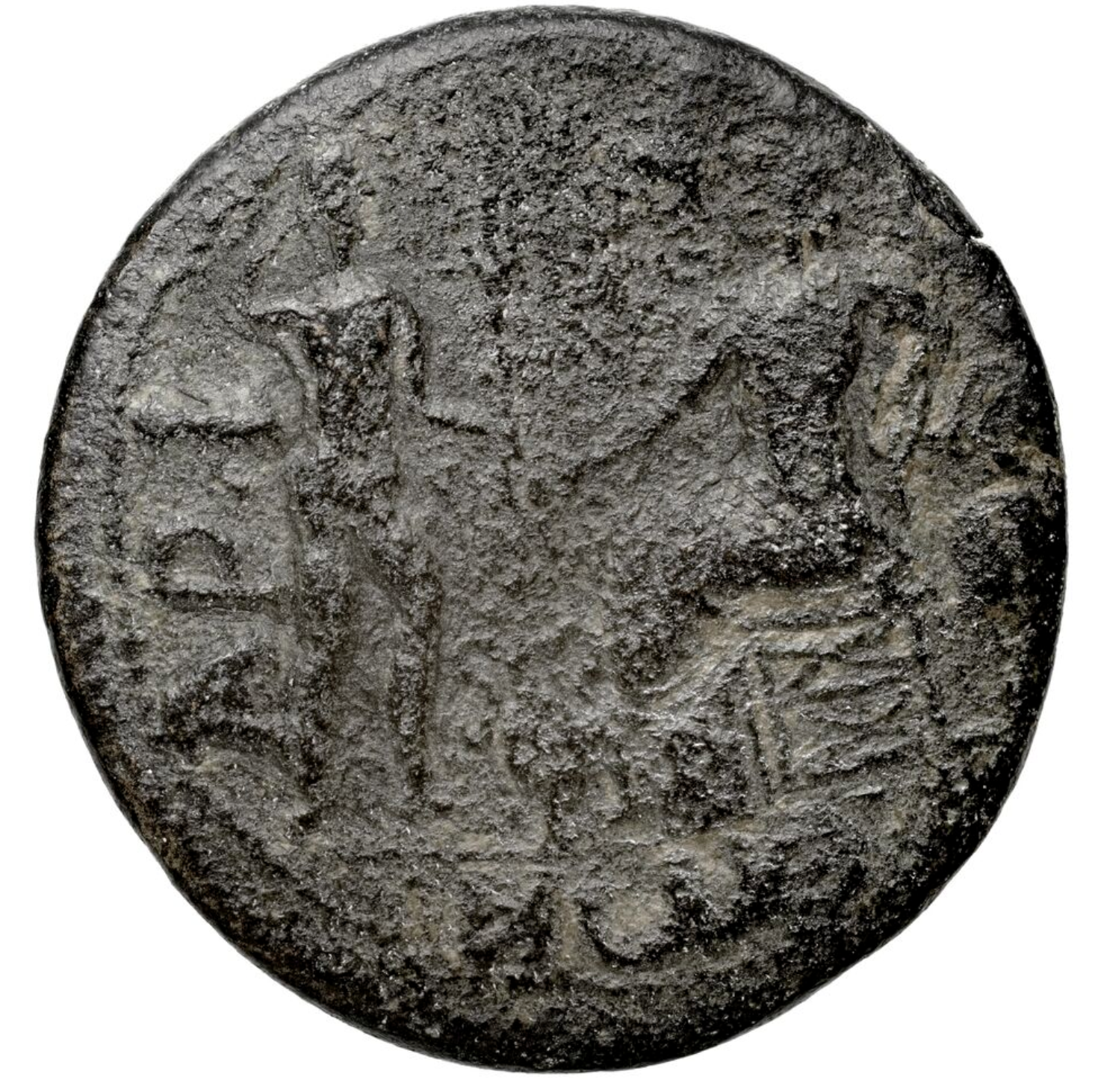
Coin of Ariassus under Gordian III: “Agon (?) seated left, dropping pebble into ballot urn and holding palm, facing nude athlete holding palm”
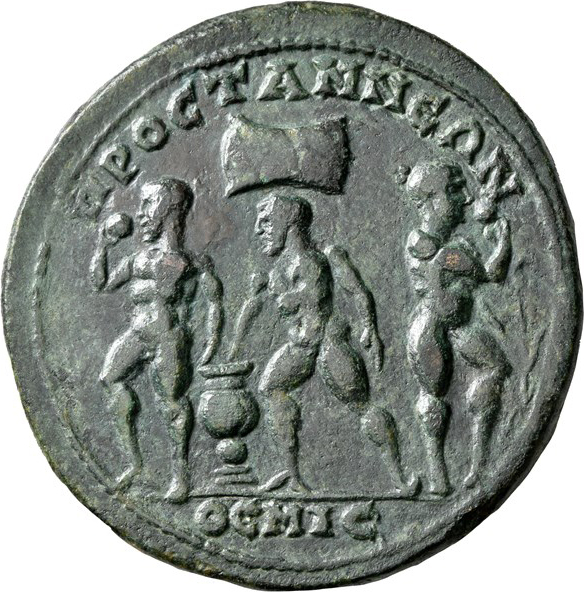
These athletes are not putting “pebbles” into the urn but drawing them out. Notice the two flanking Athletes are looking at the balls to see what place/order they have draw in the competition. The name of the god in whose honor the festival is to be held is in the exergue, Themis. It is no coincidence that so many of the deities identified as dropping pebbles into urns are identified as Themis! RPC VI, 5856 (temporary)
(vi and vii)
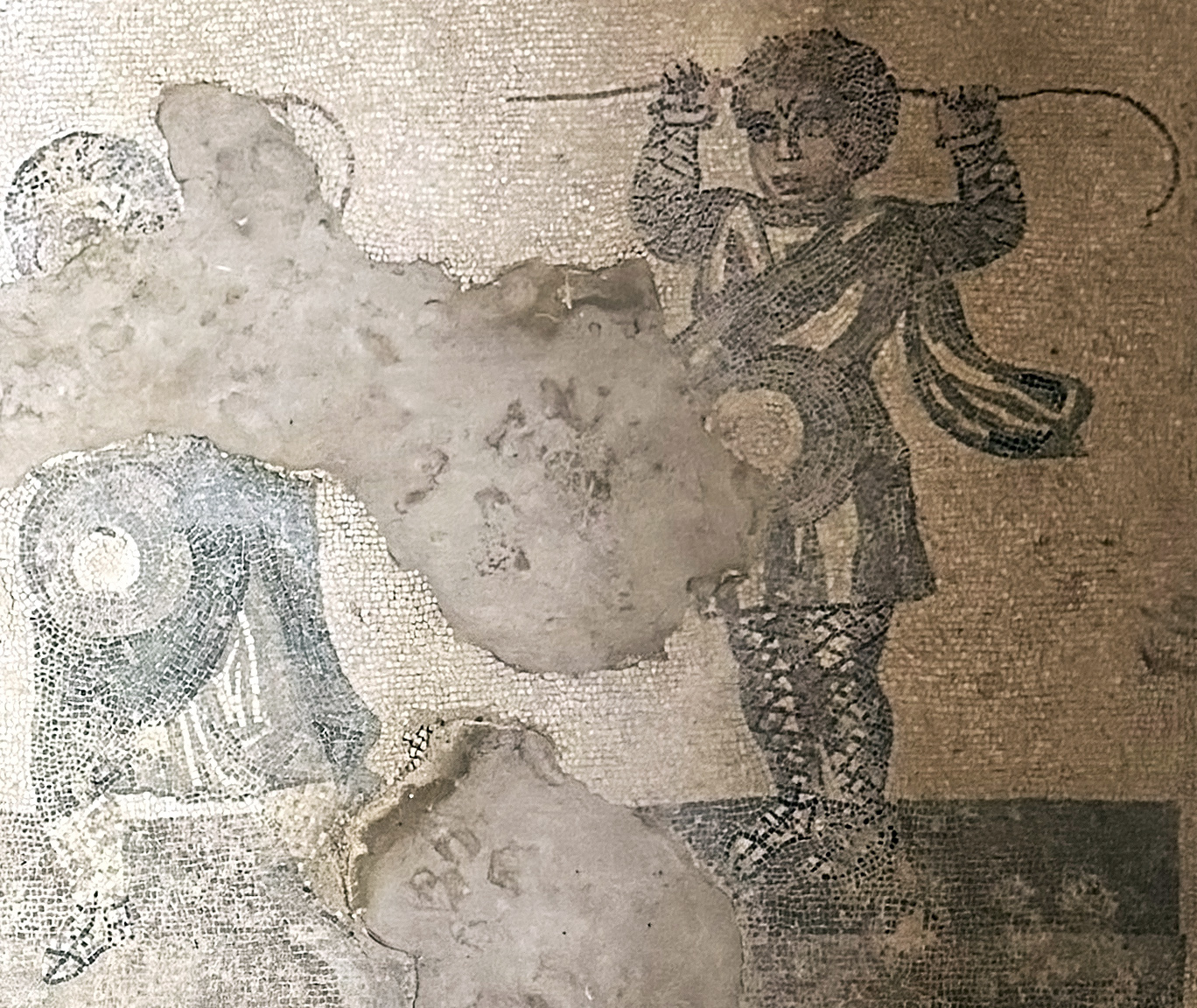
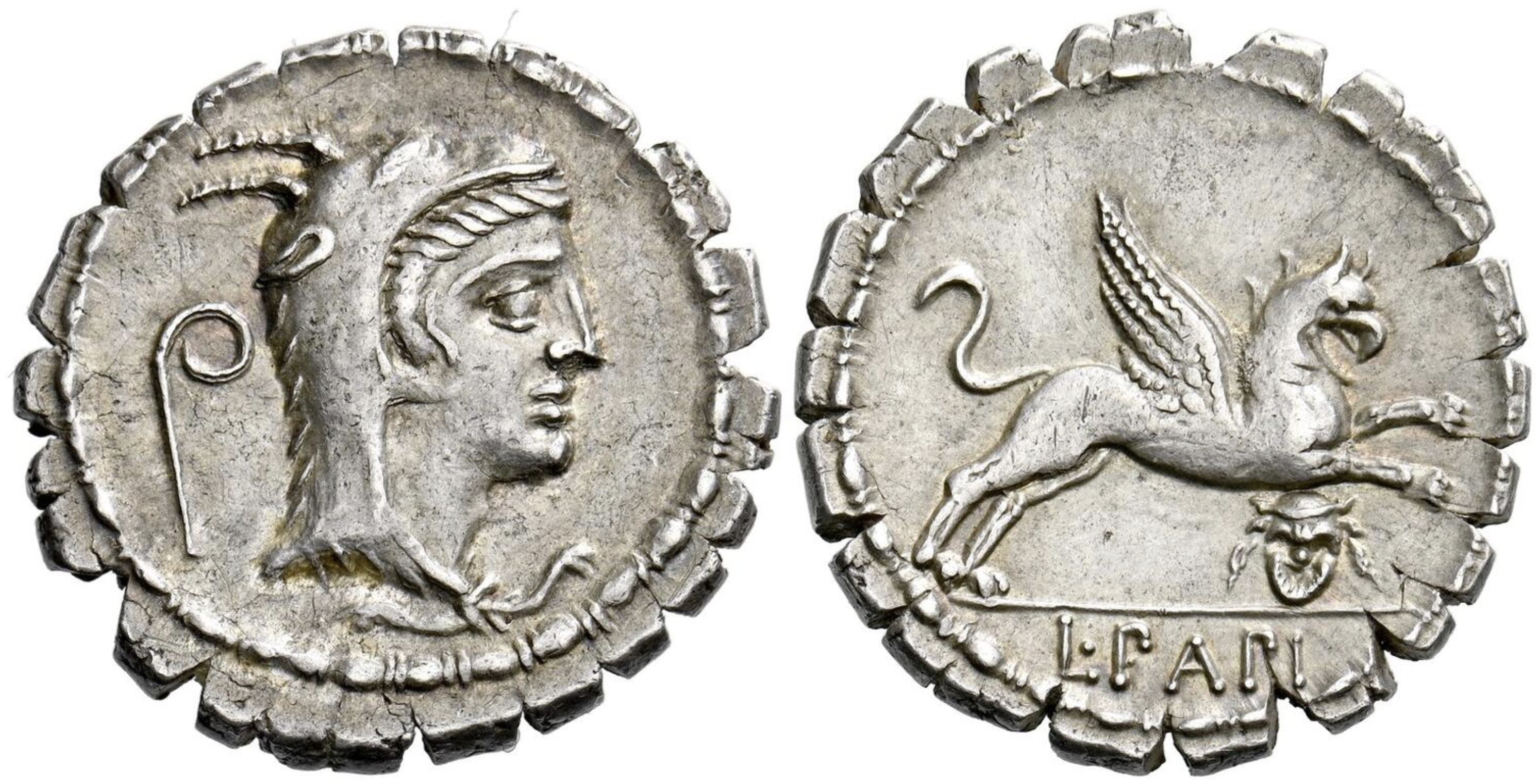
Figure vi is badly damaged but figure vii is nearly complete. The two figures interact with one another and bear key similarities. (Of course we have the forehead vs again.) Notice in particular the round protruding objects over their abdomens. This seems a late stylized version of the padded belly of the traditional comic actor. Both figures also hold very thin curved sticks. This type of ‘crook’ is also closely associated with comic actors. See below for pairing of such an object with a comic mask.
Specimen in trade illustrating RRC 384/1 no. 69 (The same symbol pair appears on RRC 412/1 no. 182)
Likewise, tall textured boots were a key costume element for certain comic actors. Notice the over the knee bindings on the right hand figure:
RRC 412/1 no. 180, specimen in trade (The same boots, mask symbol pairing also features on RRC 384/1 no. 210)
Register (E)
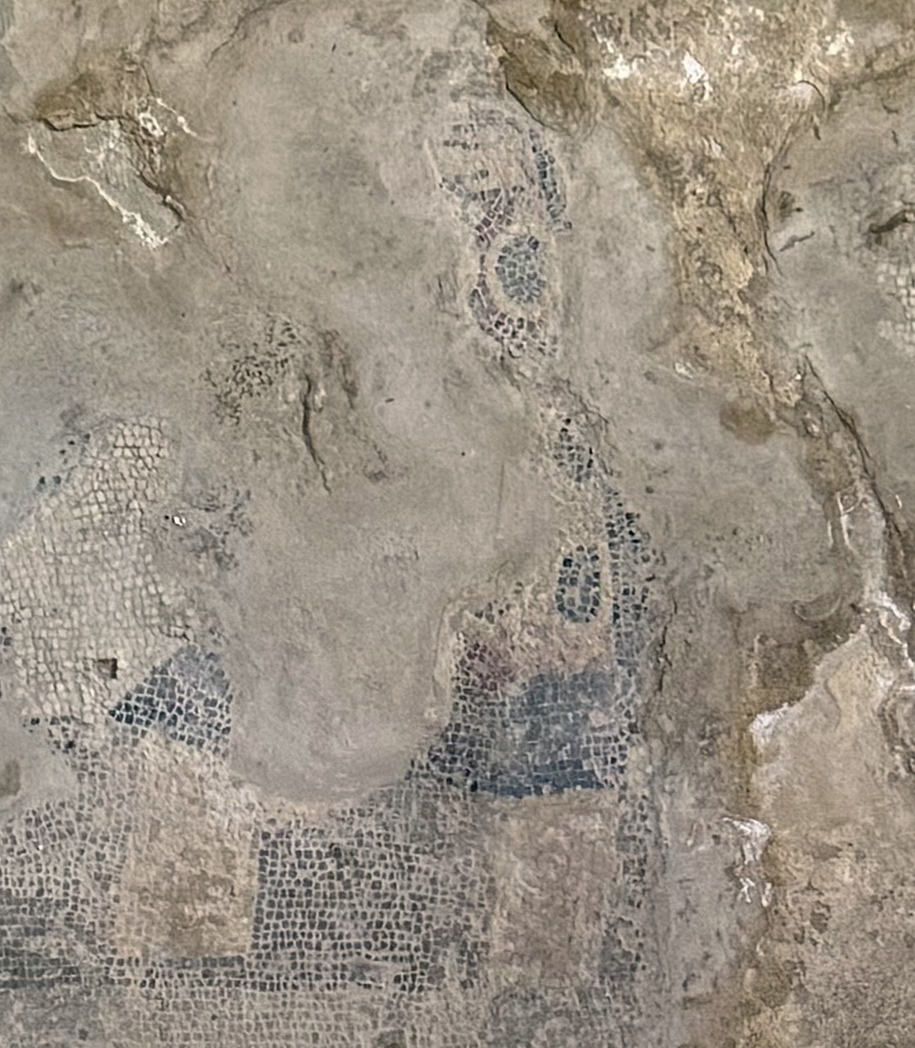
The extensive damage to the left half of this register makes interpretation especially difficult. I believe I can determine the remains of 6 overall objects/figures.
(i-iii)
The division of these remains into three objects/figures can be supported by the traces in the middle of pyramidal base made of reddish rectilinear blocks as seen elsewhere in this same mosaic. Perhaps it held another amphora as in the register above, but a narrower one. If this is the case the two objects/figures on either side may be interacting with the urn, i.e. drawing lots. My difficulty with this interpretation is what seems to be bases or rectilinear elements under the more organic forms. Let us interrogate this for each figure.
(i)
There is an S shaped curve of drapery on the left hand side. This is suggestive of cloth perhaps even a cloak on a human form. The irregular black lines on the white ground may indicate folds/pleats in an over garment. This could make the bottom band of a reddish color an undergarment perhaps with blocks of color red-grey-red-grey. I also wonder if there may have been some speculative or casual “restoration” work here that is fooling my eyes. Higher up on the figure(?), at about the the middle of the S shaped drapery there is a narrow horizontal band of alternating red and black tiles. Perhaps representing a belt? From the middle of this belt(?) there is a gentle sweeping line of tiles up to the right perhaps representing drapery over a shoulder. I see no trace of feet or arms.
(iii)
Here again we have alternating almost rectilinear blocks of color below what seems to be drapery. White and black boxes seem to alternate. Is it an undergarment or the base of an object? The impression of drapery seems clear from the irregular dark triangle to the left and the irregular series of circular patterns running in a vertical line on the right. This figure if such it seems to move forward the doughnut stand with the letter balls (iv, illustrated above in discussion of previous register).
(v-vi)
The two figures seem to gaze at each other intensely. Is it anger? A dispute over the contest? Is figure (vi) a judge or perhaps a singer? The lyre player with his plectrum and crown reminds me of the choragos from the Patras mosaic that is directing a group of boys in shorter striped tunics. The comparison is not perfect but suggestive.
So what?
I don’t think I’m done with this accidental project. I certainly have more I want to know and think about but this this the end of the first step. Observation. I always prefer to begin with articulating what I see and only then reading other perspectives on the same subjects.
My final thought is after looking at the groupings on the Patras mosaic I’m more convinced that we are seeing different competitive categories: tragedy, comedy, instrumental and choral performance. I suspect there may be a fifth category I cannot yet name or recognize. It will come in time.
I find it strangely impossible to teach and look with my own research eyes. Like even in this museum I didn’t take a single picture of some of my favorite reliefs like the midwife or the knife makers or the vegetable and animal sellers. Why? Because even though the museum was optional a handful of students decided to tag along to learn and my impromtu lecturing left no space in my brain for thinking ahead to wanting my own photos of these objects. I had no idea this was how my brain worked. I think for all those reliefs my number one impression was their small scale. I’d enlarged them in my mind’s eye and created something of a false memory.
The vivid colors in the frescoes were intense. I wonder if this is because they have been more recently excavated and/or differently conserved from those in the Naples museum? The pigmentation was so rich and so deep.
I love the relationship of mortal and divine this image captures. Not just in scale but also in posture and attitudes. It almost looks like Hercules would have preferred a libation for his cup rather than ‘just’ the sweet smells of the incense being springled on the thymiaterion. Also the skin tones are really interested. The mortal is far paler almost a color contrast we might associate with gender difference, but here I think it is about life style. The mortal is not the massive athletic warrior of the divine and thus does not have the sunburnt skin.
This little relief was not associated by the labeling with Christianity and of course in the story of Christ among the scholars of the temple he is always beardless as it is one of the v few canonical stories of his childhood. Yet… It is clearly of a type that had a deep impact on Christian art. I like that the notes are being taken in codices, perhaps waxed tablets with multiple ‘pages’. The hand gestures so well capture the depth of the disputes above which the central teacher quite literally rises on this little platform. His own hand gesture seems to be intent on calming the dispute with his gentle authority. Aesthetically I’m in love with this. I many need to blow it up, print it on say water color paper so as to even creatively colorize it for my office back on campus. Or it would make a great basis for a fantastical collage.
I’m sure I’ve seen nearly solid blue walls but I cannot think where else. It was such a deep a beautiful shade, vibrant.
The dress and pigmentation of this Thanatos evokes deep Etruscan antecedents. I want to show this in future classes next to Etruscan tomb painting.
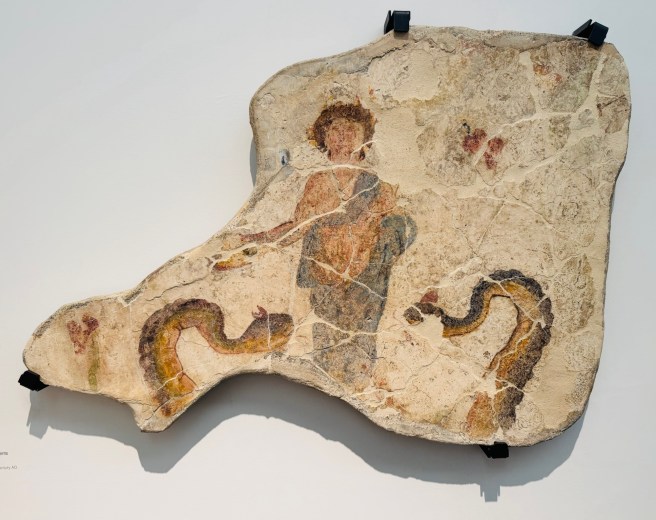
This figure was labeled as a Lar, but she seems quite different certainly another protect spirit associated with place, we have the male and female snakes on which Harriet Flower has written so brilliantly as spirits of the land on which humans dwell.
This relief and its reconstruction is fascinating to me because of the parallels with RRC 344/1. I’ve written on directionality and body posture on this coin on this blog before (and probably in my 2021 book, but I’m too lazy to check at this moment as I don’t have a copy to hand here in Rome). The heads of the two men in the reconstruction face each other like on the coin, but the foot position does not match and this calls into question if this reconstruction is accurate. Notice that for the right hand man we have a bit of lower leg and ankle including the top of a yummy lion skin boot (I think). The direction of that boot strongly suggests he’s exiting stage right. I want to think much harder about this at some point.
Here I’m most interested in the furniture, especially that large wood cupboard at the foot of bed, but we also have a foot stool, SOMETHING, a three legged table, and a lamp stand. How would you describe the something. I should have gotten a better close up.
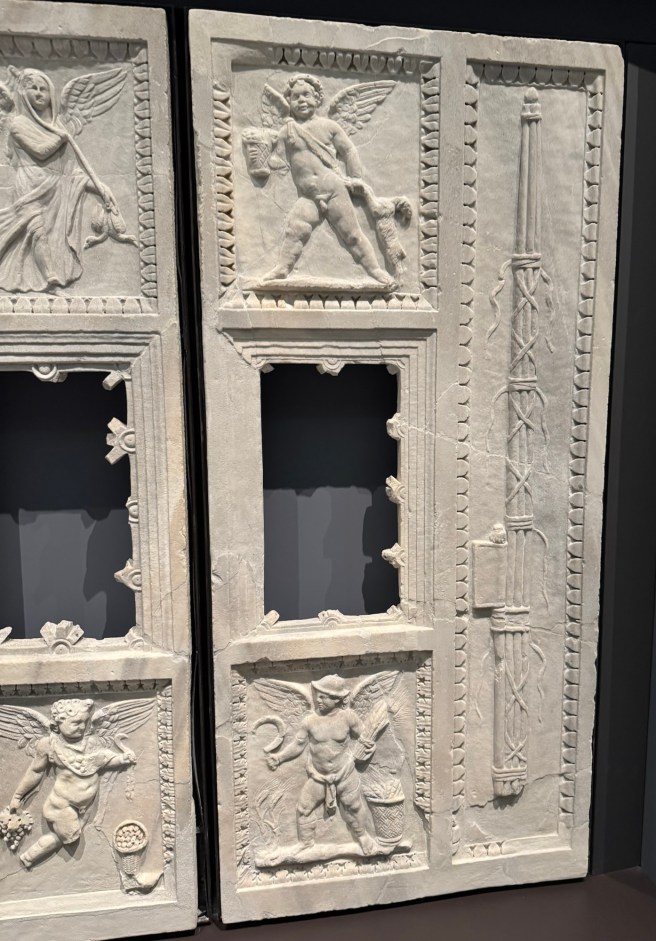
The tomb doors are excellent and I should have worried about capturing the four seasons better but I only had eyes for the fasces with AXE.
Juno’s Geese, making this absolutely with out doubt the temple of our beloved Juno Moneta. Her temple thus had ionic columns.
—
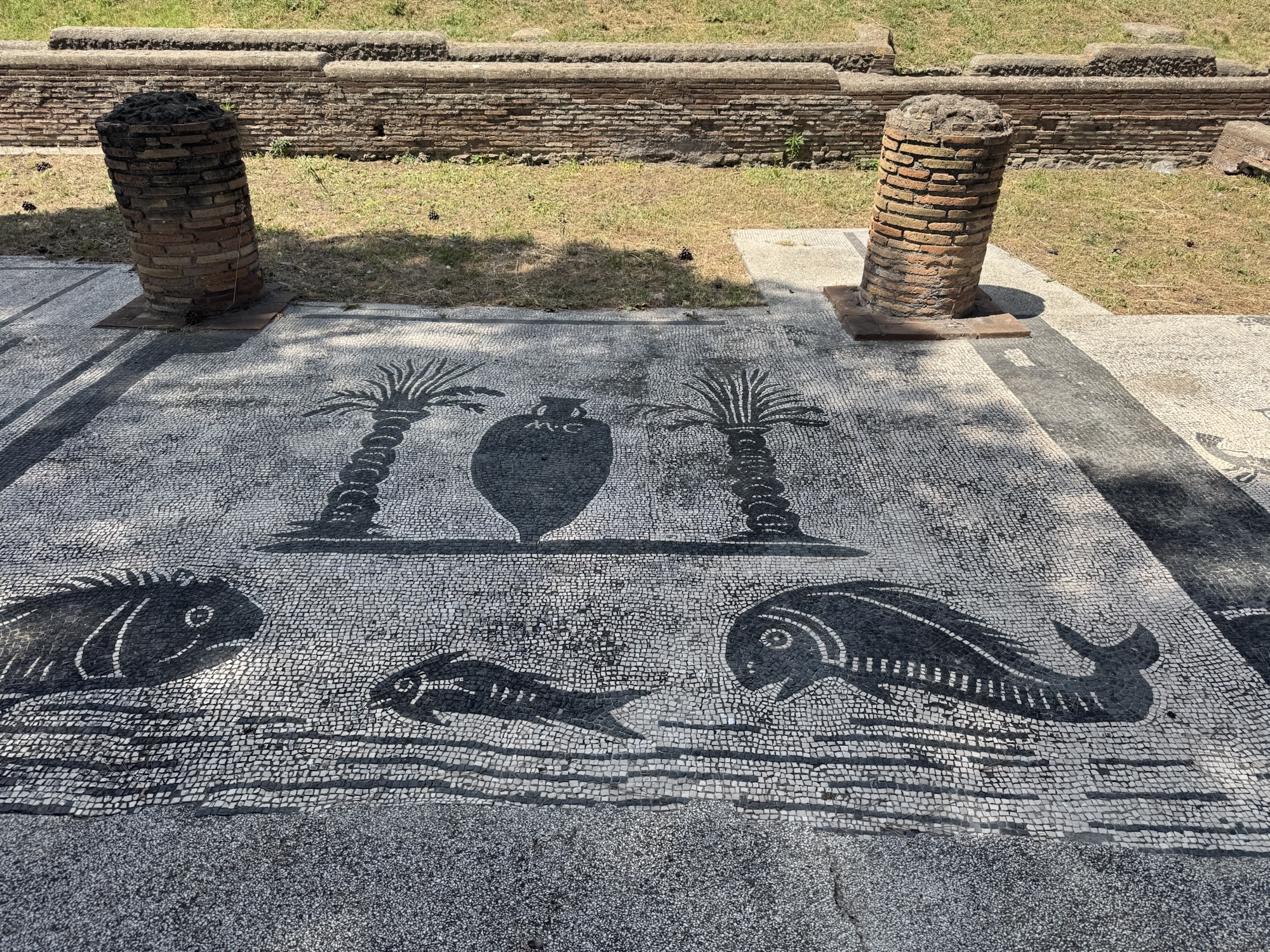
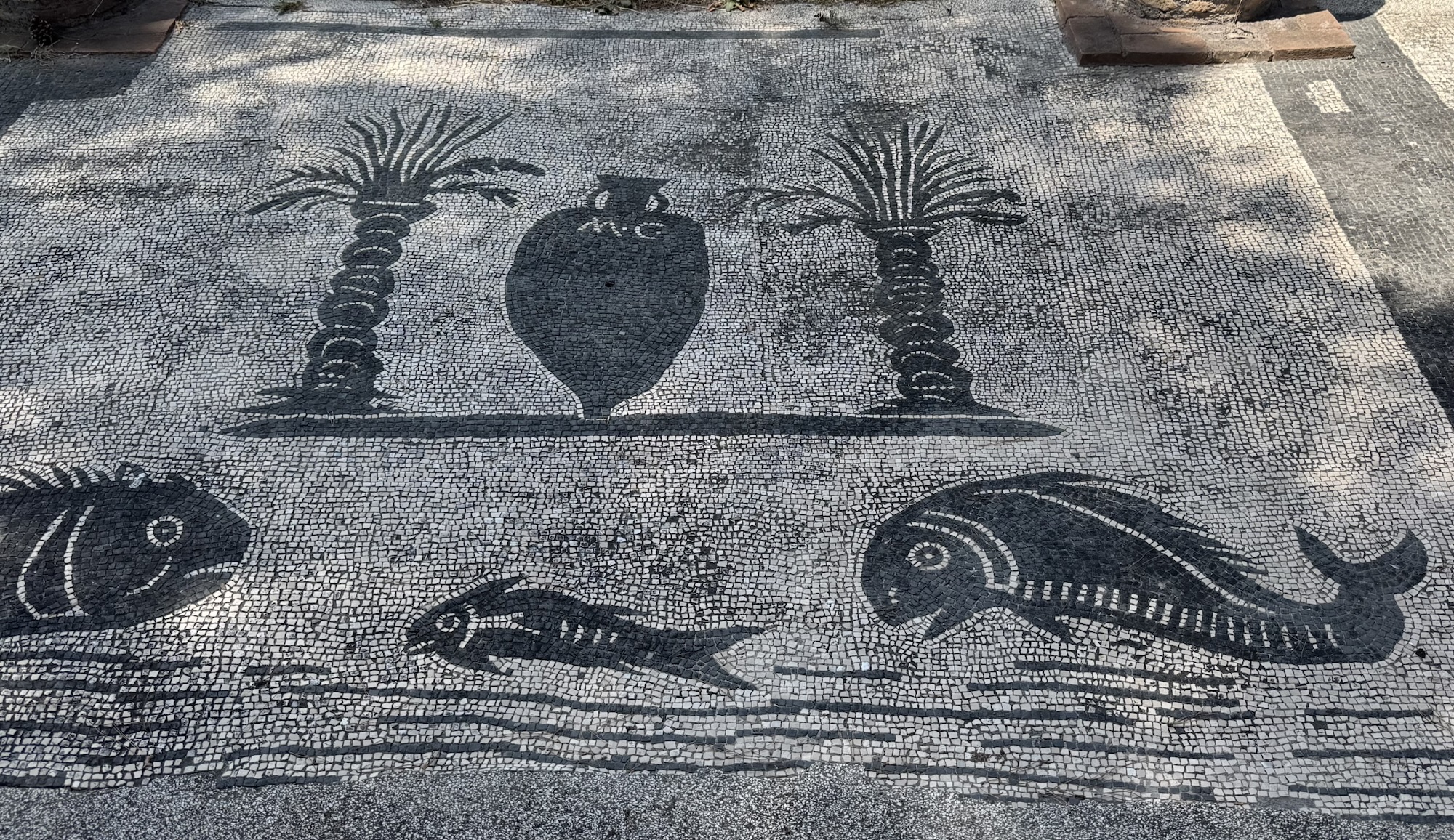
In the following outdoor images of mosaics the right hand image had simply been slightly de-skewed using my iPhone’s native software.
Something about the shape of the palm trees reminded me so strongly of date palms versus other species, I was so surprised not to see any bunches hanging from them. The fish are very fishy with clear spikes and gills and belly scales, not dolphin like. I wondered if they might evoke garum production.
The star eye of the dolphin is precious. I feel I should have taken more pictures of all the ships. There was one with a great winch on its stern end. And both of these ships seem to have raised gangways of their bows. Really what is the corvus if not a gangway weaponized? And, who doesn’t like a lighthouse. Many were very squat in their rendering. This one is taller than most with with its four layers. Maybe I’ll ask for a Pharos birthday cake one year.
Ace and I. Waiting for the rest of the troop to arrive. It you want to follow along with my travel log you are welcome to do so. All my daily posts from this trip.
I mean this blog is my professional place and there shall I’m sure be many reflections not connected to my teaching from the next three weeks in Rome with 14 awesome students. And yet, this is also central, and perhaps you want to follow along with the non-sense of the logistics and planning.
Scroll to the the bottom for later updates and minor edits.
Yesterday I chose to stand and observe campus protests because I believe in free speech and tolerance in all public spaces but especially educational spaces. I abhor the use of police force in these instances. I was not there to support either the pro Palestinian or pro Israeli protestors and was insulted by both for my actions. Those insults are another form of free speech and I celebrate their ability to publicly criticize me and others..
Let me start where I ended up yesterday as a faculty observer to peaceful student protests.
I stood back as the riot police corralled the everyone on the quad towards the front gates of campus. The gates were narrow. The closer the tail end of the observers and random bystanders got to the gates the more aggressive the police became even as we were complying and asking for clarification on the directions we were being given. To my left, less than a meter from me, a student was arrested for no reason apparent to me or those others walking nearby. He was walking peacefully with officers and faculty to the gates. I asked what he had done. No answer. The police formed a circle to block those with cameras from recording him being forced to the ground.
On the other side of the gates we were witnessing intense violence and overcrowding. The chaos was terrifying. People were being hurt. As it be came clear I was going to shoved in that mob, I started stating loudly that I was not going out there and it was not safe. I was told to stand aside. They then started to arrest another male faculty member recording events and trying to return to his office. I started yelling his name at the top of voice. They released him. Next I saw a hijabi student whom I believe to have been a random bystander being forced through the narrow gates in to the mob violence. I started shouting “don’t send her out there! it is not safe!”. The officer who had let me remain on campus along with my colleagues, then told me:
“if you keep shouting I cannot protect you”
I stayed silent then. I feel complicit for doing so. I used my privilege to protect myself.
Outside the gates chaos led to what I hear to be some 14 student arrests, maybe more maybe less. Ambulances had to be called. The police used a taser on at least one person. Pictures in the media focus on this violence. The bloody faces.
A colleague texted about shielded a group of students and then riding the subway with them until they were well clear.
Another colleague has written me about not being able to get off campus with their students.
Yet another colleague was being messaged by their students who had tried to come to class that they could not get on campus and were now caught unawares in the chaos right between the subway entrance and gates. He tried to go and help and was turned back.
I waited in my office. Messaging with colleagues outside.
Eventually, I retrieved property for those who could not return and decided to ‘brave’ crossing campus to get to my car. As I exited the building I ran into security clearing the building and telling students to leave the ground floor. Still no official mass announcement had been sent directing community members how to behave or what was happening. We have the ability to text and email everyone in an emergency. The lack of information was the most unnerving. It left me not knowing what to do or if my actions would be construed as contrary to police orders or how I or those left on campus were expected to leave with reports of violence outside multiple entrances and exits.
How did we get to this point?
When I got to campus at about 10 am, my faculty had alerted me to unusual security measures and asked me to follow up with administration. I did so and received a message that the security concern was not specific to Classics.
During common hours, time set aside for no classes so clubs and meetings can happen, a smallish group of students set up a small protest on the lawn. I’d estimate about 20-30 participants, certainly less than 50. This protest included banners and the erecting of tents. The erection of temporary structures are forbidden under the recent local campus policy approved by a council consisting of admin, faculty, and students. I am told but did not witness campus security was ordered to remove the tents. This is said to have created a minor scuffle between students and campus security but certainly heightened tensions, but campus security moved back and the small protest continued peacefully. Reports of NYPD community liaison officers in the President’s office led to some union leaders to go to the office to offer any aid to defuse the situation. They say they were rebuffed. Following this many faculty and other community members began to actively observe the event from windows and the areas around the quad. There was much discussion about the danger of police violence against students. There was a small peaceful counter protest of 3-6 students. The two groups exchanged harsh words but also danced to the same chants. The chatter was about how beautifully normal all this behavior was for a college campus. Students peacefully expressing themselves.
The campus library announced on social media an ‘internet outage’ and that the building would be closed for the remainder of the day. There is a wide belief this was a manufactured excuse to prevent any attempt to occupy the building. However, at no time did I see any protestor move towards any building or even off the grass where they might block free flow of non participants. I similarly heard of no such actions or attempts from those present when I was not.
In the mid afternoon I attended a student research conference to support my mentees. This event was in the president’s own board room over looking the quad. The conference and presentations continued without interruption. The protest did not interfere with normal academic activities.. I checked in with colleagues and returned to my office to do paperwork.
A few minutes before 5 colleagues let me know that it appeared that police numbers were rising and that faculty had gathered to form a line between protesters and police to try make a statement that force was not necessary. The faculty all agreed that our only goal was to protect the students but that we would follow all police orders as and when they were articulated. The goal was peaceful dispersal.
As I stood with the faculty, I also periodically went to talk to senior colleagues in the campus administration. I witnessed them negotiating with the students representing the protestors and also liaising with the NYPD. Things I heard said by those administrators and NYPD representatives:
Taking the tents down was insufficient. [This seemed to be a change from earlier messaging.]
The campus president did not want the NYPD involved: this was the University Chancellor’s decision. [I’ve since credibly heard that the Governor was also involved.]
The NYPD liaison made clear in my hearing that a full dispersal was going to happen regardless of what the campus administration wanted because that is what had been ordered.
I saw deep fear on those administrator’s faces. Fear for our students. I saw individuals who were doing everything in their power to deescalate and felt powerless to do so.
As the riot police entered through the Bedford gates faculty formed a long line. The student protestors asked us to step aside so they could march. We did so. They began marching in the direction of the gates on Campus Road and Hillel Strreet but were turned back by CUNY security and penned in by the NYPD riot police, or perhaps I should say the strategic response unit. The NYPD then got behind the protesters and fanned out into a long line and began moving everyone towards the Bedford gate as described above and no one was allowed to go into the buildings. I believe most people swept up and ejected from campus were bystanders and observers not protesters, including students just trying to get to class.
The recorded message said that the protesters were trespassing. Earlier we’d heard the student broke the Henderson laws. I am not sure how either of these things are true, but I am no lawyer. I do know everything was peaceful and non disruptive on campus and that it was the ejecting of students that led to violence.
I wish there had been text and email updates sent to the community. I wish the dispersal order had first come in that fashion. I wish dispersal had not been through a violent bottle neck. I wish none of this had happened.
If I remember more I will add it. I write to understand my own memories. I know everyone present experienced it differently. It is by sharing our experiences that we learn and understand.
Below updates added 13 May 2025.
“Officers turned to expelling my male colleagues. I told one officer that a particular colleague was an Israeli citizen. Then that colleague was allowed to stand by me, safe from the mob.” – This colleague believes my words were not the source of the policing decision but his own conversations with the officers which were not based on his nationality. Out of respect for this I’ve moved these words down here as part of the record of what I originally said but no longer part of the narrative as I originally believed to be true. I defer here to his own experience.
I was not on quad when pink flyers were distributed to protesters. I asked colleagues for documentation of the time they were distributed as many seem to be using my above narrative as a time line of last Thursday. The photo time stamps suggest the distribution was shortly before 3.45 pm. When I arrived on the quad at 5 I was unaware these flyers had been distributed and I suspect many observers were as well.
I only heard about the distribution after the event was over. I’ve heard colleagues ask why only one group of protestors received these fliers. I cannot be certain if this one-sided distribution is true. I’ve likewise heard colleagues voice concerns that student office workers were asked to distribute these to fellow students. Again I cannot confirm this is true only that it is a current topic of conversation.
I want to be clearer than I was in my above text on a few points:
There was a moment where all the tents were taken down by the protestors themselves. I believe this was after the announcement via a ‘mic check’ by the protestors to the protestors that the college president had delivered their demands to the Chancellor. All of this was after 5 pm as I was not present before that time. It was the belief (mine and others) in this moment of many observers that the protesters was now ending their civil disobedience (the tents) as a response to this ‘win’. It was after this that the NYPD made clear to campus administrators on the the quad and thru them to the protestors that the police would be requiring a full dispersal. Because I had not seen or heard of the pink fliers I did not know in that moment it was a re iteration, not a new statement. I believe the protestors then re erected the tents at this point in response to the news that the police were entering campus regardless. The president’s friday communication to faculty and staff acknowledged the deflation and re erection of the tents but notes that this was not sufficient as the structures (deflated tents) were not moved off campus and the protestors did not disperse.
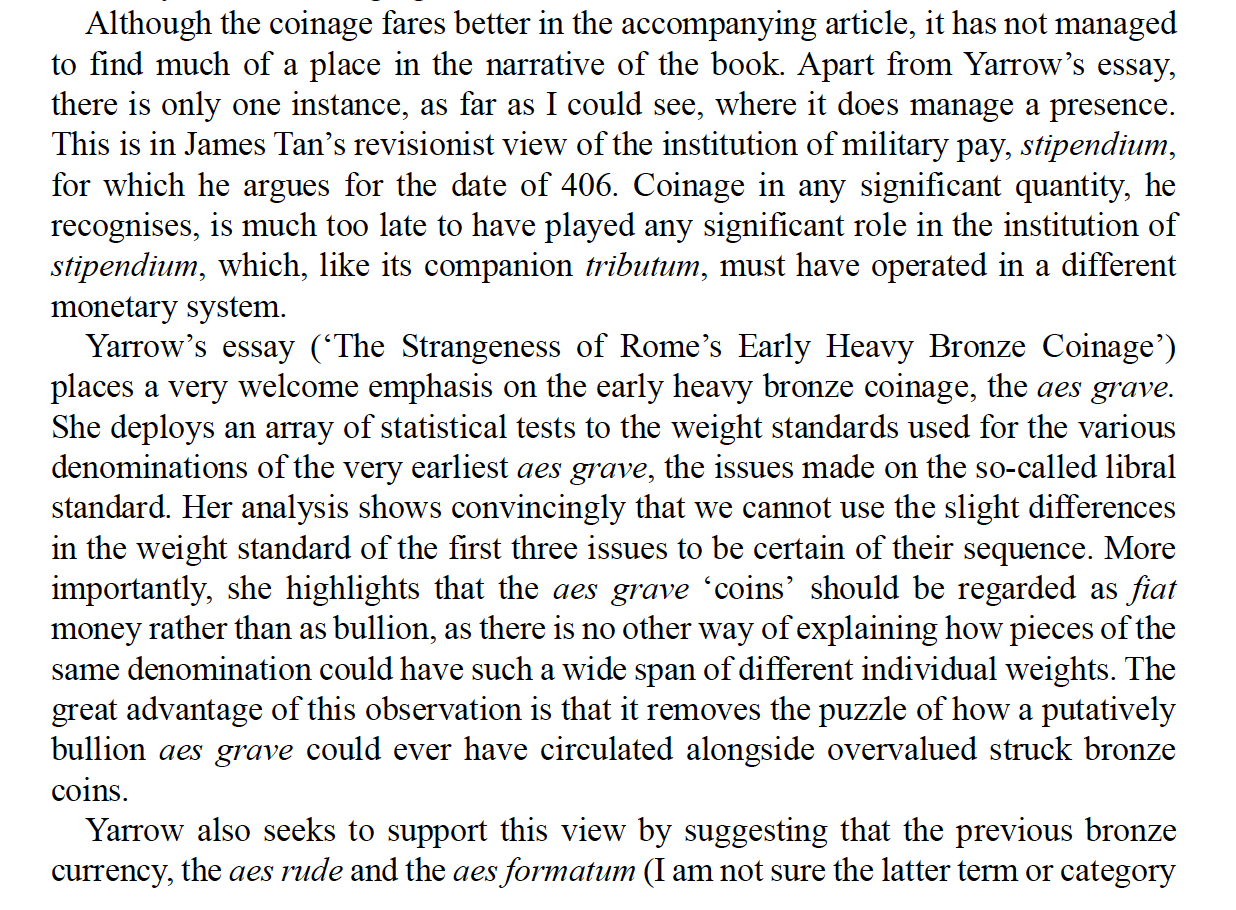
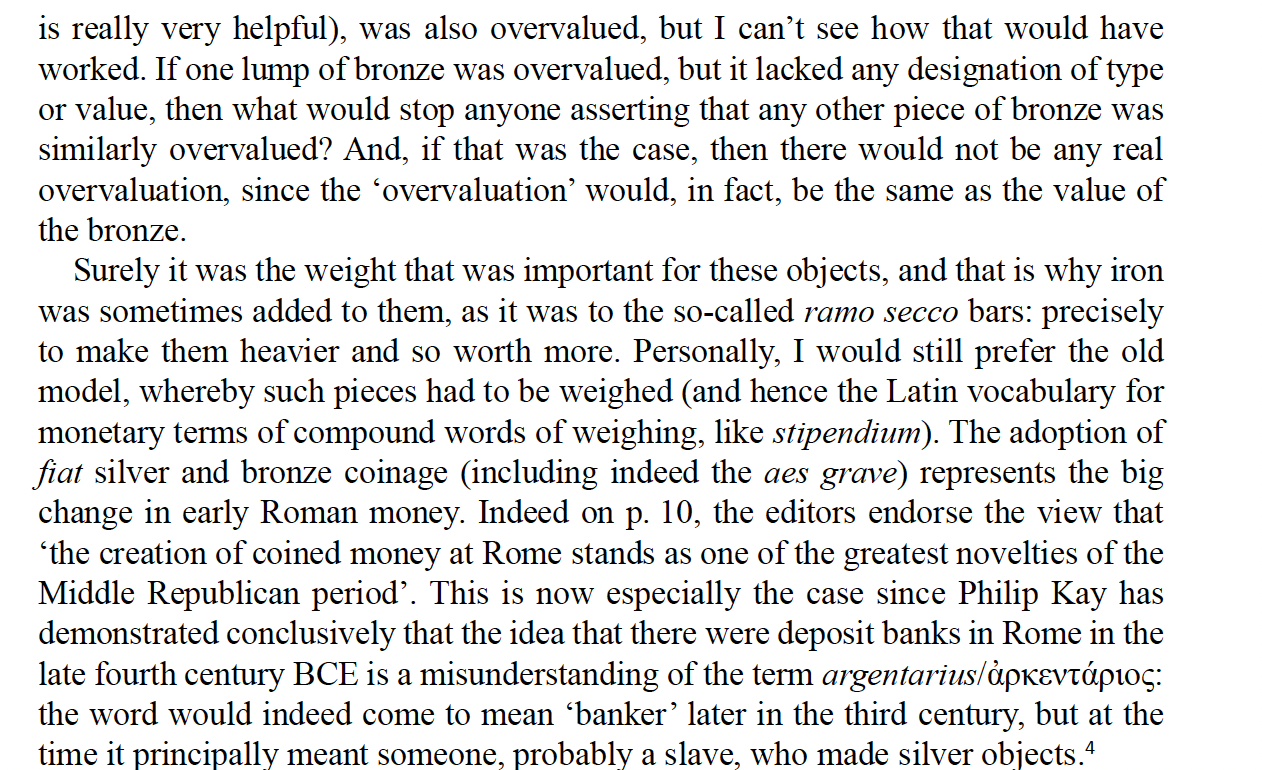
I will only point out that the iron in ramo secco makes the bars lighter not heavier. Iron is a lighter element than Copper or Lead or Tin. The Iron must remain a mystery. It render an admixture (not a true alloy) that is at once difficult to make and also completely impractical for any utilitarian purpose. I discuss this v briefly in my 2021 piece (no. 6)
I’ve been writing only emails and texts and other pieces of non-sense. This isn’t the first blog post I’ve written since April 15 but hopefully on this one I’ll hit the publish button, rather than the draft button. I did the school run and then stole some time to take a walk and talk to a bestie, now I’m stealing time to write just to stay in the habit. You almost got a gender studies deconstruction of “Honey, I’m Good” a catchy song my kids keep playing on which I have many thoughts on how it constructs male sexuality and female agency. Short answer I think it is problematic, but that sort of writing isn’t really what I tend to do publicly so I’ll save it for tomorrow and another convo with another bestie over beers.
As I have been mentoring students on research and writing, I ‘ve been talking more about my own practices. One of which I’m not sure I’ve articulated (but you will certainly have noticed if you read this blog regularly) are these chatty diary-esque paragraphs in italics at the beginning of posts. The italics is how I signal that it isn’t the real post, but rather the warm up exercise where I loosen my mind and my fingers by just typing the running commentary that is always in my head. Connecting my internal voice to the words that appear on the screen is key to letting me write freely on more ‘serious’ topics. In some ways it is all the same. I have to be able to articulate my thoughts and experiences and observations and starting with the this type of “here’s where I’m at” scene setting works a treat to get me writing and the words and ideas flowing.
—
Comfort reading for me is often adjacent to my work but never on my work. I tend to reject any historical fiction that is set in Rome, ditto movies, shows. They feel like work. Sometimes I can read actual scholarly literature in my field for leisure if it is different from my primary research. So for example I can read on Republican theatre or Imperial Architecture if my main focus is on the coins. This runs the risk of being too distracting though with the potential to pull me into a new line of research.
I find the late antique and medieval much safer recreation. In fiction I don’t know enough to worry about ‘accuracy’ and instead enjoy the plot and tidbits of historical window dressing. Fiction these days I almost exclusively enjoy via audiobooks. The Company of Liars pulled me in and left me hungry for more of a similar vein. I thought of returning to Umberto Eco or Orhan Pamuk; for both their medieval historical fiction is my absolutely favorite. Yet, the world is burning and I wanted something lighter with more guardrails (genre conventions). I’ve started on the Sister Fidelma series which I was surprised and pleased to learn was written by the same author as the Cadfael series, just under a pseudonym. They are very much in the old fashioned Agatha Christie style of mystery. Still as the world is burning, narrative is often too much. I prefer non-fiction to dip in and dip out. And occasionally poetry but that is another post.
Get to the point, LIV!
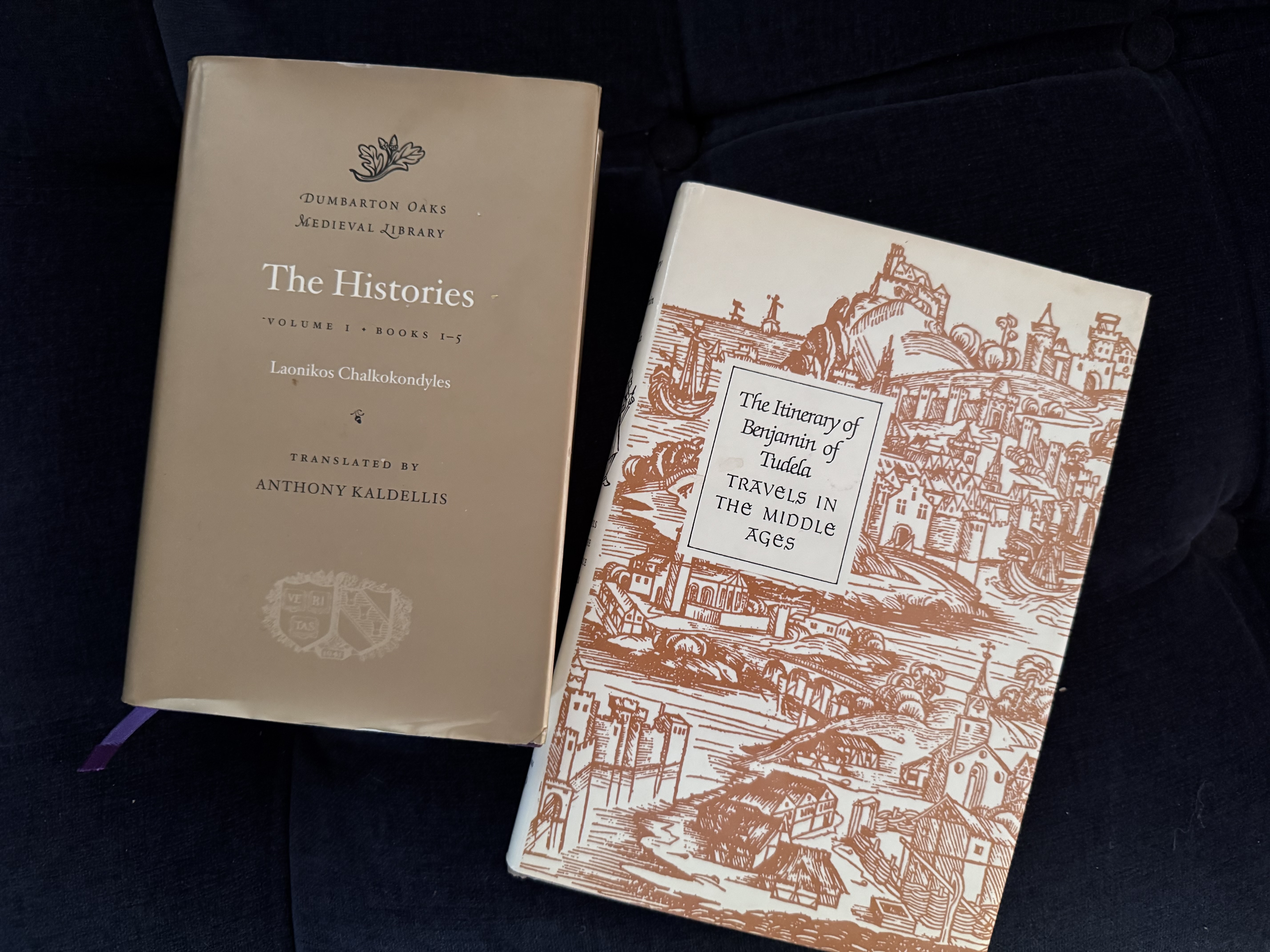
So the two non-fiction works that I’m currently obsessed with are those photographed above. Laonikos Chalkokondyles (b. 1430 CE) wrote a history of the victory of the Turks over the Greeks from the Greek perspective in the style of Herodotus and with shockingly little religious narrative focalization. He treats the rise of Islam as history coming full circle from the Greek victories over the Persians. He has all the gorgeous digressions and narrative style of Herodotus and feels like an old friend come again. Kaldellis makes slightly different translation choices as I might have, but he’s very clear about why he does so and the logic is sound and about the expectations and frame of reference of his most likely readers, i.e. those more familiar with Byzantine studies than I! The facing text in the Dumbarton Oaks series means there is no issue or true confusion. I find it striking though how accustomed I am to the Loeb Greek font so that this slightly different font feels ‘wrong’ on my eyes. I do enjoy the larger size of the physical volumes in this series and the I Tatti series. I’m reading this in a linear fashion and trying not to skip ahead to the book 3 ethnographic treatment of the Islamic Law and Mohammad as law-giver.
The other book is by a Jewish traveller making his way across the Mediterraean and Middle East in 1165-1173 CE. It is very easy to pick up and set down and dip in and out of. I find this perfect for the night stand. Last night and the inspiration for this little writing exercise, I read sections on Tyre, the Samaratians, and Jerusalem. Both Laonikos and Benjamin engage with an reflect back to their experience of the ‘classical’, the long shadow of antiquity in their world. A world dominated by Christianity but to which they both positioned themselves as outsiders, non-participants in the dominant world view, but commentators on that world.
In Tyre Benjamin tells us you can take a boat out onto the water and look down at the ruins of the ancient city. You can see all the places now submerged just as they once were. In Jerusalem he talks about Muslim and Christian constructions: the holy sepluchre, the dome on the rock. But he’s much more interested in the remnants of the temple and what he identifies as Solomon’s palace. Likewise in Caesarea he emphasizes the connection to Augustus and the magnificence of the structures. He tries to make sense of why based on the laws of Moses the Samaritans worshipped on Mount Gezirim.
Both authors make sense of their contemporary realities through a deep awareness of the Classical. They expect their readers to be equally alive to, familiar with this past. I wonder if this is in part because of their rejection of the Christian framework for making sense of the world. Antiquity offered an alternative share point of reference to a diverse audience.
Ok I can now do other things. I’ve written words and reminded myself of my whole intellectual self. On to my day job.
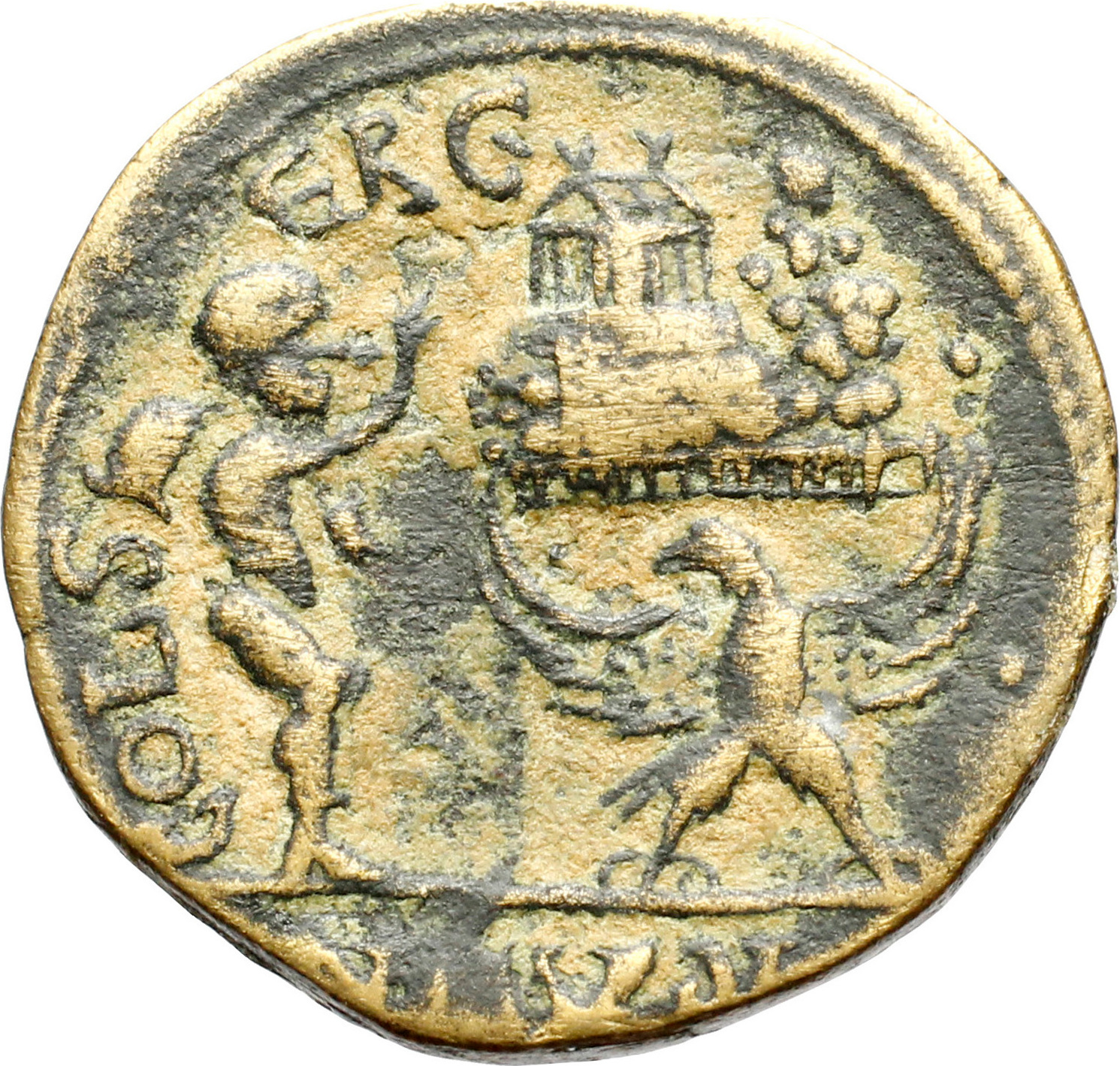
RPC VIII, — (unassigned; ID 2359), cf. all RPConline images of Mt. Gerezim. The sacred mountain is held on the back of the imperial eagle (common from Caracalla onwards), and here has the Marsayas statue that was in each colonial forum echoing the Marsayas in the Roman republican Forum. cf. RRC 363/1.






























 Liv Mariah Yarrow
