Tarpeia, comparative Etruscan iconography

This cinerary urn from the Copenhagen Glyptotek got me thinking:

The catalogue interpretation is that is a variation of the fatal duel with spirit as judge, usually taken to be Eteocles and Polynices. That type is common enough (see image below), but this dual sarcophagus seems to show a different narrative (as catalogue notes) notice beard vs. beardless and all the different head gear.

However that spirit coming from the Rocks in that top picture sure looks a lot like Tarpeia in some depictions….

Capture1Capture

Just be clear I don’t think the winged figure is Tarpeia but she and her ilk may be the model for Tarpeia iconography. I think it is likely given the snake with the winged central figure that she is a spirit of a particular place.

4 July 2021:

This intaglio also has that same design feel.  Torso emerging from rocks or shields

Capture

Republican Silverware Weights

Capture3

This hoard of silver is Tivoli and thought to be late republican in date.

You can go see it in the Met in NYC.

My interest (today) is in the reported weights and the inscriptions on one of the two cups and the ladle as reported in:

Oliver, Andrew Jr. 1965. “Two Hoards of Republican Silver.” Bulletin of the Metropolitan Museum of Art, 23(5): pp. 176–77.

CaptureCapture1

So if we do some math and are a little less sure that Roman pound was 327 grams exactly this is what the objects tell us about the ball park of the Roman pound.

Capture2

I don’t know how much is likely to be worn away from polishing or chemical reactions over time.  Both factors.  Another factor is I’m not so sure on the resolution of the number II P(ondo) seems clear but then I see IIS (2.5?) and then four dots follows by SC VII.  Not sure how IIS plus for dots = 11 ounces….

The precision must be performative, not just ‘theft’ prevention.  (We don’t see shaving of coins in the republic or Roman world generally).  I’m guessing these pieces may have been part of dowry for which an exact value was recorded and that the recording of the weight on the object is part of the performance of the fulfillment of that obligation.

The pitcher (oinochoe) from the Arcisate Treasure is also thought to be Campanian manufacture and 1st Cent BCE and also has a woman’s name.  It’s 350 grams and claims to be precisely a pound (BM 1900,0730.4):

Another that is hard to transcribe:

Capture1Capture2CaptureCapture3Capture4Capture5


Bibliography on other silverware with weight inscriptions

Late antique plate in Getty with large disparity between inscribed weight and reconstructed weight.

This MET mirror (Campania?  1st Cent AD?) is supposed to have a weight and owner’s name inscription, but I cannot see it…, ILL-ed Bibliography…

Q. Iunius Rusticus’ Weight (and friends)

CaptureCapture1

Exhibition Catalogue write up

Some smart tweets from Gareth Harney

So I would LOVE to see Zilberstein and Ben-Efraim’s method of reconstructing original mass applied to this object.

It’s a 10 pound weight from Rome with the name of a well known historical figure that can be dated with in a decade or so.  Balsalt also is far more stable than most other materials so if we can determine its original volume and then mass we’d have a very good idea about what the official pound weighed in Rome at this time!

It is in the Allard Pierson Museum, University of Amsterdam


BM 1966,0328.18 seems to claim that it is an “official” weight from the Temple of Opes (Wealth), but if so it would give a very heavy pound indeed, 356.8g!

Capture.JPG


Some bibliography on weights

A long time ago I wrote this in a draft of the book that has now been superseded by a very different version (without any real discussion beyond a footnote about the pound…word limits and all):

“Duncan-Jones uses the figure 322.8g for the Roman pound based solely on weights in the Naples collection.[1]  Other estimates are more wide ranging and often higher.  Crawford surveyed various estimates noting their different source materials – coins, stone weights, balances, metal weights – and in the end used c. 324g, with the caveat that it was not reasonable to assume “that the Romans were able to maintain the weight of their pound absolutely constant, at all times and in all places”.[2]  He conceptualizes the target weight standards for the precious metal coins as fractions of the Roman pound, 6 scruples for the didrachm, 4 scruples for the early denarius, sometimes falling to 3 scruples.[3]  A scruple was a fractional measure, 288 scruples in a pound, 24 in an uncia or ‘ounce’.[4]   One finds other scholars using other figures sometimes with no particular justification; so for instance, Heinrichs uses c. 327g without further comment in his discussion of Gratidianus’ reforms of 85/84 BC, a figure common enough in Late Roman and Byzantine studies.[5]

[1] Duncan-Jones 1994: 214-215; 1995: 110.

[2] Crawford 1974: 591.

[3] Crawford 1974: 3, 7, 11, and 34.

[4] The same vocabulary of was used by Romans to also discuss small divisions of land and time, so a scruple could also be 1/288th of a iugerum or 1/24th of an hour as well.

[5] Heinrichs 2008: 265-6; cf. Entwistle 2008: 39″

This morning I’m worrying again about want we can know or not know about the Roman pound and other weight standards in antiquity.  Riggsby does not concern himself with reconstruction of the weights itself but instead with how Romans thought about weights, which lends itself to very much to an idea about the futility of a search for a universal standard (2018: chapter 3).

I  also have some older posts on weights here on this blog.

All I really want to do in this post is record new stuff that might be relevant to a future write up on the topic.

Stone weights from Jerusalem! Not useful for ‘reconstructing’ the Roman pound, but certainly very useful for thinking about standardization in a community that had a cultural habit of regularly weighing.  Also what is the whole unit?  what are its standard fractions and multiples?  Along with linked article which is newer also:

Reich, Ronny. “The distribution of stone scale weights from the Early Roman Period and its possible meaning.” Israel exploration journal 59, no. 2 (2009): 175-184.

Abstract: In Jerusalem were discovered 525 measuring weights, which date from the 1st century BC and 1st century AD The study of 168 of them, in stone, reveals that Jerusalem is the main city of this region to include so many (elsewhere, they are metal), and they are concentrated in the private houses of the Temple district and in the residential area of the upper town. Although these weights could be used to weigh certain foods (eg meat), their usefulness was not primarily commercial but religious: it was a matter of weighing a tithe of food, offered by each household to the priest’s family.

Gill, David W. J.. “Inscribed silver plate from tomb II at Vergina.” Hesperia 77, no. 2 (2008): 335-358.

Abstract: Five items of silver plate from tomb II at Vergina are inscribed with their ancient weights. The inscriptions, using the acrophonic and alphabetic systems, suggest that the pieces were made to a drachma weight of ca. 4.2 g. This weight of drachma was introduced to Macedonia by Alexander the Great and does not appear to have been used by Philip II. The inscriptions on the silver add to the cumulative evidence provided by the cremated remains, black-gloss saltcellars, and iconography of the lion-hunt frieze, that tomb II was the final resting place not of Philip II, but of Philip III Arrhidaios and Adea Eurydike.

[Riggsby has a good discussion on why donatives/votives might have custom of precise weights recorded on them so that the divine or dead receiver not be ‘cheated’ of any of their fair portion. Good thematic connection with interpretation of Jerusalem weights, re: precision being about religious/pious scruples, pun intended.]

Hadad, Shulamit. “Weights from the Early Roman period at Ramat Hanadiv.” Israel exploration journal 57, no. 2 (2007): 208-210.

Abstract: Publishes seven lead and copper alloy weights from excavations of 2000-2004, of ill defined context but datable of the 1st century. 1st-1st century AD. AD according to the associated ceramic and glass. A weight of 28 g carries the Greek letter H, 8 (drachmas) = 30 g.

[Inscription is interesting, but assumption we know what  8 drachmas were ‘supposed’ to weigh seems ill founded.]

Alberti, Maria Emanuela, ed. Weights in context: Bronze Age weighing systems of Eastern Mediterranean : chronology, typology, material and archaeological contexts : proceedings of the international colloquium : Roma, 22nd-24th November 2004. Studi e Materiali; 13. Roma: Istituto Italiano di Numismatica, 2007.

From Weingarten’s AJAonline review the following jumps out at me:

“In Egypt there are no secure weights before the Fourth Dynasty, and most early weights are squared stones; the Old Kingdom Gold Deben (13.6–13.9 g) fluctuates by as much as ±7%.”

“While the main local unit at Ebla was the 7.8 g shekel at 60 units to the mina, Ascalone and Peyronel (49–70) demonstrate, from in situ weights in Royal Palace G, that units based on 50 and 40 shekels were also found—sometimes all three in the same room (L 3532).”

“Two weights from the cella of Temple N (dedicated to the sun-god Shamash?) suggest that the words “weight of Shamash” symbolically indicate a “correct” standard of measure with concomitant concepts of justice and rectitude.”

Mari during Zimri Lim’s reign: “Although based on the same unit, documents distinguish “weights of the king’s office” from “weights of the market.” The “weight of the city of Karkemish” is also mentioned, as is a set of weights belonging to a man named Burqân, who witnessed loans between merchants.”

Thera: “one large cone marked with a circle—the sign of an Egyptian deben—weighs 91 g, exactly a deben”

“An Old Babylonian copy of a Sumerian law attributed to Ur-Nammu, first king of the Ur III, boasts, “I standardized weight stones from the pure one shekel weight to the one mina weight.” Such standards were probably placed in the temple of Nanna in Ur; a number of inscribed weight stones were dedicated in this and other temples.”

Crete: “More than 100 copper ingot fragments from the artisans’ quarter suggest intentional division into Minoan fractions.”

[Again there is a tension between the seeking of precise standards and the observed variation.  More interesting than the modern interpretations of the variations are the ancient ways of dealing with the samevariation (i.e. identifying weights themselves and location, religious ‘guarantees’, regal posts of standardization… The last quote in bold may be good comparative evidence for aes rude.]

De Zwarte, Ruud. “On the use of the balance as a device for measuring commodities and the accuracy of ancient weighing.” Talanta  26-27 (1995): 89-139.

Abstract: An attempt is made to rectify the wide-spread misunderstanding regarding the adjustment of ancient weights and to demonstrate that a basic principle of mass measuring was already known in various parts of the world millenniums before our era.

This article on early Islamic weights is very certain about c. 324 based on weight of water volume in Byzantine times:

Capture.JPG

Capture1

[I will have to chase footnotes to find primary evidence; all the citations are too secondary literature.]

Steelyards are another means for finding local weight standards (link to article)

Capture.JPG

[Use of Michon as authority on ‘true’ weight of Roman pound is interesting… This number corresponds to Crawford’s highest quoted weight (1974: 591) and derives from the weighing of coins by Boeckh 1838.]


The Quadrigatus, Coarelli, and the “Scuola Inglese”

If you, like me, find the continuing scholarly conflicts over the dating of the quadrigatus a little confusing, I would like to recommend to you the following:

Bernard’s NC 2017 Review Article

It revisits not only

F. Coarelli’s Argentum Signatum Le origini della moneta d’argento a Roma (Rome, Istituto italiano di numismatica, 2013).
But also subsequent steps in the debate esp.
A.M. Burnett and M.H. Crawford, ‘Coinage, money and mid-Republican Rome. Reflections on a recent book by Filippo Coarelli’, AIIN  60 (2014), pp. 231-65
F. Coarelli, ‘Risposta a A.M. Burnett e a M.H. Crawford’, AIIN 60 (2014),  pp. 267-89.
On the interpretation of Janus iconography as reviewed by Bernard I would add:
BUT physical evidence should be given far more weight than iconography in dating.  Key points of the debate RE physical evidence:
  • How do you interpret two hoards from Selinunte (RRCH 58 and 61) in light of its destruction in 250 BCE?
  • And how does one interpret the Kerkouane single find in light of its destruction in
  • 256 BCE?

Bernard notes that interpretation depends on pre-supposition of scholars.  In the later case he emphasizes “a large cache of late Roman lamps near the sanctuary in which the quadrigatus was found” (p. 504 n. 8)

Key scholarship to which Bernard points includes:

On down-dating of RRC 22/1 to no earlier than 245 BCE: 
A.M. Burnett and A. McCabe, ‘An early Roman struck bronze with a helmeted goddess and an eagle’, in L. Sole and S. Tusa, eds,  Nomismata, Studi di numismatica antica offerti ad Aldina Cutroni Tusa per il suo novantatreesimo compleanno (Ragusa, 2016), pp. 238-74.
On the minting of Quadrigati in Spain and Apulia:
P. Debernardi and O. Legrand, ‘Roman Republican silver coins of the Quadrigatus Period struck in Spain’, RBN 161 (2015), pp. 273-92
P. Debernardi, ‘I quadrigati apuli’,  Notiziario del Portale Numismatico dello Stato 8 (2016), pp. 94-117.
On the use of Spanish silver to strike quadrigati, including the early type found in RRCH 58:
F. Albarède, J. Blichert-Toft, M. Rivoal, and P. Telouk, ‘A glimpse into the Roman finances of the Second Punic Was through silver isotopes’, Geochemical Perspective Letters 2 (2016), pp. 127-37.
On Roman use of Spanish Silver in Historical Context:
C. Rowan, ‘The profits of war and cultural capital: silver and society in Republican Rome’,  Historia 62.3 (2013), pp. 361-86
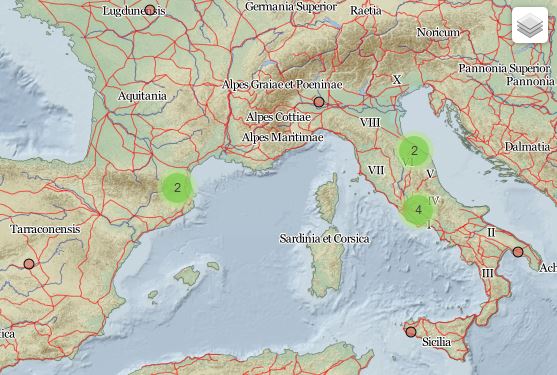
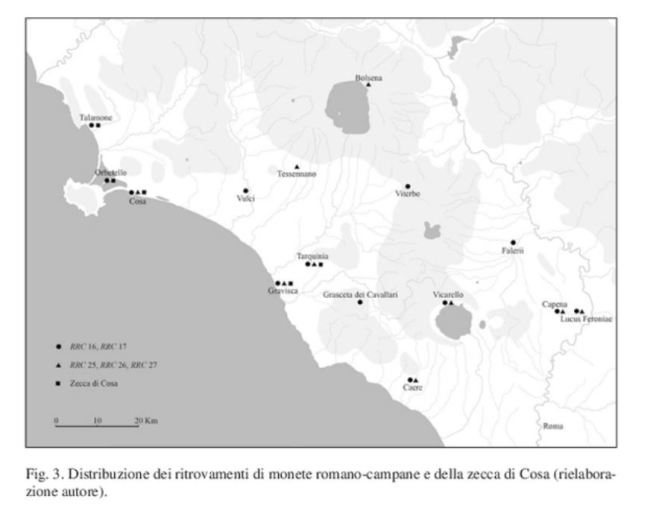
He also maps hoards containing one or more quadrigati, evidence on which Coarelli is very pessimistic (cf. Coarelli, ‘Risposta’, pp. 268-9, full ref. above):
CaptureCapture1
He interprets this distribution as follows (p. 508):
Capture.JPG
Bernard goes on to review  mid-third century hoards from which quadrigati are absent BUT with otherwise contain Roman coins (Basilicata 1860, San Martino in Pensilis, Ponte Gini near Gattaiola [a scatter hoard], Nora; p. 509-510).
p. 510-513 reviews historical context of 3rd century and Roman coinage, a topic on which Bernard has much expertise and has published widely, see his book and JRS 2018 article.

A Highly Precise Set of Weights

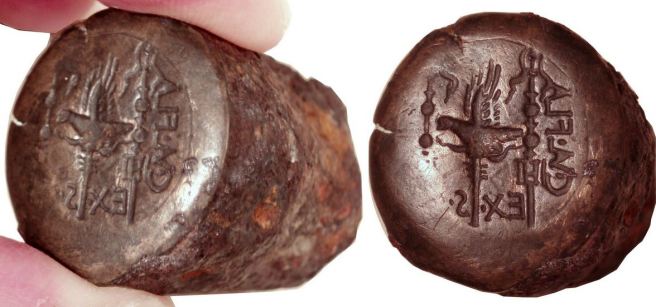
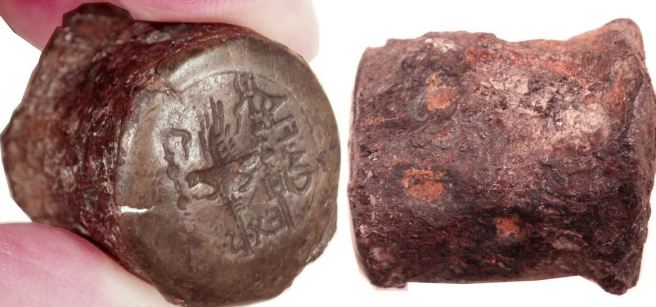
Things to notice regarding this Praeneste find from 1907 excavations:

Q – likely stands for Quaestor as on coins

The per ‘pound’ basis of each ‘denomination’ is as follows:

X – 327.4

V – 327.4

III – 327.433

II – 327.45

… – 327.44

.. – 328.5

. – 328.44

The basalt is much more resistant to corrosion than similar metal weights.

Location of Piazza in relationship to sanctuary:

Capture.JPG

View of back of cathedral from sanctuary of Fortuna, again to show relationship of find spot to sanctuary.

https://assets.atlasobscura.com/media/W1siZiIsInVwbG9hZHMvcGxhY2VfaW1hZ2VzL2U1NGVlMTI0LTZkZTEtNDIyYy1hZGZhLTk3NjIwNjc0ZWVjZGZmN2M1YTA0ZjZmMzNiZWM3NF9QYWxlc3RyaW5hQXRsYXNPYnNjdXJhICg0IG9mIDExKS5qcGciXSxbInAiLCJ0aHVtYiIsIngzOTA-Il0sWyJwIiwiY29udmVydCIsIi1xdWFsaXR5IDgxIC1hdXRvLW9yaWVudCJdXQ/PalestrinaAtlasObscura%20%284%20of%2011%29.jpg

View the other direction.  Note shadow of cathedral bell tower to orientate yourself:

scala_archives_10310474338

fortuna-in-tasca_orig

Aes Rude and Aes Grave, Praeneste Finds

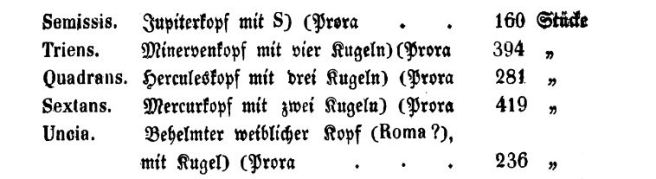
Two more bull/prow aes grave semisses have come to light at Praeneste in archaeological contexts and  are now on display in the museum.  This is HN Italy 359 = Vecchi 276 = Haberlin, pp. 157-158 (specimen in trade, second specimen in trade).  Thomsen ERC III: 149-150 thought these might be Roman aes grave but this has not been accepted by others.  Vecchi notes a weight range of 167.96-118.20g.

Previous finds were Praeneste prior to 1893 and the Ariccia 1848 hoard (c. 28 km SW of Praeneste, ~6 hour walk due to elevation changes).

Now with THREE pieces found at Praeneste, I think we should assume that it the place of manufacture until further evidence comes to light.

The other major thing to note is the regular use of aes rude in Funerary Contexts.  This was already observed in the 1907 excavations (see AJA 1908 summary below), but is now reconfirmed by the 2007 finds.

It seems that these aes grave may also be from funerary contexts as they were unearthed in the same Colombella excavations. – private correspondence with the excavator suggests the aes grave was NOT from a burial context.

img_0994

AJA 1908 report.

Vaglieri 1907 full details.

Capture.JPG

Update 1/12/23:

Possibly relevant bibliography for such finds:

Parente, Anna Rita. “La Lucania: necropoli e monete : (V-II secolo a. C.).” In Caronte: un obolo per l’aldilà, Edited by Cantilena, Renata., 276-288. Napoli: Macchiaroli, 1995.

Presence of coins in the grave goods of Greek and indigenous Lucanian necropolises. The phenomenon is recurrent in the Greek context, where the coin placed in the tomb probably has the symbolic function of a prestigious asset, in the manner of the obeloi and the aes rude (traditionally interpreted as pre-monetary objects). In the indigenous sphere the phenomenon is very rare and perhaps limited to cases of emulation of the Greek funeral practice

Ap. Claudius cos. 130 BCE, MONEYER?!

Capture.JPG

The traditional interpretation of this inscription makes it in honor of C. Claudius, moneyer of RRC 300.

But this article upsets that (full original pub on order from ILL) This is AE summary.

Capture.JPG

Machine translation cleaned up by moi.

“This article proposes that the name of Ap. Claudius Αρ. f. C. n. Pulcher, consul in 130 BCE, be restored instead of that of C. Claudius Αρ. f. C. n. Pulcher, consul in 92 BCE. Both were co-consuls with an M. Perperna. But Gaius, whose praetorship dates back to 95 BCE, was not praetor repetundis but praetor peregrinus and the curator uiis sternundis or uiarum curandarum is in better agreement with the chronology of Appius’ career. The family tree of the Claudii Pulchri reconstructed by Münzer is corrected as follows: the consul of 130 BCE would not be the son of the homonymous consul of 185 BCE (eldest son of Ap. Claudius Pulcher, consul in 212 BCE); he would be the grandson of the third son C. Claudius Pulcher, consul in 177 BCE.”

Some points that are very interesting to the numismatist:

1)  If this is true, then the title triumvir aere argento auro flando feriundo goes all the way back to the mid second century.

2) We don’t have a named coinage from the right date stuck by a Claudius.  Candidates for Appius issue would are limited and as follows:

Capture2.JPG

The argument seems to hang on whether Cicero’s Verrines is proof he was praetor peregrinus.

Capture.JPG

C. Claudius Appi filius pulcher praetor de senatu cooptando leges conscriberet.

Brennan (2000: 237) is pretty certain about the timing of the creation of the title praetor repetundis and it is too late to be held by the cos. of 130…

Capture.JPG


How to be (or not be) on the job market?

I haven’t been on the market for ages, but here is a crack at some compassionate advice.  This post is in response to a tweet thread by Mark Letteney.

1. Getting a job won’t make you a better person.  It might not even make you a happier person. It certainly isn’t a reflection of your self worth.  Also, there is no right or wrong kind of job–except, of course, the right job is the one that keeps the wolves away and that doesn’t eat your soul and the wrong job is the opposite.

2. Write down somethings you like about yourself and tape it up above your desk next to a big sign above your desk: ” today and in the future I just need to keep the wolves at bay and feed my soul.” (Don’t skip this step: you’ll just have to do it later and it may be harder then.)

3. Okay.  Now go read job postings.  Don’t limit yourself to just one major search engine or professional placement service.  Diversify where you are looking and ask mentors and friends for help in this.

4. Decide how broadly it is right for you (and your dependents/partner(s)) to apply; cross out jobs you can’t accept for whatever reason. [pay too low? ethics of institution too different from your own? too short a contract for too hard a move?]  If this is hard, it is totally normal to talk to mentors and friends about these choices.  If someone starts pressuring you to apply for things that aren’t right for you, smile politely and walk away.

5. Create a timeline of deadlines and also self imposed deadlines, like how much time mentors and supportive friends need to read your cover letter and CV and help you catch stuff you missed.  Pre-circulate your materials to your letter writers in enough time for them to give you feedback and for you to integrate your feedback.

6.  How to write a cover letter [a template]

7. You should probably read those signs above your desk and do something nice about now.

8. For each job app tailor your cover letter and CV.  Do this by re-reading their job posting and also their own website and other promotional material.  Look for key phrases and ideas that you can reflect back to them without completely rewriting the materials.  If this is hard, reflect on why that may be.  Have a conversation with a mentor/friend about it.

9. Wait. You should probably read those signs above your desk and do something you genuinely enjoy about now.

10.  No interview requests? Keep applying.  Ask colleagues if they know about any likely upcoming opportunities.  Think broadly about what type of job might keep the wolves away and not eat your soul.

11. Interview invite? Time to do you research–this is not just online!  After you’ve got the lay of the land of public facing portion of the department.  Hit the rumor mill.  No, not the evil websites, never that.  They will just make you depressed.  I mean friends of friends. Who is the youngest person they hired?  What year?  Do you know anyone who was on the market that year?  What you really want is someone with some experience about the interview style of the department.  Free-for-all?  Structured questions?  Appropriate?  Random? Testing? Friendly?  You can’t control what the interview is like but the more you know the more likely you are to preform your best.

12. Once research is done or done-ish, it’s time to start creatively brain-storming what you’re going to bring to the table.  Think about generating some 12 anecdotes that show you in your best light.  They should cover a range of topics: exciting pedagogy, research, overlaps between research and pedagogy AND demonstrate breadth, and depth, and any key aspects mentioned in the job application.

[This is also my standard advice for prepping for oral exams.  You need discrete examples you know well and that you can flexibly deploy in conversation to illustrate a variety of topics/themes.  For instance, I love the bilingual footprint roof tile from Pietrabbondante and can talk about till the cows come home or I adore Julian and Augustan adaption of the republican forum and actually drew out diagrams in interviews to show evolution or I can wax poetic about how Batman is super useful for teaching the function of mythic retellings as a reflections of contemporary society.  What are your favorite gems?]

13. Mock interview.  Share your research on the institution and their interview style with a colleague/mentor, ask them to lean on their network to find 2-3 people who will interview you, ideally people you don’t know well and are a little senior.  Your goal is to be comfortable enough with your 12 anecdotes and general self confidence to adapt the material on the fly to new questions, without failing to answer the question.

Do not be afraid of re-articulating the question back to the interviewers and clarifying that they are trying to get at what you think they are looking for!

14. Stop talking to anyone who makes you feel insecure.  Mute them on social media.  And generally work on feeling awesome about yourself, your work, and also your general engagement with the field.  What have you read lately that got you excited?

15. Wear whatever makes you comfortable to the interview.  No really.  But remember that formal attire can, for some, feel like a suit of armor, psychic protection against the experience.  I like to think of it as a costume one wears to preform a piece of theater.  If choosing an outfit freaks you out.  Delegate the choice.  It is one of the few things someone else really can do for you in this long experience.

16. Remember the basics: eye contact, posture, body language, active listening.  Perform the person you want them to see and ideally you want to be (and probably already are even if you don’t know it in your heart yet.)  Think of yourself as already hired and these are your new colleagues.  Treat it like your first day of work and you really want to learn as much as possible so you can succeed at the job.  Ask questions and in those questions and your answers demonstrate your knowledge of their institution.

17. Send a thank you email.  Be brief, don’t gush.  If you skip this step it isn’t the end of the world.

18. Wait. Avoid rumor mill, esp. online.  Double down on your best support network.  You should probably read those signs above your desk again and do something you genuinely enjoy about now.

19. Getting a job won’t make you a better person.  It might not even make you a happier person. It certainly isn’t a reflection of your self worth.  Also, there is no right or wrong kind of job, except of course the right job is the one that keeps the wolves away and that doesn’t eat your soul and the wrong job is the opposite.

20. Be good and kind to some one else on the job market.

21. Give yourself permission to take days off from being on the market–even if you have applications out there. Wake up and say “today I am not on the market”.  Turning off email for 24 hours is not the end of the world.  We all need a mental break.  Make space to feel what it means to not be on the market and to just be you.

The Constitutional Crisis of 52 BCE

53-52 BCE is a scary year for Rome.  Violence meant elections weren’t held.  Pompey took on a sole consulship and for a time it looked like that was the end of the principle of collegiality in the highest magistracies.  It’s hard to imagine what living through that was like.

One window is offered by perhaps my favorite coin (RRC 435/1) which is rich anti-regal sentiments.

BUT look at this chart of tesserae numularia:

Capture.JPG

The move from interrex to sole consulship to finally the appointed colleague.  Ordinary business goes on but they need to find new ways to think about naming the year and counting time by consuls.

Link to article with chart.

Bonus coin image.

Capture1.JPG