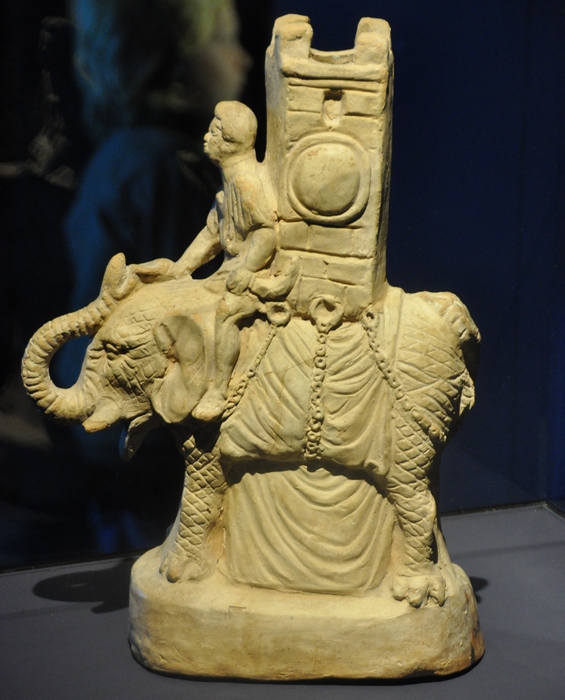
“VI.15.5 Pompeii. Clay figurine of an elephant carrying a tower on its back, 0.35m high incl. base. The figurine served as a vessel for liquid. The liquid was put in through the top of the tower, which was open. See Notizie degli Scavi di Antichità,1897, p.25, fig. 3. It was found in October 1895 in or near the garden niche, together with a group of other objects. See Notizie degli Scavi di Antichità,1895, p. 438. According to Jashemski, this was also a jug, and was now in the Naples Archaeological Museum, inventory number 124845, Ruesch 442. See Jashemski, W. F., 1993. The Gardens of Pompeii, Volume II: Appendices. New York: Caratzas. (p.155)” – quoted from Pompeii in Pictures
Update 9 April 2026:
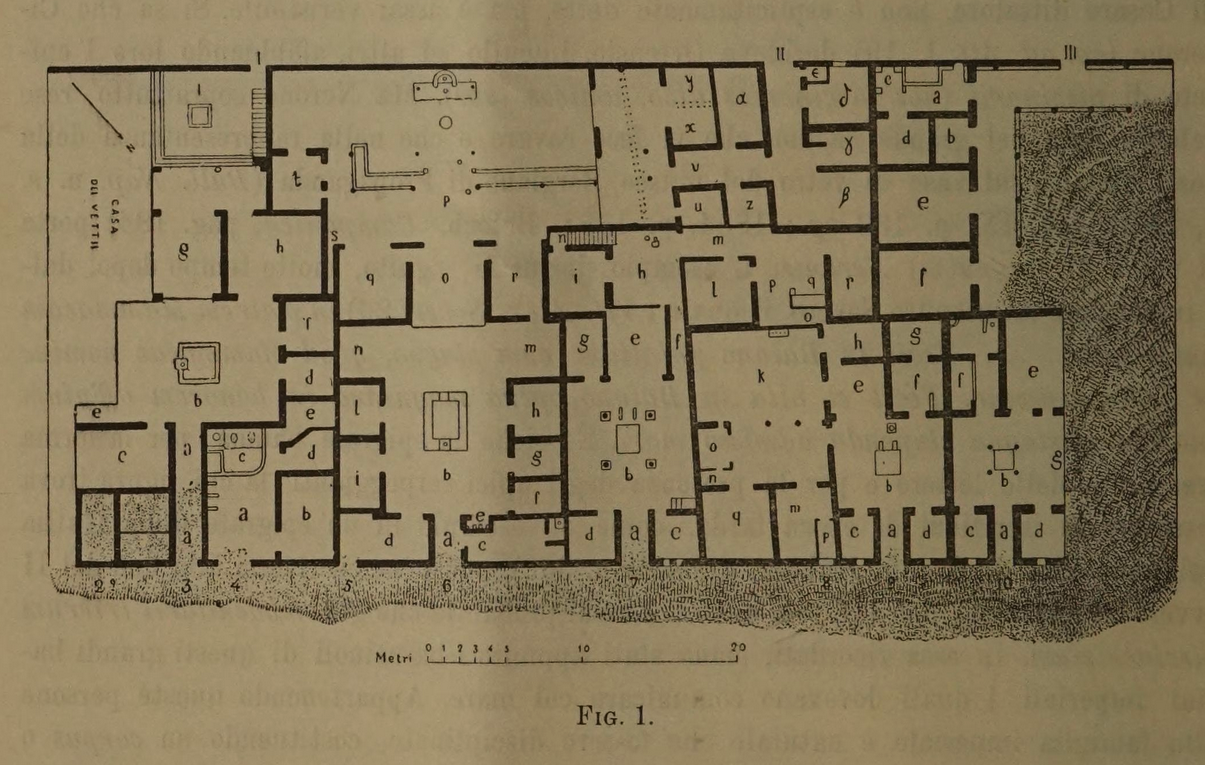
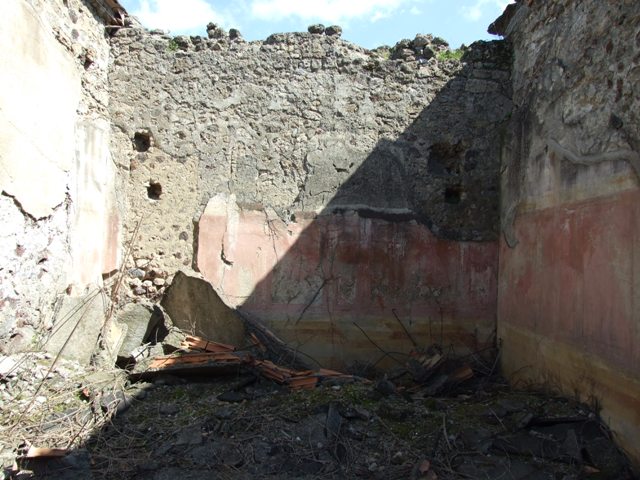
The niche against the back wall of P is the approximate find spot.
Machine translation:
“Along the eastern side—and that aforementioned section of the southern side—runs the rainwater channel, unusually wide and lined with red plaster. Originally, the peristyle most likely housed a masonry *triclinium* (dining couch), surfaced with *opus signinum* and sheltered by a pergola supported by small octagonal columns clad in green stucco. Subsequently, during a renovation of the house, the masonry *triclinium* was demolished; only a portion of the western couch remained intact, serving as a solid base upon which to rest the walls of a vaulted niche—complete with a small pediment—which, having been decorated (perhaps at a later date) with shells and mosaics, was destined to become a fountain. Still standing there today is a handsome travertine wellhead—fluted and capped by a slab of *bardiglio* marble—and, situated directly in front of the niche upon that same solid base, a circular masonry *monopodium* (pedestal), surfaced with stucco imitating *giallo antico* marble and adorned with moldings and a relief decoration of small leaves, likewise executed in stucco.
“Within the niche just described—and in its immediate vicinity—a group of sculptural works came to light in October 1895; this assemblage is not without significance, both for its overall composition and for the subject matter depicted in some of its individual pieces (cf. *Notizie* 1895, pp. 4388 ff.)
….
“Terracotta statuette; total height (including base): 350 mm. An illustration of this piece—reproduced here from a photograph—is provided in Fig. 3. It depicts a striding elephant bearing a tower upon its back, ridden by a Moor. Upon the elephant—whose back is draped in a broad housing that descends beneath its belly all the way to its feet—rests a quadrangular, crenellated tower. This tower is secured to the animal’s back by means of three chains, fastened to six rings embedded at the base of the tower (three on each of its two sides); of these chains, the first encircles the elephant’s neck, the second its belly, and the third its hindquarters. Each of the tower’s lateral faces features a large round shield, surmounted by a small window. Riding in front of the tower—positioned almost directly over the elephant’s neck—is a Moor clad in a short tunic; holding a sickle-like implement in his left hand, which rests against his corresponding thigh, he extends his right hand to offer food to the elephant. The elephant has curled its trunk backward to grasp the food with its tip, which is shaped like a serpent’s mouth. The elephant’s tusks are broken, and the Moor’s head has been reattached; the statuette shows signs of damage in several places. It also served as a vessel, with liquid being poured into it through the top of the tower, which remains open.


That’s fascinating. I have never seen anything like it. You have a tower with a Macedonian shield emblem (lots of study of those, as arch. decoration like that, specifically), but standing for what? Tower as an entire city? Maybe not necessarily. Makes me re-think the elephant as a symbol in that world for sure.