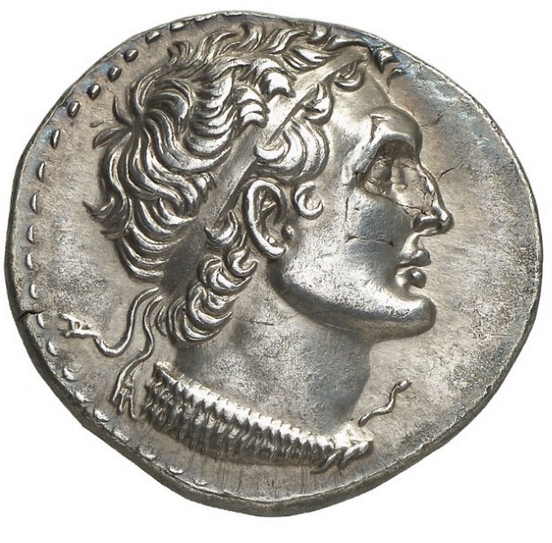
I love this banded intaglio in the BnF–its just so beautiful. I’m not sure why the catalogue identifies it as Alexander of Epirus. What struck me about it was how the portrayal of Alexander (the great?), echoes that on Ptolemy’s coins.
The BnF identifies this as a portrait of Ptolemy VI Philometor. The portraiture of this king isn’t straight forward. Two gold rings in the Louvre are associated with him (no. 1, no. 2). The two rings look much like each other but neither looks like the above intaglio. There is also one stone head (again in the Louvre) so identified, but it too looks pretty different. The intaglio does have a passing resemblance to some of the obverse heads on the tetradrachms of Philometor BUT typically this head is associated with Ptolemy I Soter.linklink
Just an interesting picture to enliven the post, no real connection. (source)
Once a year Cato (Agr. 83) suggests males on the farm go into the forest in day light and dedicate the following to Mars and Silvanus and then consume it all immediately. This amount is determined per head of oxen so a normal team would be double this.
3 (Roman) pounds Emmer
4.5 (Roman) pounds fat
4.5 (Roman) pound lean meat
3 sextarii of wine
Leaving aside the wine for now. How much food is this?
About …
3,285 calories of grain
13,151 calories of animal fat (assuming it is mutton)
4,111 calories of lean meat (assuming mutton)
Total:
20,547 calorie feast
Estimates for average US Thanksgiving dinner consumption range from 1600 to 4000+ calories per person. So even with guests getting well and truly stuffed, this feast would feed 10 men easily, with more reasonable proportions 20 some men could still partake in a whole meal, as there can be no leftovers it seems.
20+ men per oxen team however seems rather a lot of men.
Perhaps I’m over stretching the logic but Cato’s various recipes and their proportions do imply a certain scale of consumption.
By contrast that is only the rough equivalent of two bottles of wine. At a real stretch enough for 8-12 people to have just one serving of wine. Not a huge amount compared to the food quantity.
Poking around at other in the near by text, his recipe for placenta a baked dough dish with many thin layers calls for eight pounds total of grains (6 of flours, 2 of groats). That much grain in the modern kitchen would easily make 3 large loafs of crusty bread and contains some 9,434 calories. It’s a big recipe, especially given the fact it appears to be a special occasion food, not one consumed as a staple. Generous portions of this dish might be served up to 10-20 people.
n.b. I personally like Andrew Dalby’s Cato, On Farming (De Agricultura). A Modern translation with Commentary. Pp. 243, 11 ills. Totnes: Prospect Boo. ISBN: 0907325-80-7
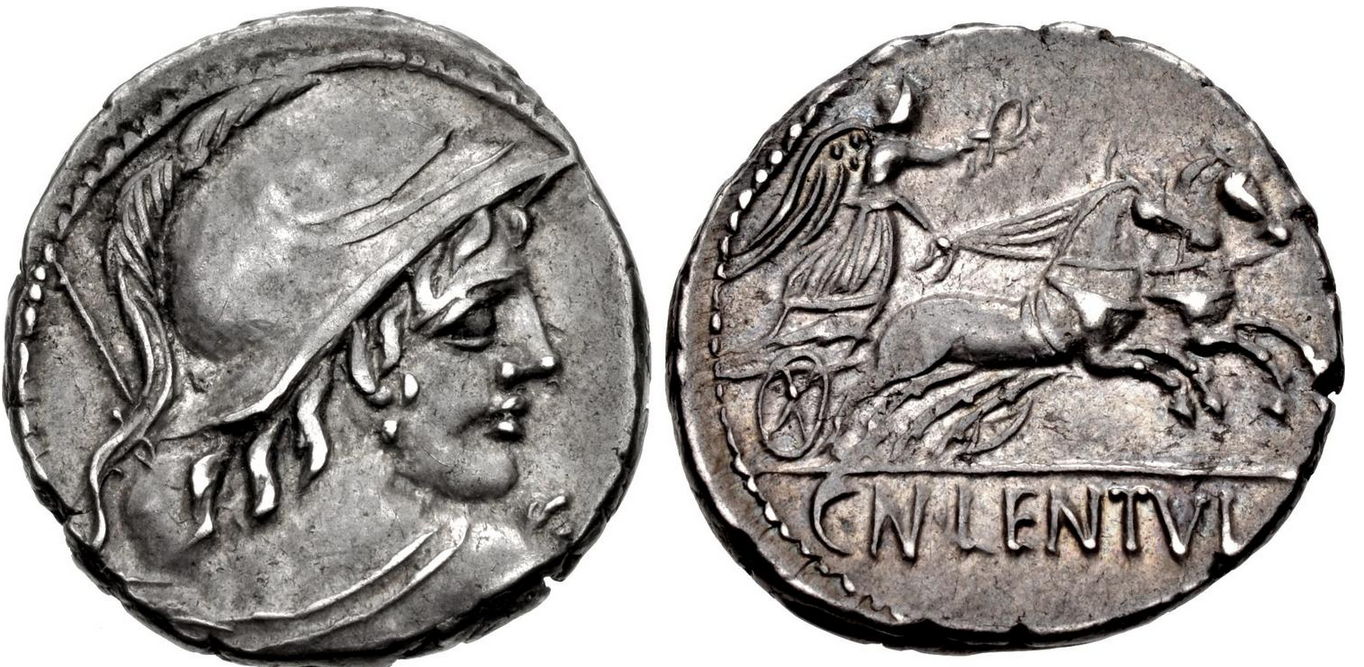
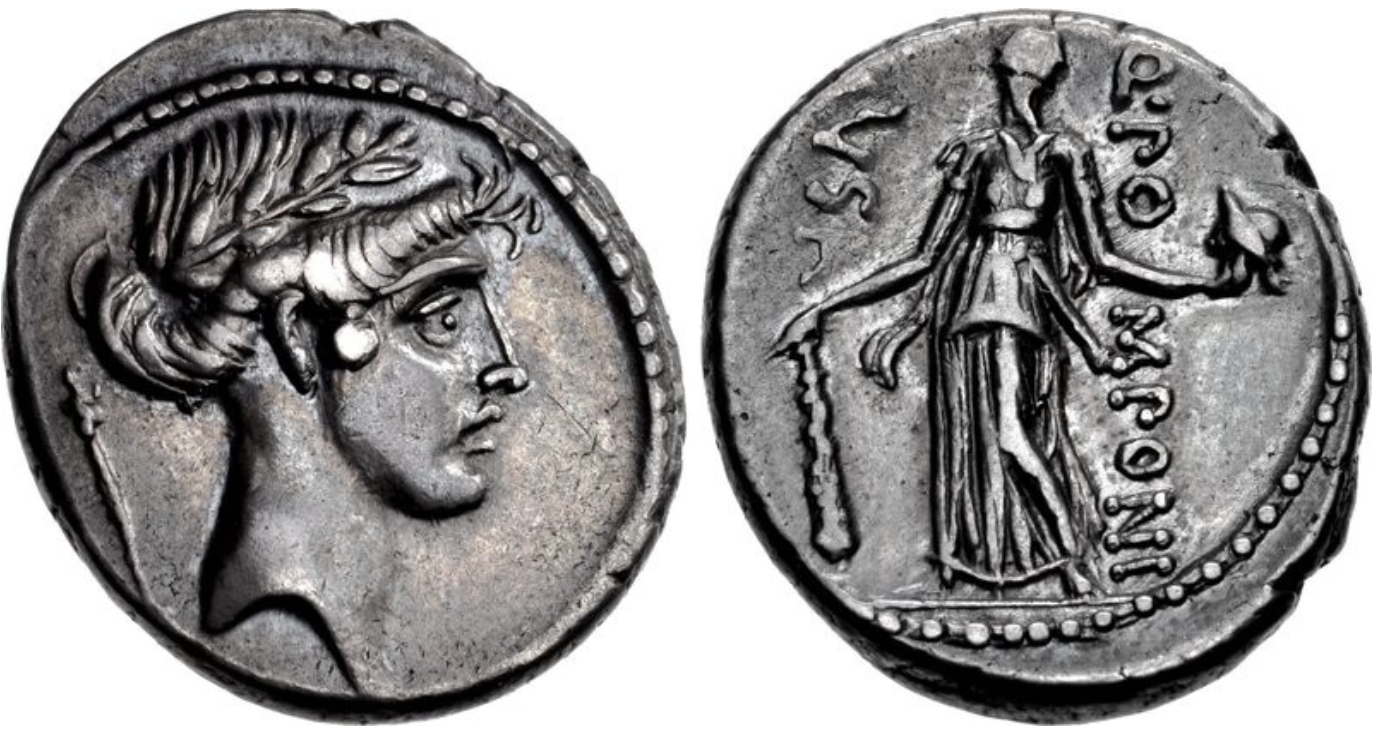
Coming across a specimen of RRC 345/1 made me think of this blog post from last year. I’m even more confident that RRC 388/1 has Mars on the obverse not Roma.
It was an honor to appear on The Partial Historians, a Roman History podcast based out of Australia. I’ve not listened to the recording, but you’re welcome to do so. If I made any gross errors, feel free to tell me in the comments.
This issue from the latter part of Sulla’s dictatorship has control numbers in two series. One series, like the specimen above, has Roman numerals I-CLXX (Crawford thought this series one went to 169, rather than 170). The other series (illustrated below) has Roman numerals preceded by the letter A and a dot (interpunct). Crawford thought this series had only one die for each control mark like the earlier series and ran as high as CXXVIIII (129). However the Schaefer materials suggest this series only runs to 113 AND most numbers up to 36 are known from two dies.
My working theory at the moment is that they started over at some point a second A series and that were only one A-# die is known for a given number that is equivalent to a missing die in one or the other series.
Why do I care? I’m reviewing all the numbered issues for a talk in Chicago in early June using Schaefer data as a data set that can be used to check and possibly refine of Esty 2011. I’ll release all my spreadsheets/die counts after the paper is delivered and of course the Schaefer images are publicly available and all the ODEC issues are slated for transcription if they’ve not already been done.
If you read this thread you’ll see I ask for more details and context and start chatting with Dr. Peter Cambell. He kindly sent me a relevant publication. The Soprintendenza del Mare and RPM Nautical Foundation are doing truly ground-breaking (or should I say sea parting?!) work.
More coins however have been found and are awaiting publication, more Punic but also Roman and Greek. Needless to say I’m over the moon a the thought of getting some well dated archaeological provenance for any mid 3rd cent BCE Roman coins, possibly game changing.
The Edagi finds have inspired one of my articles already, not to mention many blog posts. The other part of this paper that really excited me was the tabular representation of the data on the Rams regarding inscriptions and decorative elements (p. 172).
As I’ve said elsewhere use of the verb probare in the inscriptions is our best clue for understanding this same type of inscription on Italic bronzes of the period (my 2021 book p. 11 fig. 1.6).
The Sestius Salonius Ram with Rosettes approved by the board of six men remains unique in all these features. I was discovered by fishermen, not by the archaeologists. It is looking more like an outlier as we find more Rams with good provenience associated with the battle.
As many as seven rams have the helmet design and four Victory. Its also interesting to see the recurrence of Quaestors. This suggests a rapid period of creation of these rams consistent of course with the war effort and our literary testimony. I’m also intrigued that Quinctius worked on his own (common for coins later signed by quaestors), but Populicius and Paperius seem committed to signing together as colleagues (echoing Roman commitment to collegiality in elected offices e.g. the consulship and censorship).
I’d very much like to compare the eagle sword imagery (Ram 12) and the swords imagery (Ram 19) with designed found on Roman coins (esp. currency bars, so-called ‘aes signatum’). As far as I can see detailed images of these two Rams have not yet been released (one official website; another official website). Below is what I found on the internetz.
Emory 2008.031.023 (Ex coll. Michael Shubin (1950-2008), Montebello, California, acquired June 11, 1993.)
This glass paste intaglio is borrowing and adapting iconography from the below coin type (RRC 452/2). Notice that the thunderbolt has been transformed into an anchor and a spear added to the design. The carnyx is rather indistinct but wolf head axe is clear. The intaglio is mirror image in lay out.
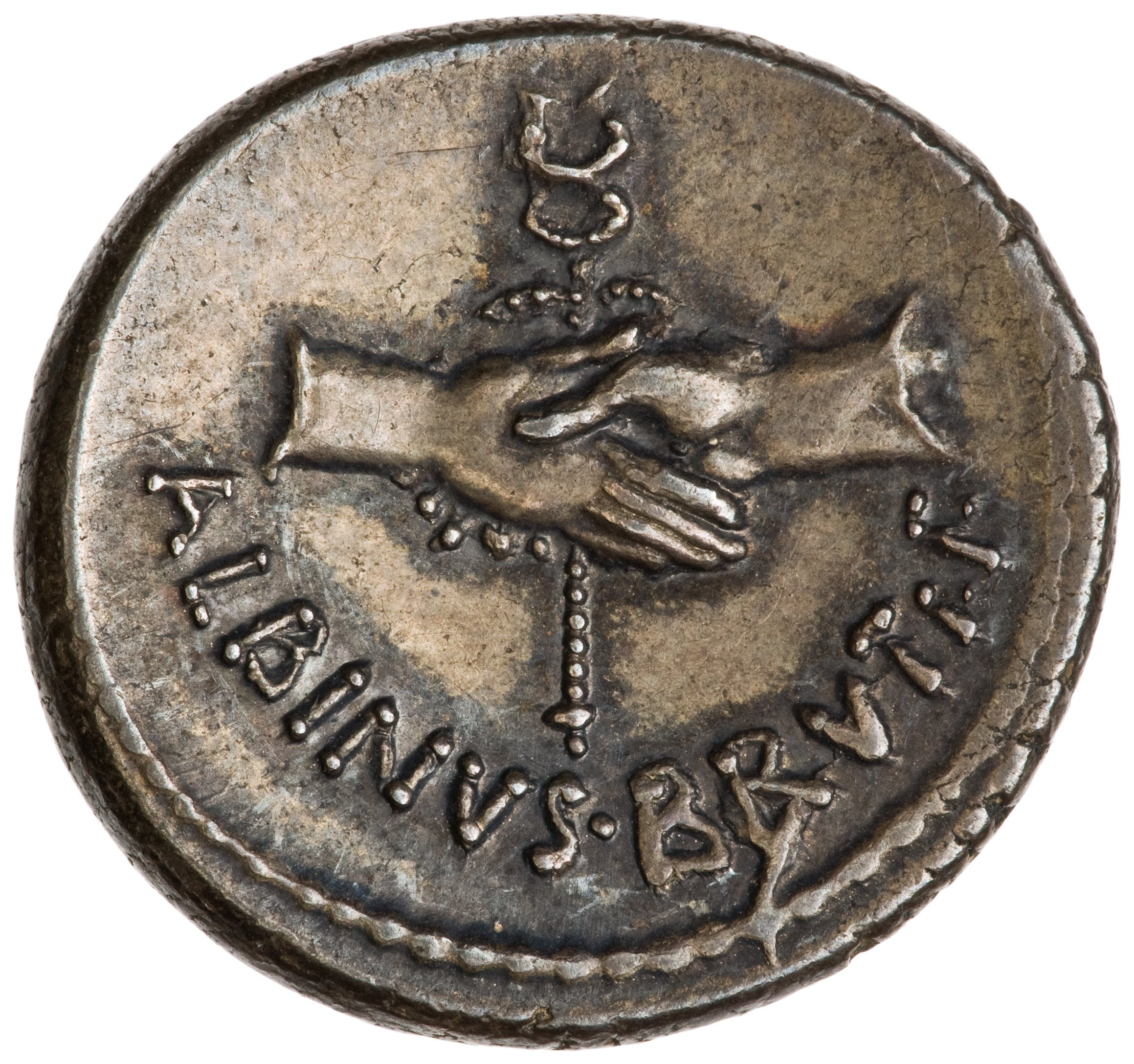
The name Caesar has been replaced by clasped hands (likely representing ideas of fides, pax, pietas, concordia, etc…). Caesar was also the first to inspire this imagery on Roman coinage. Below I give an example of RRC 450/2, but 451/1, 480/6 and 480/24 also have the clasped hands.
All in all a very nice addition to evidence discussed in my 2018 article on this type of glass paste and the influence of numismatic imagery.
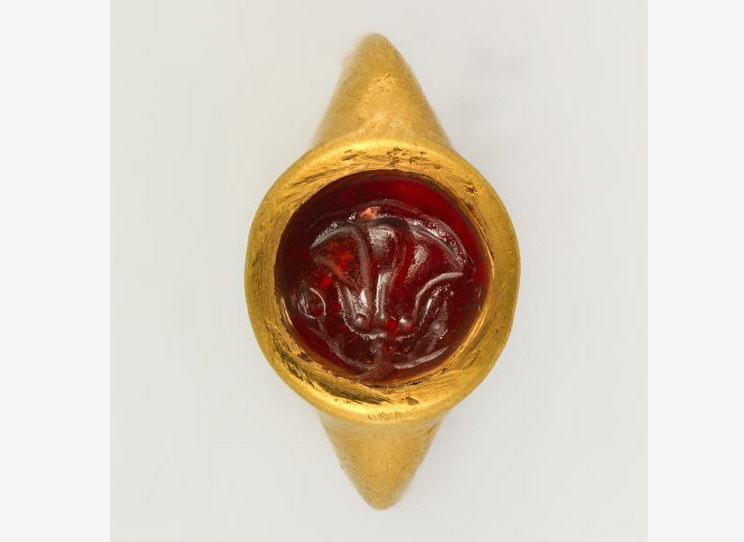
A small gold medallion, perhaps jewelry or decorative element: 2.1 cm; 1.06 g. Louvre Bj 31
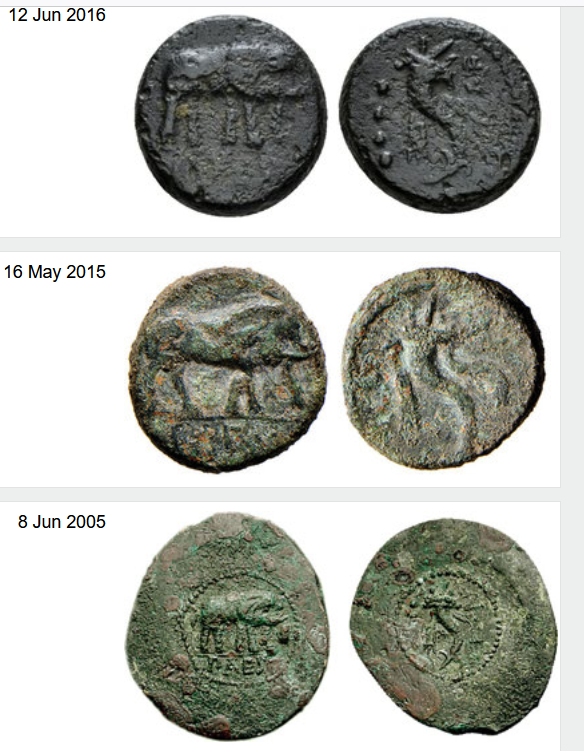
Because this object is stamped the curators speculated that it might have been created using the impression of a coin. The inspiration is clearly elephant type from Paestum, but gold-piece doesn’t look anything like specimens I’ve seen. The gold elephant looks more Indian and the bronze coins more African. Also I’ve just never seen a Paestum bronze in that good of condition. Crawford, Paestum 21/2; SNG ANS 777; HN Italy 1230.
N.B. I don’t have F. Carbone’s books to hand to see if he says anything interesting on the type.
I was making a silly fun morning tweet thread. It’s my habit if I need to wake up my coin brain and remind myself I love my job, but I don’t tend to put anything ‘serious’ in them.The danger of course is that I see something that I want to follow up on. So here’s a blog post to shake it out of my brain.
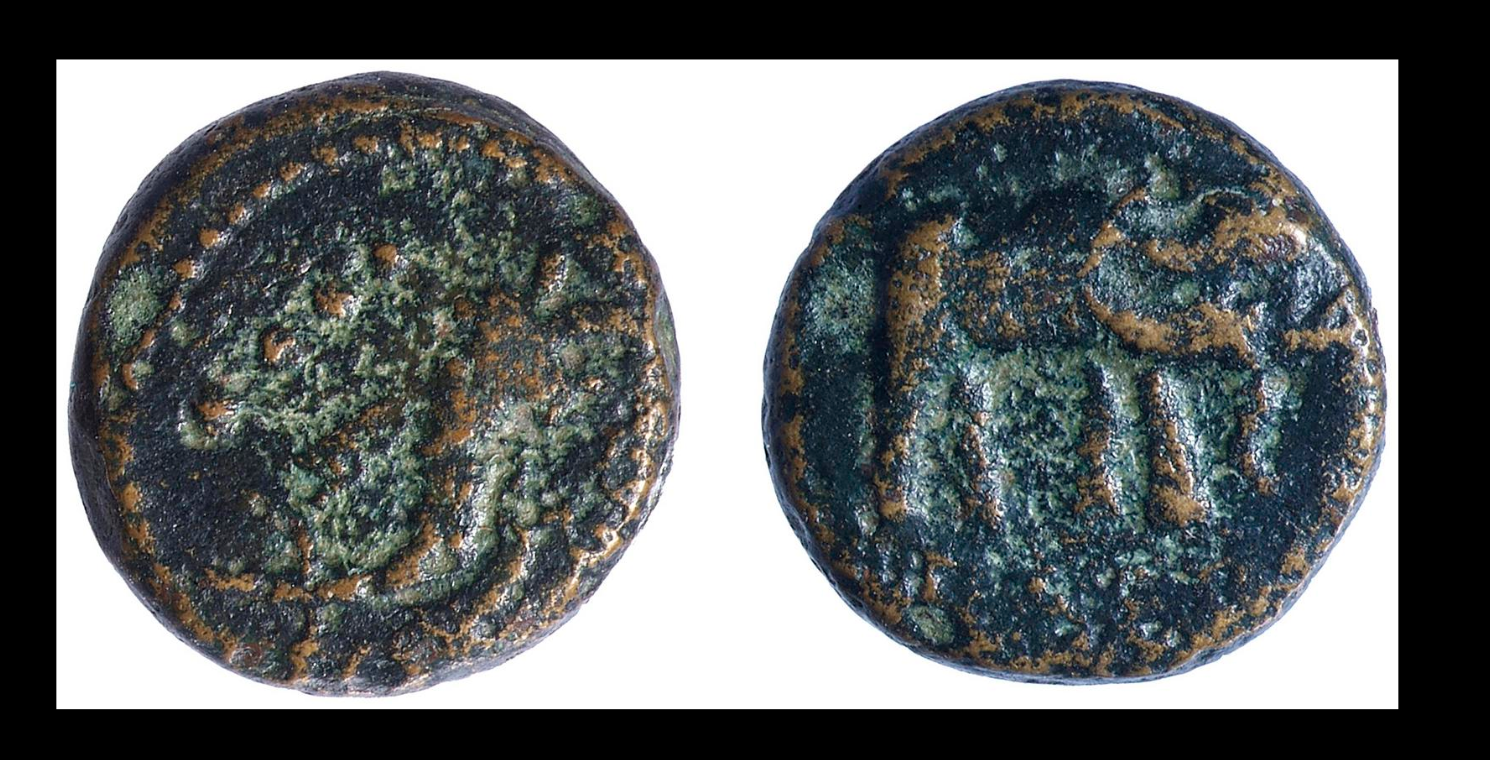
The offending coin is from Prostanna in Pisidia (see thread for a little more on this obscure mint).
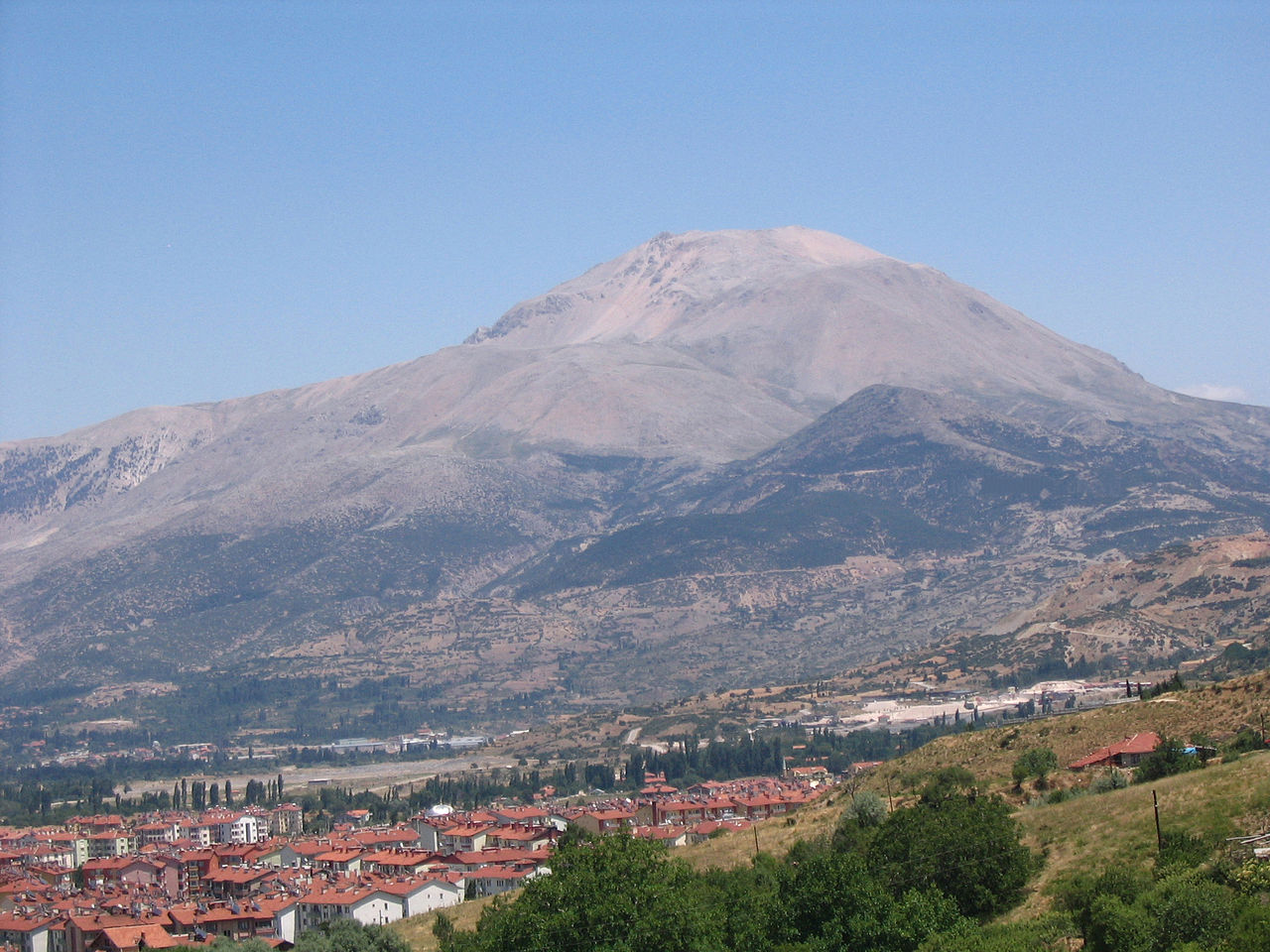
It’s really not that mysterious, once I sorted through the headaches of the various transcriptions and spelling variations. The exergue reads OVIAPOC and the type description changes this to an Anglicized rendering Mount Viaros. I did eventually work it out. Its modern name is Davraz Dağı (or Tepe), and it has a commanding presence in the regional landscape.
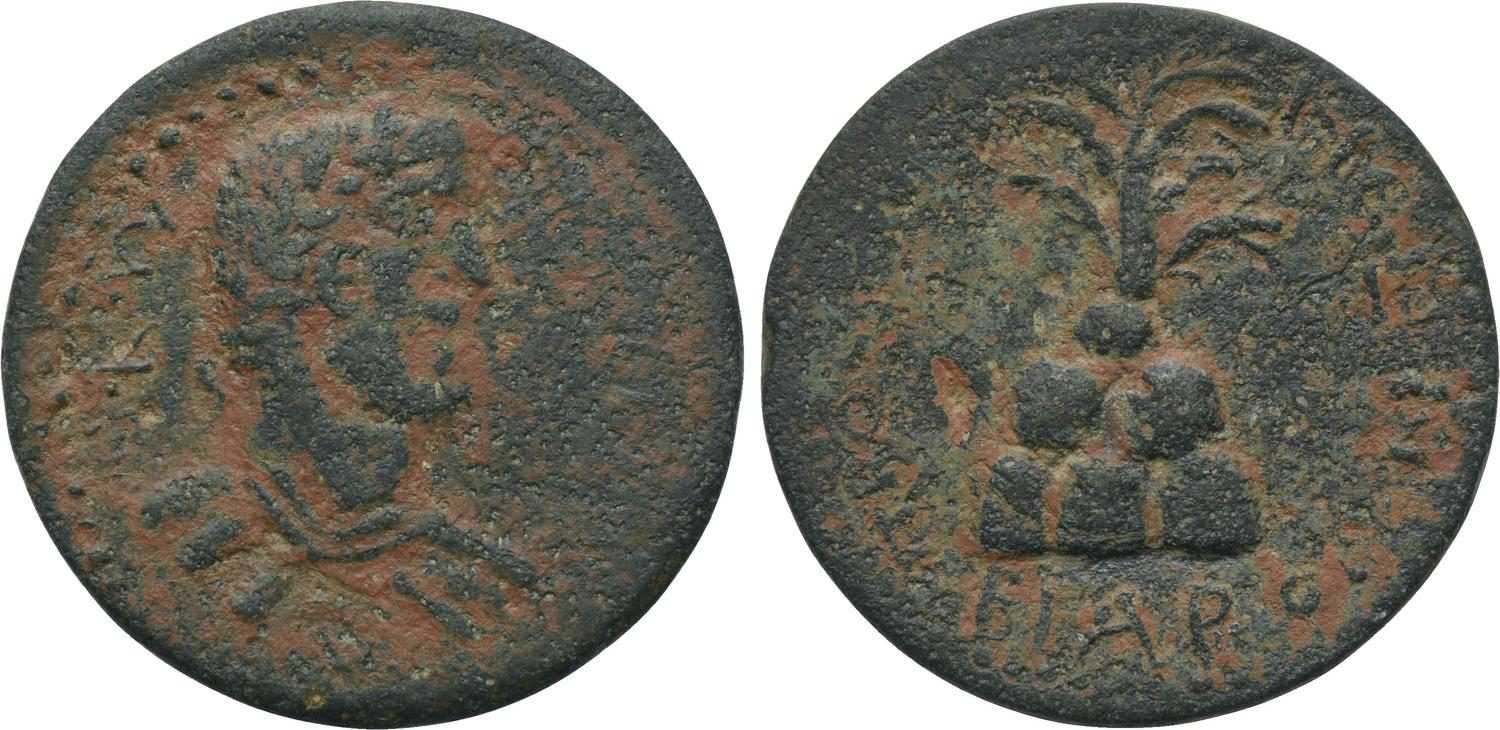
Notice that the mountain name also appears on this coin but is spelt BIAPOC (Biaros). The different transliterations were commented on is a rather odd book from 1927. I’m not sure how seriously to take any of this speculation. (Opinions welcome.)
The mountain and the tree(s) were clearly of local meaning for a very long time. This is a coin type presumed to date from the first century BCE.
Sacred mountains are well known in Central Anatolia and perhaps in the Roman era the most famous (esp to numismatists) is Mount Argeus. Weirdly, the Wikipedia entry for the mountain says nothing about its importance culturally in the Roman period.
The people of Prostanna clearly revered their mountain for centuries and yet I can find no textual references to the mountain (Cf. ToposText), only the coins and the landscape. However that 2005 article above does a great job of bring to light the sacred spaces on the mountain itself and when joined with the coins helps us recover something of the lived experience.
So much lost human experience, but I have say if there was more linked open data (LOD) to connect all the various transliterations and to get databases to speak to each other, I’d have not spent so much time on this mountain this morning.
—
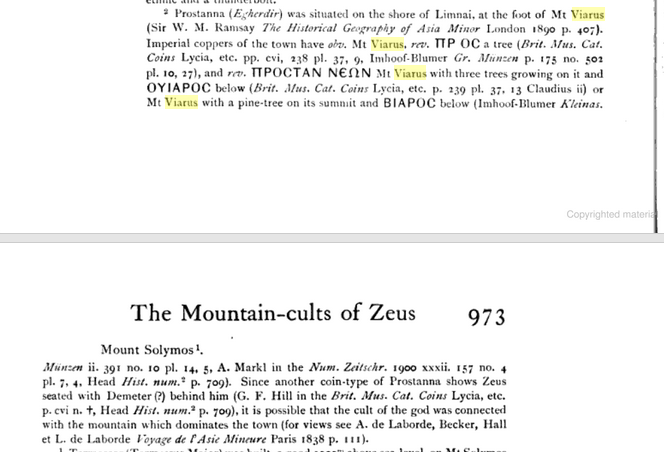
Cook in 1914 speculated that the mountain was associated with ‘Zeus’, but this is little more than a guess:
Bru. (2017). Territoires, « dieux-fleuves » et monnayages. In La Phrygie Parorée et la Pisidie septentrionale aux époques hellénistique et romaine (Vol. 401, pp. 105–143). https://doi.org/10.1163/9789004337404_010
















 Liv Mariah Yarrow