Day 7 of 234: Still more on RRC 486/1

Days 5-6 were the weekend. And, now that I have a family, I have a better appreciation of the need to stop oneself from working every possible moment.

Grueber 1910 (see last post) cited Borasi 1898 and it is indeed it not only has a very nice sketch/transcription of the stone, but also a discussion of the earlier speculations on the coin including background to the historical dating of it and a little on what was known then on the cult of Bellona in the region. Perhaps fuel for deeper digging
Borasi and others keep mentioning a hybrid type with Augustus and RRC 486/1 and the legend “imp. Caes. Augus, tr. pot. iix.” as reported by Borghesi. I wondered if any of these hybrids have turned up more recently. I’ve not tracked one down yet, but I did come across TWO fun Spanish hybrid types using the obverse of RRC 407/2 and the reverse of RIC 1 404 (or 405). Kind of wild they use different dies but from the same types.

Specimen link
specimen link
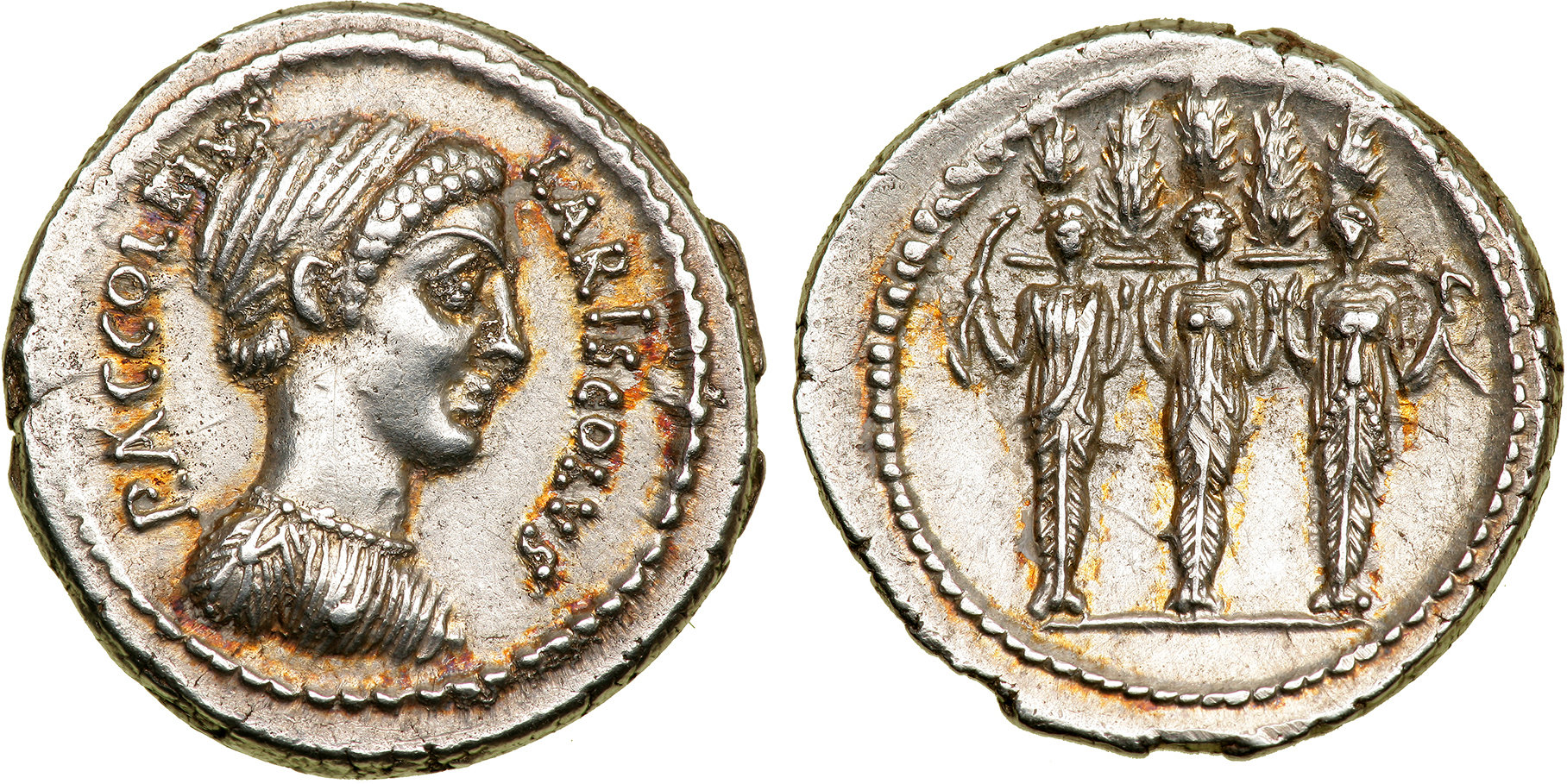
Just a nice specimen of RRC 486/1

I don’t think these goddesses are Oak Nymphs or Oak-Grove Lares (Querquetulanae) anymore than they were Larch trees, but its always good to review the evidence, before dismissing it.

Varro LL 5.49

Not my most satisfying warm up writing, but good enough… on to the lists.


Today

  • Spend EVEN MORE time with Dionysius
  • More Italy visit logistics
  • More Rutgers coordination as needed
  • More Princeton coordination as needed
  • Dr. Liz letter

Not Today (but maybe tomorrow, or the day after)

  • Teaching requests for Fall 2023
  • Circle back to department about any Jan planning meetings
  • Book flights
  • Set time table for any collaborative RRDP work/publication prep that needs to happen this semester: Chicago pub, INC pub, collaboration with RACOM, etc…
  • Circle back to Capito project
  • Consider ask for funding from Dean’s office
  • Begin Med school rec letter
  • record mini myth
  • find out what is on that v old harddrive and back up to cloud
  • follow up with Lafayette
  • Write up Teaching Eval
  • Follow up old student/tree sunset
  • Rosen Fellowship refs
  • Finalize AAH logistics
  • Cancel at least one more digital membership
  • renew Coinarchives

Day 4 of 234: More on RRC 486/1

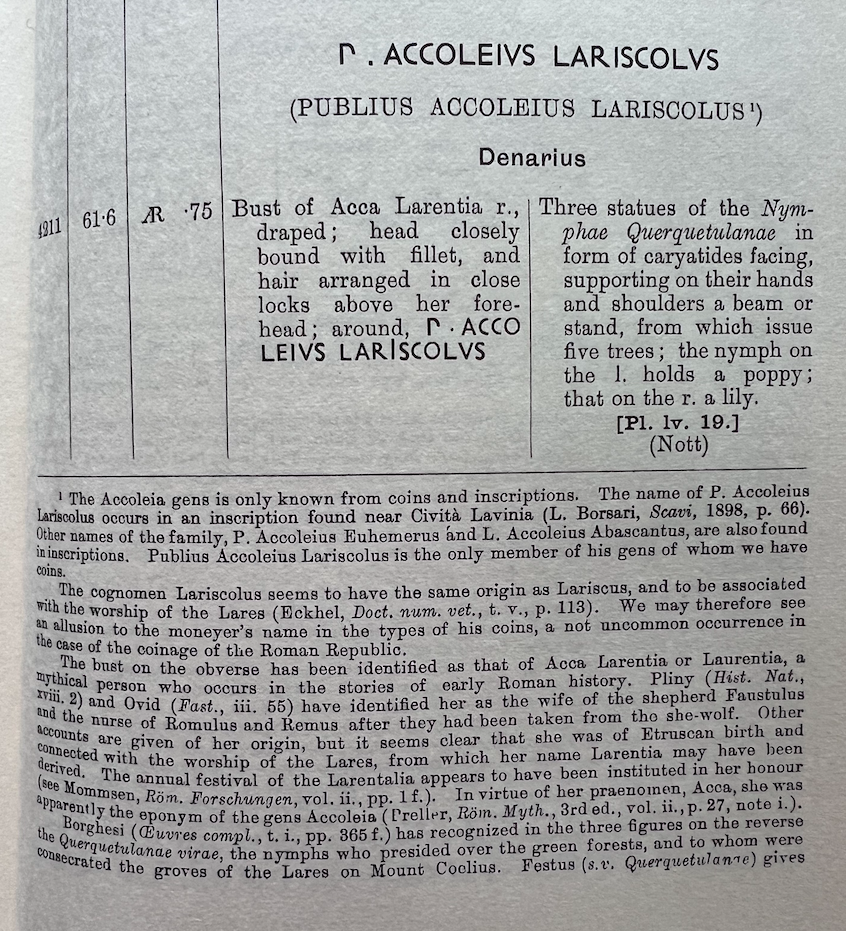
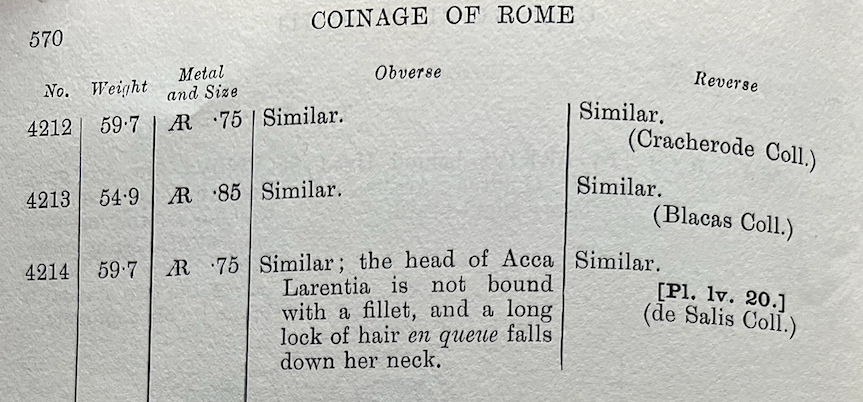
Grueber 1910 (repr. 1970): 569-570 has deliciously erudite footnotes! And yet, like so often he doesn’t explain the theories he’s dismissing. I know they are wrong and so does he, but what a lot of work to make others dig through. It makes me slightly more fond of Crawford’s dismissive asides as he condemns his predecessors. at least I know where he stands and where to look.

I use the 1970 reprint of Grueber as Crawford had a hand in its re issue and correction of errors of the 1910 edition, but if you don’t have it on your shelves or happen to be in need of it away from home, there is a digitized version of the original BMCRR.

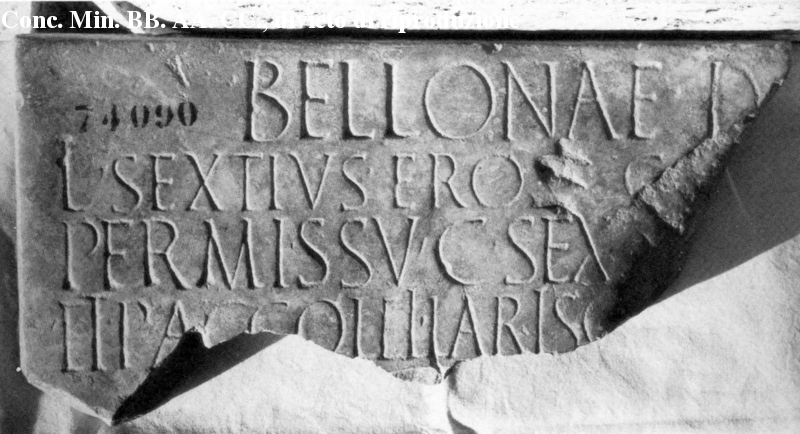
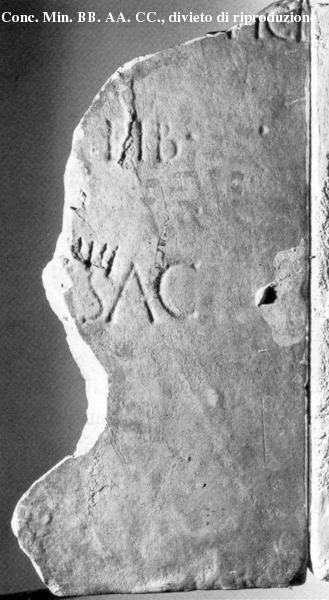
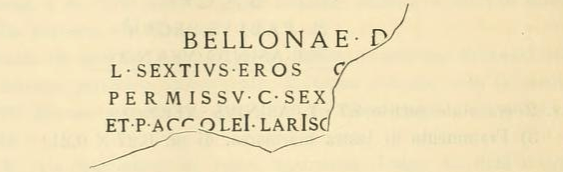
Next time I am in Rome I must make a pilgrimage to this inscription in the baths of Diocletian in the section on oriental cults! Strange to think I must have walked by it half a dozen times in the past but not noticed its numismatic connection.

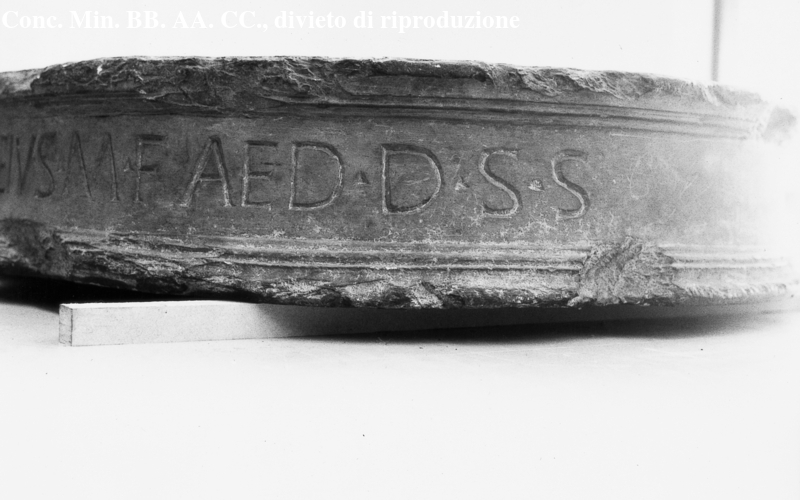
What does it mean? At first reading, It seems to be that this guy Eros wanted to make a dedication to Bellona and needed Accoleius and his colleague’s permission to do so. Our moneyer’s name is in the last line. Also notice the TALL Is which Grueber discusses as a means of indicating the long vowel sound. The stone itself is from Lanuvium.

The back of this same stone has it’s own epigraphic designation in some databases:

Also of note for our current assumptions that this coin represents the cult image at Nemi, is that at two members of the same gens as the moneyer are attested at finds from the sanctuary at Nemi. One clearly played some role in local politics in the early first century CE. AND wait for it… our own dear Lord Savile scooped up this v stone (along with the vast majority of the coin finds from the excavations) and brought it to Nottingham! (I’ll be sure to pay my respects when I visit.)

The other attestation is from a list of names of uncertain function (see line five).

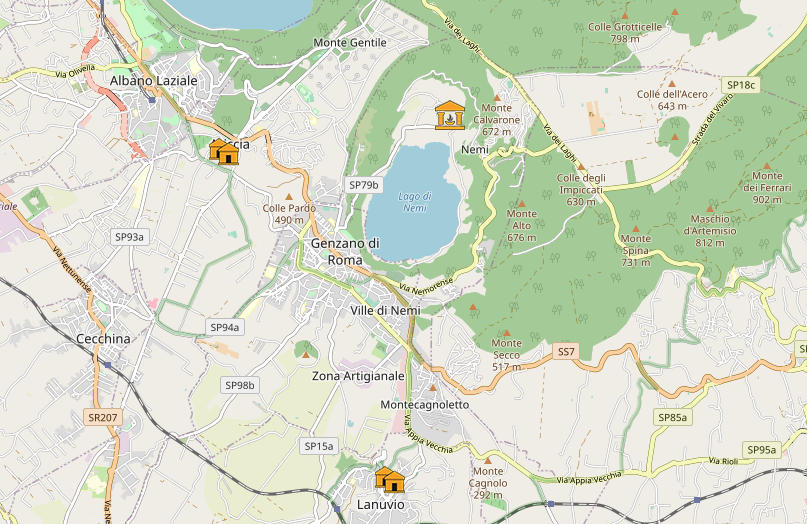
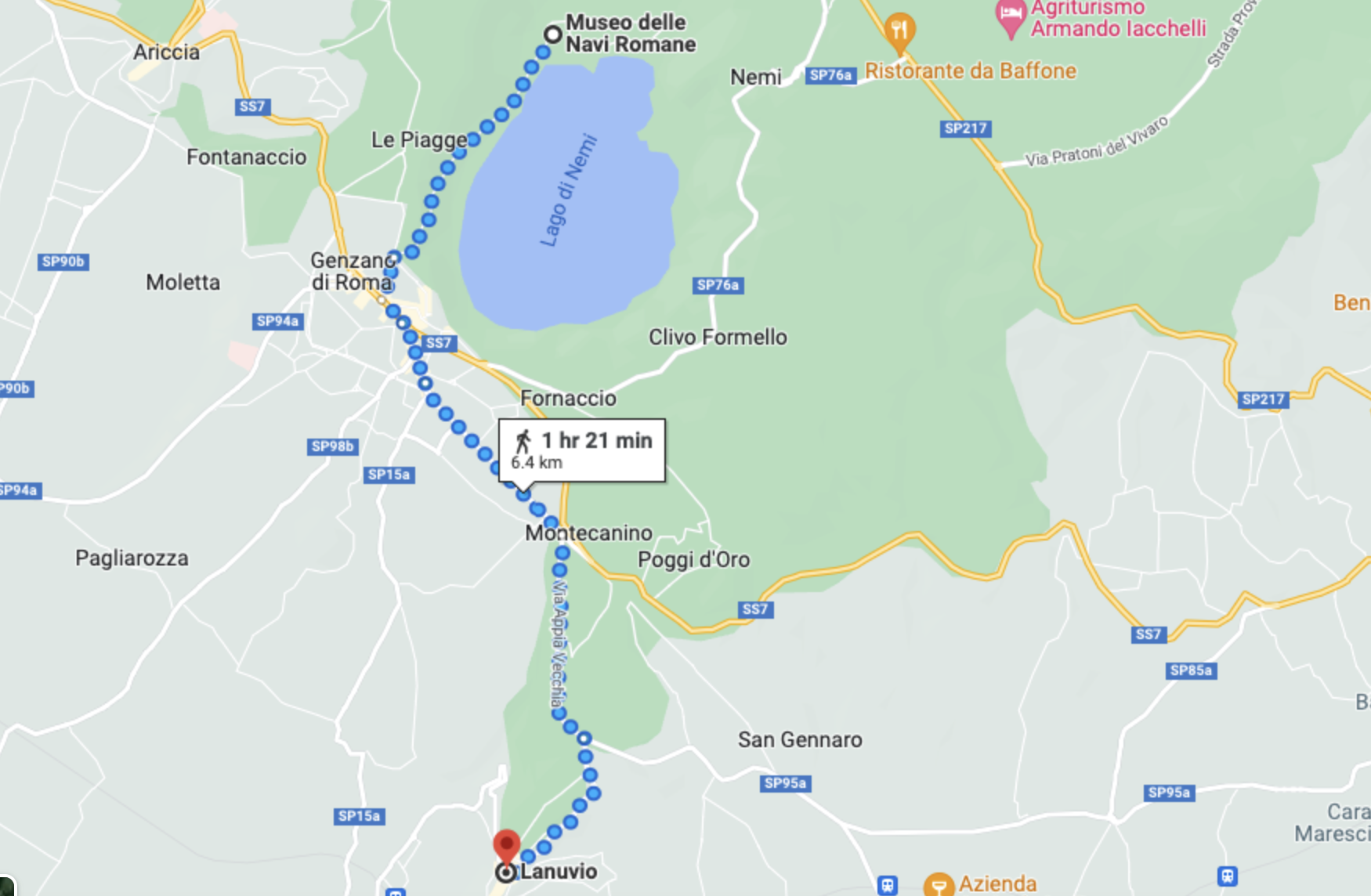
The Lanuvium makes sense once we look at the maps. Lanuvium is only about an hour and 20 minute walk away, and is the next nearest ancient community to the sanctuary after Ariccia.

Screenshot taken from ToposText

There is only one instance of gens in epigraphy from Rome itself and that seems to have been a funerary inscription that was reused in the construction of the walls of the tomb of Caecilia Metella

Right. More to learned and share here obviously, but I’m done warming up, and am ready to tackle the to do list!


Today

  • Submit Signed Tow by 5 pm Jan 6
  • Spend MORE time with Dionysius
  • Contact more curators about feasibility of collections visits concurrent with this trip (progress)
  • BM/Rowan Follow Up
  • Rutgers Follow Up
  • Enter Dates of things in Family Calendar to avoid nasty surprises
  • AAH Logistics (progress)
  • Cancel at least one digital membership
  • Princeton Follow Up (here’s a link the awesome cast bronze collection there!)

Not Today (but maybe tomorrow, or the day after)

  • Spend EVEN MORE time with Dionysius
  • Teaching requests for Fall 2023
  • Circle back to department about any Jan planning meetings
  • Book flights
  • Set time table for any collaborative RRDP work/publication prep that needs to happen this semester: Chicago pub, INC pub, collaboration with RACOM, etc…
  • Circle back to Capito project
  • Consider ask for funding from Dean’s office
  • Begin Med school rec letter
  • record mini myth
  • find out what is on that v old harddrive and back up to cloud
  • follow up with Lafayette
  • Write up Teaching Eval
  • Follow up old student/tree sunset
  • Rosen Fellowship refs
  • Finalize AAH logistics
  • Cancel at least one digital membership
  • More Rutgers coordination as needed
  • More Princeton coordination as needed

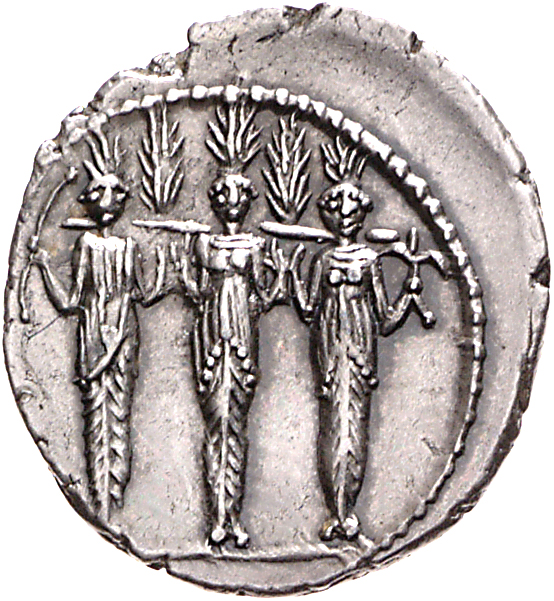
3 of 234 Days: Triple Diana or Three Nymphs?

From Schaefer’s Archives (presumed forger’s die, now in Zurich money museum (see previous blog post)

I love that I can use the Berlin catalogue as a digital index for Woytek. The pages here discuss the college of moneyers and why 41 BCE is a better date for them. It does not engage with typology, but rather mint structure.

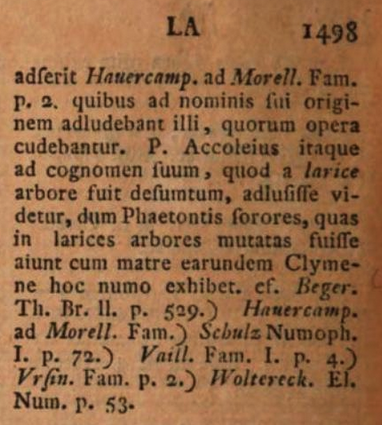
Smyth 1856: 2 describes two specimens of RRC 486/1. He discounts an unattributed description of as the Caryatidae, and favors seeing it as the metamorphosis of the three Clymenidae, sisters of Phaeton, with the obverse being their mother, Clymene. He quotes in Latin a line from Havercamp. The view is over a hundred years old by the time Smyth paraphrases. AGNETHLER 1746: 72-73 (next set of images) makes explicit what Smyth only implies. The attraction of this interpretation is based on the moneyer’s cognomen LARISCOLUS being derived from larix: the larch tree. The idea was that the three figures are turning into these trees. Smyth rejects an idea he attributes to Cavedoni that the obverse represents Acca Laurentia and that the money is thereby associating he gens, ACCOLEIUS, with the mother of the Lares and more over implying a connection between his cognomen and these protective deities.

Public domain image of a European Larch

Given the conviction of all these forebearers, I found myself surprised no one had pointed me to an ancient account of this myth. I had hope when I turned to Rasche 1785 when he gave a Pliny reference…

But NO! that passage is about the triple nature of the larch, a rather clever means of creating a connection, I admit.

“the fir and the larch divide the process into three parts and produce their buds in three batches; consequently they also shed scales of bark three times…”

Pliny 16.100

So what’s up? Well, outside of the numismatic bubble these sisters are typically called Heliades (a small point, but helpful for tracking down info!) and all of the accounts (as far as I can tell) have them turning into poplar trees if any type of tree is specified. Also their number isn’t fixed, as many as seven appear in some accounts (three is also a known number).

So how and when did our former colleagues reject this interpretation and land on the Diana as worshiped at Nemi…? A story for another day. This was enough of a pleasant warm up exercise and now onto the to-do list.


Today

  • Finalize Tow Proposal (DUE Friday, Jan 6, 5 pm)
  • Spend sometime with Dionysius
  • Send Letter of Recommendation (RE grad teaching)
  • Triage former student emails from over break
  • Contact more curators about feasibility of collections visits concurrent with this trip (progress!)
  • Contact Princeton and Rutgers about possibility of visits
  • Write BM about whether scans of Nemi photos can be had
  • Write Clare in case she’s seen these photos and is interested in those token images mentioned by Crawford

Not Today (but maybe tomorrow, or the day after)

  • Submit Signed Tow by 5 pm Jan 6
  • Spend MORE time with Dionysius
  • Teaching requests for Fall 2023
  • Circle back to department about any Jan planning meetings
  • Book flights
  • Set time table for any collaborative RRDP work/publication prep that needs to happen this semester: Chicago pub, INC pub, collaboration with RACOM, etc…
  • Circle back to Capito project
  • Consider ask for funding from Dean’s office
  • Begin Med school rec letter
  • record mini myth
  • find out what is on that v old harddrive and back up to cloud
  • follow up with Lafayette
  • Contact more curators about feasibility of collections visits concurrent with this trip
  • Write up Teaching Eval
  • Follow up old student/tree sunset
  • Rosen Fellowship refs

2 of 234 days: Nemi and More

This is the opening to Crawford 1983. I know I can visit material on deposit in Nottingham and any of Haeberlin’s collection that ended up in Berlin, but I wonder how likely it is to be able to track down any specimens that were in Pasinati’s stock? Do you know the whereabouts of one or more of these pieces of aes grave? This particular provenance would make the individual specimens deeply important from an archaeological and historical position. Link to Helbig 1885. Crawford in this piece is attempting to improve upon Cesano AIIN 1912. (She’s one of my favorite numismatic foremothers!)
Wiki bio.

Crawford tells us that “A collection of photos donated by Lord Savile to the British Museum illustrates a number of pieces not otherwise attested, which have been included in the list below, and there may well have been more. (The photos also illustrate four tesserae: Standing figure/Standing figure, Standing figure/Standing figure, IVVEN/Blank, COR/THAL /Triple Hecate) .” I think these must be on deposit in the coins and medals department, as they have not been given accession numbers and added to the collection database as far as I can tell…

The enumeration of my days is a discipline for myself. When this blog was anonymous this type of omphloscopy was easier as I could at once construct in my mind’s eye just the right sort of mildly (dis)interested external audience, while being assured that next to no one actually read these posts or cared. Now I know there are some of you are coming for a specific kind of content that has nothing to do with my own writing practice and personal reflection on my profession.

I’ve resolved to re-institute the used of categories to help you filter out posts of less interest. Posts in this series will (like last time) be marked “enumeration of my days”. The coins category will be used to mark posts with… wait for it… coins. Ditto historiography, modernity, material culture, textual evidence, and advice. I think that covers most of the things I usually blog about.

Today

  • Re-shelve books and reset home office space
  • Develop Tow proposal (DUE Friday, Jan 6, 5 pm)
  • Choose ideal dates for Rome trip (and even found my ideal flights!)
  • Contact curators about feasibility of collections visits concurrent with this trip (one, more tomorrow)
  • Respond to external advising email
  • Triage Emails from over Holiday Break (progress, not perfection)
  • respond to podcast request

Not Today (but maybe tomorrow, or the day after)

  • Spend sometime with Dionysius
  • Teaching requests for Fall 2023
  • Circle back to department about any Jan planning meetings
  • Book flights
  • Set time table for any collaborative RRDP work/publication prep that needs to happen this semester
  • Finalize Tow Proposal (DUE Friday, Jan 6, 5 pm)
  • Consider ask for funding from Dean’s office
  • Begin Med school rec letter
  • Contact Princeton and Rutgers about possibility of visits
  • Write BM about whether scans of Nemi photos can be had
  • Write Clare in case she’s seen these photos and is interested in those token images mentioned by Crawford
  • Write up Teaching Eval (overdue!)
  • A little more work on office environment
  • Triage Emails from over Holiday Break
  • Contact curators about feasibility of collections visits concurrent with this trip
  • Send Letter of Recommendation (grad teaching)

Not THIS Sabbatical

I found a post it note on my desk with a idea for a little book, potentially useful to the non-numismatists:

Roman Social History: The Coin Evidence

Ordinary Occupations

Ludi in Rome and the Provinces

Lives of Women

Athletics

Political Careers

Myth and Legend

Architecture

1 of 234 Days: the work ahead

Creating this blog was such a life-changing experience when I first set it up in June 2013 to trace where the time went. I had deep fears that writing wouldn’t happen and that I couldn’t accomplish what I set out to do. More and different work was accomplished, all of which made the work between then and now richer and more meaningful. I’m excited to see what this period of time brings. I have none of those fears. I know that even if my goals shift and change, I will always be collecting new knowledge and ideas, enough to sustain me for another decade or so.

Practically, what is a sabbatical? I’m given the privilege of working on my research for Spring 2023 (and Spring 2024) in exchange for a 20% pay cut. I’m sad I won’t be at the AIA-SCS, but it isn’t in the cards. I’m calling it a “stay-batical”. I have made a very nice home office for myself and much of the work I want to do can be done right here. I put in some applications to travel for Spring 2024 so hopeful something will come up.

What is the work I hope to do?

I’m finishing footnoting a chapter on Dionysius’ thoughts on the Republican Constitution for an edited volume. That should be off my desk in 1-2 weeks all going well.

I need to crunch data from metallurgical testing of aes grave at Yale and Lafayette and compare with BM results and see if I could fit in another local collection or two before presenting my findings in Rome in mid February. (I also have to sort logistics around that trip.) Logistics need to be done ASAP, but the data crunching is last half of January along with some write up. I don’t think it will take four weeks but I’m allowing it just to be safe.

After that my hope is to keep the calendar nice and clear so as to plow through the edits of single-author Book No. 3. I’d love to have fully revised manuscript by June but that’s a pipe dream I’m sure. Maybe June 2024? We’ll see. Almost all the chapters are drafted. What is needed in intellectual rigor and footnoting. (AND not to get too distracted along the way).

Working Title: Making History: Coins, Texts, and the Late Republic

A richly illustrated exploration of what those living within the Roman republic knew, or thought they knew, about their own past and how they made that past meaningful to their contemporary lives. Chapters: (1) How to Read this Book (2) What Sort of Thing is a King? (3) Numa’s Memory (4) Celebrating Apollo (5) The Cost of Grain (6) Sulla’s Legacy (7) The Opimian Myth (8) A Fashion for Kings (9) After the Ides (10) The Relevance of Ancient History (11) Witnessing the Past (12) Who cared about the coins?

That’s the major stuff, but other things particularly, collaborative work, that may need to come to the foreground and may delay this work here and there.

I also wouldn’t mind writing up some of my Papius and Fabatus stuff for real and perhaps even diving into other thorny control marked issues…

There will also be proofs to review at some point and I really must get to the Nemi material in Nottingham. I hope this year…

More tomorrow..

Undermining the Secret Ballot

Two men of praetorian rank were on the panel—Domitius Calvinus, who voted for acquittal so openly that everybody could see; and Cato, who, as soon as the voting tablets had been counted, withdrew from the ring of people, and was the first to tell Pompey the news.

duo praetorii sederunt, Domitius Calvinus (is aperte absolvit ut omnes viderent) et Cato (is diribitis tabellis de circulo se subduxit et Pompeio primus nuntiavit).

Cic. Q.fr. 3.4.1

In my book there is a whole section in chapter 4 on the secret ballot and voting tablets on coins. Those used in the law courts had two choices: A(bsolvo) or C(ondemno), ‘I absolve’ or ‘I condemn’, or L(ibero) or D(amno), ‘I free’ or ‘I sentence’. What I like about the above passage is that it nicely shows how followers of Pompey the would be autocrat are undermining the anonymity of the ballot to show their partisanship AND that Cicero’s words help confirm the interpretation of what we see on ballots on at least one coin (RRC 428/2) dating to just the year before.

This post relates to the content of the previous one as well.

Rumors of Dictatorship

Reading Cicero’s letters to his brother, I came across this bit from the explanation of why Gabinius was acquitted in October of 54 BCE.

sed tamen nisi incredibilis contentio, preces Pompei, dictaturae etiam rumor plenus timoris fuisset

Yet, after all, had it not been for incredible exertions and entreaties on Pompey’s part, and even an alarming rumor of a dictatorship…

Cic. Q.fr. 3.4.1

I can’t help but think of the coins of Brutus and Pompeius Rufus and how they seem to respond if not to this specific rumor to the same desires and fears. This interpretation of the iconography is not new, and I’d even go so far as to call it, well established. I just wanted to note the further support offered by this quote for the contemporary political climate.

obv. of RRC 434/1; MFA specimen
RRC 433/2; BM specimen

But you must see that the Republic, the senate, the law courts are mere ciphers, and that not one of us has any constitutional position at all.

sed vides nullam esse rem publicam, nullum senatum, nulla iudicia, nullam in ullo nostrum dignitatem.

Cic. Q.fr. 3.4.1

This quote comes just a few lines after that above. I like Shuckburgh’s translation a great deal, bit it is perhaps overly interpretative. Here’s a more stripped down version:

“Thus it seems there is no republic, no senate, no justice, no dignity in any of our affairs.”

…the Republic certainly has no power to do anything, while he [i.e. Pompey] is supreme in everything…

res publica certe nihil possit, unus ille omnia possit

Cic. Q.fr. 3.4.2

Again Shuckburgh is beautiful in his rendering; “Clearly the Republic has nothing, when that one man has everything.”

The business has been put off: the comitia postponed and postponed, till we may expect an interregnum. The rumor of a dictator is not pleasing to good men; for myself, I like still less what they say. But the proposal, as a whole, is looked upon with fear, and grows cold. Pompey says outright that he doesn’t wish it: to me previously he used not personally to deny the wish. … There is nothing else being talked about in politics just now; at any rate, nothing else is being done.

res prolatae ; ad interregnum comitia adducta. rumor dictatoris iniucundus bonis, mihi etiam magis quae loquuntur. sed tota res et timetur et refrigescit. Pompeius plane se negat velle ; antea mihi ipse non negabataliud hoc tempore de re publica nihil loquebantur; agebatur quidem certe nihil.

…Milo is alarmed at this, and no wonder, and almost gives up hope if Pompey is created dictator. If he assists anyone who vetoes the dictatorship by his troop and bodyguard, he fears he may excite Pompey’s enmity: if he doesn’t do so, he fears the proposal may be carried by force.

...hoc horret Milo, nec iniuria et, si ille dictator factus sit, paene diffidit. intercessorem dictaturae si iuverit manu et praesidio suo, Pompeium metuit inimicum ; si non iuverit, timet ne per vim perferatur.

Cic. Q.fr. 3.8; Nov 54 [I’ve adapted Shuckburgh word choices this time]

I can see that our friend Messalla will be consul, if by means of an interrex, without judgement, if by that of a dictator, without danger. He is not disliked by anyone. … En passant: nothing has, after all, been done as yet about a dictatorship. Pompey is absent; Appius schemes; Hirrus is paving the way: many may be counted on to intervene: the people are indifferent: the leading men [principes] disinclined to it: I keep quiet.

video Messalam nostrum consulem, si per interregem, sine iudicio, si per dictatorem, tamen sine periculo. odi nihil habet. ἐν παρέργῳ de dictatore tamen actum adhuc nihil est. Pompeius abest, Appius to miscet, Hirrus parat, multi intercessores numerantur, populus non curat, principes nolunt, ego quiesco.

Cic. Q.fr. 3.9; Nov or Dec 54 [again I’ve tweaked the word choice]

Capitoline Temple Again

Just more overlap between my Dionysius bibliographical research and my love of coins.

Reverse of RRC 487/2, ANS specimen

Mura Sommella, Anna. “Un frontone di età arcaica per il tempio di Giove Capitolino.” Atti della Pontificia Accademia Romana di Archeologia. Serie III, Rendiconti 89 (2016-2017): 277-298.

Abstract: The late Republican denarius of « Petillius Capitolinus », issued by the mint of Rome in 43 BC. C., confirms what is described in D. H. 1, 4, 61, 4 regarding the appearance of the Temple of Capitoline Jupiter after the destruction of the Sullan period (rebuilt identical to the original archaic building in terms of dimensions and decorative apparatus) and allows to identify in the pedimental space the presence of the Gorgon in the race on his knees, an image interpreted as a celebration of the origin of the Tarquini, who claimed to belong to the Corinthian lineage of the Bacchiadi.

Contrast this Campana tile I posted earlier.

On this passage of Dionysius also see:

Kaderka, Karolina and Tucci, Pier Luigi. “The Capitoline Temple of Jupiter: the best, the greatest, but not colossal.” Mitteilungen des Deutschen Archäologischen Instituts, Römische Abteilung = Bullettino dell’Istituto Archeologico Germanico, Sezione Romana 127 (2021): 146-187. Doi: 10.34780/09q1-1e01

Cf also this other earlier post.

Servilii

RRC 239/1

This morning I’m trying to catch up on my historiographical bibliography on Dionysius of Halicarnassus. [I look away for a couple of years and my friends and colleagues go and publish a mountain of stuff without telling me!] So this is just to get this bit of cross over numismatic bibliography on file.

Zanin, Manfredi. “« Servilia familia inlustris in fastis » : dubbi e certezze sulla prosopografia dei « Servilii Gemini » e « Vatiae » tra III e I secolo a. C.” Tyche 34 (2019): 221-236. [ download link]

Abstract: Despite some progress, it is still not possible to reconstruct the genealogy of the Servilii Gemini / Vatiae down to the last detail. The prosopographic hypotheses presented here are possible starting points for further considerations. Using Greek and Latin inscriptions as well as literary (including Dionys von Halikarnass, Pliny the Elder and Cicero) and numismatic evidence (including RRC 239).

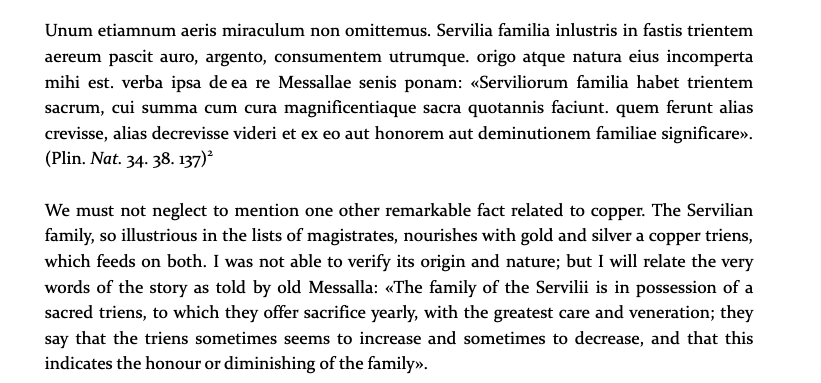
This in turn led to some scholarship on this odd bit of Pliny turning up in my search results

Viglietti, C. “The Servilian triens reconsidered.” I Quaderni del Ramo d’Oro on line (2012): 177-202. [download link]