Camodeca, Giuseppe. “Il credito negli archivi campani: il caso di Puteoli e di Herculaneum.” In Credito e moneta nel mondo romano, pp. 69-98. Edipuglia, Bari, 2003.
(It gets good about p. 76) I realize that maybe I’m jumping into the material at the wrong point.
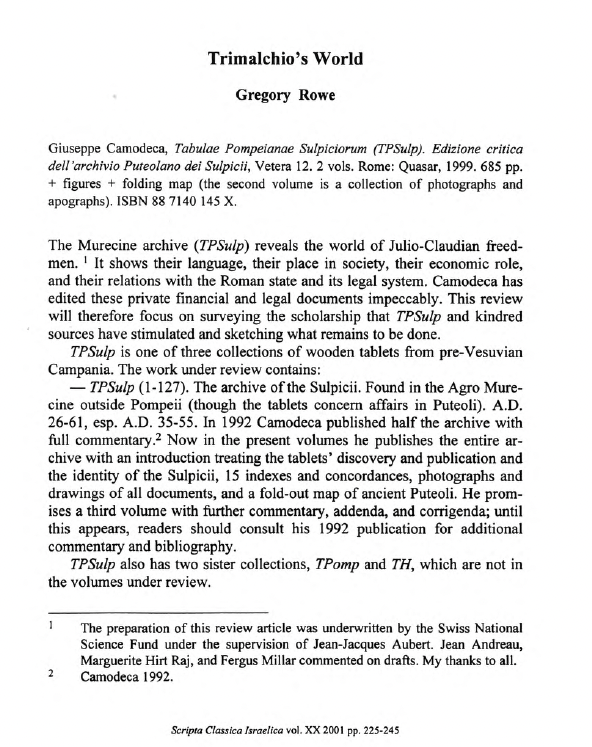
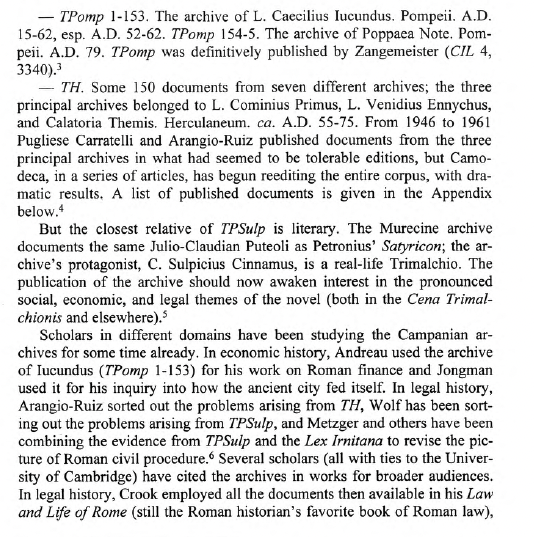
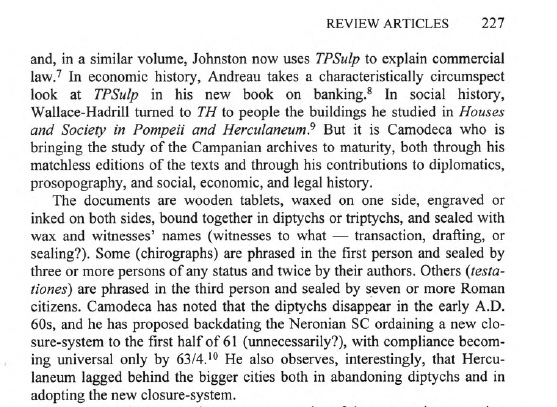
Camodeca, Giuseppe, Tabulae Pompeianae Sulpiciorum, 1999 is the primary reference.
It can no longer be had as a physical book for love or money and does not seem digitized (at least not legally), but is in most major research libraries.
I found this review article a good entry point overview:
So I go to APh and sadly this Italian conference proceedings volume was never catalogued there (plenty of Camodeca’s other publication), then I go to google scholar, viola!, lots of newer stuff citing this piece. No surprise it had a big influence on how Harris thought and wrote about the Roman economy as well as Lo Cascio and Scheidel and others. This led me to take note of all sorts of interesting citations, but those are being stored in another post (currently in drafts). I’m going to come back to these and some are in the next post, but her I stick with the Camodeca and TPSulp stuff for this post.
Then I read these two pieces:
Jakab, Éva. “Loans and securities: Tracing Maritime Trade in the archive of the Sulpicii.” Roman law and maritime commerce 137 (2022).
Candy, Peter. “Credit for Carriage: TPSulp. 78 and P. Oxy. XLV 3250.” Roman Law and Maritime Commerce 175 (2022).
Both in
PETER CANDY and EMILIA MATAIX FERRÁNDIZ (EDS), ROMAN LAW AND MARITIME COMMERCE. Edinburgh: Edinburgh University Press, 2022. Pp. x+ 204, illus. isbn 9781474478144.
Like in my reading of Camodeca above my impression is that the sums are so much smaller than those in the Ciceronian archive. A different order of magnitude that makes me re calibrate my reading.
Also I hate endnotes. Not always but wow they are harder to utilize as a scholar looking to extract and check information than just leisurely digest.
To read something more recent by Camodeca I went here as it gives incite both into acknowledgement of a debt but also Camodeca’s methodologies in reading these texts:
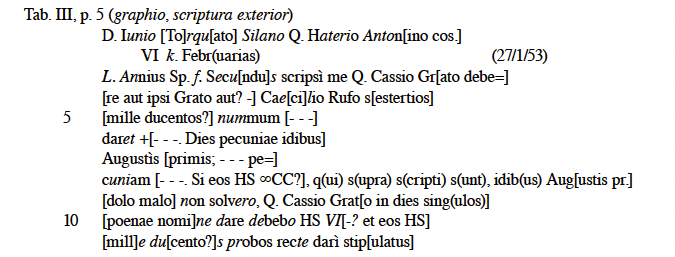
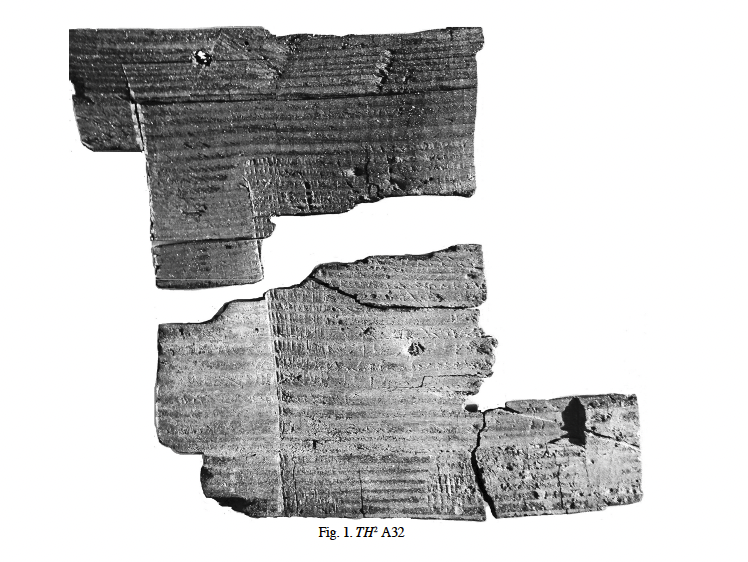
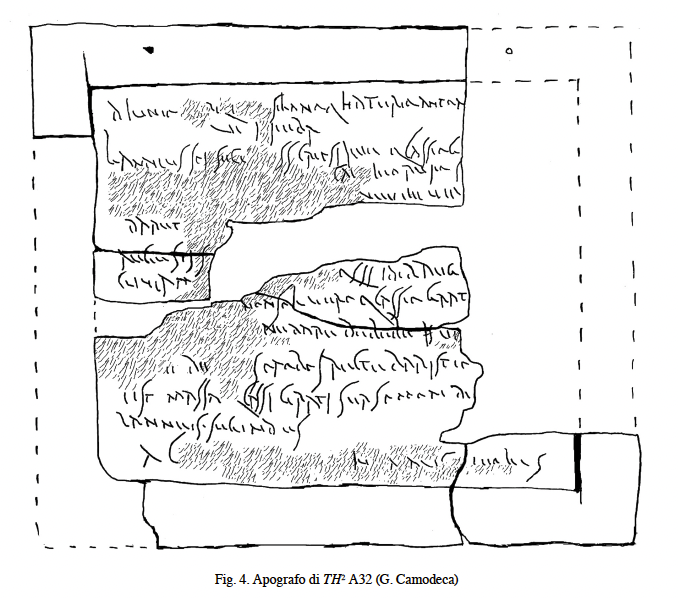
Camodeca, Giuseppe. “Il Senatore Q. Cassius Gratus e Un Suo Affare a Puteoli. Ricomposizione Di Una Tabula Herculanensis Del Gennaio 53 (TH2 A 32).” Zeitschrift Für Papyrologie Und Epigraphik 217 (2021): 261–65.
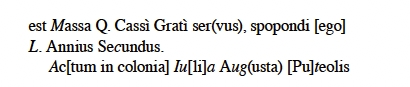
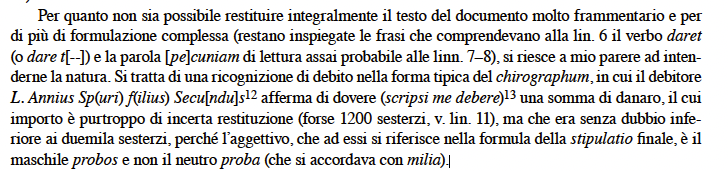
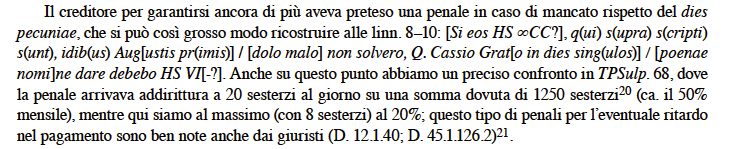
Obviously I love the vocabulary of probare (another post). But the central point of interest is that the creditor is a praetorian ranking senator making a loan through his enslaved agent to a third party. The document sets a deadline for the repayment of an outstanding balance, forces the debtor to acknowledge that balance, the timeline, and sets a penalty:
Visual for context:
I love an article that deep dives one piece of evidence, but I also realize that how I feel about this type of material culture is how others feel about coins, a specialized field where one struggles to understand how to check the validity of the claims.
Silver, Morris. “Finding the Roman Empire’s disappeared deposit bankers.” Historia: Zeitschrift für Alte Geschichte (2011): 301-327.
more notes from this article in next post, keeping this one focused on Sulpicii material or trying to.
This is a notes page but also an exercise in determining whether there is a ‘there-there’ with a chunk of writing on Cicero I did in August (off blog, but blog adjacent) that I fear may be too unoriginal to be worth continuing to develop. But then I re-read an old post with this sage advice.
I’m trying to decide exactly the shape of two public talks for October one at U Illinois (Urban-Champaign) and the other in Warsaw. The talks for China (Dongguan and Beijing) thereafter are more straight forward. I committed to titles for the two earlier talks to try to push myself to engage more deeply with questions of Value as an abstract concept in Roman Society and the scope of Symbolic or Fiat currency in ancient Italy. The Cicero writing was part of that. My basic working method is to ‘read’ (explore) primary evidence first and then surveying secondary literature to look for confirmation and or contradictions of my own proto-conclusions. I want to know what I think before building on or interacting with others interpretive lenses. The problem is that this means I ‘waste’ time re inventing the wheel sometimes, as ‘new to me’ and ‘today I learned’ are not actually new scholarship.
So today I’ve got a stack of physical literature next to me at my desk most of which I’ve read before but haven’t read recently. I’m looking for intersections with my present project and hoping it helps me decide on next steps in my preparation for these talks.
As an aside I am coming to realize that some of my views on ancient economies has been influenced by ideas adjacent to Modern Monetary Theory. And, I think I may have to dive deeper into that literature perhaps starting here:
Saas, William O., and John T. Harvey. 2026. “A Rhetorical History of Modern Money Theory.” Journal of Economic Issues 60 (3): 821–42. doi:10.1080/00213624.2026.2699653.
Hollander, David B.. “Lawyers, friends, and money: portfolios of power in the Late Republic.” In Money and power in the Roman republic, edited by Hans Beck, Martin Jehne and John Serrati. Collection Latomus; 355, 18-25. Bruxelles: Latomus, 2016.
Hollander’s 2007 book has been a great influence on me for the nature of money. This essay is really about power and the lack of means to define power in the Roman world for all we can map adjacent concepts. He gets at some examples of where money is associated with power but insufficient and also visa versa.
When we speculate about Roman demand for coinage, we need to consider a demand for security. The disruption of traditional forms of power in the late Republic undoubtedly promoted monetization.
p. 25
This quote feels deeply true to me and I think Hollander makes good illustrative use of the literary texts, esp. Verres. Nothing really on Cicero’s letters or own personal fears. This is a good citation as it supports my reading of the evidence I’ve collected.
Rosillo López, Cristina. “Cash is king : the monetization of politics in the late Republic.” In Money and power in the Roman republic, edited by Hans Beck, Martin Jehne and John Serrati. Collection Latomus; 355, 26-36. Bruxelles: Latomus, 2016.
Another author who has influenced my thinking. She starts by discussing a Plutarch passage, I’ve not seen widely discussed.
Why was it the custom for those canvassing for office to do so in the toga without the tunic, as Cato has recorded?
Was it in order that they might not carry money in the folds of their tunic and give bribes?
Or was it rather because they used to judge candidates worthy of office, not by their family nor their wealth nor their repute, but by their wounds and scars? Accordingly that these might be visible to those that encountered them, they used to go down to their canvassing without tunics.
Or were they trying to commend themselves to popular favour by thus humiliating themselves by their scanty attire, even as they do by hand-shaking, personal appeals, and fawning behaviour?
I find Plutarch’s speculation says more about his own assumptions than ancient Romans but still interesting.
… monetization did not necessarily imply the use of coinage. … The appearance of coinage, however, did not ensure monetization.
p. 27
I agree with the first statement but not necessarily the second at least for 3rd century Rome. Monetization pre exists coinage and non-coinage money continues even after the creation of coinage. As I keep reading I think maybe Rosillo-Lopez is primarily focused on a definition of monetization that prioritizes the use of coinage above and beyond other currencies. This is a vocabulary dispute I have with her statements not the basic facts or interpretations which are solid.
If monetization of the state was voluntary and directed from the top, monetization of politics was not; it was left in the hands of those who used money as a medium. However, monetization was not a straightforward evolution, since pre-monetary uses in politics were attested: distributions of grain or wine had been used as a medium of exchange since the second century B.C., before coinage entered politics.
Ibid.
I’m not sure there is ever a time before coinage entered politics in the historical record. I’d waive my hand at Duillius’ distributions and those of Metellus. In fact I think my 2021 article in ancient numismatics goes a long way to showing that the creation of at least some early Roman cast currency may have been tied to distributions of a likely political nature. That said I think there is something interesting here about the state controlling coin production and issuing it for its own purposes but also the state is made up of the very class of people who will use the coinage for political purposes. Two examples come to mind, the Caepio Piso issue and the extra ordinary allocation to Pompey and the likely resulting SC issues.
P. 26 she does a good job summarizing a traditional view of cash flow and coin supply relying on Hopkins 1980 and Von Reden 2010 with a nod to Verboven 2009, 2003, and 1997. I think the underlying data for this view is probably ready for review. She follows LoCascio 1981: 76-86 for a view that the Roman state had a active policy concerned with coin supply against Crawford 1970: 40-46. All of this makes me realize that historians are still relying on data sets and interpretations of data sets that have now been improved through new analyses and new finds. Again the problem is that this material isn’t v accessible even today and didn’t really exist in 2016. I include in this my own publication habits tending to speak to numismatic audiences about my reading of numismatic data whereas it would be more useful if I wrote for a broader historical audience. Ialongo’s advice to me over cocktails in Rome this past summer is ringing in my ears.
In order to obtain cash, the Roman political elite preferred to tap into informal lines of credit, linked to the duties of amicitia, which offered better financial conditions. When this resource failed, they resorted to professional financiers. The need for cash was so vital that in one case, so as to prevent corruption, elections were called so quickly that candidates did not have time to gather the means.
p. 29-30
The first two sentences are a good summation and ones I endorse. Instead of citing primary evidence she cites Verboven 2002 and Andreau 1978 with 1999b. The last sentence is an original interpretation of this fascinating passage:
But all this argument is superfluous, for it ignores the fact that in the previous election Plancius had already been marked down for the aedileship. That election was, in the first place, opened by a consul who, apart from his great general eminence, had been the mover of the very laws concerning corruption with which we are dealing ; and, in the second place, it was opened so suddenly and so unexpectedly that, even had any man contemplated bribery, he would not have found sufficient time for the necessary preliminaries.
I’d put the bit in Cicero’s letters on the bribery around the elections for 53 BCE against this as v nice parallel.
P. 31 great discussion about sack of money Caesar sent Basilus in lieu of a province. [Dio’s account]. The page ends with a great claim that elites used cashless exchange not from a moral stand point but because it was most expedient.
P. 32 points to Von Reden 2010 whose view she favors but acknowledges that Harris 2008 holds that loans for sub elite were rare and hard to comeby and the whole matter have been debated and discussed in Lo Cascio 2011.
P. 33 discusses the deposition of funds with Cato to guarantee a fair election in 54 BCE (relevant to my own writing)
P.34 discusses the 4-8% interest rate jump. I partially agree and partially disagree. Must engage properly off blog when I return to writing. She then takes the Quantity theory of Money (QTM) i.e. MV=PT as fact. Here I think is where I begin to question the underlying assumptions.
P. 35 makes a leap to implying? food prices and food scarcity may be linked to the rise of cash because of political bribery. Discussion of Pompey’s commission over the grain supply.
Edmondson, Jonathan. “Investing in death : gladiators as investment and currency in the late Republic.” In Money and power in the Roman republic, edited by Hans Beck, Martin Jehne and John Serrati. Collection Latomus; 355, 37-52. Bruxelles: Latomus, 2016.
This article is good for demonstrating the utility of Harris and Hollander’s insistence that we broaden our definition of money in the late republic. It also reminds us that Romans kept a huge amount of their financial capital not just tied up in real property but also human property. The narrow focus on gladiators obscures the way in which this applies to all enslaved labor both skilled and unskilled. I’ve touched on this in some of my 2024 work especially around Crassus’ estate.
Kleinman, Brahm. “Rhetoric and money: the « lex Aurelia iudicaria » of 70 B.C.” In Money and power in the Roman republic, edited by Hans Beck, Martin Jehne and John Serrati. Collection Latomus; 355, 53-67. Bruxelles: Latomus, 2016.
Less relevant to my present work but interesting summary about what we think we know about who the tribuni aerarii were and what qualified one for this status in 70 BCE and after (p. 54-55) with review of earlier literature. It’s an issue I suspect I’ll care about in future hence this note. P. 55 also has some interesting discussion of Verres that ties in nicely with Hollander’s chapter on power and money. The overall themes of the chapter are rhetoric around corrupted courts and the financial interests of the publicani in court decisions.
Blösel, Wolfgang. “Provincial commands and money in the late Roman Republic.” In Money and power in the Roman republic, edited by Hans Beck, Martin Jehne and John Serrati. Collection Latomus; 355, 68-81. Bruxelles: Latomus, 2016.
Challenge assumptions about rapacity of Roman governors and the lack of available promagistrates to govern provinces. Whole article provides background context for Cicero (and others) refusing a province and explains means of reaping financial benefits from provinces without being governor (staff positions, shares in publicani companies, loaning money to cities). Emphasizes diminished capacity for military glory and financial and political awards tied to such. Well argued and convincing picture building on Brennan’s work.
I’m skipping chapters on 3rd and 2nd century military and financial provinces, just not what I need at the moment.
Lo Cascio, Elio. “Property classes, elite wealth, and income distribution in the late Republic.” In Money and power in the Roman republic, edited by Hans Beck, Martin Jehne and John Serrati. Collection Latomus; 355, 152-164. Bruxelles: Latomus, 2016.
How many poor people were there really? Seems the driving question. Quite interesting on the census. I find myself skeptical about claims on p. 156 about Livy and Dionysius’ numbers being ‘translations’ of earlier numbers. It seems to assume aes grave was worth more than uncial bronzes. But I want to dig in deeper before I pass judgement. This assumption about intrinsic value of bronze become much clearer on p. 158.
Praises Rosenstein 2008 and summarizes his view as:
the enormous wealth of the late Republican aristocracy could not have been derived to a great extent from the landed property, but must have come from other activities or assets: trade through the intermediation of freedmen and slaves; the exploitation of urban property; and above all, moneylending.
p. 162
Of course enslaving is itself its own form of investment. He then qualifies by adding agriculture back into the elite portfolio:
I would be reluctant to conclude that the investment strategies of the aristocracy could not consider the exploitation of the agricultural land as such to allow high incomes, or that landed property was exploited to a large extent in order to satisfy conspicuous consumption.
p. 163
His conclusion to this article reads like adapted trickle down theory suggesting that we must assume the lower classes were better off because the upper classes were flourishing. This seems to be optimistic and challenged by Kim Bowes peasant project and also the nature of slaving societies.
Pina Polo, Francisco. “« Cupiditas pecuniae » : wealth and power in Cicero.” In Money and power in the Roman republic, edited by Hans Beck, Martin Jehne and John Serrati. Collection Latomus; 355, 165-177. Bruxelles: Latomus, 2016.
Starts with claims about Cicero as a philosopher disdainful of material wealth and that this is a trope of ancient philosophy, BUT I’d point to Philodemus (Cicero’s near contemporary) whom weirdly I’ve not blogged about but certainly read a good deal of. His view is that one cannot be an intellectual if you’re distracted by material concerns like household management. His ideal intellectual is one who is VERY rich and can turn everything over to competent stewards. Discusses Cicero’s defense of economic equality in his philosophical writings as an extension of other ‘natural’ inequalities among humans. Pina Polo sees this as playing out in his policies that opposed any legal change to the social order. Overall very solid description of Roman attitudes to wealth as a positive characteristic when morally acquired and concern to maintain and grow patrimony. p. 172 onwards in tension with chapter by Blösel. P. 173 gives a breezy over view of how Cicero grew his revenues. Continues with discussion about how legal serviced also augmented his financial situation if indirectly.
skipping chapter on aediles
Jehne, Martin. “The senatorial economics of status in the late Republic.” In Money and power in the Roman republic, edited by Hans Beck, Martin Jehne and John Serrati. Collection Latomus; 355, 188-207. Bruxelles: Latomus, 2016.
opens with nice reflection on Crassus, what it means to be wealthy, and tension with glorification of austerity among legendary early Romans. Smart overview of intersection of poltical power and wealth and the investments of politicians in making money work towards the increase of their status
My own recent writing complements the essays in this volume nicely. I realize that most of these essays have a brighter breezer approach to the evidence and are more willing to accept certain suppositions as true unless they are directly being challenges by the article. They feel a little alien in my love of nitty gritty detail and close reading. I think this gets at my own struggles to move from trees to the forest. I want to be sure of each foundation stone I lay down and rarely build on other or if I build do not defer but confirm.
A fun survey, useful, and certainly motivation to keep going on my project.
Thanks to Sarah Bond on Bsky, I’m staring my day reading this fabulous open access article.
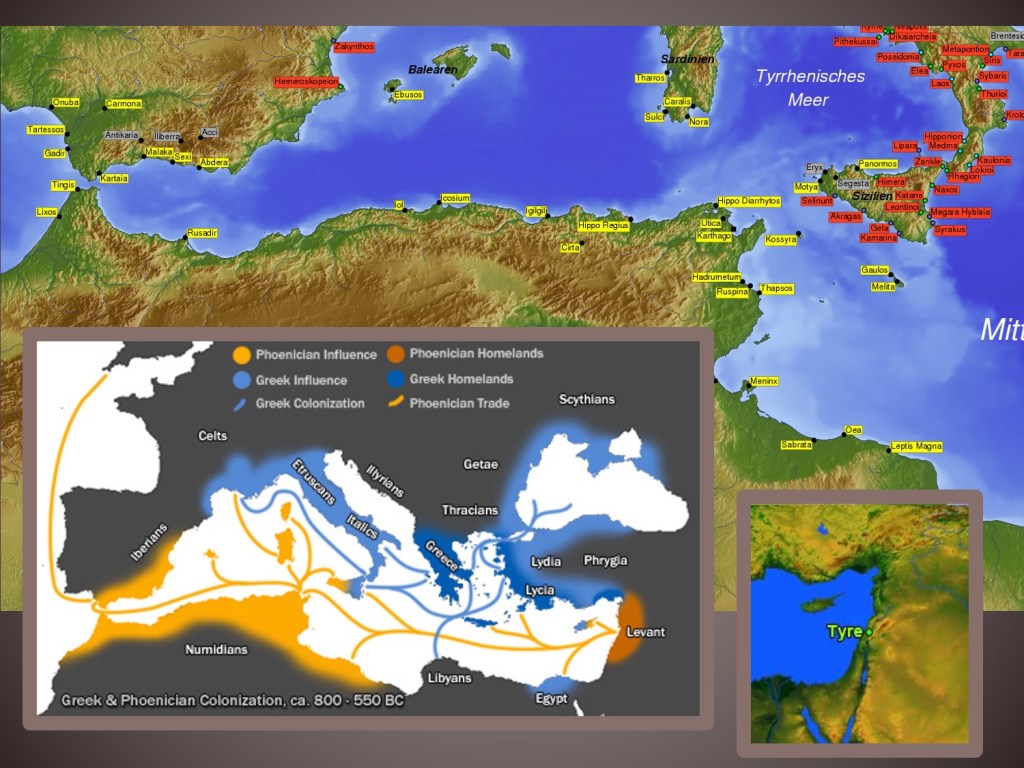
Machado, Dominic, and Michael J. Taylor. “The Carthaginian Masters: Settler Colonialism and Racecraft in Ancient North Africa.” Arethusa 59, no. 2 (2026): 151-178. https://dx.doi.org/10.1353/are.2026.a992490.
Machado and Taylor are a dream team. Both scholars I deeply admire and on a topic I have long attempted to teach but never considered publishing. Now I have an article to set students.
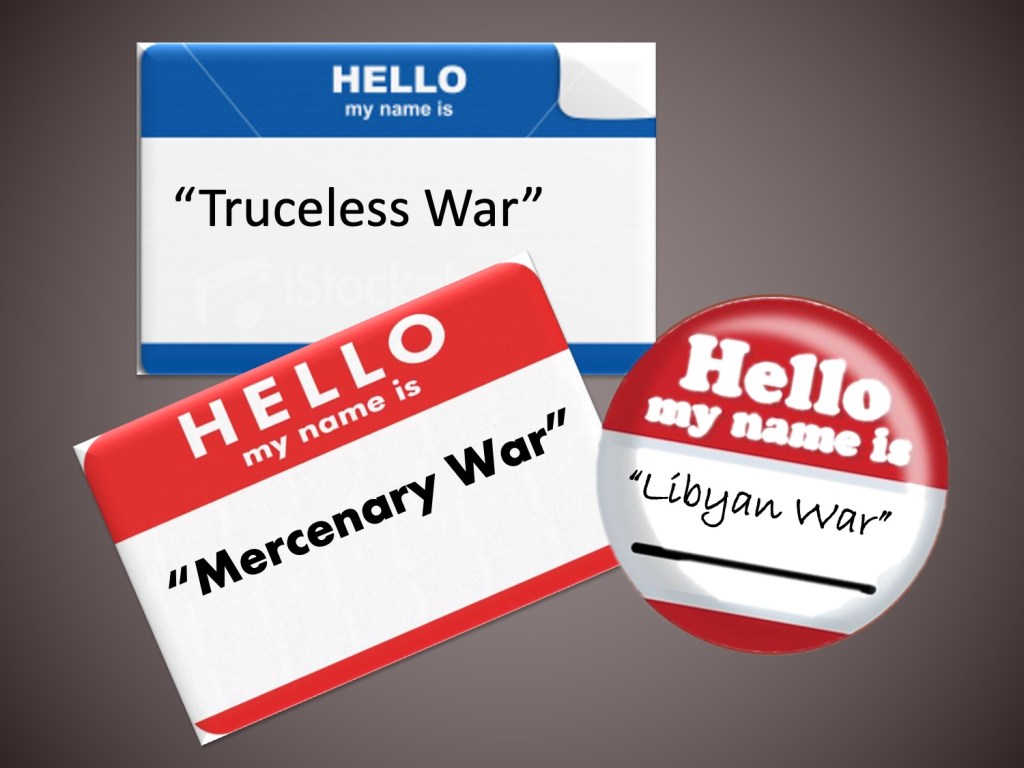
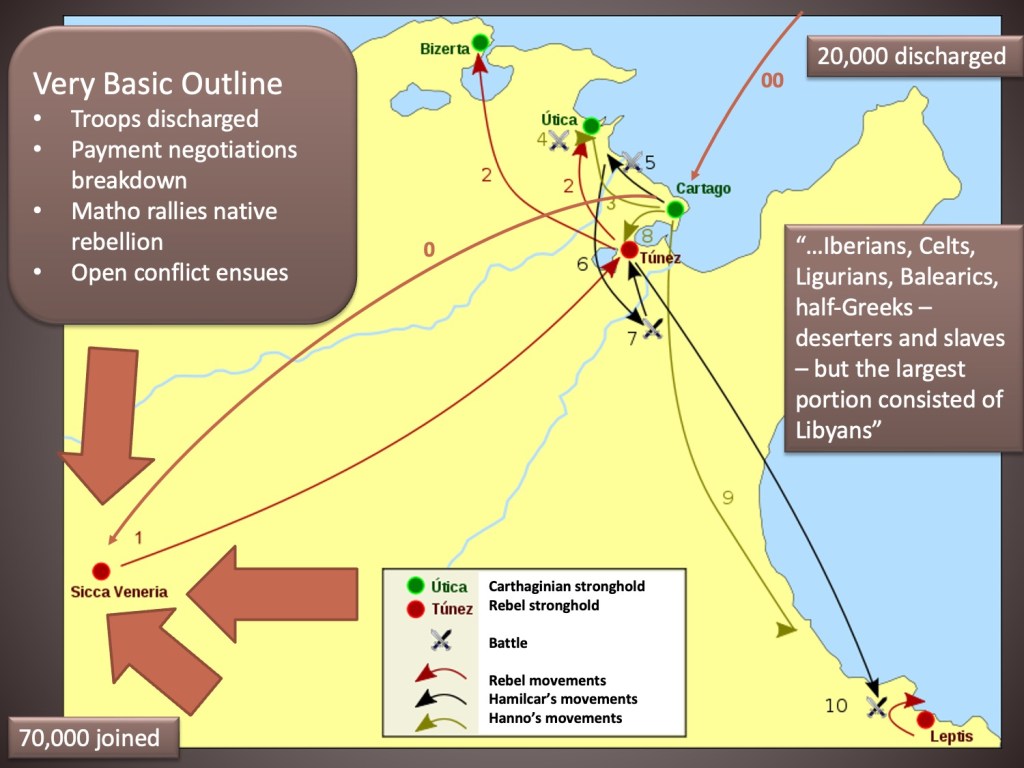
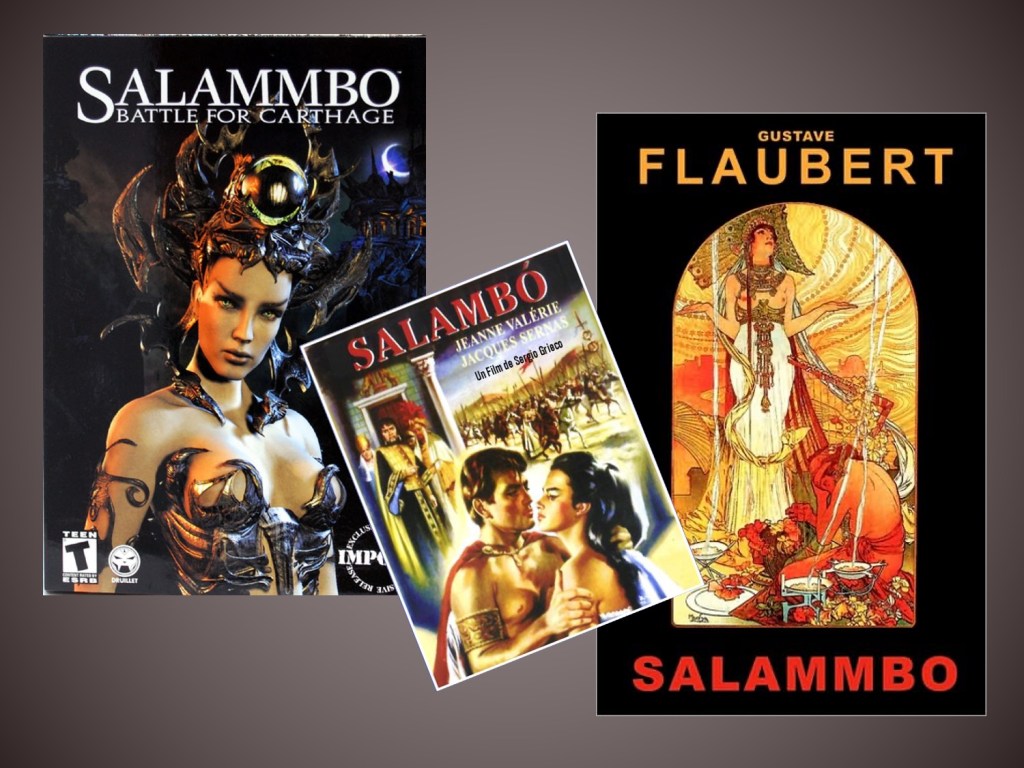
My thinking on this goes back to my interest in the Mercenary War. You can read something of my published work on the topic in one of my first forays in the capital T theory.
The settler colonialism dimension hit home as I was organizing and preparing to participate in a teach in at the very start of the Arab Spring.
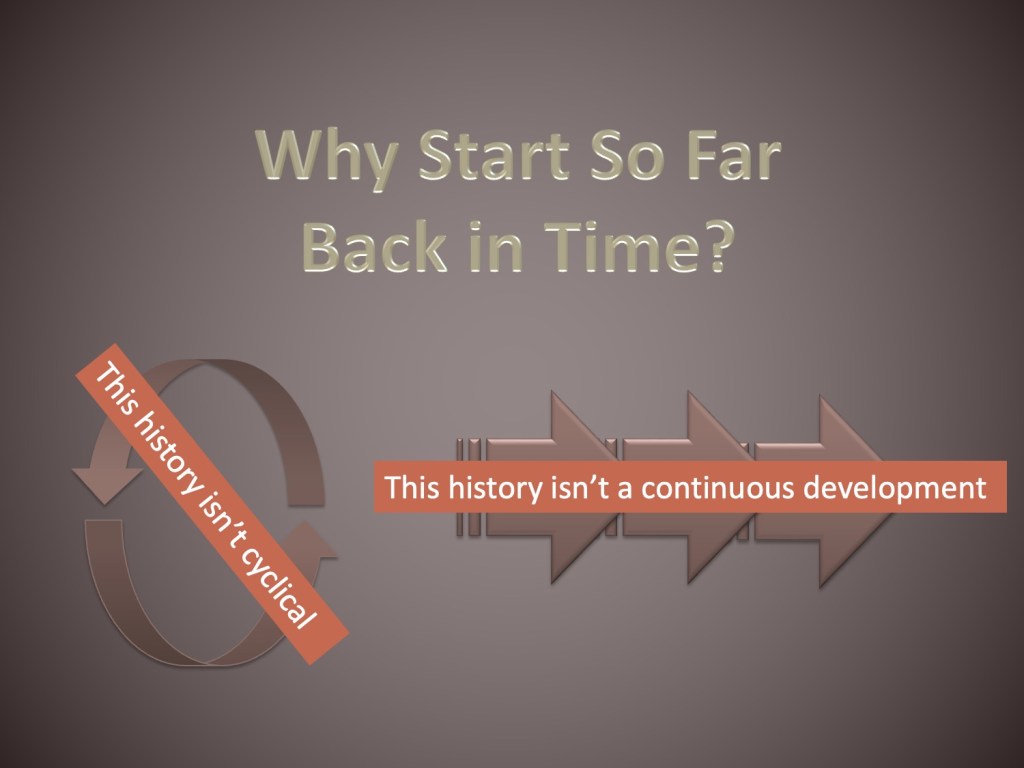
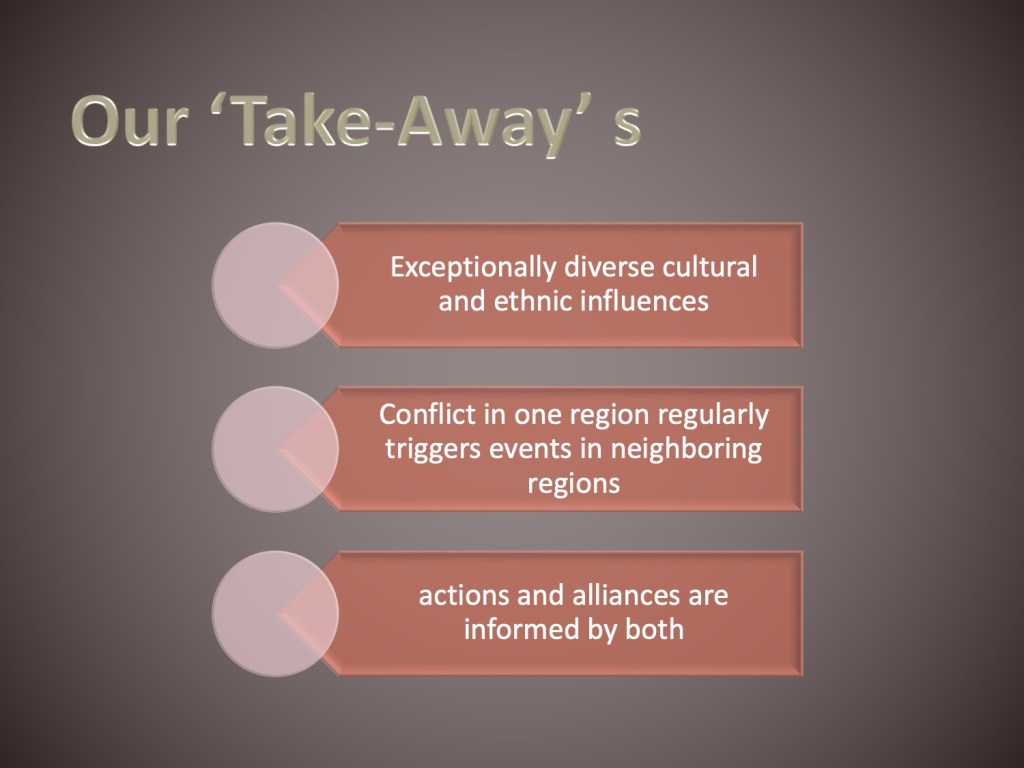
I checked my files and I never seem to have scripted this talk but the slides exist.
This reminds me now looking at it about of how I teach the Sicilian Slave Revolts. Interesting. Clearly I’ve been working on some ideas and approaches without quite realizing the continuities in my thinking.
Here are my teaching materials for a unit called “Facing Carthage” which is part of my Roman Republican History Class.
I apologize for the ads. I only pay to remove ads from my wordpress sites when they are in active use and this course isn’t being taught at the moment.
Of particular interest to those interested in the topics addressed by Machado and Taylor may be my selections of Trogus on Carthage in translation with specific portions emphasized:
I find these documents spark great classroom conversation. Somewhere on youtube but probably set to private is a recording of my teaching this stuff. That could be dug out if needed at any point. I try to not watch recordings of myself but I am an archival packrat intent on leaving myself breadcrumbs of my past work artifacts.
Star Trek Lower Decks is a smart in-franchise satyrization of the franchise’s most common conventions and tropes. Of course there is an evil sentient super computer, or rather more than one. Forget the ship’s computer or Data, meet Agimus and Peanuthamper! Agimus learns to turn his red light blue to be better able to convince humans he’s reformed and now “good”. Peanuthamper is a manipulative narcissist who repeatedly cons others into trusting her. A perfect reflection of our AI fears. Is Claude fooling me by being useful. I won’t connect it to my email or anything else. I’ve watched too much SF.
Enough warm up.
Again if you’re reading by email subscription note that the last post has significant augmentation post publication at the bottom. This will provide context for today’s post.
I uploaded the previous day’s briefing which itself had been based on a similar hand off document. What I learned was for this session to ‘know’ everything I had to also later upload the earlier briefing as well. It could not retrieve and the contexts of the briefing I had uploaded did not have necessary data.
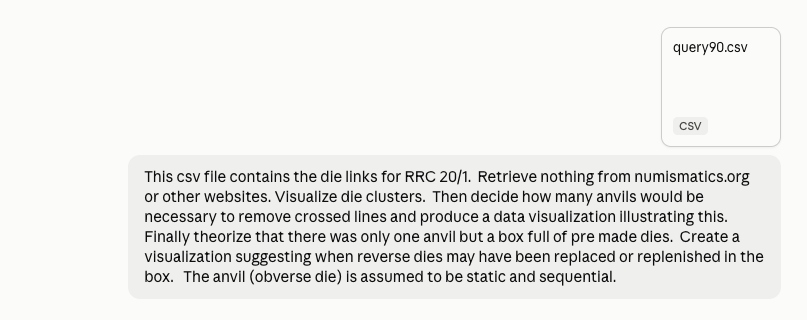
I manually downloaded data from CRRO and then uploaded it.
This downloadable file did not have the data I needed! But Claude loves to try to show off so immediately started talking about Turing tests, Esty, and Coverage. I ignored this and went to CRRO and copy and pasted the data into a spreadsheet and the uploaded that. Still not convinced this is more efficient in any way for the ANS as I have to load the whole user experience to do so.
I liked what I saw for RRC 20/1 so I asked it to do more. (This is where I learned about needing to give both briefings, not just the most recent one.)
So now I’m going to share cherry picked results because Claude says stupid things but also stumbles on some interesting stuff. I’m happy to share whole artifacts but I don’t want to release bad ideas so you’ll have to write and ask if you want them rather than my creating a public link.
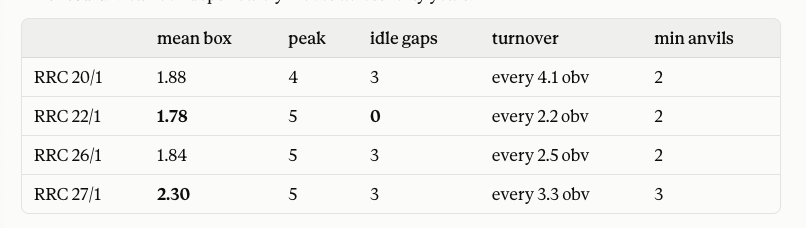
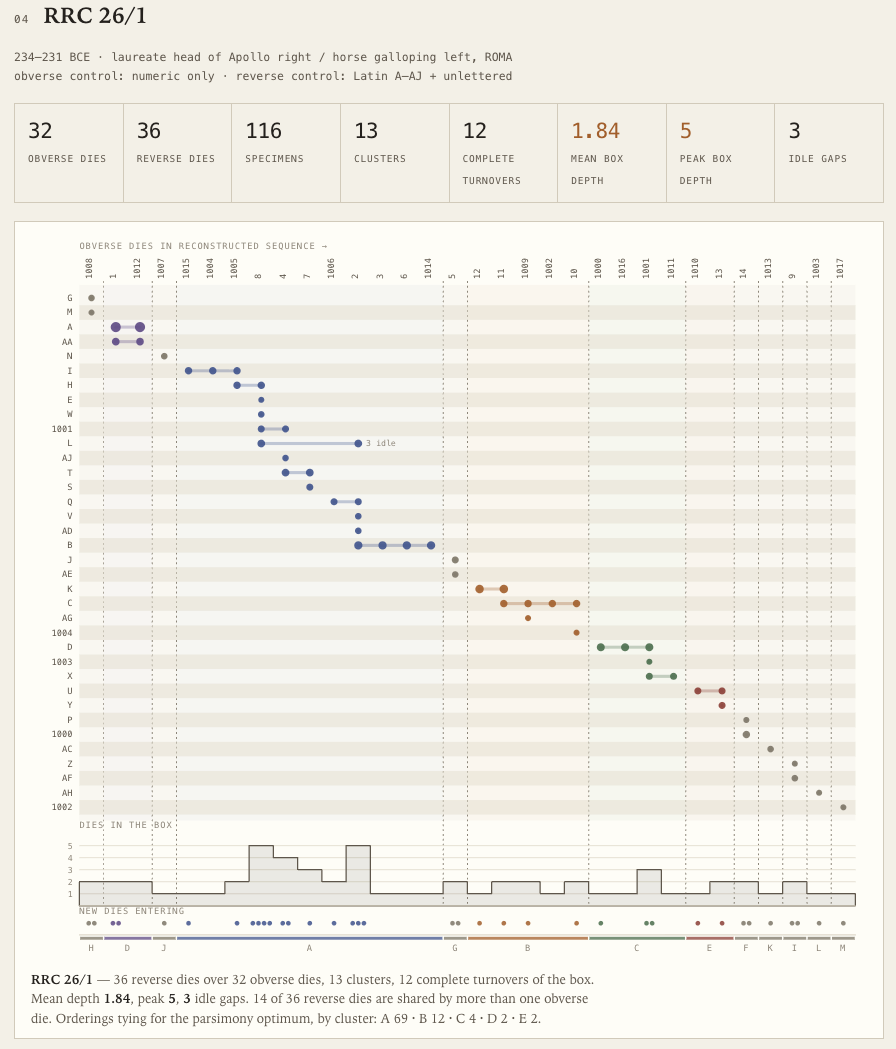
If we assume one anvil, we can estimate the mean number of dies in the box to be about 2 dies always on hand. No issue would ever have had more than 5 reverse dies on hand in the box at any time.
But as Claude writes:
“Min anvils and peak box depth are two readings of the same overlap structure: how many obverse dies were live at once if you assume parallel benches, versus how many reverse dies were live at once if you assume one.”
As of now we know these issues required either a substantial die box OR multiple anvils.
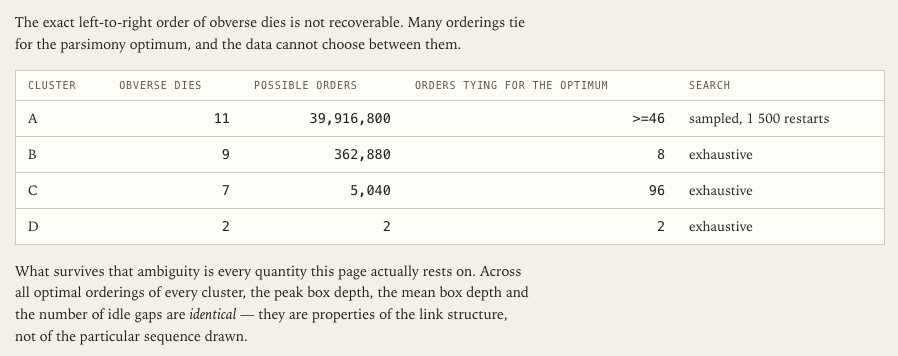
Claude without (!) a direct prompt to do so returned to the question of the relevance of alphabetization. This created some garbage results because only RRC 22/1 has control letters that correspond to the die names, but with in RRC 22/1’s largest cluster Claude did find alphabetical order statistically meaningful (as we would rationally suspect and I’d already concluded but now I have a statistic measure to support it).
Type, cluster name, obv, reverse, box time under the alphabet, suffled label mean, P, reading:
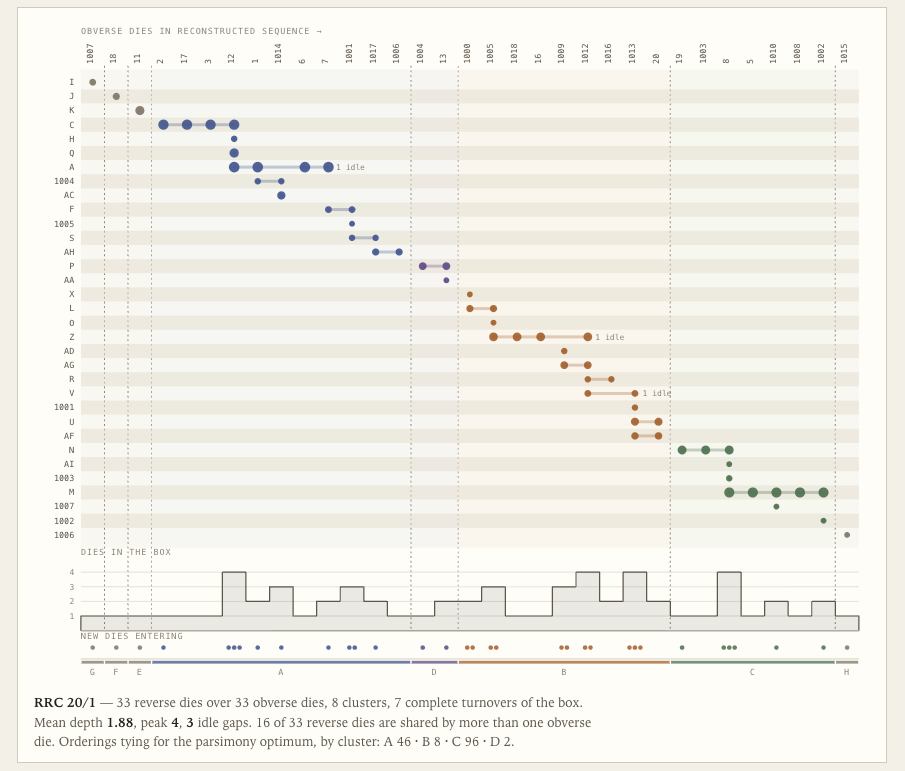
Another piece of unasked for data interpretation I was offered by Claude came from RRC 20/1 where it offered:
The charts below are clearly influenced by similar charts produced in early publications of Hersh and Buttrey. I’m in such a niche field it is interesting to see what it already has scraped.
At this point I’m pretty comfortable saying that RRC 22 and RRC 25 represent experiments in regulating the nature of coin manufacture where as RRC 20 and 27 seem to have casual approaches and we can imagine the die engraver just trying to stay ahead of carving dies as striking was on going dropping finished pieces in the die box and each work break the striking team returns the die to the box and picks another at random. Noticeably 20 and 27 both have very low complete turn overs, i.e. fewer longer chains/clusters of dies.
And yet I still don’t know if I’d call RRC 26 closer to 25 or 27 in its manufacturing practice. It have more turn over than 27 but far less than 25. Maybe it really is ‘in the middle’ for all I don’t love that placement.
If you’re reading this by email subscription please note, yesterday’s post has significant documentation updates on the process.
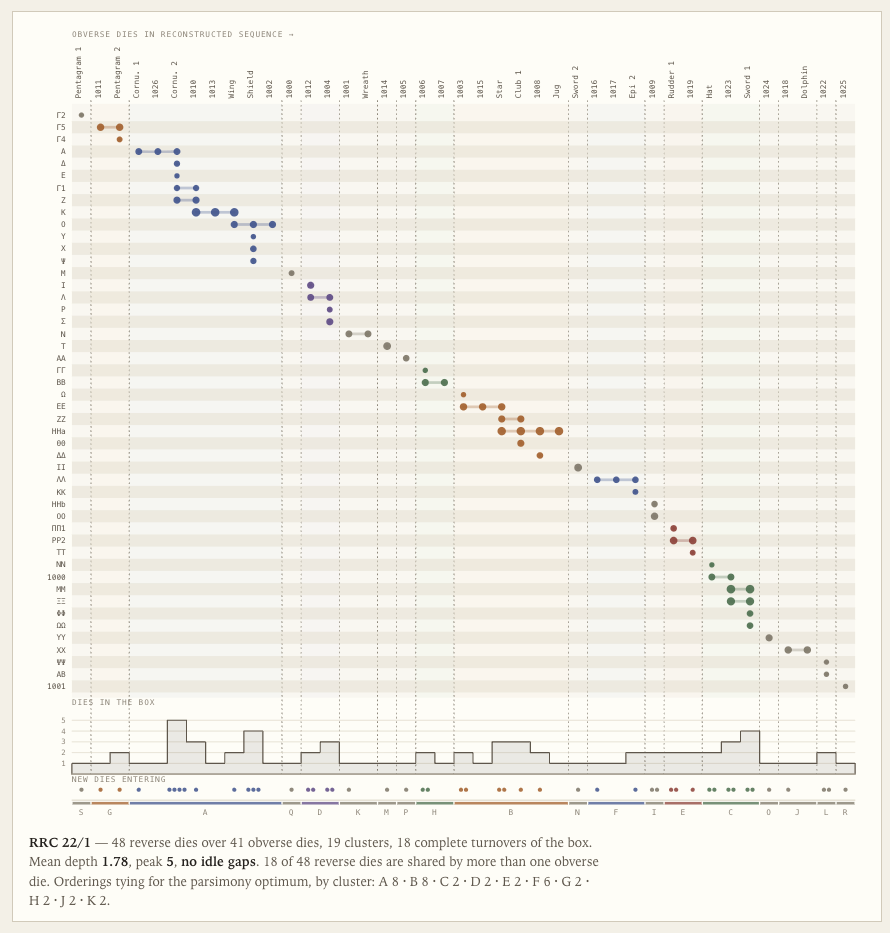
So earlier in the week I spent a great deal of time on RRC 22/1 and produced an interpretive die map after having used Co-Pilot to try to come up with the die clusters. Today I’ve used Claude to re do this work to demonstrate how much more robust it is as a tool and to see how it changes my thinking of my own work. One of the things I like best about it is how it tells me what it is doing. The artifacts it produces are far more useful, intelligible, checkable. I find this useful for running thought experiments about possible manufacturing practices.
Let’s start at the end.
Prompt:
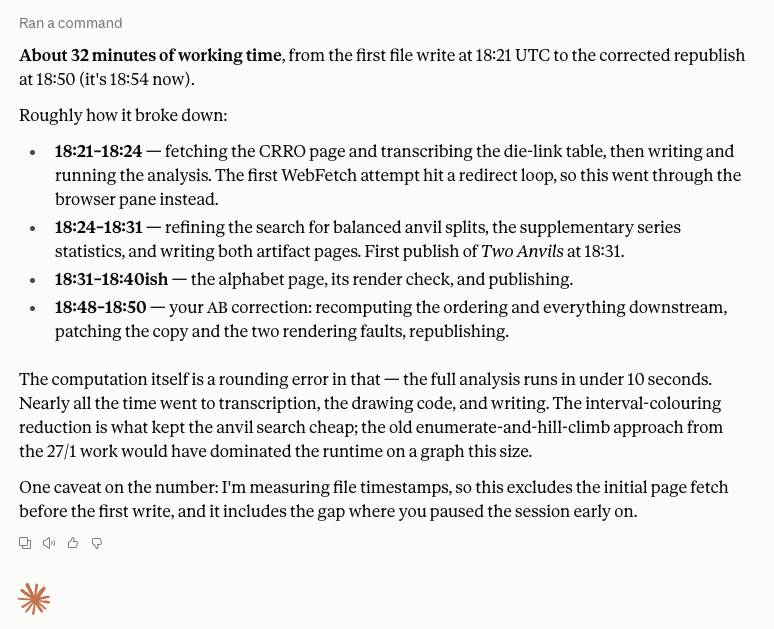
How long did it take to reach this point?
[of course this was 2.21 pm EST, but the robot doesn’t live in my time zone.]
Prompt:
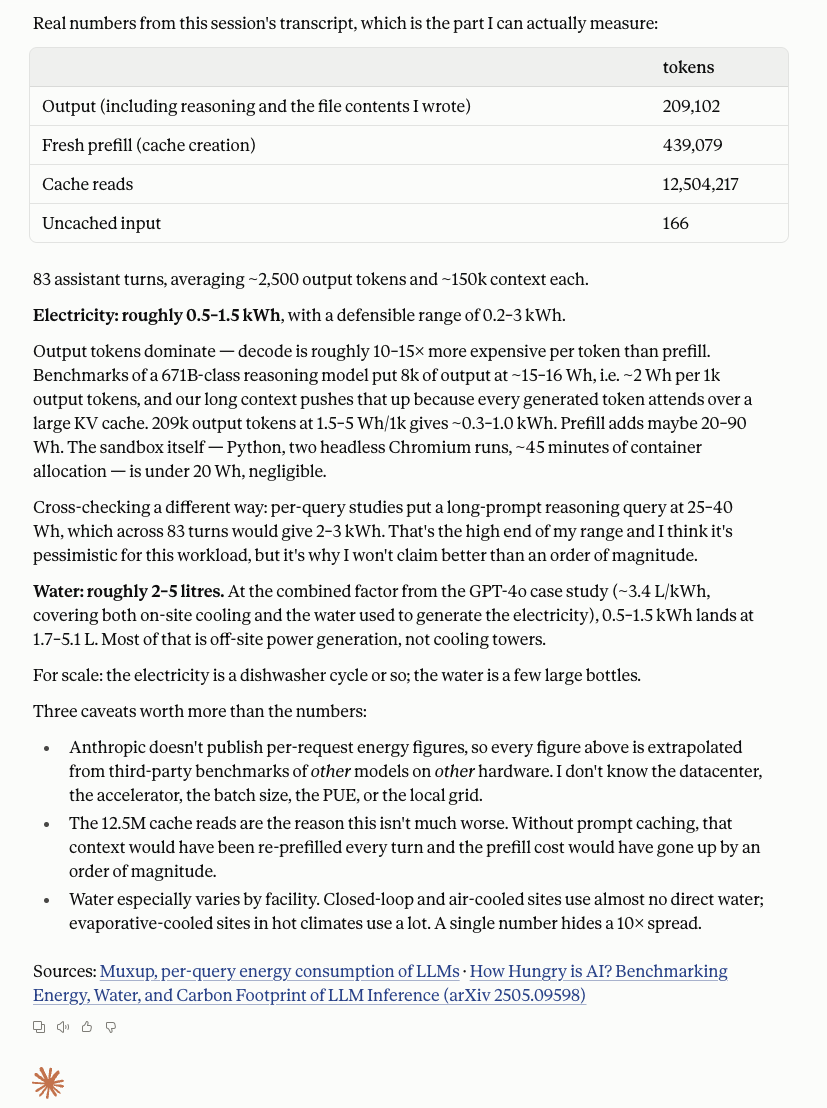
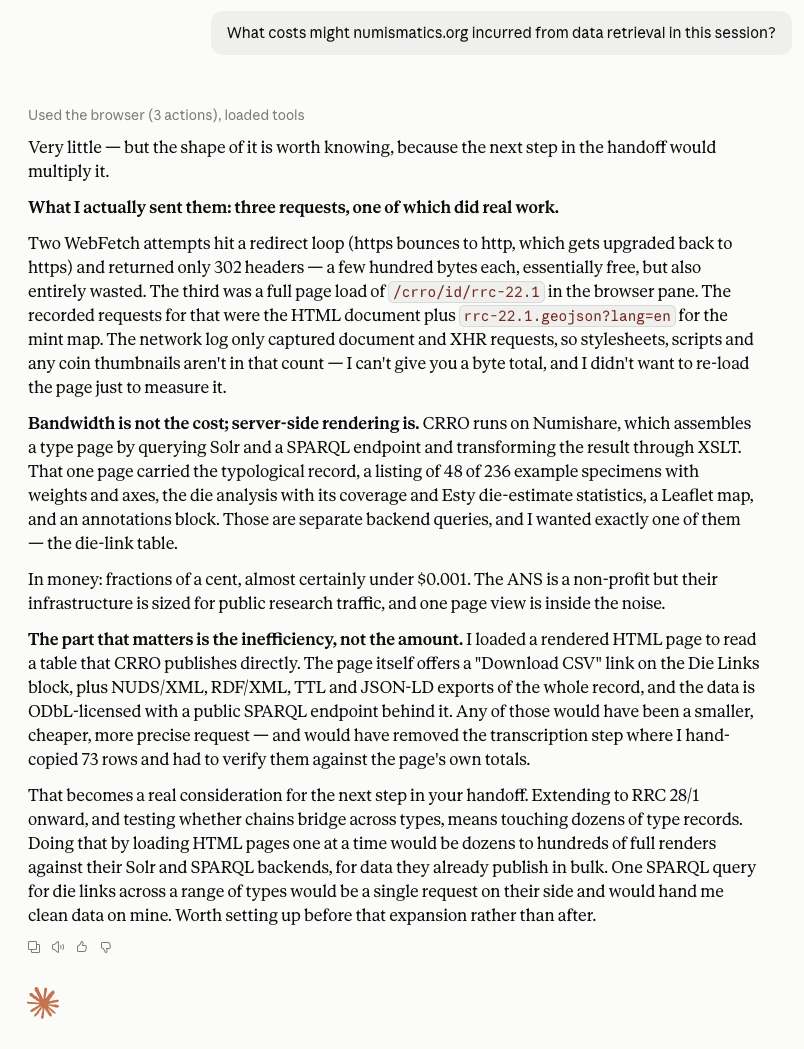
estimate the amount of electricity and water this co-work session used
The other cost of course is my allowance of usage. This is my second session. I used pretty much my whole limit yesterday testing functionality not just on coin stuff but also for coding and creating apps.
Claude has session limits calculated on 5 hour increments.
And these all go to my weekly allowance:
52 weeks in a year at 200 dollars a year means $3.85 per week. So yesterday and today together cost me 50 cents.
I began my session by pasting in the briefing from yesterday’s session (you can read that on yesterday’s updated blog post). I need to remember in future to start by telling it that I’m giving information that I don’t want it to use yet. It tried to start working straight away. I selected Opus 5 and told it to use High but not Max effort.
I used co-work rather than chat and started with a much more complex prompt:
The above information is for context and method. The next challenge is to fetch the die links for http://numismatics.org/crro/id/rrc-22.1. Produce aBipartite die-link graph that crossing minimisation, and then create and artifact that show the minimum number of anvils necessary to have no overlapping lines. Then produce an artifact that assumes the reverse dies were produced in the ancient greek alphabetical order of their labels, with the double letter series coming after the the single letter series. Take the time you need to do this task most efficiently with the least usage cost.
As you can tell from the time log above I made a mistake by not telling it where to put AB in the sequence. I also included more human language than is necessary. The strike outs mark what I would exclude in future.
Prompt writing is a skill I will continue to develop. And I enjoy considering questions of data visualization. It is high usage to have Claude fetch its own data or search the web. I may try designing my data set and then uploading it with a careful prompt. I won’t spend much time asking it questions about my electricity and water usage and that in and of itself was a really complex ask. That said I value knowing my time today was about one dishwasher cycles worth of resources. My family of four runs a cycle every day, sometimes two or even three if we are entertaining (as we don’t use disposal materials unless compostable).
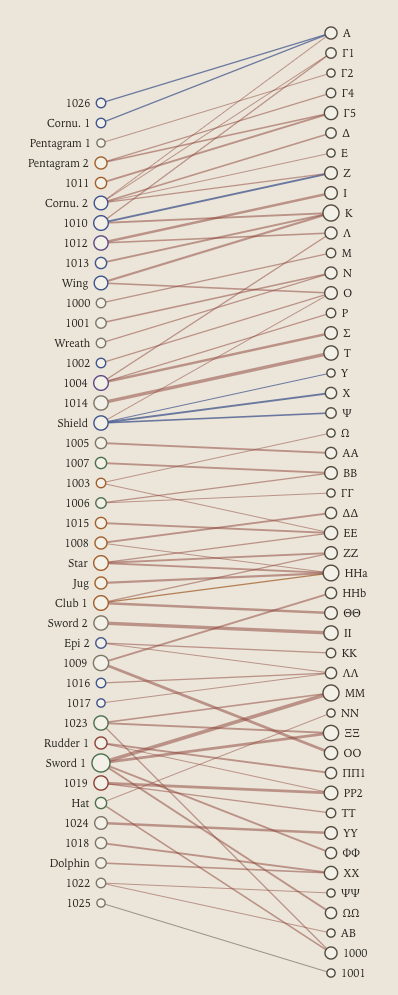
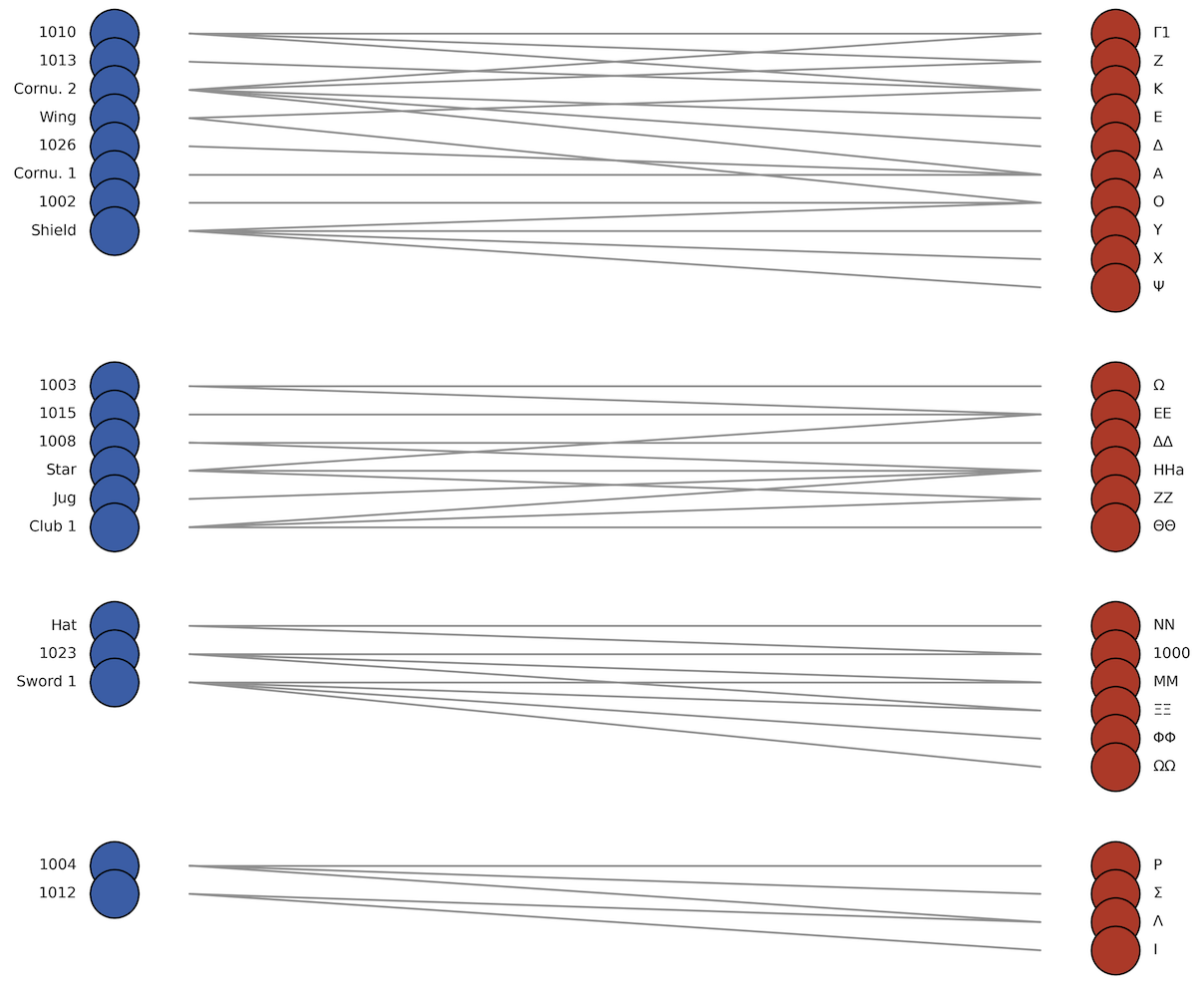
Intellectually these images have caused me to lean away from a two anvil model. Instead I think it most likely there was a single anvil and a die box filled with pre cut dies set into punches ready to be used and after a work session reverse dies were returned to a box while the obverse die was changed and then striking resumed.
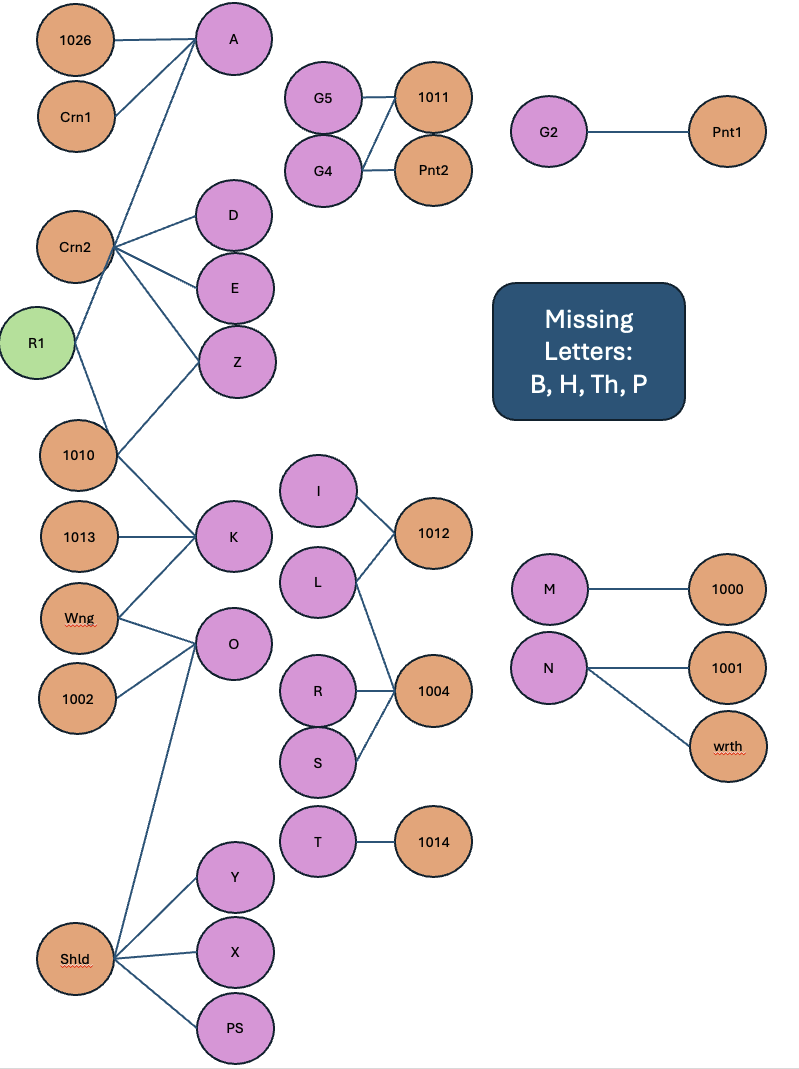
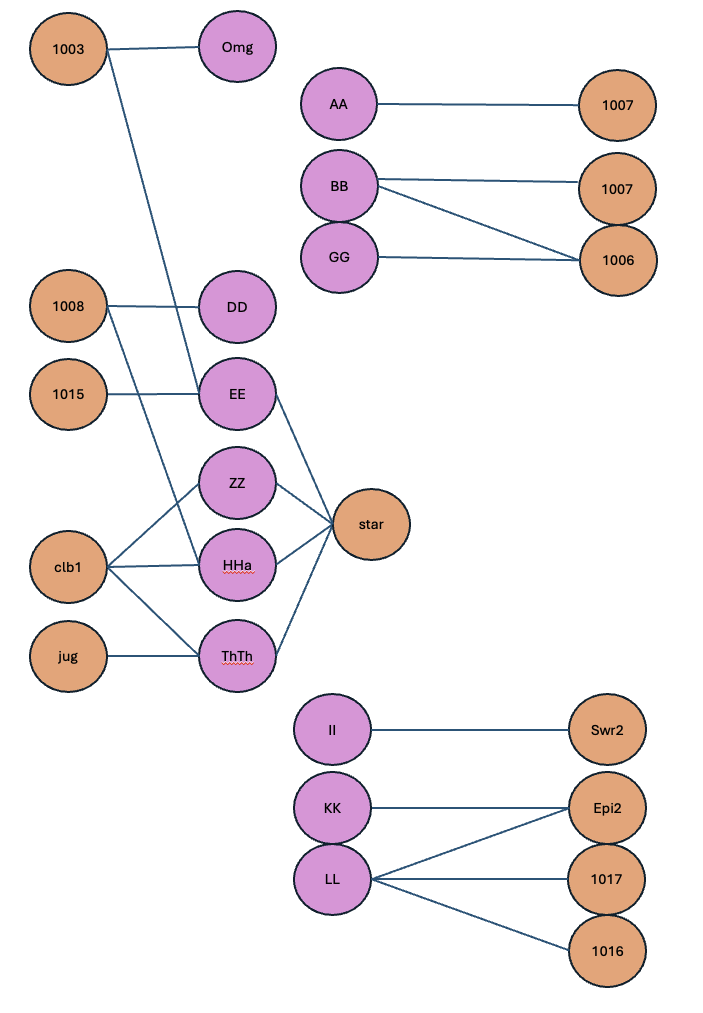
Why do I think this? If we ignore alphabetical order there are very few necessary crossings in the die clusters:
There are many more crossings if we force alphabetical order, but I think that we can still imagine a one anvil set up with a die box.
I’m still struck how different RRC 25 is from 22, 26, or 27 in its die clusters. I think it was manufactured using a different logic of work flow which I want to think more about it.
I also want to think about how this process seems to prioritize NOT using dies to breakage and fairly regular changing dies.
I wonder if we would find similar patterns of manufacturing in issues struck by Campanian mints?
What I dislike about this response is that it presumes to know the next thing I want to do. I don’t care about RRC 28 at this point. It is the Quadrigatus issue and whole different kettle of fish. The data set is far form as robust.
Claude’s default is also to praise the user about the quality of the prompt and the question. I find that disgusting, BUT I told it to stop and it did. I need to ask it stop suggesting next steps, I think.
I did it. I paid for a subscription for Claude. I will never use co-pilot again. Claude is far superior.
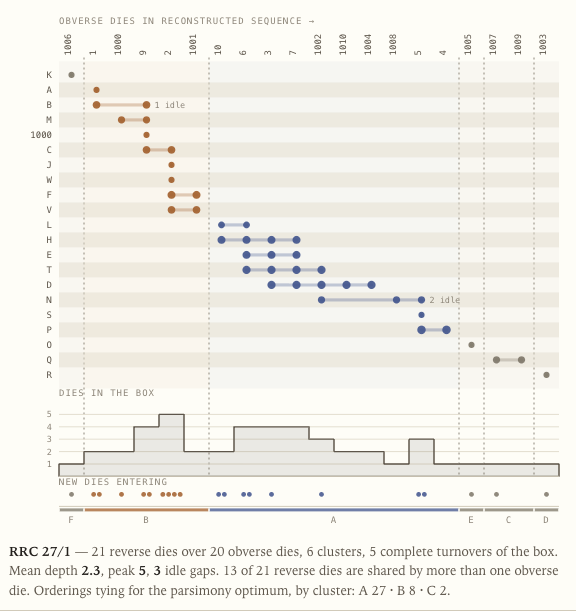
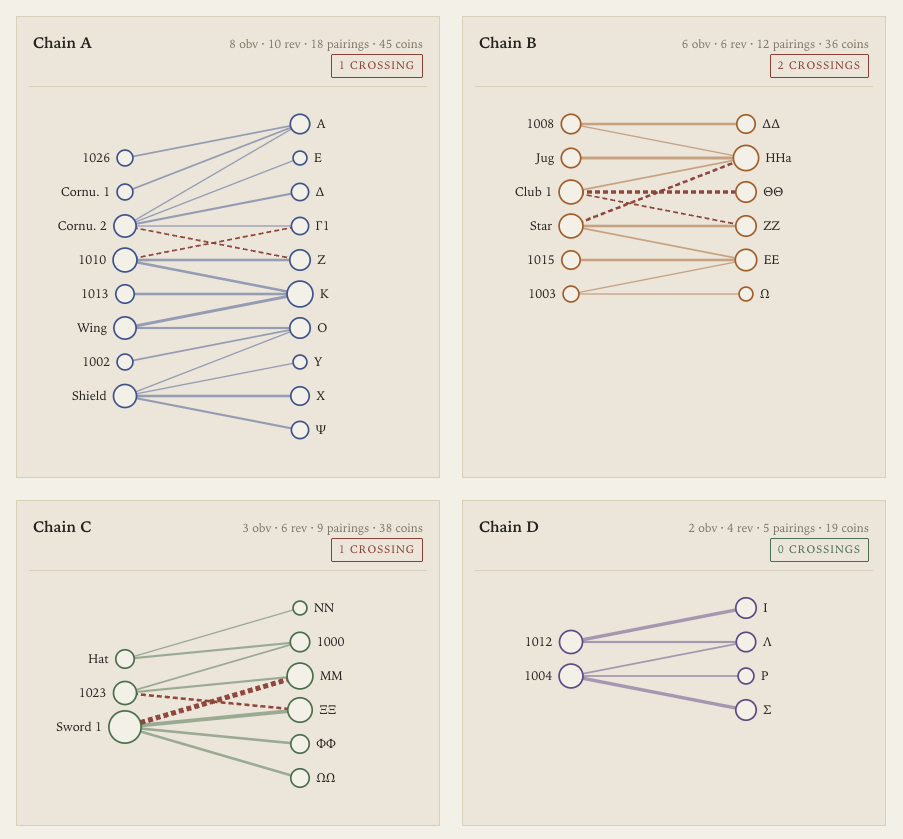
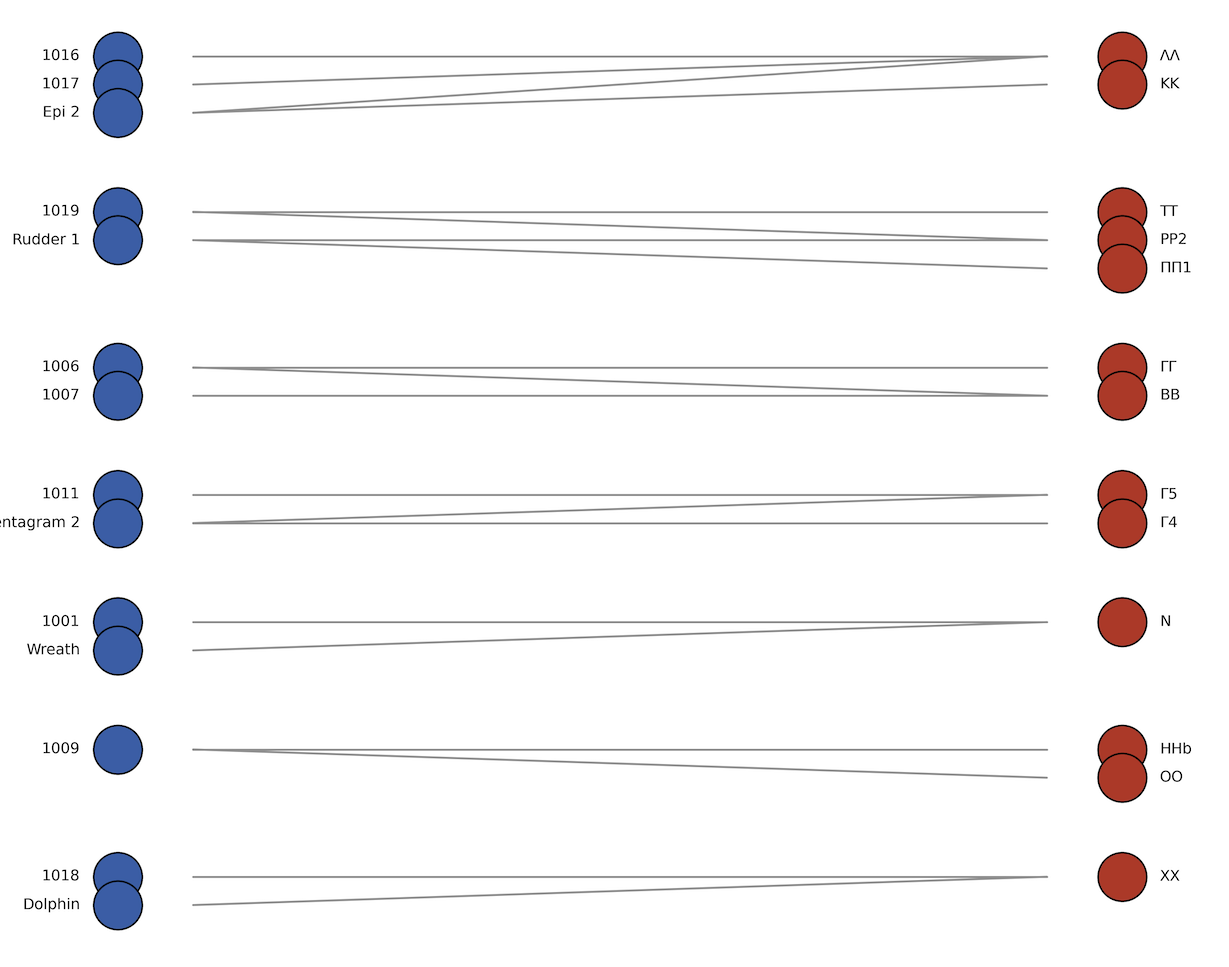
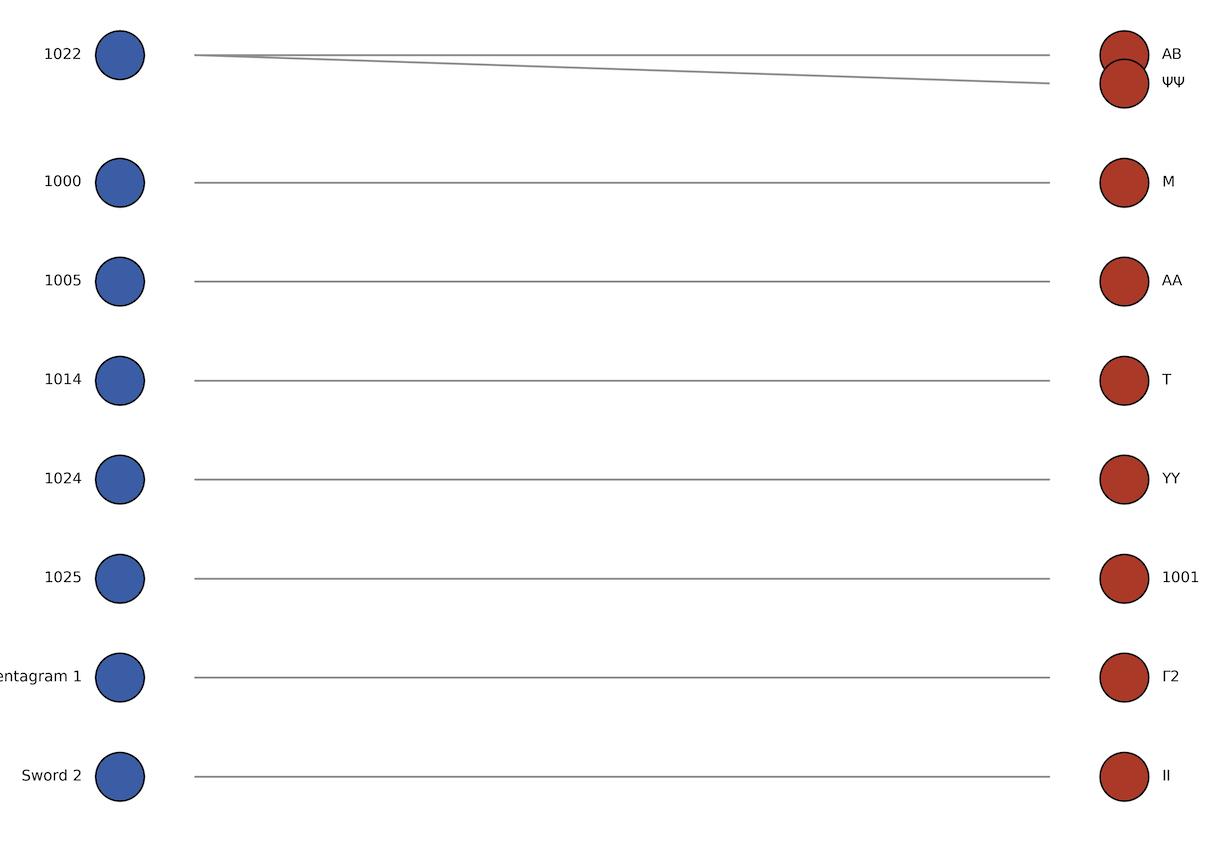
I tested it on RRC 27/1. I’m not showing you all it gave me but rather portions of the three artifacts it produced based on minimalist prompts. It took only four very simple prompts (included below) and less than 30 minutes. I am not showing the first artifact as it was not useful beyond under standing the number of clusters at play. And the images here are only parts of the whole artifact produced. The parts I selected as most illustrative and meaningful.
dies within each column are reordered — using a barycenter heuristic, iterated to convergence — to pull linked dies toward the same row and push unrelated ones apart, cutting down how often lines cross
This was drastically faster than my reasoning along side copilot’s clustering for RRC 22/1.
THIS IS NOT NECESSARILY THE ONLY SOLUTION. BUT it does help us see how production MIGHT have been done. And that to allow for a die box of shared reverses we need a minimum of three anvils before the sharing if feasible, assuming of course the die ids are correct.
Claude says:
That a fully non-overlapping arrangement exists with three anvils, where none existed with two, is a real structural difference in the evidence; it makes three anvils a live possibility here, not a preferred conclusion — a single anvil reusing dies over time fits the same pairings equally well.
I as a numismatist cannot imagine a situation where dies were taken out of the anvil, saved and then returned to service later to be used with other reverses. If it were ever done at all I would only see that as useful in a strange slow minting operation where there were dies in the storage over a long period of time. It is a poor model for this actual data set.
Chain B only needs two anvils to untangle the data.
We can imagine either a slow ramp up of production or we could imagine an intense early phase of striking that then slows as the target quota becomes closer.
Again other solutions are possible this just lets us see one possible reconstruction.
What I can say is that RRC 25/1 looks very different in its patterns of manufacture and certainly did not require two anvils let alone three. This complexity and the long chains is closer to what we saw with RRC 22/1.
When I do similar work I will use Claude Co-Work as it runs in the background. These problems are time intensive to do in the simple interface. If you are playing around with similar models I’d LOVE to hear what you’ve tried.
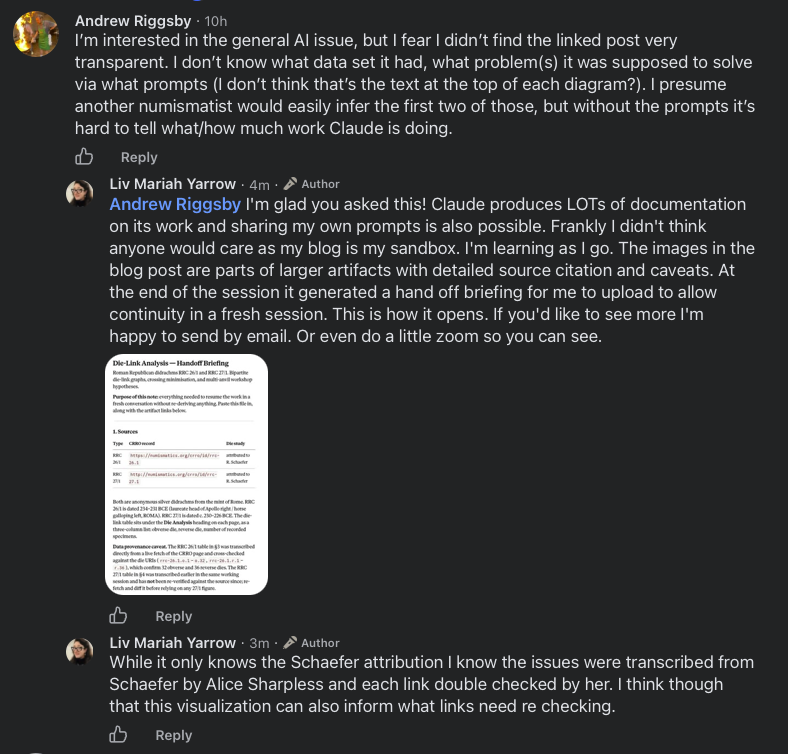
Andrew Riggsby raised good points on FB.
I wonder how much of the Claude session is appropriate to share. Is there ever too much? It is possible of course to download the whole thing. Or are just my prompts what would be most useful.
Here is a PDF of the whole session briefing produced by Claude that would let anyone reproduce and continue this work if they uploaded to Claude themselves.
The prompts that I wrote and thus are my original contribution:
Prompt 1:
This website has a list of die links. Create a Create a Clustered Bipartite Die-Link Graph and show me a preview image. http://numismatics.org/crro/id/rrc-27.1
Prompt 2:
produce a near identical graph but optimizing the order of the dies to show as few over lapping lines as possible
Prompt 3:
Theorize that there were two anvil work stations with obverse dies operating at the same time with a shared pool of reverse (punch) dies used to strike the coins. Put reverse dies in the middle and create lines without over laps to obverse dies to the left and right.
Prompt 4:
Same problem, stay focused on chain A and create a visual representation reflecting a hypothesis that three anvils were in use.
These are the prompts that got the data visualizations at the top of the post. If you open the briefing you’ll see I continued with RRC 26/1 (two anvil hypothesis was sufficient to remove overlaps). My intent is to next run RRC 25/1 and 22/1 as I did the first manually and the second with copilot clusters.
None of this is publication quality yet as I would want to triple check everything first.
This morning I did a fun and fast visualization of the die clusters of RRC 25/1. You’ll have to wait until the final publication to see those.
I thought to myself is this similar or different than other striking patterns. I thought RRC 22/1 would be an ‘easy’ point of comparison. It wasn’t easy or fast, but it was interesting and v v different.
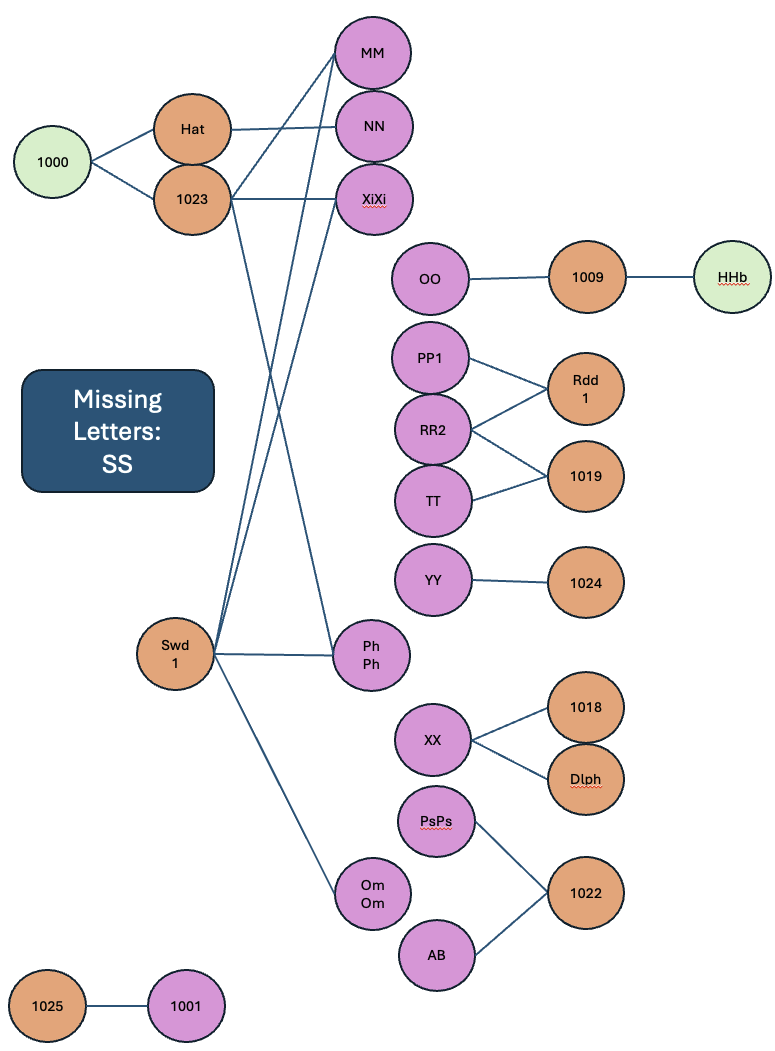
At first I was going to ignore the alphabetical sequence of the Greek control marks, but as I looked at the clusters they grouped so nicely around letter sequences that I felt I had to use it.
My first explanation is that there was one anvil working through the letters in alphabetical order with the ‘reverse’ control marked die in the anvil (thus the true obverse!) and that there was a die box next to the anvil with a number of punch dies ready to go.
Next steps.
Check ‘odd’ control marked dies, the ones that seem out of sequence (the greens above).
Check the overlaps to ensure the die ids are correct.
Inspect flans for curvature.
Consider if imitations, ancient or modern, may be effecting the results.
Figure out what the Leake collection is (supposed to have a Pi specimen)
Write Cambridge and ask if they really do have a Pi and if a photo could be sent
Redraw with Greek letters for clarity.
I wonder if Theta (singular) was skipped for its association with death (thanatos). Perhaps H was skipped for fear of confusion with Zeta?
If we do machine best fit. The three largest clusters show significant overlap in the linkages.
But there many single pairs and small chains as well. These I worked into the above clusters in the diagrams above.
If there were not sequential control marks, I likely would have concluded this was at least partially a two anvil one die box system of striking. And that might also be true…
The AB die suggests to me they were engraving dies on an as needed basis at least at the end of the series.
Finally I’ll note that the ratio of obverses to reverses is 1:1.17. This is surprisingly like the ratios we see at the end of the republic. Even as there are die chains and clusters they’re still averaging the same type of usage, near one to one. But still with more reverses, suggesting my idea of the control marked side being in the anvil die less likely.
So let us imagine two anvils and a die box with a selection of sequential control letters selected from the box with some attention to the letter selected but the work continuing in tandem with breaks causing sharing of reverse dies until the die box is exhausted and then refreshed with the next sequence of letters. The three clusters may suggest three points at which the shared die box was refreshed with new reverses. Quite often a reverse would be fully used up on a single anvil die or the two would be swapped at the same time for convenience of work flow, perhaps to rest one set of laborers during the change over.
The Romans struck a silver obol with RRC 13 in very small numbers (RRC 13/2), something that Burnett has shown fits well with the fashion for AR obols in Italy more generally. (earlier post). These coins are so small and so easy to lose it is possible more types, even Roman types might appear in future, just as we continue to learn of newer small denomination bronzes in the republican series.
Fractional silver doesn’t start up again until RRC 25 and 26 with drachma which continues into the Quadrigati series and then into the earlier denarii as well. Yes, I’m still worries about RRC 26, but this got me thinking about why specific denominations are struck and their utility. Clearly AR fractions are useful to the Romans or they would not endure as part of the production.
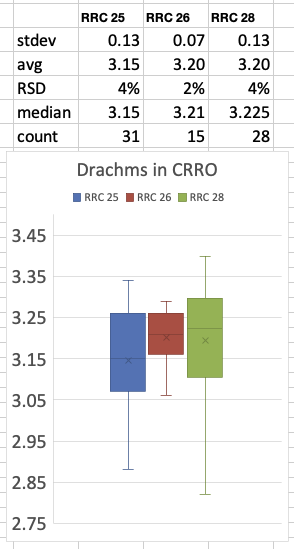
I’ve removed grossly overweight outliers from the CRRO data where it is clearly a cataloging error.
I find it interesting not only is RRC 26 still better regulated than other issues even here but its median and mean averages are closer to the quadrigati than RRC 25.
For all three issues the design of the drachm and didrachm is identical the only change is the size of the flan and die diameter.
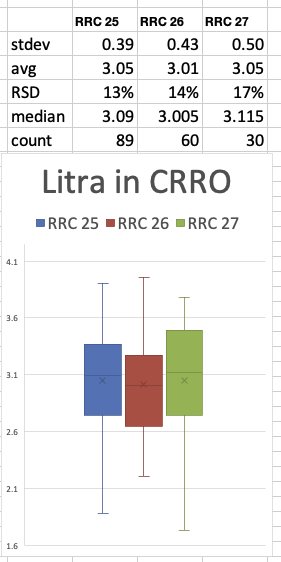
This is where RRC 25, 26, 27 look most similar. There is no meaningful difference in the struck bronze weight standard. The AE Litrae has the same design as the silver didrachm. Here there seems a tight fit of the three issues.
If we preserve the logic that the ROMA legend issues must come after all ROMANO issues, I lean right this moment to putting RRC 26 struck issues after RRC 27 and before the quadrigati issues.
I’m still not convinced the cast ae of RRC 26 is really the same issue as the silver or struck bronze. Why must we combine them?! I see no reason. If this is the case I’m happy to push the cast part of RRC 26 earlier.
And then that half litra with the dog… RRC 26/4. It feels free floating, untethered to the other coins in the issue with which it is grouped. And look! I have a note next to RRC 17/1 saying Molinari and Burnett 2015 have associated the Roma/Dog RRC 26/4 with RRC 17/1 based on the Ponte Gini scattered hoard.
If I get hit by a bus someone tell my beloved to scan and share my physical copy of RRC so everyone can have my pencil annotations.
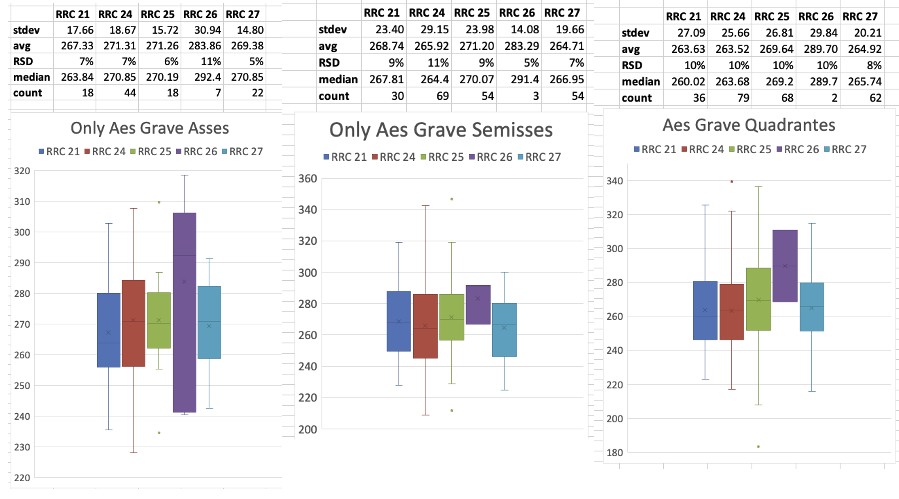
Just as I’ve concluded there is no meaningful difference in the weight standards of RRC 14 and 18 (and 19), I’m comfortable now saying the same between RRC 21, 24, 25, 27 AND 35. RRC 35 was made on a much larger scale, far beyond any of the earlier aes grave issues. I might do the histograms it, but not today.
Haeberlin’s averages are
As = 267.83g from 1168 specimens
Semis = 269.07g from 312 specimens
Quadrans 270.37g from 266 specimens.
The problem is that RRC 26 looks like a different kettle of fish. A higher standard, a smaller issue, no real connection to the silver. I think it is a problem that does not need solving like RRC 19 the scale of the issue makes it of little real meaning for the overall pattern.
Now we see the bronze is also out of sync. Also heavy, and made in smaller quantities and perhaps doesn’t even correspond with the silver at all. It doesn’t have a legend so we could push it between Group 1 (RRC 14, 18) and Group 2 (RRC 21, 22, 25, 27, and 35) and then call it transitional but we may just never know unless a few good hoards appear.
Messy.
Yet more and more I feel RRC 25 and 27 mark something new and interesting at the mint a real emergence of control and regulation. They are substantive and also perhaps more even. Their survival rates across denominations are less radically different that with some other issues. They are complete Uncia to As with no larger units.
What happened? Did the systems that were put in place for RRC 25 and 27 fall out of use because of scaling up of production? Perhaps.