And Euphorion the Chalcidian, in his Historical Memorials, writes as follows – “But among the Romans it is common for five minae to be offered to any one who chooses to take it, to allow his head to be cut off with an axe, so that his heirs might receive the reward: and very often many have returned their names as willing, so that there has been a regular contest between them as to who had the best right to be beaten to death.”
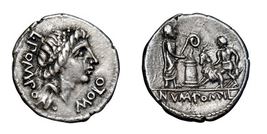
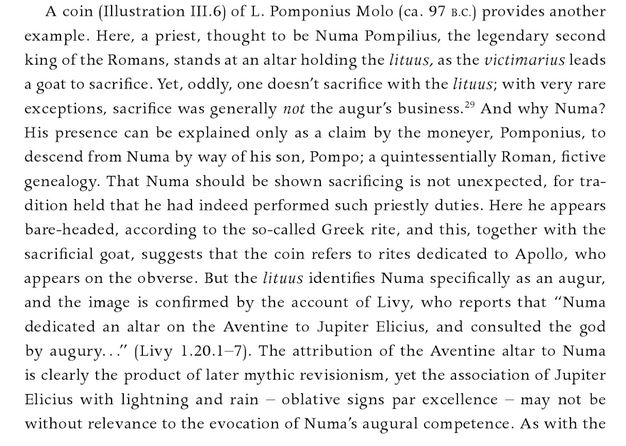
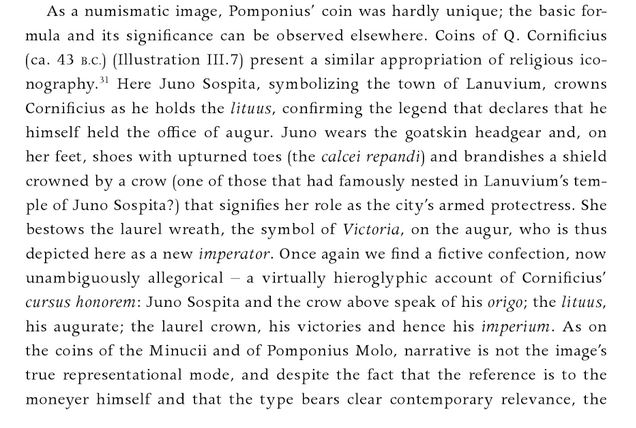
Here’s Galinsky in Augustan Culture thinking about this coin type and other related republican types as they may have informed Augustus’ own use of Numa.
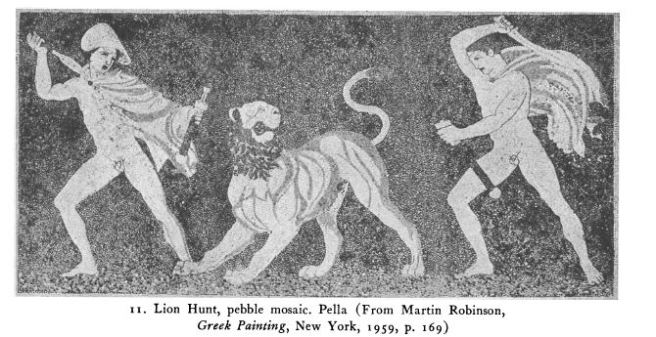
These examples were all plucked off acsearch.info and are thus from auction catalogues. They just supplement the many images available on CRRO for RRC 319/1. Anyway I just want to note that the right hand figure, which Crawford identifies as a barbarian soldier is probably meant to be a Macedonian. The round shield is one hint. As are the horns on the helmet, this may even mean a royal Macedonian is meant (see earlier posts). I think the strong diagonal element across the figure’s chest may be trying to represent a chlamys (Macedonian cloak).
Cf. Alexander’s chlamys on the so called Alexander Sarcophagus
And the left hand figure’s chlamys in this Pella pebble mosaic:
Not the easiest of images to track down a great for comparative iconography. See academic publication (no images) for discussion.
Click on images to see them better. Notice the Macedonian shields. The great feathers on the sides of two of the warriors helmets. The Rhyton is also really wonderfully depicted. I don’t know what those attendants to the horse riders are carrying to my Roman eye they look like fasces, but I guess they must be torches as Tsimbidou-Avlonitou says.
This curious episode is from Plutarch’s Life of Sulla comes shortly after Plutarch’s meditation on Sulla’s potentially inappropriate relationship with Bocchus including his choice of signet ring design. On that signet ring Sulla sits in the the chair of a quaestor, Bocchus and Jugurtha kneel. Here there seems to be a circle of three equal chairs but with Sulla’s in the dominant position. So why did this episode create so much controversy? Perhaps the Parthian King thought Orobazus was acting like a king by accepting the chair? The Romans did send stella curulis to kings as an honorific gift. Earlier post on this topic.
But what from a Roman perspective had Sulla done wrong? Was it letting the foreign king and representative of foreign king sit at all? Was it that in this context his sitting seemed regal?
The longer one spends in a database the more the errors and weaknesses appear. I love CRRO it has so much potential and is lovely and fast and easy to use and stable.
But… because nothing is perfect… I’m finding little data entry errors…
Crawford lists RRC 335 as late 90s BC, which any one used to thinking BC will know is likely to mean 95-90 BC or thereabouts. However the entries in CRRO were clearly made by some well meaning individual more used to thinking in A.D./C.E. All the types are entered as a mixture of 99-96 or just 96, none of which represents what Crawford intended. And Mattingly 1998 agreed estimating 91 BC for these moneyers:
So this is the first appearance of Apollo on the obverse of a Roman coin type since the creation of the stable denarius system (so 211 BCE).* It is the very smallest of the bronze: 1/12 of an As. So originally you’d have needed 120 of these to equal a single denarius and after the re-tariffing of the denarius 192. Needless to say not many were made, and most were lost, and few come to us in as good of a condition as this specimen!
But what is really interesting about this appearance of Apollo is that he’s displacing ROMA. Roma had been consistently the goddess of the uncia denomination since the creation of this bronze system. The rest of this series (RRC 285) follows the traditional combination of denominations and gods, but not this one. The series is also strange in its rejection of the prow reverse that has been the standard on the bronze and instead shows attributes of each of the typical gods. Why forego Roma? Was it just too complex to choose an attribute for her? This seems weak. Or did Apollo hold some special meaning? We are unlikely to know.
FYI – CRRO 241/6 (not is Crawford but identified by Russo 1998: no. 88) is catalogued as Mercury not Roma. This is just a typo. It is Roma in Russo and all known specimens.
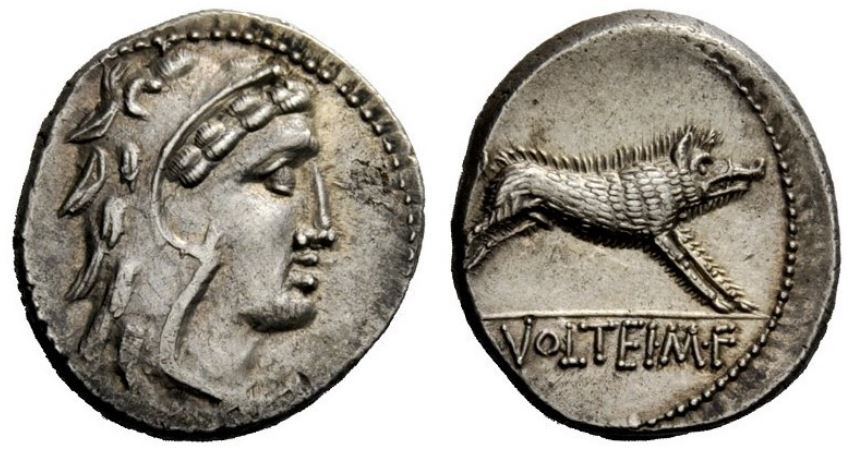
This article suggests that the boar as a military standard is the totem animal of Ceres. This seems completely counter-intuitive from a numismatic standpoint. Whenever the Boar is associated with a deity on the coinage that deity is Hercules, A MUCH BETTER GOD to follow into battle than Ceres.
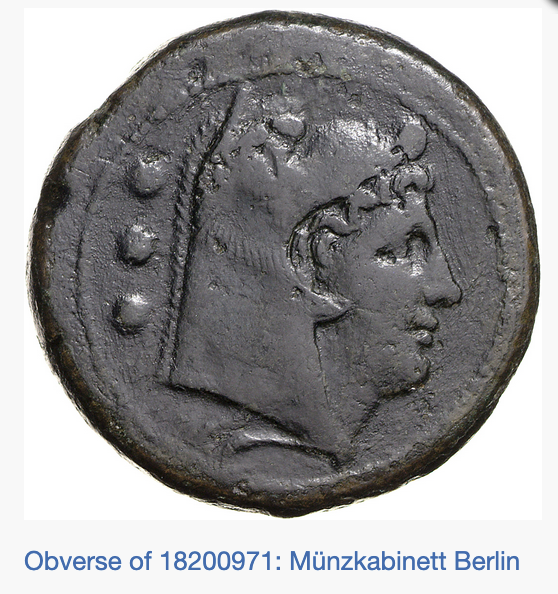
This is the typical numismatic image associated with Quirinus, but Hollstein (JNG 2011) has revived the opinion of Fulvius Ursinus (sometimes called Fulvio Orsini) that in fact RRC 268/1 is a representation of the god, not a recent ancestor of the moneyer who was a priest of the god. I find this convincing. It harmonizes well with Servius’ commentary on Aen. VI, 859 which describes Quirinus as the Mars who presides over peace.
ANS specimen
Servius’ Latin:
tertiaque arma patri suspendet capta quirino et tertia opima spolia suspendet patri, id est Iovi, ‘capta Quirino’, qualia et Quirinus ceperat, id est Romulus, de Acrone, rege Caeninensium, et ea Iovi Feretrio suspenderat. possumus et, quod est melius, secundum legem Numae hunc locum accipere, qui praecepit prima opima spolia Iovi Feretrio debere suspendi, quod iam Romulus fecerat; secunda Marti, quod Cossus fecit; tertia Quirino, quod fecit Marcellus. Quirinus autem est Mars, qui praeest paci et intra civitatem colitur: nam belli Mars extra civitatem templum habuit. ergo aut ‘suspendet patri’, id est Iovi: aut ‘suspendet patri Quirino’. varie de hoc loco tractant commentatores, Numae legis inmemores, cuius facit mentionem et Livius.










 Liv Mariah Yarrow