Semuncia

I’m due to produce by Mar 1 a draft of something readable on the end of small change at Rome. (I blogged a little about this last May).

I started this morning by making myself a spreadsheet by dumping csv data out of CRRO and then cleaning it up and adding new info. Dump was post 146 BCE to 82 BCE and the new info was thanks to my various marginalia in my physical copy of Crawford and also also to searches of trade databases and OF COURSE Schaefer’s binders in Archer as linked from CRRO (hence earlier random posts of today).

Do you see a type I missed that’s not in Crawford? Send me a photo or citation! I’m very curious.

So I thought at first I might take a chronological approach, but I’m now thinking I might take a denominational approach to exploring what’s going with small change and the Roman mint.
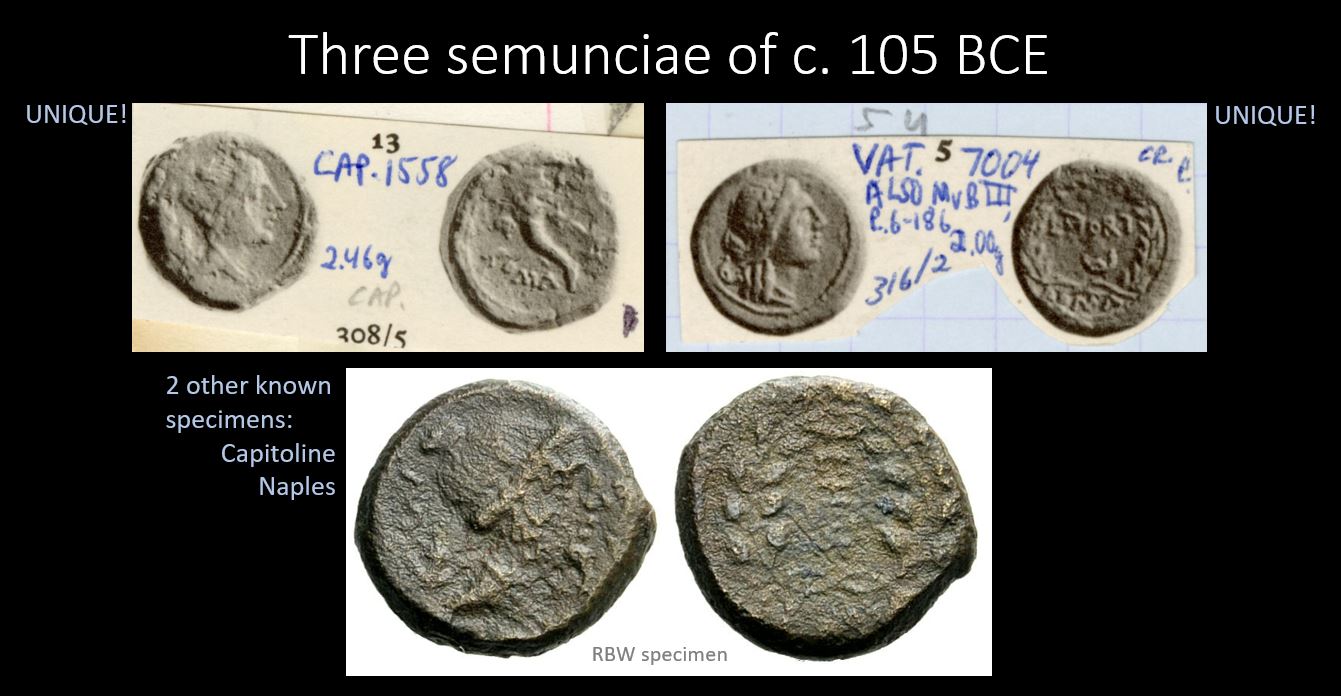
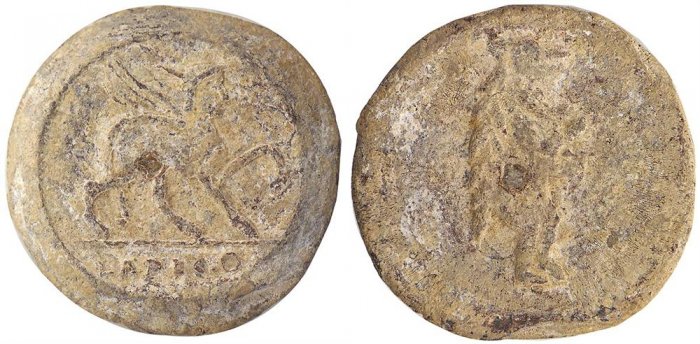
The three semuncia of c. 105 BCE seem to be a strange and wonderful revival of a tiny denomination that seems not to have been regularly by the Roman mint in some fifty years, the previous issue containing this denomination being RRC 177 (PT or TP; uncia and semuncia of this issue not known to Crawford but documented by Russo 1998, 146, see Schaefer Binder 7, p. 136, bottom row of images, image second from left hand edge).

The semuncia was never that common of a denomination (or at least we can say has a very poor survival rate). There are only 22 total examples as far as I can tell. Of course, there are lots of semunciae in Italic coinage, but they don’t really come into this discussion.

Again correct me, if I’m missing some.

RRC 308/5 and RRC 315/2 both seem to harken back to RRC 160, not RRC 177 in that they have Diana as well. The vast majority of the struck semunciae of the earlier period have Mercury as their primary obverse type. The exceptions being RRC 39/5 (part of an atypical series) which may have Cybele or a turreted personification of Roma or Fortuna Romanorum, and the Dioscuri on RRC 98A/8 (but how someone decided this unique specimen in Naples belonged to this bronze series is not yet clear to me), and the Roma on RRC 177.

Crawford thought the head on RRC 316/2 was female and this seems likely given the necklace, but barring that the hairstyle and laurel crown recall Apollo and make me think of the odd uses of Apollo on bronze denominations in the late republic.

The other thing these coins make me think of are the wreathed AE coinages of Sicily under Roman rule. … I feel a book purchase coming on: I need something for reference on Sicilian coinage…

I should also mention that RRC 308, Herennius, is not likely to be 108 BCE like Crawford would have it. Here I’m not just relying on HB Mattingly’s pref for 104 BCE based on his alternate sequence of moneyers, but rather Lockyear 2018 which says that RRC 308 denarii are probably later in the overall sequence than Crawford suggested (PDF). This suggests that these semunciae are likely all made within a one to two year period.

Otherwise for dating in this 130s to 82 BCE Molinari 2016 is also critical (PDF).

Tomorrow if all goes well I’ll give you a post on unicae.


Update 23 August 23:

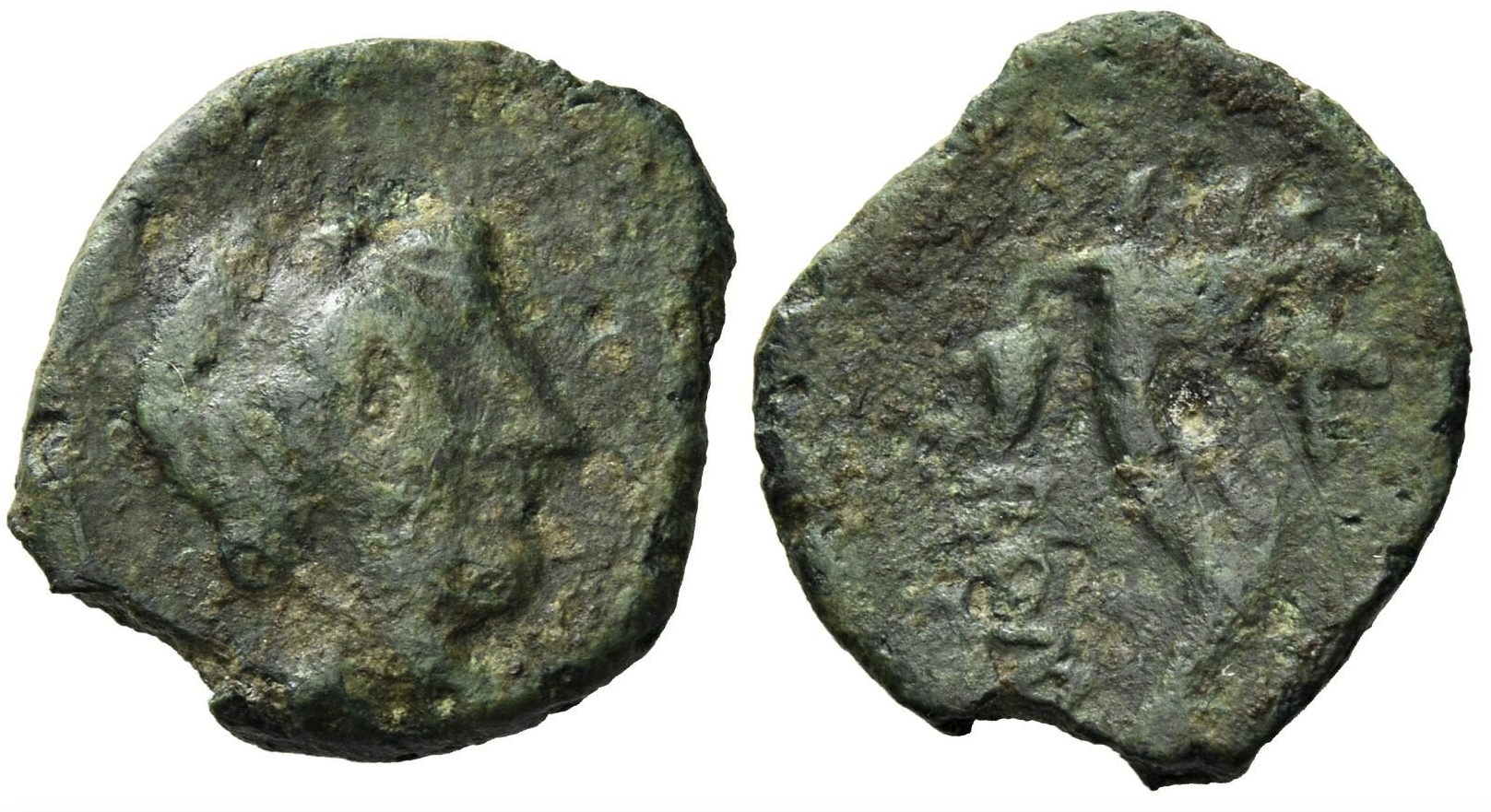
A second Herennius semuncia appeared on the market:
Notes on Dies

From Malkmus 2007 (PDF on file):

Here the thing the jumps out is the means of aligning but not necessarily strictly controlling die axis:

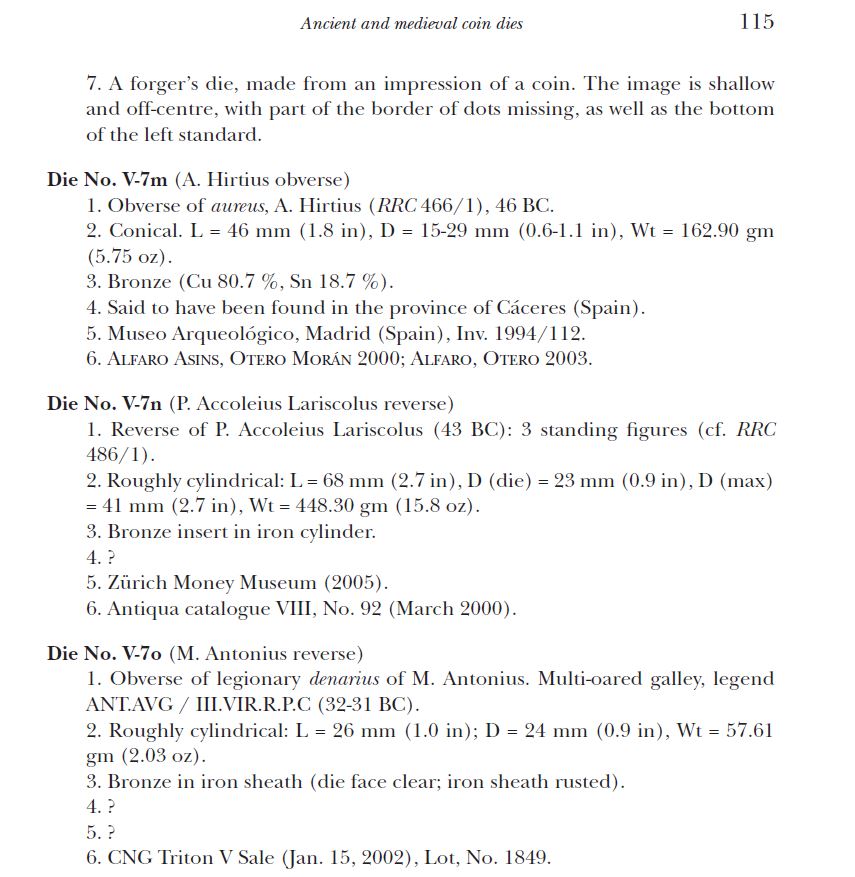
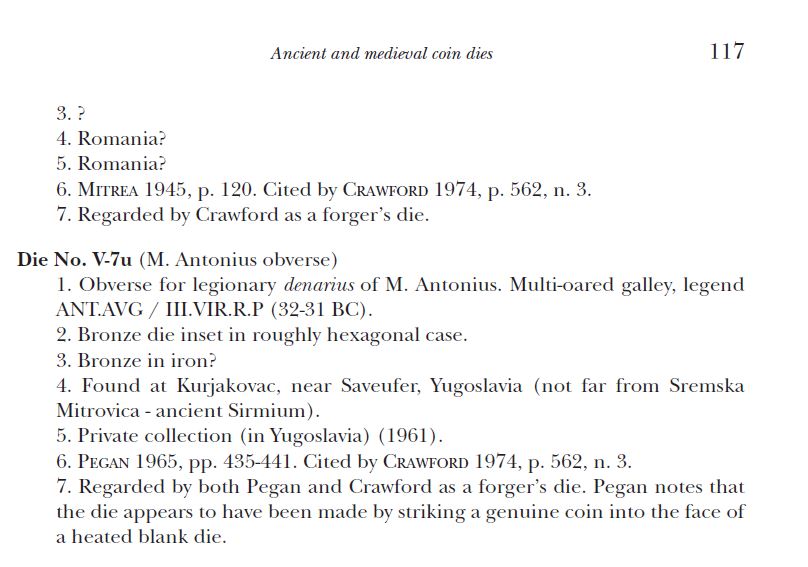
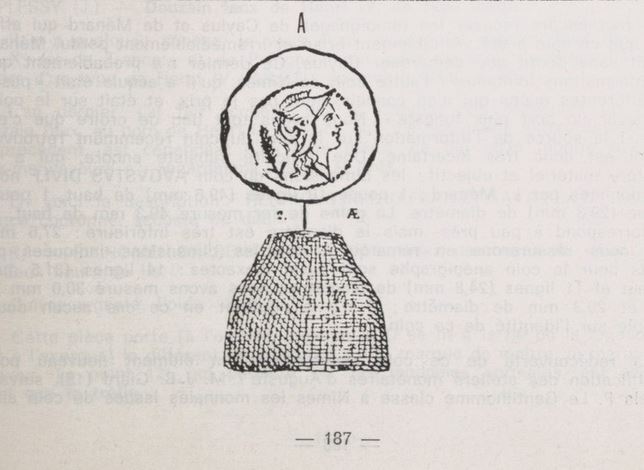
Here I reproduce his list of known Republican dies for ease of future reference:

RICHARD J.-C.M. 1977, Un coin monétaire de la République romaine découvert à La Tour de
France, «BSFN», 32, 4, pp. 184-185, 187
(digitized on Gallica!!)

Consult PDF for Geto Dacian.

ROBERTSON J.D. 1878, A Handbook to the Coinage of Scotland, London; reprint Argonaut,
Chicago, 1968, xxvii, 146 pp.
Complete speculation but given how rarely CORNEL- appears on coins as a legend, seems likely this may be RRC 310/1.

On Byres

From Page 52 Footnote 335 of Luigi Lanzi’s notebooks edited by Donata Levi:

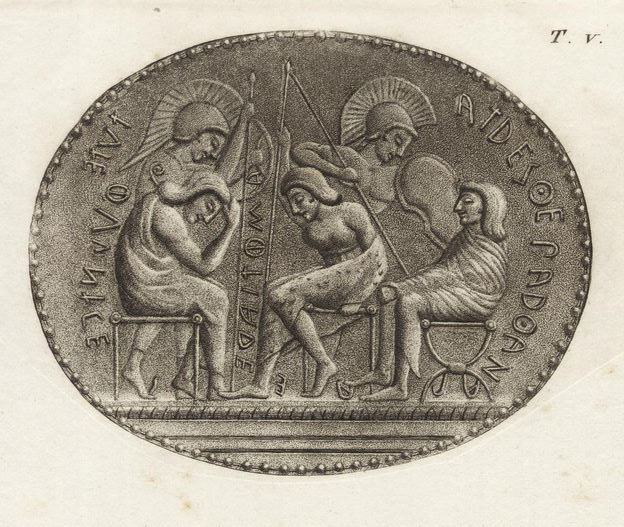
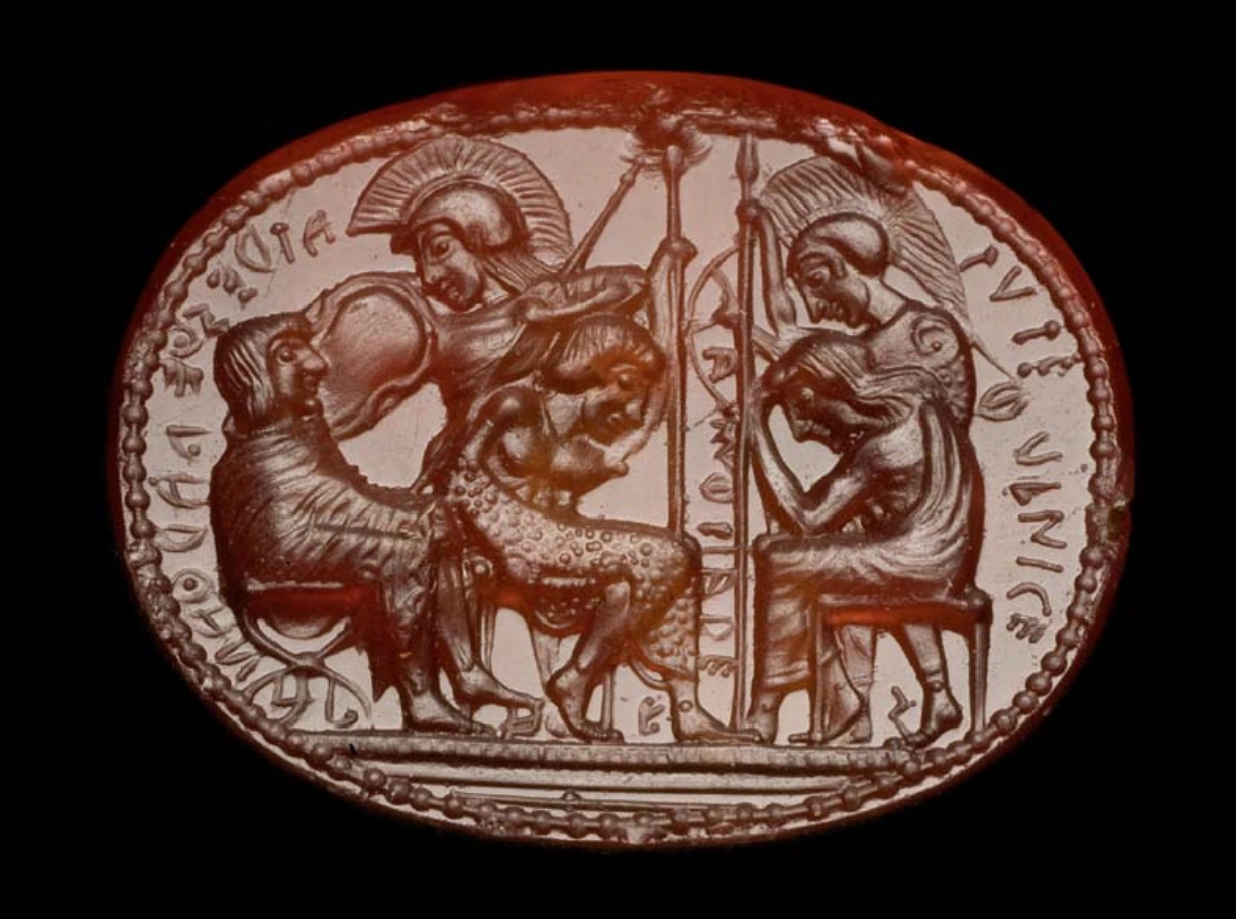
“Regarding James Byres, a Scottish resident in Rome, Winckelmann mentions his observations on the theater of Taormina (WINCKELMANN 1830-1834, V, 451-452) and also mentions him (about the trochus) as the owner of a gem, a carnelian with Discobolus (ibid., V, 472), which is often mentioned in contemporary antiquarian literature (for example in GUATTANI, I, February 1784, xiii, and in VISCONTI 1782-1807, I [1782], 95, fig. 7 [SIC! actually fig.6] of plate A): Byres “can boast of having in this carving one of the most elegant and beautiful figures, which have ever been carved in gems”.

He is also mentioned in LANZI, Notizie, 56, [another ref.] as the owner of an Etruscan patera. Byres was also preparing a description of the paintings of an Etruscan hypogeum of Tarquinia with copper plates. For information on him see HAWCROFT 1988, passim: he was in Rome from 1756, at first as a painter with interests also in the field of architecture, but since the mid-1760s he was active especially as a merchant and guide. He participated in important affairs, such as the sale of what is now called the Portland vase to Sir W. Hamilton and the Seven Sacraments of Poussin to the Duke of Rutland. He was one of the first visitors to Paestum in 1766 and left Rome in 1790. See also JENKINS SLOAN 1996, 196, for an onyx cameo with bacchanal, which he sold to Lord Fortrose, Seaforth, before 1781. Byres also acted as an agent on the commission for the altarpiece that Mengs was to have made for All Souls College, Oxford (see ROETTGEN 1993, 30). On Byres see also SKINNER 1966, esp. 16-17, FORD 1974 and STAINTON 1974” (a cleaned up machine translation)

More on Byres in Facos 2018

Social War Overstrike?!

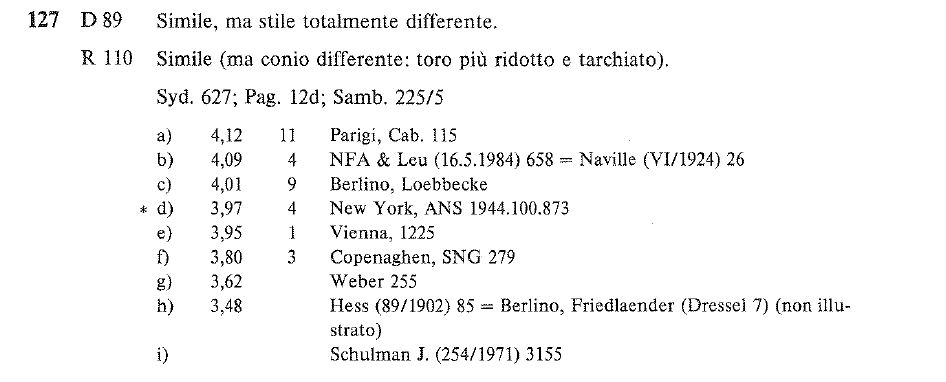
Checking third proofs, esp. for legibility of images…. fig. 3.21 is HN Italy 407, Italia, 90–89 BCE, denarius, 3.97 grams, ANS 1944.100.873.

The image reproduction of the coin isn’t great (YET!) so I was looking to see if it could be improved in some way as the ANS images are exceptionally hi res. I noticed some funny features. Circled above. Red could just be the helmet and Blue could be damage, but …

I wanted to compare it to an image of the same coin struck by the same dies. Thanks Campana. But I cannot find an image quickly. Boo. So now I need to get back to the proofs.

Imitation with interesting punch marks

I find myself getting more interested in the punch marks / test punches / counter marks seen on some RR specimens. And this is just a fascinating article by Gazdac and colleagues. Can’t wait to see the full details of the hoard when that comes out. I’m especially interested in learning more about the methods used for the Metallurgical testing, particularly the investigation of pre existing ‘minute cracks’ though non-destructive techniques to compare surface and interior readings.