Odysseus Alone

Carnelian ring stone

There are many iconographic representations Odysseus/Ulysses with other characters or indications of setting that link him to a specific narrative: Sirens, Argos, Diomedes and Dolon, the Palladion, etc… However, it seems on gems that if you’re going to have just Odysseus/Ulysses all by himself, there are two main ways he can be represented (three if we count just a bust, but I’m leaving those aside today). One is with a walking stick and legs crossed. A rather upright example is given above (Cf. A glass paste in Munich no. 1375). Most of these cross legged Odysseus’ are more bent over and their staffs tend to be more crooked.

Gem of glass paste imitating sard, engraved with Odysseus as a beggar, with a pointed cap, chiton and crooked staff, standing to the right with his legs crossed.

Another example with an image on-line here, and also here (also cf. Munich 488 and 1374). Often the cross-legged Odysseus is described as ‘in the guise of a beggar’ this seems fairly apt, esp. when the figure is hunched over and the staff is crooked. I’m not sure, however, that the top image is ‘as a beggar’ it may just be Odysseus as traveler… that is if the traveler iconography can actually be distinguished from the beggar iconography.

The other solo Odysseus is with a cup. A LARGE cup.

Gem of glass paste imitating sard, engraved with Odysseus bending forward to the right, holding out a cup; he wears a pileus, short chiton and a sword at his side.

Another online image here (Cf. Munich 1369-1371). I’m under the impression that this might be a wee bit more common on glass pastes that on precious stones, i.e. “faux” gems of lower cost. Whereas the traveller/beggar Odysseus certainly appears on both. Why is he holding out the cup? Is this a begging action? Or might it be related to the comic Odysseus of the stage:

Or the wiley Odysseus who tricks Polyphemus with drink:

Post Script. I note that in the Wyndham Cook Collection no. 160 depicts a solo Odysseus as Archer with a legend resolved in the Catalog as ‘Nicander’.

92, 93, 94 out of 410 days: Fight or Flight

I’m trying to tamp down the panic of leaving the country for ten months.  I no longer wake up with coins in my mind: its all logistics and I’ve not slept straight through the night for days.  I wake up with the ‘what ifs’ and ‘must remembers’ and cold sweats.  

Monday I finished section two of the current chapter by moving two large epigraphic-ish topics (1,200 words plus) into an appendix to keep my narrative flow smooth.  

Tuesday morning I realized I really should have ordered images of gems for section three from other museum collections, oh say two months ago.  They both went out Wednesday. No word back.

Yesterday, I fought with HSBC over my lost 720 dollar wire transfer and tried two other wire transfer services both of which went better than HSBC but resulted in prohibitive fees on the Turkish bank end.

I when to the doctors (at long last, I hate doctors, not unlike Cato) and scheduled even more check-up, preventive medicine type things.  I researched the cost of out of pocket medical care in Turkey.  (Totally affordable from an American perspective, no surprise.)

I finalized a going away party.  I went running.  I cooked.  Apparently, I cook when stressed.  

I dealt with messy little bits of college matters that reared their hydra-like heads even on sabbatical.

I felt guilty for ignoring my blog.

Bad Neighborhoods

Today I’m worrying over the Turris Mamilia, or the Tower of the Mamilii.  Really there are only three pieces of evidence.

1) Passages in Festus.  The reference is under the entry for the October Horse:

“October Horse” is the name of the horse which is annually sacrificed to Mars on the Campus Martius in the month of October. It is the right- hand horse of the winning pair in a chariot race. There used to be an  intense struggle for its head between the inhabitants of the Subura and those of the Sacra Via: the latter hoping to affix it to the wall of the Regia, the former to the Mamilian Tower. And the tail of the same animal is conveyed to the Regia, with speed enough for the blood to drip from it to the hearth, for partaking in a divine service.

(Here’s a  French translation.)

2) The fact that some members of the gens in the third century had the cognomen ‘Turrinus’.   Refs can be found here and here.

3) An inscription, CIL 6.33837 = ILS 7242:  “M. Octavius M. l. Attalus centurar[ius] a t. M.”  where the t.M. is taken to be a reference to the Turris Mamilia as a topographical marker.

This is not a lot of evidence. Frankly its not absolutely clear that all three pieces of evidence refer to the same ‘tower’.  What we make of it all pretty much depends on how one wants to think about the Festus passage.  Is this tower an ancient and embedded part of the religious ritual? Is this proof of the Mamilii being part of the archaic Roman landscape on par with the ancient kings?  Is some ancient power struggle between two claimants to the throne crystalized in this annual rite?   Or was the tower just any old third-century landmark in an otherwise squalled, hot and dirty neighborhood?   A point of focus in the district that was co-opted into the ritual contest for convenience sometime after its building presumably well after the origins of the religious festival itself?

None of the other sources on the October horse and the battle for its head emphasized the Mamilii in anyway, although we do hear about the Subura participants in this contest from Plutarch.

89, 90, 91 out of 410 days: a Sea of Sukkot

My neighbors have finished the High Holidays and booths (sukkah singular, sukkot plural) have been appearing in every spare space that is open to the sky in preparation for the beginning of Sukkot this coming Wednesday.  The singing will go on long into the evening from inside the booths.  There will be large citron fruits and palm branches and myrtle and willow too.   I can see just one remaining unconstructed sukkah in a neighbor’s yard.  In just a few hours the hammering is sure to begin.  

It’s a good time of year to be outside, to be with family and friends.

The weekend SDA’s family came into the borough Saturday, a lovely time.  Sunday I had a little freak out about moving to Turkey for 10 months.  An attack of the what-ifs.  I find answering the question ‘Why are you going?’ exhausting.  Even to myself.  Also the question ‘aren’t you nervous about Syria…’  I am nervous about many things.  Money, my ability to write efficiently there, the stress of everyday activities, and isolation.  But not about Syria.  

So I made Foccacia.  

The most academic things I did was haggle with a street vendor for eight Loebs.  He threw in the ninth (Horace) for free.  And, wrote a sentence or two about the turris Mamilia more on that here later perhaps.

***

Sukkot always reminds me of the line in 2 Maccabees 1:9.  This book has a few letters from Jews in Judea writing to Jews in Egypt appended to the beginning.  The book as a whole is a testament to the Divine assistance to the Maccabean restoration of the temple (i.e. in contrast with 1 Maccabees which is more a history of the new dynasty).   The one line urges the Jews in Egypt to celebrate the feast of Booths in Chislev.  The ‘real’ feast of booths is the one now in Tishri.  The letter seems to be drawing a parallel between the establishment of the new holiday Chanukah and the activities and traditions of Sukkot. Borrowing the Torah-endorsed legitimacy of the latter for the former.

88 out of 410 days: Seeing Too Much

Reverse Image

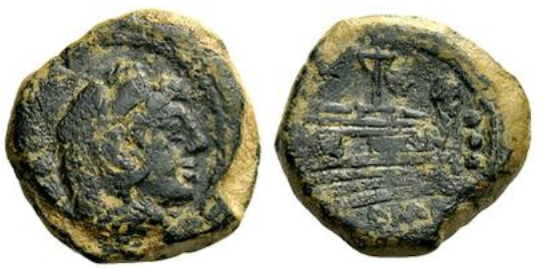
This reverse type has been the victim of too much speculation.  Crawford in RRC wants the type to be visual representation of the moneyer’s name.  The other type made at the same time by the same moneyer seems to pun on the constellation the Triones (a.k.a. the seven stars of the Plough a.k.a. the Big Dipper a.k.a. the Great Bear) and the moneyer’s cognomen:

To make a pun out of the winged boy on a dolphin Crawford had to speculate that it might represent Melicertes (a.k.a. Palaemon) and thus by extension his mother Leucothea whose name sounds like Lucretius.  This has then been spun into a legendary genealogy connecting the family to this goddess and tying the moneyer to Odysseus via a connection with Antium. [Hence how I found this in my notes today and thought I’d write it up as it’s unlikely to ever really make it into the book.]

The problem is that is that Melicertes is never represented with wings.  So says the LIMC (not just the website, I promise I checked the books as well on this).   That is just a regular little cupid (eros) on a dolphin.  A perfectly normal, completely common representation on gems, lamps, and dozens of other decorative art forms. One that appears on many coins as well:


And even on Roman coins:


The main problem with the tentative suggestion of Melicertes is not the speculative reconstructions above, but that by saying “winged boy” in the catalog entries of every major database it never returns in searches for “eros and dolphin”  or “cupid and dolphin” thus virtually erasing an important link in the history of the iconography.

Of course, Melicertes can be represented riding a dophin.  And there are lots of boys on dolphins, most famously at Tarentum.  But the wings rather make a difference!

As a fun aside:

Image


Yep that’s George Washington!


Acrostolium (again)

RRC 213

I lied.  I wasn’t ready to move on.  I kept poking around and my eyes caught this specimen from Andrew McCabe’s collection:

Image

And I was surprised to see a head in the acrostolium because I thought I knew all the Roman republican types with this sort of head.  All two of them.  We discussed them at length earlier.  So I checked Crawford.  No such note.  Then the ANS and BM specimens.  Possible but nothing that really looked conclusively similar.  The auction catalogs gave slightly better results and I turned that uncia above.  The neck of the head seems really clear.  I assume that even when it isn’t clear, it is meant to be there:

Link

Figures on Prows (again)

I was poking through the ANS database thinking about the placement of symbols in relation to the main type.  Does the symbol float in the field?  Is it interacting with the figures?  Does it sit on a line suggesting it is on the same visual plane?  How can I be sure the placement is significant versus unintentional?  Of course I was looking for patterns, consistency, anything to suggest deliberate choice.  Doing this I stumbled upon the coins of Arados.  The mint is well studied and is well represented in most collections. See the specimen above.  Here are a few more:


These last two reminded me of our discussion of the seal of the Sidonians and possible precedents.  They confirm the use of the reclining figure on the prow in the region.

The first two make me think that small figures standing on prows were just part of the Hellenistic visual repertoire (esp. Athena) and that would make it more likely for the die engravers and/or designers to integrate a symbolic figure into the design proper….

So also the silver from Phaselis produced after 160BC when Rome detached it from Rhodes and added it to the Lycian Confederacy:


(It does look a wee bit Roman now doesn’t it.)

***

Enough musing back to my revisions.

Interesting Errors circa 1889

Capture

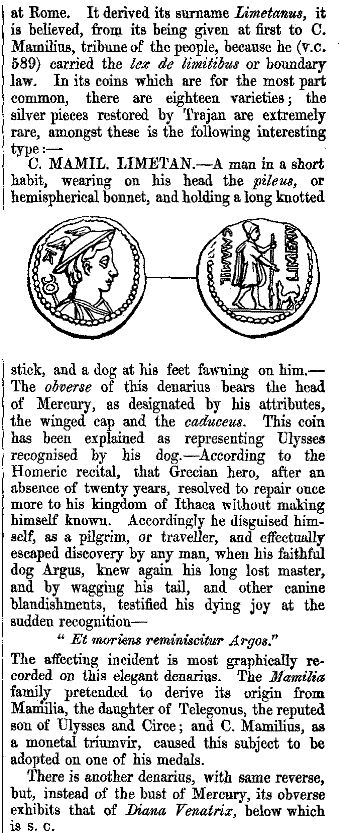
The website Forvm Ancient Coins has a Numiswiki for collaborative work.  I’m very impressed with their crowd sourcing transcription and editing of public domain books relevant to the discipline.  I stumbled upon this entry yesterday in the Dictionary of Roman Coins from 1889.   Two ‘errors’  are really intriguing.

1) The dating of the lex de limitibus.  This is the Mamilian law that proscribed the width of the strip of land dividing two properties and seems also to have governed the process by which disputes over these boundaries were adjudicated.  The date is controversial, as is the contents.   109 BC is the most common attribution, associating it with the same tribune who fought corruptions amongst the nobiles.   There are detractors though, most notably:  Morgan, L. 2007. The Moneyer C. Mamilius Limetanus. Ostraka 16.1: 195-201.  Leaving aside the modern debate, the date in this old general reference work is given as v.c. 589.  That’s A.U.C. 589 or 165 BC.  Somewhere, somehow, someone got the idea that the Lex Mamilia might have something to do with the Praetor Lentulus’ efforts to return Campanian land to ager publicus (public land) by paying off the holders.  There are two basic sources, Granius and Cicero, the former being the more substantive and narrative in quality.  This date doesn’t fit with any of the other prosopographical evidence or literary testimony.  It is most likely just flat wrong and a guess, but right now I’d give my eyeteeth to know where the idea came from.

2) An alternative obverse type.  The final sentence of the entry claims that the reverse is known with a different obverse.  Again, given the popular nature of publication there is no reference to the location or provenance of the specimen.  BUT the description is pretty clear.  It means the obverse of this type:

RRC 383/1

This error is easier to understand.  Either there was a forgery that combined the two, or some catalog entry or illustration was inadvertently created or suggested the connection, or someone looking through a collection mismembered what they saw.  [Yes, I know that’s not a real word. It should be though.]

The one problem with the otherwise fabulous quest to digitize just about everything in the public domain is that it generalizes and disseminates that information that is 70 years old, making that canonical and widely accessed knowledge.   I think this blog is slowly becoming an open access advocacy site.

81 thru 87 out of 410 days: Returning to a State of Grace

I did not coin the phrase, ‘The State of Grace, otherwise known as Brooklyn.’  That honor goes to an old friend who one December 31 I texted her asked what state she was in meaning was she still in the great Midwestern state of our birth and formative years or had she too already returned to NY.   I’ve adopted her reply as my watchword ever since.

Here I am myself.  The self I’ve chosen to be in my adulthood.  Here I know I am no better or worse than each of my neighbors.   Here I am home.

The details of domesticity and nostalgia from my sojourner on the great plains don’t have much of a place here.  The dissertation got read.  There were few to no coins except in the final chapter just to tease me a little.  The viva was won in the first moments by a brilliant opening statement far surpassing the introduction or conclusion of the written piece.  When the snake emerged, most of the committee joined in the defense.

And, yesterday was a good solid writing day with no blogging because I needed that.  I need just the peace of being at work.

80 out of 410 days: Work in Transit

20130905-095753.jpg
I have 3 hours and 15 minutes of time before being plunged into the land of my origin. My constant companion for the next five days is a Doctoral dissertation. It must be read by my return to the state of grace otherwise known as Brooklyn. Hopefully there will be some coins in it for light relief. Now to find a quiet corner of the airport. …