Disarming the People? Ancient Perspectives on Weapons Bans

The passage below comes from Dionysius’ extended digression on the tyranny of Aristodemus at Cumae.  A common argument in favor of a broad interpretation of the US second amendment and the right to bear arms is to allow the people to defend themselves against tyrannical government.  You can read about this and how it have entered the rhetoric of the presidential campaign in 2015 here. 

I found it interesting to find tyranny in antiquity characterized by a weapons confiscation followed by the imposition of a police force.  It seems such weapons confiscations maybe a very old historiographical theme.  The other one that pops immediately to mind is the order by the Roman consul to the Carthaginians to surrender all arms as the second condition of their surrender into the faith of the Romans (Polybius 36.6.5ff.).

When he had said this and thereby filled all the common people with wonderful hopes, he established two institutions which are the worst of all human institutions and the prologues to every tyranny — a redistribution of the land and an abolition of debts. He promised that he would take upon himself the care of both these matters if he were appointed general with absolute power till the public tranquillity should be secured and they had established a democratic constitution. When the common people and the unprincipled rabble gladly accepted the proposal to pillage the goods of other men, Aristodemus conferred upon himself the supreme command, and proposed another measure by which he deceived them and deprived them all of their liberty. For pretending to suspect that the rich would raise disturbances and insurrections against the common people on account of the redistribution of the land and the abolition of debts, he said the only means he could think of to prevent a civil war and the slaughter of citizens and to guard against these miseries before they happened, was for all of them to bring the arms out of their houses and to consecrate them to the gods, in order that they might make use of them against foreign enemies who should attack them, whenever the necessity should arise, and not against one another, and that in the mean time they would be suitably placed in the keeping of the gods. When they agreed to this also, he disarmed all the Cumaeans that very day, and during the following days he searched their houses, where he put to death many worthy citizens, alleging that they had not produced all their arms for the gods. After this he strengthened his tyranny by three sorts of guards. The first consisted of the filthiest and the most unprincipled of the citizens, by whose aid he had overthrown the aristocracy; the second, of the most impious knaves, whom he himself had freed for having killed their masters; and the third, a mercenary force, consisting of the most average barbarians, who amounted to no fewer than two thousand and were far better soldiers than any of the rest. (DH 7.8.1-3)

I’m just getting back to work after maternity leave.  A piece of mine that was partly worked out here on the blog has finally been published.  You can read it here.  Fair warning, my next speaking engagement is on Dionysius of Halicarnassus, so I’m on a bit of historiographical kick at the moment.

The Palm Tree as a Symbol of the Jewish State

For the most part, I’m very happy to follow chapter 9 ‘Between Rome and Jerusalem: The Date Palm as a Jewish Symbol’ in Steven Fine’s 2005 book, Art and Judaism in the Greco Roman World.  It’s a broad and nuanced survey, but in the end concludes that the primary reason for the equation of Judaea with the Date Palm is because it was the most readily identifiable and desirable regional export, and could, on top of that, be given a symbolic meaning that did not offend the Jewish prohibitions against graven images.

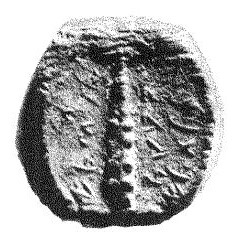
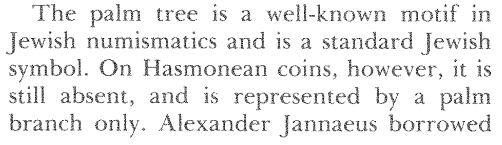
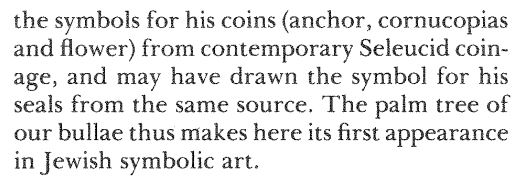
However, two key pieces of early evidence aren’t illustrated by Fine, only discussed.  Hence, I thought I might put them up for the curious here.  [I do love connections between seals and coins!] These images are taken from ‘Two Bullae of Jonathan, King and High Priest’, p. 257-259 of Ancient Jerusalem Revealed (1994).  This summarizes and expands two previous publications.

Capture

Based on comparison with the legends of the coins of the Hasmonean kings, Avigad concludes that these two bullae are imprints of the seals of Alexander Jannaeus (103-76 BCE).

Capture

Capture

Capture

Capture

As Avigard says:

Capture

Capture1

Note that originally in the first of the 1974 publications Avigard identified the High Priest Bulla as displaying a club; his opinion was revised on the discovery of the second bulla and the new identification as a palm tree was first made in his second 1974 article.

For later follow up:

A gem with a palm tree.

Also cf.

J. J. Winckelmann, Description des pierres gravées du feu Baron de Stosch, dédiée à son Eminence Monseigneur le Cardinal Alexandre Albani (1760), 564, Kat.Nr. VIII,14 Zenon; Image of impression on Arachne

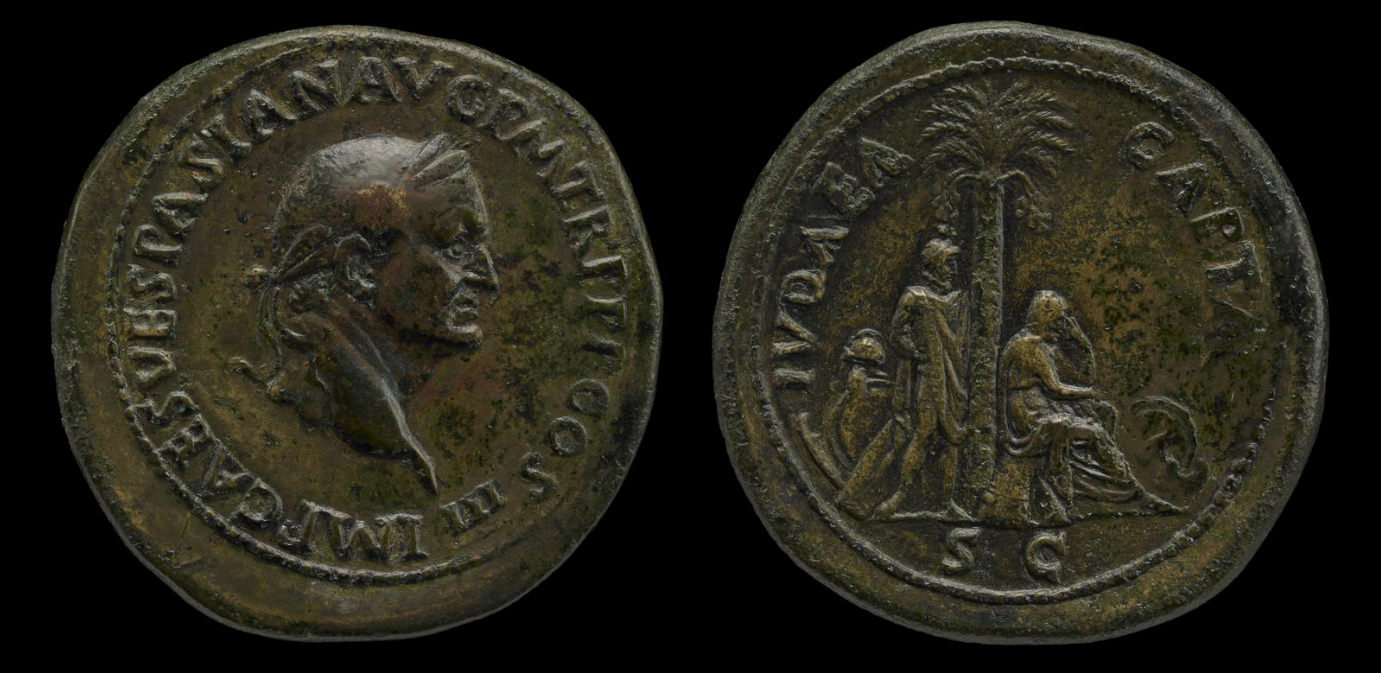
“Judaea Capta” Scholarship

BM specimen

So I was poking around for the right thing to cite on the “Judaea Capta” coins.  I wanted something more than a set of catalog numbers, something that actually put them in context as a whole.  This was surprisingly difficult to find; most scholarship seems to assume that they are so famous the intended audience already knows the basics.  I eventually got to

[Don’t get too excited that is just a link to where you can buy a copy of the article if you can’t order it from ILL or it’s not in your local library. The author hasn’t put a copy on open access, as far as I can see.]
The article does a good job of tying provincial and Roman issues together and providing a wider historical context.  It’s readable and well footnoted, even if one may wish to bicker over any small points.  It’s far more complete in its overview than the two page piece by C. Kraay in the Israel Numismatic Journal 1963, the most common ‘general’ citation one sees for these coins.  It’s a shame it’s not in a numismatic journal or one on JSTOR or somewhere else its likely to come to the attention of a wider audience.  Hence my inclination to give it this general shout out.

Full disclosure.  I did overlap briefly with Zarrow in grad school and I find his twitter account pretty awesome too.  Lots of lovely images and a good number of coins.

Broken image links fixed 17 August 2026

Hercules Revived

Denarius 19/18, Rome. Moneyer M. Durmius. M DVRMIVS – III VIR Bust of young Hercules to r., wearing diadem and carrying club on r. shoulder. Rev. CAESAR AVGVSTVS SIGN RECE Kneeling, bare headed Parthian to r. holding signum to which is attached a vexillum marked X. 3,82 g. RIC 314. BMC 59. C. 433b. Ex L. A. Lawrence Coll., Auction Glendining, London, 7 December 1950, lot 359. UBS auction 78, lot 1299.

My favorite thing about numismatic databases are the things that pop up that I wasn’t looking for.  This is a great example.  There aren’t many known specimens, but there are two in the British Museum (example 1, example 2). Its obverse clearly echoes a much earlier republican didrachm (RRC 20/1).

Anonymous moneyer. AR Didrachm (6.85g) minted at Rome, 270-265 BC. Diademed head right of young Hercules, with long sideburn; club and lion’s skin over right shoulder. Reverse : ROMANO. She-wolf standing right, head reverted, suckling the twins Romulus and Remus. Sear 24; RSC 8; Craw 20/1; Syd 6. Provenance: The Hunter Collection; Ex Superior Stamp & Coin, NYINC Auction, December 8-9, 1995, lot 847. Ira and Larry Goldberg auction 72, lot 4115.

It’s always interesting to see an awareness of earlier types surfacing after such an extended period–over two centuries regardless of how one wishes to date RRC 20/1.  That said, it also raises questions about why this earlier type might have been attractive in this moment under Augustus.  Hercules is usually associated with his rival Antony.  As is Hellenistic Kingship. The connotations of the obverse type seem at odds with the Augustan program.  Perhaps this explains its rarity? Perhaps the moneyer thought better of the design choice?  A choice which at first which might have been attractive simply because of its antiquity and Augustus’ own rhetoric of conservative restoration?

Roma and the Parazonium

Crawford 403
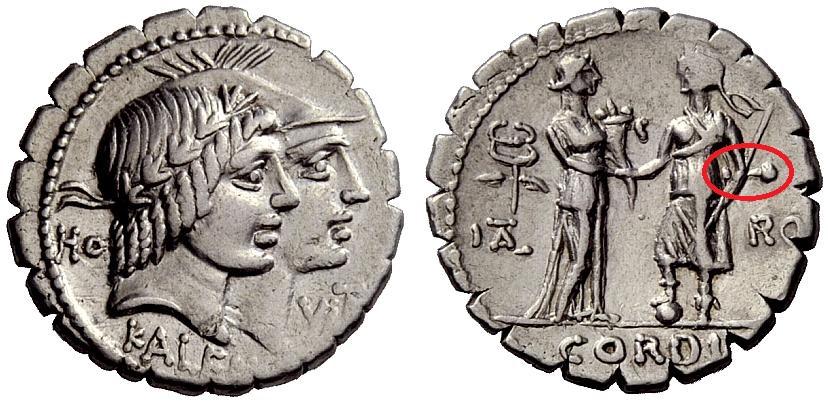
Q. Fufius Calenus and Mucius Cordus. Denarius serratus 70, AR 3.98 g. Jugate heads of Honos and Virtus r. Rev. Italia, holding cornucopia, and Roma, holding fasces and placing r. foot on globe, clasping their hands; at side, winged caduceus. Babelon Fufia 1 and Mucia 1. Sydenham 797. Crawford 403/1. NAC 54, lot 922.

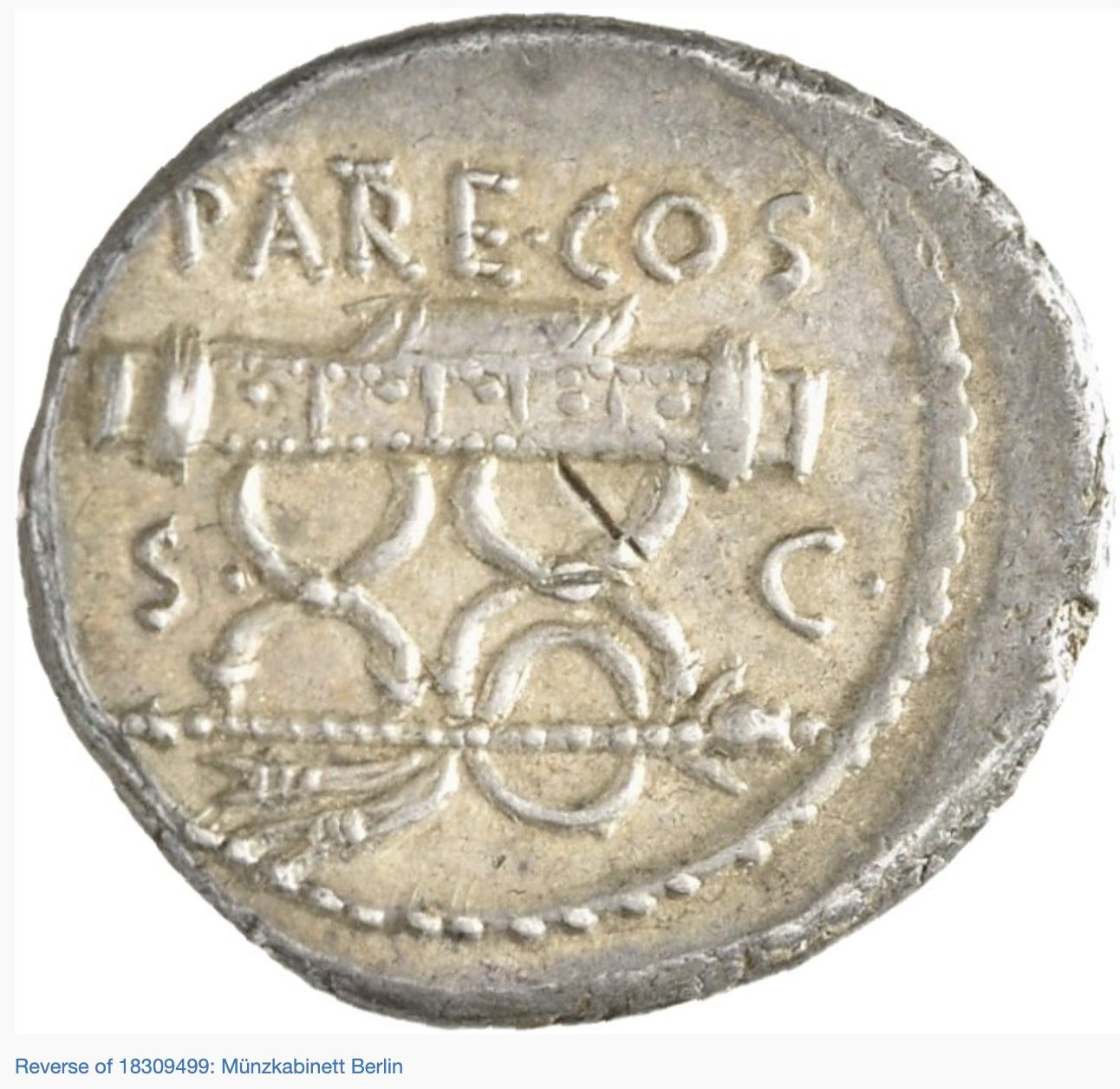
Crawford called the object in Roma’s left hand on this coin a fasces.  This doesn’t make a huge amount of sense as one doesn’t carry fasces in the crook of one’s arm, but instead with the axe high over one’s shoulder.  The classic example is the Brutus coin (RRC 433/1).  Moreover the republican coin series has a pretty definite iconography of what fasces should look like on a coin and specimens of RRC 403/1 just don’t fit the type.  The long stick may well be a scepter.  This would make some sense, if one agrees that those fillets off Roma’s head indicate she’s wearing a diadem. The diadem and the scepter probably deserve a post of their own, exploring particularly the appropriation of Hellenistic regal iconography for the personification of Roma.  Alternatively, the fillets may be only the fillets of a victory crown without any regal connotations. For now, however, I’m just concerned with the little blob circled in red above.

This is likely to be a parazonium. What, one might ask, is a parazonium?  Well, besides being a numismatic term for iconography better known from the imperial period, it is a dagger or short sword worn on the left hand side off the girdle. Our only literary testimony is Martial Epigrams 14.32:

Capture Capture1

The word itself is derived from the Greek, although it is pretty rare in Greek texts as well: in the TLG it shows up only in a fifth century CE lexicon and one equally late hagiography.  I don’t think this type is our earliest examples of Roma with a parazonium; it’s already part of her iconography on RRC 335/1 (one example, another example) and probably also on RRC 391/3.  What this type does do nicely is suggest that the parazonium is already perhaps a linking piece of iconography between virtus and Roma.  On the imperial coinage by the time of Nero the parazonium is a common attribute for reverse personifications of virtus.

RRC 403/1

Where were the first Liberian Coins manufactured?

If you are interested in this question the person to whom you should be listening is Bill Dalzell, not me. My writing this piece put us in touch and I now defer to his wisdom on the matter.

Dalzell, Bill. “Early Coins and Currency of the Republic of Liberia.” American Journal of Numismatics (1989-) 36 (2024): 403–72. https://www.jstor.org/stable/27352958.


specimen in trade

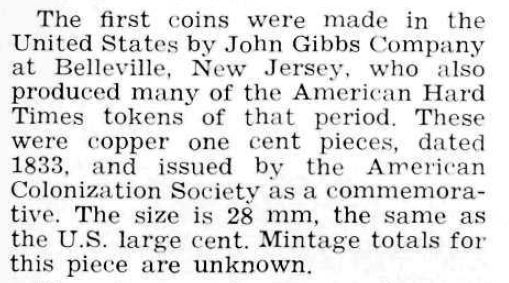
The short answer is I don’t know, but I have some concerns about the common assertions.  This is the statement by Colver and Harley in their 1971 piece in Calcoin News:

Capture

This might go back to Low’s comments in AJN 1899:

Capture

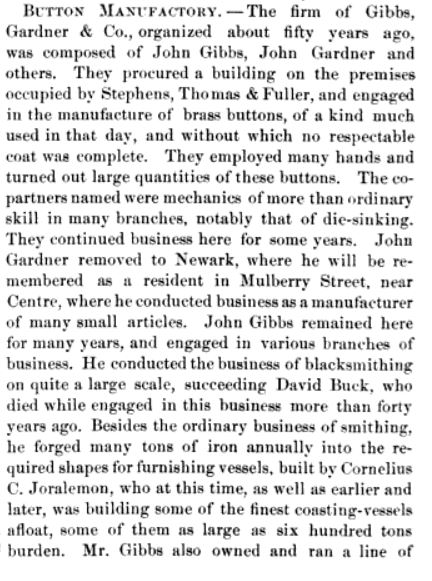
But the problem starts to rear its head here. How does Low know about Gibbs, Gardner & Co’s foreign contacts?   It’s hard to see Gibbs, Gardner & Co actively involved in the manufacture of coins and coin like objects as early as 1833.  It’s not even clear the company existed at this point, let alone had already diversified from buttons into coins and tokens.  Where did Low get his 1835 date?  Maybe from the1884 History of Essex and Hudson Counties.  The language ‘about 50 years ago’  is frustratingly vague.

Capture

Notice that in 1884 the token/minting production of the company is seen as too insignificant to mention.  If the 1833 Liberia coin was made by  Gibbs, Gardner & Co., it would be one of the first commissions of a fledgling company.

The January annual report of the American Colonization Society from 1833 makes only the briefest mention of the coins:

Though in the view of the Managers, it is essential that Liberia should become an agricultural colony, and therefore that no measures should be adopted tending to elevate commerce at the expense of agriculture; yet the inconveniences arising from the want of a circulating medium, have caused them to resolve on the introducing a small quantity of coin. It is proposed that this coin shall bear appropriate devices and inscriptions, and that the amount shall in no degree exceed what may be required by the actual necessity of the Colony.

The coinage doesn’t even get its own budget line in the treasurer’s reports.

Are there any other candidates? Remick in the 1965 Numismatic Circular speculates:

Capture

Why is Scovill a candidate? Perhaps because Wm. Scovill is known to have been a paying contributor to the American Colonization Society by the mid 1840s at least.  And his company was well established with many government contracts by this period, having been founded in 1802.

That’s what I know so far.  I may just have to let it go.

Mithridates on the Republican Coin Series?

Capture
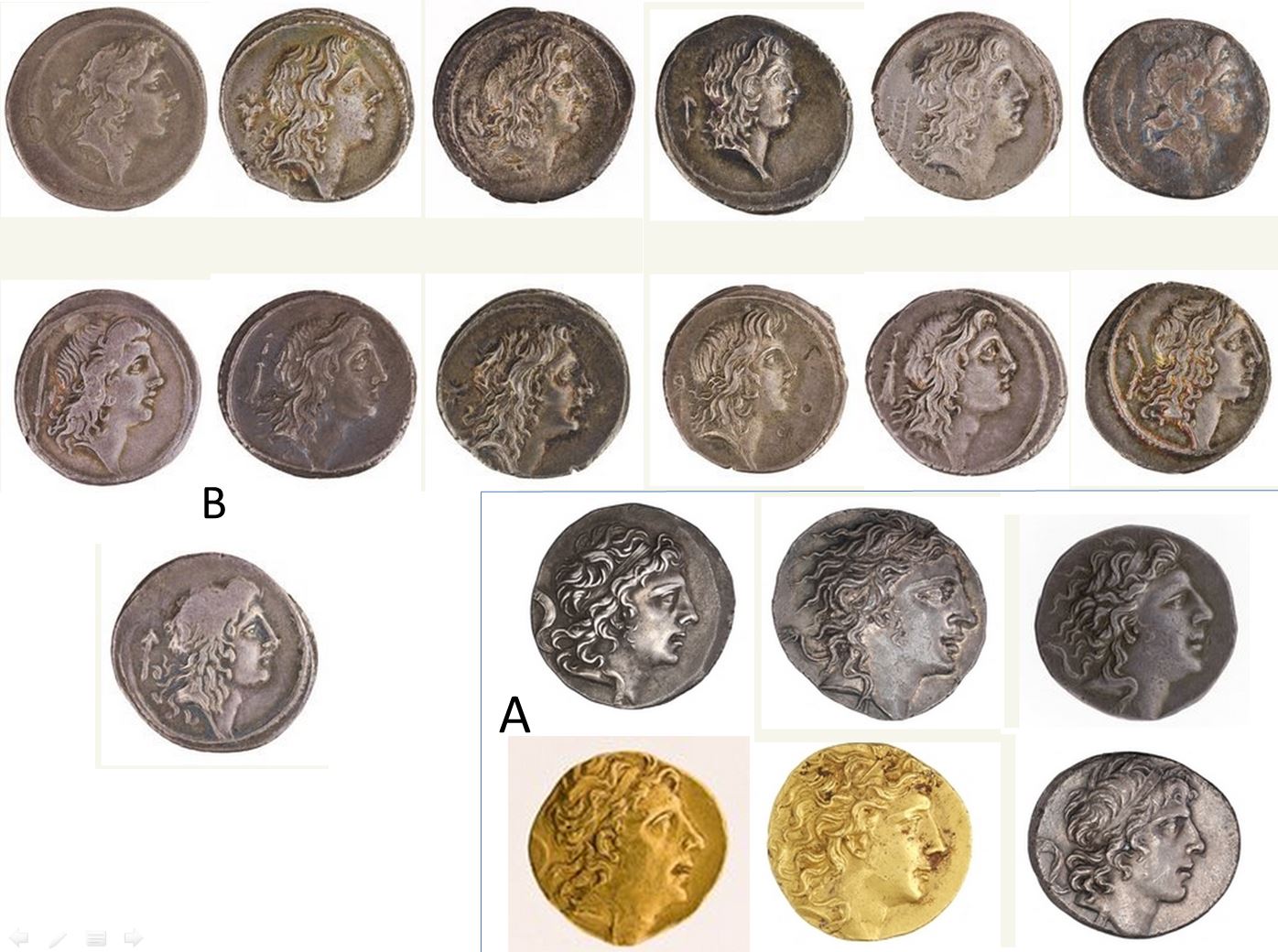
A page of my image notes from my pre-blog days. The images are all from the ANS. Click to be taken to ANS collection of RRC 405/5 specimens. Or click on the title of this post to see all the images at a higher resolution within the post itself.

It may not be immediately obvious but this little spate of blog posts are all coming out of my efforts to wrap my head around representations of Monarchy on the Republican Coin Series, a topic I’m attempting to work up for a conference paper submission today.

Gem scholars have long recognized the stylistic connection between Mithridates Tetradrachms and this republican coin type. Cf. Vermeule 1970: 206.

Capture

Crawford proposed Mercury as an other possible identification of the intended deity.  The iconographic parallel is striking but I find myself ambivalent about whether it is just an artistic choice of style or an intended reference to the Pontic king.  It’s part of a complicated series perhaps alluding the the cult of Fortuna at Praeneste and/or other Italic cults.  How it fits into the series as a whole has alluded explanation.

I would just note that with the new dating based on the Messange Hoard of RRC 405 to 58 BC, this potential regal allusion comes in the midst of a spate of such allusions to foreign kings on the reverses of the series:

  • Perseus of Macedon (reverse of RRC 415/1; 62 BC)
  • Aretas of Nabataea (reverse of RRC 422/1; 58 BC)
  • Ptolemy V of Egypt (reverse of RRC 419/2; 58 BC)
  • Bocchus of Mauritania and Jugurtha of Numidia (reverse of RRC 426/1; 56 BC)
  • Bacchius of Judaea (reverse of RRC 431/1; 55 (or 54?) BC)

Spiral Columns? Rusticated Drums?

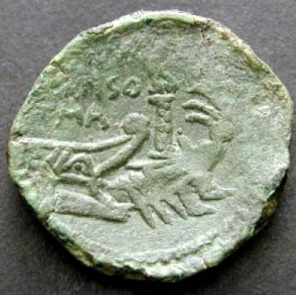
C. Marcius Censorinus, As, Rome, 88 BC, AE (g 11,33"; mm 29; h 8), Jugate heads of Numa Pompilius, bearbed, and Ancus Marcius, not bearbed, r.; on l., NVMA POMPILI; on r., [ANCVS MARCI], Rv. Two ships crossing; behind, spiral column on which statue of Victory; above, C CENSO / ROMA. Crawford 346/4a. Art Coins Roma 8, lot 350.
C. Marcius Censorinus, As, Rome, 88 BC, AE (g 11,33″; mm 29; h 8), Jugate heads of Numa Pompilius, bearbed, and Ancus Marcius, not bearbed, r.; on l., NVMA POMPILI; on r., [ANCVS MARCI], Rv. Two ships crossing; behind, spiral column on which statue of Victory; above, C CENSO / ROMA. Crawford 346/4a. Art Coins Roma 8, lot 350.
I think the form of the column on this bronze issue can be productively used as comparative evidence for how numismatic artists thought to represent monolithic columns.  The importance of the rendering of the shaft can be seen even on less well preserved specimens:

A. Takalec AG Sept 2008, lot 258

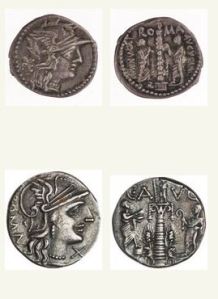
This is relevant for how we think about the rendering of the column on the early Minucian coins:

ANS sample specimens.  Image links to further examples as well as these.
ANS sample specimens of RRC 242/1 and 243/1. Image links to further examples as well as these.

Evans in her 2011 paper originally presented at Glasgow congress emphasizes the uniqueness of the form of this column:

The form of the column itself also requires some comment, owing to its archaic-looking features. I can find no parallel to this type of column shaft in Greek, Etruscan or early Roman sources, nor can I find any early versions of rusticated column drums. (p.659)

She continues with a comparison to the column on the Marsyas coin (RRC 363) saying:

The shaft of the column can be shown as smooth, or fluted in a spiral or, on a small number of dies, with rounded drums with moldings between each drum. If this Marsyas depicts the statue of Marsyas in the Forum (as generally acknowledged), then the column shown is the Columna Maenia, erected in 338 (Plin. NH 34.20). Although the column shaft is not shown in a consistent fashion, when it is shown with rusticated drums, the die engraver may again be
referring to the early date of the column.

I cannot readily identify any specimens in trade or at the ANS or BM collections I would readily describe as rusticated or spiral (with the possible exception of Ghey, Leins & Crawford 2010 363.1.16).  Finally she concludes that:

the shaft of the column injects a note of fantasy to the depiction

I cannot particularly agree, especially in light of the above bronzes.  It seems to me that the articulated column shaft is one banal means of rendering a column on a coin.  The shaft is a red herring in any argument for the historicity of the Minucian monument.

The Diadem on Anti-Autocratic Coin Types

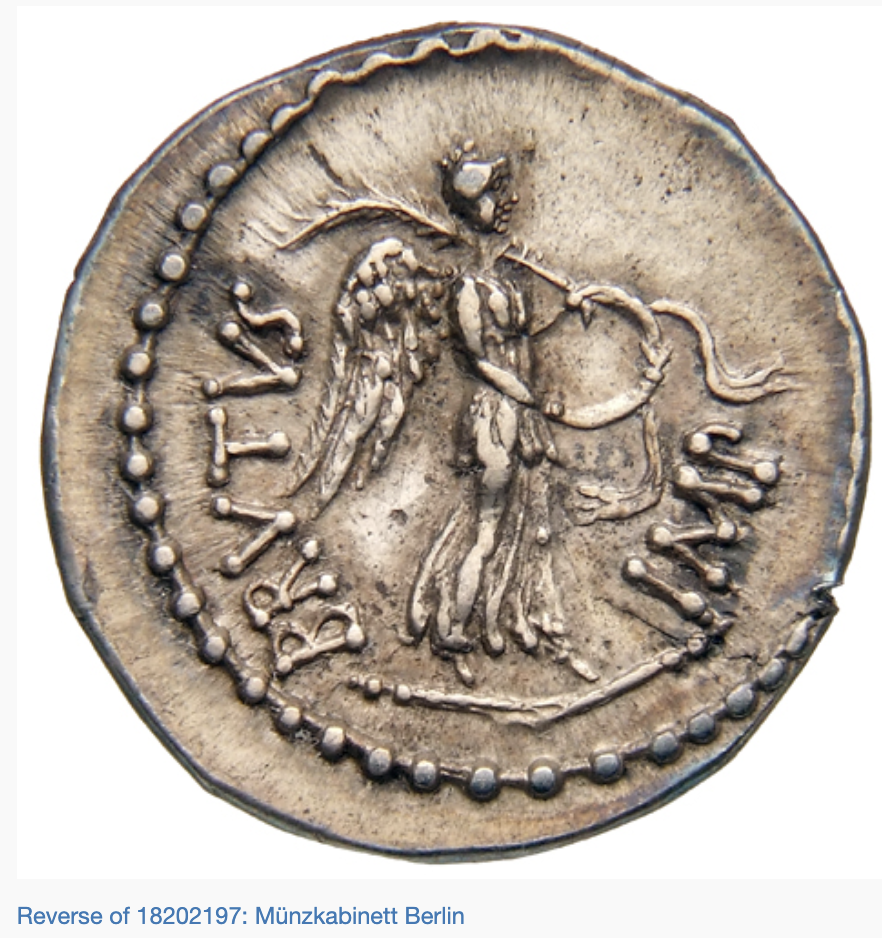
This seems to be the earliest coin (c.53BCE, RRC 435/1) in which the symbols of Hellenistic kingship, the diadem and the scepter, are used in such a way as to suggest their rejection in favor of the traditional symbols of Roman power in this case the curule chair.  For this coin, the context is the threat of Pompey assuming sole control of the Roman state.

We see a similar iconographic strategy on a coin of Brutus after the murder of Julius Caesar (RRC 507/2):

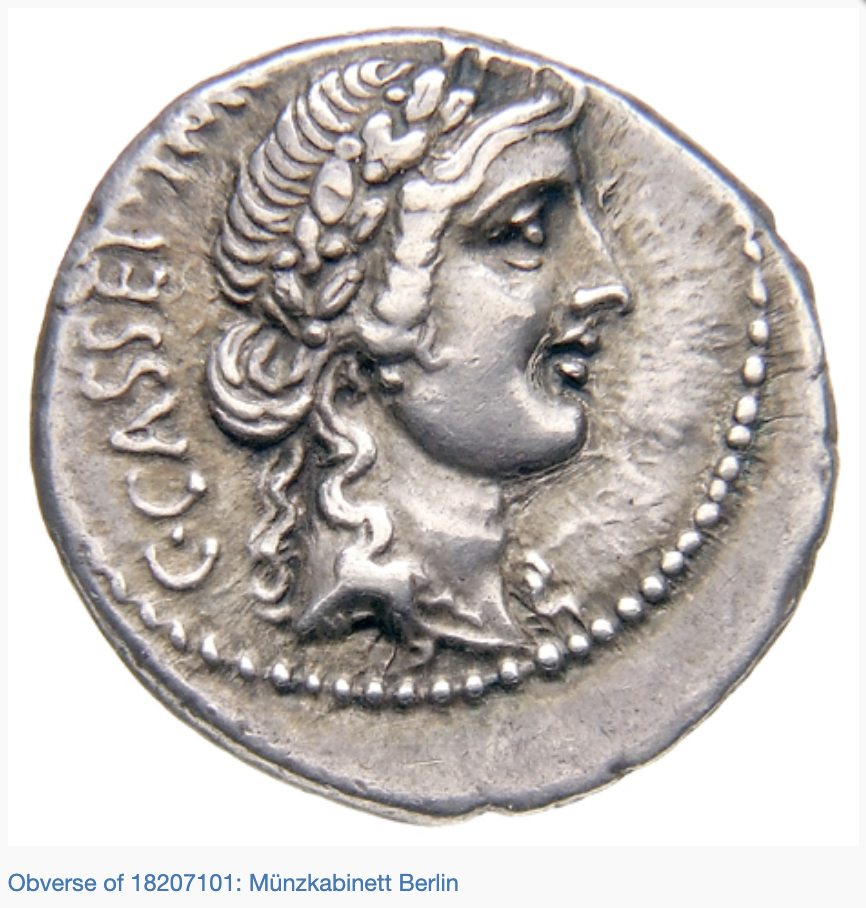
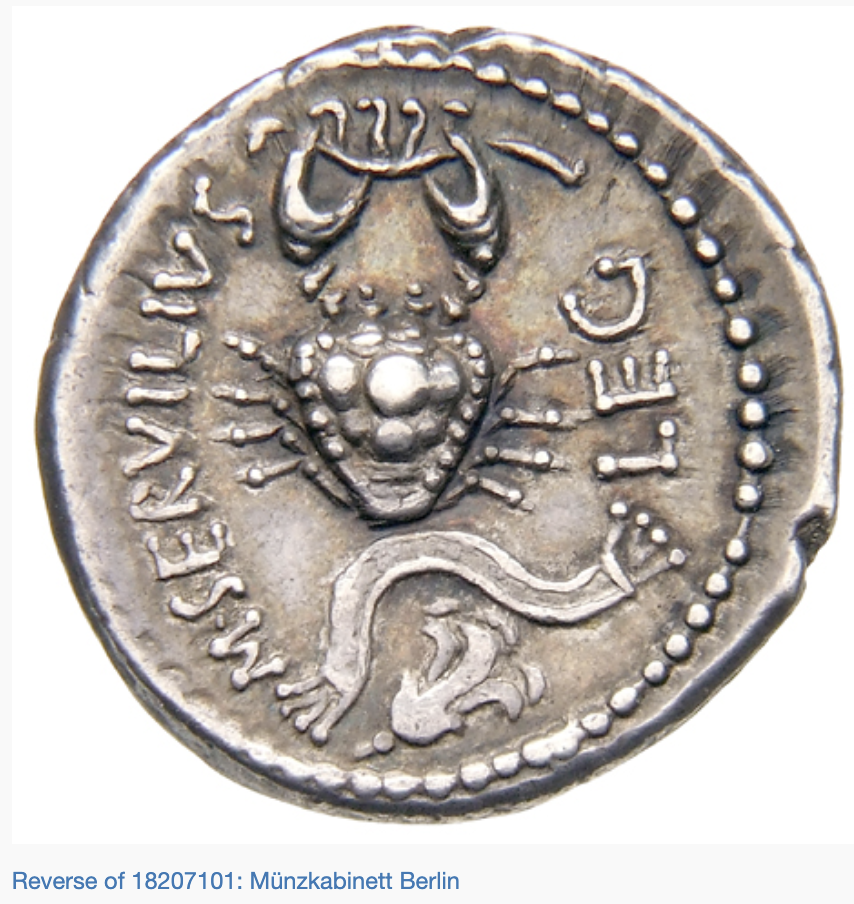
The question in my mind is should a similar interpretation also apply to this type (RRC 505/3):

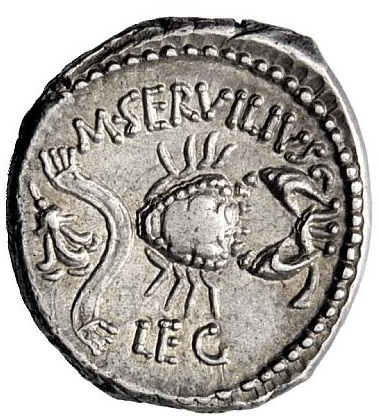
Today the type is invariably photographed with the orientation shown above, but Crawford had his plates printed at the 90 degree rotation of the reverse:

1275129

Crawford is silent on the symbolism of diadem saying only: “Part of one issue of Cassius records his capture of Rhodes after a battle at Myndus, opposite the island of Cos; the rose of Rhodes and crab of Cos both figure, together with an aplustre as a symbol of victory” (p. 741).  I must say, the aplustre doesn’t seem very victorious to me as it is clutched in the claws of the crab.  Or perhaps its just Cos offering the naval victory to Cassius…

I also think I prefer symbolically the crab and aplustre read as over and above the more diminished Rhodian rose and the diadem, just as the curule chair symbolically sits over the diadem and sceptre in the first type above.

The Cassius coin is often connected to this quote from Plutarch’s Life of Brutus 30:

“Cassius, having taken Rhodes, behaved himself there with no clemency; though at his first entry, when some had called him lord and king, he answered that he was neither king nor lord, but the destroyer and punisher of a king and lord.”

I’m not sure this is specifically the allusion the die engraver was aiming at but it is certainly a reflection of the same rhetorical impulse.

1/17/16: on Crabs on coins:

http://www.jstor.org/stable/750132

12/1/25:

Images replaced, citations corrected, broken links fixed.

Cicero Imperator

obverse
Silver cistophorus, Laodiceia ad Lycum. ANS 1967.144.1. Stumpf 92.a. (?Ex Leu and M&M 3 Dec 1965, lot 419?)

https://i0.wp.com/numismatics.org/collectionimages/19501999/1967/1967.144.1.rev.noscale.jpg

Reading a PhD dissertation draft on Asia Minor and came across a reference to this coin type and others issued in the name of Cicero during his time as governor in the province of Cilicia (51/0 BC).

Other known specimens include:

M TVLLIVS M F CICIIRON (sic) PROCOS above (STUMPF 91): Berlin 35/1909 = Hirsch 21, 16 Nov. 1908, 3550; M – TVLLIVS  / IMP above (STUMPF 92-93, PINDER 201): Paris 2726; Athens = Hierapytna hoard; Berlin (Löbbecke); Berlin 453/1891; ANS 1967.144.1 = Leu and Münzen und Medaillen; 3 Dec. 1965 (Niggeler), 419 (but TVLLIV / IMP)

[I disagree with the reading of the ANS specimen.  I think a small badly formed S is visible after the V.]

Anyway, I’m throwing it up here because these cistophori don’t get enough press in the average undergraduate or graduate classroom when Cicero’s governorship is discussed.

For more on this chapter in Cicero’s career the thing to read is:

Magnus Wistrand: Cicero Imperator. Studies in Cicero’s correspondence 51–47 BC. (Studia Graeca et Latina Gothoburgensia, XLI.) Pp. viii + 230. Göteborg: Acta Universitatis Gothoburgensis, 1979. Paper.

To read about how Cicero became Imperator in his own words click here.

Reading time is short for this draft so I must crack on.  More later.  We sure want to connect this caduceus with our early discussions of its symbolism…Not to mention IMP as a coin legend.

keyword: Tullius